Regular readers of this blog will know that I am Editor-in-Chief of a Diamond open access journal called the Open Journal of Astrophysics. This has been running nicely for a few years now and as the number of submissions ramps up I would like to expand the Editorial Board so the workload on its members and myself (who are all volunteers) does not become too onerous.
We apply a simple criterion to decide whether a paper is on a suitable topic for publication, namely that if it it is suitable for the astro-ph section of the arXiv then it is suitable for the Open Journal of Astrophysics. This section of the arXiv, which is rather broad,is divided thuswise:
astro-ph.GA – Astrophysics of Galaxies.
Phenomena pertaining to galaxies or the Milky Way. Star clusters, HII regions and planetary nebulae, the interstellar medium, atomic and molecular clouds, dust. Stellar populations. Galactic structure, formation, dynamics. Galactic nuclei, bulges, disks, halo. Active Galactic Nuclei, supermassive black holes, quasars. Gravitational lens systems. The Milky Way and its contents
astro-ph.CO – Cosmology and Nongalactic Astrophysics.
Phenomenology of early universe, cosmic microwave background, cosmological parameters, primordial element abundances, extragalactic distance scale, large-scale structure of the universe. Groups, superclusters, voids, intergalactic medium. Particle astrophysics: dark energy, dark matter, baryogenesis, leptogenesis, inflationary models, reheating, monopoles, WIMPs, cosmic strings, primordial black holes, cosmological gravitational radiation
astro-ph.EP – Earth and Planetary Astrophysics.
Interplanetary medium, planetary physics, planetary astrobiology, extrasolar planets, comets, asteroids, meteorites. Structure and formation of the solar system
astro-ph.HE – High Energy Astrophysical Phenomena.
Cosmic ray production, acceleration, propagation, detection. Gamma ray astronomy and bursts, X-rays, charged particles, supernovae and other explosive phenomena, stellar remnants and accretion systems, jets, microquasars, neutron stars, pulsars, black holes
astro-ph.IM – Instrumentation and Methods for Astrophysics.
Detector and telescope design, experiment proposals. Laboratory Astrophysics. Methods for data analysis, statistical methods. Software, database design
astro-ph.SR – Solar and Stellar Astrophysics.
White dwarfs, brown dwarfs, cataclysmic variables. Star formation and protostellar systems, stellar astrobiology, binary and multiple systems of stars, stellar evolution and structure, coronas. Central stars of planetary nebulae. Helioseismology, solar neutrinos, production and detection of gravitational radiation from stellar systems.
The expertise of the current Editorial Board is concentrated in the area of (2), and a bit of (5), which is where most of our submissions come so we would like to have additional Editors in this area. In addition there are sometimes papers from large collaborations for which existing Editors may be conflicted. We would also like to add some Editors from different areas (i.e. 1, 3, 4 and 6) so this call is open for volunteers from all other areas of astrophysics too, especially stars/exoplanets, etc.
If you’re interested please let me know either by my work email or by using the contact form here:
Yesterday we had a very nice pedagogical seminar in the Department of Theoretical Physics by one of our PhD students, Gert Vercleyen, who talked about something that isn’t really to do with his main research topic. A departmental seminar is a good environment for research students to gain experience giving presentations. Anyway, the abstract for this talk was:
Anyone doing a degree in physics, engineering, or mathematics will, at a very early stage, need to learn how to deal with vectors. Typically the theory of vectors comes with several products, like the dot product which is useful for determining lengths and angles, the cross product which allows one to find orthogonal vectors, and in 2D the complex product which allows one to easily describe rotations and dilations. Each of these products has its benefits and problems. The dot product is not invertible, the complex product only works in 2D, and the cross product has too many issues to put in this abstract. The goal of the talk is to present an alternative product of vectors, the geometric product, that works in any dimension, allows one to get geometric data, and can be used to apply geometric transformations. I will describe how the usual products can be obtained from the geometric product and work out various examples.
I was familiar with the basic ideas of this approach (related to Clifford algebra) which encompasses many ideas used frequently in theoretical physics – including quaternions for example (I have to mention them as I’m in Ireland) – in a single elegant formalism. I have never actually used it for anything however. Maybe that will change, though, as many interesting ideas suggested themselves during the talk.
If you’d like to learn a bit more at an introductory level about Geometric Algebra you could do a lot worse than read this paper which, unbelievably, is almost 30 years old. I mentioned at the end of the talk that the first author of this paper, Steve Gull, taught the first course in Mathematics for Natural Sciences I took when I was in the first year at Cambridge way back in 1982. Although he crammed a huge amount into that course, including the “standard” way of talking about vectors, rotations thereof using matrices, and a bit of cartesian tensors, he didn’t talk about Geometric Algebra.
I do think however that there is a case for starting in Year 1 with geometric algebra instead of the way we do it nowadays, not least because as well as being an elegant formalism it lends itself very easily to computational implementation; indeed, I note that there is a Python implementation of Clifford Algebra (which I have not yet played with). Also I think it’s harder to “unlearn” traditional methods and adapt to new ones as you get older.
Back to the day job, teaching Advanced Electromagnetism, I put up these two nice tutorial problems about the Lorentz transformation of Electric and Magnetic fields, as a prelude to doing the fully covariant formulation of the Maxwell equations. You might like to have a go at these exercises:
Professor Gene Parker, May 18, 2017. (Photo by Jean Lachat)
I was very sad to hear via the NASA website of the death, yesterday at the age of 94, of Professor Eugene N. Parker (known to all as “Gene”). He was best known for his work on solar magnetism and the solar wind, but he made important contributions across a wide range of astrophysics; he wrote an excellent book entitledCosmical Magnetic Fields: Their Origin and Activity which I bought many years ago. Most recently NASA’s Parker Solar Probe was named in his honour.
I only met Gene Parker once, many years ago, and was a bit in awe of him because of his intellectual reputation but he came across as a very likeable and friendly man.
We have lost a giant in the field of astrophysics who leaves a huge legacy and will be greatly missed. I send my condolences to his family, friends and colleagues at the University of Chicago where he worked since 1955.
I was shocked to see just now the news that legendary Australian legspinner Shane Warne has passed away suddenly at the age of just 52. I always admired his bowling hugely no doubt partly because having tried to bowl leg-breaks myself I have some idea how difficult it is to do well! I thought as a tribute I would rehash a piece I posted about 12 years ago about the prodigious amount of spin Shane Warne was able to generate.
For those of you not so familiar with cricket here’s a clip of another prodigious spinner of the ball, Australia’s legend of legspin Shane Warne:
For beginners, the game of cricket is a bit similar to baseball (insofar as it’s a game involving a bat and a ball), but the “strike zone” in cricket is a physical object ( a “wicket” made of wooden stumps with bails balanced on the top) unlike the baseball equivalent, which exists only in the mind of the umpire. The batsman must prevent the ball hitting the wicket and also try to score runs if he can. In contrast to baseball, however, he doesn’t have to score; he can elect to play a purely defensive shot or even not play any short at all if he judges the ball is going to miss, which is what happened to the hapless batsman in the clip.
You will see that Warne imparts considerable spin on the ball, which has the effect of making it change direction when it bounces. The fact that the ball hits the playing surface before the batsman has a chance to play it introduces extra variables that you don’t see in baseball, such as the state of the pitch (which generally deteriorates over the five days of a Test match, especially in the “rough” where bowlers have been running in).
A spin bowler who causes the ball to deviate from right to left is called a legspin bowler, while one who makes it turn the other way is an offspin bowler. An orthodox legspinner generates most of the spin from a flick of the wrist while an offspinner mainly lets his fingers do the torquing.
Another difference that’s worth mentioning with respect to baseball is that the ball is bowled, i.e. the bowler’s arm is not supposed to bend during the delivery (although apparently that doesn’t apply if he’s from Sri Lanka). However, the bowler is allowed to take a run up, which will be quite short for a spin bowler, but long like a javelin thrower if it’s a fast bowler. Fast bowlers – who can bowl up to 95 mph (150 km/h) – don’t spin the ball to any degree but have other tricks up their sleeve I haven’t got time to go into here. A typical spin bowler delivers the ball at speeds ranging from 45 mph to 60 mph (70 km/hour to 100 km/hour).
The physical properties of a cricket ball are specified in the Laws of Cricket. It must be between 22.4 and 22.9 cm in circumference, i.e. 3.57 to 3.64 cm in radius and must weigh between 155.9g and 163g. It’s round, made of cork, and surrounded by a leather case with a stitched seam.
So now, after all that, I can give a back-of-the-envelope answer to the question I was wondering about on the way home. Looking at the video clip my initial impression was that the ball is deflected by an angle as large as a radian, but in fact the foreshortening effect of the camera is quite deceptive. In fact the ball deviates by less than a metre between pitching and hitting the stumps. There is a gap of about 1 metre between the popping crease (where the batsman stands) and the stumps – it looks much less from the camera angle shown – and the ball probably pitches at least 2 metres in front of the crease. I would guess therefore that it actually deflects by an angle less than twenty degrees or so.
What happens physically is that some of the rotational kinetic energy of the ball is converted into translational kinetic energy associated with a component of the velocity at right angles to the original direction of travel. In order for the deflection to be so large, the available rotational kinetic energy must be non-negligible compared to the original kinetic energy of the ball. Suppose the mass of the ball is , the translational kinetic energy is where is the speed of the ball. If the angular velocity of rotation is then the rotational kinetic energy , where is the moment of inertia of the ball.
Approximating the ball as a uniform sphere of mass and radius , the moment of inertia is . Putting , cancelling on both sides and ignoring the factor of – because I’m lazy – we see that the rotational and translational kinetic energies are comparable if
or , which makes sense because is just the speed of a point on the equator of the ball owing to the ball’s rotational motion. This equation therefore says that the speed of sideways motion of a point on the ball’s surface must be roughly comparable to speed of the ball’s forward motion. Taking km/h gives m/s and m gives radians per second, which is about 100 revolutions per second. This would cause a huge deviation (about 45 degrees), but the real effect is rather smaller as I discussed above (see comments below). If the deflection is actually around 15 degrees then the rotation speed needed would be around 30 rev/s.
This estimate is obviously very rough because it ignores the direction of spin and the efficiency with the ball grips on the pitch – friction is obviously involved in the change of direction – but it gives a reasonable ballpark (or at least cricketground) estimate.
Of course if the bowler does the same thing every time it’s relatively easy for the batsman to allow for the spin. The best bowlers therefore vary the amount and angle of spin they impart on each ball. Most, in fact, have at least two qualitatively different types of ball but they disguise the differences in the act of delivery. Offspinners typically have an “arm ball” which doesn’t really spin but holds its line without appearing to be any different to their spinning delivery. Legspinners usually have a variety of alternative balls, including a topspinner and/or a flipper and/or a googly. The latter is a ball that comes out of the back of the hand and actually spins the opposite way to a legspinner while being produced with apparently the same action. It’s very hard to bowl a googly accurately, but it’s a deadly thing when done right.
Another thing also worth mentioning is that the rotation of the cricket ball also causes a deviation of its flightpath through the air, by virtue of the Magnus effect. This causes the ball to curve in the air in the opposite direction to which it is going to deviate on bouncing, i.e. it would drift into a right-handed batsman before breaking away from him off the pitch. You can see a considerable amount of such movement in the video clip, away from the left-hander in the air and then back into him off the pitch. Nature clearly likes to make things tough for batsmen!
With a number of secret weapons in his armoury the spin bowler can be a formidable opponent, a fact that has apparently been known to poets, philosophers and astronomers for the best part of a thousand years:
The Ball no Question makes of Ayes and Noes,
But Right or Left, as strikes the Player goes;
And he that toss’d Thee down into the Field,
He knows about it all — He knows — HE knows!
You can’t spend over 30 years working in theoretical physics without encountering Russian physicists and mathematicians. Over the years I’ve got to know a few quite well, through collaborations and discussions, and others by acquaintance. It occurred to me this morning that many of them might get caught up in the widespread condemnation of the Putin regime’s invasion of Ukraine. I don’t know any Russians (physicists or anything else) who support Putin or his oligarchs. I’m not saying that there are no such people, just that I don’t know any.
I think it’s important to say that my comments yesterday were not aimed at the many Russians around the world – including Russia itself – who want no part of the war and are horrified by the actions taken by the Russian leader.
On a related note this news, of Russian agency Roscosmos suspending all flights of the Soyuz spacecraft from the ESA launch facility in Kourou and withdrawing all Russian personnel from the site, seems to confirm what I thought yesterday, that the launch of Euclid will be postponed indefinitely. The alternative launcher, Ariane 6, has not yet had its first flight and at least two successful launches are required before it can be established as the vehicle for Euclid. On top of that the Euclid spacecraft itself will be need to be modified for the different vehicle. Details are yet to be confirmed, but it seems a lengthy delay is likely.
We’ve had three major storms over the past week (Dudley, Eunice and Franklin). Today I was reminded that precisely five years ago today I was trying to make it from Cardiff to Lincoln to give a lecture, so I thought I’d reblog the post I wrote at the time. It took me nearly all day and I was an hour late, but, you know, the show must go on and so it did.
There’s obviously a thing about February and storms!
This morning I set out from Cardiff to travel here to Lincoln for mypublic lecture. I took the9.45 train via Birmingham which, after a change of trains in Nottingham, should have got me into Lincoln at 14.23, with plenty of time to have a look around and chat to people before the scheduled start of my talk at 18.00 hours.
That was the plan, but it omitted an important factor:Storm Doris.Fallen trees, broken down trains and general disorganisation meant that it took ninehours to get to Lincoln, even including getting a taxi from Nottingham because I missed my connection.
The strangest thing was that I never actually saw any particularly bad weather. In fact there was quite a lot of sunshine en route. All the chaos was caused elsewhere, apparently.
Anyway I finally turned up almost an hour late for my talk…
Catching up on some literature on the inestimable arXiv I came across this paper by Obinna Umeh which I haven’t gone through in detail but which looks very interesting:
How does a smooth cosmic distance ladder emerge from observations made from a single location in a lumpy Universe? Distances to the Type Ia supernova (SN1A) in the Hubble flow are anchored on local distance measurements to sources that are very nearby. We described how this configuration could be built in a perturbed universe where lumpiness is described as small perturbations on top of a flat Friedmann-Lemaıtre Robertson-Walker (FLRW) spacetime. We show that there is a non-negligible modification (about 11%) to the background FLRW area distance due to the presence of inhomogeneities in the immediate neighbourhood of an observer. We find that the modification is sourced by the electric part of the Weyl tensor indicating a tidal deformation of the local spacetime of the observer. We show in detail how it could impact the calibration of the SN1A absolute magnitude in the Hubble flow. We show that it resolves the SN1A absolute magnitude and Hubble tensions simultaneously without the need for early or late dark energy.
The area distance here is what I usually call the angular-diameter distance; when one thinks of supernova measurements one usually thinks of the luminosity distance but these are related through the reciprocity relation discussed here which applies to each source regardless of whether the metric is of FLRW form or not. For a general discussion of cosmological distances see here.
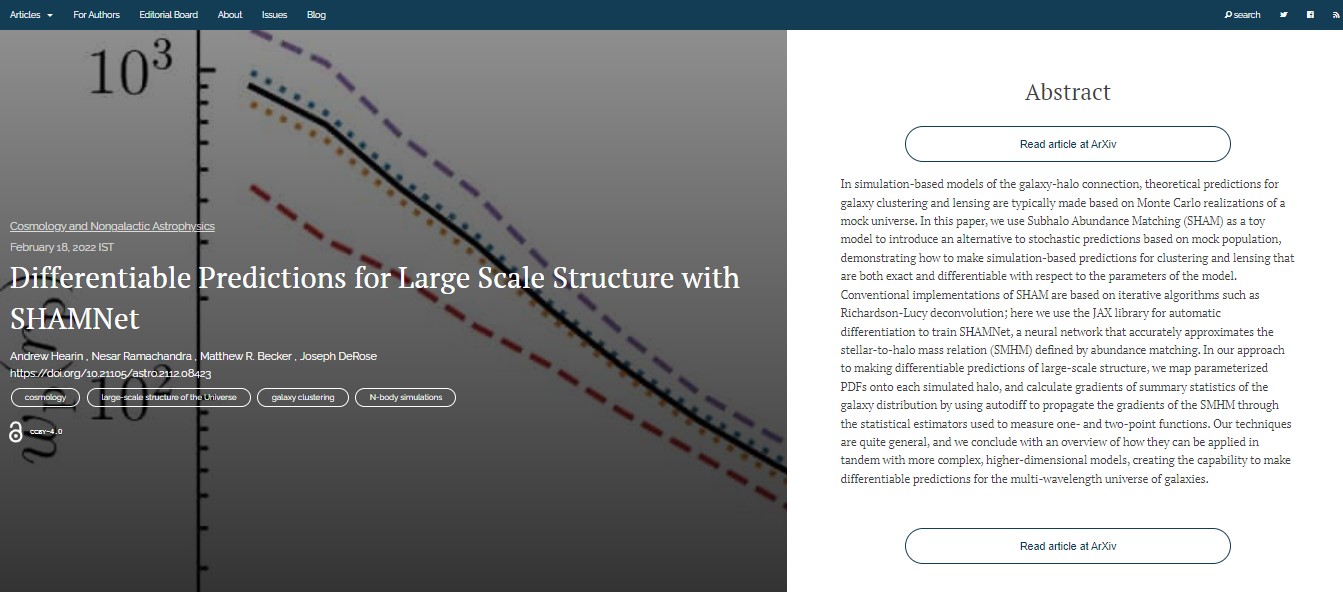
It’s time yet again to announce a new publication in the Open Journal of Astrophysics! This one is the 3rd paper in Volume 5 (2022) and the 51st in all. We actually published this on Friday, byt I’ve only just got around to announcing it here now.
The latest publication is entitled Differentiable Predictions for Large Scale Structure with SHAMNet and is written by Andrew Hearin, Nesar Ramachandra and Matthew R. Becker of the Argonne National Laboratory and Joseph DeRose of the Lawrence Berkeley Laboratory (both institutions being in the USA).
Here is a screen grab of the overlay which includes the abstract:
You can click on the image to make it larger should you wish to do so. You can find the arXiv version of the paper here. This paper is in our popular Cosmology and Non-galactic Astrophysics section.
P. S. Here’s a bit of feedback from the author of this paper about the referees:
They reviewed the paper in conscientious detail, and every comment was thoughtful. We feel that our paper has materially improved in clarity as a result of their critique.”
There’s a paper recently published in Nature Astronomy by Moreno et al, which you can find on the arXiv here. The title is Galaxies lacking dark matter produced by close encounters in a cosmological simulation and the abstract is here:
The standard cold dark matter plus cosmological constant model predicts that galaxies form within dark-matter haloes, and that low-mass galaxies are more dark-matter dominated than massive ones. The unexpected discovery of two low-mass galaxies lacking dark matter immediately provoked concerns about the standard cosmology and ignited explorations of alternatives, including self-interacting dark matter and modified gravity. Apprehension grew after several cosmological simulations using the conventional model failed to form adequate numerical analogues with comparable internal characteristics (stellar masses, sizes, velocity dispersions and morphologies). Here we show that the standard paradigm naturally produces galaxies lacking dark matter with internal characteristics in agreement with observations. Using a state-of-the-art cosmological simulation and a meticulous galaxy-identification technique, we find that extreme close encounters with massive neighbours can be responsible for this. We predict that approximately 30 percent of massive central galaxies (with at least 1011 solar masses in stars) harbour at least one dark-matter-deficient satellite (with 108 – 109 solar masses in stars). This distinctive class of galaxies provides an additional layer in our understanding of the role of interactions in shaping galactic properties. Future observations surveying galaxies in the aforementioned regime will provide a crucial test of this scenario.
It’s quite an interesting result.
I’m reminded of this very well known paper from way back in 1998, available on arXiv here, by Priya Natarajan, Steinn Sigurdsson and Joe Silk, with the abstract:
We propose a scenario for the formation of a population of baryon-rich, dark matter-deficient dwarf galaxies at high redshift that form from the mass swept out in the Intergalactic Medium (IGM) by energetic outflows from luminous quasars. We predict the intrinsic properties of these galaxies, and examine the prospects for their observational detection in the optical, X-ray and radio wavebands. Detectable thermal Sunyaev-Zeldovich decrements (cold spots) on arc-minute scales in the cosmic microwave background radiation maps are expected during the shock-heated expanding phase from these hot bubbles. We conclude that the optimal detection strategy for these dwarfs is via narrow-band Lyman-α imaging of regions around high redshift quasars. An energetically scaled-down version of the same model is speculated upon as a possible mechanism for forming pre-galactic globular clusters.
It’s true that the detailed mechanism for forming dwarf galaxies with low dark matter densities is different in the two papers, but it does show that the issue being addressed by Moreno et al. had been addressed before. It seems to me therefore that the Natarajan et al. paper is clearly relevant background to the Moreno et al. one. I always tell junior colleagues to cite all relevant literature. I wonder why Moreno et al. decided not to do that with this paper?
Had Moreno et al. preprinted their paper before acceptance by Nature Astronomy I’m sure someone would have told them of this omission. This is yet another reason for submitting your papers to arXiv at the same time as you submit them to a journal rather than waiting for them to be published.
The views presented here are personal and not necessarily those of my employer (or anyone else for that matter).
Feel free to comment on any of the posts on this blog but comments may be moderated; anonymous comments and any considered by me to be vexatious and/or abusive and/or defamatory will not be accepted. I do not necessarily endorse, support, sanction, encourage, verify or agree with the opinions or statements of any information or other content in the comments on this site and do not in any way guarantee their accuracy or reliability.




 , the translational kinetic energy is
  where
where  is the speed of the ball. If the
  then the rotational kinetic energy
  , where
  is the
  , the moment of inertia is
  . Putting
  , cancelling
  – because I’m lazy – we see that the rotational and translational kinetic energies are comparable if
 , which makes sense because
  is just the speed of a point on the equator of the ball owing to the ball’s rotational motion. This equation therefore says that the speed of sideways motion of a point on the ball’s surface must be roughly comparable to speed of the ball’s forward motion. Taking
  km/h gives
  m/s and
  m gives
  radians per second, which is about 100 revolutions per second. This would cause a huge deviation (about 45 degrees), but the real effect is rather smaller as I discussed above (see comments below). If the deflection is actually around 15 degrees then the rotation speed needed would be around 30 rev/s.