Archive for the The Universe and Stuff Category

On LinkedIn

Posted in Science Politics, The Universe and Stuff with tags , , , , on July 4, 2021 by telescoper

A former colleague recently contacted me with a request to join my “network” on LinkedIn.  That was quite hard to do as (at least until this morning) I was not on LinkedIn. That reminded me of a talk at INAM2019 a couple of years ago about the Astronomical Society of Ireland  which was about to be re-launched with a new website. One of the main reasons for doing this is that Ireland recently joined the European Southern Observatory and in order to capitalize on its involvement it is important to persuade the Irish government to invest in the resources needed (especially postdocs, etc) to do as much science as possible using ESO facilities. The idea was to improve the lobbying power for astronomy in Ireland. One of the suggestions made yesterday was that astronomers in Ireland should join LinkedIn in order to raise their profile individually and collectively.

I was not on LinkedIn at the time and didn’t get around to joining it mainly because I’ve always thought it was more for businessy types than academics. Anyway, in the light of recent events I decided it couldn’t do any harm to bite the bullet and set up a LinkedIn profile, which you can find here. It’s really a rather basic profile but I think I’ve set it up so that posts from here will be posted to LinkedIn too, so if you’re on it yourself you might want to add me. Or not. It’s up to you!

P.S. The only thing I have put under “Awards and Honours” is Winner of Beard of Ireland 2020.

Hubble Tension – The Plot Thickens

Posted in The Universe and Stuff with tags , , , on July 2, 2021 by telescoper

One topic on this blog seems to be as perennial as the weeds in my garden: the so-called Hubble Tension. I just saw a review paper by Wendy Freedman, one of the acknowedged experts in this area, on arXiv here. I have abstracted the abstract here:

You can find the PDF here.

What’s particularly interesting about this discussion is that stellar distance indicators have typically produced higher values than the 69.8 ± 0.6 (stat) ± 1.6 (sys) km s-1 Mpc-1 quoted here, which is consistent with the lower value favoured by Planck. See the above graphic discussed here. So perhaps there’s no tension at all. Maybe.

Anyway, here’s that poll again! I wonder if this paper might change the voting.


The State of the Universe Video

Posted in Biographical, Talks and Reviews, The Universe and Stuff, YouTube on June 29, 2021 by telescoper

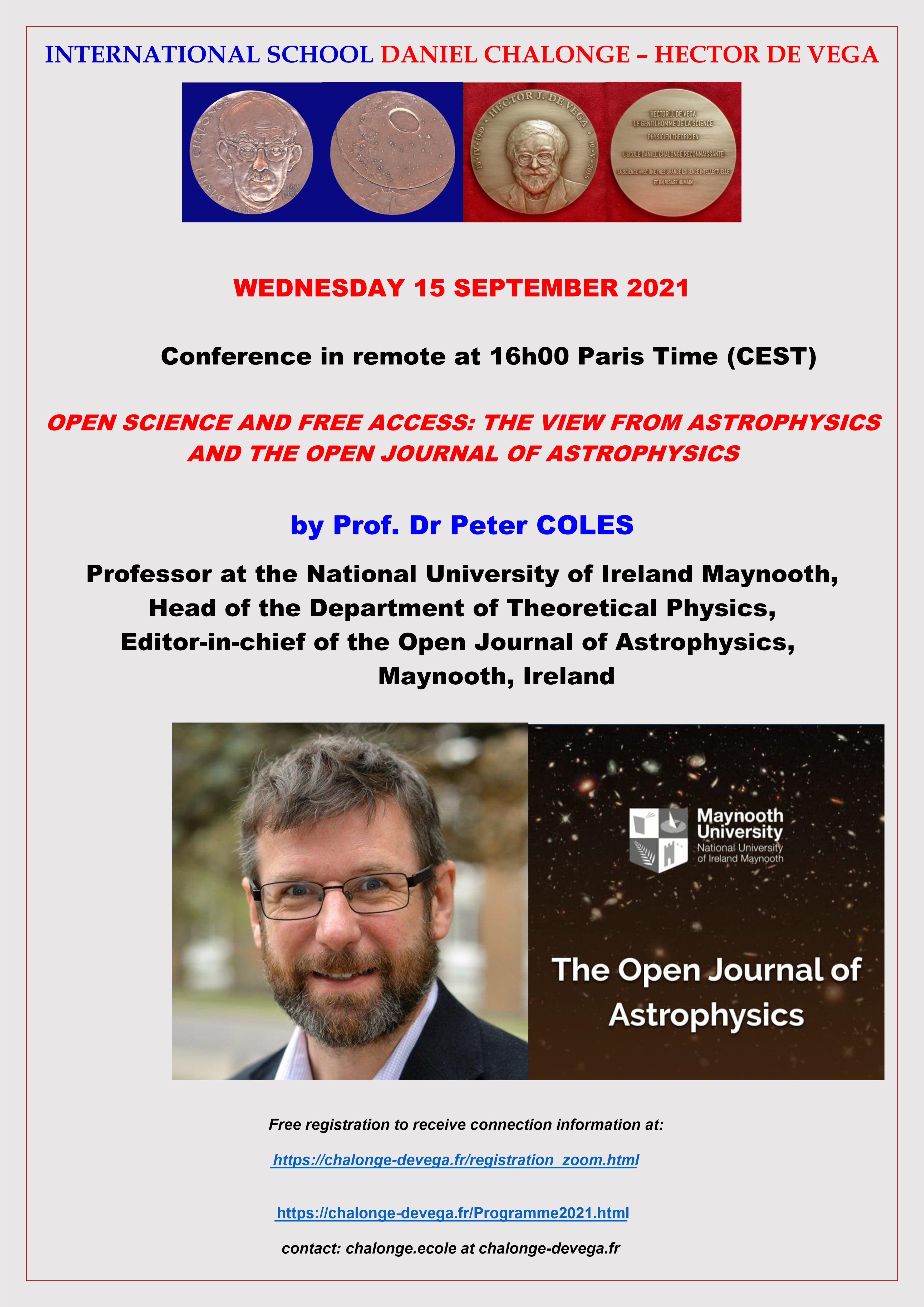
And now the moment you’ve all been waiting for. Here is a recording of the Invited Colloquium at the International School Daniel Chalonge – Hector de Vega I gave via Zoom on 23rd June 2021, introduced by Prof. Norma Sanchez.

In the talk I give a general review of the current state of cosmology, discussing the standard model of cosmology and some of the possible ways in which it might be revised or extended. It’s not a very technical talk but does assume some knowledge of cosmology. I hope a general audience will get something out of it.

I’m sorry if the recording is a bit choppy but that’s an occupational hazard with Zoom recordings and rather limited broadband!

This is an edited version of the session which in total lasted well over three hours including lengthy discussions and a trip down memory lane at the end. I cut out the introduction but kept a few of the questions and answers at the end, so it’s still rather long despite the rather brutal edits.

A video of the full event can be found here (1.6GB) and a PDF file of the slides can be found here. The slides are also available to be viewed here.

Catching up on Cosmic Dawn

Posted in The Universe and Stuff with tags , , , , , on June 25, 2021 by telescoper

Trying to catch up on cosmological news after a busy week I came across a number of pieces in the media about “Cosmic Dawn” (e.g. here in The Grauniad). I’ve never actually met Cosmic Dawn but she seems like an interesting lady.

But seriously folks, Cosmic Dawn refers to the epoch during which the first stars formed in the expanding Universe lighting up the Universe after a few hundred million years of post-recombination darkness.

According to the Guardian article mentioned above the new results being discussed are published in Monthly Notices of the Royal Astronomical Society but they’re actually not. Yet. Nevertheless the paper (by Laporte et al.) is available on the arXiv which is where people will actually read it…

Anyway, here is the abstract:

Here is a composite of HST and ALMA images for one of the objects discussed in the paper (MACS0416-JD):

I know it looks a bit blobby but it’s not easy to resolve things at such huge distances! Also, it’s quite small because it’s far away. In any case the spectroscopy is really the important thing, not the images, as that is what determines the redshift. The Universe has expanded by a factor 10 since light set out towards us from an object at redshift 9. I’m old enough to remember when “high redshift” meant z~0.1!

At the end of my talk on Wednesday Floyd Stecker asked me about what the James Webb Space Telescope (due for launch later this year) would do for cosmology and I replied that it would probably do a lot more for galaxy formation and evolution than cosmology per se. I think this is a good illustration of what I meant. Because of its infrared capability JWST will allow astronomers to push back even further and learn even more about how the first stars formed, but it won’t tell us much directly about dark matter and dark energy.

The State of the Universe Slides

Posted in Talks and Reviews, The Universe and Stuff on June 23, 2021 by telescoper

So I have given my talk on the State of the Universe. It’s a bit intimidating giving a talk with Nobel Laureates in the audience, but I think it went OK.

The slides are here:

I’ll add a link to the recording when I have it. Here is a link to the event. The video is very long because of a lengthy introduction and discussion at the end so if I get time I’ll put an edited version of just the talk on my Youtube channel.

In the meantime here’s a picture of me looking weird during the presentation:

The State of the Universe Talk – Reminder

Posted in Biographical, Books, Talks and Reviews, Sport, Talks and Reviews, The Universe and Stuff with tags on June 21, 2021 by telescoper

Just time for a quick reminder that I’m giving a talk on Wednesday (23rd June 2021). It’s at 4pm Paris Time which is 3pm Irish Time. See my original post here.

I had a sudden sense of dread that this Colloquium might clash with the Portugal-France game in the European Championship which takes place the same day but it turns out that won’t kick off until 9pm Paris Time which means that I should just about be finished before the football starts. I don’t think even I could overrun by 4 hours! Indeed I should finish before the earlier games that day, which kick off at 5pm Paris Time…

If you want to attend the Colloquium (via Zoom) you can register for it here.

The Summer Solstice 2021

Posted in The Universe and Stuff with tags , , , , , , on June 20, 2021 by telescoper

The Summer Solstice in the Northern hemisphere happens tomorrow, Monday 21st June 2021, at 04:32  Irish Time (03:32 UTC). Among other things, this means that tomorrow is the longest day of the year around these parts.  Usually I post about the Solstices and Equinoxes close to the time that they occur,  and on the same day, but because I don’t want to get up before 4.32am and few would be awake to read it then, I thought I’d do this one in advance.

Sunrise in the Dublin area is about 04:56 local time tomorrow and sunset is at 21:57: the interval between sunrise and sunset will be just about 1s longer on 21st June than today, 20th June, and 5 seconds longer than Tuesday 22nd June. The longest day will last 17 hours and 11 seconds (approximately) so make the most of it – it’s all downhill from now on!

Days will get shorter from tomorrow until the Winter Solstice in December, although this does not mean that sunset will necessarily happen earlier on 22nd  than it does tomorrow. In fact it is a little later. This is because there is a difference between mean solar time (measured by clocks) and apparent solar time (defined by the position of the Sun in the sky), so that a solar day does not always last exactly 24 hours. A description of apparent and mean time was given by Nevil Maskelyne in the Nautical Almanac for 1767:

Apparent Time is that deduced immediately from the Sun, whether from the Observation of his passing the Meridian, or from his observed Rising or Setting. This Time is different from that shewn by Clocks and Watches well regulated at Land, which is called equated or mean Time.

The discrepancy between mean time and apparent time arises because of the Earth’s axial tilt and the fact that it travels around the Sun in an elliptical orbit in which its orbital speed varies with time of year (being faster at perihelion than at aphelion).

Using a rapid calculational tool (Google), I found a table of the local mean times of sunrise and sunset for Dublin around the 2021 summer solstice. This shows that the earliest sunrise was actually on 17th June and the latest sunset is on 24th.

If you plot the position of the Sun in the sky at a fixed time each day from a fixed location on the Earth you get a thing called an analemma, which is a sort of figure-of-eight curve whose shape depends on the observer’s latitude. Here’s a photographic version taken in Edmonton, with photographs of the Sun’s position taken from the same position at the same time on different days over the course of a year:

maxresdefault

The summer solstice is the uppermost point on this curve and the winter solstice is at the bottom. The north–south component of the analemma is the Sun’s declination, and the east–west component is the so-called equation of time which quantifies the difference between mean solar time and apparent solar time. This curve can be used to calculate the earliest and/or latest sunrise and/or sunset.

P.S. A bit of light googling revealed to me that if you live in York then your sunrise on 21st June 2021 is at 4.32am, precisely the same time as the Solstice.

Opening Up Again

Posted in Biographical, Covid-19, Maynooth, The Universe and Stuff on June 15, 2021 by telescoper

The Irish Government has just produced its plan for A Safe Return to on-site further and higher education and research that outlines what is basically a full return to on-campus activity from September 2021.
I quote from the preamble to the document linked to above:

It is expected that the majority of the people over 18 in Ireland will have been vaccinated by September 2021, and so planning is proceeding on the basis that full resumption of on-site activity is possible, while ensuring that overall numbers attending on-site are monitored and controlled.

In the absence of regular updates about the progress of Ireland’s vaccination programme it is difficult to know whether the first sentence is accurate or not, especially since it appears that two vaccine doses are needed to protect against the Delta-variant. I think most teaching staff will have been immunized by September, but am not so sure about the student population.

I’m also mindful that we were optimistic in advance of the start of last academic year and things didn’t exactly go to plan then. Nevertheless there do seem to be reasonable grounds for believing that we can return to on-campus teaching in September and we will be planning on that basis until there is evidence to the contrary. I just hope we don’t have to do a rapid about-turn like we did last year.

The first step in this process for us here in Maynooth is that from 5th July staff and research students can return to their offices on campus – following the existing protocols on social distancing, sanitation and ventilation – without having to make a special case. Only a few people have been working inside the Department since the start of the year and I’d expect most to begin making their way back.

In fact some members of the Department of Theoretical Physics joined us only this academic year and have never actually been the building (or on campus) at all. I suppose I’ll now have to find office space for them, something that hasn’t been necessary while we have all been working from home!

As a matter of fact, since it’s a nice day and I’ve been on Teams all morning, I might take a walk onto campus myself this afternoon and visit my office in the Department for the first time in a month…

Challenges for the Standard Cosmological Model

Posted in The Universe and Stuff with tags , , , on June 14, 2021 by telescoper

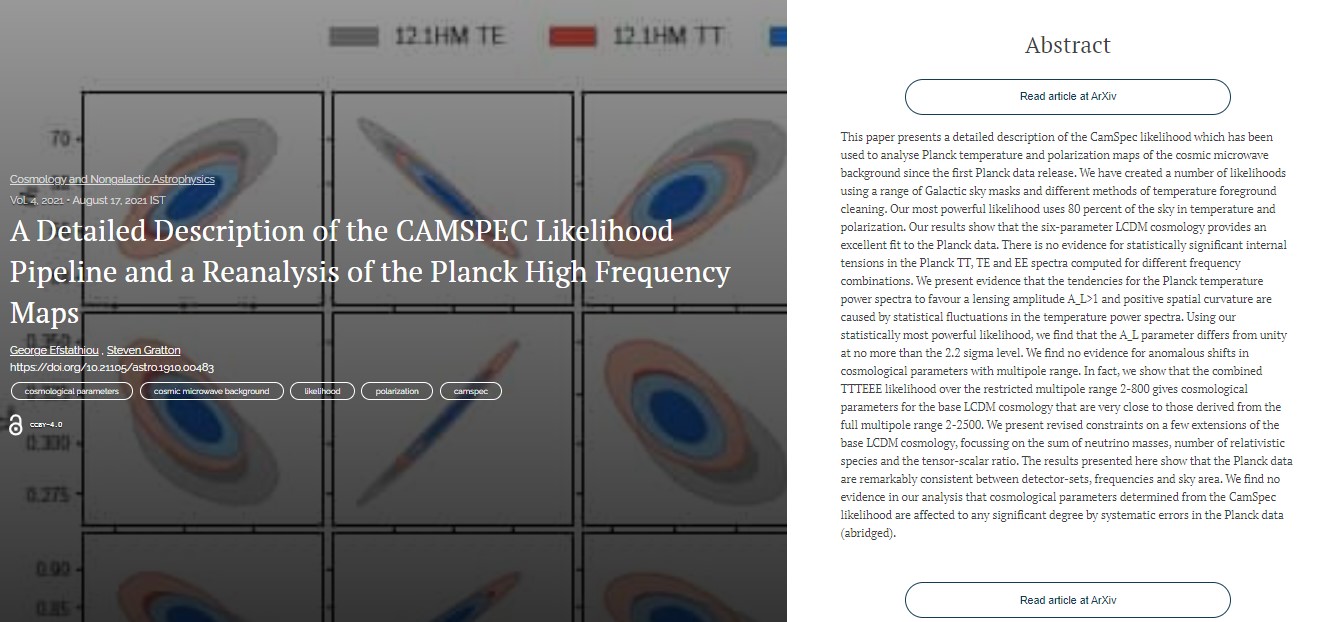
I recently came across a comprehensive review article on the arXiv and thought some of my regular readers might find it interesting as a description of the current state of play in cosmology. The paper is called Challenges for ΛCDM: An update and is written by Leandros Perivolaropoulos and Foteini Skara.

Here is the abstract:

A number of challenges of the standard ΛCDM model has been emerging during the past few years as the accuracy of cosmological observations improves. In this review we discuss in a unified manner many existing signals in cosmological and astrophysical data that appear to be in some tension (2σ or larger) with the standard ΛCDM model as defined by the Planck18 parameter values. In addition to the major well studied 5σ challenge of ΛCDM (the Hubble H0 crisis) and other well known tensions (the growth tension and the lensing amplitude AL anomaly), we discuss a wide range of other less discussed less-standard signals which appear at a lower statistical significance level than the H0 tension (also known as ‘curiosities’ in the data) which may also constitute hints towards new physics. For example such signals include cosmic dipoles (the fine structure constant α, velocity and quasar dipoles), CMB asymmetries, BAO Lyα tension, age of the Universe issues, the Lithium problem, small scale curiosities like the core-cusp and missing satellite problems, quasars Hubble diagram, oscillating short range gravity signals etc. The goal of this pedagogical review is to collectively present the current status of these signals and their level of significance, with emphasis to the Hubble crisis and refer to recent resources where more details can be found for each signal. We also briefly discuss possible theoretical approaches that can potentially explain the non-standard nature of some of these signals.

Among the useful things in it you will find this summary of the current ‘tension’ over the Hubble constant that I’ve posted about numerous times (e.g. here):

DES in the Eye

Posted in The Universe and Stuff on June 13, 2021 by telescoper

I see that the press interest in the recent Dark Energy Survey results (to which I referred in a post here) has extended to a cartoon in the latest Private Eye