Archive for the The Universe and Stuff Category

The Euclid Consortium Conference Photo!

Posted in Covid-19, The Universe and Stuff on June 11, 2021 by telescoper

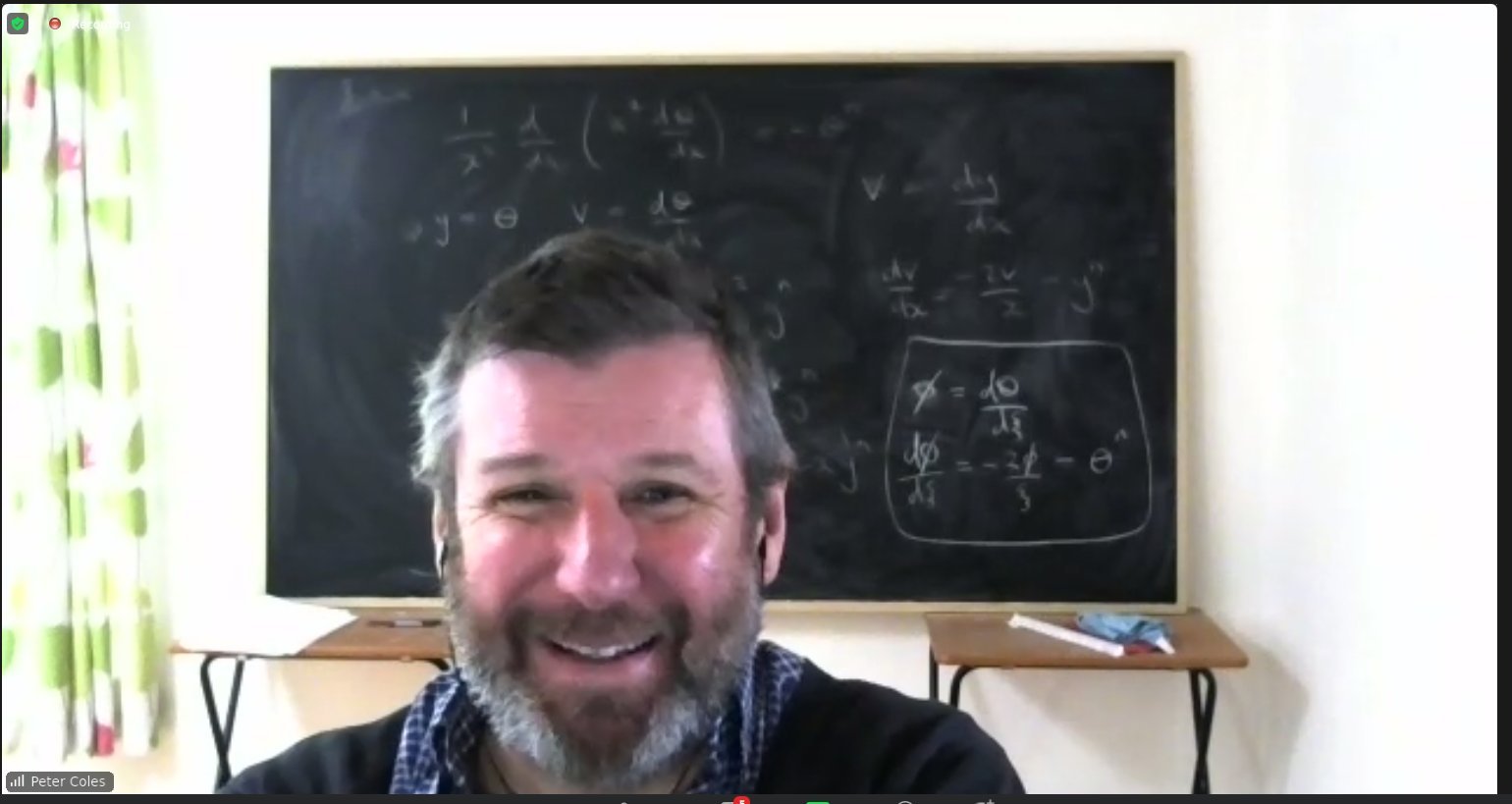
The Coronavirus pandemic has not only changed the nature of conferences but also changed the nature of conference photographs. Here’s the group picture of the Euclid Consortium Conference that took place via Zoom at the end of May. I’m actually in it, though I wasn’t paying attention at the time and am therefore not looking at the camera. Moreover, there are some other people who are in it several times!

Partial Eclipse Picture!

Posted in The Universe and Stuff on June 10, 2021 by telescoper

I’ve a very busy morning this morning but I’ve just got time to share this stunning picture of the partial solar eclipse happening between about 10.00am and 12.20pm across Ireland, as seen from Maynooth.

I’ll post more exciting images if and when the sky ceases to be eclipsed by clouds.

New Publication at the Open Journal of Astrophysics

Posted in OJAp Papers, Open Access, The Universe and Stuff with tags , , , , , on June 7, 2021 by telescoper

Time to announce another publication in the Open Journal of Astrophysics. This one was actually published on Friday actually, but I didn’t get time to post about it until just now. It is the fourth paper in Volume 4 (2021) and the 35th paper in all.

The latest publication is entitled The local vertical density distribution of ultracool dwarfs M7 to L2.5 and their luminosity function and the ultracool authors are Steve Warren (Imperial College), Saad Ahmed (Open University) and Richard Laithwaite (Imperial College).

Here is a screen grab of the overlay which includes the abstract:

You can click on the image to make it larger should you wish to do so. You can find the arXiv version of the paper here. This one is in the Astrophysics of Galaxies section but it also has overlap with Solar and Stellar Astrophysics.

Over the last few months I have noticed that it has taken a bit longer to get referee reports on papers and also for authors to complete their revisions. I think that’s probably a consequence of the pandemic and people being generally overworked. We do have a number of papers at various stages of the pipeline, so although we’re a bit behind where we were last year in terms of papers published I think may well catch up in the next month or two.

I’ll end with a reminder to prospective authors that the OJA  now has the facility to include supplementary files (e.g. code or data sets) along with the papers we publish. If any existing authors (i.e. of papers we have already published) would like us to add supplementary files retrospectively then please contact us with a request!

Who is a proper physicist?

Posted in History, The Universe and Stuff on June 1, 2021 by telescoper

There is a rather provocative paper on the arXiv by Jeroen van Dongen with the title String theory, Einstein, and the identity of physics: Theory assessment in absence of the empirical. I thought I’d share it here because it sort of follows on from yesterday’s post.

The abstract is:

String theorists are certain that they are practicing physicists. Yet, some of their recent critics deny this. This paper argues that this conflict is really about who holds authority in making rational judgment in theoretical physics. At bottom, the conflict centers on the question: who is a proper physicist? To illustrate and understand the differing opinions about proper practice and identity, we discuss different appreciations of epistemic virtues and explanation among string theorists and their critics, and how these have been sourced in accounts of Einstein’s biography. Just as Einstein is claimed by both sides, historiography offers examples of both successful and unsuccessful non-empirical science. History of science also teaches that times of conflict are often times of innovation, in which novel scholarly identities may come into being. At the same time, since the contributions of Thomas Kuhn historians have developed a critical attitude towards formal attempts and methodological recipes for epistemic demarcation and justification of scientific practice. These are now, however, being considered in the debate on non-empirical physics.

You can find a PDF of the full paper here.

As always, proper comments are welcome through the box below.

P. S. The answer to the question posed in the title is of course that a proper physicist is a physicist who’s at rest in the laboratory frame.

More from the Dark Energy Survey

Posted in Astrohype, The Universe and Stuff with tags , , , , , , on May 28, 2021 by telescoper

To much media interest the Dark Energy Survey team yesterday released 11 new papers based on the analysis of their 3-year data. You can find the papers together with short descriptions here. There’s even a little video about the Dark Energy Survey here:

The official press release summarizes the results as follows:

Scientists measured that the way matter is distributed throughout the universe is consistent with predictions in the standard cosmological model, the best current model of the universe.

This contrasts a bit with the BBC’s version:

The results are a surprise because they show that it is slightly smoother and more spread out than the current best theories predict.

The observation appears to stray from Einstein’s theory of general relativity – posing a conundrum for researchers.

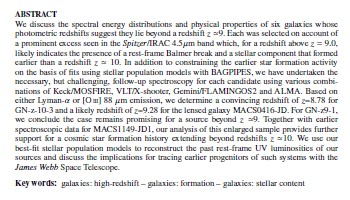
The reason for this appears to be that the BBC story focusses on the weak lensing paper (found here; I’ll add a link to the arXiv version if and when it appears there). The abstract is here:

The parameter S8 is a (slightly) rescaled version of the more familiar parameter σ8  – which quantifies the matter-density fluctuations on a scale of 8 h-1 Mpc – as defined in the abstract; cosmic shear is particularly sensitive to this parameter.

The key figure showing the alleged “tension” with Planck is here:

The companion paper referred to in the above abstract (found here has an abstract that concludes with the words (my emphasis).

We find a 2.3σ difference between our S8 result and that of Planck (2018), indicating no statistically significant tension, and additionally find our results to be in qualitative agreement with current weak lensing surveys (KiDS-1000 and HSC).

So, although certain people have decided to hype up a statistically insignificant l discrepancy, everything basically fits the standard model…

Meet the Astronomer Royal for Scotland!

Posted in Maynooth, The Universe and Stuff on May 27, 2021 by telescoper

I just heard this morning the wonderful news that Scotland has a new Astronomer Royal, in the form of Professor Catherine Heymans who is based at the Royal Observatory in Edinburgh. I am delighted to hear of this appointment! I have known Catherine for a long time from her work on cosmological applications of gravitational lensing. She was kind enough to visit us in Maynooth back in 2019 on University business and to meet Maynooth University Library Cat.

Catherine Heymans is the 11th Astronomer Royal for Scotland, succeeding Professor John Brown who passed away in 2019. She is also the first female holder of the title, in the 187 years since it was created.

I’m not exactly sure what is in the job description of Astronomer Royal for Scotland. I think it is largely an honorary title, but it will give Catherine a platform for outreach and other public activities which I’m sure she will do brilliantly, hopefully inspiring a future generation of female scientists in the process!

P.S. I can’t resist mentioning that I have posted a look-alike

R.I.P. Dave Carter

Posted in The Universe and Stuff on May 26, 2021 by telescoper

Dave Carter, photographed around 2001 by the Liverpool Telescope. Picture credit here.

It is with great sadness that I pass on the news of the death over the weekend of Professor David Carter of Liverpool John Moores University who, among many other things, was a regular commenter on this blog. I understand he had been suffering from leukemia for some time.

Dave Carter obtained his PhD from the Institute of Astronomy, Cambridge in 1977 working on the surface brightness profiles of galaxies. He then had a number of positions: at Oxford, at Mount Stromlo and Siding Spring Observatories in Australia, the Isaac Newton Group on La Palma and back in Cambridge. In 1996 he joined Liverpool John Moores University as Project Scientist for the Liverpool Telescope. He took early retirement from LJMU in 2012 but carried on research as an Emeritus Professor mainly working on the HST/ACS Coma Cluster survey.

His comments on this blog over the years – his first was in 2010 – revealed him to have a wide range of interests outside astronomy, including cricket and music. He was also involved in his local Methodist Church and Community Centre, and a local parish councillor.

I didn’t know Dave very well in a personal capacity – we only met in person a few times – but he always struck me as a very nice man as well as being immensely knowledgeable about matters astronomical. I send my deepest condolences to his wife and three sons, as well all his friends and colleagues both in Liverpool and around the world who miss him terribly.

I’m not in Lausanne…

Posted in Biographical, Maynooth, The Universe and Stuff on May 25, 2021 by telescoper

A view of Lausanne, where I am not.

For the rest of this week I shall not be in the beautiful town of Lausanne on the shores of Lake Léman in Switzerland.

The reason I am not in Lausanne is that the Annual Meeting of the Euclid Consortium is being held here this year. I was not in Barcelona for the corresponding meeting last year. At least I have actually been to Barcelona a few times. I’ve never been to Lausanne, and won’t have been even after attending a conference there.

While not in Lausanne I shall be watching the talks remotely from Maynooth but of course there is much more to a conference than the formal sessions. I am looking forward to not travelling there and back as well as not socializing with the other delegates, not sampling the local food and wine, not meeting any new people and not making any use of networking opportunities to start new collaborations. I’ll also not be rummaging around in the conference goody bag.

Above all I am looking forward to not seeing many old friends for the first time in ages and not going out for a drink with them. Instead of that I’ll be not having a drink, on my own, in Maynooth.

These virtual conferences are all very well, and of course made necessary by the Covid-19 pandemic, but what particular annoys me about them is the absence of travel means I don’t get to use my Irish passport. I deeply resent being denied the opportunity brandish it in front of my UK colleagues as I use the fast track at the airport…

Open Science and Open Software

Posted in Open Access, Science Politics, The Universe and Stuff with tags , , , , on May 22, 2021 by telescoper

As the regular readers of this blog – both of them – will know, I’ve been banging on from time to time about Open Access to scientific publications. After posting a video featuring Volker Springel and the GADGET-4 code I thought I’d return to an issue that came up briefly in my recent talk about Open Access and the Open Journal of Astrophysics here which is the question whether open access to scientific results enough, or do we have to go a lot further?

An important aspect of the way science works is that when a given individual or group publishes a result, it should be possible for others to reproduce it (or not as the case may be). Traditional journal publications don’t always allow this. In my own field of astrophysics/cosmology, for example, results in scientific papers are often based on very complicated analyses of large data sets. This is increasingly the case in other fields too. A basic problem obviously arises when data are not made public. Fortunately in astrophysics these days researchers are pretty good at sharing their data, although this hasn’t always been the case.

However, even allowing open access to data doesn’t always solve the reproducibility problem. Often extensive numerical codes are needed to process the measurements and extract meaningful output. Without access to these pipeline codes it is impossible for a third party to check the path from input to output without writing their own version assuming that there is sufficient information to do that in the first place. That researchers should publish their software as well as their results is quite a controversial suggestion, but I think it’s the best practice for science. There isn’t a uniform policy in astrophysics and cosmology, but I sense that quite a few people out there agree with me. Cosmological numerical simulations, for example, can be performed by anyone with a sufficiently big computer using GADGET the source codes of which are freely available. Likewise, for CMB analysis, there is the excellent CAMB code, which can be downloaded at will; this is in a long tradition of openly available numerical codes, including CMBFAST and HealPix. Researchers in these and other areas do tend to share their software on open-access repositories, especially GitHub.

I suspect some researchers might be reluctant to share the codes they have written because they feel they won’t get sufficient credit for work done using them. I don’t think this is true, as researchers are generally very appreciative of such openness and publications describing the corresponding codes are generously cited. In any case I don’t think it’s appropriate to withhold such programs from the wider community, which prevents them being either scrutinized or extended as well as being used to further scientific research. In other words excessively proprietorial attitudes to data analysis software are detrimental to the spirit of open science.

Anyway, my views are by no means guaranteed to be representative of the community, so I’d like to ask for a quick show of hands via a poll that I started about 8 years ago.

You are of course welcome to comment via the usual box, as long as you respect my comments policy…

Cosmology Talks: Volker Springel on GADGET-4

Posted in The Universe and Stuff with tags , , , , , , , on May 18, 2021 by telescoper

It’s time I shared another one of those interesting cosmology talks on the Youtube channel curated by Shaun Hotchkiss. This channel features technical talks rather than popular expositions so it won’t be everyone’s cup of tea but for those seriously interested in cosmology at a research level they should prove interesting.

In this talk from a couple of months ago  Volker Springel discusses Gadget-4 which is a parallel computational code that combines cosmological N-body and SPH code and is intended for simulations of cosmic structure formation and calculations relevant for galaxy evolution and galactic dynamics.

The predecessor of GADGET-2 is probably the most used computational code in cosmology; this talk discusses what new ideas are implemented in GADGET-4 to improve on the earlier version and what new features it has.  Volker also explains what happened to GADGET-3!

The paper describing Gadget-4 can be found here.