Archive for the The Universe and Stuff Category

More from the Dark Energy Survey

Posted in Astrohype, The Universe and Stuff with tags , , , , , , on May 28, 2021 by telescoper

To much media interest the Dark Energy Survey team yesterday released 11 new papers based on the analysis of their 3-year data. You can find the papers together with short descriptions here. There’s even a little video about the Dark Energy Survey here:

The official press release summarizes the results as follows:

Scientists measured that the way matter is distributed throughout the universe is consistent with predictions in the standard cosmological model, the best current model of the universe.

This contrasts a bit with the BBC’s version:

The results are a surprise because they show that it is slightly smoother and more spread out than the current best theories predict.

The observation appears to stray from Einstein’s theory of general relativity – posing a conundrum for researchers.

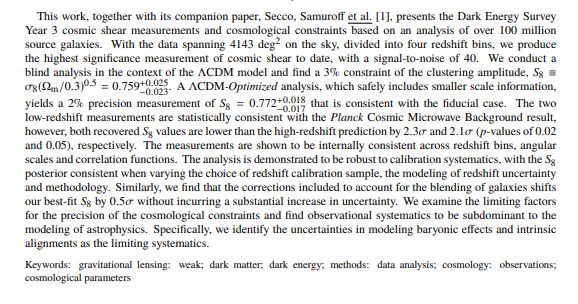
The reason for this appears to be that the BBC story focusses on the weak lensing paper (found here; I’ll add a link to the arXiv version if and when it appears there). The abstract is here:

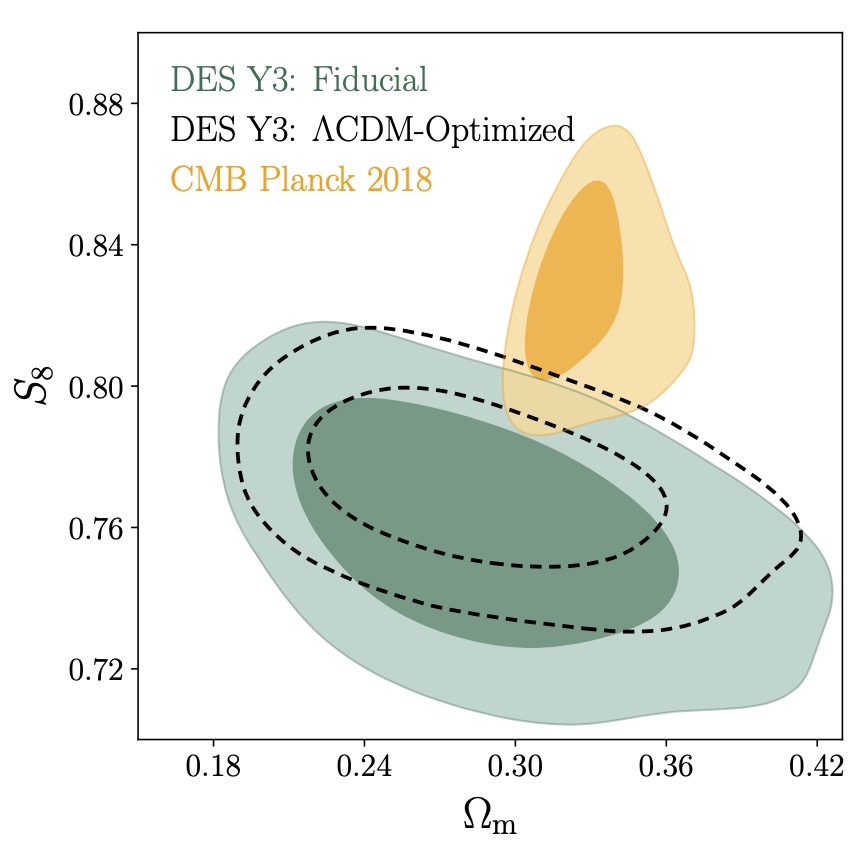
The parameter S8 is a (slightly) rescaled version of the more familiar parameter σ8  – which quantifies the matter-density fluctuations on a scale of 8 h-1 Mpc – as defined in the abstract; cosmic shear is particularly sensitive to this parameter.

The key figure showing the alleged “tension” with Planck is here:

The companion paper referred to in the above abstract (found here has an abstract that concludes with the words (my emphasis).

We find a 2.3σ difference between our S8 result and that of Planck (2018), indicating no statistically significant tension, and additionally find our results to be in qualitative agreement with current weak lensing surveys (KiDS-1000 and HSC).

So, although certain people have decided to hype up a statistically insignificant l discrepancy, everything basically fits the standard model…

Meet the Astronomer Royal for Scotland!

Posted in Maynooth, The Universe and Stuff on May 27, 2021 by telescoper

I just heard this morning the wonderful news that Scotland has a new Astronomer Royal, in the form of Professor Catherine Heymans who is based at the Royal Observatory in Edinburgh. I am delighted to hear of this appointment! I have known Catherine for a long time from her work on cosmological applications of gravitational lensing. She was kind enough to visit us in Maynooth back in 2019 on University business and to meet Maynooth University Library Cat.

Catherine Heymans is the 11th Astronomer Royal for Scotland, succeeding Professor John Brown who passed away in 2019. She is also the first female holder of the title, in the 187 years since it was created.

I’m not exactly sure what is in the job description of Astronomer Royal for Scotland. I think it is largely an honorary title, but it will give Catherine a platform for outreach and other public activities which I’m sure she will do brilliantly, hopefully inspiring a future generation of female scientists in the process!

P.S. I can’t resist mentioning that I have posted a look-alike

R.I.P. Dave Carter

Posted in The Universe and Stuff on May 26, 2021 by telescoper

Dave Carter, photographed around 2001 by the Liverpool Telescope. Picture credit here.

It is with great sadness that I pass on the news of the death over the weekend of Professor David Carter of Liverpool John Moores University who, among many other things, was a regular commenter on this blog. I understand he had been suffering from leukemia for some time.

Dave Carter obtained his PhD from the Institute of Astronomy, Cambridge in 1977 working on the surface brightness profiles of galaxies. He then had a number of positions: at Oxford, at Mount Stromlo and Siding Spring Observatories in Australia, the Isaac Newton Group on La Palma and back in Cambridge. In 1996 he joined Liverpool John Moores University as Project Scientist for the Liverpool Telescope. He took early retirement from LJMU in 2012 but carried on research as an Emeritus Professor mainly working on the HST/ACS Coma Cluster survey.

His comments on this blog over the years – his first was in 2010 – revealed him to have a wide range of interests outside astronomy, including cricket and music. He was also involved in his local Methodist Church and Community Centre, and a local parish councillor.

I didn’t know Dave very well in a personal capacity – we only met in person a few times – but he always struck me as a very nice man as well as being immensely knowledgeable about matters astronomical. I send my deepest condolences to his wife and three sons, as well all his friends and colleagues both in Liverpool and around the world who miss him terribly.

I’m not in Lausanne…

Posted in Biographical, Maynooth, The Universe and Stuff on May 25, 2021 by telescoper

A view of Lausanne, where I am not.

For the rest of this week I shall not be in the beautiful town of Lausanne on the shores of Lake Léman in Switzerland.

The reason I am not in Lausanne is that the Annual Meeting of the Euclid Consortium is being held here this year. I was not in Barcelona for the corresponding meeting last year. At least I have actually been to Barcelona a few times. I’ve never been to Lausanne, and won’t have been even after attending a conference there.

While not in Lausanne I shall be watching the talks remotely from Maynooth but of course there is much more to a conference than the formal sessions. I am looking forward to not travelling there and back as well as not socializing with the other delegates, not sampling the local food and wine, not meeting any new people and not making any use of networking opportunities to start new collaborations. I’ll also not be rummaging around in the conference goody bag.

Above all I am looking forward to not seeing many old friends for the first time in ages and not going out for a drink with them. Instead of that I’ll be not having a drink, on my own, in Maynooth.

These virtual conferences are all very well, and of course made necessary by the Covid-19 pandemic, but what particular annoys me about them is the absence of travel means I don’t get to use my Irish passport. I deeply resent being denied the opportunity brandish it in front of my UK colleagues as I use the fast track at the airport…

Open Science and Open Software

Posted in Open Access, Science Politics, The Universe and Stuff with tags , , , , on May 22, 2021 by telescoper

As the regular readers of this blog – both of them – will know, I’ve been banging on from time to time about Open Access to scientific publications. After posting a video featuring Volker Springel and the GADGET-4 code I thought I’d return to an issue that came up briefly in my recent talk about Open Access and the Open Journal of Astrophysics here which is the question whether open access to scientific results enough, or do we have to go a lot further?

An important aspect of the way science works is that when a given individual or group publishes a result, it should be possible for others to reproduce it (or not as the case may be). Traditional journal publications don’t always allow this. In my own field of astrophysics/cosmology, for example, results in scientific papers are often based on very complicated analyses of large data sets. This is increasingly the case in other fields too. A basic problem obviously arises when data are not made public. Fortunately in astrophysics these days researchers are pretty good at sharing their data, although this hasn’t always been the case.

However, even allowing open access to data doesn’t always solve the reproducibility problem. Often extensive numerical codes are needed to process the measurements and extract meaningful output. Without access to these pipeline codes it is impossible for a third party to check the path from input to output without writing their own version assuming that there is sufficient information to do that in the first place. That researchers should publish their software as well as their results is quite a controversial suggestion, but I think it’s the best practice for science. There isn’t a uniform policy in astrophysics and cosmology, but I sense that quite a few people out there agree with me. Cosmological numerical simulations, for example, can be performed by anyone with a sufficiently big computer using GADGET the source codes of which are freely available. Likewise, for CMB analysis, there is the excellent CAMB code, which can be downloaded at will; this is in a long tradition of openly available numerical codes, including CMBFAST and HealPix. Researchers in these and other areas do tend to share their software on open-access repositories, especially GitHub.

I suspect some researchers might be reluctant to share the codes they have written because they feel they won’t get sufficient credit for work done using them. I don’t think this is true, as researchers are generally very appreciative of such openness and publications describing the corresponding codes are generously cited. In any case I don’t think it’s appropriate to withhold such programs from the wider community, which prevents them being either scrutinized or extended as well as being used to further scientific research. In other words excessively proprietorial attitudes to data analysis software are detrimental to the spirit of open science.

Anyway, my views are by no means guaranteed to be representative of the community, so I’d like to ask for a quick show of hands via a poll that I started about 8 years ago.

You are of course welcome to comment via the usual box, as long as you respect my comments policy…

Cosmology Talks: Volker Springel on GADGET-4

Posted in The Universe and Stuff with tags , , , , , , , on May 18, 2021 by telescoper

It’s time I shared another one of those interesting cosmology talks on the Youtube channel curated by Shaun Hotchkiss. This channel features technical talks rather than popular expositions so it won’t be everyone’s cup of tea but for those seriously interested in cosmology at a research level they should prove interesting.

In this talk from a couple of months ago  Volker Springel discusses Gadget-4 which is a parallel computational code that combines cosmological N-body and SPH code and is intended for simulations of cosmic structure formation and calculations relevant for galaxy evolution and galactic dynamics.

The predecessor of GADGET-2 is probably the most used computational code in cosmology; this talk discusses what new ideas are implemented in GADGET-4 to improve on the earlier version and what new features it has.  Volker also explains what happened to GADGET-3!

The paper describing Gadget-4 can be found here.


What is the Standard Cosmological Model?

Posted in The Universe and Stuff with tags , , , , on May 12, 2021 by telescoper

There’s a nice little paper – a summary of a talk – by Eric Linder on the arXiv here. The abstract is:

Reports of “cosmology in crisis” are in vogue, but as Mark Twain said, “the report of my death was an exaggeration”. We explore what we might actually mean by the standard cosmological model, how tensions – or their apparent resolutions – might arise from too narrow a view, and why looking at the big picture is so essential. This is based on the seminar “All Cosmology, All the Time”.

You can find a PDF here.

The paper discusses not only the question “what is the standard cosmological model?” in a fairly general way but also the more basic question “what is cosmology?” I’d think you’d be surprised how different would be the answers to that question from different cosmologists!

Anyway, I usually say when I give talks that the following are the six main ingredients of the standard model:

  1. General Relativity
  2. The Cosmological Principle
  3. Cold Dark Matter
  4. Cosmological Constant
  5. Primordial (nearly) Gaussian adiabatic fluctuations
  6. Inflation in the very early Universe

There are other ingredients of course, such as baryons and neutrinos but I don’t include them in a model because I feel one should distinguish at some level between the ingredients of a model and the  ingredients of the actual Universe. What I mean by that is that we know baryons exist (though we may not know their cosmic abundance precisely) but we don’t know for sure whether Cold Dark Matter exists.

Note that (1) isn’t really a model because it has no free parameters: it’s only when you add (2) that it comes a FLRW model with e.g. the curvature as a free parameter, and some assumed form of the energy-momentum tensor. The other ingredients have one or more free parameters, e.g. the density of CDM (3) and the value of Λ (4); these can be made more flexible by including, e.g., a dark energy term with equation of state w. Ingredient (5) needs the user to specify an initial power spectrum, which is at least two parameters (amplitude and slope), which may or may not be motivated by (6).

Anyway, the following items in the above list are – to a greater or lesser extent – open to question:

  1. General Relativity
  2. The Cosmological Principle
  3. Cold Dark Matter
  4. Cosmological Constant
  5. Primordial (nearly) Gaussian adiabatic fluctuations
  6. Inflation in the very early Universe

We’d be unwise to question only, e.g., 3 or 4 while ignoring the possibility that we may be wrong about the others!


Cosmology and the Born-Again Bayesians!

Posted in Bad Statistics, Biographical, The Universe and Stuff with tags , , , , on May 10, 2021 by telescoper

The other day, via Twitter, I came across an interesting blog post about the relatively recent resurgence of Bayesian reasoning in science. That piece had triggered a discussion about why cosmologists seem to be largely Bayesian in outlook, so I thought I’d share a few thoughts about that. You can find a lot of posts about various aspects of Bayesian reasoning on this blog, e.g. here.

When I was an undergraduate student I didn’t think very much about statistics at all, so when I started my DPhil studies I realized I had a great deal to learn. However, at least to start with, I mainly used frequentist methods. Looking back I think that’s probably because I was working on cosmic microwave background statistics and we didn’t really have any data back in 1985. Or actually we had data, but no firm detections. I was therefore taking models and calculating things in what I would call the forward direction, indicated by the up arrow. What I was trying to do was find statistical descriptors that looked likely to be able to discriminate between different models but I didn’t have the data.

Once measurements started to become available the inverse-reasoning part of the diagram indicated by the downward arrow came to the fore. It was only then that it started to become necessary to make firm statements about which models were favoured by the data and which weren’t. That is what Bayesian methods do best, especially when you have to combine different data sets.

By the early 1990s I was pretty much a confirmed Bayesian – as were quite a few fellow theorists -but I noticed that most observational cosmologists I knew were confirmed frequentists. I put that down to the fact that they preferred to think in “measurement space” rather than “theory space”, the latter requiring the inductive step furnished by Bayesian reasoning indicated by the downward arrow. As cosmology has evolved the separation between theorists and observers in some areas – especially CMB studies – has all but vanished and there’s a huge activity at the interface between theory and measurement.

But my first exposure to Bayesian reasoning came long before that change. I wasn’t aware of its usefulness until 1987, when I returned to Cambridge for a conference called The Post-Recombination Universe organized by Nick Kaiser and Anthony Lasenby. There was an interesting discussion in one session about how to properly state the upper limit on CMB fluctuations arising from a particular experiment, which had been given incorrectly in a paper using a frequentist argument. During the discussion, Nick described Anthony as a “Born-again Bayesian”, a phrase that stuck in my memory though I’m still not sure whether or not it was meant as an insult.

It may be the case for many people that a relatively simple example convinces them of the superiority of a particular method or approach. I had previously found statistical methods – especially frequentist hypothesis-testing – muddled and confusing, but once I’d figured out what Bayesian reasoning was I found it logically compelling. It’s not always easy to do a Bayesian analysis for reasons discussed in the paper to which I linked above, but it least you have a clear idea in your mind what question it is that you are trying to answer!

Anyway, it was only later that I became aware that there were many researchers who had been at Cambridge while I was there as a student who knew all about Bayesian methods: people such as Steve Gull, John Skilling, Mike Hobson, Anthony Lasenby and, of course, one Anthony Garrett. It was only later in my career that I actually got to talk to any of them about any of it!

So I think the resurgence of Bayesian ideas in cosmology owes a very great deal to the Cambridge group which had the expertise necessary to exploit the wave of high quality data that started to come in during the 1990s and the availability of the computing resources needed to handle it.

But looking a bit further back I think there’s an important Cambridge (but not cosmological) figure that preceded them, Sir Harold Jeffreys whose book The Theory of Probability was first published in 1939. I think that book began to turn the tide, and it still makes for interesting reading.

P.S. I have to say I’ve come across more than one scientist who has argued that you can’t apply statistical reasoning in cosmology because there is only one Universe and you can’t use probability theory for unique events. That erroneous point of view has led to many otherwise sensible people embracing the idea of a multiverse, but that’s the subject for another rant.

Bernard Schutz FRS!

Posted in Cardiff, The Universe and Stuff with tags , , , , on May 6, 2021 by telescoper

I was idly wondering earlier this week when the annual list of new Fellows elected to the Royal Society would be published, as it is normally around this time of year. Today it finally emerged and can be found here.

I am particularly delighted to see that my erstwhile Cardiff colleague Bernard Schutz (with whom I worked in the Data Innovation Research Institute and the School of Physics & Astronomy) is now an FRS! In fact I have known Bernard for quite a long time – he chaired the Panel that awarded me an SERC Advanced Fellowship in the days before STFC, and even before PPARC, way back in 1993. It just goes to show that even the most eminent scientists do occasionally make mistakes…

Anyway, hearty congratulations to Bernard, whose elevation to the Royal Society follows the award, a couple of years ago, of the Eddington Medal of the Royal Astronomical Society about which I blogged here. The announcement from the Royal Society is rather brief:

Bernard Schutz is honoured for his work driving the field of gravitational wave searches, leading to their direct detection in 2015.

I thought I’d add a bit more detail by repeating what was included in the citation for Bernard’s Eddington Medal which focuses on his invention of a method of measuring the Hubble constant using coalescing binary neutron stars. The idea was first published in September 1986 in a Letter to Nature. Here is the first paragraph:

I report here how gravitational wave observations can be used to determine the Hubble constant, H 0. The nearly monochromatic gravitational waves emitted by the decaying orbit of an ultra–compact, two–neutron–star binary system just before the stars coalesce are very likely to be detected by the kilometre–sized interferometric gravitational wave antennas now being designed1–4. The signal is easily identified and contains enough information to determine the absolute distance to the binary, independently of any assumptions about the masses of the stars. Ten events out to 100 Mpc may suffice to measure the Hubble constant to 3% accuracy.

In this paper, Bernard points out that a binary coalescence — such as the merger of two neutron stars — is a self calibrating `standard candle’, which means that it is possible to infer directly the distance without using the cosmic distance ladder. The key insight is that the rate at which the binary’s frequency changes is directly related to the amplitude of the gravitational waves it produces, i.e. how `loud’ the GW signal is. Just as the observed brightness of a star depends on both its intrinsic luminosity and how far away it is, the strength of the gravitational waves received at LIGO depends on both the intrinsic loudness of the source and how far away it is. By observing the waves with detectors like LIGO and Virgo, we can determine both the intrinsic loudness of the gravitational waves as well as their loudness at the Earth. This allows us to directly determine distance to the source.

It may have taken 31 years to get a measurement, but hopefully it won’t be long before there are enough detections to provide greater precision – and hopefully accuracy! – than the current methods can manage!

Here is a short video of Bernard himself talking about his work:

Once again, congratulations to Bernard on a very well deserved election to a Fellowship of the Royal Society.

UPDATE: a more detailed biography of Bernard is now available on the Royal Society website.

The 2021 Gruber Prize for Cosmology: Marc Kamionkowski, Uroš Seljak &Matias Zaldarriaga

Posted in The Universe and Stuff on May 5, 2021 by telescoper

I’ve just heard via the IAU newsletter that the 2021 Gruber Prize for Cosmology has been awarded to Marc Kamionkowski, Uroš Seljak and Matias Zaldarriaga (from left to right in the picture). Congratulations to them on a well-deserved honour!

In brief the prize is awarded for their contributions to the study of the Cosmic Microwave Background (CMB) and the early Universe. The three recipients of the prize developed techniques to use observations of the CMB to derive information about the early Universe, including some classic work in the 1990s developing the CMBFAST code for calculating properties of the CMB and seminal papers on the polarization of the CMB published in 1997 here and here that did a huge amount to advance that as the important topic it remains this day.

For a fuller description see the press release here.