Archive for the The Universe and Stuff Category

New Publication at the Open Journal of Astrophysics

Posted in OJAp Papers, Open Access, The Universe and Stuff with tags , , , on August 13, 2021 by telescoper

Back from my short trip, I now have time to announce another publication in the Open Journal of Astrophysics. This one was published at the end of last month, but owing to the holiday season there was a delay in activating the DOI and registering the metadata  so I have delayed posting about it until just now. It is the seventh paper in Volume 4 (2021) and the 38th in all.

The latest publication is entitled A Differentiable Model of the Assembly of Individual and Populations of Dark Matter Halos. The authors are Andrew P. Hearin,  Jonás Chaves-Montero, Matthew R. Becker and Alex Alarcon, all of the Argonne National Laboratory.

Here is a screen grab of the overlay which includes the abstract:

You can click on the image to make it larger should you wish to do so. You can find the arXiv version of the paper here. This one is also in the folder marked Cosmology and Nongalactic Astrophysics.

We’ve had a bit of a surge in submissions over the last few weeks – no doubt due to authors using their “vacation” to finish off papers. August is not the best month for finding referees, but we’ll do our best to process them quickly!

New Publication at the Open Journal of Astrophysics

Posted in OJAp Papers, Open Access, The Universe and Stuff with tags , , , on August 10, 2021 by telescoper

Time to announce another publication in the Open Journal of Astrophysics. This one was actually published at the end of last month, but owing to the holiday season there was a delay in activating the DOI and registering the metadata  so I have delayed posting about it until just now. It is the sixth paper in Volume 4 (2021) and the 37th in all.

The latest publication is entitled Euclid: Forecasts for k-cut 3 × 2 point statistics. The first author is Peter L. Taylor of the Jet Propulsion Lab in Pasadena, USA and there are almost 100 authors altogether. This is definitely the paper with the longest author list we have published so far, and also the first paper we have published on behalf of the Euclid Consortium. I am a member of Euclid so I of course recused myself from the editorial process.

Here is a screen grab of the overlay which includes the abstract:

You can click on the image to make it larger should you wish to do so. You can find the arXiv version of the paper here. This one is, fairly obviously, in the Cosmology and Nongalactic Astrophysics folder..

The Euclid Consortium has a strict protocol for papers it publishes which, together with the large number of authors, not to mention the pandemic, meant it took quite a long time to make the revisions suggested by referees. Still, it has turned out a very nice paper I think.  I am also very pleased that a major consortium such as Euclid has decided to publish in OJAp.

We have another bunch of papers in the pipeline – in fact one further has already been published – so watch this space for further developments!

I’ll end with a reminder to prospective authors that the OJA  now has the facility to include supplementary files (e.g. code or data sets) along with the papers we publish. If any existing authors (i.e. of papers we have already published) would like us to add supplementary files retrospectively then please contact us with a request!

Autumn Arrives

Posted in Biographical, Maynooth, The Universe and Stuff with tags , on August 6, 2021 by telescoper

Working at home all day yesterday I thought I might take a break and go for a walk…

… and then I thought “perhaps not”.

The inclement weather did however remind me of something I should have posted last Sunday, namely that 1st August is regarded in the traditional Celtic calendar as the first day of Autumn. In Irish September is Meán Fómhair (middle of autumn/harvest season) and October is Deireadh Fómhair); August itself is Lúnasa.

Each season lasts approximately three months. Traditionally, winter starts on 1st November and includes November December and January (with the Winter Solstice in the middle). Summer consists of May June and July (with the Summer Solstice in the middle). That period is definitely the best time of the year in Ireland, actually. Spring (February to April) and Autumn (August to October) are likewise roughly bisected by the two equinoxes. It all makes astronomical sense.

This also makes sense of something that puzzled me until yesterday, which is why the repeat examinations held in August (which I should be marking instead of wasting my time blogging) are called the Autumn repeats in Maynooth instead of Summer repeats (which is what they are called everywhere else I’m aware of). That’s because August is in the Autumn.

P. S. The title is meant to be a play on Autumn Leaves…

When was the Epoch of Galaxy Formation?

Posted in Biographical, The Universe and Stuff with tags , , , on July 31, 2021 by telescoper

As a cosmologist I am often asked when was the Epoch of Galaxy Formation?

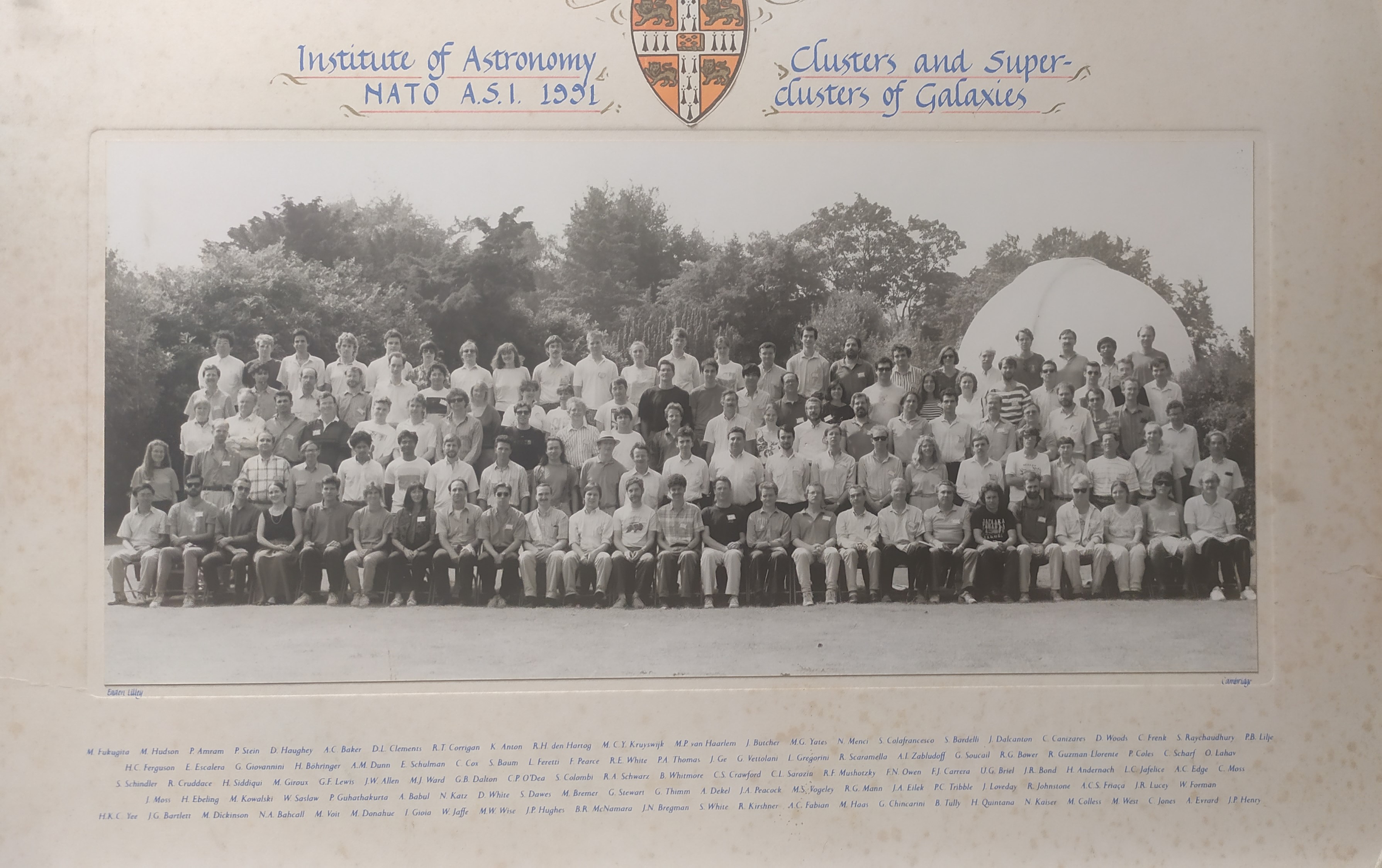
Here I provide the definitive answer: the meeting entitled The Epoch of Galaxy Formation took place in Durham between July 18th and 22nd 1988, i.e. about 33 years ago. Here is a relic of that period.

I am in there with John Barrow to my left (ie your right) . I can also identify Jim Peebles, Simon White, Richard Ellis, George Efstathiou and Carlos Frenk, Martin Rees and Tom Shanks among others but I wonder how many others you can identify…

P.S. Note the male-female asymmetry in cosmology was much greater in this period during the early Universe.

UPDATE: here is the solution to the problem.

R. I. P. Steven Weinberg (1933-2021)

Posted in Biographical, The Universe and Stuff with tags , , , on July 24, 2021 by telescoper

I just heard this morning via Twitter of the death at the age of 88 of the physicist Steven Weinberg. The news media don’t seem to have caught on yet but I’ll add links to appropriate tributes when they do.

UPDATE: You will find an appreciation from UT Austin here and an Associated Press article here.

Steven Weinberg is probably most famous in physics circles for his work on electroweak unification, together with Seldon Glashow and Abdus Salam, for which he jointly won the Nobel Prize for Physics in 1979. He did many other things besides, of course, and his influence is felt across huge swathes of particle physics, quantum field theory and cosmology. As well as a researcher he was a prolific writer, both of technical books – his Gravitational and Cosmology is a classic text on the principles and applications of the general theory of relativity – but also of works for the general public. He was an author of rare elegance and lucidity with some wonderful turns of phrase and a beautifully articulated secular view of the human condition. For example

If there is no point in the universe that we discover by the methods of science, there is a point that we can give the universe by the way we live, by loving each other, by discovering things about nature, by creating works of art. And that—in a way, although we are not the stars in a cosmic drama, if the only drama we’re starring in is one that we are making up as we go along, it is not entirely ignoble that faced with this unloving, impersonal universe we make a little island of warmth and love and science and art for ourselves. That’s not an entirely despicable role for us to play.

I bought Weinberg’s popular book The First Three Minutes about 40 years ago, and I still have a copy today. It’s no exaggeration to say that this book played a major part in my decision to continue a career in theoretical physics. I know I’m not the only physicist of my generation (or others) for whom this is the case. Although I never met Steven Weinberg in person, he was definitely an inspiration and he will be greatly missed.

Rest in peace, Steven Weinberg (1933-2021).

Searching for the Predicted Peaks in the CMB Power Spectrum

Posted in The Universe and Stuff with tags , , on July 11, 2021 by telescoper

I came across this on social media and thought I’d share it here. It’s a nice graphical demonstration of the interplay between theory and experiment in the field of cosmic microwave background physics. The video was created by Forrest Fankhauser and Lloyd Knox at the University of California, Davis with funding from the National Science Foundation.

As someone famous once said: “we’ve come a long way from pigeon shit…”

IRC Starting and Consolidator Awards

Posted in Maynooth, Science Politics, The Universe and Stuff with tags , , , , on July 9, 2021 by telescoper

Just a quick post to pass on the news that there are a couple of new funding programmes run by the Irish Research Council. The full description of these programmes can be found here, but here is an excerpt:

The Council is inviting applications at the early and mid-career level (Starting and Consolidator). Funding will be awarded on the basis solely of excellence, assessed through a rigorous and independent international peer-review process. Laureates will enhance their track record and international competitiveness. As well as the benefits for the laureate and their team, it is anticipated that the award will enhance the potential for subsequent ERC success as a further career milestone; indeed it will be a requirement of all laureates that they make a follow-on application to the ERC.

Fortunately the remit of the IRC is broader than Science Foundation Ireland, which has a narrow focus on research likely to lead to short-term returns, so it is more likely to appeal to those working in more speculative fundamental or frontier science, including Astrophysics. Unfortunately IRC has a lot less money than SFI.

An overview of the programme can be found in the following recording of a webinar that took place last week:

The way the call works is that you must first lodge an Expression of Interest with the institution to which you wish to apply, i.e. Maynooth University. That must be done by 27th August 2021. Full applications will then be due in November.

New Publication at the Open Journal of Astrophysics

Posted in OJAp Papers, Open Access, The Universe and Stuff with tags , , , , , on July 7, 2021 by telescoper

Time to announce another publication in the Open Journal of Astrophysics. This one was actually published last Friday, but I didn’t get time to post about it until just now. It is the fifth paper in Volume 4 (2021) and the 36th paper in all.

The latest publication is entitled Gravitational Wave Direct Detection does not Constrain the Tensor Spectral Index at CMB Scales and the author is Will Kinney of the State University of New York at Buffalo (which is SUNY Buffalo, for short).

Here is a screen grab of the overlay which includes the abstract:

You can click on the image to make it larger should you wish to do so. You can find the arXiv version of the paper here. This one is, fairly obviously, in the Cosmology and Nongalactic Astrophysics folder..

Over the last few months I have noticed that it has taken a bit longer to get referee reports on papers and also for authors to complete their revisions. I think that’s probably a consequence of the pandemic and people being generally overworked. We do have a number of papers at various stages of the pipeline, so although we’re a bit behind where we were last year in terms of papers published I think may well catch up in the next month or two.

I’ll end with a reminder to prospective authors that the OJA  now has the facility to include supplementary files (e.g. code or data sets) along with the papers we publish. If any existing authors (i.e. of papers we have already published) would like us to add supplementary files retrospectively then please contact us with a request!

On LinkedIn

Posted in Science Politics, The Universe and Stuff with tags , , , , on July 4, 2021 by telescoper

A former colleague recently contacted me with a request to join my “network” on LinkedIn.  That was quite hard to do as (at least until this morning) I was not on LinkedIn. That reminded me of a talk at INAM2019 a couple of years ago about the Astronomical Society of Ireland  which was about to be re-launched with a new website. One of the main reasons for doing this is that Ireland recently joined the European Southern Observatory and in order to capitalize on its involvement it is important to persuade the Irish government to invest in the resources needed (especially postdocs, etc) to do as much science as possible using ESO facilities. The idea was to improve the lobbying power for astronomy in Ireland. One of the suggestions made yesterday was that astronomers in Ireland should join LinkedIn in order to raise their profile individually and collectively.

I was not on LinkedIn at the time and didn’t get around to joining it mainly because I’ve always thought it was more for businessy types than academics. Anyway, in the light of recent events I decided it couldn’t do any harm to bite the bullet and set up a LinkedIn profile, which you can find here. It’s really a rather basic profile but I think I’ve set it up so that posts from here will be posted to LinkedIn too, so if you’re on it yourself you might want to add me. Or not. It’s up to you!

P.S. The only thing I have put under “Awards and Honours” is Winner of Beard of Ireland 2020.

Hubble Tension – The Plot Thickens

Posted in The Universe and Stuff with tags , , , on July 2, 2021 by telescoper

One topic on this blog seems to be as perennial as the weeds in my garden: the so-called Hubble Tension. I just saw a review paper by Wendy Freedman, one of the acknowedged experts in this area, on arXiv here. I have abstracted the abstract here:

You can find the PDF here.

What’s particularly interesting about this discussion is that stellar distance indicators have typically produced higher values than the 69.8 ± 0.6 (stat) ± 1.6 (sys) km s-1 Mpc-1 quoted here, which is consistent with the lower value favoured by Planck. See the above graphic discussed here. So perhaps there’s no tension at all. Maybe.

Anyway, here’s that poll again! I wonder if this paper might change the voting.