Archive for the The Universe and Stuff Category

Phosphine on Venus again…

Posted in Astrohype, The Universe and Stuff with tags , , , on February 8, 2021 by telescoper

Remember all the excitement last September about the claimed detection of Phosphine in the atmosphere of Venus? If you do you will remember that the claim has been contested. Now there is another paper on this matter claiming that what was interpreted as a spectral feature due to Phosphine (PH3) could actually be due to Sulphur Dioxide (SO2)). Here is the abstract of the latest paper.

You can find the full paper on the arXiv here.

P.S. I bookmarked the arXiv paper about a week ago but was very busy and forgot about it until now!

New Publication at the Open Journal of Astrophysics

Posted in OJAp Papers, Open Access, The Universe and Stuff with tags , , , , , , , on February 2, 2021 by telescoper

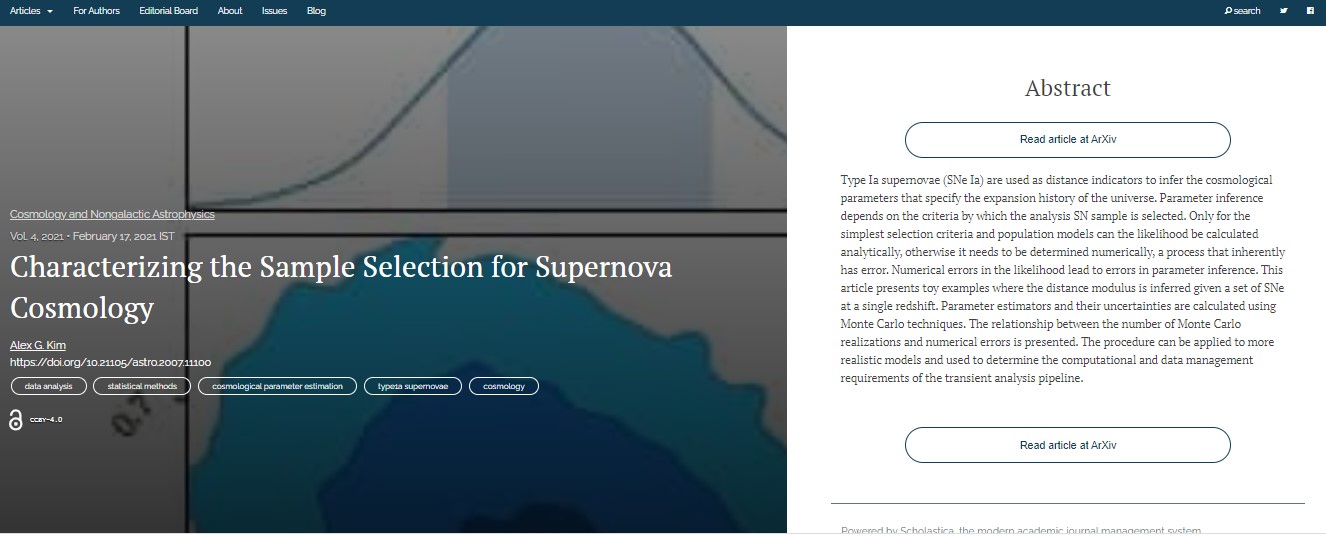
Time to announce the first publication of 2021 in the Open Journal of Astrophysics. This one was actually published a few days ago but  it took a bit of time to get the metadata and DOI registered so I held off announcing it until that was done.

The latest publication is a lengthy and comprehensive review article (67 pages altogether) by Allahverdi et al. which has 26 authors from all round the world. It is entitled The First Three Seconds: a Review of Possible Expansion Histories of the Early Universe and is a study of the various possible evolutionary histories of cosmic expansion possible with a wide range of cosmological models with their implications for baryogenesis, nucleosynthesis, primordial gravitational wave production, and many other things besides.

Here is a screen grab of the overlay:

You can click on the image to make it larger should you wish to do so. You can find the arXiv version of the paper here. This is one for the Cosmology and Nongalactic Astrophysics folder.

And so Volume 4 begins. Volume 3 had 15 papers, Volume 2 had 12 , and Volume 1 just 4 so we’re growing slowly but surely! Let’s see how many we publish in 2021. I can tell you  we have some very exciting papers in the pipeline…

Maynooth and the Boyle Family

Posted in History, Maynooth, The Universe and Stuff with tags , , , , , , , on January 30, 2021 by telescoper

It’s a rainy Saturday afternoon in Maynooth and I don’t feel like taking my usual walk so I thought I’d post another bit of local history like I did last week. This is another thing I’ve just found out and thought I’d share. This is a view I took last spring of Maynooth Castle (or the ruins thereof):

The Castle, together with a Manor House that was next to it, belonged to the Fitzgerald family, local aristocracy since the 13th Century. As I mentioned in a previous post, Thomas Fitzgerald, the 10th Earl of Kildare, led a rebellion against the English authorities during the time of Henry VIII. He acquired the nickname “Silken Thomas” because of the ribbons of silk worn by his supporters. The rebellion failed and his family castle was badly damaged. Thomas surrendered and was subsequently executed, along with several members of his family, in 1537. The family fortunes declined pretty drastically at that point but the family line did survive.

Now fast forward to 1630 when George Fitzgerald, the 16th Earl of Kildare married a Lady Joan Boyle. She was the daughter of a tremendously powerful figure by the name of Richard Boyle, the 1st Earl of Cork. Richard Boyle had been part of the Tudor plantation of Ireland and had acquired enormous amounts of land and personal wealth in the process. He spent some of his riches at the time of his daughter’s wedding doing up the ancestral home of his son-in-law, refurbishing the castle and building a new manor house next to it.

Unfortunately this didn’t last long. During the Irish Confederate Wars the Castle was attacked several times and badly damaged. It remained in occupation but by the end of the 17th Century it was derelict. The Fitzgerald family eventually moved to a new home at the other end of Maynooth, Carton House (now an upmarket golf resort). All Richard Boyle’s refurbishment work went to nothing and all that survives to the present day – the Gatehouse and Solar Tower – dates to the 13th Century, no doubt because it was more solidly built.

I’ve known about this for quite a while, but only this morning I discovered something else. Richard Boyle had a very large family – fifteen children altogether – and his seventh son (14th child altogether) was none other than the famous natural philosopher Robert Boyle, after whom Boyle’s Law is named. He was a particularly important figure in the development of chemistry, paid for the publication of a translation of the Bible into Irish, was a founder member of the Royal Society of London and, more importantly than any of those things, wrote the book whose cover I use when I post rambling from In The Dark on Twitter:

It’s a very descriptive title for this blog, but perhaps not so catchy.

Anyway, largely because he found it difficult to acquire materials and equipment in Ireland, Robert Boyle spent most his scientific career in England. He did however return to Ireland a number of times. He was born in Lismore, in County Waterford, so probably would have stayed near there on these visit. It is entirely possible – and indeed likely – that he may have visited his sister in Maynooth while in Ireland.

Physics versus Astrophysics

Posted in The Universe and Stuff with tags , on January 21, 2021 by telescoper

I don’t often post memes on here, but I couldn’t resist this one. Credit here.

NUI Dr Éamon De Valera Post-Doctoral Fellowship in Mathematical Sciences

Posted in History, mathematics, Maynooth, The Universe and Stuff with tags , , , on January 21, 2021 by telescoper

I found out yesterday that the National University of Ireland is commemorating the centenary of the election of Éamon de Valera as its Chancellor. To mark this occasion, NUI will offer a special NUI Dr Éamon De Valera Post-Doctoral Fellowship in Mathematical Sciences. This post is in addition to the regular NUI awards, which include a position for Science & Engineering.

Éamon de Valera, photographed sometime during the 1920s.

Éamon de Valera, founder of Fianna Fáil (formerly one of the two largest political parties in Ireland) and architect of the Irish constitution. De Valera (nickname `Dev’) is an enigmatic figure, who was a Commandant in the Irish Republican Army during the 1916 Easter Rising, who subsequently became Taoiseach  and then President of the Irish Republic.

You may or may not know that de Valera was a mathematics graduate, and for a short time (1912-13) he was Head of the Department of Mathematics and Mathematical Physics at St Patrick’s College, Maynooth,  a recognized college of the National University of Ireland. The Department became incorporated in Maynooth University, when it was created in 1997.Mathematical Physics is no longer a part of the Mathematics Department at Maynooth, having become a Department in its own right and it recently changed its name to the Department of Theoretical Physics.

Anyway, the Fellowship will be awarded on the basis of a common competition open to NUI graduates in all branches of the Mathematical Sciences. All branches of the Mathematical Sciences will be deemed as including, but not limited to, all academic disciplines within Applied Mathematics, Pure Mathematics, Mathematical Physics and Statistics and Probability.

You can find more details of the position here. I should say however that it is open to NUI graduates only, though it can be held at any of the constituent colleges of the National University of Ireland. Given the de Valera connection with Maynooth, it would be fitting if it were held here!
The deadline for applications is February 9th.

On the Colours of Stars

Posted in The Universe and Stuff with tags , , , on January 20, 2021 by telescoper

There’s an interesting paper on the arXiv by Harre & Heller with the title Digital Color Codes of Stars. Here’s the abstract:

Publications in astrophysics are nowadays mainly published and read in digitized formats. Astrophysical publications in both research and in popular outreach often use colorful representations of stars to indicate various stellar types, that is, different spectral types or effective temperatures. Computer generated and computer displayed imagery has become an integral part of stellar astrophysics communication. There is, however, no astrophysically motivated standard color palette for illustrative representations of stars and some stars are actually represented in misleading colors. We use pre-computed PHOENIX and TLUSTY stellar model spectra and convolve them with the three standard color matching functions for human color perception between 360nm and 830nm. The color matching functions represent the three sets of receptors in the eye that respond to red, green, and blue light. For a grid of main sequence stars with effective temperatures between 2300K and 55,000K of different metallicities we present the red-blue-green and hexadecimal color codes that can be used for digitized color representations of stars as if seen from space. We find significant deviations between the color codes of stars computed from stellar spectra and from a black body radiator of the same effective temperature. We illustrate the main sequence in the color wheel and demonstrate that there are no yellow, green, cyan, or purple stars. Red dwarf stars (spectral types M0V – M9V) actually look orange to the human eye. Old white dwarfs such as WD1856+534, host to a newly discovered transiting giant planet candidate, occur pale orange to the human eye, not white. Our freely available software can be used to generate color codes for any input spectrum such as those from planets, galaxies, quasars etc.

This reminded me of a post I wrote in 2011 about why you never see any green stars. They say a picture paints a thousand words so here’s an illustration from the above paper:

This shows that although there are stars in the Main Sequence whose spectra peak at wavelengths corresponding to green light, none of them look green. The paper also claims that there are no yellow stars either. The Sun can look yellow when viewed from Earth but that is to do with scattering in the atmosphere: from space, the Sun looks white.

For another discussion of the use of colour representations in cosmology, see here.


Cosmology Talks: Marika Asgari on Kids 1000

Posted in Cardiff, Maynooth, The Universe and Stuff with tags , , , , on January 18, 2021 by telescoper

It’s time I shared another one of those interesting cosmology talks on the Youtube channel curated by Shaun Hotchkiss. This channel features technical talks rather than popular expositions so it won’t be everyone’s cup of tea but for those seriously interested in cosmology at a research level they should prove interesting. Since I haven’t posted any of these for a while I’ve got a few to catch up on – this one is from September 2020.

In this talk Marika Asgari tells us about the recent Kilo-Degree Survey (KiDS) cosmological results. These are the first results from KiDS after they have reached a sky coverage of 1000 square degrees. Marika first explains how they know that the results are “statistics dominated” and not “systematics dominated”, meaning that the dominant uncertainty comes from statistical errors, not systematic ones. She then presents the cosmological results, which primarily constrain the clumpiness of matter in the universe, and which therefore constrain Ωm and σ8. In the combined parameter “S8“, which is constrained almost independently from Ωm by their data they see a more than 3σ tension with the equivalent parameter one would infer from Planck.

P. S. The papers that accompany this talk can be found here and here.

R.I.P. Kumar Chitre (1936-2021)

Posted in The Universe and Stuff with tags , on January 11, 2021 by telescoper

Shashikumar Madhusudan Chitre

Yet more sad news to pass on, I’m afraid.

I heard today of the death at the age of 84 of Indian theoretical astrophysicist Sashikumar Madhusan Chitre. Kumar worked on diverse subjects from solar physics to gravitational lensing (and many things in between) and had a very strong interest in science education. He was a frequent visitor to Queen Mary College when I worked there and I remember very many interesting discussions with him there, and then later when we met up at the Tata Institute for Fundamental Research in Mumbai and spent a very pleasant evening chatting to him over dinner at his home.

Kumar held a number of Visiting Professorships including the Universities of Cambridge, Sussex, Columbia, and Amsterdam, as well as Queen Mary, so many people around the world will miss not only his scientific expertise but also his wonderfully warm, kindly, humorous and generous personality.

R.I.P. Professor Sashikumar Madhusan Chitre (1936-2021).

Two Job Opportunities in Quantum Computing/ Quantum Information Processing in Maynooth!

Posted in Maynooth, The Universe and Stuff with tags , , , on January 11, 2021 by telescoper

Gratuitous Graphic purporting to represent Quantum Information Processing

Regular readers of this blog may recall an announcement that the Department of Theoretical Physics scored a notable success, or rather Dr Professor Jiri Vala did, in securing funding as part of a project called Quantum Computing in Ireland: A Software Platform for Multiple Qubit Technologies. To be eligible for this kind of funding, projects must involve businesses and this particular project includes IBM Ireland Ltd, MasterCard Ireland, Rockley Photonics and Equal 1 Laboratories, the latter two being SMEs based in the Dublin area. The project also involves the Tyndall National Institute (Cork); University College Dublin; and Maynooth University. This is the first large collaboration in Ireland in this area.

Well, now that the funds have actually arrived, I  thought I’d use the medium of this blog to pass on the information that the Department of Theoretical Physics at Maynooth University is looking two appoint not one but two theoretical physicists as postdoctoral researchers to work on this project.

The first position (for which you can find further details here) is  to work on modelling and simulations of quantum photonic systems for quantum information processing.

The second position (further details here) is to work on the development of compilers, quantum control protocols and algorithms for quantum information processing in quantum photonic systems.

The deadline for both positions is Sunday 31st January 2021!

Please feel free to pass this on to anyone you think may be interested!


Postponed: Astrophysics & Cosmology Masterclass at Maynooth

Posted in Education, Maynooth, The Universe and Stuff with tags , , on January 10, 2021 by telescoper

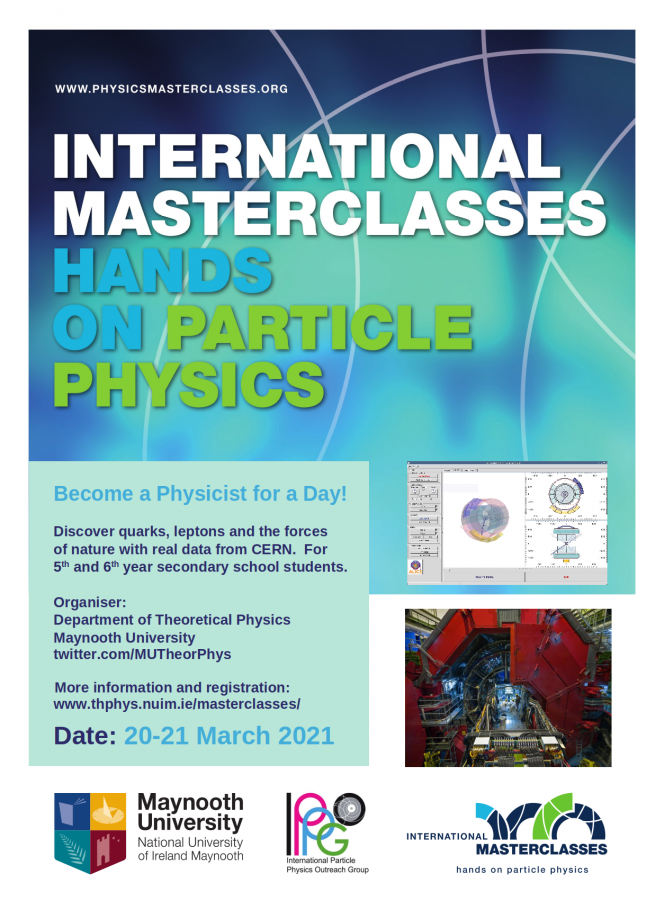
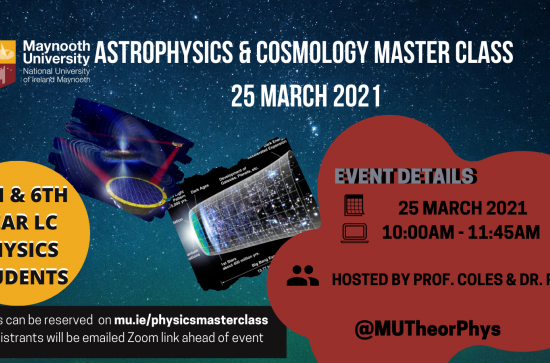
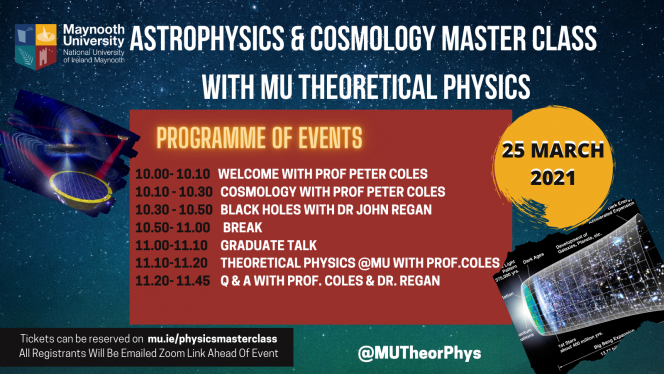
Regular readers of this blog may recall that the Department of Theoretical Physics at Maynooth University  planned to host a Masterclass in Astrophysics & Cosmology on January 14th 2021 (i.e. next Thursday). Unfortunately the closure of schools in Ireland until at least the end of January has given us no alternative but to postpone this event. It’s not cancelled though and we intend to run it as soon as possible: the date is now set provisionally for 25th February.  Limited places remain available and bookings are still open. You can find more information, including instructions on how to book a place, here.

Here is the official poster and the programme (timings still apply, but not the date..):

I’ll be talking about cosmology early on, while John Regan will talk about black holes. After the coffee break one of our PhD students will talk about why they wanted to study astrophysics. Then I’ll say something about our degree programmes for those students who might be interested in studying astrophysics and/or cosmology as part of a science course. We’ll finish with questions either about the science or the courses.

For updates please follow the Department’s on twitter-feed: