Archive for the The Universe and Stuff Category

New Publication at the Open Journal of Astrophysics

Posted in OJAp Papers, Open Access, The Universe and Stuff with tags , , , , , , , on December 15, 2020 by telescoper

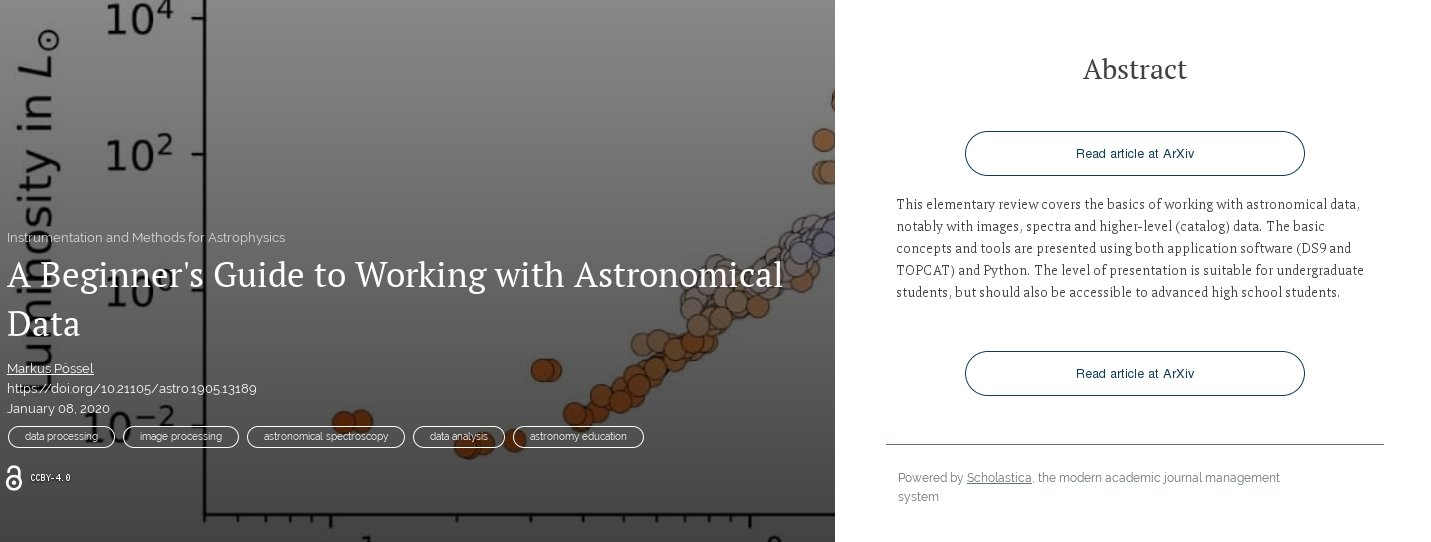
The Christmas rush is definitely upon us and papers are queuing up to be published in the Open Journal of Astrophysics. The latest publication is by Tom Kitching and Anurag Deshpande of MSSL (University College London) and Peter Taylor of JPL (Caltech). It is entitled Propagating residual biases in masked cosmic shear power spectra. This is another one for the folder marked Cosmology and Nongalactic Astrophysics.

Here is a screen grab of the overlay:

You can click on the image to make it larger should you wish to do so. You can find the arXiv version of the paper here.

When I last posted about a new OJA paper I mentioned that it seemed to be taking authors longer than usual to make revisions. There are signs now that some authors are trying to get papers off their desk before the Christmas break so we may have two or three more to publish before the year is out.

P.S. Last week I received an offer from a commercial organization to buy the Open Journal of Astrophysics. I replied politely that it is not for sale.

New Publication at the Open Journal of Astrophysics!

Posted in OJAp Papers, Open Access, The Universe and Stuff with tags , , , , , , on December 10, 2020 by telescoper

Time to announce another new paper in the Open Journal of Astrophysics. The latest publication is by Johan Comparat and 27 others – too numerous to list individually here –  and is entitled Full-sky photon simulation of clusters and active galactic nuclei in the soft X-rays for eROSITA. This is another one for the Cosmology and Nongalactic Astrophysics folder.

This paper is closely connected to the eROSITA instrument which is why it involves a considerable number of authors in different institutions – the current record length for an OJAp author list – though this is by no means a large collaboration by the standards of astrophysics and cosmology! It’s good to see some big names in there though!

Here is a screen grab of the overlay:

You can click on the image to make it larger should you wish to do so. You can find the arXiv version of the paper here.

With this paper we have exceeded the number of papers published last year. We do in fact have quite a few in the pipeline but owing to the ongoing pandemic there have been some refereeing delays and in some cases authors are taking more time than expected to do the “revise and resubmit” routine. I think there are plenty of other people around who are just as tired as I am! Perhaps we’ll see a clutch emerging in the New Year!

Lorentz-Fitzgerald or Fitzgerald-Lorentz?

Posted in Beards, History, The Universe and Stuff with tags , , , , on December 9, 2020 by telescoper

I’ve recently moved on to the part about Special Relativity in my module on Mechanics and Special Relativity and this afternoon I’m going to talk about the Lorentz-Fitzgerald contraction or, as it’s properly called here in Ireland, the Fitzgerald-Lorentz contraction.

The first thing to point out is that the physicists George Francis Fitzgerald and Hendrik Lorentz, though of different nationality (the former Irish, the latter Dutch), both had fine beards:

George Francis Fitzgerald (1851-1901)

Hendrik Lorentz (1853-1928)

One of the interesting things you find if you read about the history of physics just before Albert Einstein introduced his theory of special relativity in 1905 was how many people seemed to be on the verge of getting the idea around about the same time. Fitzgerald and Lorentz were two who were almost there; Poincaré was another. It was as if special relativity was `in the air’ at the time. It did, however, take a special genius like Einstein to crystallize all that thinking into a definite theory.

Special relativity is fun to teach, not least because it throws up interesting yet informative paradoxes (i.e. apparent logical contradictions) arising from  that you can use to start a discussion. They’re not really logical contradictions, of course. They just challenge `common sense’ notions, which is a good thing to do to get people thinking.

Anyway, I thought I’d mention one of my favorite such paradoxes arising from a simple Gedankenerfahrung (thought experiment) here.

Imagine you are in a railway carriage moving along a track at constant speed relative to the track. The carriage is dark, but at the centre of the carriage is a flash bulb. At one end (say the front) of the carriage is a portrait of Lorentz and at the other (say the back) a portrait of Fitzgerald; the pictures are equidistant from the bulb and next to each portrait is a clock.The two clocks are synchronized in the rest frame of the carriage.

At a particular time the flash bulb goes off, illuminating both portraits and both clocks for an instant.

It is an essential postulate of special relativity that the speed of light is the same to observers in any inertial frame, so that an observer at rest in the centre of the carriage sees both portraits illuminated simultaneously as indicated by the adjacent clocks. This is because the symmetry of the situation means that light has to travel the same distance to each portrait and back.

Now suppose we view the action from the point of view of a different inertial observer, at rest by the trackside rather than on the train, who is positioned right next to the centre of the carriage as the flash goes off. The light flash travels with the same speed in the second observer’s frame, but this observer sees* the back of the carriage moving towards the light signal and the front moving away. The result is therefore that this observer sees the two portraits light up at different times. In this case the portrait of Fitzgerald is lit up before the portrait of Lorentz.

Had the train been going in the opposite direction, Lorentz would have appeared before Fitzgerald. That just shows that whether its Lorentz-Fitzgerald contraction or Fitzgerald-Lorentz contraction is just a matter of your frame of reference…

But that’s not the paradoxical thing. The paradox is although the two portraits appear at different times to the trackside observer, the clocks still appear show the same time….

*You have to use your imagination a bit here, as the train has to be travelling at a decent fraction of the speed of light. It’s certainly not an Irish train.

Einstein’s Universe

Posted in The Universe and Stuff with tags , , on December 7, 2020 by telescoper

I’ve just started teaching about special relativity and for some reason I suddenly remembered this blast from the past (in 1979) which I saw when I was still at School. It is now available in fully remastered form on YouTube. It’s a feature-length film (2 hours long) but I think it’s worth sharing in its entirety. Here is the description from YouTube, with a few additions:

Based on Nigel Calder’s book Einstein’s Universe, this fascinating and rare film going by the same title has been re-mastered and digitally enhanced to bring Einstein fans a priceless experience. Narrated by the charismatic Peter Ustinov and hosted by Nigel Calder, the film was first broadcast on the centenary of Albert Einstein’s Birth; March 14th, 1979. Ustinov takes the viewer on a wonderful experience through the McDonald Observatory at the University of Texas-Austin where he is thoroughly enlightened on the great physicist’s theories, especially General Relativity, by a renowned team of scientists including Dennis Sciama, Roger Penrose, John Wheeler, Wallace Sergeant, Irwin Shapiro, Sidney Drell, and Ken Brecher.

Included in Ustinov’s experience at the McDonald Observatory are experiments to help understand gravity, warped space, how light responds to gravity, the “Doppler effect” and how radio waves, as used in police radar, are an unbeatable way of measuring speed. From these simpler experiments much larger concepts are drawn, such as the discovery of a Binary Pulsar, the nature of black holes and how they are created, and the ultimate theory of how the universe was formed. Other demonstrations measure the speed of light, how time passes more slowly for people traveling in an airplane, the incredible accuracy of the Atomic Clock in Washington, DC and how time itself would appear to stop at the surface of a black hole. The conclusion of the program portrays Einstein as a great humanitarian. Although known as the “father of the Atomic Bomb”, his greatest concern was for the potentially devastating effects splitting the atom could have on the future of mankind. His famous letter to President Franklin Roosevelt warned that although the splitting of the atom to detonate an atomic bomb could be used to end World War II, it could also potentially be used for far more deadly ends.

It’s a great chance to see and hear some of the greats of physics as they were over forty years ago, some of whom make remarkably prescient comments about the future (now our present) including about gravitational waves!

Another Week Ending

Posted in Biographical, Covid-19, Education, GAA, Maynooth, The Universe and Stuff on December 4, 2020 by telescoper

As this term staggers on I once again arrive at a weekend in a state of exhaustion. Still there are just two teaching weeks left for this term so soon it will be the Christmas break. At least there won’t be any teaching then, though there will be other things to do before the examinations start in January.

I’ve managed to keep a reasonable pace up in both sets of lectures. The last one due this term is for Vector Calculus and Fourier Series, on Friday 18th December, but I think I may be able to complete the module content on the Tuesday lecture which means the students will be able to have a bit more time to relax before Christmas or, alternatively, a bit more time for revision. I hope it’s the former, as I imagine the students are at least as tired as we staff are. This has been a difficult year for everyone.

At Maynooth University, lectures for Semester 2 start on February 1st 2020. That will give us a bit of time to see how the Covid-19 pandemic progresses before deciding exactly how we’re going to approach teaching. Other universities that resume earlier have less time to make this decisions. I fear that the number of cases may rise rapidly over the three weeks remaining before Christmas, even before the Christmas break itself, and we therefore might have to go fully online next term. What I don’t want to happen is what happened in September, namely that we made elaborate plans for lecture rotations and tutorial groups that were then ditched because the Coronavirus situation changed. That was quite demoralizing because it involved a great deal of effort that was wasted.

Being a Department of Theoretical Physics we don’t have the problems facing the more experimental subjects that require extensive laboratory classes which are difficult to do under social distancing. Next term however we do have Computational Physics, which has laboratory classes, so I’ll have to decide how much of that we can do in person and how much students will have to do online using their laptops. I hope we can return to full in-person lab sessions, but we can’t be that will be possible right now. In any case computer labs are far easier to run online that practical chemistry or physics labs, so I think we will be able to do a reasonable job whatever the circumstances.

For added fun, next term I’ll be teaching a new module; 4th Year Advanced Electromagnetism. Although there’s always a lot of work required to teach a module for the first time, I am actually looking forward to doing this one as there’s some interesting physics in it (especially relativistic electrodynamics). I may try to squeeze a bit of plasma physics in too. But will it be online or on campus, or a mixture of both? Time alone will tell.

Anyway I’m looking forward to this weekend being as stress-free as possible. There’s a good start tonight, as Newcastle’s game against Aston Villa has been postponed due to Covid-19 so no anxious looking at the score this evening. The rest of the weekend will be dominated, for me, by the two semi-finals of the All Ireland Gaelic Football Championship (Cavan versus Dublin tomorrow and Mayo versus Tipperary on Sunday). It seems to be written in the stars that the final should be Dublin versus Tipperary, the two teams that played on Bloody Sunday, but time will tell on that one too.

Update: Dublin did indeed comfortably beat Cavan on Saturday but Mayo beat Tipperary in a high scoring game in a foggy Croke Park on Sunday (Mayo 5-20 Tipperary 3-13). The final will therefore not be a rerun of the 1920 final.

That’s enough rambling. Have a good weekend.

Our Solar Neighbourhood

Posted in The Universe and Stuff with tags , , , on December 3, 2020 by telescoper

Here’s a very nice movie showing the stars in the Solar neighbourhood (defined to be within 100 parsecs of the Sun) with positions and colours mapped by the European Space Agency’s Gaia mission.

P.S. The video is timed to coincide with Gaia’s third data release: for more information about DR3 see here.

Cosmology Talks: Eiichiro Komatsu & Yuto Minami on Parity Violation in the Cosmic Microwave Background

Posted in Cardiff, Maynooth, The Universe and Stuff with tags , , , , , , , , on December 2, 2020 by telescoper

It’s time I shared another one of those interesting cosmology talks on the Youtube channel curated by Shaun Hotchkiss. This channel features technical talks rather than popular expositions so it won’t be everyone’s cup of tea but for those seriously interested in cosmology at a research level they should prove interesting.

In this video, Eiichiro Komatsu and Yuto Minami talk about their recent work, first devising a way to extract a parity violating signature in the cosmic microwave background, as manifested by a form of birefringence. If the universe is birefringent then E-mode polarization would change into B-mode as electromagnetic radiation travels through space, so there would be a non-zero correlation between the two measured modes. They  try to measure this correlation using the Planck 2018 data, getting  a 2.4 sigma `hint’ of a result.

A problem with the measurement is that systematic errors, such as imperfectly calibrated detector angles,  could mimic the signal. Yuto and Eiichiro’s  idea was to measure the detector angle by looking at the E-B correlation in the foregrounds, where light hasn’t travelled far enough to be affected by any potential birefringence in the universe. They argue that this allows them to distinguish between the two types of measured E-B correlation. However, this is only the case if there is no intrinsic correlation between the E-mode and B-mode polarization in the foregrounds, which may not be the case, but which they are testing. The method can be applied to any of the plethora of CMB experiments currently underway so there will probably be more results soon that may shed further light on this issue.

Incidentally this reminds me of Cardiff days when work was going on about the same affect using the Quad instrument. I wasn’t involved with Quad but I do remember having interesting chats about the theory behind the measurement or upper limit as it was (which is reported here). Looking at the paper I realize that paper involved researchers from the Department of Experimental Physics at Maynooth University.

P. S. The paper that accompanies this talk can be found here.

“And” Time Draws Nigh

Posted in History, Poetry, The Universe and Stuff with tags , , , , , , , on November 30, 2020 by telescoper

It’s November 30th 2020, which means we have just three teaching weeks to go until the end of term. I am currently teaching two modules: Mechanics 1 and Special Relativity for first-year students and Vector Calculus and Fourier Series for second years. We’re now getting to the “and” bit in both modules.

I didn’t want to present the two topics mentioned in the title of the second year module as completely disconnected, so I decided to link them with a lecture in which I use the divergence theorem of vector calculus to derive the heat equation, the solution of which led Joseph Fourier to devise his series in Mémoire sur la propagation de la chaleur dans les corps solides (1807), a truly remarkable work for its time that inspired so many subsequent developments.

That gives me an excuse to repost the following “remarkable” poem about Fourier by William Rowan Hamilton:

In the first-year module I will be spending most of this week talking about potentials and forces before starting special relativity next week, at the proper time.

This day and age we’re living in
Gives cause for apprehension
With speed and new invention
And things like fourth dimension
Yet we get a trifle weary
With Mr. Einstein’s theory
So we must get down to earth at times
Relax relieve the tension
And no matter what the progress
Or what may yet be proved
The simple facts of life are such
They cannot be removed

As time goes by, the other thing drawing nigh is the loosening of Ireland’s current Level 5 Covid-19 restrictions which were imposed about six weeks ago though, judging by the crowds drinking in Courthouse Square on Saturday night, a lot of folks have thrown the rules out the window already.

I think it’s a dangerous time. The daily cases are still hovering around the 250-300 mark and will undoubtedly start climbing even before Christmas itself:

The chances of us getting back to anything resembling normality during the early part of next year are exceedingly slim.

Cosmological Non-Linearities as an Effective Fluid

Posted in The Universe and Stuff with tags , , , , , , , on November 27, 2020 by telescoper

We know our Universe is inhomogeneous, comprising regions of high density (galaxies and clusters of galaxies) as well as regions of much lower density (e.g. cosmic voids). Our standard cosmological models are based on exact solutions of Einstein’s equations of general relativity that assume homogeneity and isotropy. The general assumption is that if we confine ourselves to large enough scales the effect of the clumpiness of matter can either be disregarded or treated using perturbation theory. As far as we can tell, that approach works reasonably well but we know it must fail on smaller scales where the structure is in the non-linear regiome where it can’t be described accurately using perturbation theory because the fluctuations are so large.

From time to time I’ve idly wondered whether it might be possible to understand the effect of these non-linearities in general relativity by treating them as a kind of fluid with an energy-momentum tensor that acts as a correction to that of the perfect fluid form of the background cosmological model. This would have to be done via some sort of averaging so it would be an effective, coarse-grained description rather than an exact treatment. It is clear though that non-linearities would generate departures from the perfect fluid form, particularly resulting in off-diagonal terms in the energy-momentum tensor corresponding to anisotropic stresses (e.g. viscosity terms).

Anyway, a recent exchange on Twitter relating to a new paper that has just appeared revealed that far cleverer people than me had looked at this in quite a lot of detail a decade ago:

You can find the full paper here.

There are quite a lot of subtleties in this – how to do the spatial averaging, how to do the time-slicing, etc – which I don’t fully understand but at least I’m reassured that it isn’t a daft idea to try thinking of things this way!

P.S. The relativistic simulations reported in this paper could in principle be used to estimate the parameters mentioned in the abstract above, if that hasn’t been done before!


John & Diego

Posted in Poetry, The Universe and Stuff with tags , , on November 26, 2020 by telescoper

The Guardian obituary of John Barrow (written by Michael Rowan-Robinson) has finally appeared in today’s print edition*, alongside that of footballer Diego Maradona who passed away yesterday.

As a lifelong football fan I think John would have been amused by the coincidence, especially because John’s first book (co-written with Joe Silk) was called The Left Hand of Creation:

*I don’t usually buy foreign newspapers, but I managed to find a copy of today’s Grauniad in Maynooth.