Archive for the The Universe and Stuff Category

Astronomy Photograph of the Year 2020

Posted in Art, The Universe and Stuff with tags , , , , on September 24, 2020 by telescoper

Very busy today so I only have time to share a this stunning picture, the overall winner of the 2020 Astronomy Photographer of the Year, Andromeda Galaxy at Arm’s Length? by Nicolas Lefaudeux (France).


Photo credit: Nicolas Lefaudeux/2020 astronomy photographer of the year

The Autumnal Equinox 2020

Posted in Biographical, Maynooth, The Universe and Stuff with tags , , on September 22, 2020 by telescoper

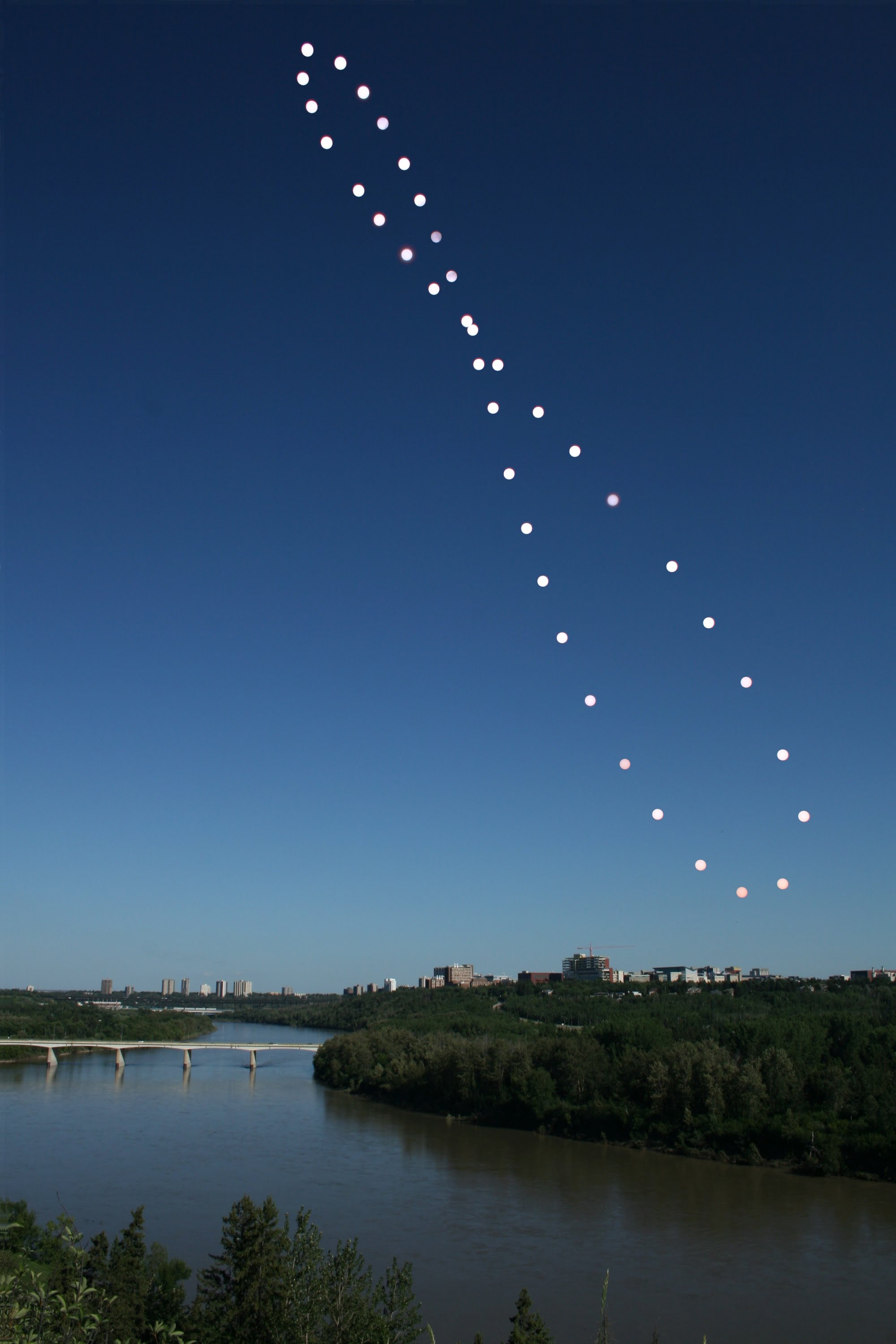
So here we are then. The Autumnal Equinox (in the Northern hemisphere) takes place this afternoon at 14.31 Irish Time (13.31 UT).

Though  the term `equinox’  refers a situation in which day and night are of equal length which implies that it’s a day rather than a specific time, the equinox is more accurately defined by a specific event when the plane defined by Earth’s equator passes through the centre of the Sun’s disk (or, if you prefer, when the centre of the Sun passes through the plane defined by Earth’s equator). Day and night are not necessarily exactly equal on the equinox, but they’re the closest they get. From now on days in the Northern hemisphere will be shorter than nights and they’ll get shorter still until the Winter Solstice.

For many people the autumnal equinox is taken to be the end of summer, though there is a saying around these parts that `Summer is Summer to Michaelmas Day’ (September 29th). Looking back over the posts I’ve written at this time of year since I started blogging in 2008, it’s noticeable how many times we’ve had a window of good weather around the autumnal equinox. In Wales such a warm spell in late September is called Haf Bach Mihangel – “the little summer of St Michael”.

Here’s a sample excerpt from the post I wrote in 2008 on this:

The weather is unsettling. It’s warm, but somehow the warmth doesn’t quite fill the air; somewhere inside it there’s a chill that reminds you that autumn is not far away.

I find this kind of weather a bit spooky because it always takes me back to the time when I left home to go to University, as thousands of fledgling students are about to do this year in their turn.

It has been quite warm here in Maynooth recently too. Last night I mowed the lawn in the evening sunshine, which may well be the last time I do that until spring. The weather turned a bit colder overnight and the weather forecast suggests the little summer may be over.

Anyway, this is Welcome Week in Maynooth and, barring any sudden changes of plan, we’re due to start teaching on Monday 28th September. I’ve been keeping an eye on the registrations of students as they come in as well as starting to get my notes, problem sheets, recordings and other teaching materials together. I have to say that hasn’t been helped by the decision to install a new fire alarm system in the Science Building this week. I had to go home early because of the constant din of the sounders being tested.

I have to admit I’m very apprehensive about the forthcoming semester and beyond. It’s impossible to predict where we will be by the next equinox in March, or even by the Solstice in December. Covid-19 cases are increasing and it doesn’t seem that anyone has a clue how to stop the `second wave’ surging through the population this autumn. The September equinox is often said to to be the start of Astronomical Autumn. This year more than ever it seems to herald that Winter is coming.

Twelve Years in The Dark!

Posted in Biographical, The Universe and Stuff with tags on September 15, 2020 by telescoper

When I logged onto WordPress today I received a message that it was the 12th anniversary of my registration with them as a blogger, which is when I took my first step into the blogosphere; that was way back on 15th September 2008.

I actually wrote my first post on the day I registered but unfortunately I didn’t really know what I was doing on my first day at blogging – no change there, then – and I didn’t actually manage to figure out how to publish this earth-shattering piece. It was only after I’d written my second post that I realized that the first one wasn’t actually visible to the general public because I hadn’t pressed the right buttons, so the two appear in the wrong order in my archive.

If you’re interested in statistics then, as of 13.00 Irish Summer Time Today today, I have published 5197 blog posts posts and have received 4,369,422 hits altogether; I get an average of just under 1000 per day. This varies in a very erratic fashion from day to day, but there has been a bit of a downward trend over the last few years, presumably because I’m getting older and more boring. The largest number of hits I have received in a single day is 8,864 (at the peak of the BICEP2 controversy).

There have been 35,313 comments published on here and 2,672,823 rejected by the spam filters. The vast majority of the rejected comments were from bots, but a small number have been removed for various violations, usually for abuse of some kind. And, yes, I do get to decide what is published: it is my blog!

While I am on the subject of comments, I’ll just repeat here the policy stated on the home page of this blog:

Feel free to comment on any of the posts on this blog but comments may be moderated; anonymous comments and any considered by me to be abusive will not be accepted. I do not necessarily endorse, support, sanction, encourage, verify or agree with the opinions or statements of any information or other content in the comments on this site and do not in any way guarantee their accuracy or reliability.

It does mean a lot to me to know that there are people who find my ramblings on this `shitty wordpress blog’ interesting enough to look at, or even read, and sometimes even to come back for more, so I’d like to take this opportunity to send my best wishes to all those who follow this blog and especially those who take the trouble to comment on it in such interesting and unpredictable ways!

The last twelve years have been eventful, to say the least, both personally and professionally. I started blogging not long after I’d moved into my house in Pontcanna, Cardiff. Since then I moved to Sussex, then back to Cardiff, and now to Ireland. More importantly we’ve seen the discovery of the Higgs Boson and gravitational waves, both of which resulted in Nobel Prizes, as did the studies of high-redshift supernovae. The Planck mission mission was launched, did its stuff, and came to a conclusion in this time too. Science has moved forward, even if there are many things in this world that seem to be going backwards.

New Publication at the Open Journal of Astrophysics!

Posted in OJAp Papers, Open Access, The Universe and Stuff with tags , , , , , , on September 15, 2020 by telescoper

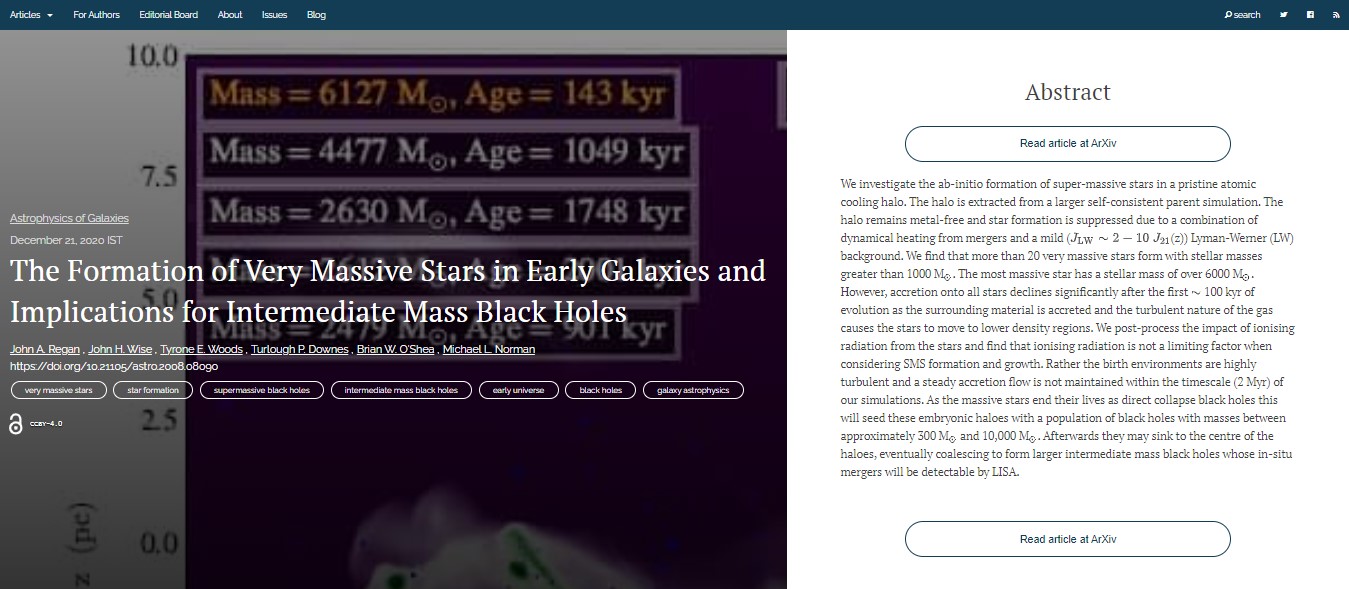
A day may come when I don’t write a blog post every time we publish a new paper in the Open Journal of Astrophysics, but it is not this day…

Today’s new publication is by Liliya Williams (of the University of Minnesota, Twin Cities) and David Zegeye of the University of Chicago and is entitled Two-component mass models of the lensing galaxy in the quadruply imaged supernova iPTF16geu.

Here is a screen grab of the overlay:

You can click on the image to make it larger should you wish to do so.

Incidentally, you may notice that Scholastica have added MathJax to the platform to render mathematical expressions in the abstract.

You can find the arXiv version of the paper here.

Today’s Big Astronomy Announcement

Posted in Astrohype, Cardiff, The Universe and Stuff with tags , , on September 14, 2020 by telescoper

Rumours have been circulating for a few days about a big astronomical discovery. Here is a video of the announcement:

Sorry, that’s the wrong video.

The actual announcement will take place live at 4pm BST here:

Until a few minutes ago I didn’t have a clue what this was about, but now I do…

Phone ship surprisingly detected in atmosphere of Venus (9)

If you would like to read more about this discovery then you can read the paper in Nature here. Several of the authors are former Cardiff colleagues, including first author Jane Greaves, as well as Annabel Cartwright and my former office mate Emily Drabek-Maunder. Congratulations to them on an exciting result!

P.S. Emily reminded me last night that I was present at the discussion with Jane that started this project, over four years ago. I remember them talking about phosphine but had no idea that it would lead to this!

New Publication at the Open Journal of Astrophysics!

Posted in OJAp Papers, Open Access, The Universe and Stuff with tags , , , , , , , , on September 10, 2020 by telescoper

Another new paper  has been published in the Open Journal of Astrophysics! This is another for the folder marked Cosmology and Nongalactic Astrophysics and is entitled Low-scatter galaxy cluster mass proxies for the eROSITA all-sky survey.

The authors of this paper are Dominique Eckert of the University of Geneva, Alexis Finoguenov (Helsinki), Vittorio Ghirardini (MPE Garching), Sebastian Grandis (LMU), Florian Käfer (MPE Garching), Jeremy Sanders (MPE Garching) and Miriam Ramos-Ceja (MPE Garching).

For those of you unfamiliar with eROSITA, it is an X-ray instrument that was built at the Max Planck Institute for Extraterrestrial Physics, where several of the authors work.

Here is a screen grab of the overlay:

You can click on the image to make it larger should you wish to do so.

You can find the arXiv version of the paper here.

R.I.P. Govind Swarup (1929-2020)

Posted in The Universe and Stuff with tags , , , on September 8, 2020 by telescoper

This morning I learnt the sad news of the passing of Professor Govind Swarup who died yesterday at the age of 91. Govind Swarup was a pioneer in radio astronomy, especially in India, and in particular was a driving force behind the construction of the Giant Metrewave Radio Telescope, and the establishment of a world-leading radioastronomy group, which is located about 80km North of Pune in Maharashtra. I remember meeting with him a couple of times during visits to Pune and was struck by his friendliness and unbounded enthusiasm for astrophysics.

I send my condolences to his family, friends and colleagues in India who I know will miss him enormously.

R. I. P. Govind Swarup (1929-2020).

Littlewood on `the real point’ of lectures

Posted in Education, mathematics, The Universe and Stuff with tags , , , on September 3, 2020 by telescoper

We’re often challenged these days to defend the educational value of the lecture as opposed to other forms of delivery, especially with the restrictions on large lectures imposed by Covid-19. But this is not a new debate. The mathematician J.E. Littlewood felt necessary to defend the lecture as a medium of instruction (in the context of advanced mathematics) way back in 1926 in the Introduction to his book The Elements of the Theory of Real Functions.

(as quoted by G. Temple in his Inaugural Lecture as Sedleian Professor of Natural Philosophy at the University of Oxford in 1954 “The Classic and Romantic in Natural Philosophy”.)

Temple concluded his lecture with:

Classic perfection should be reserved for the monograph: the successful lecture is almost inevitably a romantic adventure. It is at once the grandeur and misery of a scientific classic that it says the last word: it is the charm of a scientific romance that it utters the first word, and thus opens the windows on a new world.

Modern textbooks do try to be more user-friendly than perhaps they were in Littlewood’s day, and they aren’t always “complete and accurate” either, but I think Littlewood is right in pointing out that they do often hide `the real point’ so students sometimes can’t see the wood for the trees. The value of lectures is not in trying to deliver masses of detail but to point out the important bits.

It seems apt to mention that the things I remember best from my undergraduate lectures at Cambridge are not what’s in my lecture notes – most of which I still have, incidentally – but some of the asides made by the lectures. In particular I remember Peter Scheuer who taught Electrodynamics & Relativity talking about his first experience of radio astronomy. He didn’t like electronics at all and wasn’t sure radio astronomy was for him, but someone – possibly Martin Ryle – reassured him by saying “All you need to know in order to do this is Ohm’s Law. But you need to know it bloody well.”

Watch “Why the Universe is quite disappointing really – Episode 7” on YouTube

Posted in The Universe and Stuff, YouTube with tags , , , , on September 3, 2020 by telescoper

Back for Episode 7 of this series in which I explain how we can measure the strength of acoustic waves in early Universe using measurements of the cosmic microwave background, and how that leads to the conclusion that the Big Bang wasn’t as loud as you probably thought. You can read more about this here.

Primordial Figures

Posted in Biographical, The Universe and Stuff with tags , , , , on August 28, 2020 by telescoper

I was rummaging around looking for some things related to a paper I’m struggling to finish before term starts and I found some vintage diagrams. They brought back a lot of memories of working on the textbook I wrote with Francesco Lucchin way back in the 1990s. In particular I remember how long it took to make these figures, when nowadays it would take a few minutes. In fact I’m thinking of setting this as a Computational Physics project for next year. These are not full computations either, just a simple fluid-based approach.

The curves show the evolution of fluctuations in both matter δm and radiation δr on a particular scale (i.e. a Fourier mode of given wavelength) defined as δm=δρmm, etc.  The x-axis shows the cosmic scale factor, which represents the expansion of the Universe and in both cases the universe is flat, i.e. it has a critical density. The first graph shows a universe with only baryonic matter:

Notice the strongly coupled oscillations in matter and radiation until a scale factor of around 10-3, corresponding to a redshift of a thousand or so, which is when matter and radiation decouple. The y-axis is logarithmic so the downward spikes represent zero points.

It is these oscillations which are responsible for the bumps and wiggles in the spectrum of the cosmic microwave background spectrum, as different Fourier modes arrive at the last scattering surface at a different phase of its oscillation. Of course going from the Figure above to the CMB fluctuation spectrum (see below) involves more calculations, and there is now a well-established machinery for doing these with full physical descriptions, but I think the above diagram makes the physical origin of these features clear.

The CMB power spectrum from Planck

The second diagram shows what happens if you add a third component called `X’ in the Figure below which we take to be cold non-baryonic matter. Because  this stuff doesn’t interact directly with radiation (while baryons do) it doesn’t participate in the oscillations but the density perturbations just carry on growing:

Notice too that at late times (i.e. after the baryonic matter and radiation have decoupled) the baryonic component grows much more quickly than in the first Figure. This is because, when released from the effect of the photon background, baryons start to feel the gravitational pull of the dark matter perturbations.

There’s nothing new in this of course – these Figures are thirty years old and similar were produced even earlier than that – but I still think pictures like these are pedagogically useful,