Archive for the The Universe and Stuff Category

What’s the Vector, Victor?

Posted in Film, mathematics, The Universe and Stuff with tags , , , on February 18, 2020 by telescoper

Following on from Sunday’s post about the trials and tribulations caused by Storm Dennis, here is a clip of a plane (an Airbus 380)  landing at Heathrow airport on Saturday.

There are other clips of this same event on Youtube and some of them describe this landing as `dangerous’. Although it undoubtedly involved skill and concentration by the pilot it’s not actually dangerous. Aircrew are trained to land in windy weather like this, and it’s fairly routine. My plane to Dublin (an Airbus 320) landed like this on Saturday evening and, although the pilot got a well-deserved round of applause on landing, nobody was ever really at risk.

As it happens, this week I start teaching vector algebra to my first-year Engineering students, so the weekend’s weather events have  given me a good illustration of vector addition. The plane has to have a velocity vector relative to the air such that the sum of it and the wind vector adds to a resultant vector directed along the runway. Lots of people seem to think this is just guesswork but it isn’t. It’s applied mathematics.

This is in principle simple as long as the crosswind is steady, but obviously the pilot needs to be alert to gusting and make adjustments along the way. When the plane has slowed down enough to land in normal conditions, the wind over the wings is still causing a bit of extra lift. You can see that in the last moments before touchdown this aircraft is gliding because of this effect. I’m told that because of this, in windy conditions planes usually descend at a steeper angle than usual.

The interesting bit for me is that the plane touches down in such a way that its body is at an angle to the runway. As soon as it has landed it has to correct this and point along the runway. I think this is done with the rudder rather than the undercarriage, but I don’t know. Perhaps any experienced pilots that happen to be reading this could give more details through the comments box?

P.S. The title of this post is a reference to the film Airplane!


Not the Open Journal of Astrophysics Impact Factor – Update

Posted in Open Access, The Universe and Stuff with tags , , , , on February 11, 2020 by telescoper

 I thought I would give an update with some bibliometric information about the 12 papers published by the Open Journal of Astrophysics in 2019. The NASA/ADS system has been struggling to tally the citations to a couple of our papers but this issue has now been resolved.  According to this source the total number of citations for these papers is 532 (as of today). This number is dominated by one particular paper which has 443 citations according to NASA/ADS. Excluding this paper gives an average number of citations for the remaining 11 of 7.4.

I’ll take this opportunity to re-iterate some comments about the Journal Impact Factor. When asked about this my usual response is (a) to repeat the arguments why the impact factor is daft and (b) point out that we have to have been running continuously for at least two years to have an official impact factor anyway.

For those of you who can’t be bothered to look up the definition of an impact factor , for a given year it is basically the sum of the citations for all papers published in the journal over the previous two-year period divided by the total number of papers published in that journal over the same period. It’s therefore the average citations per paper published in a two-year window. The impact factor for 2019 would be defined using data from 2017 and 2018, etc.

The impact factor is prone to the same issue as the simple average I quoted above in that citation statistics are generally heavily skewed  and the average can therefore be dragged upwards by a small number of papers with lots of citations (in our case just one).

I stress again we don’t have an Impact Factor as such for the Open Journal. However, for reference (but obviously not comparison) the latest actual impact factors (2018, i.e. based on 2016 and 2017 numbers) for some leading astronomy journals are: Monthly Notices of the Royal Astronomical Society 5.23; Astrophysical Journal 5.58; and Astronomy and Astrophysics 6.21.

My main point, though, is that with so much bibliometric information available at the article level there is no reason whatsoever to pay any attention to crudely aggregated statistics at the journal level. Judge the contents, not the packaging.

This post is based on an article at the OJA blog.


The Reverend Professor Callan

Posted in Biographical, History, Maynooth, The Universe and Stuff with tags , , , , , on February 5, 2020 by telescoper

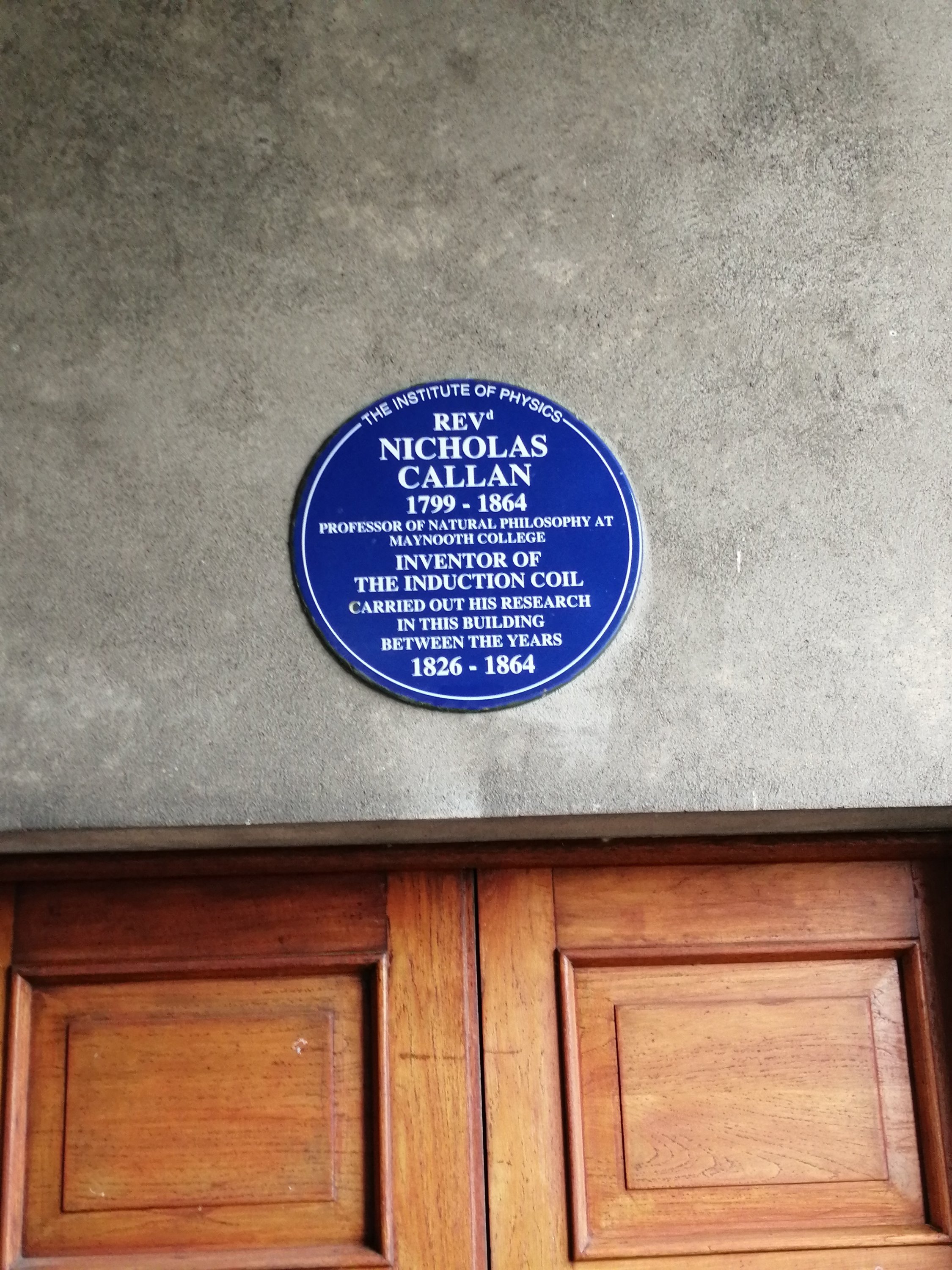
I’ve had a busy day doing various things that took me to various places on the Maynooth University campus, culminating in my first visit to the Department of Mathematics and Statistics (which is based in Logic House) to give a colloquium. On my travels I passed this sign, which I hadn’t noticed before:

Since I’ve been too busy to write a post today I thought I’d rehash an old one about the person named in the plaque, which is above Callan Hall (on the South Campus)

Father Nicholas Callan (or, more formally, The Reverend Professor Nicholas Joseph Callan) was born in County Louth in 1799 went to the seminary of St Patrick’s College, Maynooth, in 1816 to train as a priest. During his time as a seminarian Callan studied ‘Natural Philosophy’ and became interested in experiments involving electricity. In 1823 Callan was ordained as a priest, and went to Rome in 1826 to obtain his doctorate in Divinity. At the time Italy was a centre for research into electricity and here Callan became familiar with the work of the Italian physicist Alessandro Volta who had developed the world’s first battery. Callan returned to Maynooth where he was made chair of Natural Philosophy, a post he would hold until his death in 1864.

Callan is most famous for inventing the induction coil (in 1836). By connecting two copper wire coils to a battery and electromagnet and then interrupting the current he was able to generate much larger voltages than could be obtained from batteries alone. His 1837 version that used a clock mechanism to interrupt the current 20 times a second is estimated to have produced 60,000 volts – the largest artificially generated charge at that time. It is said that his induction coil could produce sparks 15″ long, which must have been fun to watch.

Callan’s biggest induction coil, unfinished at the time of his death, can be found in the National Science Museum of Ireland (which is in Maynooth). This was one of the largest in the world at the time. The iron core is 109 cm long. The secondary windings are 53 cm in diameter and consist of about 50 km of iron wire insulated with beeswax. They were made in three separate rings separated by air gaps, so wires carrying large voltage differences would not lie adjacent to each other, reducing the risk of the insulation breaking down. At the left end is a vibrating mercury ‘contact breaker’ in the primary circuit, actuated by the magnetic field in the primary, which interrupted the primary current to generate potentials of over 200,000 volts.

Sadly Callan’s work was forgotten for quite a period after his death – experimental electromagnetism was not a priority for St Patrick’s College at this time – for which reason the invention of the induction coil has often been attributed to Heinrich Ruhmkorff who made his first device (independently) about 15 years after Callan. More recently, however, Callan’s achievements have been more widely recognized and in 2000 the Irish government issued a stamp in his honour.

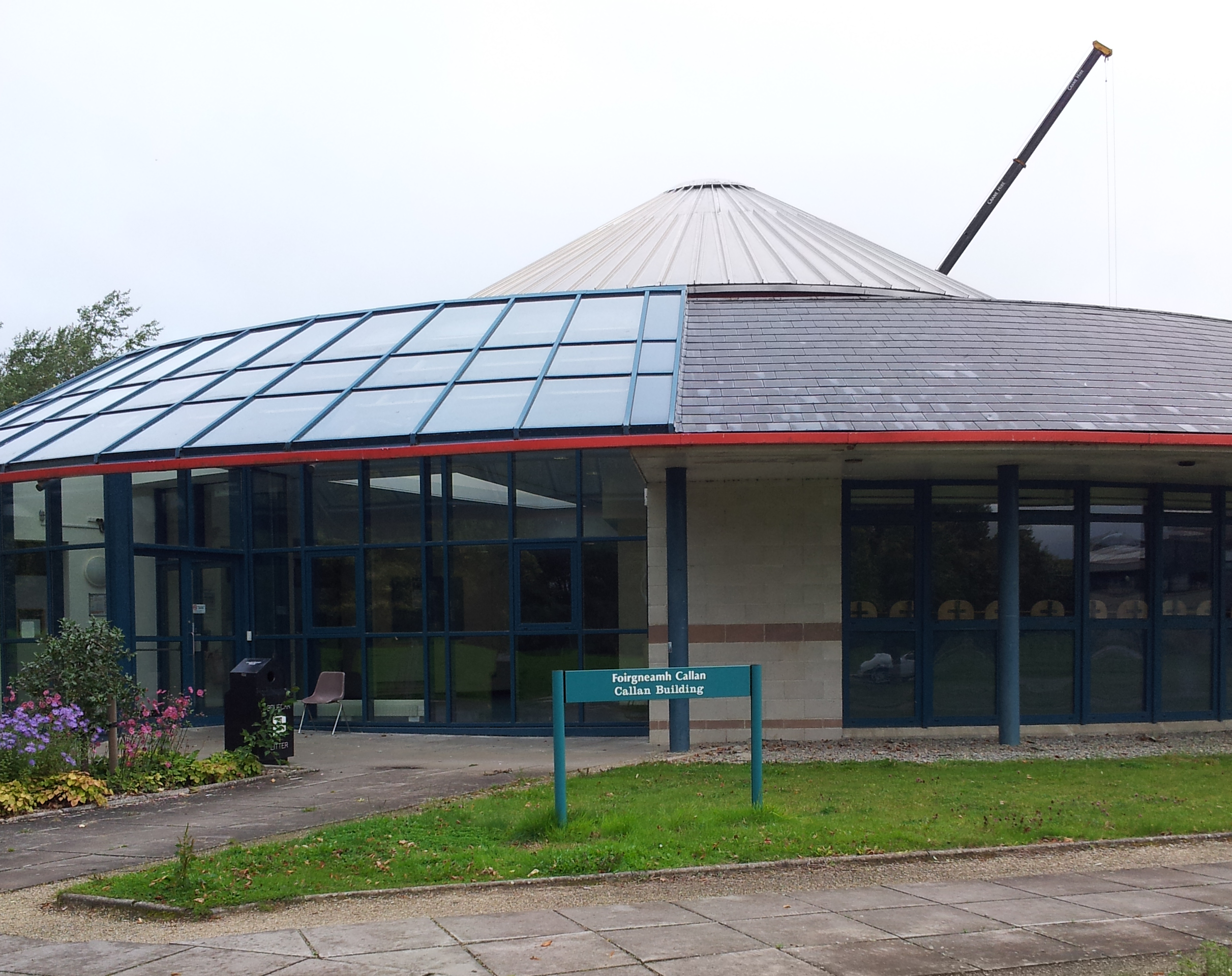
The Callan Building

Nicholas Callan was laid to rest in the College Cemetery at Maynooth in 1864. The Callan Building (above) on the North Campus of the present-day Maynooth University is named in his honour, as of course is Callan Hall which I mentioned at the start.

Voids, Galaxies and Cosmic Acceleration

Posted in The Universe and Stuff with tags , , , , , , on February 4, 2020 by telescoper

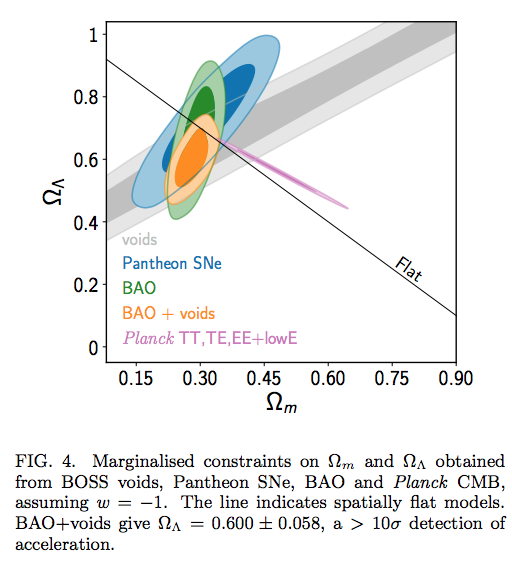
Time for a quick plug for a paper by Nadathur et al. that appeared on the arXiv recently with the title Testing low-redshift cosmic acceleration with large-scale structure. Here is the abstract:

You can make it bigger by clicking on the image. You can download a PDF of the entire paper here.

The particularly interesting thing about this result is that it gives strong evidence for models with a cosmological constant (or perhaps some other form of dark energy), in a manner that is independent of the other main cosmological constraints (i.e. the Cosmic Microwave Background or Type 1a Supernovae). This constraint is based on combining properties of void regions (underdensities) with Baryon Acoustic Oscillations (BAOs) to produce constraints that are stronger than those obtained using BAOs on their own. The data used derives largely from the BOSS survey.

As well as this there’s another intriguing result, or rather two results. First is that the the BAO+voids data from redshifts z<2 gives H0 = 72.3 ± 1.9, while, on the other hand adding, BAO information from the Lyman-alpha forest for from z>2 gives a value H0 = 69 \pm 1.2, favouring Planck over Riess. Once again, the `tension’ over the value of the Hubble constant appears to be related to using nearby rather than distant sources.

On the Surface of the Sun

Posted in The Universe and Stuff with tags , , , on January 30, 2020 by telescoper

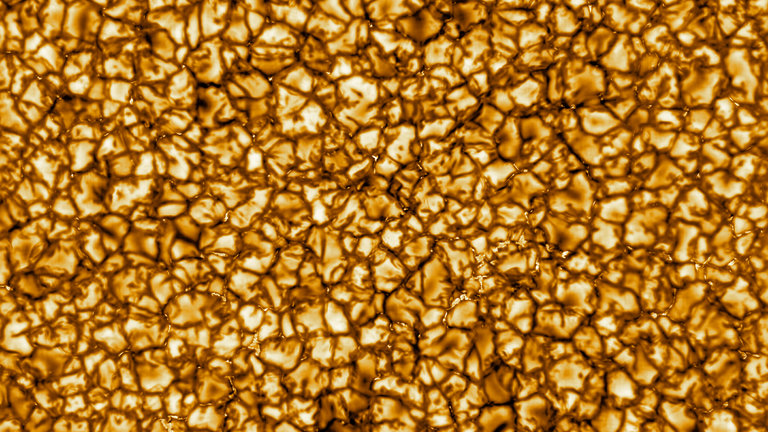
There are some wonderful images and movies going around from the Daniel K Inouye Solar Telescope which has produced the highest resolution images of the solar surface ever seen.

Here’s a snapshot:

And here’s a movie:

In the above image you can see the granular structure of the Sun’s photosphere. The cells you can see are a manifestation of the large-scale convective motions that transport energy from the Sun’s inner regions to the surface. This energy is created by nuclear reactions in the solar core and it sets up convective motions in the outer layers rather like those in a pan of boiling water set up by heating from below (or perhaps the gentler motions that appearin a lava lamp).

The surface structure looks surprisingly regular but the highly turbulent magnetized plasma is responsible to an extraordinary range of activity, from sunspots, flares and prominences, to the heating of the solar corona and the generation of the solar wind.


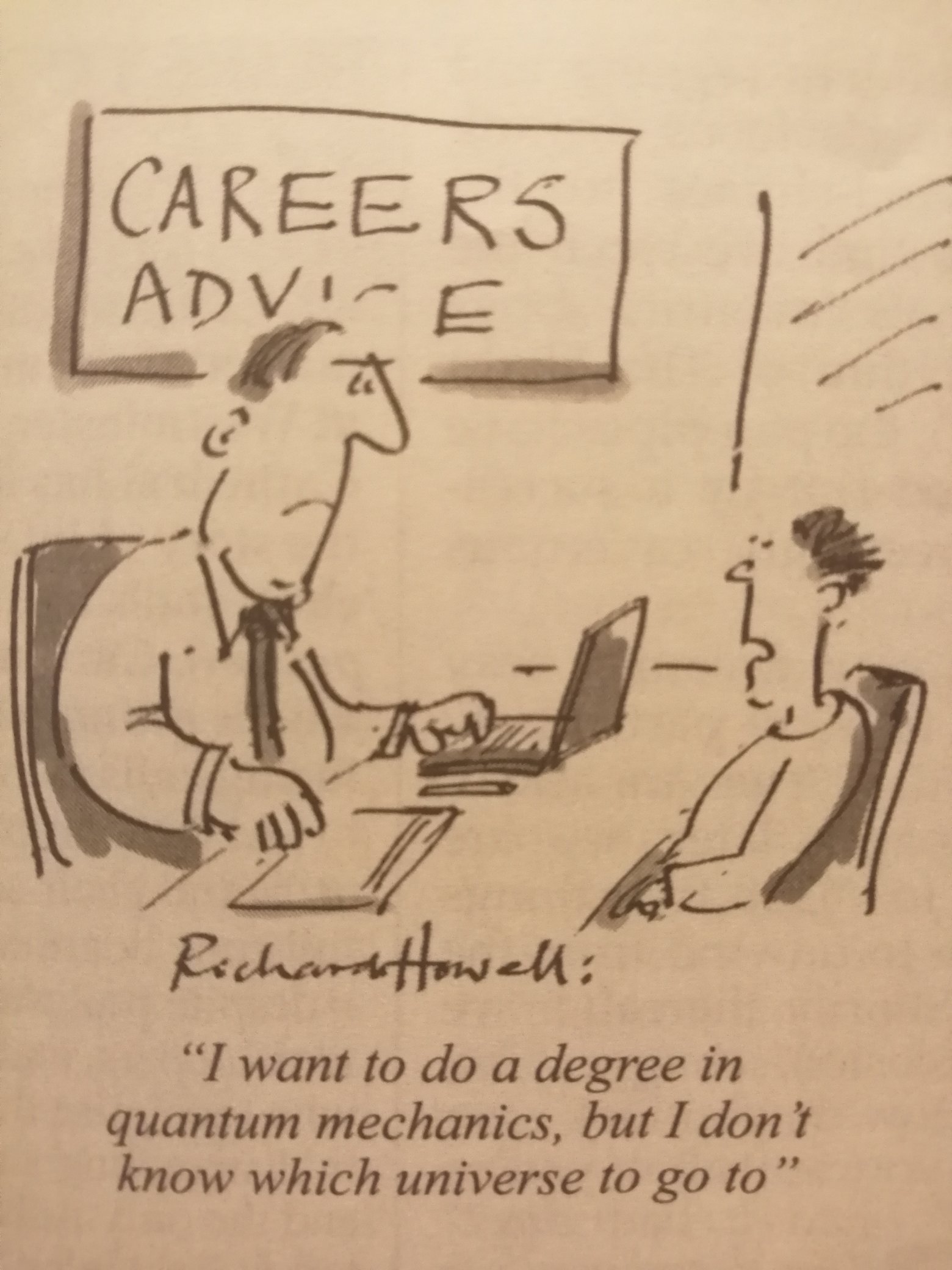
A Question for Prospective Physics Students

Posted in The Universe and Stuff with tags , , on January 28, 2020 by telescoper

I saw this in the latest Private Eye…

Not the Open Journal of Astrophysics Impact Factor – Update

Posted in Open Access, The Universe and Stuff with tags , , , , on January 20, 2020 by telescoper

Now that we have started a new year, and a new volume of the Open Journal of Astrophysics , I thought I would give an update with some bibliometric information about the 12 papers we published in 2019.

It is still early days for aggregating citations for 2019 but, using a combination of the NASA/ADS system and the Inspire-HEP, I have been able to place a firm lower limit on the total number of citations so far for those papers of 408, giving an average citation rate per paper of 34.

These numbers are dominated by one particular paper which has 327 citations according to Inspire (see above). Excluding this paper gives an average number of citations for the remaining 11 of 7.4.

I’ll take this opportunity to re-iterate some comments about the Journal Impact Factor. When asked about this my usual response is (a) to repeat the arguments why the impact factor is daft and (b) point out that we have to have been running continuously for at least two years to have an official impact factor anyway.

For those of you who can’t be bothered to look up the definition of an impact factor , for a given year it is basically the sum of the citations for all papers published in the journal over the previous two-year period divided by the total number of papers published in that journal over the same period. It’s therefore the average citations per paper published in a two-year window. The impact factor for 2019 would be defined using data from 2017 and 2018, etc.

The impact factor is prone to the same issue as the simple average I quoted above in that citation statistics are generally heavily skewed and the average can therefore be dragged upwards by a small number of papers with lots of citations (in our case just one).

I stress again we don’t have an Impact Factor for the Open Journal. However, for reference (but obviously not direct comparison) the latest actual impact factors (2018, i.e. based on 2016 and 2017 numbers) for some leading astronomy journals are: Monthly Notices of the Royal Astronomical Society 5.23; Astrophysical Journal 5.58; and Astronomy and Astrophysics 6.21.

My main point, though, is that with so much bibliometric information available at the article level there is no reason whatsoever to pay any attention to crudely aggregated statistics at the journal level. Judge the contents, not the packaging.


Farewell to Spitzer

Posted in The Universe and Stuff with tags , , on January 17, 2020 by telescoper

Just a quick post to advertise the fact that NASA’s Spitzer Space Telescope, which was launched in 2003, is due to be `retired’ at the end of January 2020. Spitzer is an infrared telescope that has done a great number of wonderful things over the past 16 years or so. Here’s a short video giving an overview of the mission.

There will be a live-streamed event next week, on January 22nd 2020, featuring mission members and NASA leadership, at 10am PST (6pm GMT/Irish Time) during which members of the public can ask questions. For more details of this event see here.

Although it’s sad to see the end of one `Great Observatory’, hopefully it would be long before the launch of the James Webb Space Telescope which should be even greater. It certainly has a much bigger budget anyway! JWST is due to be launched in March 2021.

My Life in Physical Cosmology – Jim Peebles

Posted in The Universe and Stuff with tags , , , on January 16, 2020 by telescoper

This is very nice, a talk by Nobel Laureate Jim Peebles given at the Oska Klein Centre in Stockholm. Well worth watching if you want to learn about the evolution of the field of physical cosmology over the last 50 years or so.

Luminosity Evolution in Type 1a Supernovae?

Posted in The Universe and Stuff with tags , , , , on January 14, 2020 by telescoper

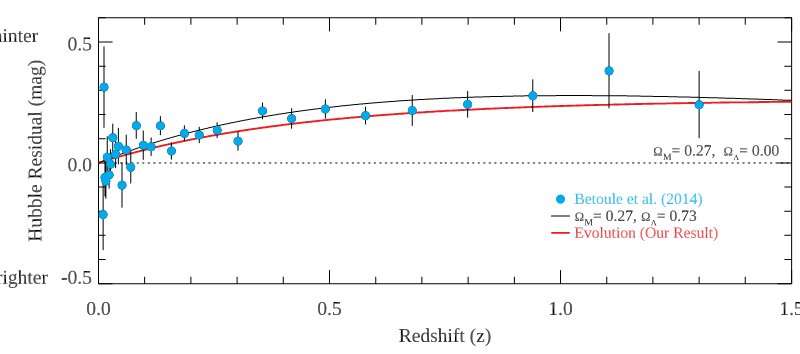
Figure 1 of Kang et al.

During this afternoon’s very exciting Meeting of the Faculty of Science and Engineering at Maynooth University I suddenly remembered a paper I became aware of over Christmas but then forgot about. There’s an article here describing the paper that makes some pretty strong claims, which was what alerted me to it. The actual paper, by Kang et al., which has apparently been refereed and accepted for publication by the Astrophysical Journal, can be found on the arXiv here. The abstract reads:

The most direct and strongest evidence for the presence of dark energy is provided by the measurement of galaxy distances using type Ia supernovae (SNe Ia). This result is based on the assumption that the corrected brightness of SN Ia through the empirical standardization would not evolve with look-back time. Recent studies have shown, however, that the standardized brightness of SN Ia is correlated with host morphology, host mass, and local star formation rate, suggesting a possible correlation with stellar population property. In order to understand the origin of these correlations, we have continued our spectroscopic observations to cover most of the reported nearby early-type host galaxies. From high-quality (signal-to-noise ratio ~175) spectra, we obtained the most direct and reliable estimates of population age and metallicity for these host galaxies. We find a significant correlation between SN luminosity (after the standardization) and stellar population age at a 99.5% confidence level. As such, this is the most direct and stringent test ever made for the luminosity evolution of SN Ia. Based on this result, we further show that the previously reported correlations with host morphology, host mass, and local star formation rate are most likely originated from the difference in population age. This indicates that the light-curve fitters used by the SNe Ia community are not quite capable of correcting for the population age effect, which would inevitably cause a serious systematic bias with look-back time. Notably, taken at face values, a significant fraction of the Hubble residual used in the discovery of the dark energy appears to be affected by the luminosity evolution. We argue, therefore, that this systematic bias must be considered in detail in SN cosmology before proceeding to the details of the dark energy.

Of course evidence for significant luminosity evolution of Type Ia supernovae would throw a big spanner in the works involved in using these objects to probe cosmology (specifically dark energy), but having skimmed the paper I’m a bit skeptical about the results, largely because they seem to use only a very small number of supernovae to reach their conclusions and I’m not convinced about selection effects. I have an open mind, though, so I’d be very interested to hear through the comments box the views of any experts in this field.