Archive for the The Universe and Stuff Category

Another Cosmologist for Maynooth!

Posted in Maynooth, The Universe and Stuff with tags , , on January 13, 2020 by telescoper

A few people have contacted me to ask what happened with the research position in cosmology at Maynooth University advertised a few months ago. Well, I am now in a position to provide the answer.

I’m very happy to announce that as of January 2nd 2020, Dr John Regan has joined the staff of the Department of Theoretical Physics, bringing with him an SFI – Royal Society University Research Fellowship (URF) which will fund his research for five years.

Dr John Regan

John’s primary area of research is in trying to understand the formation of black holes in the early Universe and their subsequent growth and evolution. He is interested in trying to determine how the first massive black holes in the Universe formed and the conditions required to form them. The problem is well posed since at early times the Universe was a comparatively simple place compared to the Universe today. Recent observations have indicated that Supermassive Black Holes existed less than 1 billion years after the big bang (the Universe is approximately 14 billion years old). A current open problem in Cosmology is how did black holes form and grow quickly enough in order to become super-massive so early in the Universe?

In answering this question John uses high resolution numerical simulations to study the environments in which the first massive black hole seeds may have formed and then grown to become the super-massive ones we can still observe today.

I’m delighted that John has joined the Department and look forward to many years of fruitful collaborations and discussions. He will be joined by a PDRA and a research student in due course.

You can follow John on Twitter here:

200 Years of the RAS Club

Posted in History, The Universe and Stuff with tags , , on January 11, 2020 by telescoper

Here I am in Heathrow Terminal 2 waiting for flight back to Dublin. I managed to get to London from Birmingham in time for a special dinner to mark the 200th anniversary of the RAS Club. As I have mentioned in previous posts, according to the brief history published on the RAS website:

The ‘Astronomical Society of London’ was conceived on 12 January 1820 when 14 gentlemen sat down to dinner at the Freemason’s Tavern, in Lincoln’s Inn Fields, London. After an unusually short gestation the new Society was born on 10 March 1820 with the first meeting of the Council and the Society as a whole. An early setback, when Sir Joseph Banks induced the Duke of Somerset to withdraw his agreement to be the first President, was overcome when Sir William Herschel agreed to be the titular first President, though he never actually took the Chair at a meeting.

Since the RAS Club always dines on the second Friday of the month after Ordinary Meetings of the Royal Astronomical Society itself, January 10th was the closest date to that first dinner. As expected for such a special occasion, there was a very big turnout with more than double the usual number of diners (and many more guests than usual). It was very nice to see some people I haven’t seen for ages! The food and wine were excellent and we ended with champagne and a slice of a cake baked and decorated for the occasion. Unfortunately it was so crowded in the Gallery Room that I couldn’t get close enough to take a photo of it before it was whisked away to be cut into slices.

After dinner we had some speeches, including one really brilliant one by my former colleague from Cardiff days, Mike Edmunds who had researched the `14 gentlemen’ who attended that first dinner. I had known previously that Charles Babbage and John Herschel were there but here (thanks to Mike) is a complete list:

Charles Babbage, Esq. M.A. F.R.S. L. & E. No. 5 Devonshire Street Portland Place
Arthur Baily, Esq, Gray’s Inn
Francis Baily, Esq. F.R.S. & L.S. Gray’s Inn
Major Thomas Colby, of the Royal Engineers, LL.D. F.R.S. L. & E. Tower
Henry T. Colebrooke, Esq. F.R.S. & L.S. Albany, Piccadilly
Olinthus G. Gregory, LL.D. Professor of Mathematics Royal Military Academy, Woolwich
Stephen Groombridge, Esq. F.R.S. S.R.A.Nap. Blackheath
J.F.W. Herschel, LL.D. F.R.S. Slough
Patrick Kelly, LL.D. Finsbury Square
Daniel Moore, Esq. F.R.S. S.A. & L.S. Lincoln’s Inn
Rev. William Pearson, LL.D. F.R.S. East Sheen, Surrey
James South, Esq. F.R.S. and L.S. No. 11 Blackman Street Southwark
Charles Stokes, Esq. F.R.S. S.A. & L.S. Gray’s Inn
Peter Slawinski D.P. Proff. University Wilna

P.S. Because I was attending the LGBTQ+ STEMinar I couldn’t get to the ordinary meeting of the Royal Astronomical Society earlier in the day, which was a shame because it was there that the winners of this year’s awards were announced. You can find a full list here. Congratulations to all!

LGBTQ+ STEMinar 2020

Posted in LGBTQ+, The Universe and Stuff with tags , , , on January 10, 2020 by telescoper

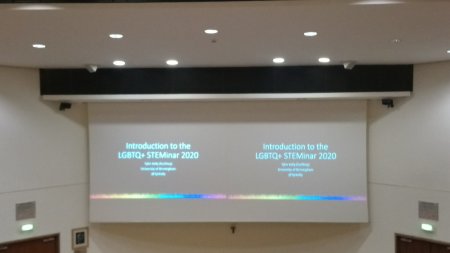
Well I made it to Birmingham (after getting up at 3.30am!) and to the Leonard Deacon Lecture Theatre in the School of Medicine at the University thereof for this year’s LGBT+ STEMinar (the 5th of a series that started in 2016).

This is the largest one of these do far, with around 250 participants, and an impressive array of sponsors:

One of the great things about the LGBTSTEMeminar (apart from the feeling of being amongst ‘family’) is the opportunity to hear talks about fields other than your own, which I am enjoying very much.

Ooh. I forgot to mention that next year’s event will also be in the Midlands, at Oxford University.

New Publication at the Open Journal of Astrophysics!

Posted in OJAp Papers, Open Access, The Universe and Stuff with tags , , , , , , on January 8, 2020 by telescoper

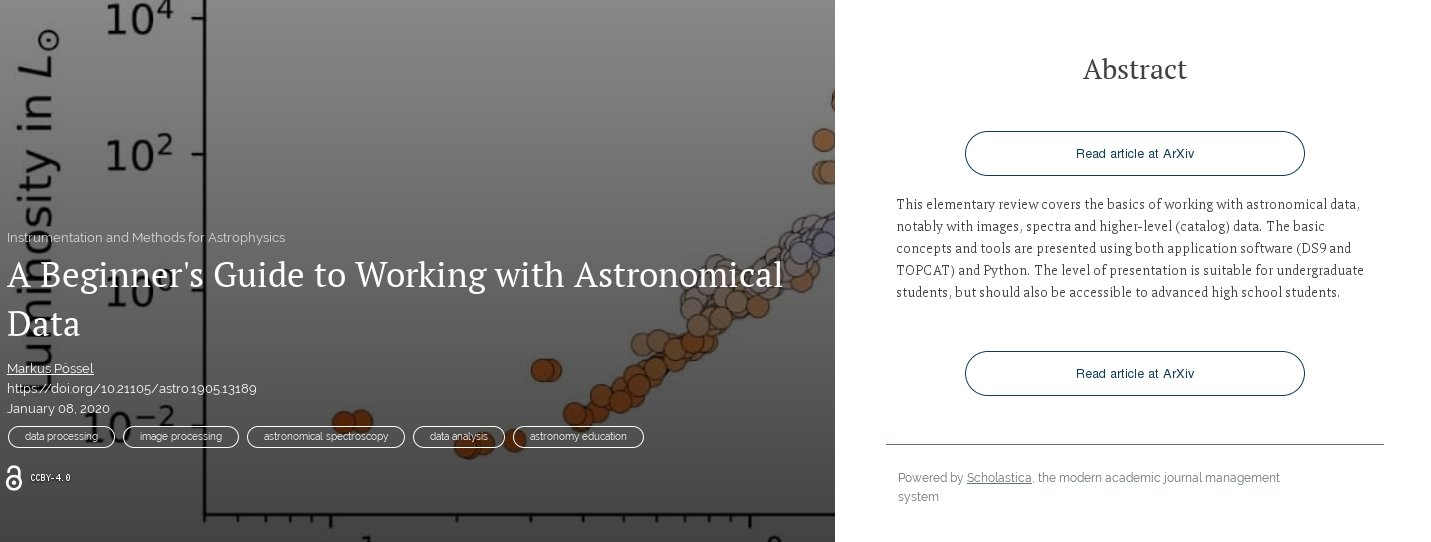
It’s two in two days because we have published another new paper at The Open Journal of Astrophysics. The title is A Beginner’s Guide to working with Astronomical Data. Here is a grab of the overlay:

You can find the arXiv version of the paper here.

The author is Markus Pössel of the Haus der Astronomie at the Max Planck Institute for Astronomy in Heidelberg (Germany). This is a long paper – 71 pages with over a hundred figures – that gives a comprehensive introduction to the various kinds of astronomical data and techniques for working with such data. I think this paper will attract a lot of interest from many different kinds of people but it will be particularly interesting to students doing undergraduate projects involving astronomical data (and their supervisors).

Another point worth noting is that there’s a small addition to the overlay for this paper, which will apply to all future papers (and retrospectively once we have worked through the back catalogue) and that is in the bottom left of the image above. It shows that the article is published with the latest form of Creative Commons License (CC-BY-4.0). It has always been our policy to publish under a CC-BY licence but Scholastica have very helpfully set up a new facility to make this explicit on each page. This is part of our efforts to ensure that we are compliant with Plan S which makes CC-BY licenses mandatory.

UPDATE: the CC-BY-4.0 license has now been applied retrospectively to all our publications.

New Publication at the Open Journal of Astrophysics!

Posted in OJAp Papers, Open Access, The Universe and Stuff with tags , , , on January 7, 2020 by telescoper

Back after the New Year break we have published another new paper at The Open Journal of Astrophysics, our first of 2020!

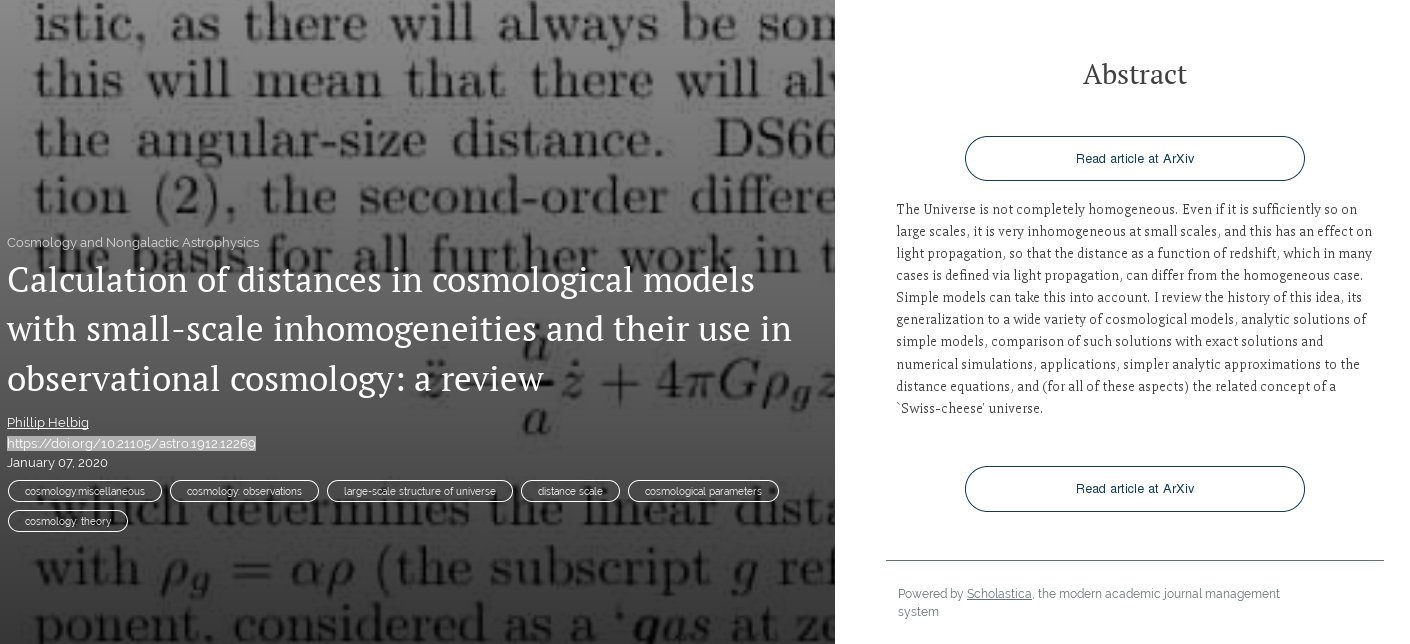
Here is a grab of the overlay:

The author is Phillip Helbig (Who? Ed). This is a review article. Our `For Authors‘ page includes the following:

We may accept review articles on appropriate subjects if the Editorial Board considers them a useful contribution to the literature.

You can find the accepted version on the arXiv here. This is another one for the `Cosmology and Nongalactic Astrophysics’ section . We would be very happy to get more submissions from other areas, especially Stellar and Planetary astrophysics. Hint! Hint!

P.S. Just another reminder that we now have an Open Journal of Astrophysics Facebook page where you can follow updates from the Journal should you so wish..

The Largest Known Spiral Galaxy – UGC 2885

Posted in The Universe and Stuff with tags , , , , , on January 6, 2020 by telescoper

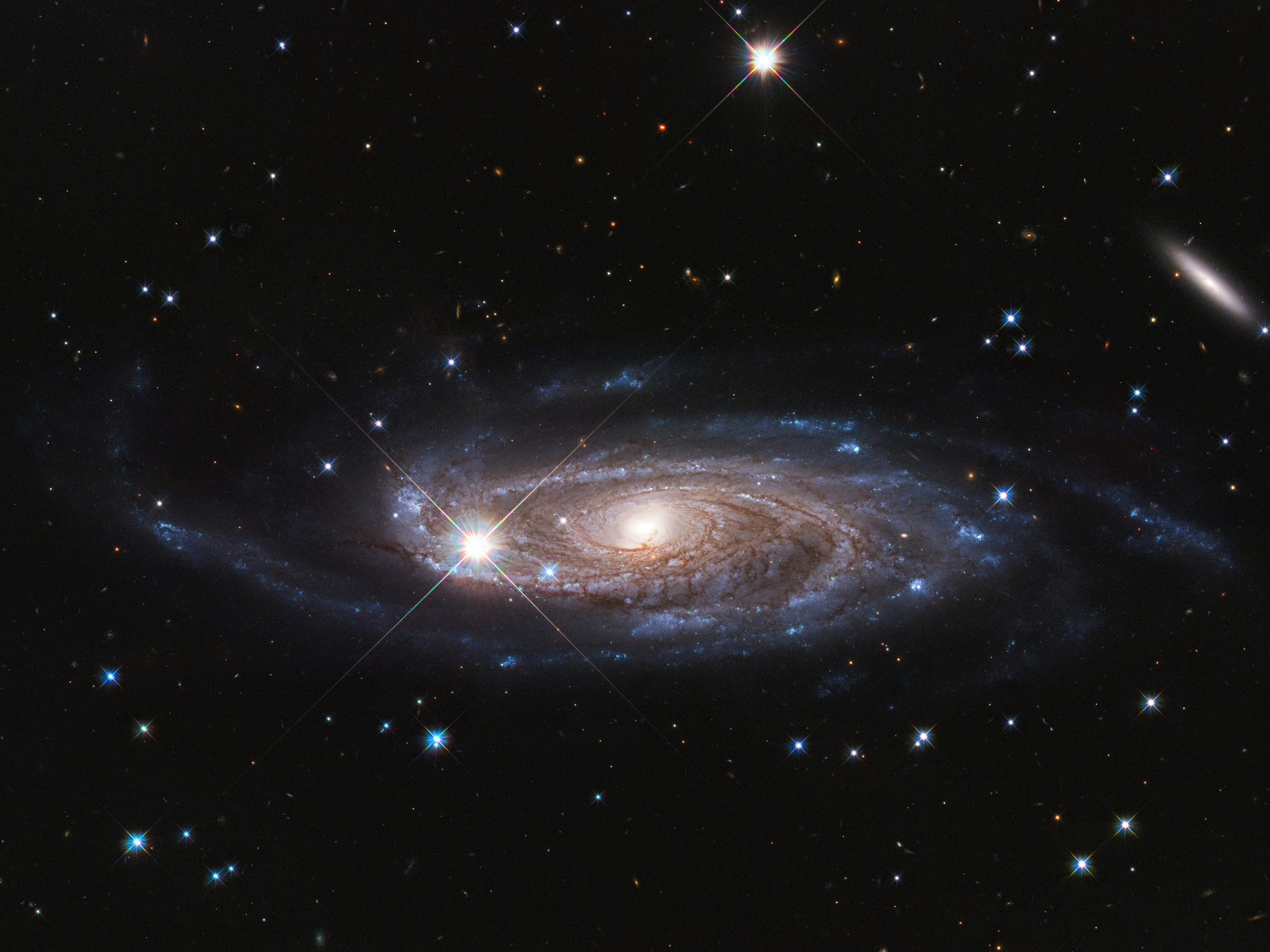
So here I am, Christmas break over, waiting in Cardiff Airport for my flight back to civilization. I thought I’d take the opportunity to share this wonderful picture, courtesy of the Hubble Space Telescope, of the galaxy UGC 2885 – the largest known spiral galaxy. You can click on the picture to make it bigger or if you really are a size queen you can download an ultra-high=resolution version here.

UGC 2885 is located about 71 Mpc (232 million light-years) from us, in the direction of the constellation Perseus. The galaxy is 2.5 times wider than our own Milky Way and contains approximately 10 times as many stars. A number of foreground stars (in our Galaxy), identified by the diffraction crosses produced by unresolved point sources, can be seen in the image, including one superimposed on the disk of the galaxy, to the left of its centre. The galaxy UGC 2885 has been nicknamed “Rubin’s galaxy” after Vera Rubin, the astronomer who studied the rotation of the galaxy and found evidence for dark matter therein.

There is a very interesting and informative thread on Twitter by Benne Holwerda covering the background to this latest image of the galaxy:

If you click on the above it will take you to Twitter where you can read the series of linked tweets on this subject by clicking on `show this thread’.

Advance of Perihelion

Posted in The Universe and Stuff with tags , , , , , , , on January 4, 2020 by telescoper


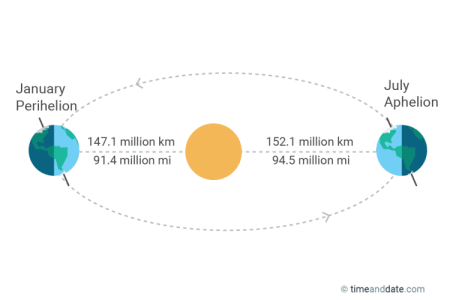
Tomorrow (Sunday 5th January 2020) at approximately 07.48 GMT the Earth reaches at the point on its orbit at which it is at its closest to the Sun, i.e. at its perihelion. At this time the distance from the Sun’s centre to Earth’s centre will be 147,091,144 km.

This year, aphelion (the furthest distance from the Sun) is  at 12.34 GMT on July 4th 2020 at which point the centre of the Earth will be 152,095,295 km from the centre of the Sun.

You can find a list of times and dates of perihelion and aphelion for future years  here.

It surprises me how many people think that the existence of the seasons has something to do with the variation of the Earth’s distance from the Sun as it moves in its orbit. The fact that perihelion occurs in the depth of winter should convince anyone living in the Northern hemisphere that this just can’t be the case, as should the fact that it’s summer in the Southern hemisphere while it is winter in the North.

The real reason for the existence of seasons is the tilt of the Earth’s axis of rotation. I used to do a little demonstration with a torch (flashlight to American readers) to illustrate this when I taught first-year astrophysics. If you shine a torch horizontally at a piece of card it will illuminate a patch of the card. Keep the torch at the same distance but tilt the card and you will see the illuminated patch increase in size. The torch is radiating the same amount of energy but in the second case that energy is spread over a larger area than in the first. This means that the energy per unit area incident on the card is decreases when the card is tilted. It is that which is responsible for  winter being  colder than summer. In the summer the sun is higher in the sky (on average) than in winter. From this argument you can infer that the winter solstice not the perihelion, is the relevant astronomical indicator of winter.

That is not to say that the shape of the Earth’s orbit has no effect on temperatures. It may, for example, contribute to the summer in the Southern hemisphere being hotter than in the North although it is not the only effect. The Earth’s surface possesses a significant North-South asymmetry: there is a much larger fraction of ocean in the Southern hemisphere, for example, which could be responsible for moderating any differences in temperature due to isolation. The climate is a non-linear system that involves circulating air and ocean currents that respond in complicated ways and on different timescales not just to insolation but to many other parameters, including atmospheric composition (especially the amount of water vapour).

The dates when Earth reaches the extreme points on its orbit (apsides) are not fixed because of the variations in its orbital eccentricity so, in the short-term, the dates can vary up to 2 days from one year to another. The perihelion distance varies from year to year too.

There is however a long-term trend for perihelion to occur later in the year. For  example, in 1246, the December Solstice (Winter Solstice for the Northern Hemisphere) was on the same day as the Earth’s perihelion. Since then, the perihelion and aphelion dates have drifted by an average of one day every 58 years and this trend will continue. This means that by  the year 6430 the timing of the perihelion and the March Equinox will coincide (although I will probably have retired by then).

 

The Winter Solstice 2019

Posted in The Universe and Stuff with tags , , , , , , on December 21, 2019 by telescoper

The winter solstice in the Northern hemisphere happens tomorrow, Sunday 22nd December 2019, at 04.19 Irish Time (04.19 UTC). Among other things, this means that tomorrow is the shortest day of the year in the Northern hemisphere. Days will get steadily longer from now until the Summer Solstice next June.  In fact, the interval between sunrise and sunset tomorrow will be a whole second longer tomorrow than it is today. Yippee!

This does not mean that sunrise will happen earlier tomorrow than it did this morning, however. Actually, sunrise will carry on getting later until the new year. This is because there is a difference between mean solar time (measured by clocks) and apparent solar time (defined by the position of the Sun in the sky), so that a solar day does not always last exactly 24 hours. A description of apparent and mean time was given by Nevil Maskelyne in the Nautical Almanac for 1767:

Apparent Time is that deduced immediately from the Sun, whether from the Observation of his passing the Meridian, or from his observed Rising or Setting. This Time is different from that shewn by Clocks and Watches well regulated at Land, which is called equated or mean Time.

The discrepancy between mean time and apparent time arises because of the Earth’s axial tilt and the fact that it travels around the Sun in an elliptical orbit in which its orbital speed varies with time of year (being faster at perihelion than at aphelion).

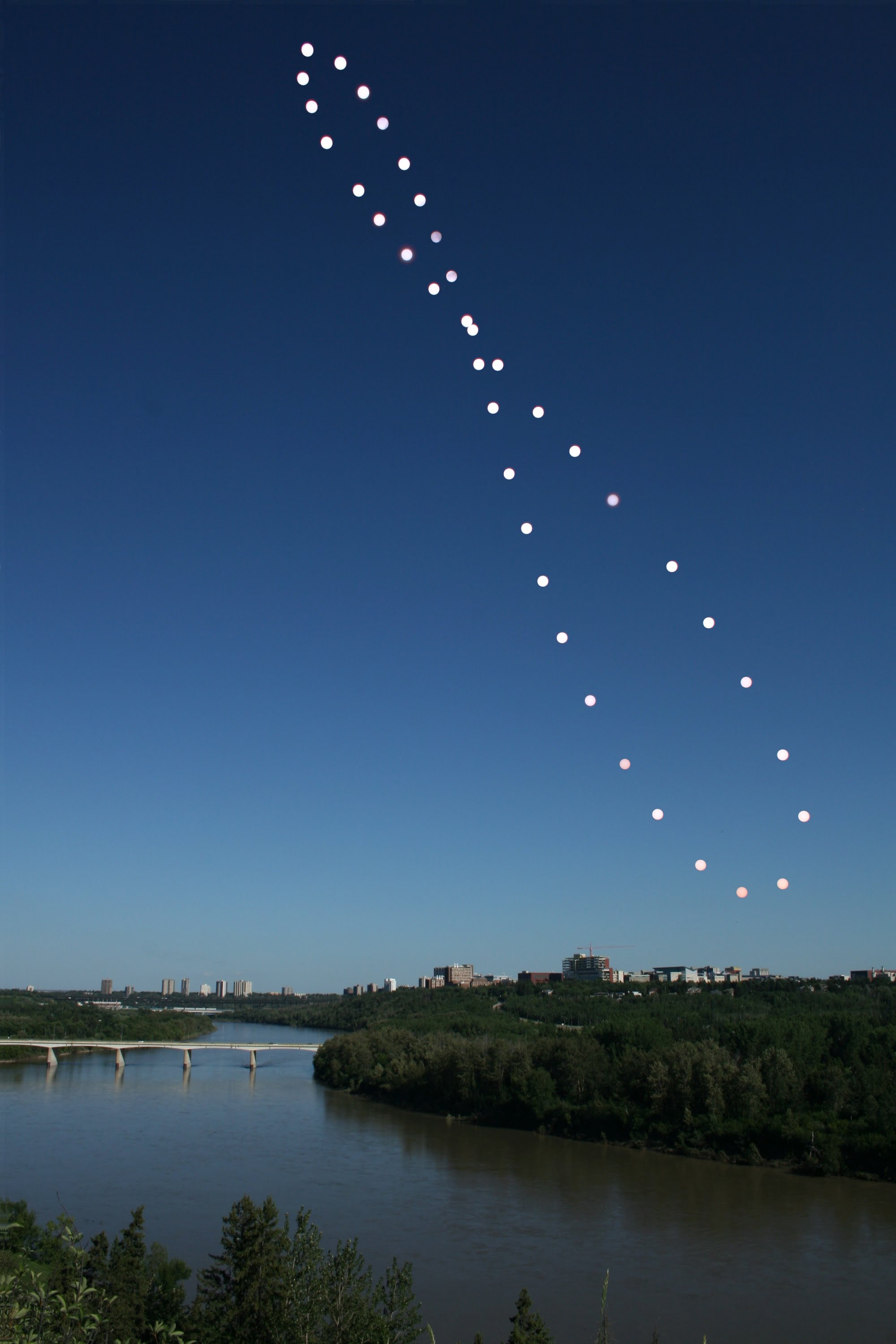
In fact if you plot the position of the Sun in the sky at a fixed time each day from a fixed location on the Earth you get a thing called an analemma, which is a sort of figure-of-eight shape whose shape depends on the observer’s latitude. Here’s a photographic version taken in Edmonton, with photographs of the Sun’s position taken from the same position at the same time on different days over the course of a year:

maxresdefault

The winter solstice is the lowermost point on this curve and the summer solstice is at the top. The north–south component of the analemma is the Sun’s declination, and the east–west component is the so-called equation of time which quantifies the difference between mean solar time and apparent solar time. This curve can be used to calculate the earliest and/or latest sunrise and/or sunset.

Using a more rapid calculational tool (Google), I found a table of the local mean times of sunrise and sunset for Dublin around the 2019 winter solstice. This shows that tomorrow is indeed the shortest day (with a time between sunrise and sunset of 7 hours 29 minutes and 58 seconds).  The table also shows that sunset already started occurring later in the day before the winter solstice, and sunrise will continue to happen later for a few days after the solstice, notwithstanding the fact that the interval between sunrise and sunset gets longer from today onwards.

I hope this clarifies the situation.

Britain’s Potential Explained

Posted in Politics, The Universe and Stuff with tags , , , on December 14, 2019 by telescoper

As a physicist I was intrigued by the recent use by Tory election campaigners of the slogan “Unleash Britain’s Potential”, so I decided to study the matter in more detail. I am pleased to say I am now ready to report on my conclusions.

First here is a sketch of Britain’s potential, which I denote V(r):

How do we interpret this potential?

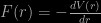
Recall that the force F(r) derived from V(r) is given by

F(r) = - \frac{dV(r)}{dr}.

The gradient of this potential being negative the force is directed towards increasing values of r. By Newton’s Second Law this means accelerated motion to the right (i.e. in the direction of increasing isolation), accompanied by steady and irreversible decline.

Note also that the form of this potential implies that there is something completely repulsive at its origin.

I hope this clarifies the situation.

New Publication at the Open Journal of Astrophysics!

Posted in OJAp Papers, Open Access, The Universe and Stuff with tags , , , , , , on December 11, 2019 by telescoper

We seem to be having an end-of-year rush and have published yet another new paper at The Open Journal of Astrophysics!

Here is a grab of the overlay:

The authors are Aditi Krishak (IISER Bhopal) and Shantanu Desai (IIT Hyderabad), both in India.

You can find the accepted version on the arXiv here. This is another one for the `Cosmology and Nongalactic Astrophysics’ section with a cross-listing in `Instrumentation and Methods for Astrophysics’, both of which are proving rather popular.

We would be very happy to get more submissions from other areas, especially Stellar and Planetary astrophysics. Hint! Hint!

P.S. Just a reminder that we now have an Open Journal of Astrophysics Facebook page where you can follow updates from the Journal should you so wish..