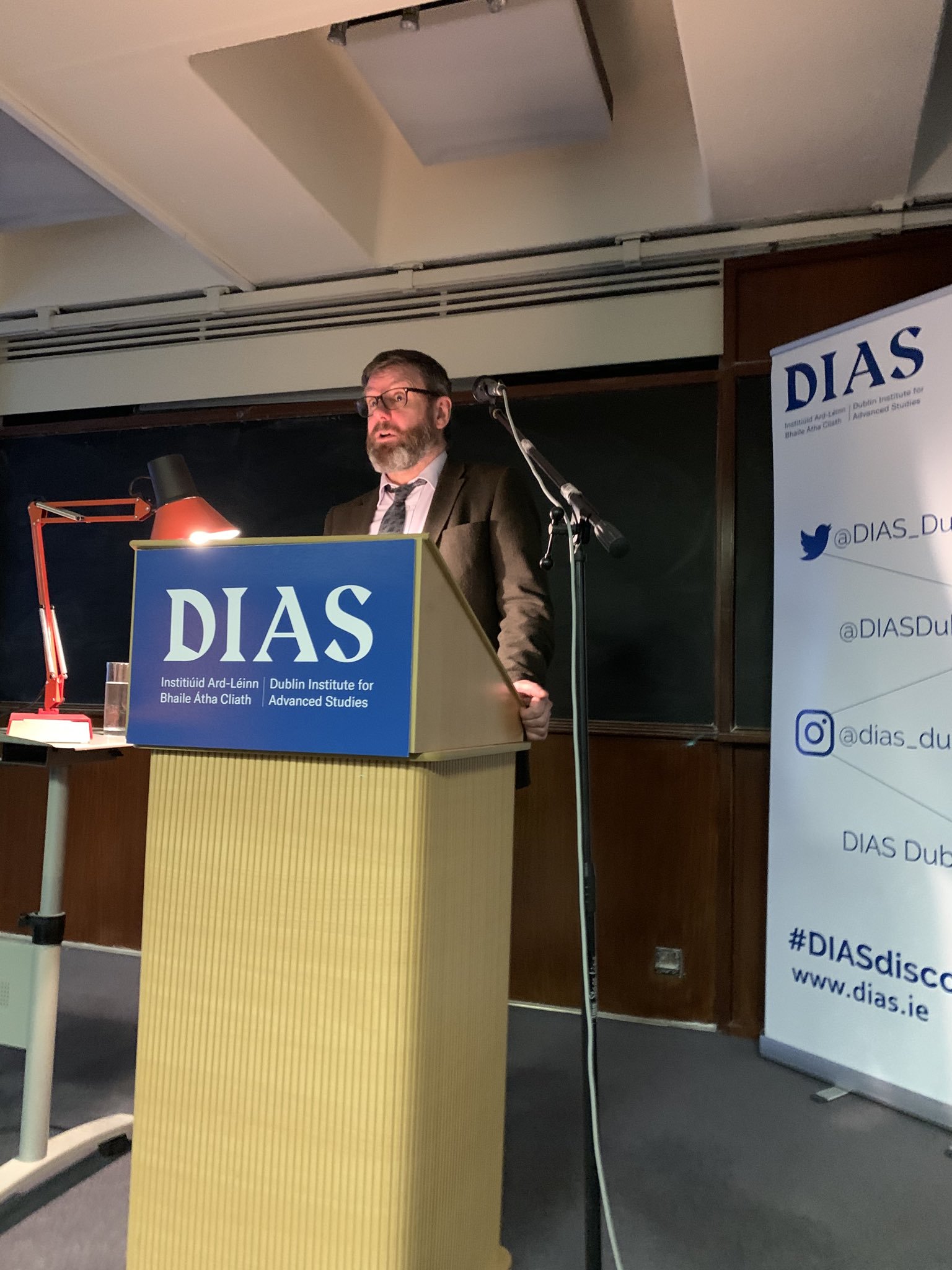
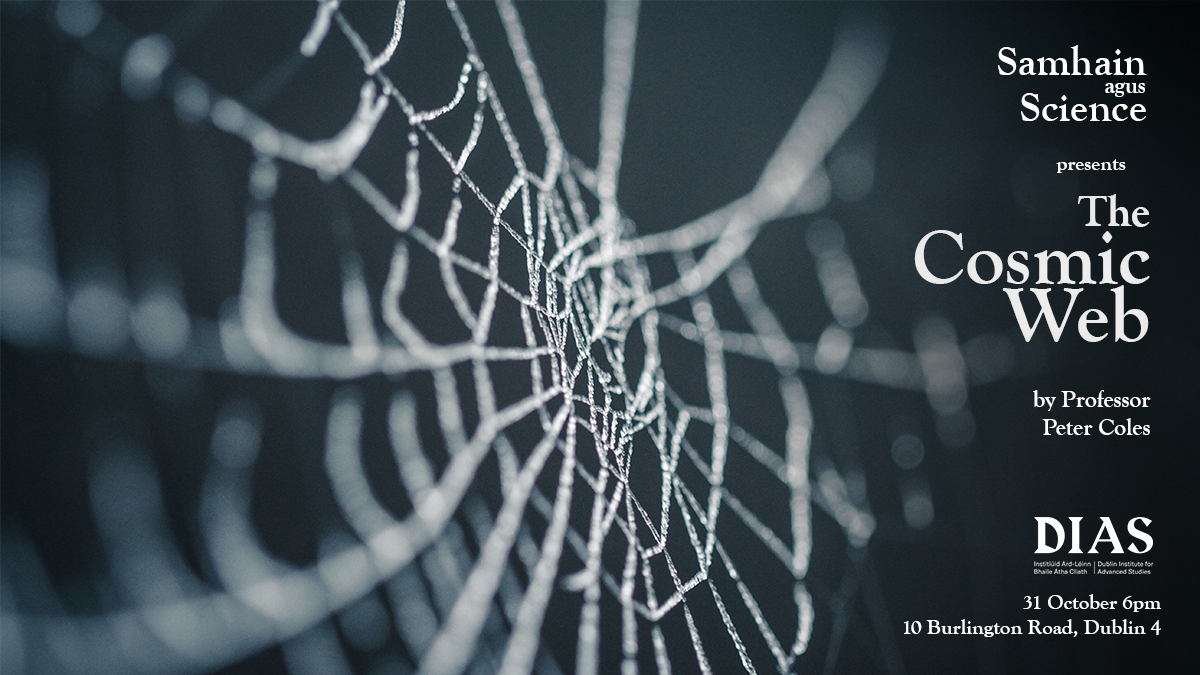
Just a quick post to mention that I’m giving a public talk at the Dublin Institute for Advanced Studies (DIAS) on Dark Matter Day, October 31st 2019, coincidentally the same day as Halloween. I am particularly grateful to be invited to give a talk that evening because it allows me to avoid getting involved in trick-or-treat or any of that nonsense.
Here is the nice advert the people at DIAS have made for the event:
The talk is free, but you need to sign up here as the venue is not infinitely large. You can also find some more details about the talk there.
Just a quick reminder that this year’s crop of Nobel Prizes will be announced next week, with the one of most personal interest to me – the Physics Prize – being due on Tuesday 8th October. Before going on here is a picture of my own Nobel Prize Medal:
It’s actually chocolate inside, though it is 13 years old and by now probably inedible if not toxic. You can read about how I got it here.
Anyway, as usual there has been quite a lot of speculation about these awards. Despite not having a great track-record of success some persist in trying to use citation metrics as a predictor; see here for example. Others have a less formulaic approach; see e.g. here.
I don’t really have any idea who is going to get it this year, but here are three possibilities:
Extrasolar Planets. This has to be a strong contender, but to whom should the prize be awarded? Possible winners include Didier Queloz, Aleksander Wolszczan, Dale Frail, and Michel Mayor, but the maximum number allowed to win is three….
Geometric Phase. Although if they were going to win they probably would have done so by now, I still think there’s an outside change for Michael Berry and Yakir Aharonov.
Quantum Information. This isn’t my area but is very hot these days. It’s also very broad so I’m not sure what specific area and which individuals would prompt an award – quantum cryptography is a possibility, but who?
Anyway, I’d welcome other suggestions through the comments box.
In writing the homework problems for my first-year Mathematical Physics module I was sorely tempted to include some political references but I restrained myself in order not to cause any offence. That doesn’t stop me posting some examples here, however, so here are three examples of the sort of thing I had in mind:
Arlene and Boris arrange to have a secret meeting near the Irish British Border. Arlene drives a car at 20 mph along a straight road that takes her within one mile of a customs post where Boris is waiting. Boris has a bicycle on which his top speed is 12 mph and he wishes to leave the customs post at the last possible minute to intercept Arlene. How far away is Arlene when Boris leaves the customs post, and how far must Boris cycle to meet her?
Donald falls 200m from the top floor of Trump Tower. Neglecting air resistance, what is Donald’s velocity when he hits the ground? Assuming he has a mass of 200 kg and he is brought to rest by the impact, what is the energy dissipated? Is this likely to cause serious damage (to the sidewalk)?
Jacob is reclining on a bench in the House of Commons with his head against an arm rest. The coefficient of static friction between Jacob and the armrest is 0.3 and between Jacob and the seat it is 0.4. Assuming that Jacob is infinitely thin, one-dimensional and entirely rigid, calculate the minimum angle he can make with the bench without slipping.
I came across an article in the Irish Times this morning entitled `Hyping research runs risk of devaluing science‘. That piece is directly aimed at medical science and the distressing tendency of some researchers in that field to make extravagant claims about `miracle cures’ that turn out to be a very long way from being scientifically tested. The combination of that article, yesterday’s blog post, and the fact that this year I’ve been speaking and writing a lot about the 1919 Eclipse expedition reminded me that I ended a book I wrote in 1998 with a discussion of the dangers to science of researchers being far too certain and giving the impression that they are members of some sort priesthood that thinks it deals in absolute truths.
I decided to post the last few paragraphs of that book here because they talk about the responsibility scientists have to be honest about the limitations of their research and the uncertainties that surround any new discovery. Science has done great things for humanity, but it is fallible. Too many scientists are too certain about things that are far from proven. This can be damaging to science itself, as well as to the public perception of it. Bandwagons proliferate, stifling original ideas and leading to the construction of self-serving cartels. This is a fertile environment for conspiracy theories to flourish.
To my mind the thing that really separates science from religion is that science is an investigative process, not a collection of truths. Each answer simply opens up more questions. The public tends to see science as a collection of “facts” rather than a process of investigation. The scientific method has taught us a great deal about the way our Universe works, not through the exercise of blind faith but through the painstaking interplay of theory, experiment and observation.
This is what I wrote in 1998:
Science does not deal with ‘rights’ and ‘wrongs’. It deals instead with descriptions of reality that are either ‘useful’ or ‘not useful’. Newton’s theory of gravity was not shown to be ‘wrong’ by the eclipse expedition. It was merely shown that there were some phenomena it could not describe, and for which a more sophisticated theory was required. But Newton’s theory still yields perfectly reliable predictions in many situations, including, for example, the timing of total solar eclipses. When a theory is shown to be useful in a wide range of situations, it becomes part of our standard model of the world. But this doesn’t make it true, because we will never know whether future experiments may supersede it. It may well be the case that physical situations will be found where general relativity is supplanted by another theory of gravity. Indeed, physicists already know that Einstein’s theory breaks down when matter is so dense that quantum effects become important. Einstein himself realised that this would probably happen to his theory.
Putting together the material for this book, I was struck by the many parallels between the events of 1919 and coverage of similar topics in the newspapers of 1999. One of the hot topics for the media in January 1999, for example, has been the discovery by an international team of astronomers that distant exploding stars called supernovae are much fainter than had been predicted. To cut a long story short, this means that these objects are thought to be much further away than expected. The inference then is that not only is the Universe expanding, but it is doing so at a faster and faster rate as time passes. In other words, the Universe is accelerating. The only way that modern theories can account for this acceleration is to suggest that there is an additional source of energy pervading the very vacuum of space. These observations therefore hold profound implications for fundamental physics.
As always seems to be the case, the press present these observations as bald facts. As an astrophysicist, I know very well that they are far from unchallenged by the astronomical community. Lively debates about these results occur regularly at scientific meetings, and their status is far from established. In fact, only a year or two ago, precisely the same team was arguing for exactly the opposite conclusion based on their earlier data. But the media don’t seem to like representing science the way it actually is, as an arena in which ideas are vigorously debated and each result is presented with caveats and careful analysis of possible error. They prefer instead to portray scientists as priests, laying down the law without equivocation. The more esoteric the theory, the further it is beyond the grasp of the non-specialist, the more exalted is the priest. It is not that the public want to know – they want not to know but to believe.
Things seem to have been the same in 1919. Although the results from Sobral and Principe had then not received independent confirmation from other experiments, just as the new supernova experiments have not, they were still presented to the public at large as being definitive proof of something very profound. That the eclipse measurements later received confirmation is not the point. This kind of reporting can elevate scientists, at least temporarily, to the priesthood, but does nothing to bridge the ever-widening gap between what scientists do and what the public think they do.
As we enter a new Millennium, science continues to expand into areas still further beyond the comprehension of the general public. Particle physicists want to understand the structure of matter on tinier and tinier scales of length and time. Astronomers want to know how stars, galaxies and life itself came into being. But not only is the theoretical ambition of science getting bigger. Experimental tests of modern particle theories require methods capable of probing objects a tiny fraction of the size of the nucleus of an atom. With devices such as the Hubble Space Telescope, astronomers can gather light that comes from sources so distant that it has taken most of the age of the Universe to reach us from them. But extending these experimental methods still further will require yet more money to be spent. At the same time that science reaches further and further beyond the general public, the more it relies on their taxes.
Many modern scientists themselves play a dangerous game with the truth, pushing their results one-sidedly into the media as part of the cut-throat battle for a share of scarce research funding. There may be short-term rewards, in grants and TV appearances, but in the long run the impact on the relationship between science and society can only be bad. The public responded to Einstein with unqualified admiration, but Big Science later gave the world nuclear weapons. The distorted image of scientist-as-priest is likely to lead only to alienation and further loss of public respect. Science is not a religion, and should not pretend to be one.
PS. You will note that I was voicing doubts about the interpretation of the early results from supernovae in 1998 that suggested the universe might be accelerating and that dark energy might be the reason for its behaviour. Although more evidence supporting this interpretation has since emerged from WMAP and other sources, I remain skeptical that we cosmologists are on the right track about this. Don’t get me wrong – I think the standard cosmological model is the best working hypothesis we have – I just think we’re probably missing some important pieces of the puzzle. I may of course be wrong in this but, then again, so might everyone.
I saw that there’s a new paper that has just been published in the journal Science by Umehata et al with the title Gas filaments of the cosmic web located around active galaxies in a protocluster. In case you run into a paywall at Science, you may of course, find the paper on the arXiv here.
The abstract reads:
Cosmological simulations predict the Universe contains a network of intergalactic gas filaments, within which galaxies form and evolve. However, the faintness of any emission from these filaments has limited tests of this prediction. We report the detection of rest-frame ultraviolet Lyman-alpha radiation from multiple filaments extending more than one megaparsec between galaxies within the SSA 22 proto-cluster at a redshift of 3.1. Intense star formation and supermassive black-hole activity is occurring within the galaxies embedded in these structures, which are the likely sources of the elevated ionizing radiation powering the observed Lyman-alpha emission. Our observations map the gas in filamentary structures of the type thought to fuel the growth of galaxies and black holes in massive proto-clusters.
The existence of a complex cosmic web of filaments and voids has been known about for some time as it is revealed on large scales by the distribution of galaxies through redshift surveys:
You can see all my posts agged with `Cosmic Web’ here. There are also good theoretical reasons (besides numerical simulations) for believing this is what the large-scale distribution of matter should look like. Roughly speaking, dense knots of matter lie at the vertices of a three-dimensional pattern traced out by one-dimensional structures.
We have also known for some time, however, that there is more going on in cosmic structure than is revealed by light from stars in galaxies. In particular the way gas flows along the filaments into the knots plays an important role in galaxy and cluster formation. This paper reveals the distribution of gas around a giant cluster that has formed at such a node using observations made using the European Southern Observatory’s MUSE instrument.
Here’s a pretty picture:
I found out about this paper from a news piece in the Guardian with the title Scientists observe mysterious cosmic web directly for first time. That’s sufficiently misleading for me to cross-file the paper under `Astrohype’ because, as I explained above, we have been observing the cosmic web for decades. It is however only just becoming possible to observe the diffuse gas rather than having to join the dots between the galaxies so it is an exciting result. My complaint, I suppose, is that the word `directly’ is doing a lot of heavy lifting in the title!
It was calm and rather mild this morning as I walked into work, although the news on the radio this morning was filled with news about the rapidly approaching Storm Lorenzo. Lorenzo is a huge storm and was only downgraded from hurricane to tropical storm when it was about 500km from the Irish coast so it could be even more serious than Storm Ophelia, which caused chaos a couple of years ago.
This is how the storm looked in the early hours of this morning:
And this is the projection for later today. The prevailing wind right now is westerly, but this will veer to south-westerly as the storm moves along its (roughly) north-easterly path:
Here is an infra-red image taken this morning showing the outer belts of cloud already over Ireland.
Quite a few events have been called off in anticipation of the arrival of Storm Lorenzo this evening, with heavy rain and gale force winds forecast across the country. There are signs, however, that the low pressure region at the heart of the storm is filling more rapidly than expected, so it might not be as severe as feared, although there remains a significant risk of localized flooding and wind damage, especially in the West. I plan to sit it out at home this evening with a glass or two of wine for company…
The arrival yesterday of this year’s Royal Astronomical Society diary reminded (for obvious reasons) that next year (2020) sees the bicentenary of the Society and that there will be a number of special events to mark the occasion.
The ‘Astronomical Society of London’ was conceived on 12 January 1820 when 14 gentlemen sat down to dinner at the Freemason’s Tavern, in Lincoln’s Inn Fields, London. After an unusually short gestation the new Society was born on 10 March 1820 with the first meeting of the Council and the Society as a whole. An early setback, when Sir Joseph Banks induced the Duke of Somerset to withdraw his agreement to be the first President, was overcome when Sir William Herschel agreed to be the titular first President, though he never actually took the Chair at a meeting.
The Society became the `Royal Astronomical Society’ in 1831 when it was granted a Royal Charter by William IV, but this is no time to be quibbling about names.
It’s not only the Royal Astronomical Society that has survived and prospered for two hundred years. The group of `gentlemen’ who met for dinner in January 1820 has also carried on in the form of the RAS Club which is, of course, older than the RAS itself.
As well as being a Fellow of the Royal Astronomical Society (and having twice served on its Council), I also have the honour of having been elected a Member of the RAS Club about 11 years ago. I blogged about this here.
The members of the RAS Club are all Fellows of the Royal Astronomical Society. All you have to do to join the Royal Astronomical Society is to find two Felllows to support you, pay some money and sign your name in a book, but to get into the RAS Club you have to be elected by the existing membership. Nominations are solicited each November (via a process called `The Naming of Names’) and the elections held – usually with a great deal of confusion about the voting system – in January. Frankly, it’s all a bit dotty, but I like it. I don’t really carte much for the real world anyway. The club’s various little rituals are a bit bizarre, but quaintly amusing in their own way, and the proceedings are remarkably lacking in pomposity.
Nowadays, the RAS Club usually meets at the Athenaeum in Pall Mall, shortly after the end of the monthly `Ordinary Meetings’ of the RAS at Burlington House (always referred to at the Club as `another place’) which happen on the second friday of each month. That is except when the RAS meeting is the annual National Astronomy Meeting (NAM) which is held at a different location each year; on these occasions the club also meets, but at an appropriate alternative venue near the NAM location.
I think the RAS Club (and even the RAS itself) is sometimes viewed with suspicion and perhaps even hostility by some astronomers, who seem to think the club is a kind of sinister secret society whose existence is intrinsically detrimental to the health of astronomy in the UK. Actually it’s just an excuse for a good nosh-up and some daft jokes, although I was initially disappointed to find out that there wasn’t after all a covert plan for world domination. Or if there is, nobody told me about it.
The other common complaint is that the club’s membership is just a bunch of old male dinosaurs. Now it is true that your typical member of the RAS Club isn’t exactly in the first flush of youth, but that’s no excuse for ageism. And the club does try very hard to secure encourage nominations from female Fellows and the gender balance is improving steadily.
The diary reminded me also that the first meeting of the RAS of the new term, and hence the first Club dinner, will be on Friday October 11th. I hope to be there to find out more about the plans for the bicentennial dinner in January 2020…
Anyway, as a postscript, although many of my colleagues seem not to use them, I like old-fashioned diaries like the one above. I do run an electronic calendar for work-related events, meetings etc, but I use the paper one to scribble down extra-curricular activities such as concerts and cricket fixtures, as I find the smartphone version of my electronic calendar a bit fiddly. I’m interested to know the extent to which I am an old fogey so here’s a little poll on the subject of diaries:
I thought you might enjoy this entry in the Cute Problems folder.
An asteroid is moving on a circular orbit around the Sun with an orbital radius of 3AU when it spontaneously splits into two fragments, which initially move apart along the direction of the original orbit. One fragment has a speed which is a fraction 0.65 of the original speed, the other has a speed of 1.35 times the original speed. The original orbit (solid line) is shown above, along with the two new orbits (dashed and dotted).
Which orbit does the fast fragment follow, and which the slow fragment?
Calculate the original orbital speed in AU/year.
Calculate the angular momentum per unit mass, h, of the original asteroid and of each of the two fragments in units of AU2 per year. [HINT: Show that in these units, for a general orbit of eccentricity e and semi-major axis a, h2=4π2 a (1-e2).]
Calculate the eccentricities of the orbits of the two fragments.
Calculate the orbital periods of the two fragments in years.
Answers please through the Comments box. First complete set of answers wins a trip to the Moon on gossamer wings.
Yesterday we published another new paper at The Open Journal of Astrophysics, but I didn’t get time to write a post about because of teaching and other start-of-term business so I’m correcting that omission now.
The authors are Selim Can Hotinli of Imperial College London (UK), Marc Kamionkowski of Johns Hopkins University, Baltimore (USA) and Andrew Jaffe, also of Imperial College.
You can find the accepted version on the arXiv here. This version was accepted after modifications requested by the referee and editor. Because this is an overlay journal the authors have to submit the accepted version to the arXiv (which we then check against the copy submitted to us) before publishing; version 2 on the arXiv is the accepted version.
You will see that this is one for the `Cosmology and Nongalactic Astrophysics’ folder. We would be happy to get more submissions from other areas, especially Stellar and Planetary astrophysics. Hint! Hint!
Just a quick post to advertise the fact that I’ve been invited by Scholastica to do a webinar (whatever that is) about the Open Journal of Astrophysics, which will involved a short presentation delivered over the interwebs jointly by myself and Fiona Morley (Head of Digital Programmes and Information Systems at Maynooth University Library), followed by a question and answer session. The session will be conducted via Zoom (which is the pretty neat platform we use, e.g., for Euclid teleconference meetings).
While I’m on the subject(s) of Scholastica and the Open Journal of Astrophysics, I thought I’d add a bit of news about Plan S. Scholastica has been working hard behind the scenes to develop a roadmap that will enable its journals to become compliant with Plan S. The roadmap is here. Three important landmarks on it are:
Core machine-readable XML metadata in the JATS standard for all articles
Automated Digital Object Identifier (DOI) registration through Crossref
Automated metadata, including funding sources, deposited into major indexes and archives including DOAJ and Portico
Currently we do some of these manually for each article, and it’s nice to see that Scholastica is intending to provide these services automatically which will save us (i.e. me) a considerable amount of fiddling about!
The views presented here are personal and not necessarily those of my employer (or anyone else for that matter).
Feel free to comment on any of the posts on this blog but comments may be moderated; anonymous comments and any considered by me to be vexatious and/or abusive and/or defamatory will not be accepted. I do not necessarily endorse, support, sanction, encourage, verify or agree with the opinions or statements of any information or other content in the comments on this site and do not in any way guarantee their accuracy or reliability.