Towards a New Ecosystem for Scientific Publication

Posted in Open Access with tags , , , on October 4, 2023 by telescoper

A few days ago I posted an item about how the current system of scientific publication is under such intolerable strain that it is no longer fit for purpose. This is something I’ve felt for a while. Some time ago I wrote a post musing about what should replace it. That article included this:

I know I’m not alone in thinking that the current publishing ecosystem is doomed and will die a natural death soon enough. In my view the replacement should be a worldwide network of institutional and/or subject-based repositories that share research literature freely for the common good.

https://telescoper.blog/2023/09/12/lets-make-no-pay-open-access-real/

The Open Journal of Astrophysics was set up to demonstrate a way of achieving this kind of change in the field of Astrophysics. With this in mind I was delighted to to see a paper in PLOS Biology by Richard Sever (published just yesterday) with the following abstract:

Academic journals have been publishing the results of biomedical research for more than 350 years. Reviewing their history reveals that the ways in which journals vet submissions have changed over time, culminating in the relatively recent appearance of the current peer-review process. Journal brand and Impact Factor have meanwhile become quality proxies that are widely used to filter articles and evaluate scientists in a hypercompetitive prestige economy. The Web created the potential for a more decoupled publishing system in which articles are initially disseminated by preprint servers and then undergo evaluation elsewhere. To build this future, we must first understand the roles journals currently play and consider what types of content screening and review are necessary and for which papers. A new, open ecosystem involving preprint servers, journals, independent content-vetting initiatives, and curation services could provide more multidimensional signals for papers and avoid the current conflation of trust, quality, and impact. Academia should strive to avoid the alternative scenario, however, in which stratified publisher silos lock in submissions and simply perpetuate this conflation.

https://doi.org/10.1371/journal.pbio.3002234

(I added the emphasis). In case you were not aware, Richard Sever is a cofounder of the preprint servers bioRxiv and medRxiv.

I’m very glad to see similar thoughts to those I expressed about astrophysics being echoed in the field of biomedicine. I hope that more disciplines follow this path. The way it is realized will no doubt be domain-specific, but the benefits of such a new ecosystem will be for all science.
Exploring the Cosmos at Maynooth

Posted in Maynooth, The Universe and Stuff with tags , , on October 4, 2023 by telescoper

Being away on sabbatical I almost forgot to post a reminder of the event I blogged about a few weeks ago at Maynooth University entitled Exploring the Cosmos. I’m told this has attracted a huge amount of interest, but the room for the event is very large and there may well be some space left.

Best wishes to everyone taking part and I hope it goes well!

On the 5th of October, at 6.30pm, in the TSI Building Maynooth University will host an all-ages event to explore the vastness of space. Using stunning visualisations Maynooth University Astrophysicists will examine star and planet formation, peer back in time with our physicists trying to image the very edges of our visible universe, and take a journey into the unknown as we trace the origin and evolution of black holes.

Programme:

18.30 Welcome

18.35: John Regan: “Black Holes in Our Universe”

Black Holes are among the most exotic objects in our Universe. In this talk John will discuss the basics of black hole formation, how we can detect them today and the future of black hole hunting using gravitational wave observatories that Maynooth University is a part of. John will also discuss some of the strange effects you might encounter near a black hole – like time slowing down!

18.55: Aoibhinn Gallagher: “The Dark Universe”

There is so much in our universe which is unknown to us, most of it in fact. What is dark matter, what is dark energy? We will go on a journey during this talk through the history of our universe and the history of cosmology (the study of the universe) itself to try and arrive at answers to these questions. Also I will talk about the real life science happening at Maynooth university on these very topics.

19.15: Tea & Coffee Break

19.45: Neil Trappe: “Seeing the Invisible Universe – Terahertz Astronomy”

When you look outside at the clear night sky you will see many thousands of stars overheard. The Moon, stars, planets, comets and galaxies can all be observed if you know where to look just using your eyes, binoculars or a telescope.

Astronomers spend many hours looking at the night sky with large automated telescopes from many exotic places around the world to add to our knowledge of the Universe and understand difficult questions like how did the Sun and our Solar System form, how are stars born and how do they die, is there life elsewhere in the Universe, and indeed how did the Universe come into existence at all?

In Maynooth University a team of researchers develop telescopes to see the Universe with different kinds of light, specifically far infrared or “terahertz” light. Why do we do this – we see the Universe differently and can learn lots more information ‘seeing’ with terahertz radiation that is invisible to our eyes.

20.05: Patrick Kavanagh: “The First Year of the James Webb Space Telescope”

The James Webb Space Telescope has made unexpected and groundbreaking discoveries almost routine in its first year. It has produced captivating images of our own Solar System, measured the content of atmospheres around other stars, viewed the stellar birth and death in amazing detail, revealed the skeletal structure of galaxies, and peered deep in to the cosmic past in search of the first stars and galaxies. In this talk Dr. Kavanagh will give an overview of Webb and present some of the highlights of the first year of this revolutionary telescope.

20.30: Finish

It should be a fun evening. If you’re around please come along. This event is free to attend but you need to register, which you can do here. Please feel free to share this with friends and colleagues.

New Views of the Orion Nebula

Posted in The Universe and Stuff with tags , , on October 3, 2023 by telescoper

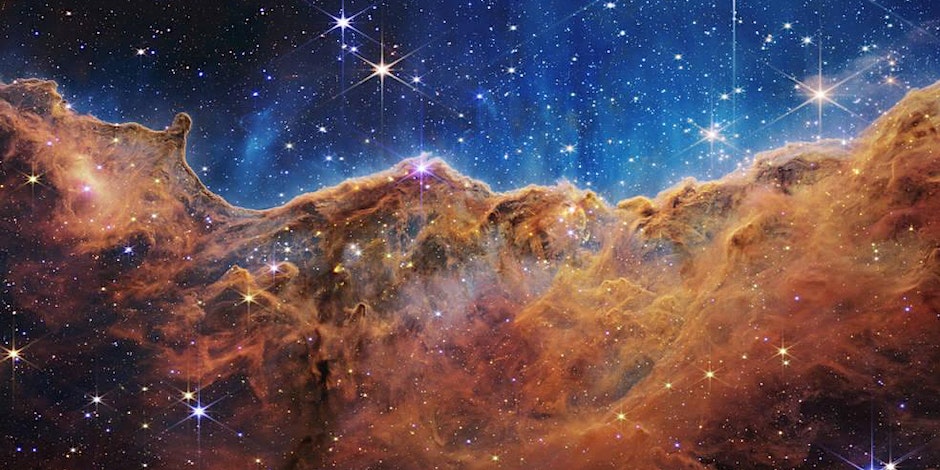
The Orion Nebula, a stellar nursery about 400 pc away from Earth, is a much-studied object that has yielded considerable insights into the processes of star formation. If you thought that there wasn’t much more to be learned about this object, though, you’d be very wrong. A set of JWST images has been released by the European Space Agency and they are amazing. You can see them all here, but here’s a taster in the form of a detail from one of the pictures. The following image is entitled “Explosion fingers from the BN-KL region in Orion” but to me it looks like demons rising up from the Underworld, like in the last act of Don Giovanni…

Here’s the blurb:

This cutout from the new NASA/ESA/CSA James Webb Space Telescope short-wavelength infrared image of the Orion Nebula shows bright ‘fingers’ of gas racing away from an explosion that occurred roughly 500 to 1000 years ago in the heart of a dense molecular cloud behind the nebula, perhaps as two young massive stars collided. The dense cloud is called Orion Molecular Cloud 1 and lies to the northwest of the visible Trapezium stars in Orion.

The fingers are predominantly red, indicating emission from molecular hydrogen gas that has been shocked by the immense energy pouring out from the explosion site. Near the tips of some of the fingers, the emission turns green due to hot iron gas and even white in some cases where the gas is at its hottest. Further down, the fingers seem mostly turbulent, but in some places, the flow appears laminar.

The Orion Nebula lies roughly 1300 light-years from Earth in the so-called ‘sword’ of the constellation of Orion the Hunter, and the image shows a region that is 4 by 2.75 light-years in size.

Image description: The image shows a series of red fingers of shocked molecular gas expanding from the bottom of the image towards the top and top right. Each of the fingers comprises a series of bright arcs of emission like bow waves, expanding behind tips, the latter often appearing green. There are many stars spread across the image with the characteristic eight spikes due to diffraction in the optics of Webb, and there is a foreground haze of wisp blue clouds due to the Orion Nebula, which lies in front of the fingers.

Nobel Prize for Physics Speculation

Posted in Science Politics, The Universe and Stuff with tags , on October 2, 2023 by telescoper

Just  to mention that tomorrow morning (Tuesday, October 3rd 2023) will see the announcement of this year’s Nobel Prize for Physics. I must remember to make sure my mobile phone is fully charged so I can be easily reached.

Of course this is just one of the announcements. This morning, for example, there is the announcement of the Prize for Physiology or Medicine, and on Wednesday is the Prize for Chemistry: both of these sometimes go to physicists too. You can find links to all the announcements here.

I do, of course, already have a Nobel Prize Medal of my own already, dating from 2006, when I was lucky enough to attend the prize-giving ceremony and banquet.

I was, however, a guest of the Nobel Foundation rather than a prizewinner, so my medal is made of chocolate rather than gold. I think after 17 years the chocolate is now inedible, but it serves as a souvenir of a very nice weekend in Stockholm!

Regular readers of this blog, Sid and Doris Bonkers, may recall that I called it correctly last year when Alain Aspect, John F. Clauser and Anton Zeilinger won. I had however predicted them every year for many years until they won, and they won’t win it again, so I can’t follow my usual strategy. I’ll suggest that there’s an outside chance for Michael Berry and Yakir Aharonov for their work on the geometric phase, although if they were going to win they probably would have done so by now. Feel free to make your predictions through the comments box below.

To find out you’ll have to wait for the announcement, around about 10.45 (UK/Irish time) tomorrow morning. I’ll update this post when the wavefunction has collapsed.

UPDATE: The 2023 Nobel Prize for Physics goes to:

Pierre Agostini
The Ohio State University, Columbus, USA

Ferenc Krausz
Max Planck Institute of Quantum Optics, Garching and Ludwig-Maximilians-Universität München, Germany

Anne L’Huillier
Lund University, Sweden

“for experimental methods that generate attosecond pulses of light for the study of electron dynamics in matter”

Congratulations to them! The full press release containing the citation can be found here.

Anyway, for the record, I’ll reiterate my opinion that while the Nobel Prize is flawed in many ways, particularly because it no longer really reflects how physics research is done, it does at least have the effect of getting people talking about physics. Surely that at least is a good thing?

P.S. My own claim for the 2023 Physics Nobel Prize is based on the discovery of the Coles Law.

The Week in Barcelona

Posted in Barcelona, Biographical on October 1, 2023 by telescoper
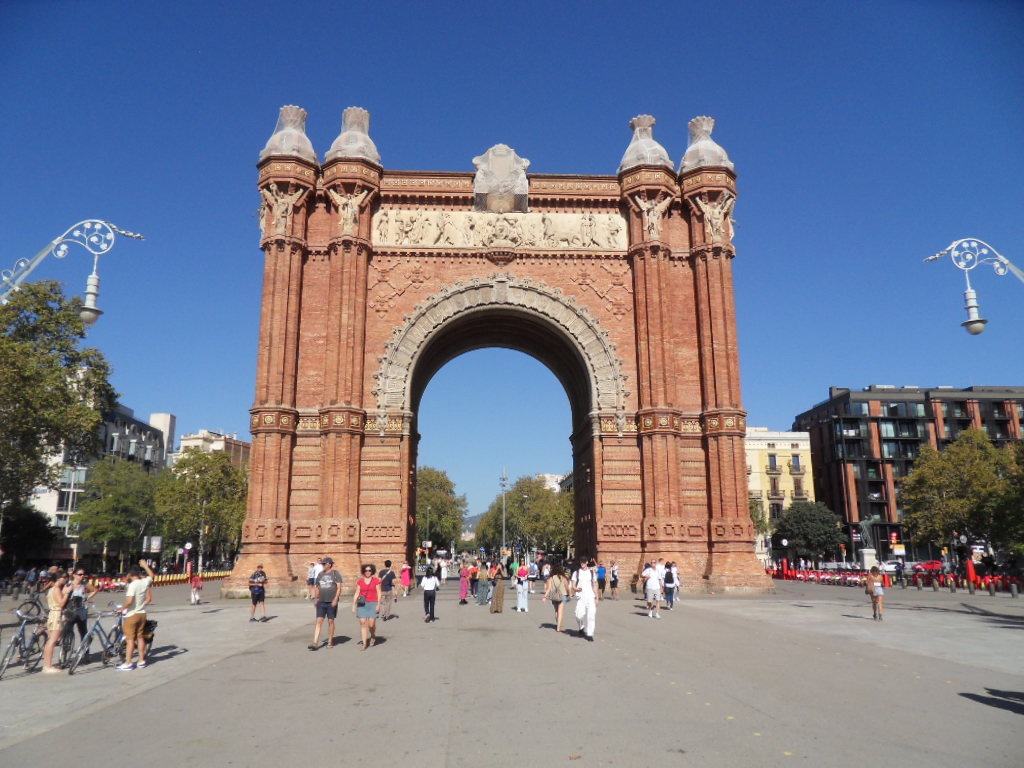
The Arc de Triomf which can be loosely translated as “Arc de Triomphe”…

I was doing another tour of Barcelona today in the blazing sunshine, when it suddenly struck me that (a) I’ve been here for a week already and (b) it’s October! It certainly doesn’t feel like a normal October with not a cloud in the sky and the temperature at 27°C.

The tourist crowds were out in force. I always find it quite interesting listening for different languages as I go around. There are a few British and American, and of course Spanish, but the language I’ve come across most often among the tourists is French. That’s not surprising, of course, given the proximity to the border and, e.g., train services to and from France.

A bit of advice for people visiting. Many of the interesting locations (museums and art galleries, for example) are very busy and one can’t just turn up, buy a ticket and go in without a very long wait. The best way to do it is to buy a ticket online with a specific time on it, then you can bypass the queues and go straight in at the appointed hour.

The main that to have struck me while I’ve been here is that the cost of living is so much lower than Ireland. The grocery stores and supermarkets are stocked with a huge range of fresh food at prices much lower than back home. The choice of good quality wines for less than €10 per bottle is astonishing.

Eating in restaurants – even in the touristic areas – is generally inexpensive (although there are of course expensive places). In the area I am living in, every street corner seems to have a place where you can get something to eat and/or drink. I’ve sampled a few in my neighbourhood, and most have been very good indeed. There are, of course, some that aren’t so good.

Actually, I’m eating rather a lot less these days. I have a hearty breakfast but usually skip lunch and often only have a light snack or tapas in the evening. I think the temperature has reduced by appetite (at least for food….). That’s not bad, actually, because I could do with losing a bit of weight.

I’m still in my (very pleasant) hotel but will be moving to an apartment later next week, assuming nothing goes wrong with the contract.

Gaudí and a Shorts Story

Posted in Architecture, Barcelona, Biographical with tags , , on September 30, 2023 by telescoper

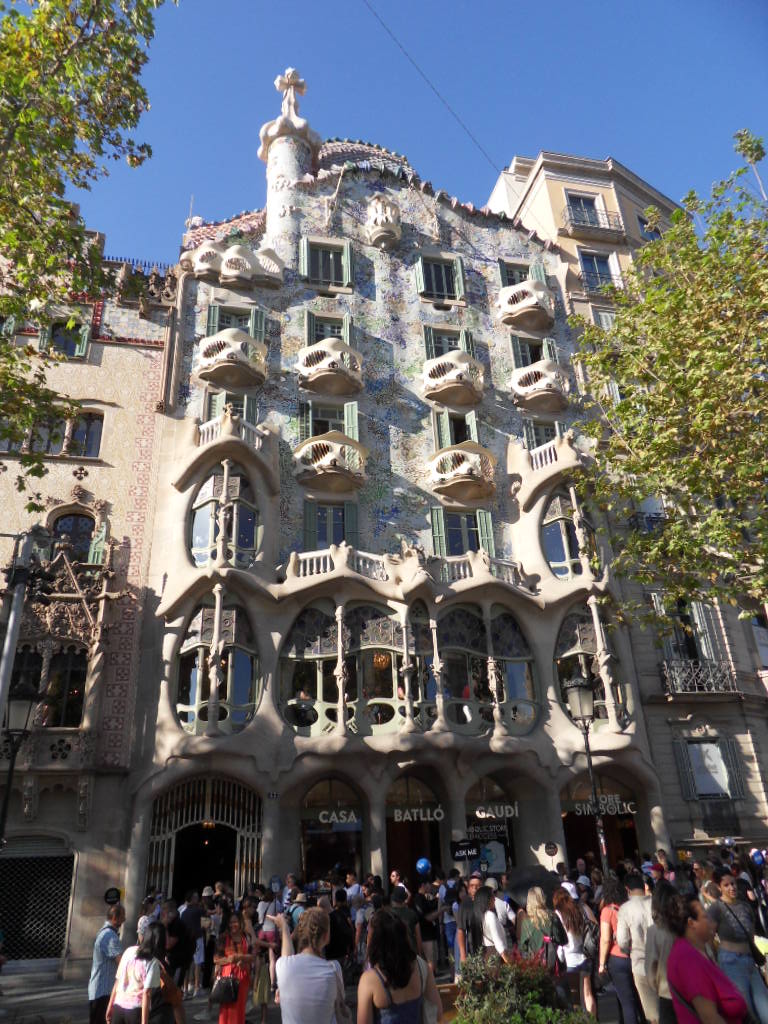
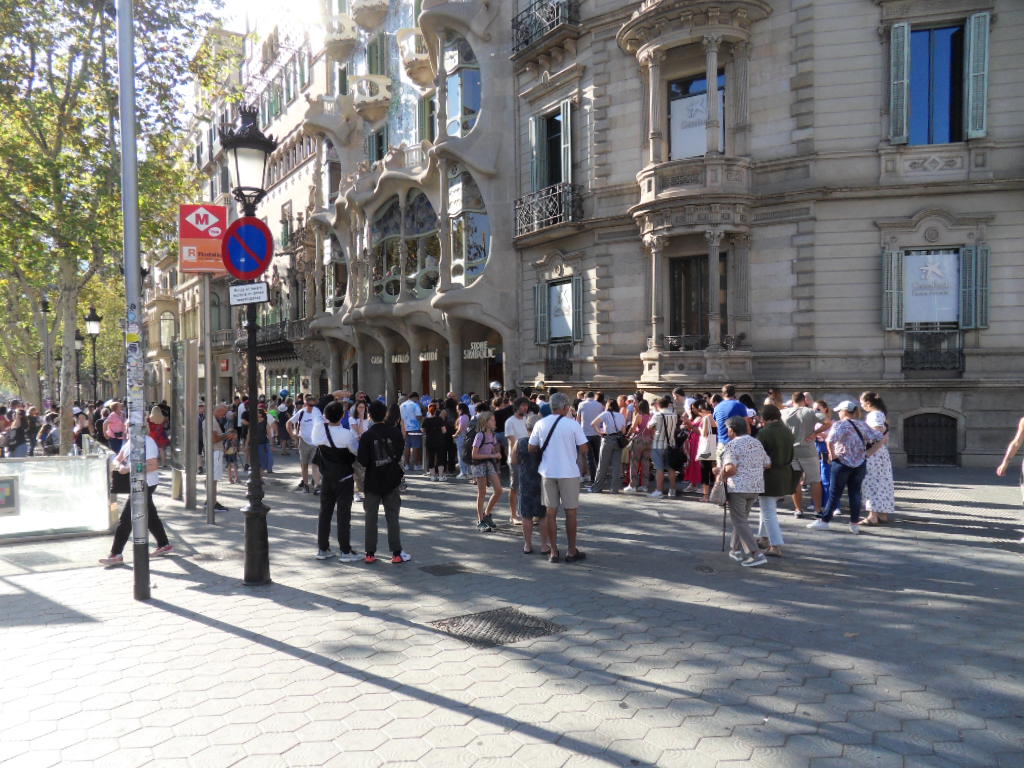
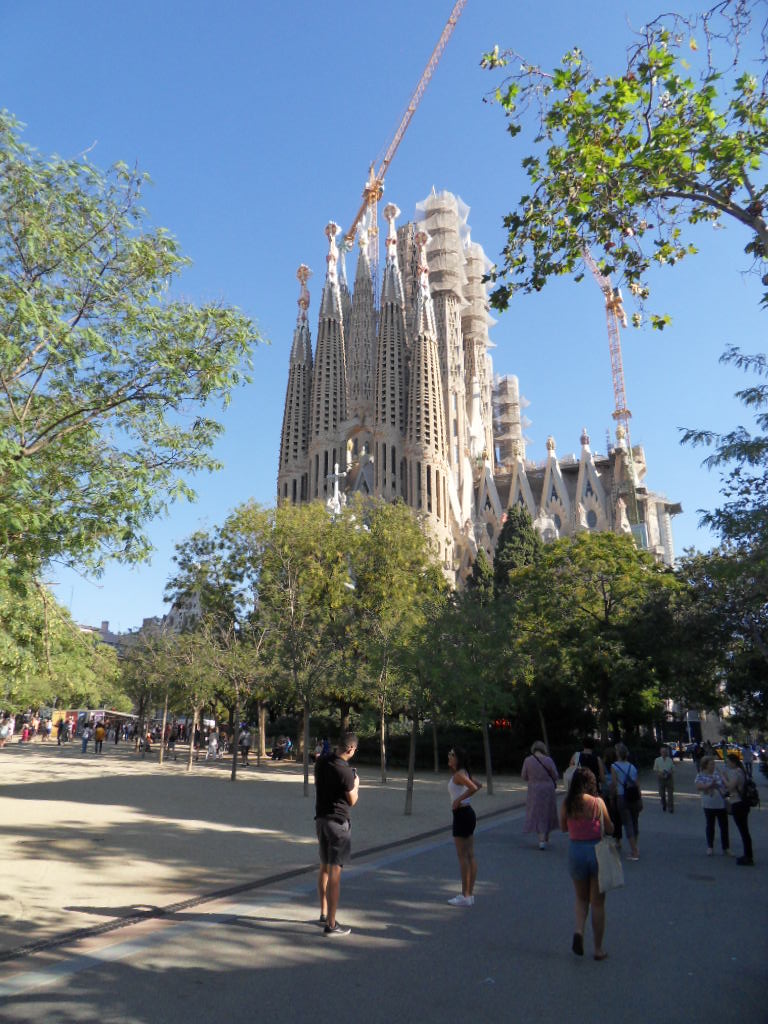
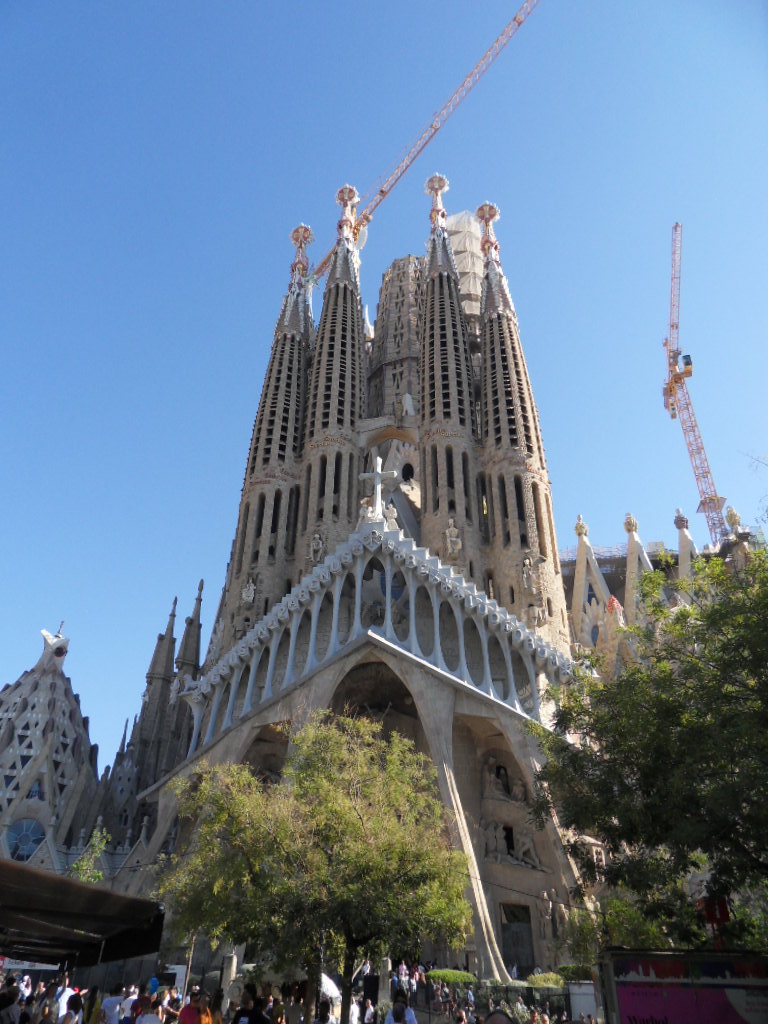
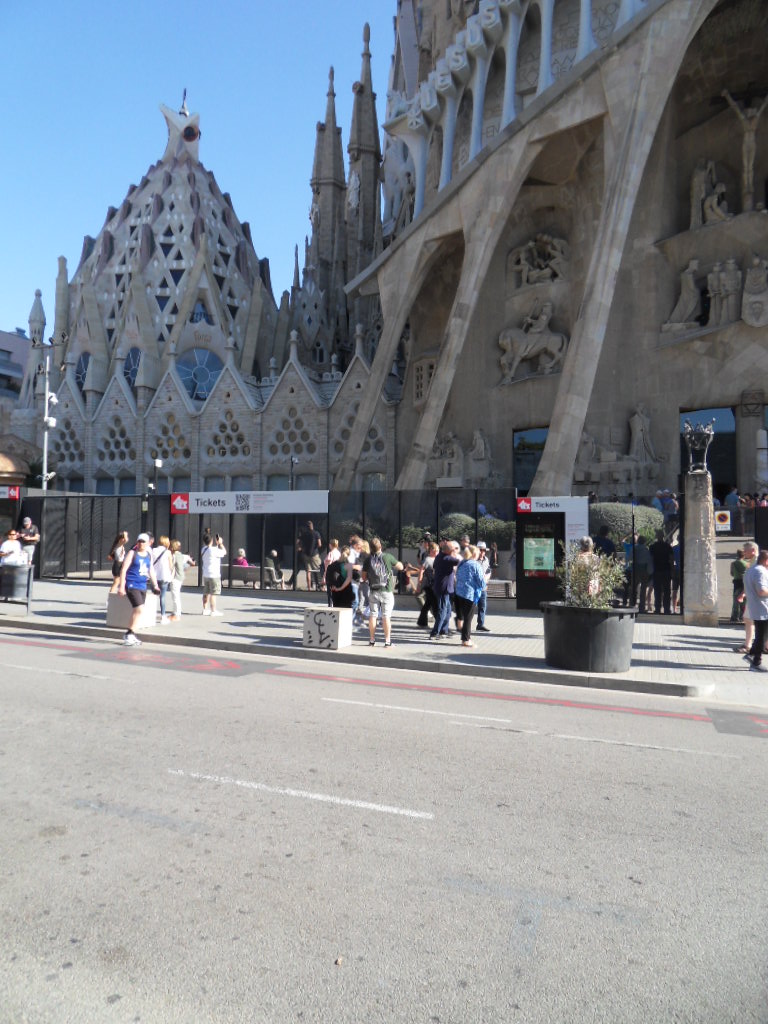
It being a Saturday, and the weather forecast suggesting a temperature of around 30° C, I made an early start this morning to beat the tourist crowds and the heat as I walked around. I managed the latter but not the former. My aim was to visit the famous landmarks associated with architect Antoni Gaudí, the Casa Botlla and the still unfinished Sagrada Familia. Here are some pics I took on the way there and back.

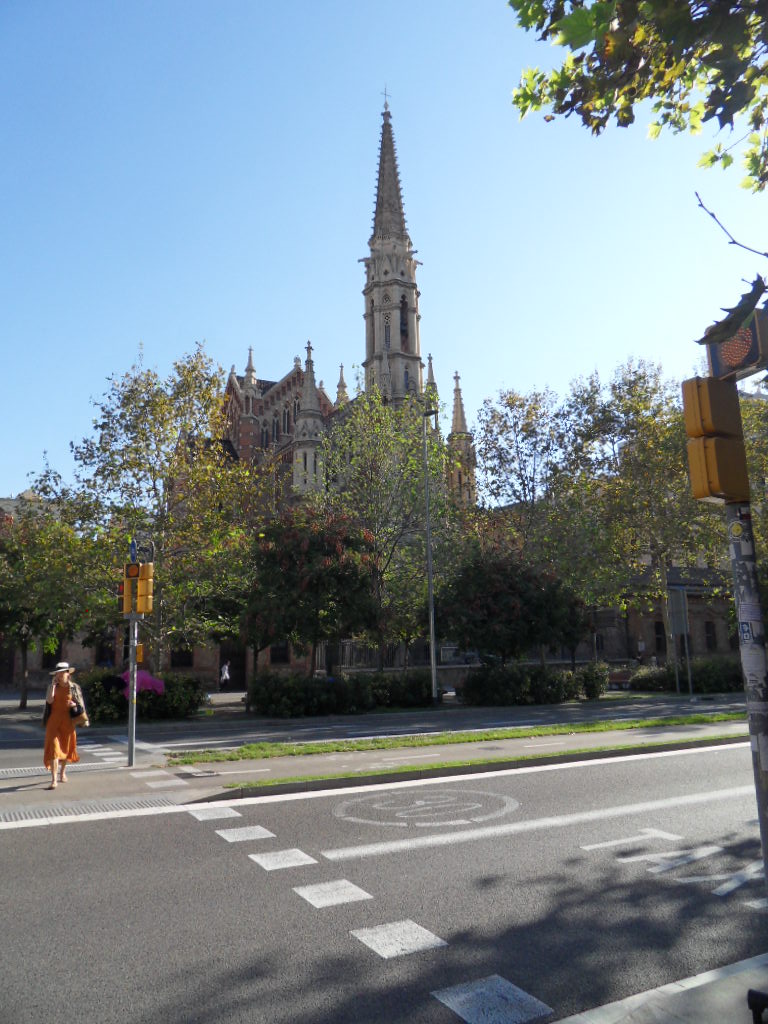
I didn’t actually go in either establishment because of the cost and the crowds. I’m told things will get a bit quieter later in the year so I might try again in November or so. Incidentally, if you’re interested in visiting the Sagrada Familia then be careful as it is quite difficult to get to: there are a lot of roadworks nearby associated with a new tram track so it’s best to walk there than try to get near it by car. It’s also quite expensive to get in – €34, no less. The other church (in the 6th pic) I passed on the way is, I think, this one.

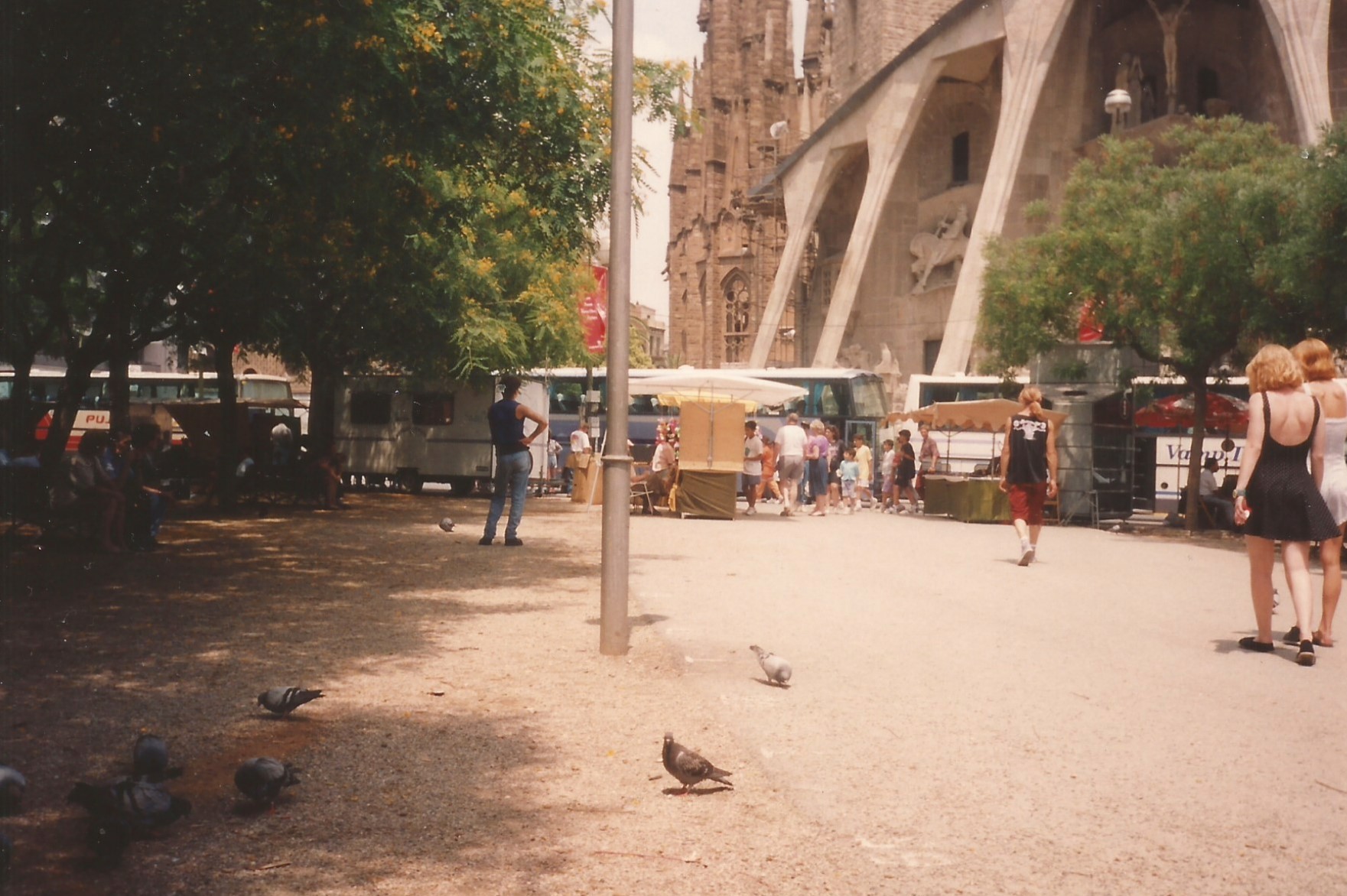
The approach to the Sagrada Familia triggered some memories of my last visit there 30 years ago but the surrounding area has changed quite a bit. The fifth picture, entitled ‘Entrance’, was the best attempt I could make at recapturing an old view:

There is a busy main road now where there was a dirt track back in 1993 and I didn’t want to get run over by bus taking my picture so I couldn’t get close enough to reproduce the angle. Note also that the tower to the left in the old picture now has a new structure in front of it.

Anyway, I had a nice walk around, ending up by the harbour where there was a jazz-and-cocktails event going on but it was getting too hot by then so I went and ate an indoor pizza then retreated to my hotel for a siesta.

Last week, discovering how warm it is here, I decided to buy a new pair of shorts (Bermudas). That turned out to be trickier than expected. Many stores here are selling their autumn range rather than summer gear, but when I tried a nearby El Corte Inglés I found the remnants of the summer short range were on sale at half price. Sadly I was then flummoxed by the sizes and confounded by the lack of a signal so I could check using my phone. When I did find a conversion table from UK to Spanish sizes I found it was wildly inaccurate and had to try on three pairs of increasing size until I found a pair that fit.

Fancy that. Inaccurate information on the internet! Who would have though it?

The Strain on Scientific Publishing

Posted in Open Access with tags , on September 29, 2023 by telescoper

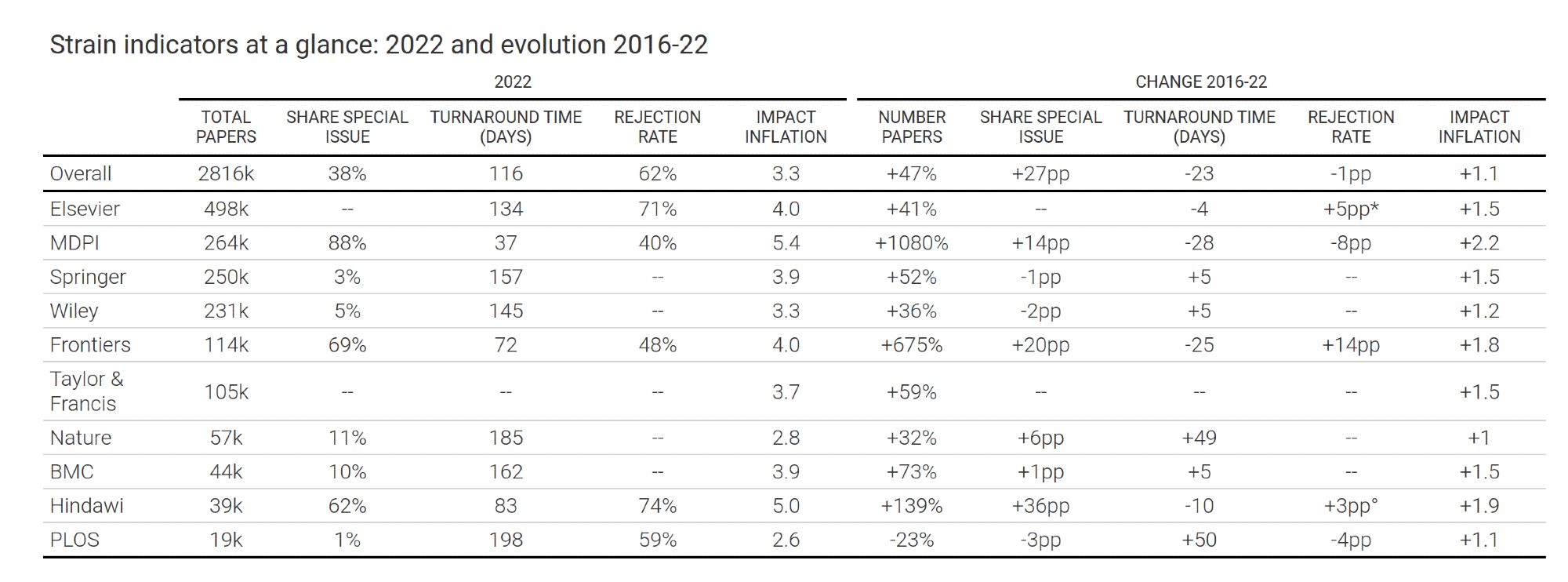
It’s the end of my first week away but before I go home for a swim in the pool on my roof terrace I thought I’d share an interesting paper on the arXiv by Hanson et al. (4 authors) entitled The Strain on Scientific Publishing. The abstract is:

Scientists are increasingly overwhelmed by the volume of articles being published. Total articles indexed in Scopus and Web of Science have grown exponentially in recent years; in 2022 the article total was 47% higher than in 2016, which has outpaced the limited growth, if any, in the number of practising scientists. Thus, publication workload per scientist (writing, reviewing, editing) has increased dramatically. We define this problem as the strain on scientific publishing. To analyse this strain, we present five data-driven metrics showing publisher growth, processing times, and citation behaviours. We draw these data from web scrapes, requests for data from publishers, and material that is freely available through publisher websites. Our findings are based on millions of papers produced by leading academic publishers. We find specific groups have disproportionately grown in their articles published per year, contributing to this strain. Some publishers enabled this growth by adopting a strategy of hosting special issues, which publish articles with reduced turnaround times. Given pressures on researchers to publish or perish to be competitive for funding applications, this strain was likely amplified by these offers to publish more articles. We also observed widespread year-over-year inflation of journal impact factors coinciding with this strain, which risks confusing quality signals. Such exponential growth cannot be sustained. The metrics we define here should enable this evolving conversation to reach actionable solutions to address the strain on scientific publishing.

arXiv:2309.15884

Here’s a table with some figures taken from the article, from which is easy to identify the most extreme behaviour and see that it is associated with predatory publishers.

How did we end up with such an absurd system that encourages this sort of behaviour?

This of course just covers the big publishers. The Open Journal of Astrophysics is much smaller: it has only published about a hundred papers in the period covered by the Table. For comparison, the OJAp rejection rate is about 49% and our turnaround time is about three weeks, on average, though with a large dispersion.

The Meaningless University Rankings

Posted in Education with tags , , , on September 29, 2023 by telescoper
Photo by Pixabay on Pexels.com

I see that the Times Higher has now released this year’s outcomes of its annual exercise in numerology called the World University Rankings. The announcement is accompanied by narratives such as this:

China is edging closer to the top 10 and now has two institutions in the top 15 for the first time. Tsinghua and Peking universities both overtake the University of PennsylvaniaJohns Hopkins University and Columbia University to rank 12th and 14th respectively in this year’s 20th edition of the ranking. Meanwhile, Japan’s University of Tokyo now outperforms the University of EdinburghKing’s College London and the London School of Economics and Political Science, after rising 10 places to 29th.

Blah Blah Blah.

Such statements are rendered even more meaningless than they usually are by the fact that this year’s (2024) rankings are constructed using a very different methodology from previous years. How do we know, then, that the changes in rank described above are due simply to a change in methodology?

The answer is that we don’t.

As I pointed out last week, it would be a very simple task to answer that question. All the Rankers need to do is run last year’s methodology using this year’s data and/or last year’s methodology with this year’s data, and compare the result with this year’s rankings. Any differences so produced would demonstrate whether or not the methodology is more important that the data. This is the sort of test that anyone with a basic knowledge of the scientific method would perform. Over the years I’ve asked the Times Higher many times to do this exercise and they have always refused.

My theory is that actual institutional changes take place much more slowly, over a much longer timescale than a year. These rankings would be much harder to sell, and to construct commentaries that sell, if the rankers if nothing much happened between, say 2023 and 2024. That’s why they shake up the methodology every few years, to make it look like something is happening with which their “journalists” can fill column inches.

It seems to me a reasonable inference that the Times Higher doesn’t really care whether the results of its annual Rankfest actually mean anything or not. They just want to peddle the results to the world’s bureaucrats and politicians who lap it all up unquestioningly. Unfortunately the people in and around universities who make strategic decisions often believe this sort of nonsense and hold quite a lot of power, so the league tables aren’t merely irrelevant garbage – they’re potentially dangerous garbage.

Hats off, then, to Utrecht University in the Netherlands who have refused to participate in this year’s rankings. I quote:

UU has chosen not to submit data. A conscious choice:

  • Rankings put too much stress on scoring and competition, while we want to focus on collaboration and open science.
  • In addition, it is almost impossible to capture the quality of an entire university with all the different courses and disciplines in one number.
  • Also, the makers of the rankings use data and methods that are highly questionable, research shows.

Quite so. More of this please!

The Decline of the Milky Way’s Rotation

Posted in The Universe and Stuff with tags , , , , on September 28, 2023 by telescoper

I just noticed an interesting item on the ESA website about results described in a paper by Jiao et al. (on the arXiv here) relating to the rotation of the Milky Way as determined by Gaia’s Data Release 3.

The key result in the paper is summarized in this diagram:

A galaxy rotation curve like this is a diagnostic of the radial distribution of mass. If all the mass were concentrated at the centre, the galaxy would behave like the Solar System (in which most of the mass is contained within the Sun). In such a Keplerian profile the rotation speed falls off with distance, just as the outer planets move more slowly in their orbits than the inner ones. According to modern cosmology, however, there is dark matter not concentrated in the centre, in which case the rotation curve does not decline with distance and may even rise. According to theory, at large distances, the rotation curve of a spiral galaxy should be roughly flat.

The new results seem to contract this notion. The Figure shows a rotation curve that declines for distances about 15 kpc from the Galactic Centre; for reference the Sun orbits at a radius of about 10 kpc.

One of the problems in constructing a rotation curve of our own Galaxy is that we are inside it so it isn’t possible to make measurements across the entire system like we can with other galaxies. Using the Gaia measurements and a plausible model, however, the authors find much less dark matter than anticipated.

With a bit of extrapolation using a model, this measurement leeds to a reduction in the estimated total mass of the Milky Way. The value usually bandied about is around 1012 Solar Masses, while the new measurements imply a much lower mass of about 2 × 10¹¹ Solar Masses.

A factor of five reduction is quite a dramatic change and I’m sure this result will be challenged by those of an orthodox persuasion while also providing encouragement to dark matter sceptics. We’ll just have to wait and see how this pans out.

New Publication at the Open Journal of Astrophysics

Posted in OJAp Papers, Open Access, The Universe and Stuff with tags , , , on September 28, 2023 by telescoper

Time to announce yet another new paper at the Open Journal of Astrophysics. This one was published yesterday (27th September 2023).

The latest paper is the 37th  so far in Volume 6 (2023) and the 102nd in all. The authors are Joe McCaffrey (Maynooth, Ireland), Samantha Hardin (Georgia Tech, USA), John Wise (Georgia Tech) and John Regan (Maynooth). As this one involved two authors from my own Department, I recused myself from the editorial process, although it is work I am very interested in.

The primary classification for this paper is Astrophysics of Galaxies and its title is “No Tension: JWST Galaxies at z>10 Consistent with Cosmological Simulations”.  I’ve blogged about this paper before, a few months ago, when it appeared on the arXiv. The editorial process on this one has been very thorough and  it has been a few rounds with the reviewers before being accepted for publication. The authors may have found this a bit irksome, but I think the process improved them paper considerably, which is what it is meant to do.

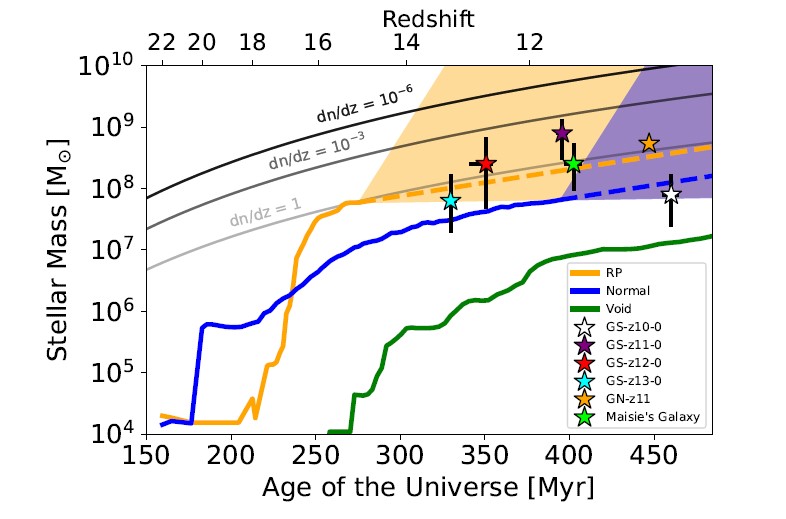
As many of you will be aware, there’s been a considerable to-do not to mention a hoo-hah about the detections by JWST of some galaxies at high redshift. Some of these have been shown not to be galaxies at high redshift after all, but some around z=10 seem to be genuine. This paper is a response to claims that these somehow rule out the standard cosmological framework.

The key figure in the current paper is this:

The solid curves show the number of galaxies of a given mass one would expect to see as a function of redshift in fields comparable to those observed with estimated values from observations (star-shaped symbols). As you can see the observed points are consistent with the predictions. There’s no tension, so you can all relax.

Anyway, here is a screen grab of the overlay of the published version which includes the  abstract:


You can click on the image of the overlay to make it larger should you wish to do so. You can find the officially accepted version of the paper on the arXiv here.