Memories of Barcelona

Posted in Architecture, Art, Biographical with tags , , , on September 17, 2023 by telescoper

I’ve had this poster for 30 years. It’s survived several relocations and is now on my bedroom wall in Maynooth. I bought it on a holiday in Barcelona in 1993 which, coincidentally, was the centenary of the birth of Joan Miró, and the reason for a special exhibition.

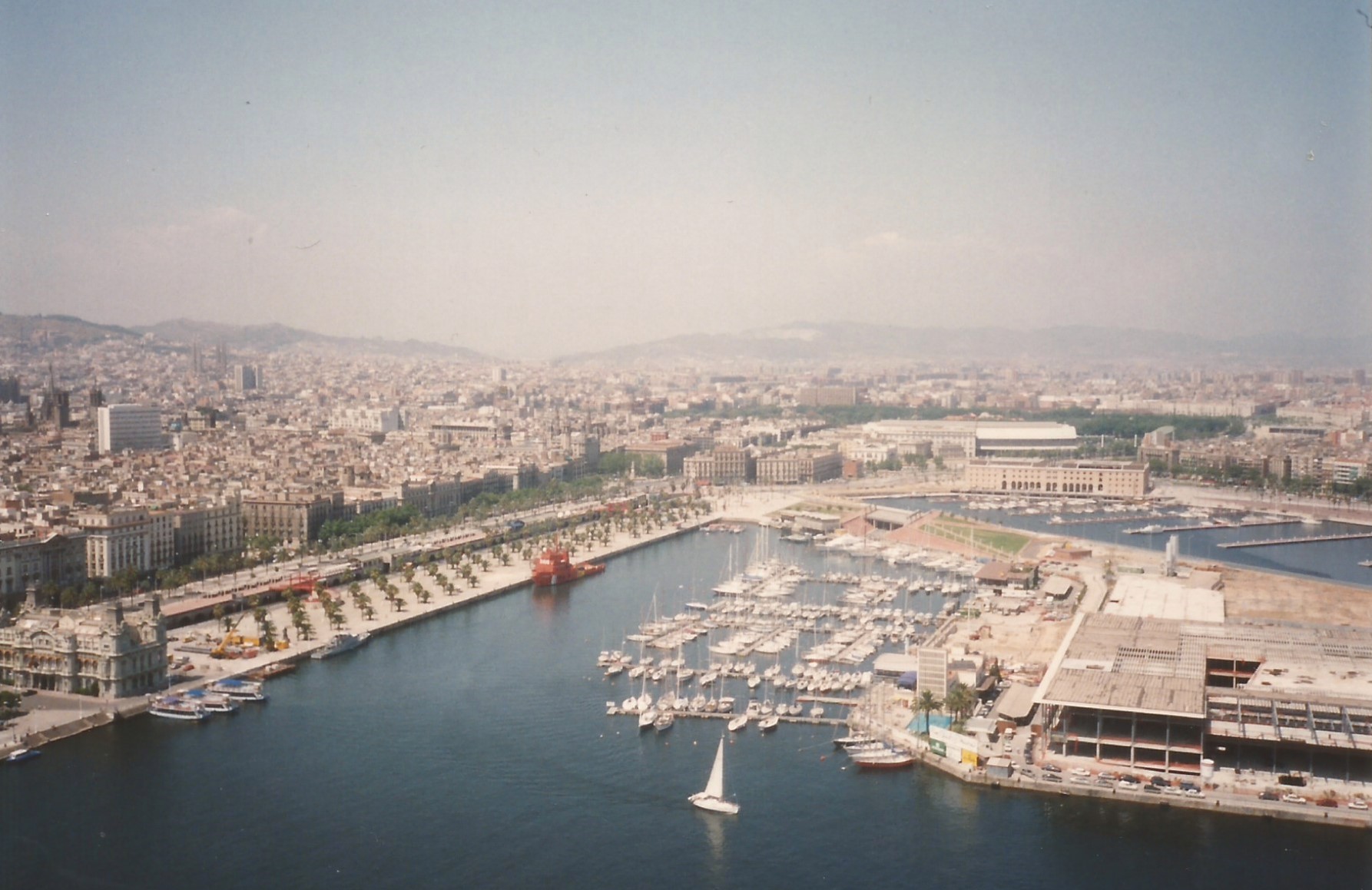
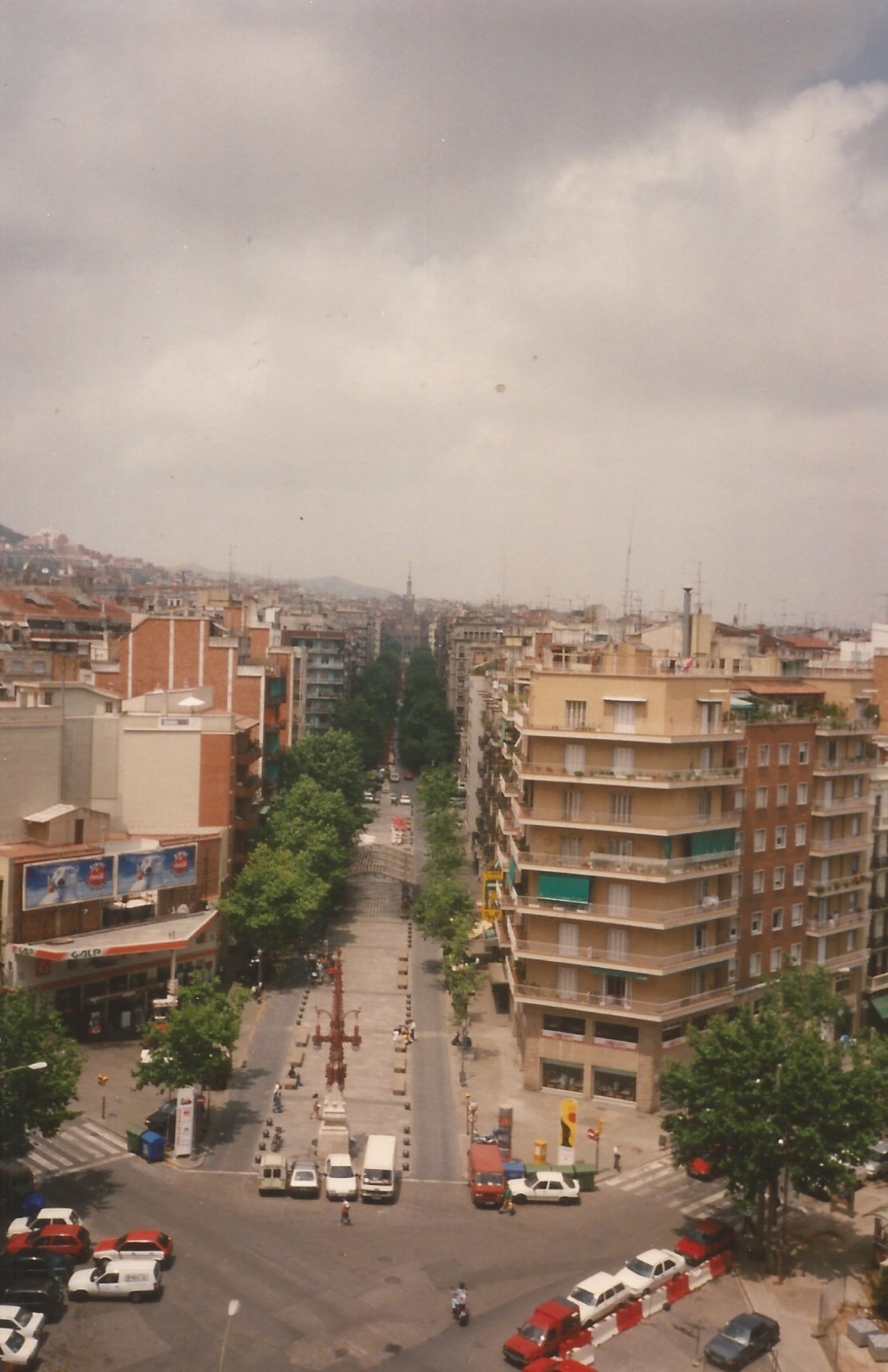
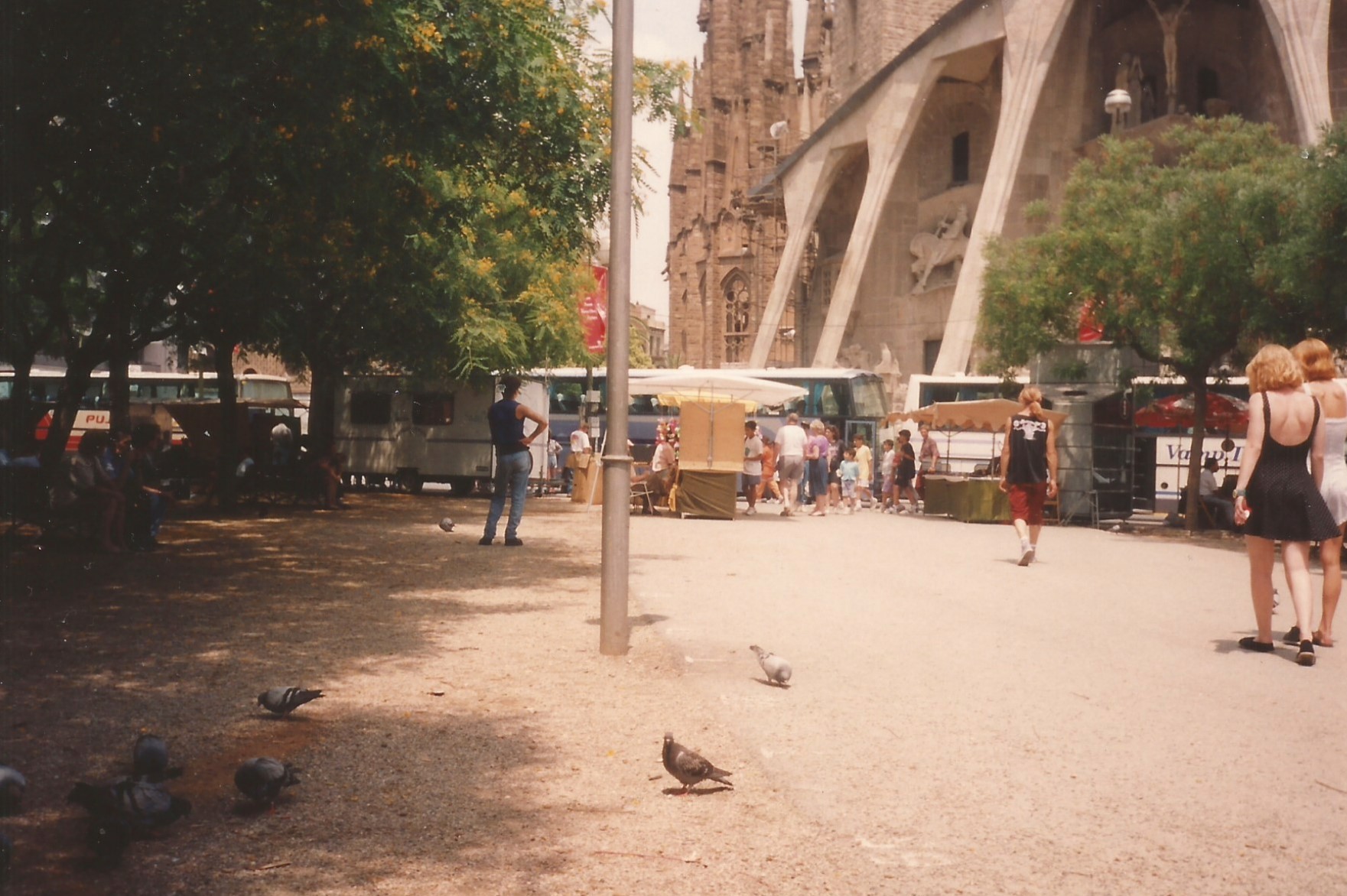
Since it’s a rainy Sunday afternoon and I’m feeling a bit nostalgic with just a week to go before I go to Barcelona once more, I thought I’d rummage through some boxes of old photographs to share some pictures taken on that trip in 1993. The first one is me being a bit scared on the funicular railway. The last picture shows my holiday mate David in blue (to the centre left) looking rather fetching from the rear as he ponders the Sagrada Familia:

Back in 1993 the Sagrada Familia was basically a building site. Thirty years on, it still isn’t finished but will be completed in 2026. Possibly. So I’m told.

15 Years In The Dark

Posted in Biographical, The Universe and Stuff on September 15, 2023 by telescoper

When I logged onto WordPress yesterday I received a message that it was the 15th anniversary of my registration with them, which is when I took my first step into the blogosphere. That was way back on 15th September 2008.

I actually wrote my first post on the day I registered but unfortunately I didn’t really know what I was doing on my first day at blogging – no change there, then – and I didn’t actually manage to figure out how to publish this earth-shattering piece. It was only after I’d written my second post that I realized that the first one wasn’t actually visible to the general public because I hadn’t pressed the right buttons, so the two appear in the wrong order in my archive.

Such was the inauspicious beginning of this “shitty WordPress blog”!

Since then I have published 6507 blog posts posts which have received well over 5M page views. The largest number of hits I have received in a single day is still 8,864 (in 2014, at the peak of the BICEP2 controversy). Scientifically we’ve seen the discovery of the Higgs Boson and gravitational waves, both of which resulted in Nobel Prizes, as did the studies of high-redshift supernovae. The Planck mission mission was launched, did its stuff, and came to a conclusion in this time too. Most recently we have had the launch of JWST and have started to see the first science results. Euclid was launched earlier this year. Science at least has moved forward, even many other things have not.

This year saw my 60th birthday, so I’ve been blogging for about 25% of my life so far. I’ll have to keep going until I’m 90 to reach 50%…

New Publication at the Open Journal of Astrophysics

Posted in OJAp Papers, The Universe and Stuff with tags , , , , , on September 15, 2023 by telescoper

Time to announce yet another new paper at the Open Journal of Astrophysics. This one is hot off the press and was published today (15th September 2023).

The latest paper is the 36th  so far in Volume 6 (2023) and the 101st in all. The authors are Kareem El-Badry (Department of Astronomy, California Institute of Technology, USA), Kevin Burdge (Kavli Institute for Astrophysics and Space Research, Massachusetts Institute of Technology, USA), Jan van Roestel (Anton Pannekoek Institute for Astronomy, University of Amsterdam,NL) & Antonio C. Rodriguez (Department of Astronomy, California Institute of Technology, USA).

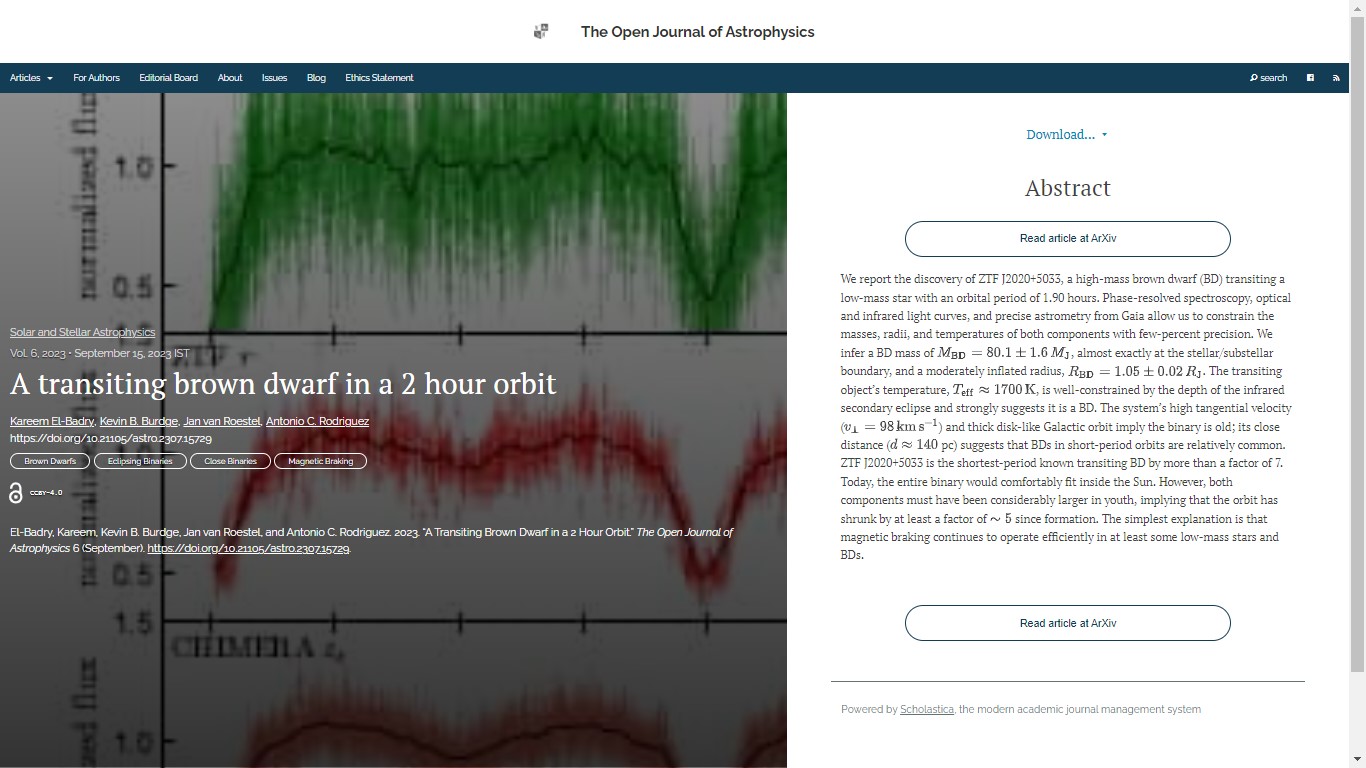
The primary classification for this paper is Solar and Stellar Astrophysics and its title is “A transiting brown dwarf in a 2 hour orbit”.  The article reports the discovery of a brown dwarf in a very short orbit around a low-mass star with a discussion about the evolution of this orbit probably due to magnetic braking. Amazingly, the entire binary system would fit comfortably inside the Sun (although that’s not actually where it is).

Anyway, here is a screen grab of the overlay of the published version which includes the  abstract:


You can click on the image of the overlay to make it larger should you wish to do so. You can find the officially accepted version of the paper on the arXiv here.

Enquiring into UK Astronomy

Posted in Science Politics, The Universe and Stuff with tags , , , on September 14, 2023 by telescoper

Apparently I still have a few readers in the UK, so I thought I’d share a bit of news aimed at them.

It seems the Science, Innovation and Technology Committee of the House of Commons has initiated an inquiry into ” how well placed the UK astronomy sector is to showcase the UK as a science superpower and maximise its leadership in international programmes”. Apparently this will examine the status of the UK’s astronomical research base and assets, UK access to international astronomical facilities and contribution to international programmes. It will also explore astronomy’s potential contribution to the UK economy and what considerations should inform the Science and Technology Facilities Council’s next Strategic Delivery Plan, due in 2026. 

I don’t know why STFC doesn’t just use ChatGPT to write its strategic plan like everyone else, but there you go.

Anyway, the Committee welcomes submissions addressing any or all of the following:

  • The strengths and weaknesses of UK astronomy and how these compare to other nations
  • The opportunities and challenges facing UK astronomy and whether it is receiving sufficient support
  • What the aims and focus of UK astronomy should be
  • The extent to which UK astronomy contributes to the UK’s status as a science superpower
  • Whether the UK is maximising the contribution that astronomy can make to the wider UK economy
  • What role astronomy is playing in encouraging greater diversity and inclusion in STEM and public interest in science

To find out more information and/or submit a submission go here. The deadline is 27th October.

Have fun!

Astronomy Volunteers Needed!

Posted in The Universe and Stuff with tags , on September 14, 2023 by telescoper

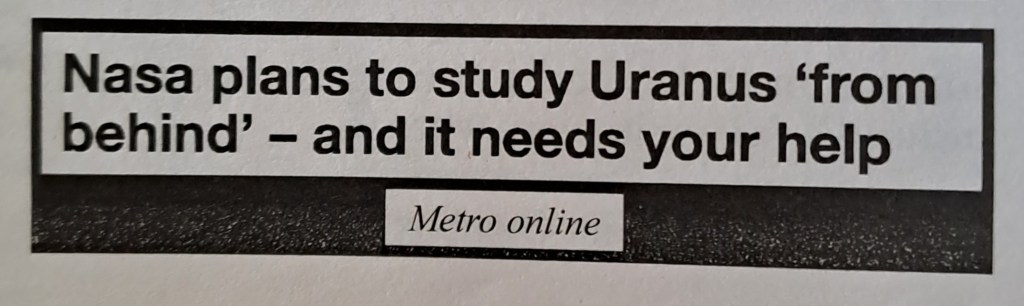
NASA apparently needs volunteers for an upcoming a forthcoming analysis:

From Private Eye

I’m not sure whether this involves a telescope, or an endoscope, or some other device yet to be erected, but I am always prepared to bend over backwards to help such initiatives. If you are similarly receptive, please apply to NASA. I’m sure they’ll be gratified by your submission.

Physics as Fun

Posted in Biographical, Education, Maynooth on September 13, 2023 by telescoper

To add to all the excitement I’ve just had a visit from a representative of ESB Networks who installed a new “smart” meter at my house in Maynooth. That process involved cutting off the electricity for about 15 minutes, which was long enough to set off my burglar alarm. Now that’s sorted, I have to go round resetting the clocks. All of that after I wasted half an hour this morning watching my laptop do compulsory Windows updates which involved two restarts.

Anyway, despite the distractions I’ve been working busily at home and getting ready for my departure abroad. This is the first year for a while that I haven’t been involved in Welcome Week or the Student Orientation process, which are ongoing. I have, however, looked at the online registrations so far and confirmed that there will indeed be some students in Theoretical Physics for the forthcoming academic year.

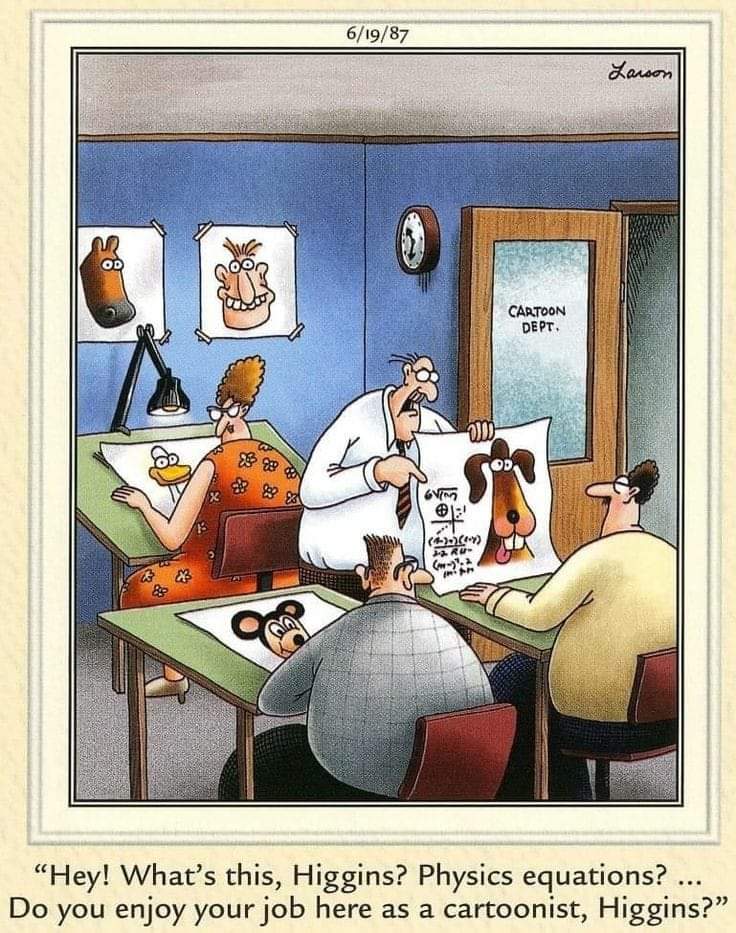
Yesterday I saw this cartoon by Gary Larson so thought I’d share it here.

It reminded me of this picture I have in the past shown at Open Days

I think there are many people out there who think physics, especially theoretical physics, isn’t something to be enjoyed. I think it is, or at least that it can be. I also think the best way to succeed at physics is by enjoying it, and I hope the new and returning students at Maynooth enjoy their theoretical physics over the next year while I am slaving away on sabbatical in Barcelona…

Let’s Make “No pay” Open Access Real…

Posted in Open Access, Politics with tags , on September 12, 2023 by telescoper

I took the liberty of reblogging this short post by Olivier Pourret about “No Pay” Open Access to direct readers to it and to make a couple of points. One is that you have to realize that “publishing-industry representatives” have a vested interest in the much of the discussion is about possible models for what might happen in the future, some of us have been busy making “No Pay” Open Access real in the here and now.

For some background, the article refers to a Council of Europe a document (PDF) that calls for “transparent, equitable, and open access to scholarly publications”.  In its conclusions, the Council calls on the Commission and the member states to support policies towards a scholarly publishing model that is not-for-profit, open access and multi-format, with no costs for authors or readers. In other words, it calls for Diamond Open Access. The covering press release includes:

If we really believe in open science, we need to make sure that researchers can make their findings available and re-usable and that high-quality scientific articles are openly accessible to anyone that needs to read them. This should be particularly the case for research that benefits from public funding: what has been paid by all should be accessible to all.

Mats Persson, Swedish Minister for Education, Ministry of Education and Research

This is clearly how Open Access should be, though I am still worried that the sizeable publishing lobby will still try to persuade research agencies and institutions to pay the existing fees on behalf of authors, which does not solve the problem but merely hides it.

I know I’m not alone in thinking that the current publishing ecosystem is doomed and will die a natural death soon enough. In my view the replacement should be a worldwide network of institutional and/or subject-based repositories that share research literature freely for the common good. Universities and research centres should simply bypass the grotesque parasite that is the publishing industry. Indeed, I would be in favour of hastening the demise of the Academic Journal Racket by having institutions make it a disciplinary offence for any researcher to pay an APC to any journal.

We are lucky in physics and astronomy because arXiv has already done the hard work for us. With the existence of arXiv, old-style journals are no longer necessary. It is great that arXiv is being joined by similar ventures in other fields, such as BiorXiv and EarthArxiv. A list of existing repositories can be found here. I’m sure many more will follow. The future is Diamond.

What is needed is a global effort to link these repositories to each other and to peer review mechanisms. One way is through overlays, as demonstrated by the Open Journal of Astrophysics, there being no reason why the idea can’t be extended beyond arXiv. Other routes are possible, of course, and some of these are mentioned in the article I reposted. I would love to see different models developed, but that needs action, not words.

From Einstein to Euclid: the Gallery

Posted in Biographical, Maynooth, The Universe and Stuff with tags , , on September 11, 2023 by telescoper

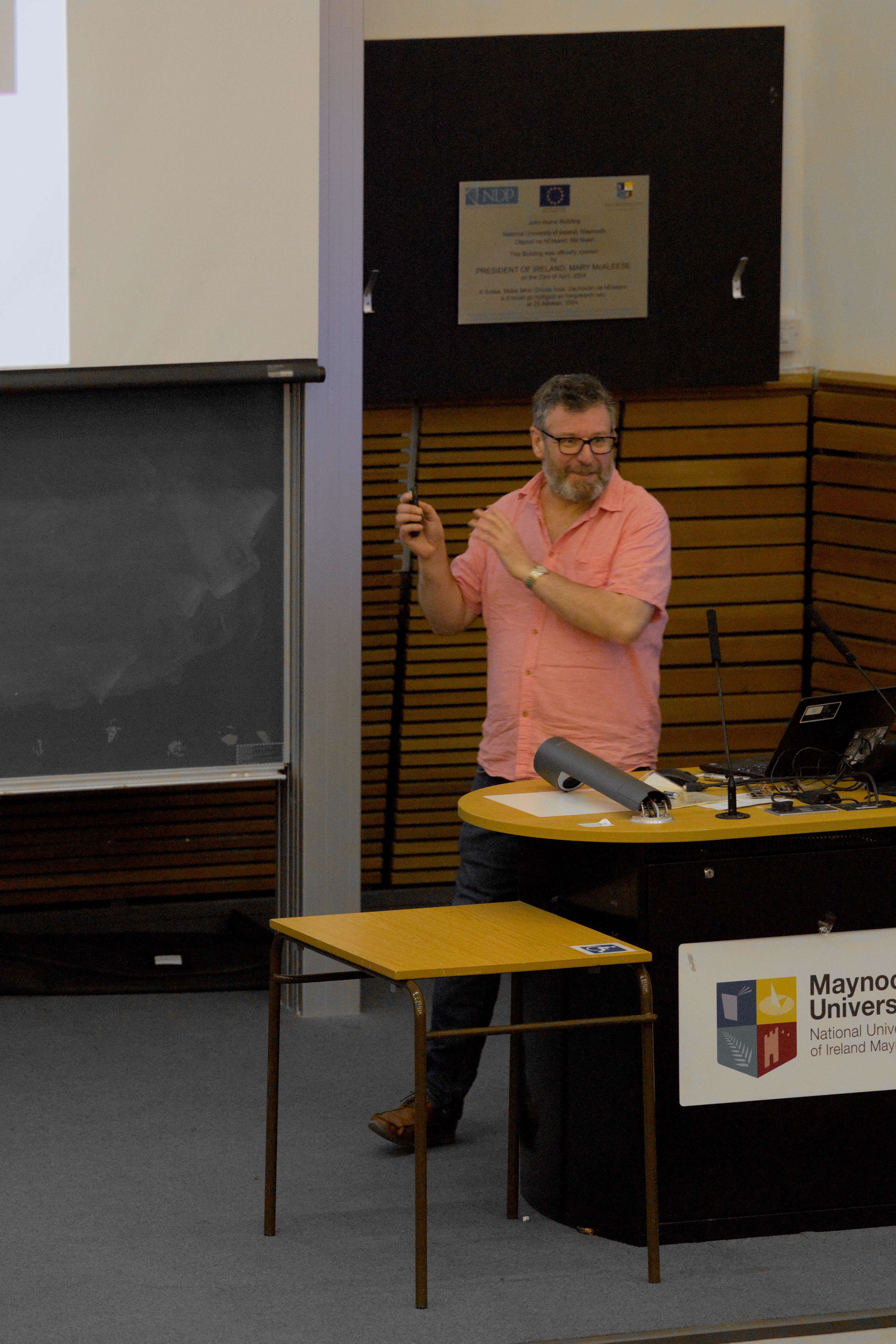
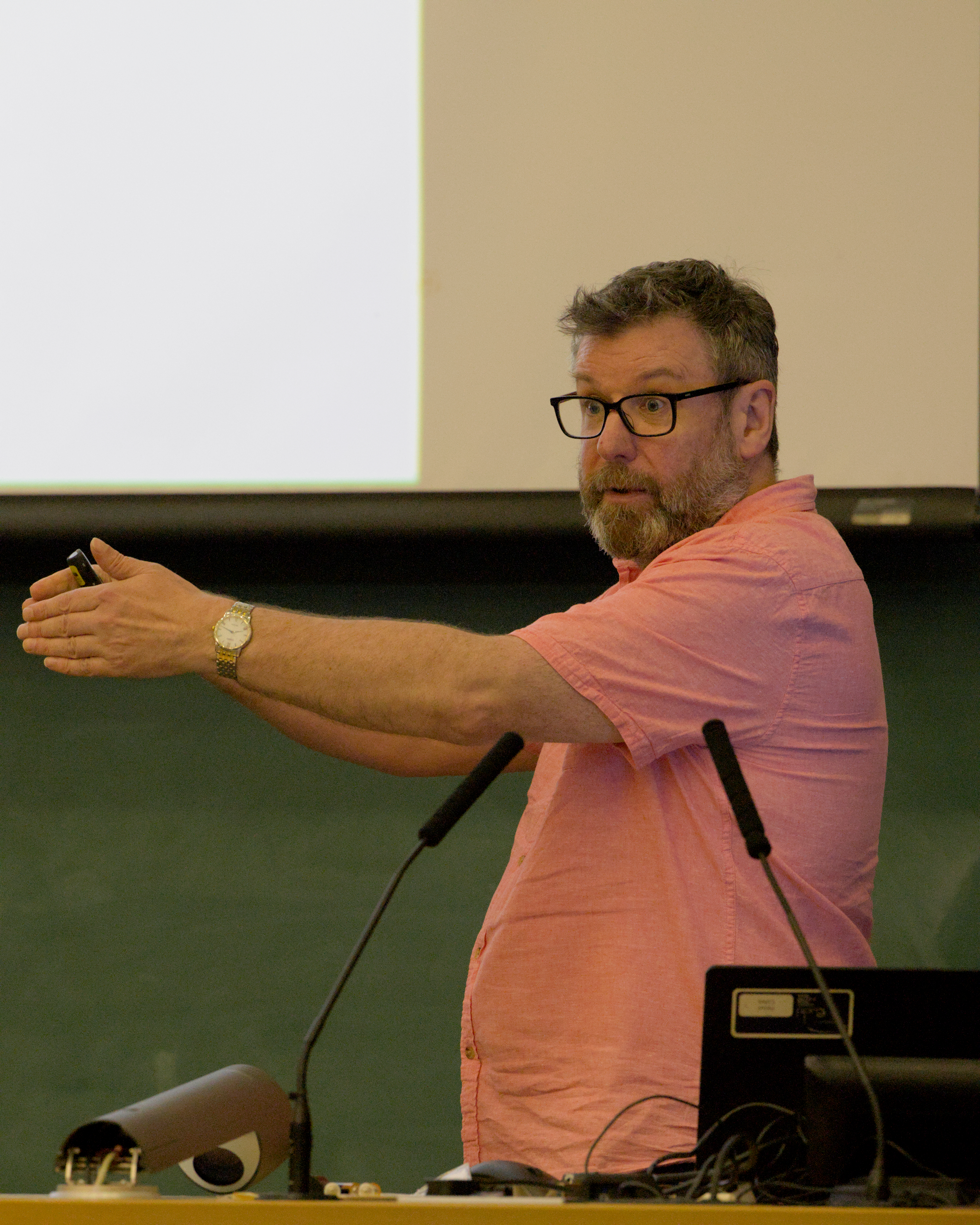
Last week I posted a photograph taken during my public lecture at Maynooth University. I thought I’d compound your collective misery by putting up more. I’m not sharing any pics of the audience because we didn’t ask them for permission, so you’re basically stuck with pictures of me (and one of Joost Slingerland, our Head of Department, in the first one).

Thanks to Dale for taking the pictures!

The 100th Publication at the Open Journal of Astrophysics

Posted in OJAp Papers, Open Access, The Universe and Stuff with tags , , , on September 11, 2023 by telescoper

I am happy to announce the publication of yet another new paper at the Open Journal of Astrophysics. This one is hot off the press; it was published today, 11th September 2023.

The latest paper is in fact our 100th publication. It is also the 35th in Volume 6 (2023), which means that we have now published more papers so far this year than in the previous two years put together. I’d like to thank everyone who has supported the Open Journal of Astrophysics and helped us get this far! Here’s to the next 100!

Anyway, the new paper is entitled A complete catalogue of merger fractions in AGN hosts: No evidence for an increase in detected merger fraction with AGN luminosity and it is a complete and systematic analysis of detected merger fractions in AGN hosts from the literature leading to the conclusion that there is no evidence for correlation between the two.

The primary classification for this paper is Astrophysics of Galaxies and the author is Carolin Villforth of the Department of Physics in the University of Bath. As author of our 100th paper, Carolin wins a year’s free subscription to the Open Journal of Astrophysics.

Here is a screen grab of the overlay of the published version which includes the  abstract:


You can click on the image of the overlay to make it larger should you wish to do so. You can find the officially accepted version of the paper on the arXiv here.

Incidentally, you might notice a new feature on the overlay above. Just above the Abstract heading on the right and side you can see a little link saying “Download”. This allows you to download the citation to the paper in BibTex format.

Research Matters

Posted in Science Politics, The Universe and Stuff with tags , , , , , on September 10, 2023 by telescoper

One of the things that happened last week while I was preoccupied with ITP2023 is that, finally, the UK Government has decided to re-join the European Union’s Horizon 2020 project. I’m very happy about this, and can’t understand why it has taken so long to reach an agreement. I know many researchers in the UK who will be mightily relieved too. Of course things won’t immediately get back to normal. It’s not just that the UK contributions will start in January 2024 so there will have to be some sort of transitional arrangement. More importantly it remains to be seen how long it takes to repair the damage done to goodwill by all the political shenanigans.

While I’m on about research I should also mention that there was a short talk at ITP2023 by a particle physicist by the name of Ronan McNulty who is based at University College Dublin. The topic of that talk was the history of Ireland’s non-membership of CERN; I have blogged about this before, for example here. Currently Ireland is in the anomalous position of not having any form of association agreement with CERN; the list of Full and Associate Member states can be found here. It does seem, however, that Ireland is at last about to lodge an application for Associate Membership, perhaps as early as January 2024.

Ronan made a particularly important point about membership, which I hope is not sidelined in the discussions. The case for joining CERN made at political levels is largely about the return in terms of the potential in contracts to technology companies based in Ireland from instrumentation and other infrastructure investments. This was also the case for Ireland’s membership of the European Southern Observatory, which Ireland joined about five years ago. The same thing is true for involvement in the European Space Agency, which Ireland joined in 1975. These benefits are of course real and valuable and it is entirely right that arguments should involve them.

Looking at CERN membership from a scientific point of view, however, the return to Ireland will be negligible unless there is a funding to support scientific exploitation of the facility. That would include funding for academic staff time, and for postgraduate and postdoctoral researchers to build up an active community as well as, e.g., computing facilities. This need not be expensive even relative to the modest cost of associate membership (approximately  €1.5M). I would estimate a figure of around half that would be needed to support CERN-based science.

The problem is that research funding for fundamental science (such as particle physics) in Ireland is so limited as to be virtually non-existent by a matter of policy at Science Foundation Ireland, which basically only funds applied research. Even if it were decided to target funding for CERN exploitation, unless there is extra funding that would just lead to the jam being spread even more thinly elsewhere.

As I have mentioned before, Ireland’s membership of ESO provides a cautionary tale. The Irish astronomical community was very happy about the decision to join ESO, but it was not accompanied by significant funding to exploit the telescopes. Few astronomers have therefore been able to benefit from ESO membership. While there are other benefits of course, the return to science has been extremely limited. The phrase “to spoil a ship for a ha’porth of tar” springs to mind.

Although Ireland joined ESA almost fifty years ago, the same issue applies there. ESA member countries pay into a mandatory science programme which includes, for example, Euclid. However, did not put any resources on the table to allow full participation in the Euclid Consortium. There is Irish involvement in other ESA projects (such as JWST) but this is somewhat piecemeal. There is no funding programme in Ireland dedicated to the scientific exploitation of ESA projects.

Under current arrangements the best bet in Ireland for funding for ESA, ESO or CERN exploitation is via the European Research Council but to get a grant from that one has to compete with much better developed communities in those areas.

A significant shake-up of research funding in Ireland is in view, with Science Foundation Ireland and the Irish Research Council set to merge into a single entity. If I had any say in the new structure I would set up a pot of money specifically for the purposes I’ve described above. Funding applications would have to be competitive, of course, and I would argue for a panel with significant international representation to make the decisions. But for this to work the overall level of public sector research funding will have to increase dramatically from its current level, well below the OECD average. Ireland is currently running a huge Government surplus which is projected to continue growing until at least 2026.

Only a small fraction of that surplus would be needed to build viable research communities not only in fundamental science but also across a much wider range of disciplines. Failure to invest now would be a wasted opportunity.