Euclid First Light Video

Posted in Euclid, The Universe and Stuff on August 1, 2023 by telescoper

Following on from yesterday’s post about the “first light” images from the European Space Agency’s Euclid mission, here is a little video highlighting the brilliant work done by the instrument teams over the last month .

P.S. You can find some Irish press coverage of the first light images here.

“First Light” Images from Euclid

Posted in Euclid, The Universe and Stuff with tags , , , , , on July 31, 2023 by telescoper

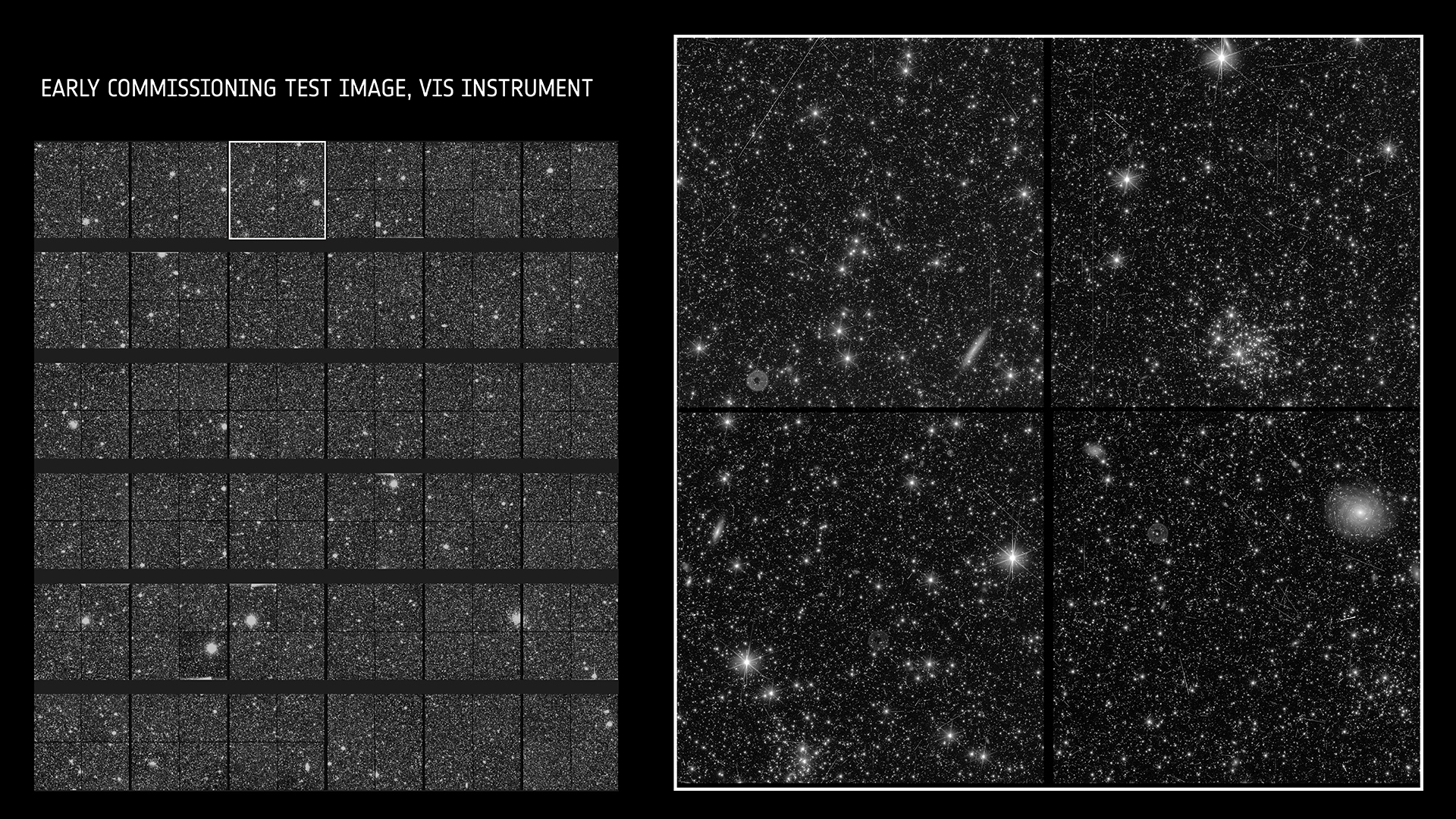
As I promised a couple of days ago, the “first light” images from the European Space Agency’s Euclid mission have now been released. You can find all the details here, but a summary is that these are “engineering” images, rather than part of the full survey to be undertaken by Euclid, and the commissioning of the instruments is not quite finished, but the telescope is now in focus and both instruments (the visual instrument, VIS, and the Near-Infrared Spectrometer & Photometer, NISP) are working well enough to show some preliminary results.

Anyway, here are the pictures released today, first from VIS:

Euclid early commissioning test images, showing an image by the VIS instrument (visible light). The full focal plane of VIS consisting of 36 detectors is shown on the left, and one detector in higher resolution on the right. Credits: © ESA/Euclid/Euclid Consortium/NASA, CC BY-SA 3.0 IGO

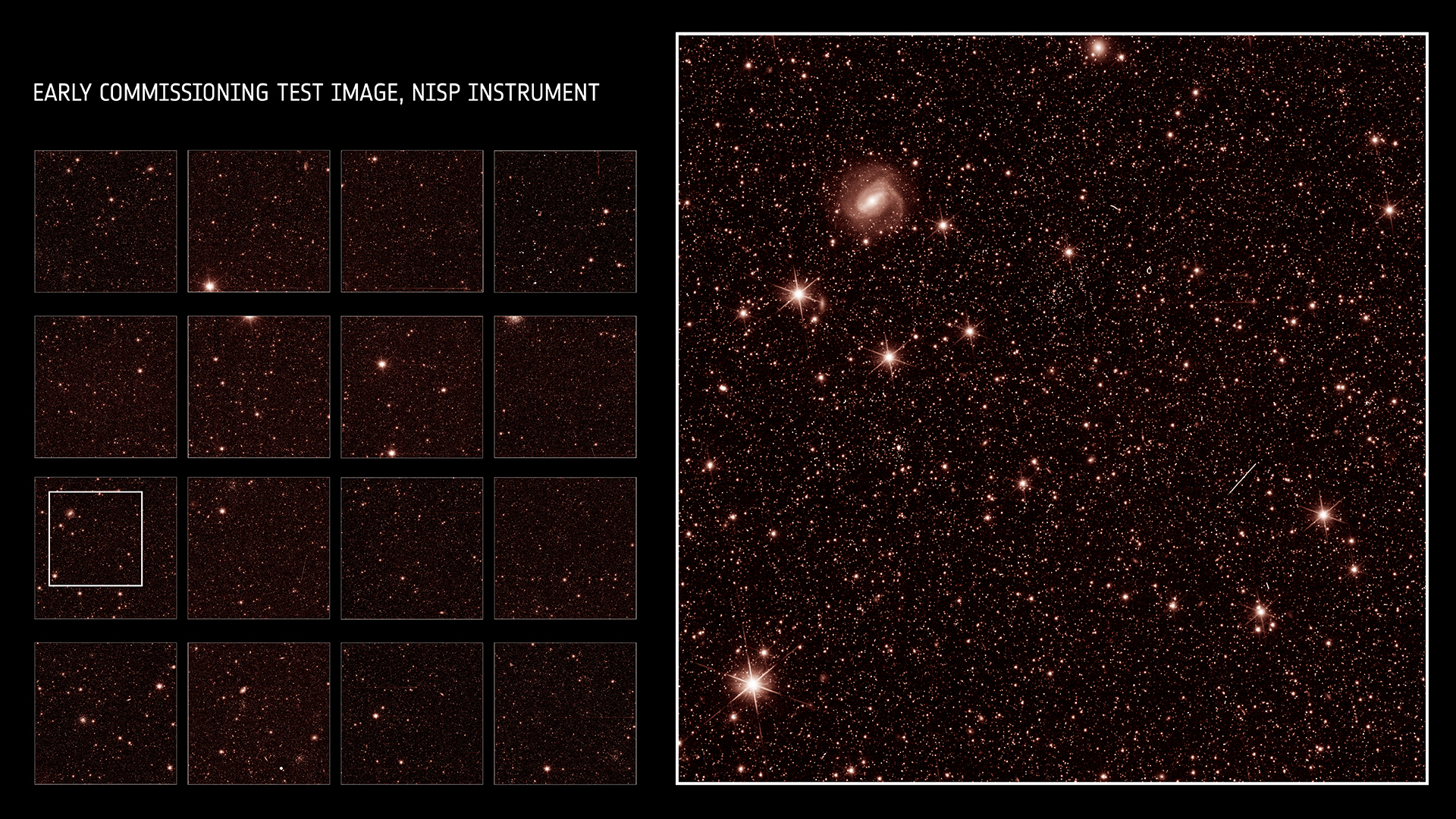
The next one is from NISP:

Euclid early commissioning test images, showing an image by the NISP instrument (near-infrared light). The full focal plane of NISP consisting of 16 detectors is shown on the left, and part of one detector in higher resolution on the right. Credits: © ESA/Euclid/Euclid Consortium/NASA, CC BY-SA 3.0 IGO

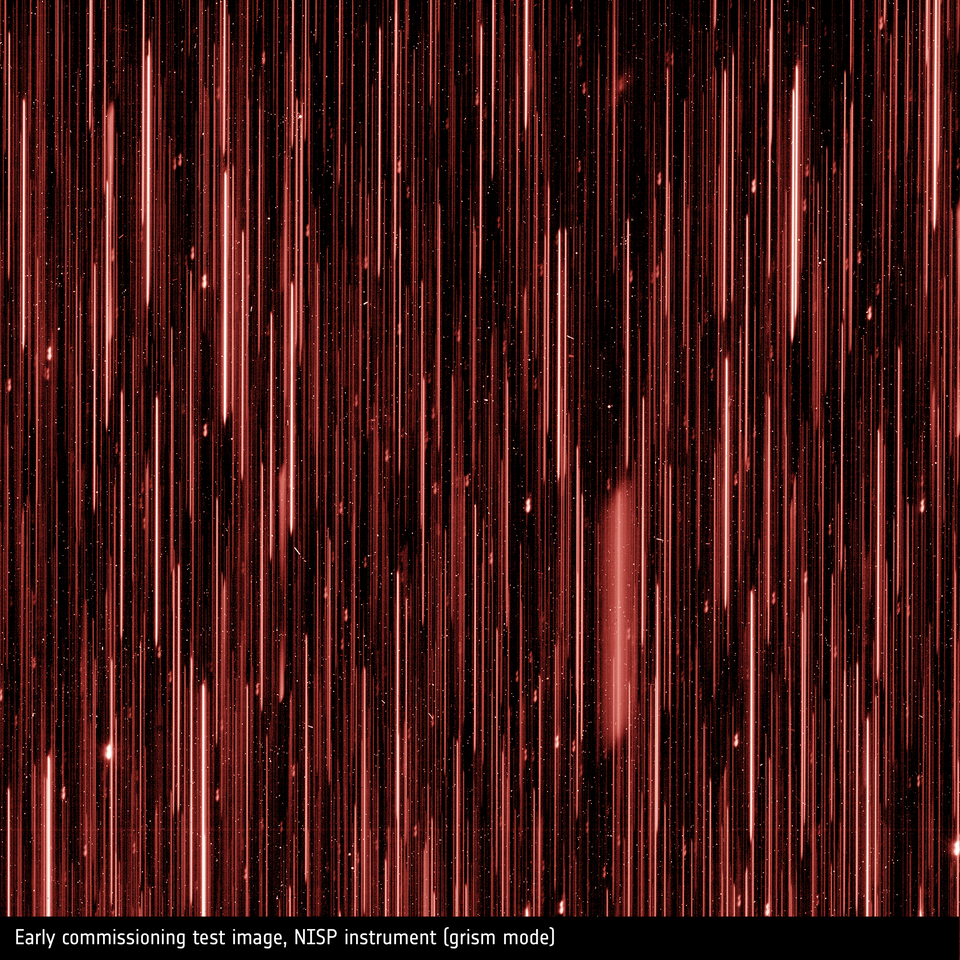
This final one, also from NISP, shows it working in grism mode, which allows the light from sources to be dispersed into a spectrum, enabling us to get much more information about the sources galaxies than a straightforward image would. The resulting images look a bit strange to the untrained eye – as the light from a point is spread out into a streak – but the result is wonderfully rich in information:

Euclid early commissioning test images, showing an image by the NISP instrument (near-infrared light), in its grism slitless spectroscopy mode. The full focal plane of NISP consists of 16 detectors, here a part of one detector is shown in full resolution. Credits: © ESA/Euclid/Euclid Consortium/NASA, CC BY-SA 3.0 IGO

For more information – and some higher-resolution images – see the official Euclid press release here.

For myself, I’d just say these images are absolutely amazing given that they were taken during the commissioning phase and the instruments aren’t fully tweaked yet. Over the next few weeks, there will be a performance verification phase which will tell us how good Euclid will be at meeting its science goals. But so far it’s all looking very good indeed. I’ve only ever seen simulations of what would come out and it’s very exciting to see what the real thing looks like!

Hats off to the brilliant instrumentation experts who not only designed and built the kit but who have been working so hard on the commissioning. They’ve done so much in the month that has passed since the launch!

P.S. You can find here a nice explainer of some of the instrumental artefacts you might have spotted in the images above.

From OJAp to AI

Posted in OJAp Papers with tags , on July 30, 2023 by telescoper

I was messing around with an AI “Art” generator and decided to use it to generate images to go with the latest four papers published at the Open Journal of Astrophysics, using the titles of these papers as prompts. The results are a mixture of strange and hilarious. I was only using the free version of the software which only allows 10 generations per day and there are lots of possible styles. I’m sure with more attempts one could get even more interesting outputs!

Anyway, if you click on each of the images below it should take you to an image of the overlay of the paper it is supposed to represent….

(This is a guest post by our Artificial Intelligence correspondent, A.I. Addio.)

Euclid has arrived…

Posted in Euclid, The Universe and Stuff with tags , , , on July 29, 2023 by telescoper

Here’s a little video update to accompany the news that, as of yesterday (28th July), the European Space Agency’s Euclid spacecraft has reached its orbit around L2, the second Lagrange Point of the Earth-Sun system:

More news is on the way. Commissioning of the instruments is now complete and the telescope is in focus. On Monday 31st July, ESA will release the first actual images from the Euclid telescope!

Stay tuned here.

Four New Publications at the Open Journal of Astrophysics

Posted in OJAp Papers, Open Access, The Universe and Stuff with tags , , , , , , , , , , , , , , , , on July 29, 2023 by telescoper

The rate of publication at the Open Journal of Astrophysics has now reached the point at which I think I’ll have to limit myself to weekly updates here rather than announcing every paper as it appears. We still announce individual papers on social media of course, meaning Mastodon, Facebook and the platform formerly known as Twitter…

This week we have published four papers which I now present to you here. These four take the count in Volume 6 (2023) up to 31 and the total published by OJAp up to 96. I speculated earlier this year that we might reach 100 before the end of 2023, now it looks certain we will reach the century mark as early as August! It is gratifying to see the range of papers published increasing, with all four of these in different categories.

In chronological order, the four papers published this week, with their overlays, are as follows. You can click on the images of the overlays to make them larger should you wish to do so.

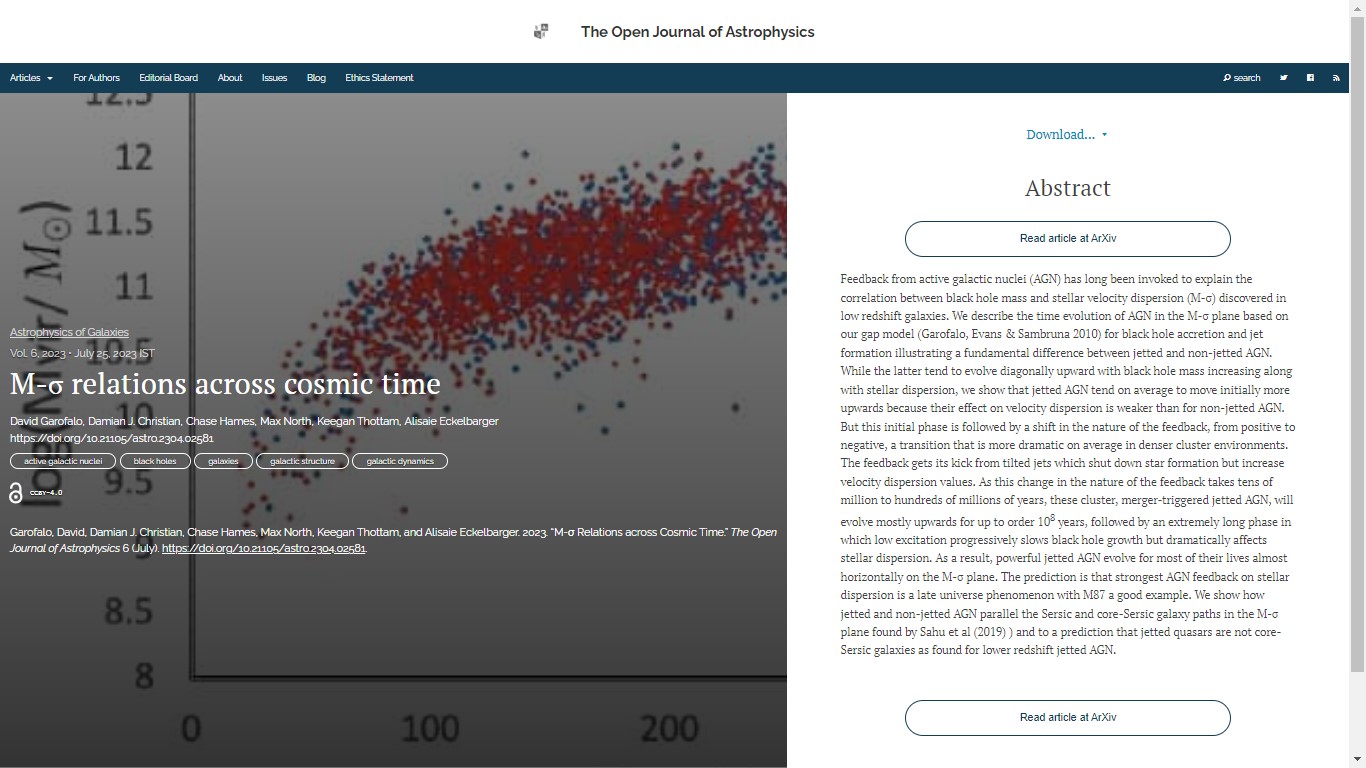
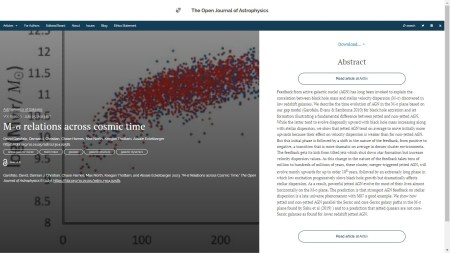
First one up is “M-σ relations across cosmic time” by David Garofalo (1), Damian J. Christian (2), Chase Hames (1), Max North (3), Keegan Thottam (1) & Alisaie Eckelbarger (1). The author affiliations are: (1) Department of Physics, Kennesaw State University, USA; (2) Department of Physics and Astronomy, California State University, Northridge, USA; (3) Department of Information Systems, Kennesaw State University, USA. This is a discussion of the relationship between black hole mass and stellar velocity dispersion discovered in low redshift galaxies and its evolution with cosmic time. The paper was published on 25th July, is in the folder marked Astrophysics of Galaxies and can be found here.

Here is a screen grab of the overlay, which includes the abstract:
You can find the officially accepted version of the paper on the arXiv here.

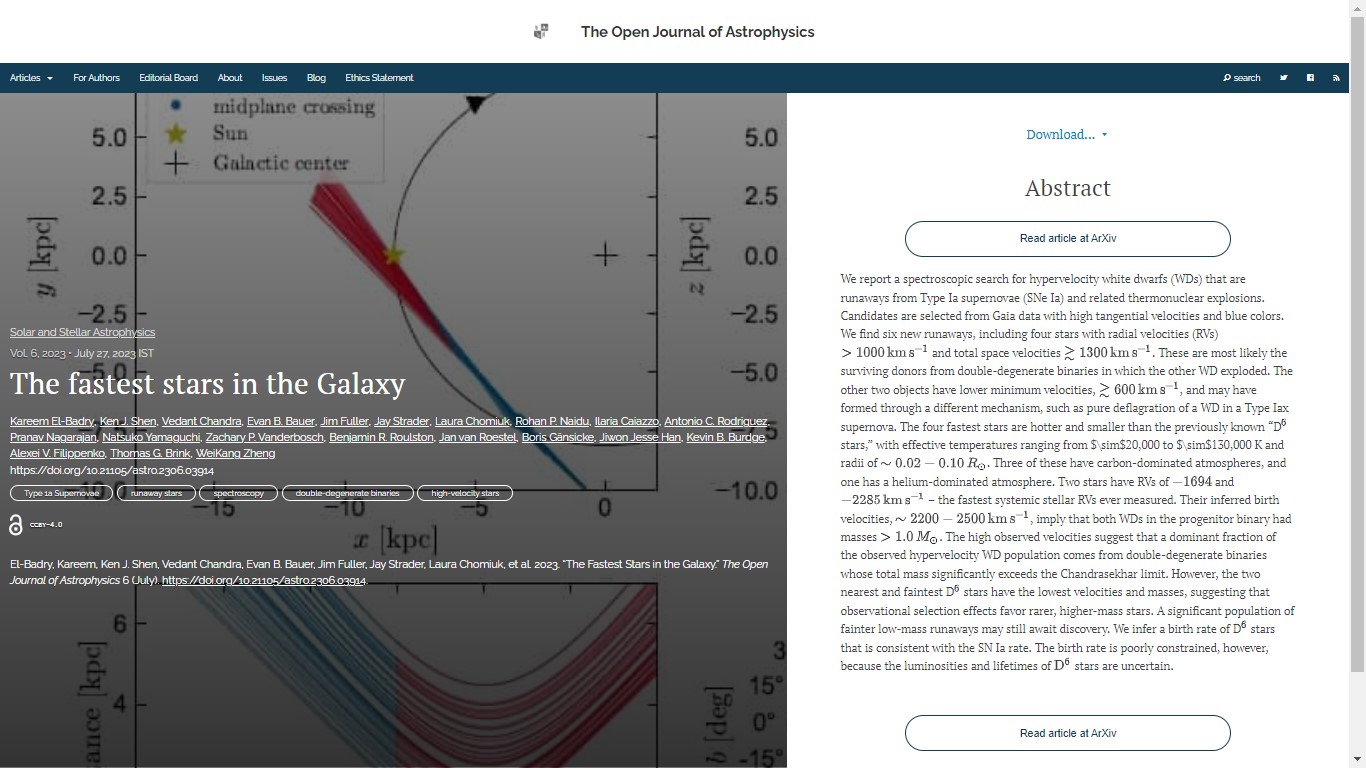
The second paper to announce is “The fastest stars in the Galaxy” by Kareem El-Badry et al. (21 authors. This one is the fourth item in the folder marked Solar and Stellar Astrophysics and it reports the spectroscopic discovery of 6 new “runaway” stars, probably the surviving members of binary star systems in which one star exploded in a Type 1a supernova. The paper was published on 27th July 2023 and you can see the overlay here:
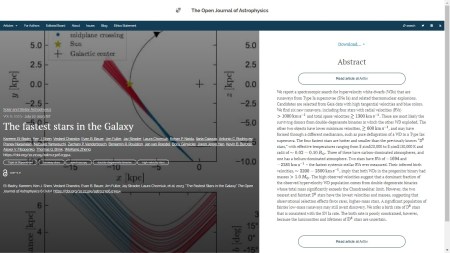
The accepted version of this paper can be found on the arXiv here.

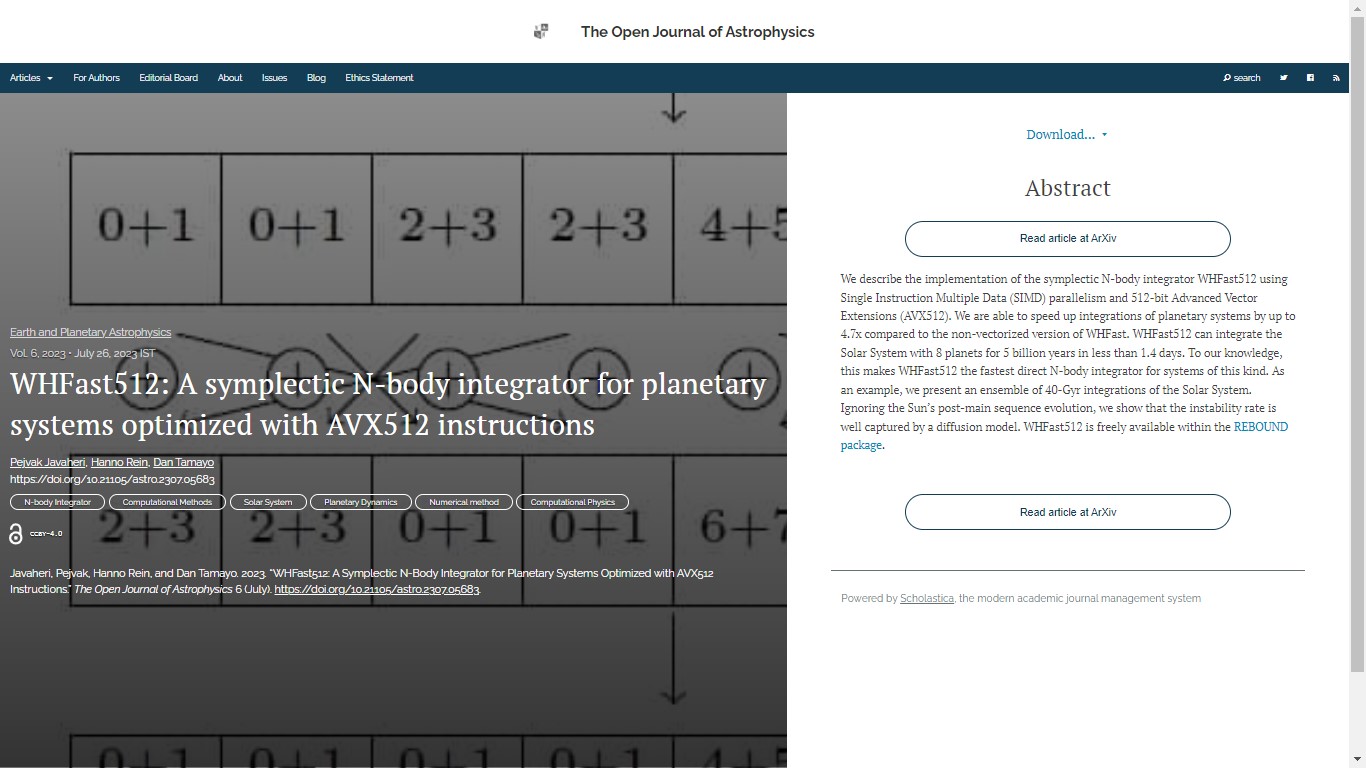
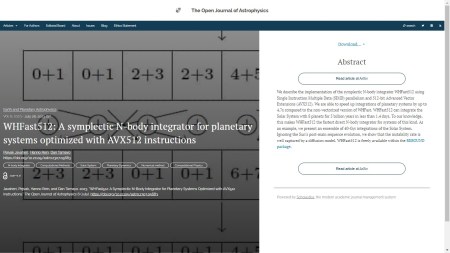
The next paper is in the Earth and Planetary Astrophysics folder. It is in fact only the second paper we have published in that area. It is entitled “WHFast512: A symplectic N-body integrator for planetary systems optimized with AVX512 instructions” by Pejvak Javaheri & Hanno Rein (University of Toronto, Canada) and Daniel Tamayo (Harvey Mudd College, USA). This paper presents a fast direct N-body integrator for gravitational systems, and demonstrates it using a 40 Gyr integration of the Solar System.

Here is the overlay:
 

You can find the full text for this one on the arXiv here.

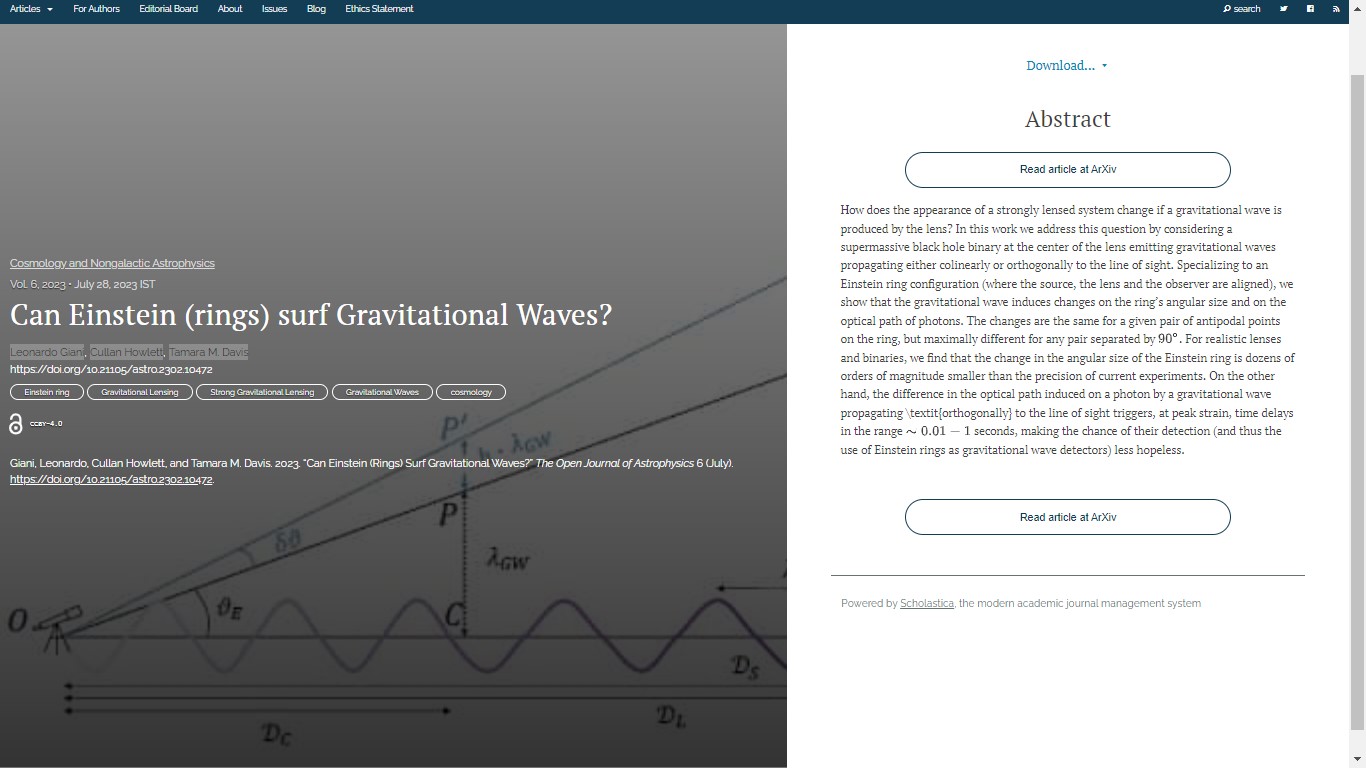
Last but by no means least, published yesterday (29th July), we have a paper that asks the question “Can Einstein (rings) surf Gravitational Waves?” by Leonardo Giani, Cullan Howlett and Tamara M. Davis of the University of Queensland, Australia. The primary classification for this one is Cosmology and Nongalactic Astrophysics and it discusses the possible effect(s) of gravitational waves on gravitational lensing observations.
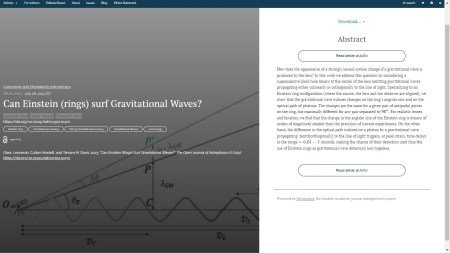
 

You can click on the image of the overlay to make it larger should you wish to do so. You can find the officially accepted version of the paper on the arXiv here.
Notes to Future Self

Posted in Biographical, The Universe and Stuff with tags , on July 28, 2023 by telescoper

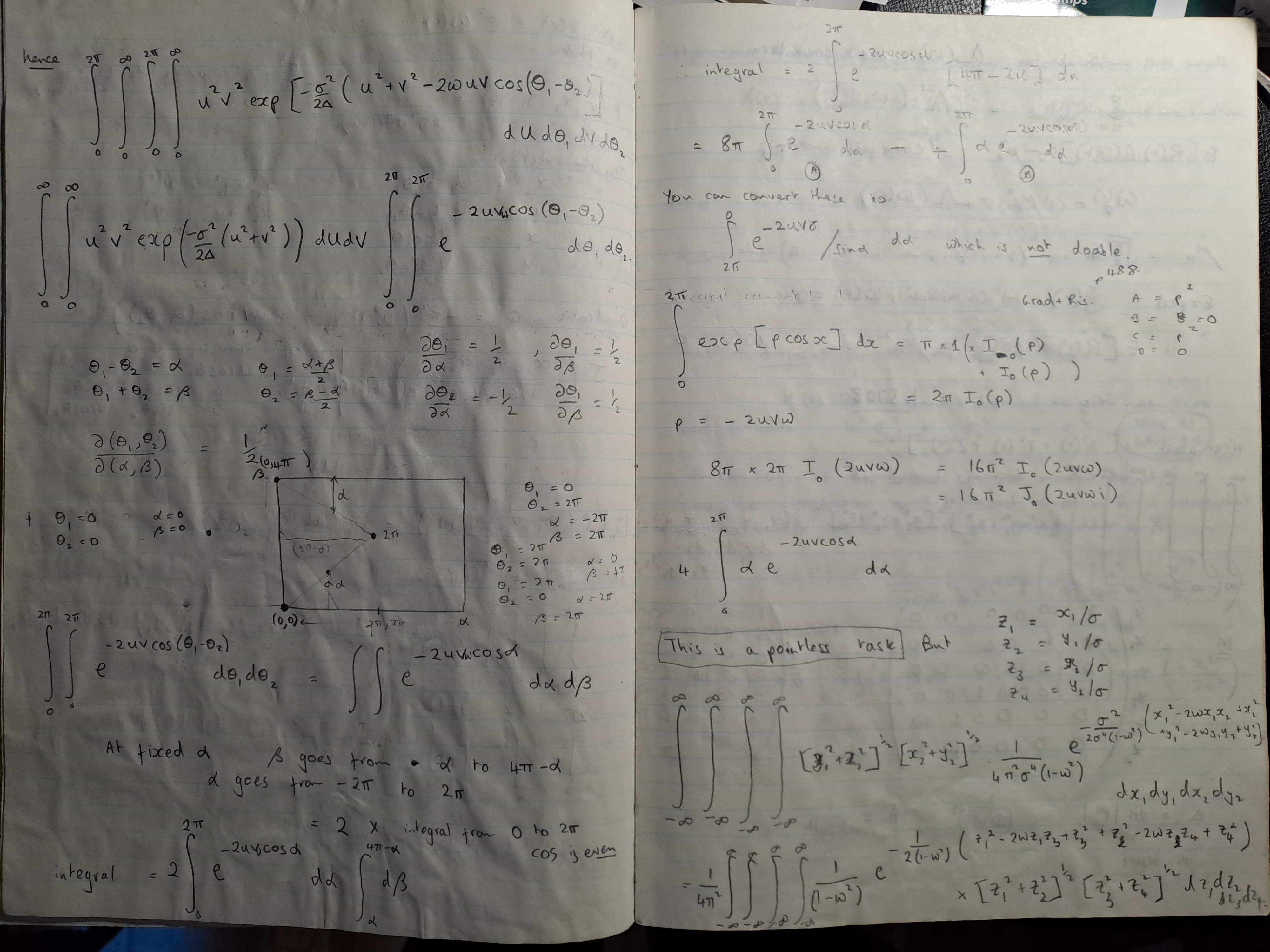
Yesterday I was tidying up a bit and came across the old notebooks I used when I was a research student. As I suppose is the case with everyone else, there’s quite a lot in them that never went anywhere. If you can read the example above, about 3/4 of the way down the right-hand page I left a note saying “This is a pointless task”. I can’t remember if that referred to that particular integral or my research in general!

Some people who have seen this picture remarked on the size of my integral signs. That’s because I had to do quite a lot of integrals with complicated integrands, so I got into the habit of drawing big integral signs as a prelude to writing down what I assumed would be a horrible formula.

The way I worked in those days (1985-88) was to do a lot of rough scribblings on scrap paper. When I got to something I thought was promising I would write up a “neat” version in the notebook and throw away the workings. I know younger folks these days do most of their work on a screen but, as an old fogey, I still write a lot down on paper or on a blackboard. I didn’t have my own blackboard when I was a PhD student, but I did have plenty of notebooks – most of which I have kept. I think that I’ll always find an essential part of the mathematical thought process involves a pen or piece of chalk in my hand, moving around and guiding my brain.

Looking through these books I remember that I also wrote down ideas for follow-up projects. I managed to do very few of these, but some were done by other people elsewhere independently of me, so at least they were reasonable ideas!

No Second Troy, by W.B. Yeats

Posted in Poetry with tags , , on July 27, 2023 by telescoper

Why should I blame her that she filled my days
With misery, or that she would of late
Have taught to ignorant men most violent ways,
Or hurled the little streets upon the great,
Had they but courage equal to desire?
What could have made her peaceful with a mind
That nobleness made simple as a fire,
With beauty like a tightened bow, a kind
That is not natural in an age like this,
Being high and solitary and most stern?
Why, what could she have done, being what she is?
Was there another Troy for her to burn?


by William Butler Yeats (1865-1939)

R.I.P. Sinéad O’Connor (1966-2023)

Posted in Music, R.I.P. with tags , , on July 26, 2023 by telescoper

I just heard the truly awful news of the death at the age of 56 of Sinéad O’Connor. Words fail me, so here’s her classic Nothing Compares 2 U from 1990, when it was a worldwide hit.

There can’t be many pop videos done like this, entirely in close-up.

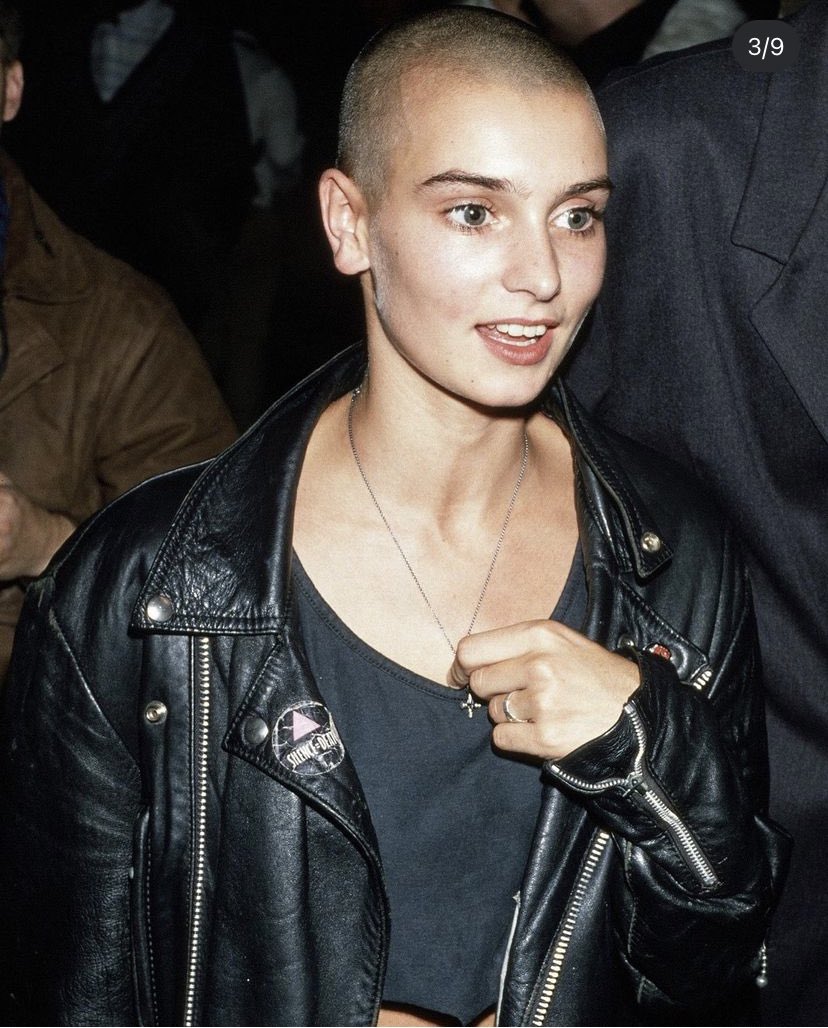
Incidentally I once saw Sinéad O’Connor in person, at the Zap Club in Brighton, when I literally bumped into her trying to get to the bar. When she turned around I was staggered to see such a beautiful face looking at me, although to be honest I did for a moment assume she was a boy. I was expecting an angry response to my clumsiness, but all I saw was an impish grin and those amazingly lovely eyes. That must have been in 1990 or earlier. Anyway, she was wearing the same leather jacket and cropped hair as in this picture, taken in 1988.

Back then, the time of the AIDS crisis, Sinéad O’Connor stood up for LGBTQ+ rights. She sang at Pride when it was far from fashionable to do so, and participated in the Red Hot and Blue album, which featured a wide range of artists doing covers of Cole Porter songs. I’ve always loved her satirical take on You So Something To Me, in which she is done up to resemble Veronica Lake:

Life had often been a struggle for Sinéad – she suffered from mental health problems and had to endure the loss of her son just 18 months ago – but she was a uniquely talented artist who enriched many lives. I just hope she knew how much she was loved by so many people.

R.I.P. Sinéad O’Connor (1966-2023).

R.I.P. Charles W. Misner (1932-2023)

Posted in R.I.P., Uncategorized with tags , , , on July 26, 2023 by telescoper
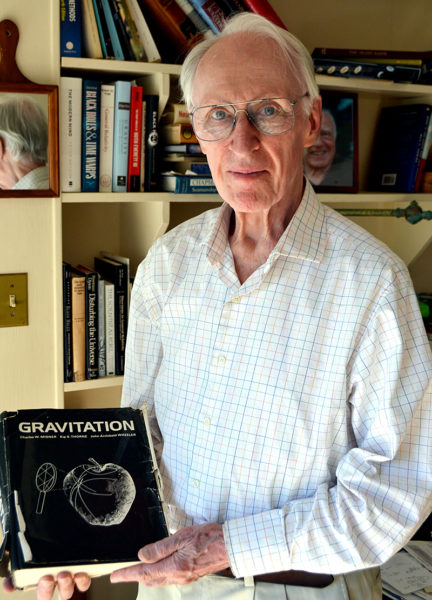
Charles Misner, pictured in 2016. (Picture credit: Maia Zewert)

Earlier this year I wrote a blog post pointing out that the classic textbook Gravitation by Misner, Thorne and Wheeler (above) is 50 years old this year. MTW (as it is usually known) was first published in 1973, and has has now been reprinted 24 times.

I was therefore saddened to learn that the eminent theoretical physicist Charles W. Misner, the first author of this famous tome, passed away a couple of days ago, on 24th July 2023, at the age of 91. A full obituary of Prof. Misner can be found here.

Rest in peace, Charles W. Misner (1932-2023)

The First Room-Temperature Superconductor?

Posted in The Universe and Stuff with tags , , , on July 25, 2023 by telescoper

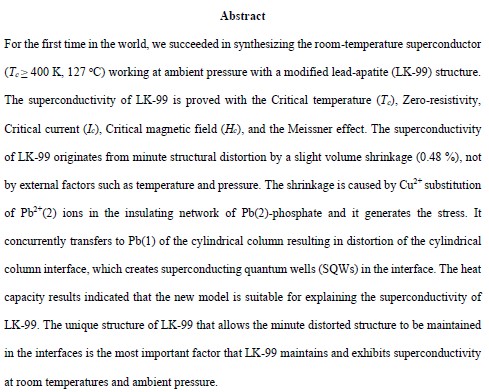
This is outside my usual areas, but there’s a new paper on arXiv which, if verified, could be extremely important. It’s called The First Room-Temperature Ambient-Pressure Superconductor and it is written by three scientists based in Korea. High temperature superconductivity has been, er, a hot topic for some years. One must be cautious because (as far as I am aware) the article has not yet been refereed, but is this a breakthrough?

Here is the abstract:

It seems to me that 400K is a bit hot for a room, but the point is that the material behaves as a superconductor (i.e. zero resistivity) for T < Tc so cooler rooms would do! The current definition of “high temperature” is Tc > 77K which is much lower than the Tc = 400 K stated here.

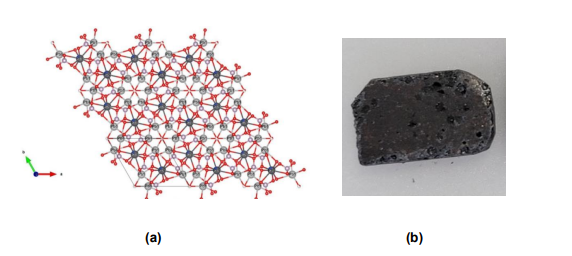
Here’s part of a figure from the paper showing (right) the material LK-99 and its structure (left):

I’m not an expert, but it looks like the material involved is neither particularly expensive nor particularly complicated so it should be relatively easy to determine whether these results are reproducible.

Comments from experts are welcome!