Maynooth Open Day Admissions

Posted in Education, Maynooth with tags , , on April 22, 2023 by telescoper
The Day Before The Open Day

Well, it’s Saturday 22nd April and it’s another Open Day at Maynooth University. I was there for the similar event at this time last year, and many others before that, but others are doing it this year so I’m sitting at home drinking coffee and writing this blog. I hope it’s going well (though it is raining quite heavily as I write this).

This year’s event is in the new TSI building on the North Campus, a change of venue since last year when it was in the Iontas building. I went in there last night on my way home to have a look at the setup. Our stand was pretty bare then but it will be a bit more exciting now (I hope).

In previous years I taught the first-year module in Mathematical Physics taken by new students, some of whom recognized me from an Open Day. I won’t be teaching the first-years this September, though. I won’t be teaching anyone else this September, either, as I’ll be away on sabbatical for the whole academic year.

The real problem facing first-years, however, is that it seems that yet again this year’s Leaving Certificate results will be late. Last year, new students started a week later than returning students, meaning their teaching term was truncated. The shift from August release to September was excusable during the Covid-19 pandemic, but its continuation is a farcical and is causing huge stress for new students, arising from difficulties in finding accommodation and no time for proper induction events on top of the delayed start to lectures. Well have to wait until June to see how much all this has affected progression rates.

There was an opinion piece about this in the Irish Times last week, from an academic at Trinity, which I agree with and I think is well worth reading. Here’s a quote:

This may all have once felt like an inevitable consequence of the pandemic, but the novelty has long since worn off. Students and universities alike have been left frustrated and hugely discommoded.

The word “discommoded” is a considerable understatement. Let’s just hope that the start of next year is less chaotic than the last three. The academic year at Maynooth starts and ends a bit later than other Irish third-level institutions, so our students have only lost a week at the beginning. Elsewhere more time has been lost: two weeks at Trinity, for example. I wonder if this particular selling-point will be mentioned to prospective students at the Open Day?

Teaching those who want to learn

Posted in Biographical, Education, mathematics, Maynooth with tags , , , on April 21, 2023 by telescoper

Yesterday afternoon I ran the last formal Computational Physics laboratory of the term. As is often the case with these sessions, the students were given a Python task to work through, with assistance available from myself and a demonstrator (and indeed other students). We have 25 students registered on this module, who are split into two groups, so about a dozen students were in yesterday’s session. That’s a comfortable number to make sure everyone can get some help.

This is the sixth year I’ve done this module, and I decided a long time ago that the best way to ensure that students learn the necessary skills is to give them things to do and let them work things out for themselves (with help where necessary). A couple of years ago, on my module feedback questionnaire, a student wrote an intended criticism along the lines of – “It’s like he expects us to learn to code by doing it ourselves, rather than him teaching us”. That is, of course, exactly what I intended, though we do give plenty of help during the labs.

Just as the best way to learn a foreign language is by speaking it, the best way to learn coding is by writing programs. Some of the students on this module have done any before, so for them the early stages of the module are rather straightforward. At least half the class, however, haven’t done any programming, so for them it’s a fairly steep learning curve.

Anyway, it being the last formal session of term this week’s task was a rather challenging one, involving the solution of a boundary value problem via the shooting method. It’s a good exercise because it brings together methods for solving ordinary differential equations with root-finding, as well as requiring some thought as to the general construction of a code that combines these two.

As expected, given the difference in background of the students, some finished this in good time, but others went more slowly. Some very excellent things happened, though, which made me very happy with the the whole experience.

One was that instead of leaving as soon as they had finished, a few of the students who had completed the task early stayed behind to help their friends. I encourage this, but it doesn’t always happen as much as yesterday. It’s called teamwork, and it’s essential not only in physics but also in everyday life.

The lab session was supposed to finish at 4pm, but not all students were done by then. Another excellent thing though was they didn’t just quit when they had run out of time. I stayed well past 4pm to help those who were determined to finish. In one case it was just a ‘0’ that should have been a ‘1’ in the index of an array that stopped it working. I don’t know why it took me so long to spot this, but we got there in the end.

One student, however, had another class at 4pm so left, only to return at five to continue. The student finally left, having completed the exercise, at about 6.45. The persistence shown by the students in refusing to be defeated was truly admirable. This harks back to a piece of advice I gave some time ago:

If you really want to develop as a physicist, don’t just solve a lot of easy problems; challenge yourself by tackling difficult ones too. Don’t be afraid to get “stuck” or make a mistake, as those are both necessary parts of the learning process. Above all, develop the confidence in your ability to take on a problem and back yourself to solve it and don’t be deterred if the answer doesn’t come quickly!

You may say that if it took some students much longer than the allocated time to finish then the problem was too difficult. That may be the case, but do you ever really learn if you’re not stretched? There is a place for straightforward formulaic tasks in higher education, but there’s much more to a university education than doing things like that.

Obviously the lab took up much more of my time as I had originally planned – more than double, in fact – but I went home pleased with a good day’s work. As I’ve said on this blog many times before, there are few things more rewarding than teaching students who want to learn.

Marking and Assessment Boycott

Posted in Education with tags , , on April 20, 2023 by telescoper

Meanwhile, in the UK, members of the University and College Union have begun a marking and assessment boycott as part of the lengthy industrial action they are taking against employers over pay and working conditions. I am no longer involved in UK academia, of course, and indeed I will be spending much of this afternoon correcting class tests, but I know plenty of people who are so I’d like to express my support for this just cause.

I’m taking this opportunity to share this video made by UCU of a presentation about the marking and assessment boycott, which I hope may prove useful.

Student Feedback and Lecture Recordings

Posted in Cardiff, Education, Maynooth with tags , , on April 19, 2023 by telescoper

This afternoon we had a very interesting meeting about teaching in the Department of Theoretical Physics at Maynooth University, involving teaching faculty and student representatives from each year of each of the courses we offer.

It was nice that most of the feedback gathered by the student reps from their peer groups was positive. For one thing, they really like the blackboard-based teaching we use to deliver most of our modules. Most of the negative comments, however, related directly to lack of resources.

A particular concern, expressed unanimously by all the student reps at the meeting, was the lack of lecture recordings. I don’t think I am alone among the teaching staff in the Department in saying that I wish we could offer lecture recordings as routine. Unfortunately, however, and much to my disappointment, the Senior Management at Maynooth University has discouraged lecture recording as a matter of policy and has not invested in the technology required to make this possible so it is not practicable anyway.

My two previous employers – the University of Sussex and Cardiff University – both had systems in place long before the Covid-19 pandemic and all lectures were recorded as standard . I blogged about this 8 years ago, in fact. In my view the benefits of lecture capture far outweigh the disadvantages, and we should incorporate recordings of lectures as part of our standard teaching provision, as a supplement to learning rather than to replace face-to-face sessions. Every student learns in a different way and we should therefore be doing as much as we possibly can to provide a diverse range of teaching resources so that each can find the combination that suits them best. Technology allows us to do this far better now than in the past.

Some really enjoy live in-person lecture sessions, especially the ability to interact with the lecturer and the shared experience with other students, but others don’t like them as much. Others have reasons (such as disability) for not being able to attend in-person lectures, so providing recordings can help them. Others still have difficulty attending all lectures because of a dratic shortage of student accommodation. Why not in any case provide recordings for everyone? That seems to me to be a more inclusive approach.

The problem with lecture capture in Maynooth is that we will need to improve the cameras and recording equipment in the large lecture rooms to make it possible for lectures with a significant mathematical content. The existing setups in teaching rooms do not easily allow the lecturer to record material on a whiteboard or blackboard. In Cardiff, for example, the larger rooms have more than one camera, usually one on the lectern and one on the screen or whiteboard (which has to be placed further away and therefore needs to be of higher resolution). In Maynooth we only have small podium cameras in the teaching rooms. In fact I have far better facilities in my study at home – provided at my own expense – than my employer is prepared to provide on campus.

My home teaching room

I’m baffled and frustrated by Maynooth’s decision in this matter, which is generating a great deal of negativity amongst faculty and students alike. I hope The Management can be persuaded to change its mind. Persisting with the current policy would send a clear message that teaching and learning are not valued at Maynooth. Maybe they just aren’t?

P.S. The single most common inquiry I have received about the new MSc course announced recently has been whether it is possible to take it remotely. Given our lack of recording facilities, regrettably the answer to this is “no”.

Astronomy Plot of the Week

Posted in The Universe and Stuff with tags , , on April 19, 2023 by telescoper

Pictures made by observational astronomers, like the one I featured a couple of days ago, often feature on various sites as “Astronomy Pic of the Week” or such. I’ve often thought that this disadvantages astrophysicists of the more theoretical sort and wondered why don’t we do same with graphical illustrations of other kinds. On that basis, I offer this (found here) as my inaugural Astrophysics Plot of the Week:

Its explanatory power is matched by its simplicity and elegance.

New Publication at the Open Journal of Astrophysics

Posted in OJAp Papers, Open Access, The Universe and Stuff with tags , , , , on April 18, 2023 by telescoper

Back after a short hiatus due to the Easter holidays, it’s time to announce yet another new paper at the Open Journal of Astrophysics. This one was accepted for publication a few weeks ago but the final version only appeared on the arXiv yesterday. Since OJAp is an arXiv-overlay journal, we have to wait for authors to upload the accepted version before we can publish the overlay.

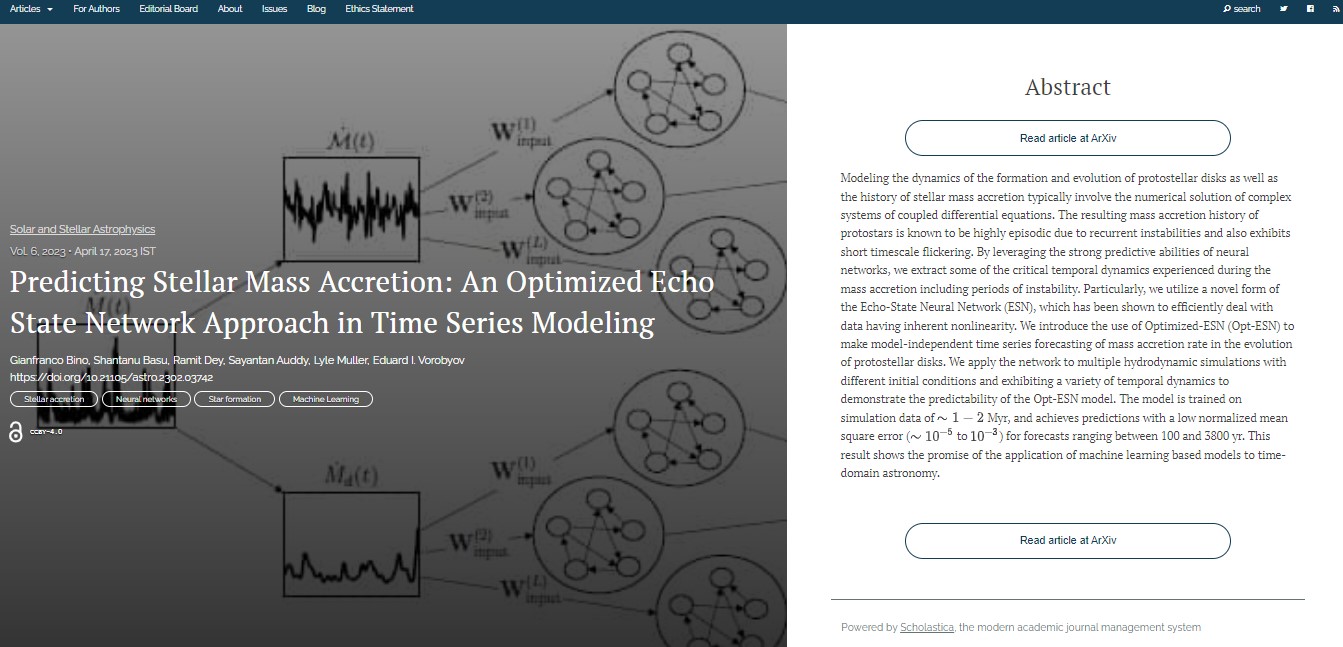
Anyway, the latest paper is the 12th paper so far in Volume 6 (2023) and the 77th in all. This one is in the currently under-populated folder marked Solar and Stellar Astrophysics and its title is “Predicting Stellar Mass Accretion: An Optimized Echo State Network Approach in Time Series Modeling”.

The authors are: Gianfranco Bino, Shantanu Basu & Ramit Dey (all at the University of Western Ontario, Canada), Sayantan Auddy (Jet Propulsion Laboratory, Pasadena, USA), Lyle Muller (University of Western Ontario, Canada) and Eduardo I. Vorobyov (University of Vienna, Austria & Southern Federal University, Russia).

Here is a screen grab of the overlay which includes the  abstract:

You can click on the image of the overlay to make it larger should you wish to do so. You can find the officially accepted version of the paper on the arXiv here.

R.I.P. Ahmad Jamal (1930-2023)

Posted in Jazz, R.I.P. with tags , , , on April 17, 2023 by telescoper

With the passing, on Sunday, of Ahmad Jamal, at the age of 92, another legendary Jazz musician has left us. He was a consistently inventive pianist, of great elegance, and a wonderful knack of deconstructing a tune into its component parts before reassembling it into something fresh. His formative years were a time when many keyboard players emphasized virtuosic brilliance, but Jamal’s approach was relaxed and spare. He was great letting his story develop gradually but very enjoyably through a series of riffs over a compelling rhythmic foundation. A perfect example is this track, Poinciana, from a hugely popular album Live at the Pershing: But Not For Me, recorded in 1958 with Israel Crosby on bass and Vernel Fournier on drums. Ahmad Jamal is no longer with us, but this groove will last forever!

R.I.P. Ahmad Jamal (born Frederick Russell Jones, 1930-2023).

Maynooth Astronomy Picture of the Week!

Posted in Maynooth, The Universe and Stuff with tags , , , , on April 17, 2023 by telescoper
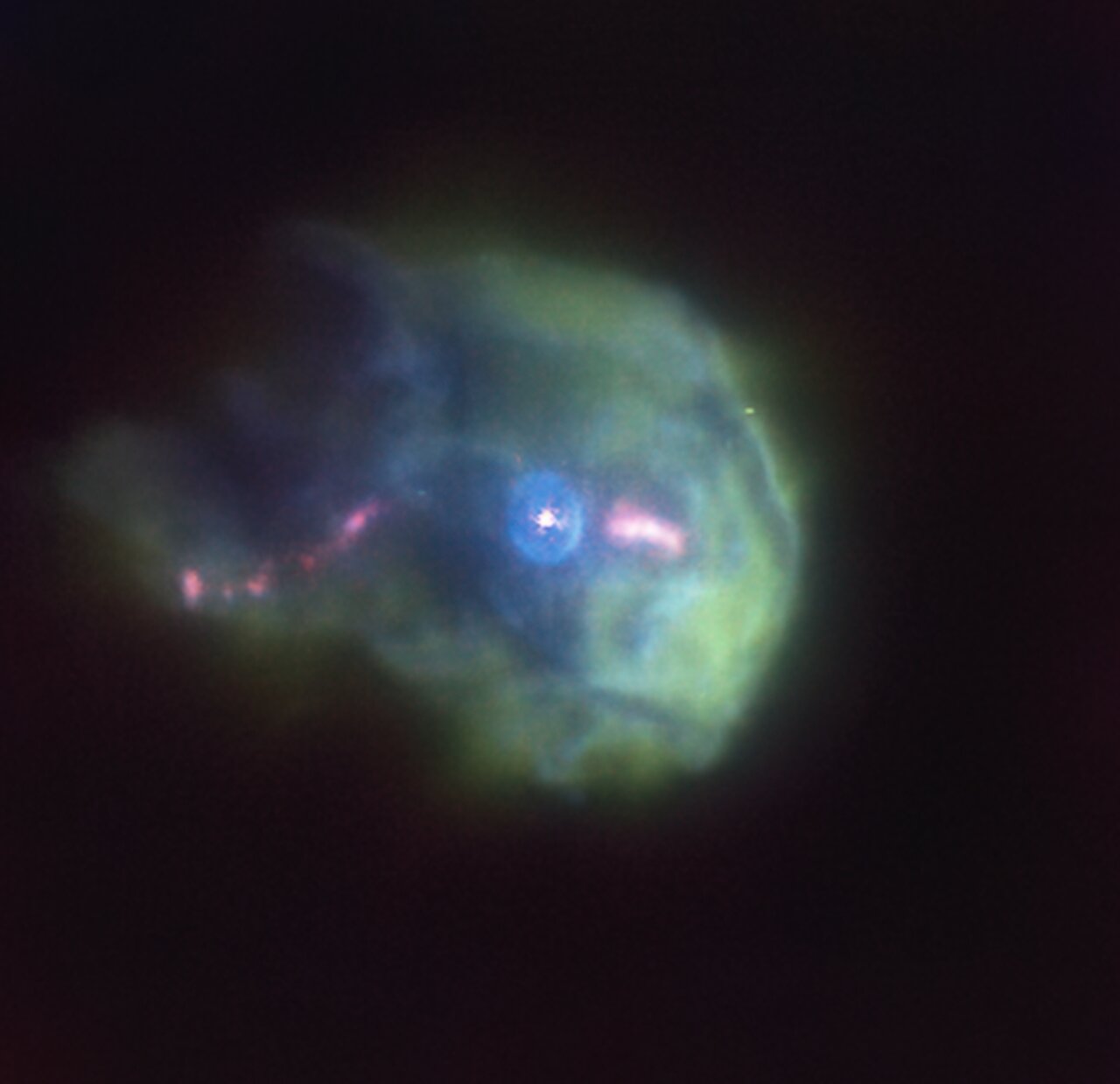
“A Stellar Sprinkler”

I think for the first time, Maynooth astronomers have been featured in the European Space Agency’s Picture of the Week. Here is the blurb from ESO:

–o–

This Picture of the Week shows the young stellar object 244-440 in the Orion Nebula observed with ESO’s Very Large Telescope (VLT) –– the sharpest image ever taken of this object. That wiggly magenta structure is a jet of matter launched close to the star, but why does it have that shape?

Very young stars are often surrounded by discs of material falling towards the star. Some of this material can be expelled into powerful jets perpendicularly to the disc. The S-shaped jet of 244-440 suggests that what lurks at the center of this object isn’t one but two stars orbiting each other. This orbital motion periodically changes the orientation of the jet, similar to a water sprinkler. Another possibility is that the strong radiation from the other stars in the Orion cloud could be altering the shape of the jet.

These observations, presented in a new paper led by Andrew Kirwan at Maynooth University in Ireland, were taken with the Multi Unit Spectroscopic Explorer (MUSE) instrument at ESO’s VLT in Chile. Red, green and blue colours show the distribution of iron, nitrogen and oxygen respectively. But this is just a small fraction of all the data gathered by MUSE, which actually takes thousands of images at different colours or wavelengths simultaneously. This allows astronomers to study not only the distribution of many different chemical elements but also how they move. 

Moreover, MUSE is installed at the VLT’s Unit Telescope 4, which is equipped with an advanced adaptive optics facility that corrects atmospheric turbulence, delivering images sharper than Hubble’s. These new observations will therefore allow astronomers to study with unprecedented detail how stars are born in massive clouds like Orion.

–o–

There’s also a little video showing how the picture was made using MUSE:

Congratulations to Andrew Hirwan and supervisor Emma Whelan from the Department of Experimental Physics for this coup!

The Cyclic Universe of the UK Astronomy Grant System

Posted in Biographical, Science Politics, The Universe and Stuff with tags , , , on April 17, 2023 by telescoper

I stumbled by accident yesterday on a bit of news relating to UK Astronomy Grant funding via the Science and Technology Facilities Council (STFC). I am of course completely out of that system, and have been for years, but I am nevertheless quite nosy so was interested to find out about the changes. Thanks to Alan Heavens and Paul Crowther for enlightening me.

Way back in 2010 I wrote in somewhat critical terms about the new-style Consolidated Grants that STFC was planning to introduce. This system replaced a dual approach of so-called “Standard Grants” – which were typically rather small, usually funding one postdoctoral researcher and bits and bobs – and “Rolling Grants” – which were usually larger, covering all the activities of a department or institution – with a single system of “Consolidated Grants”. The Standard Grants were “responsive”, in that investigators could put in an application whenever they wanted, whereas Rolling Grants were on a fixed timetable. After the change, the responsive mode went out the window and Departments were forced to apply collectively, once every three years.

Much of the reason for the change was the administrative cost of the system. There were huge numbers of standard grant applications. Back in the mists of time there were two application deadlines per year so it was a heavy burden on the panels and the Swindon office, especially since so little funding was available in the first place. Standard grants were also the first to get squeezed when there was a funding shortfall, whereas Rolling grants generally carried on rolling.

Well, the news is that the current Astronomy grant round, with applications in 2022 and grants starting in 2023, will see the last of these Consolidated Grants. From this year on, there will be a new system of – wait for it – “Small” and “Large” grants, thought these are officially called Type 1 and Type 2. The Small Awards scheme is described here and it looks very much like the old Standard Grant system. Details of the Large grants scheme are not yet available, but I believe they will start next year. You can find more details here (PDF).

So now it seems something very like the old system is returning, and there are no doubt the same worries that Large grants will eat up most of the money, leaving very little for the Small grants. Déjà vu.

Anyway, the way I came across this piece of news was via the announcement of a clutch of PDRA positions in cosmology and extragalactic astrophysics at the University of Sussex (where I worked from 2013-16). It seems the Astronomy Centre must have done pretty well in the (final) STFC Consolidated Grant round, which is very good to hear! It seems there might be a bit more money generally in the grant line this year too, which is also good news.

The Other Side of Easter

Posted in Biographical, Maynooth with tags , on April 16, 2023 by telescoper

I haven’t been reading my work email for a few days as I’ve been working from home during the recent Easter mini-break and wanted to catch up on a few things without too many distractions. Having to return to campus tomorrow, however, I decided with some trepidation to see what had accumulated in my inbox while I wasn’t looking and got a rather pleasant surprise.

Just before Easter I mentioned that I had been granted a half-year sabbatical for next academic year. Well, reading my email this morning I found a letter saying that it had been decided to change that to a full year, which is what I originally requested:

The period of sabbatical leave granted is from 1st September 2023 to 31st August 2024.

So having spent a bit of time thinking about how to spend the reduced period, I’m now back to square one (but in a good way). I’m not sure why the powers that be changed their mind on this. Perhaps they’re even keener to get me out of the way than I thought?

The revised schedule means that I will still be around in Maynooth for the August repeat examinations (and marking thereof), but I hope to leave shortly after that is all done and dusted. I’m sure I will miss the teaching next year, but I’m looking forward to being able to concentrate on research and to working in a different environment for a time.

All this means that we will shortly have an advertisement for a sabbatical replacement lecturer in the Department of Theoretical Physics at Maynooth University to cover my teaching while I’m absent. Watch this space. Obviously I will help advertise the position, but I can’t play any further role in the recruitment process.

Anyway, the immediate focus of my attention will be the remaining three weeks of teaching for this Semester. I have a couple more Computational Physics laboratory sessions to organize, as well as the final batch of lectures for Advanced Electromagnetism. That will be followed by an intense period of grading project work, revision lectures, and finally correcting examination scripts. The Examination Period in Maynooth starts on Friday 12th May, but the two with which I am directly involved take place on Thursday 18th and Saturday 20th.

But for now, back to my inbox…