Three weeks in…

Posted in Biographical, Education, Maynooth on February 17, 2023 by telescoper

The first quarter of the second Semester at Maynooth University has flown by. I’ve now done three weeks of lectures and even conducted the first class test in the computer lab. It is from the correcting of these submissions that I am now taking a short break to compose this blog.

Amazingly, for the first time ever, there have been no major problems in the Computational Physics lab at all. In previous years, something has always gone wrong but not (so far) this time round. I’m sure our nice new digital display screen has also improved the experience for the students in that they can now actually see the instructions I give them!

I’m actually ahead of the game in my Advanced Electromagnetism module, having done 7 lectures in 3 weeks instead of the usual 6, because I used one of my tutorial slots to give an extra lecture, anticipating that I’d lose a lecture on Good Friday (7th April) as this is a national holiday in Ireland. The following week is a holiday here too. Three weeks from now we have the mid-term Study Break (13th-17th March, ending on St Patrick’s Day), so after the first six weeks of this Semester we get a little more time to relax.

Soon it will be time to write the examinations for Semester 2. I need to think up some questions for Advanced Electromagnetism and Computational Physics. Writing an examination takes the same time regardless of how many students are taking it, but when the class sizes are small it takes much less time to do the marking. There is a large component of continuous assessment in Computational Physics, which means more work for me through the term, but there are only 25 in the class so it’s not too bad. The class for Advanced Electromagnetism is even smaller, which should make my marking workload in June a bit less heavy than it was in January.

Today students were notified of their provisional Semester 1 examination results. I expect I’ll be talking to some of them next week to discuss their options in the light of the outcome. Final marks don’t get confirmed until the Summer, when we have a full meeting of the Examination Board together with the External Examiner. Marks don’t usually change but they can if the Board decides they should.

We often have a seminar on Friday afternoons but we don’t have one today which is why I’ve got time to write this post. Often I go to the National Concert Hall on Friday evenings but I’m not going this evening. I decided to have a quiet night in tonight, as I’ve got something important to do tomorrow. After I finish marking this first class test I think I’ll toddle off home.

A 13-billion-year-old Galaxy Spectrum

Posted in The Universe and Stuff with tags , , , , , on February 16, 2023 by telescoper

The Galaxy GN-z11 has been known for some time to have a very high redshift z~11 (hence the name) but you can now feast your eyes on the exquisite infrared spectrum of this object recently obtained using JWST:

It’s incredible to see so many clear emission lines for an object at such an enormous distance. The light from this galaxy set out towards us over 13 billion years in the past, when the Universe was less than 400 million years old, so it provides clues about the very early stages of cosmic structure formation. The spectral lines can not only be used to establish the redshift with great precision – it is z = 10.603 – but also to probe the physical properties of this source and its environment. The progress in this field is truly remarkable thanks to superb advances in observational technology.

For more details of this amazing result see the paper by Bunker et al now on the arXiv.

50 Years of Hawking & Ellis

Posted in mathematics, The Universe and Stuff with tags , , , on February 15, 2023 by telescoper

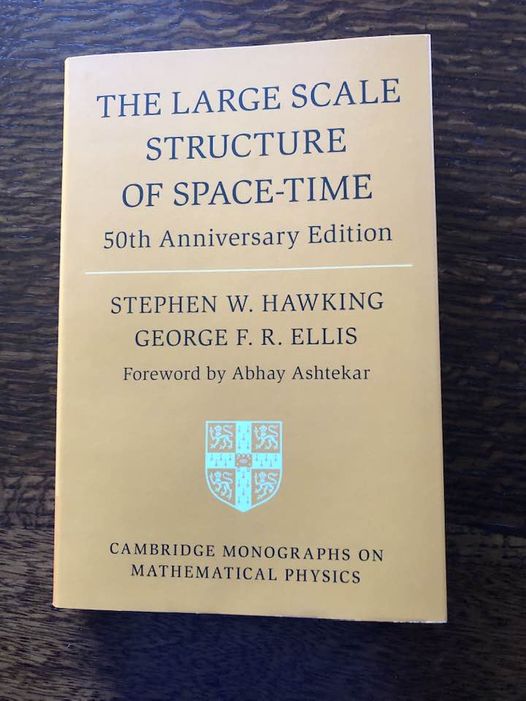
Today, 16th February 2023, sees the official publication of a special 50th anniversary edition classic monograph on the large scale structure of space-time by Stephen Hawking and George Ellis. My copy of a standard issue of the book is on the left; the special new edition is on the right. The book has been reprinted many times, which testifies to its status as an authoritative treatise. I don’t have the new edition, actually. I just stole the picture from the Facebook page of George Ellis, with whom I have collaborated on a book (though not one as significant as the one shown above).

This book is by no means an introductory text but is full of interesting insights for people who have studied general relativity before. Stephen Hawking left us some years ago, of course, but George is still going strong so let me take this opportunity to congratulate him on the publication of this special anniversary edition!

P.S It struck me while writing this post that I’ve been working as a cosmologist in various universities for getting on for about 35 years and I’ve never taught a course on general relativity. As I’ll be retiring pretty soon it’s looking very likely that I never will…

The Elements of Euclid

Posted in Euclid, mathematics, The Universe and Stuff with tags , , , , on February 15, 2023 by telescoper

My recent post pointing out that the name of the space mission Euclid is not formed as an acronym but is an homage to the Greek mathematician Euclid (actually Εὐκλείδης in Greek) prompted me to do a post about the Euclid of geometry and mathematics rather than the Euclid of cosmology, so here goes.

When I was a lad – yes, it’s one of those tedious posts about how things were better in the old days – we grammar school kids spent a disproportionate amount of time learning geometry in pretty much the way it has been taught since the days of Euclid. In fact, I still have a copy of the classic Hall & Stevens textbook based on Euclid’s Elements, from which I scanned the proof shown below (after checking that it’s now out of copyright).

This, Proposition 5 of Book I of the Elements, is in fact quite a famous proof known as the Pons Asinorum:

The old-fashioned way we learned geometry required us to prove all kinds of bizarre theorems concerning the shapes and sizes of triangles and parallelograms, properties of chords intersecting circles, angles subtended by various things, tangents to circles, and so on and so forth. Although I still remember various interesting results I had to prove way back then – such as the fact that the angle subtended by a chord at the centre of a circle is twice that subtended at the circumference (Book III, Proposition 20) – I haven’t actually used many of them since. The one notable exception I can think of is Pythagoras’ Theorem (Book I, Proposition 47), which is of course extremely useful in many branches of physics.

The apparent irrelevance of most of the theorems one was required to prove is no doubt the reason why “modern” high school mathematics syllabuses have ditched this formal approach to geometry. I think this was a big mistake. The bottom line in a geometrical proof is not what’s important – it’s how you get there. In particular, it’s learning how to structure a mathematical argument.

That goes not only for proving theorems, but also for solving problems; many of Euclid’s propositions are problems rather than theorems, in fact. I remember well being taught to end the proof of a theorem with QED (Quod Erat Demonstrandum; “which was to be proved”) but end the solution of a problem with QEF (Quod Erat Faciendum; “which was to be done”).

You can see what I mean by looking at the Pons Asinorum, which is a very simple theorem to prove but which illustrates the general structure:

  1. GIVEN
  2. TO PROVE
  3. CONSTRUCTION
  4. PROOF

When you have completed many geometrical proofs this way it becomes second nature to confront any  problem in mathematics (or physics) following the same steps, which are key ingredients of a successful problem-solving strategy

First you write down what is given (or can be assumed), often including the drawing of a diagram. Next you have to understand precisely what you need to prove, so write that down too. It seems trivial, but writing things down on paper really does help. Not all theorems require a “construction”, and that’s usually the bit where ingenuity comes in, so is more difficult. However, the “proof” then follows as a series of logical deductions, with reference to earlier (proved) propositions given in the margin.

This structure carries over perfectly well to problems involving algebra or calculus (or even non-Euclidean geometry) but I think classical geometry provides the ideal context to learn it because it involves visual as well as symbolic logic – it’s not just abstract reasoning in that compasses, rulers and protractors can help you!

I don’t think it’s a particular problem for universities that relatively few students know how to prove, e.g.,  the perpendicular bisector theorem, but it definitely is a problem that so many have no idea what a mathematical proof should even look like.

Come back Euclid, all is forgiven!

New Publication at the Open Journal of Astrophysics

Posted in OJAp Papers, Open Access, The Universe and Stuff with tags , , , on February 14, 2023 by telescoper

It’s time to announce another new paper at the Open Journal of Astrophysics. This was published yesterday (13th February 2023). The rate of submissions has increased greatly in recent weeks, so  I am thinking seriously about switching to a weekly round-up on here instead of individual posts, but for the meantime I’ll carry on.

The latest paper is the 7th paper in Volume 6 (2023) as well as the 72nd  in all. This one is another one for the folder marked Instrumentation and Methods for Astrophysics. The title is “FRBSTATS: A web-based platform for visualization of fast radio burst properties”. This paper describes a software platform which can be accessed directly here. If you want to read more about Fast Radio Bursts, you can look here.

The authors of the paper are Apostolos Spanakis-Misirlis, who gives his affiliations as the University of Piraeus and University of Crete (Greece), and Cameron Van Eck of ANU in Canberra, Australia

Here is a screen grab of the overlay which includes the  abstract:


You can click on the image of the overlay to make it larger should you wish to do so. You can find the officially accepted version of the paper on the arXiv here.

Solidarity to the UCU Strikers #UCURising

Posted in Education with tags , , , on February 14, 2023 by telescoper

Today is Thursday 14th February so it sees the first of another three consecutive days of strike action by members of the University and College UCU across the UK over pay, pensions and working conditions. Although I no longer work in the UK I’d like to send this message of support to my former colleagues there who will be out on the picket lines today. There will be another three days of strikes next week, and four days the week after that.

A Backronym for Euclid?

Posted in Euclid, mathematics, Poetry, The Universe and Stuff with tags , , , , on February 13, 2023 by telescoper
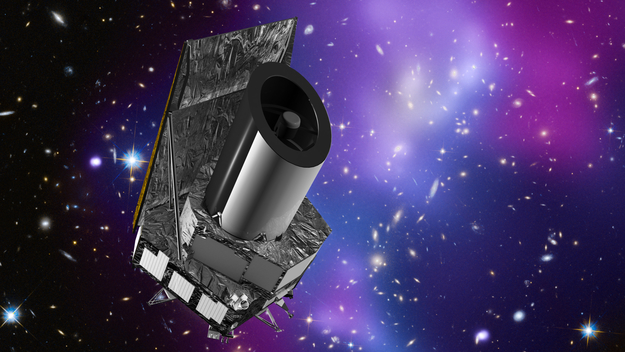
The Euclid Satellite

As a fully paid-up member of the Campaign for the Rejection of Acronymic Practices I was pleased to see the top brass in the Euclid Consortium issue instructions that encourage authors to limit their use of acronyms in official technical documents. Acronyms are widely used in the names of astronomical instruments and surveys. Take BOOMERanG (Balloon Observations Of Millimetric Extragalactic Radiation And Geophysics) and HIPPARCOS (HIgh Precision PARallax COllecting Satellite) to name just two. A much longer list can be found here.

I’m very pleased that the name of the European Space Agency’s Euclid mission is not an acronym. It is actually named after Euclid the Greek mathematician widely regarded as the father of geometry. Quite a few people who have asked me have been surprised that Euclid is not an acronym so I thought it might be fun to challenge my readers – both of them – to construct an appropriate backronym i.e. an acronym formed by expanding the name Euclid into the words of a phrase describing the Euclid mission. The best I’ve seen so far is:

Exploring the Universe with Cosmic Lensing to Identify Dark energy

But Euclid doesn’t just use Cosmic Lensing so I don’t think it’s entirely satisfactory. Anyway, your suggestions are welcome via the box below.

While you’re thinking, here is the best poetic description I have found (from Edna St Vincent Millay):

Euclid alone has looked on Beauty bare. 
Let all who prate of Beauty hold their peace,
And lay them prone upon the earth and cease
To ponder on themselves, the while they stare
At nothing, intricately drawn nowhere
In shapes of shifting lineage...

Institutional Affiliations and the Open Journal of Astrophysics

Posted in Open Access with tags , on February 13, 2023 by telescoper

This is a copy of a blog post I put up in the Open Journal of Astrophysics website at the weekend.

The Research Organization Registry (ROR) is a community-led database that aims to provide a persistent identifier for every research organization in the world. In other words, it aims to do for institutions what ORCID does for individual researchers.

Scholastica has recently introduced a facility to allow authors to include an ROR tag for authors when they submit a paper. We encourage authors of papers submitted to the Open Journal of Astrophysics to do this. Institutions and organizations may require this in due course, as some do with ORCID, so it would be good to get into practice!

For example the ROR entry for NUI Maynooth is:

https://ror.org/048nfjm95

You can find your institutions ROR identifier here.

Not all corresponding authors of papers to OJAp supply details of institutional affiliations when they submit papers to us., presumably because it takes a while enter the relevant data. We can only supply the metadata to Crossref that authors supply to us. The more authors include the better, of course, but the ROR tag supplies a unique persistent identifier that is sufficient to pinpoint the relevant organization, so it is undoubtedly useful. Obviously, however, we can only pass this information on if authors supply it to us.

What should it mean to be an author of a scientific paper?

Posted in Open Access, The Universe and Stuff with tags , , , on February 12, 2023 by telescoper

The implementation of artificial intelligence techniques in tools for generating text (such as ChatGPT) has caused a lot of head-scratching recently as organizations try to cope with the implications. For instance, I noticed that the arXiv recently adopted a new policy on the use of generative AI in submissions. One obvious question is whether ChatGPT can be listed as an author. This has an equally obvious answer: “no”. Authors are required to acknowledge the use of such tools when they have used them in writing a paper.

One particular piece of the new policy statement caught my eye:

…by signing their name as an author of a paper, they each individually take full responsibility for all its contents, irrespective of how the contents were generated. If generative AI language tools generate inappropriate language, plagiarized content, biased content, errors, mistakes, incorrect references, or misleading content, and that output is included in scientific works, it is the responsibility of the author(s).

The first sentence of this quote states an obvious principle, but there are situations in which I don’t think it is applied in practice. One example relates to papers emanating from large collaborations or consortia, where the author lists are often very long indeed, sometimes numbering in the thousands. Not all the “authors” of such papers will have even read the paper, so do they “each individually take full responsibility”? I don’t think so. And how can this principle be enforced as policy?

All large consortia have methods for assigning authorship rights as a way of assigning credit for contributions made. But why does “credit” have to mean “authorship”? Papers just don’t have thousands of authors, in the meaningful sense of the term. It’s only ever a handful of people who actually do any writing. That doesn’t mean that the others didn’t do any work. The project would probably not have been possible without them. It does mean, however, that pretending that they participated in writing the article that describes the work isn’t be the right way to acknowledge their contribution. How are young scientists supposed to carve out a reputation if their name is always buried in immensely long author lists? The very system that attempts to give them credit at the same renders that credit worthless.

As science evolves it is extremely important that the methods for disseminating scientific results evolve too. The trouble is that they aren’t. We remain obsessed with archaic modes of publication, partly because of innate conservatism and partly because the lucrative publishing industry benefits from the status quo. The system is clearly broken, but the scientific community carries on regardless. When there are so many brilliant minds engaged in this sort of research, why are so few willing to challenge an orthodoxy that has long outlived its usefulness.

In my view the real problem is not so much the question of authorship but the very idea of the paper. It seems quite clear to me that the academic journal is an anachronism. Digital technology enables us to communicate ideas far more rapidly than in the past and allows much greater levels of interaction between researchers. The future for many fields will be defined not in terms of “papers” which purport to represent “final” research outcomes, but by living documents continuously updated in response to open scrutiny by the community of researchers. I’ve long argued that the modern academic publishing industry is not facilitating but hindering the communication of research. The arXiv has already made academic journals redundant in many of branches of  physics and astronomy; other disciplines will inevitably follow. The age of the academic journal is drawing to a close. Now to rethink the concept of “the paper”.

In the meantime I urge all scientists to remember that by signing their name as an author of a paper, they individually take full responsibility for all its contents. That means to me that at the very least you should have read the paper you’re claiming to have written.

Ireland v France in Dublin

Posted in Rugby with tags , , , on February 11, 2023 by telescoper

I forgot to mention in this morning’s post that I walked past the above bus on the way to last night’s concert. It is evidently the official transport of the French rugby team who played Ireland today in the Six Nations this afternoon. I didn’t spot any of the French players at the concert, although I did help a couple of friendly France supporters with directions en route.

As expected, it was a cracking match between two excellent teams, a real heavyweight contest, with no quarter asked and non given. But, in the end, Ireland ran out convincing winners by 32-19 despite the absence of a number of first choice players. It was a very impressive performance from Ireland and the best game of rugby I’ve seen for a very long time.