At the Solstice, by Sean O’Brien

Posted in Poetry with tags , , on December 22, 2022 by telescoper

We say Next time we’ll go away.
But then the winter happens, like a secret

We’ve to keep yet never understand,
As daylight turns to cinema once more:

A lustrous darkness deep in ice-age cold,
And the print in need of restoration

Starting to consume itself
With snowfall where no snow is falling now.

Or could it be a cloud of sparrows, dancing
In the bare hedge that this gale of light

Is seeking to uproot? Let it be sparrows, then,
Still dancing in the blazing hedge,

Their tender fury and their fall,
Because it snows, because it burns.

by Sean O’Brien (born 1952)

The Winter Solstice 2022

Posted in The Universe and Stuff with tags , , , , , on December 21, 2022 by telescoper

The Winter Solstice in the Northern hemisphere happens later today, Wednesday 21st December, at 21:48 Irish Time.

People often think that the Winter Solstice is defined to be the “shortest day” or the “longest night” of the year. The Solstice does indeed happen on the shortest day, but it is defined in astronomical terms much more precisely than that. It happens when the axial tilt of the Earth away from the Sun is greatest, so that the Sun appears in the sky with its lowest maximum elevation. The timing of this event can be calculated with great precision.

Anyway, today is the shortest day of the year in the Northern hemisphere. Days will get steadily longer from then until the Summer Solstice next June.  The shortest day – defined by the interval between sunrise and sunset – is today, although not by much. Today in Dublin is shorter than yesterday by about six seconds, but tomorrow will be longer than today by less than a second.

This does not, however,  mean that sunrise will happen earlier tomorrow than it did this morning.  Actually, sunrise will carry on getting later until the new year, the length of the day nevertheless increasing because sunset occurs even later. Sunrise yesterday morning (20th December) was at 08.42 Dublin Time while today it was 08.43; the latest sunrise will be on 30th December (09.05). Sunset last night was at 16.49 and tonight it will be at 16.50. The earliest sunset this year was actually on 13th December (16:48).

These complications arise because there is a difference between mean solar time (measured by clocks) and apparent solar time (defined by the position of the Sun in the sky, i.e. what you would measure on a sundial), so that a solar day does not always last exactly 24 hours as measured by a clock. A description of apparent and mean time was given by Nevil Maskelyne in the Nautical Almanac for 1767:

Apparent Time is that deduced immediately from the Sun, whether from the Observation of his passing the Meridian, or from his observed Rising or Setting. This Time is different from that shewn by Clocks and Watches well regulated at Land, which is called equated or mean Time.

The discrepancy between mean time and apparent time arises because of the Earth’s axial tilt and the fact that it travels around the Sun in an elliptical orbit in which its orbital speed varies with time of year (being faster at perihelion than at aphelion). The upshot of this is that solar noon – when the Sun is at its highest point in the sky on a given day – is not always at 12 noon local mean time. Solar noon today in Ireland is actually at 12.30 Irish time. Around the time of the Winter Solstice, solar noon is getting later in the day and this will continue to happen until well into the New Year; solar noon on New Year’s Eve is at 12.34. While the interval between sunrise and sunset shrinks towards the solstice, the mid-point of this interval is drifting later in the day, making both sunrise and sunset occur later despite the gap between the two getting smaller.

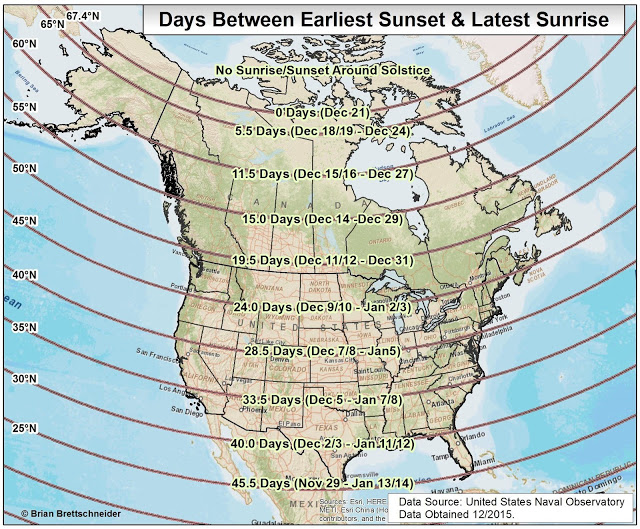
The discrepancy between latest sunrise (or earliest) and the solstice varies with latitude, although if you go far enough North into the Arctic Circle, there is neither sunrise or sunset around the Winter Solstice, and if you go far enough South to the Equator the length of the day does not vary at all with time of year. The behaviour is illustrated for North America in this graphic produced by the United States Naval Observatory

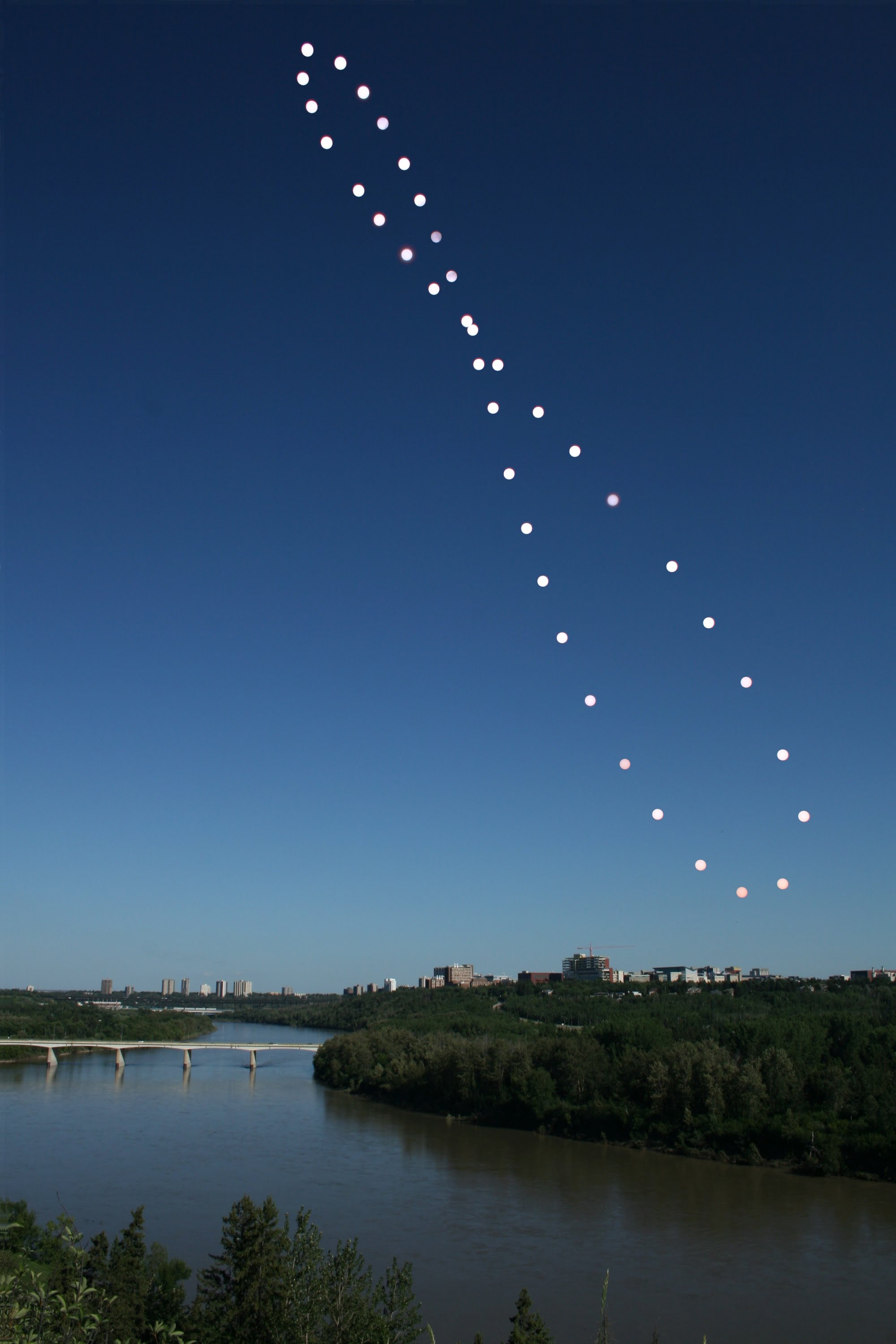
If you plot the position of the Sun in the sky at a fixed time each day from a fixed location on the Earth you get a thing called an analemma, which is a sort of figure-of-eight shape whose shape depends on the observer’s latitude. Here’s a photographic version taken in Edmonton, with photographs of the Sun’s position taken from the same position at the same time on different days over the course of a year:

maxresdefault

The winter solstice is at the lowermost point on this curve and the summer solstice is at the top. These two turning points define the time of the solstices much more precisely than the “shortest day” or  “longest night”. The Winter Solstice is takes place at a very specific time, when the angle of tilt of the Earth’s axis relative to the Sun is maximum.

Anyway, the north–south component of the analemma is the Sun’s declination, and the east–west component arises from the  equation of time which quantifies the difference between mean solar time and apparent solar time. This curve is used to calculate the earliest and/or latest sunrise and/or sunset. Looking at a table of the local mean times of sunrise and sunset for Dublin around the 2022  winter solstice shows that today is indeed the shortest day (with a time between sunrise and sunset of 7 hours 33 minutes and 49 seconds).

P.S. As usual, crowds gathered today at the spectacular neolithic monument at Newgrange in County Meath to observe the sunrise at the Solstice.
R.I.P. Terry Hall (1959-2022)

Posted in Biographical, Music, R.I.P. on December 20, 2022 by telescoper

I was very sad last night to hear the news of the death at the age of 63 of Terry Hall, lead singer of The Specials, one of the leading bands of the 2 Tone movement which swept the UK music scene in 1979. The Guardian obituary makes it clear what a tough upbringing Terry Hall had but also how firmly he stuck to his political ideals.

I was still at School in the 1970s and, though never a fan of Punk (which immediately preceded 2-Tone in popularity), I absolutely loved bands like The Specials, The Beat and especially Selecter. I enjoyed not only their music, but also their admirably inclusive multi-racial approach, exemplified by their adoption of Ska, the Jamaican music genre that paved the way to Reggae.

Being a bit of an anorak I actually managed way back then to get hold of some of the very rare original Ska recordings, principally by the superb Skatalites. This wonderful band specialized in irreverent and eccentric cover versions of movie film tunes from the 1960s including Doctor Zhivago and James Bond, plus the classic Guns of Navarone. Nowadays you can find lots of this music to download, but it was quite hard work getting vinyl recordings at that time. As well as enjoying 2-Tone itself I was immensely grateful for the window it provided to a treasure house of wonderful music.

Ska is usually played (at least nominally) in 4/4 time, but each beat is really a cluster of sub-beats forming a triplet so the usual 1-2-3-4 of the 4/4 turns into 123-123-123-123, etc . Usually the drummer puts a heavy bass accent (and usually a side stick or rim shot on the snare) on the 3rd component of each triplet, and there would be guitar chops, other percussion, and/or brass riffs on the “off” beats. It is said that this structure was inherited, at least in part, from the marching bands that played in Jamaica and it does give a kind of strutting feel to the overall pulse. But wherever it came from the beat gives the music an infectiously bouncy rhythm that gives anyone dancing to it an irresistible urge to jump up and down, especially on up-tempo numbers. The triplet structure also gives those with no sense of rhythm a greater probability of moving in time with at least one relevant beat.

Anyway, here as a tribute to Terry Hall are The Specials, in a typically exuberant live performance recorded on British TV in 1979 (a programme which I think I actually watched at the time). They are playing the theme from The Guns of Navarone as a direct tribute to the Skatalites, whose wonderful original version you can also find on Youtube here (although it is really just audio).

Rest in peace, Terry Hall (1959-2022)

Another year, another RAS diary…

Posted in Uncategorized on December 19, 2022 by telescoper

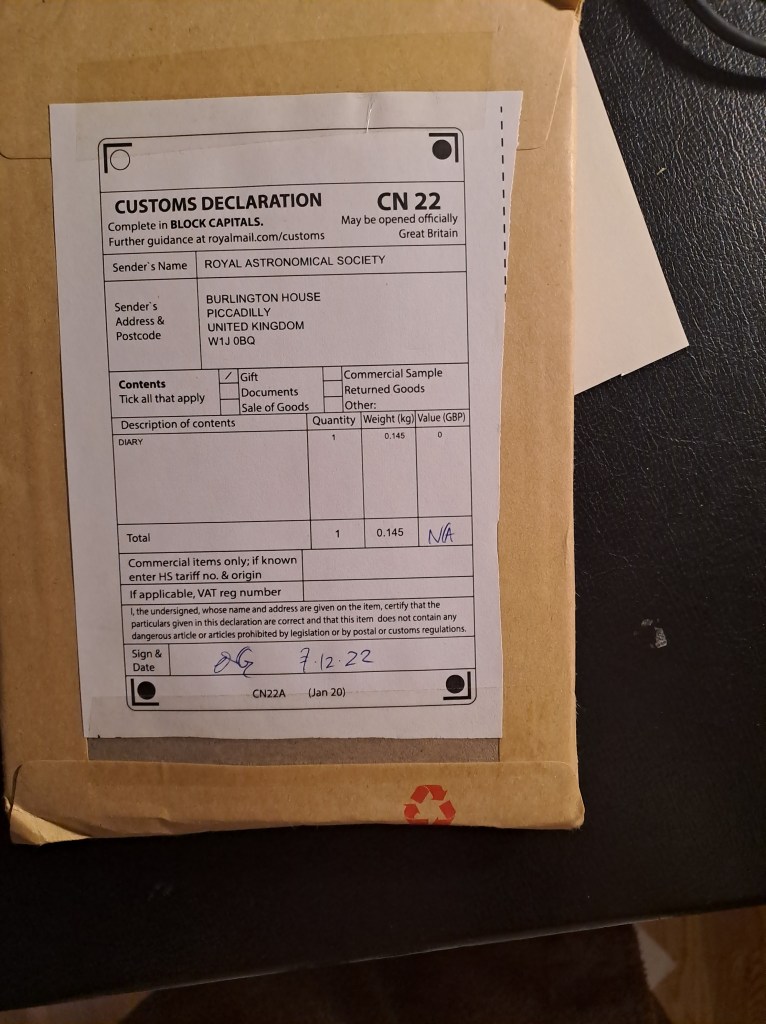
It’s December 19th 2022 and my 2023 RAS Diary has arrived in Ireland, this time with an added Brexit bonus of a customs declaration!

The diary part of the RAS diary, being I suppose intended for academics, actually runs from October to December the following year. In previous years it has arrived in time to use it for Semester 1 but for the last three years it hasn’t arrived in the post until December, meaning that I couldn’t use the first three months in the new diary. The heavy delay of the diary is matched by that of the RAS house journal Astronomy & Geophysics which usually takes a couple of months to reach Ireland. I notice that this year’s wasn’t even sent out from Burlington House until 7th December…

Apparently about a quarter of all Fellows of the Royal Astronomical Society (including myself) are located “overseas”. Those in far-flung places presumably get everything even later than I do here in Ireland.

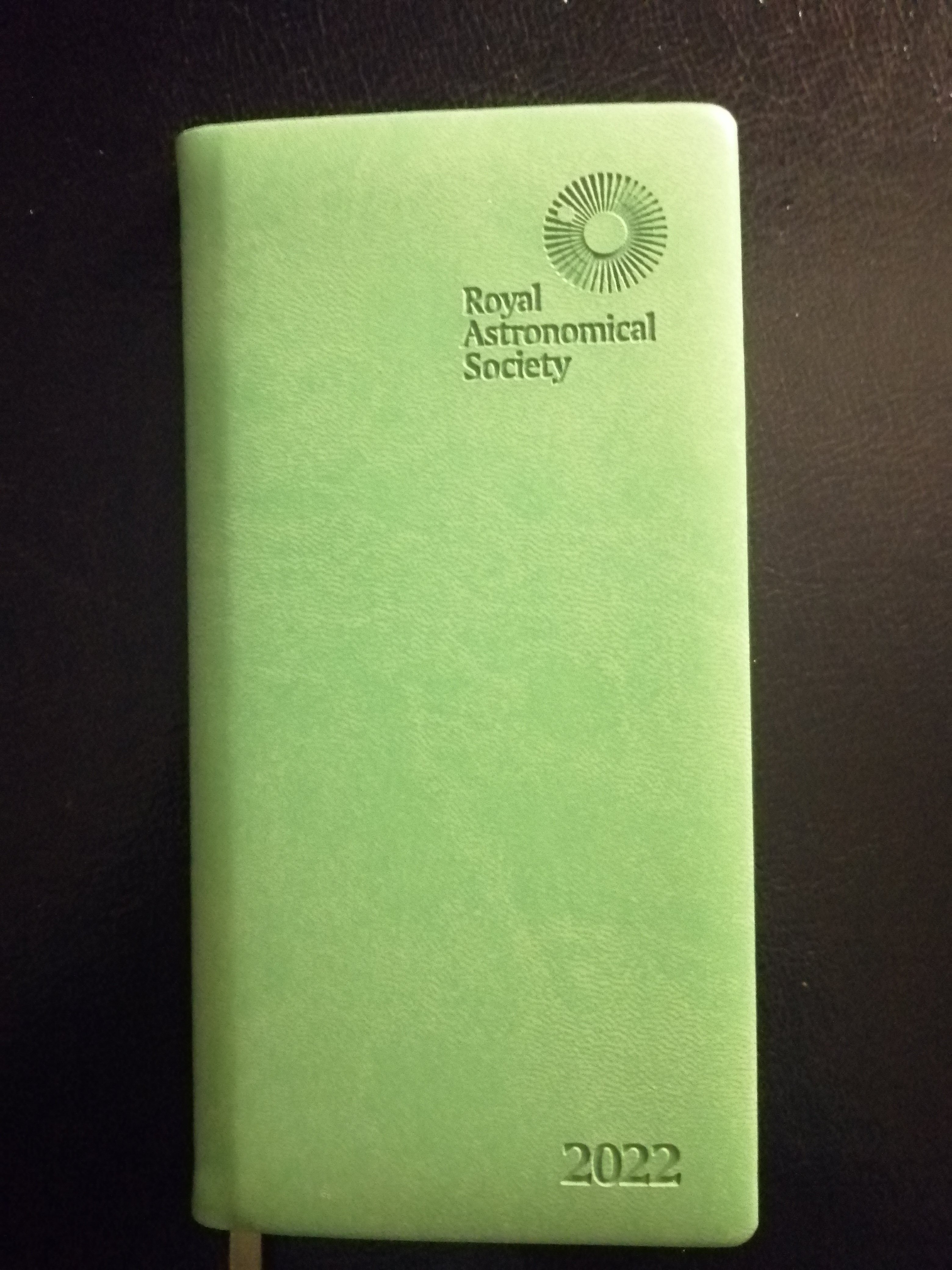
This year’s diary is a much brighter orange colour than the picture suggests. I’ve included a picture here along with various others from over the years.

Although many of my colleagues seem not to use them, I like old-fashioned diaries like the one above. I do run an electronic calendar for work-related events, meetings etc, but I use the paper one to scribble down extra-curricular activities such as concerts and sporting fixtures, as I find the smartphone version of my electronic calendar a bit fiddly.

Pre-Christmas Lurgy

Posted in Biographical, Covid-19 on December 17, 2022 by telescoper

Well, this is just great. No sooner does term end than I come down with some sort of bug. It started yesterday, but today I’ve been in bed nearly all day with a nasty cough, fever, fatigue, and my joints aching (more than usual, I mean).

I’ve done an antigen test, which was negative, but I’ve heard it can take several days for Covid-19 to manifest itself that way. I’ll do another tomorrow.

I hope whatever it is subsides by Christmas as I have some serious culinary self-indulgence planned. At the moment, I’ve got no appetite for food at all.

Here Endeth the Term

Posted in Biographical, Education, Maynooth on December 16, 2022 by telescoper

So here we are, then, the last day of teaching term at Maynooth University. There is still another week before Christmas of course, but no lectures next week. I’ll be returning to action on 3rd January for a couple of revision lectures for my 2nd year module, the exam being on 7th January 2023. Yes, that’s a Saturday. I hope to get those scripts marked before my second and much larger examination on 14th January. Yes, that’s also a Saturday.

It’s been an exhausting term and I’m glad there’s a break. I just have a couple of non-teaching things to do before the official closure on Wednesday 21st, but I think I can do all those from home.

Teaching a group of students from very different backgrounds, such as our first-year general science group, can be very challenging but also very rewarding. Among the fully justified criticisms of my teaaching there were some very nice comments in the module questionnaire returns this year, especially for my team of tutors on MP110 so I think I should end the term by saying a very public thank you to Aoibhinn, Kay, and Thomas, all of whom have been wonderfully support not only of the students but of their ageing lecturer.

Next Semester, which starts after the end of the exam period in late January, should be a little less stressful, as I’m teaching smaller classes in the 3rd year and 4th year.

SpaceX launch confirmed for Euclid

Posted in Biographical, Euclid, The Universe and Stuff with tags , , , on December 15, 2022 by telescoper

I’m a bit fragile today. I don’t know why, but it may be connected with our Departmental Christmas partylast night. I’m glad I didn’t have too much to drink. Ahem.

Anyway, in my current condition I only have time for a short post to pass on the news that I today saw official confirmation that, negotiations having been successfully completed, the European Space Agency’s Euclid mission will indeed be launched by SpaceX, on a Falcon 9 rocket.

Various working meetings have been scheduled to start next week between ESA, SpaceX and Thales Alenia Space – Italia (TAS-I, who constructed the vehicle). The launch period is confirmed to be somewhere in the 3rd Quarter of 2023 and may even be as early as 1st July 2023. The actual launch window of one month will be agreed on the 1st of February.

Now there will be intense activity preparing the Euclid vehicle for launch as well as readying the Ground Segment – the bit that collects and processes the data.

The 2023 Annual Euclid Consortium Meeting, scheduled to be in Copenhagen in from 19th to 23rd June will be the last such meeting before the launch. I am very much looking forward to attending it.

Preparing for Exams

Posted in Biographical, Education, Maynooth with tags , on December 14, 2022 by telescoper

Just time for a very quick post today to mark the fact that this afternoon I did my last lecture of the 2022 calendar year, a revision class on special relativity. I’ll be back to do further classes in January ahead of the examinations but that’s it for me until after Christmas. It’s been a very hectic term so I’m glad it’s almost over.

Thoughts are now turning to the exams, I ended today’s lecture with some tips about examinations as the January session will be the first most students have ever had at third level. The tips I passed on today included:

  1. Try to get a good night’s sleep before the examination and arrive in plenty of time before the start.
  2. Read the entire paper before starting to answer any questions. In particular, make sure you are aware of any supplementary information, formulae, etc, given in the rubric or at the end.
  3. Start off by tackling the question you are most confident about answering, even if it’s not Question 1. This will help settle any nerves.
  4. Don’t rush! Students often lose marks by making careless errors. Check all your numerical results on your calculator at least twice and – PLEASE – remember to put the units!
  5. Don’t panic! You’re not expected to answer everything perfectly. A first-class mark is anything over 70%, so don’t worry if there are bits you can’t do. If you get stuck on a part of a question, don’t waste too much time on it (especially if it’s just a few marks). Just leave it and move on. You can always come back to it later.

Readers of this blog are welcome to add other tips through the comments box below!

Latest Results from the South Pole Telescope

Posted in The Universe and Stuff with tags , , , , on December 13, 2022 by telescoper

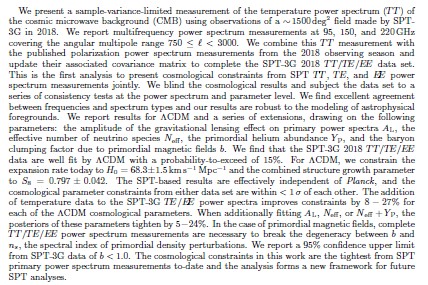
Just time for a quick post to point out the latest results from the South Pole Telescope (SPT) have now hit the arXiv. The measurements were made in 2018 but the outcome of a full analysis of temperature and polarization has only just appeared.

Here’s a grab of the abstract:

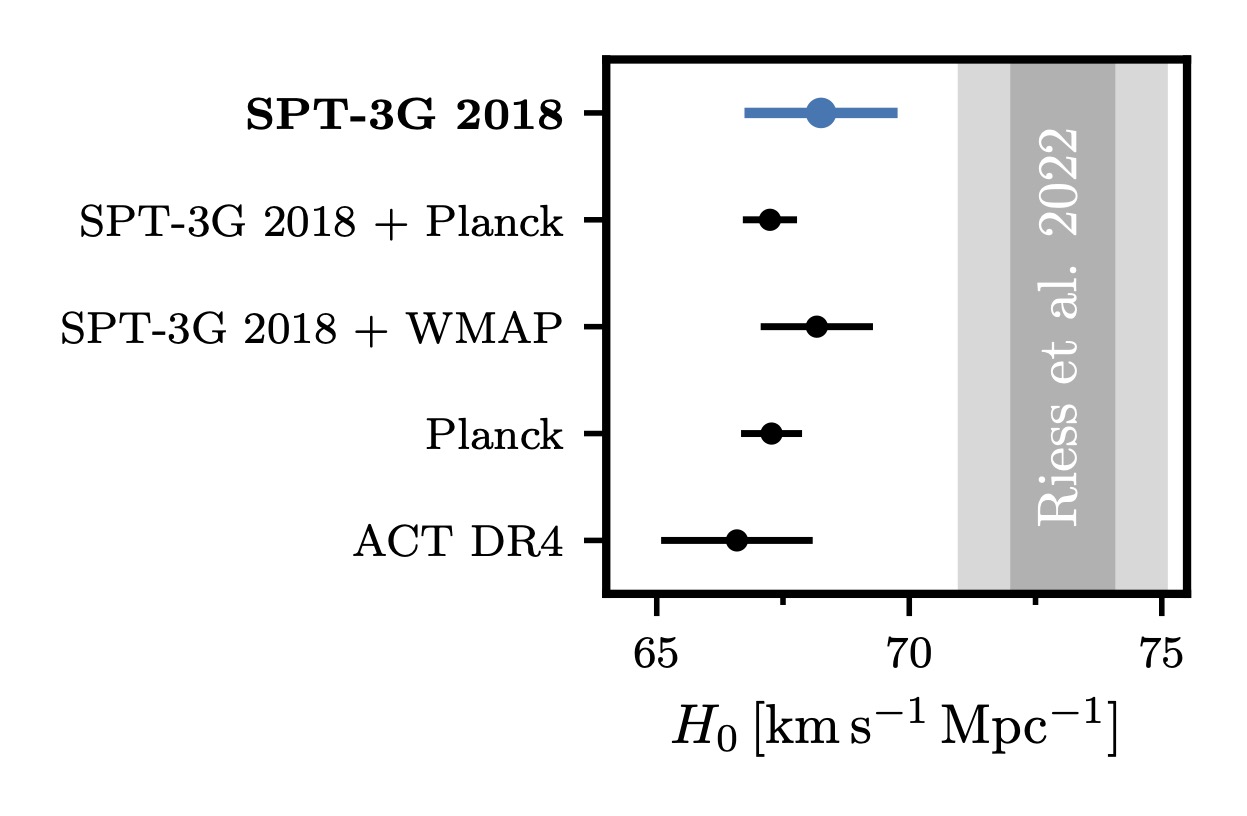
The key figures showing the constraints on the Hubble Constant H0 and the parameter S8 are shown here:

As you can see, the results from SPT-3G are consistent with the standard cosmological model and agree on H0 with Planck rather than the higher value obtained from local measurements. If you thought there was Hubble tension before this measurement, then you will still think so now!

The Passage of Time

Posted in Biographical, Education, History with tags , , on December 12, 2022 by telescoper

We have arrived at last at the final week of teaching for this term. The way the timetable has worked out, my last lecture before the break will be on Wednesday afternoon. Later that evening we have our staff Christmas party. I did one lecture this morning, by the end of which I had completed the syllabus for my Mechanics & Special Relativity Module. I have two more sessions with that class, tomorrow and Wednesday, which I will devote to some worked examples and revision for the examination which is on January 14th.

I’m sure the students are tired too, but at least they have the advantage of youth which probably endows them with more energy than I can summon at this point!

Two events over the weekend added to the general sense of exhaustion and made me feel even older. One was that a very dear friend whom I first met, when he was 19 and I was 29, just had his 50th birthday. I remember very well celebrating his 20th. For some reason I felt more comfortable when our ages began with the same digit, if only for a few months. Now he’s 50 and I’m 59…

The other thing that happened was that last night I watched the first episode of a three-part documentary series The Irish Civil War. I thought it was excellent and will definitely watch the other two programmes. The Irish Civil War, which was raging 100 years ago, was as brutal as it was tragic and the episode made uncomfortable viewing, not least because even a century later many of the scars are still painful.

The thought suddenly struck me watching the programme that I was born in 1963, just 40 years or so after the end of the Civil War and 20 years closer in time to that event than to today. Time passes.

Anyway, enough of that. I don’t have time to mope about feeling old. I’ve got some examples to work out for tomorrow’s lecture, including a problem on time dilation…