Nocturne in Black and Gold

Posted in Art, Biographical with tags , , on November 5, 2022 by telescoper

`Only Connect’ – the epigraph of the novel Howard’s End by E.M. Forster – was a favourite phrase of one of my English teachers at school, and he invoked it whenever he set us one of his creative writing challenges. We were given two apparently disconnected things (usually news items), asked to think of a possible connection between them and write an story joining them together. From time to time when stuck for a topic for a blog post I’ve resorted to playing the same game.

In that vein: (a) I noticed a story last week about a painting by Piet Mondrian which has been hanging upside down for 75 years and (b) today is November 5th, Bonfire Night in the United Kingdom. The connection between these two things that sprang to my mind is this painting, Nocturne in Black and Gold – The Falling Rocket by James McNeill Whistler.

James Abbott McNeill Whistler, Nocturne in Black and Gold – the Falling Rocket, c1875, oil on panel, 60.3 × 46.7 cm (Detroit Institute of Arts)

This, the last in his wonderful series of paintings of night-time scenes, first displayed in 1877, is set in the Cremorne Gardens, which was a park in Chelsea, though in a manner typical of Whistler’s work of this period it is more a response to the location than a representation of it. The sombre colours – mainly green and blue, except for the grey smoke of the falling rocket and the gold flames and flashes of fireworks – are layered in such a way as to blur the situational context of the composition so that it’s no longer a purely figurative work. It’s certainly an enigmatic painting, but I think the arrangement of colours and textures is very well balanced as well as intriguing. It is historically important too, because it represents one of the first stirrings of modernism in art in England.

The compositional ambiguity is deliberate. The ghostly figures in the foreground are almost transparent. Are they even people? When asked this question himself, Whistler replied “They are just what you like”. Whistler is encouraging viewers of his work to construe their own meaning in, and interpretation of, what he put on the canvas. As an astrophysicist, the filamentary pattern of sparks reminds me of chains of distant galaxies. What does it remind you of?

Nocturne in Black and Gold is also famous for having been at the centre of a libel case. The influential art critic John Ruskin hated it and accused Whistler of “flinging a pot of paint in the public’s face”. Whistler sued for damages (though he couldn’t really afford to). He won the case against Ruskin, but the outcome was financially disastrous for him because he was awarded only one farthing in damages.

Anyway, the connection with the Mondrian story is that Whistler’s case was done no favours when this painting was brought into the courtroom during the Whistler v Ruskin case, as it was was presented for viewing upside down

New Publication at the Open Journal of Astrophysics

Posted in OJAp Papers, Open Access, The Universe and Stuff with tags , , , , , on November 4, 2022 by telescoper

It’s time once again for me to announce new paper at the Open Journal of Astrophysics. The new paper, published last week, is the 15th paper in Volume 5 (2022) and the 63rd in all. The latest publication is entitled “Two-photon amplitude interferometry for precision astrometry” and the authors are Paul Stankus, Andrei Nomerotski and Anže Slosar of Brookhaven National Laboratory (USA) and Stephen Vintskevich (Moscow Institute of Physics & Technology, Russia).

The paper presents a new method for doing interferometry with quantum-mechanically entangled photons and is thus is in the folder marked Instrumentation and Methods for Astrophysics. I don’t know much about this area – and there are many whose baseline opinion is that interferometry is a bit of a fringe topic that is rather complex perhaps needs more visibility in the current phase of its development  (geddit?) – but the physics looks fascinating to me. Amplitude interferometry should be contrasted with the intensity interferometry method of Hanbury Brown and Twiss which I remember learning about as an undergraduate.

Anyway, here is a screen grab of the overlay which includes the  abstract:

You can click on the image to make it larger should you wish to do so. The full image used in the overlay is this:


You can find the officially accepted version of the paper on the arXiv here.

Is Astronomy the worst for Bullying and Harassment?

Posted in Harassment Bullying etc on November 3, 2022 by telescoper

I don’t mind admitting that I’m deeply depressed about all these stories of bullying and sexual harassment in Astronomy that have surfaced recently, and I’m sure there are many more that haven’t yet come to light. I’ve experienced some toxic behaviour in my time but nothing on the scale of what has emerged recently.

I wonder whether all this means that Astronomy is worse than other areas of academia or whether everywhere else is just as bad?

I put up a totally unscientific Twitter poll to see what my readers think. Please feel free to let me know your opinion:

Guest Post: The Bullying of Hannelore

Posted in Harassment Bullying etc on November 2, 2022 by telescoper

I am publishing this guest post from someone who works in Astronomy in a UK University. The author is anonymous (though I know who it is), the Department is not identified (though I know what it is) and all the names have been changed (for the reason that there is an ongoing legal case). Despite these restrictions, in the wake of the Tim de Zeeuw scandal, and others, I think these stories should be told.

The Bullying of Hannelore

I am an Astronomy Professor at a UK University. In June last year, I witnessed acts of bullying by my Head of Department against a junior administrative assistant on a fixed-term contract.

The administrative assistant — her name is Hannelore — was assigned to help me with the Examinations, in the time of COVID.  She was in a visibly wretched condition, weeping uncontrollably on zoom calls. I am sure Hannelore hated appearing in such a dejected and tearful state on zoom with someone she barely knew. She was a proud woman once, but it had all gone. 

She told me a harrowing story of sustained bullying by my Head of Department, culminating in an (illegal) dismissal notice from my University at the end of the academic year.

By the end of the Examinations, Hannelore was not sleeping. I remember going to bed after zooming one evening, and wondering what to do, who to contact, whether Hannelore would be alive the next day. I remember being relieved on checking email the next morning that there were messages from her through the night. She may not have slept, but at least Hannelore was still alive. 

What to do? Till then, I had been very friendly with my Head of Department, a (superficially) genial and charming man. We had written research papers together. By contrast, I hardly knew Hannelore. 

My University regularly pumps out tweets about breaking the silence around bullying and harassment. It has compulsory ‘active by-standing’ online courses for us all to attend. My University has ‘Dignity at Work’ representatives and ‘Well-being Advocates’ in every department. It has multiple Equality, Diversity & Inclusion committees to protect, amongst other things, the interests of women. It trumpets its ‘people strategy’ and ‘people action plan’. 

But, when I told others about the bullying of Hannelore, they were not interested. The Departmental ‘Well-being Advocate’ thought it was someone else’s problem. The Chair of the Departmental EDI Committee declined to intervene and repeatedly acted to protect the abuser. No-one wanted to believe that bullying on this scale was actually taking place, right under their noses, in my University.

So, I blew the whistle. I covertly recorded what was going on and made a witness statement to my University. By now, news of this distressing scandal had begun to reach the top. Senior managers were taking the decisions.

My University was aghast at what had happened.

Not at the bullying. At the covert recording.

And then my genial and charming Head of Department wielded his knife. I had always known that there was a streak of cunning and malice beneath the jokey bluster. My Head of Department said that it was all the other way round.  I had been harassing him. I had been deliberately causing stress and anxiety to Hannelore, so as to trap him and smear him as a bully.

At first, I thought this was some kind of sick joke. Surely no-one would believe such a far-fetched and improbable story. It was like Boris Johnson saying he was the victim and complaining that other people were bullying him by going on and on about lockdown parties.

I was wrong.  My University thought the allegations against me were so serious that they warranted an immediate investigation. It has an excellent, detailed and well-constructed grievance policy, which it proudly publishes on the web. The first step is that the accuser produces some evidence in support of any allegation. But, senior managers decided that my Head of Department’s allegations were too grave to warrant asking for any evidence. There was no need to be hampered by a well-constructed grievance policy. An investigation into my activities by an external and highly-paid barrister was commissioned to probe the extent of my wrong-doing.

My University’s investigation into me continues to this day, 15 months later. I have been forced to hire lawyers to defend myself (at my expense).

Hannelore did not kill herself. Some inner core of doggedness somehow pulled her through the darkness. The bullying has abated, though not stopped. Her insecure job was reluctantly returned to her. Hannelore was withdrawn and almost catatonic for many months afterwards. She still cannot talk easily about what happened to her. She is too frightened to complain formally to my University. She has been receiving counselling (at her expense).

The genial and charming Head of Department continues to hold sway with the top-level managers who run my University. He still enjoys exercising power over people, especially ones he dislikes. 

And I … I have learnt some very ugly things about my University. Things I would rather not have discovered. 

I have learnt that the current power and methods of my University’s management directly contradict the values my University purports to have. They are abusive of basic trust, integrity and decency. I have learnt that many of my departmental colleagues are ready to look the other way, if it involves challenging a powerful man who controls promotion or resources.

I have learnt that my University prefers sloganizing to action, prefers tweeting about ‘people strategies’ to safeguarding.  I have learnt what it is like to be a female member of staff on an insecure contract. As a male Professor with a good salary and tenure, I had the resources to hire lawyers to defend myself against my University. The Hannelores stand no chance.

Astronomical Apocalypse Look-alike

Posted in Astronomy Lookalikes, Film, The Universe and Stuff with tags , , on November 1, 2022 by telescoper

I know it’s a bit late for Hallowe’en but have you noticed the similarity between the physical manifestation of the apocalyptic Sumerian deity Gozer as seen in the film Ghostbusters (left) and the pattern of dark coronal holes recently observed by NASA in the Sun’s atmosphere (right)? I wonder if, by any chance, they might be related?

Hallowe’en in the Dark once more

Posted in Biographical, Film, Music with tags , , on October 31, 2022 by telescoper

So we have arrived at October 31st, Hallowe’en or, in pagan terms, Samhain. This, a cross-quarter day – roughly halfway between the Autumnal Equinox and the Winter Solstice – represents the start of winter (“the dark half of the year“) in the Celtic calendar. As it turns out I didn’t get any trick-or-treaters this evening. I think the torrential rain put the dampeners on any such adventures, and I could scarcely hear the fireworks for the sound of the rain stotting down on my roof.

Despite my own reservations about Hallowe’en, I’ve decided to resurrect the following little video which seems to be appropriate for the occasion. It’s made of bits of old horror B-movies but the music – by Bobby “Boris” Pickett and the Crypt-kickers is actually the second 7″ single I ever bought, way back in 1973…

On Mastodon…

Posted in Biographical with tags , , , on October 31, 2022 by telescoper

The recent takeover of Twitter by Elon Musk, and the likely removal of content moderation with all that implies for increased toxic behaviour, has led me to reconsider my use of social media. I know I’m not alone in this either. Over the weekend I noticed quite a few of my friends quitting Twitter for Mastodon so I thought I’d give it a go.

Mastodon is a microblogging service with a similar look and functionality to Twitter but there are some big differences. For a start Mastodon is not run from a single website. It is a distributed network of servers around the world running open-source software; each server is called an ‘instance’. This means that it is not owned by a single individual or company and the different instances can have different moderation policies. Any person or organization capable of operating a server running the software, and willing to take on the legal issues, can federate to the overall network.

For another thing it is community led, with each instance run by volunteers. It is free of charge, has no advertising , so none of those annoying ‘promoted tweets’, nor any creepy algorithms trying to influence your behaviour, and above all does not exist to serve the ego of a billionaire owner with sociopathic tendencies.

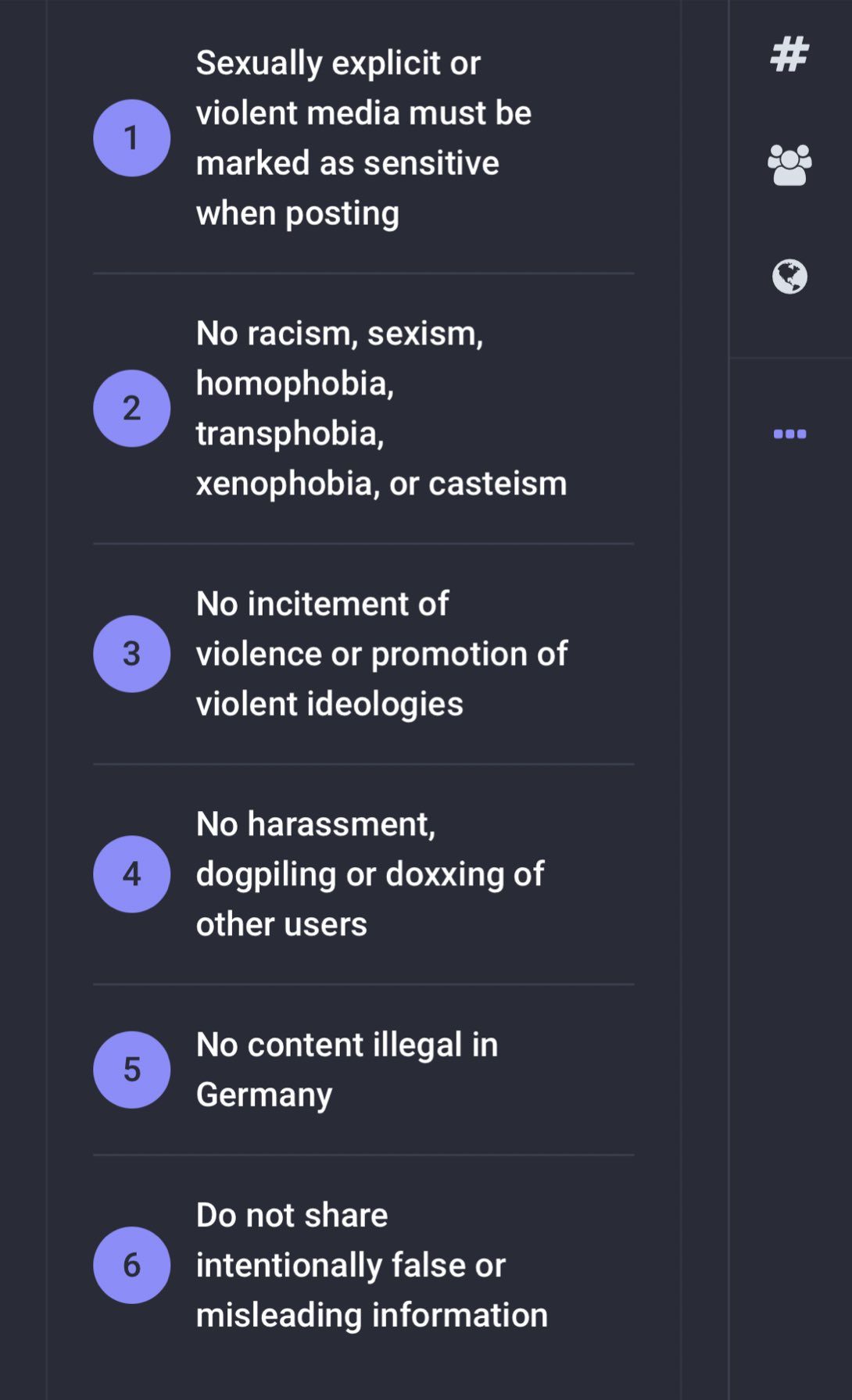
Then there is the moderation policy. I joined the original server `mastodon.social’ (where I am the usual @telescoper) which has the following rules:

Hopefully this will deter those who spend all their time on Twitter sending abuse from joining Mastodon. This server is based in Germany, hence number 5. Although I think it was included for other reasons, it reminds me that defamation is a criminal offence in Germany, punishable by a prison sentence. A certain individual who has a habit of posting defamatory messages about me on Twitter should bear this in mind…

Anyway, I’ve only just got onto the platform and am still finding my way around. I only have a handful of followers, compared to the 7000+ I have on Twitter. For the time being I’m still on Twitter, but if it goes well then I intend to leave that to the trolls and bigots. I’m sick of spending so much time blocking objectionable people and seeing decent people abused.

P.S. One thing I think would be handy would be an API that allows me to publish these blog posts automatically on Mastodon like I do on Twitter, but I haven’t seen one yet…

Changing Time Again

Posted in History with tags , , on October 30, 2022 by telescoper

Some time ago, before the Covid-19 Pandemic, the European Parliament approved a directive that would abolish `Daylight Saving Time’. Unfortunately that plan has been ‘paused’ and this year we had to go through the usual rigmarole of putting the clocks back. Fortunately most devices do this automatically, though I have never figured out how to change the time on the clock on my cooker which means that we’re now in the 5 months of the year during which it shows the correct time.

I’ve long felt that the annual ritual of putting the clocks forward in the Spring and back again in the Autumn was a waste of time effort, so I’ll be glad when this silly practice is terminated. It would be far better in my view to stick with a single Mean Time throughout the year. I’m only disappointed that this hasn’t happened already.

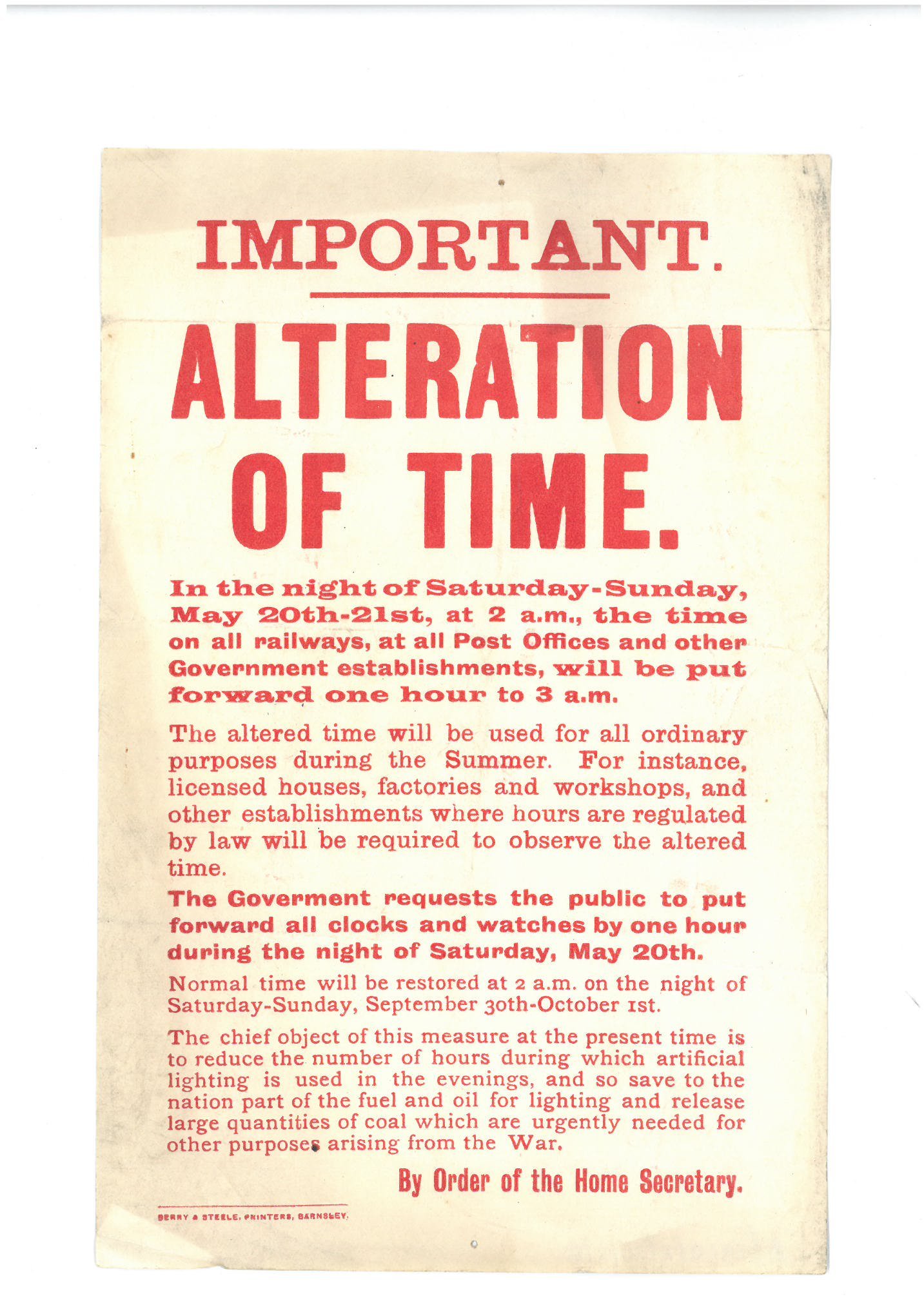
The marvellous poster above is from 1916, when British Summer Time was introduced. I was surprised to learn recently that the practice of changing clocks backwards and forwards in the UK is only about a hundred years old and was introduced as an emergency measure in wartime. To be honest I’m also surprised that the practice persists to this day, as I can’t see any real advantage in it. Any institution or organisation that really wants to change its working hours in summer can easily do so, but the world of work is far more flexible nowadays than it was a hundred years ago and I think very few would feel the need.

Anyway, while I am on about Mean Time, here is a another poster from 1916.

Until October 1916, clocks in Ireland were set to Dublin Mean Time, as defined at Dunsink Observatory, rather than at Greenwich. The adoption of GMT in Ireland was driven largely by the fact that the British authorities found that the time difference between Dublin and London had confused telegraphic communications during the Easter Rising earlier in 1916. Its imposition was therefore, at least in part, intended to bring Ireland under closer control. This did not go down well with Irish nationalists.

Ireland had not moved to Summer Time with Britain in May 1916 because of the Easter Rising. Dublin Mean Time was 25 minutes 21 seconds behind GMT but the change to GMT was introduced in Ireland at the same time as BST ended in the UK, hence the alteration by one hour minus 25 minutes 21 seconds, i.e. 34 minutes and 39 seconds as in the poster.

Britain will probably never scrap British Summer Time on the grounds that whatever the EU does must be bad. What will happen to Northern Ireland when Ireland scraps Daylight Saving Time is yet to be seen…

Study Break Time

Posted in Biographical, Covid-19, Education, Irish Language, Maynooth with tags , , , , on October 29, 2022 by telescoper

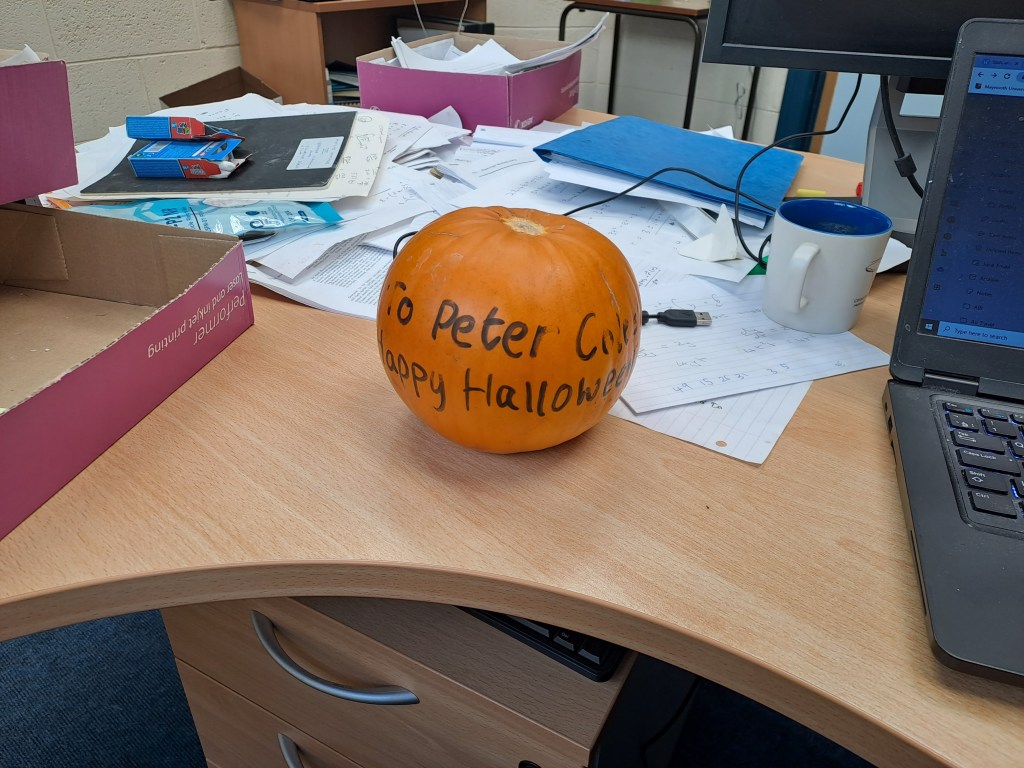
Yesterday my Vector Calculus students gave me the above Hallowe’en gift, which was nice of them, although I did chastise them for missing the apostrophe. Of course Hallowe’en itself is not until Monday, but that is a Bank Holiday in Ireland and the rest of next week is Study Week so there are no lectures or tutorials.

Hallowe’en is, in pagan terminology, Samhain. This, a cross-quarter day – roughly halfway between the Autumnal Equinox and the Winter Solstice, represents the start of winter (“the dark half of the year“) in the Celtic calendar. Samhain is actually November 1st but in Celtic tradition the day begins and ends at sunset, so the celebrations begin on the evening of 31st.

Incidentally, Samhain is pronounced something like “sawin”. The h after the m denotes lenition of the consonant (which in older forms of Irish would have been denoted by a dot on top of the m) so when followed by a broad vowel the m is pronounced like the English “w”; when followed by a slender vowel or none “mh” is pronounced “v” or in other words like the German “w” (which makes it easier to remember). I only mention this because I will be resuming my Irish language education after the break with classes every week for the rest of the academic year. Hopefully I’ll make some progress.

This term has been very tiring so far. I have to teach a very big first-year class this year which meant adding another tutorial group. Although I stepped down as Head of Department at the end of August the powers that be delayed appointing a replacement until well into term which caused a lot of unnecessary stress for everyone. Once we got under way, though, everything has settled down reasonably well.

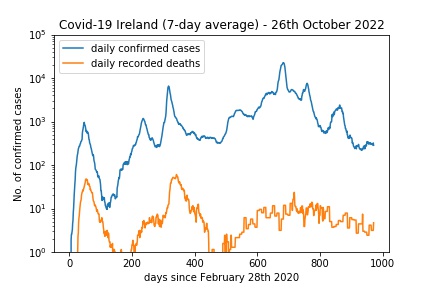
One thing I was a bit worried about this term was that the resumption of in-person teaching would lead to a surge in Covid-19 cases, not only in Maynooth but across the country. However there isn’t any evidence of significant increases in the latest figures (updated weekly nowadays, on Wednesdays):

Some students have come down with Covid-19 of course but not in the numbers I had feared. Also despite accommodation shortages and other difficulties, attendance at lectures and tutorials has so far held up well.

I like having the study break. I’ve never previously worked at an institution that has such a thing, but I think 12 weeks of non-stop teaching would be extremely exhausting. Anyway, after the break we have a further six weeks of teaching until December 16th, which is the official end of term, but for now I have Monday off completely and the rest of the week without teaching duties. That’s not to say I’ll be on holiday though. I have a number of tasks to catch up on, including setting examination papers for January…

Summer Programme for Undergraduate Research

Posted in Biographical, Maynooth, The Universe and Stuff with tags , , , on October 28, 2022 by telescoper

Not long ago I posted an item about the Summer Programme for Undergraduate Research (SPUR) at Maynooth University. This past summer I had two undergraduate students doing research projects with me funded under this scheme. They were both involved with making Monte Carlo simulations of galaxy clustering and using them to test various statistical analysis tools. The Department of Theoretical Physics actually had five students on three different projects, which is quite a lot for a small Department. The University as a whole had 57 SPUR students so we had almost ten percent of the total!

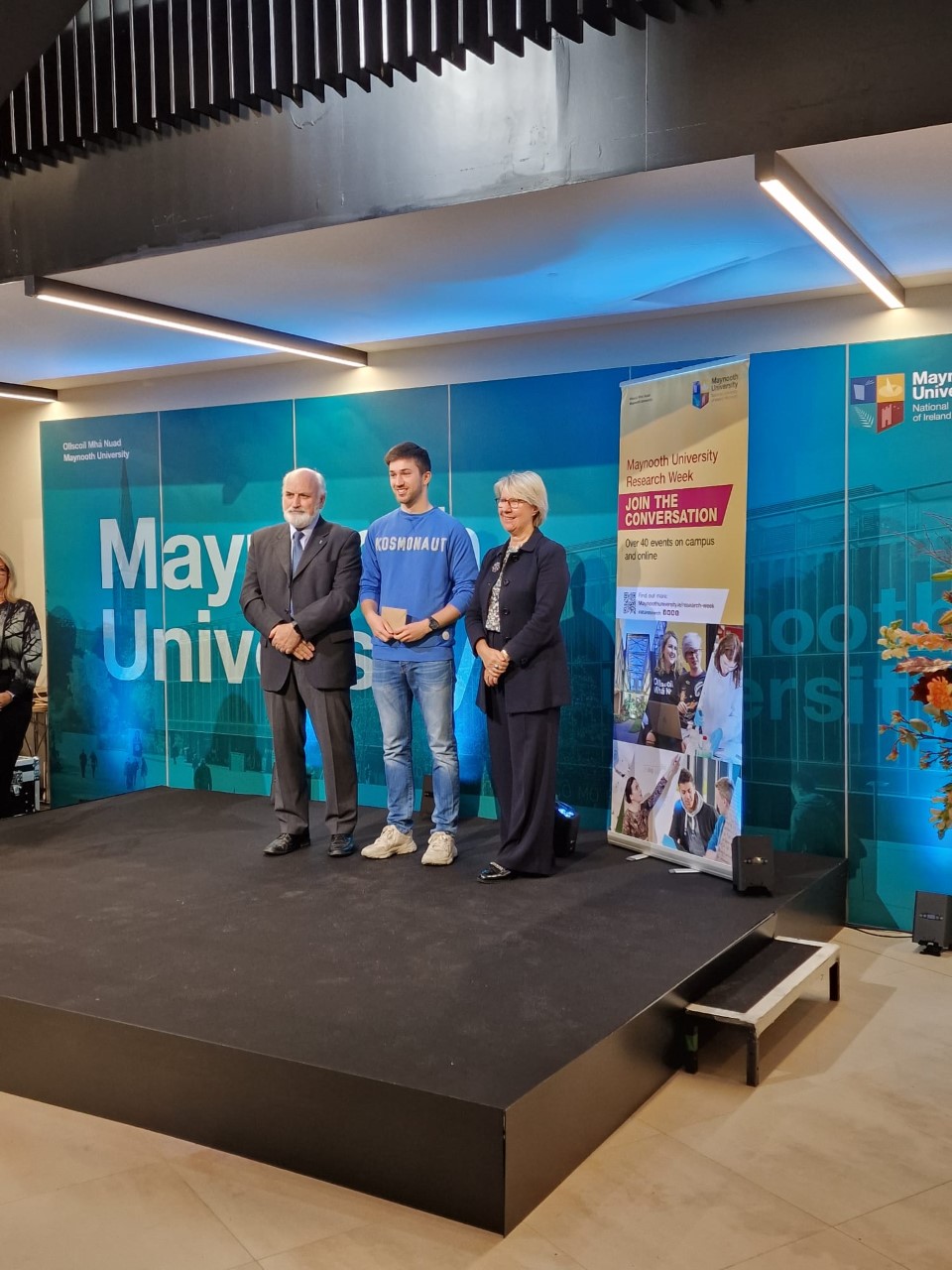
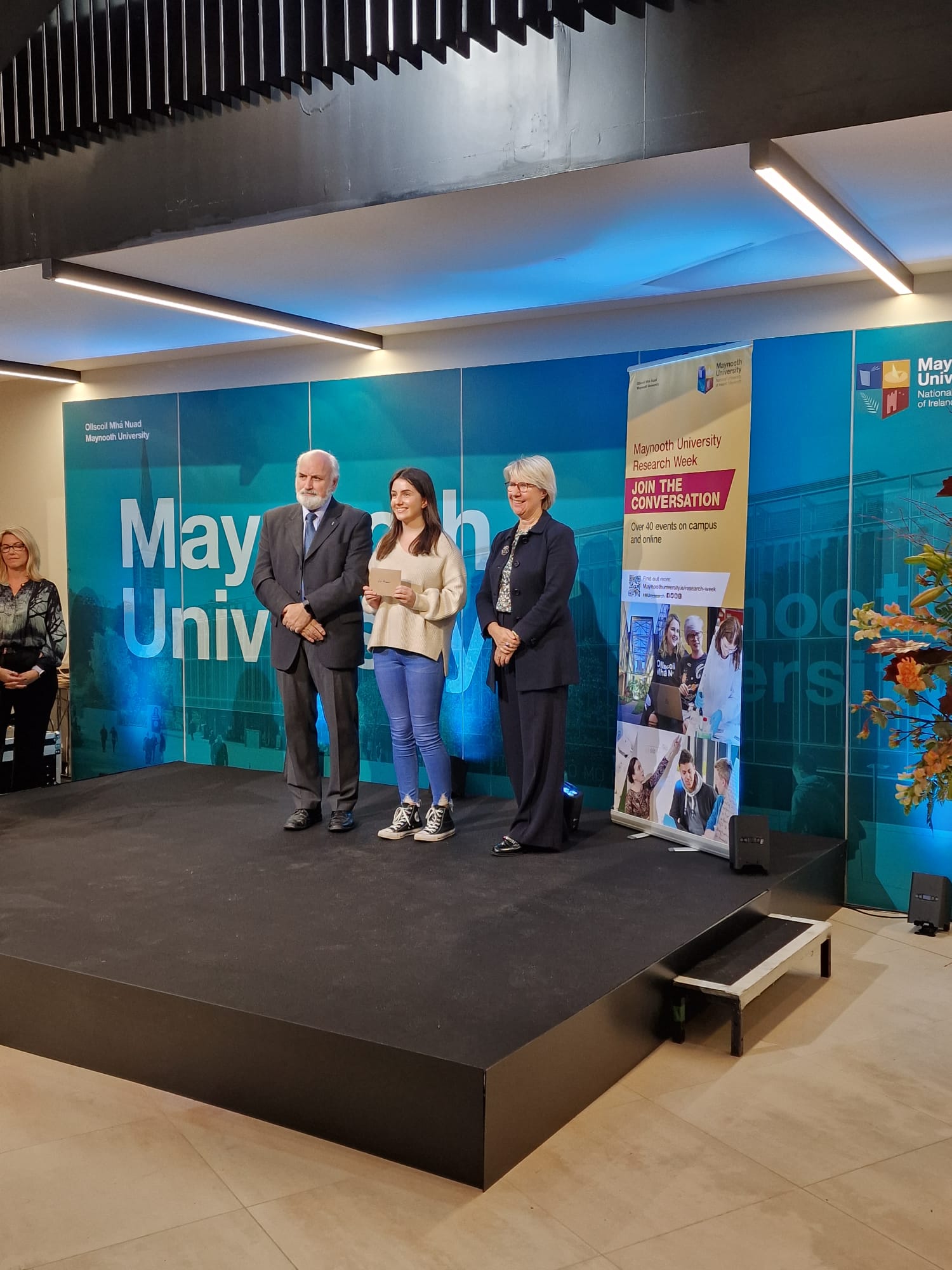
Well, earlier this week there was a Research Symposium at which all the summer’s research undergraduates presented posters on their work, with prizes being awarded for the best. I couldn’t attend the Symposium because of other commitments but I was delighted to find out that both my students won prizes – that’s two out of the five awarded. Here are the pictures of them being presented with their awards at the ceremony yesterday, flanked by the Vice-for Research and Innovation, Brian Donnellan and the President, Eeva Leinonen.

The awards ceremony was held in the foyer of the new TSI building yesterday afternoon, which wasn’t an ideal choice because the acoustic is very poor and lots of students were making their way to and from lectures. I didn’t hear a word of the speeches, actually. Nevertheless it was nice to see Pawel (top prize in the Science and Engineering category) and Lisa (audience choice prize winner) collect their awards. It was a pleasure to work with both of them this summer!

Incidentally, the SPUR students are paid for the projects, which last for (usually) six weeks but can be extended. I wish we could offer these projects to every student who wanted one, actually, but we just can’t afford to do that. I don’t agree with unpaid internships as these can only be taken up by students who have access to enough income to cover living expenses over the summer, so are discriminatory. We select students based on an application form and their academic performance.