The Verdict in the Ott Case

Posted in Harassment Bullying etc with tags , , , on November 17, 2022 by telescoper

Just time for a very quick post regarding the court case I mentioned last week initiated by Christian Ott.

You will recall that Christian Ott resigned from a position at Caltech in 2016 after being found guilty of gender-based harassment against two graduate students, I wrote about this case and some of the issues it raised here. Little information about the case was divulged publicly by Caltech at the time.

After leaving Caltech, Ott was offered a position at the University of Turku in Finland but that offer was rescinded after protests about this apparent case of “passing the harasser”. Syksy Räsänen and Till Sawala initiated an open letter that was signed by a large number of academics calling for Ott’s appointment to be cancelled. Syksy blogged about the case here (in Finnish; scroll down to see the English translation). Ott now works as a software consultant.

Not being at all knowledgeable about Finnish law, I wasn’t sure of the legal basis on which Ott’s case was being pursued but it seemed to involve an accusation of “aggravated defamation”; the second charge was “aggravated dissemination of information that violates privacy”.

Anyway, the relevant court issued its judgment today. The charges against Räsänen and Sawala were dismissed.I am delighted and relieved by this news. The only coverage I have seen so far is in Finnish – see here for example – but I’ll update with more when it becomes available.

Here is the text of a press release from Syksy Räsänen and Till Sawala about the verdict.

Two astrophysicists win defamation trial after calling out harassment

Two astrophysicists at the University of Helsinki, Finland, were today acquitted of “aggravated defamation” and “aggravated dissemination of information that violates privacy” in the district court of Southwest Finland in Turku [1]. They had spoken out when Christian Ott, an astrophysicist previously suspended due to harassment, was hired at the University of Turku. The prosecutor had demanded suspended prison sentences or substantial fines, while Ott demanded €60,000.

“I am relieved that our right to speak out was affirmed today, but I remain concerned how people in positions of power downplayed harassment in this case. The issue is harassment, not the fact that people are finally talking about it”, says Till Sawala, one of the defendants. “Too much attention has been paid to protecting the reputation of institutions or the perpetrators of harassment. Our attention should be on the rights of the victims and on creating a community where everyone can feel safe.”

 “I welcome the acquittal after over three years of process. I hope this case will set a precedent”, comments Syksy Räsänen, the other defendant. “No one should have to fear fines or a prison sentence for simply speaking out against harassment based on widely and reliably reported facts. The threat alone can have a chilling effect that can set back work against harassment. We had the financial resources, and support from our scientific community, to contest the baseless charges against us. If someone in a less secure position, such as a PhD student, were to be put in this situation, they might not fare so well.”

In 2015, an investigation at the California Institute of Technology (Caltech) had found that Ott had committed “unambiguous gender-based harassment” of two graduate students. The case received international media attention [2, 3, 4, 5, 6]. Ott had been placed on unpaid leave for nine months and his suspension was extended after he breached its terms. During the Turku trial, it was revealed that Ott received his full salary of over $200,000 from Caltech in 2017.

Following Ott’s resignation at the end of 2017, in January 2018, it emerged that Ott was due to be hired at the University of Turku [7]. Just prior to this, Ott had been offered a job at the University of Stockholm, but the offer was withdrawn after staff protests. Alexandra Veledina, who had recruited Ott to Stockholm, also works in the group of Juri Poutanen, the director of the observatory in Turku.

Räsänen and Sawala wrote a letter to the University of Turku leadership expressing their concern over the appointment. Räsänen and Sawala also published a statement against harassment in astronomy, which was signed by the majority of Finnish astronomers [8]. Referring to the response of the scientific community, the University of Turku cancelled the appointment [9].


Juri Poutanen acted as a witness for the prosecution in the trial. In emails shown in court, he had told Räsänen: “In my view there is no evidence” that Ott harassed anyone. When presented with Caltech’s findings in court, he responded that ”it really makes no difference what happened at Caltech“.

Poutanen also commented that only one of his staff had expressed concerns to him. Documents and testimony in court showed that several other astronomers at the University of Turku had reported their concerns to the rector, the university leadership, and to their trade union. The staff member who had spoken to Poutanen became the subject of a police investigation after Ott filed a criminal complaint, alleging they spoke to the press about the matter. They were ultimately not charged.

The prosecutor claimed that Sawala and Räsänen’s statements about Ott’s conduct violated privacy, in part because Caltech is a private institution. The prosecutor also alleged that the defendants’ writings were defamatory, arguing that being guilty of harassment implies being guilty of a crime, of which Ott has never been charged. The prosecutor also argued that because Ott’s actions had not involved physical contact, they did not constitute sexual harassment. Ott’s lawyers claimed that the defendants had repeated false claims from a “gossip website”.

Räsänen and Sawala argued that they were speaking about a matter of professional concern in their own scientific field, a protected category of speech under Finnish defamation law [10]. They also argued that the facts of the case were widely known and reported by many credible sources, including Caltech’s own public statements and the world’s premier scientific journals.

The court concluded that Räsänen and Sawala had spoken about a matter of public interest, based their statements on credible sources, and had at least not knowingly disseminated information they didn’t have good reason to consider true. As such, the violation of privacy and defamation charges were both dismissed.

As grounds for the financial compensation, Ott had stated that the sum of €50,000 was a “token”, intended “to hurt, but not bankrupt the respondents”. He asked for a further €10,000 in damages. Both claims were dismissed along with the criminal charges. Ott also appeared to dispute the findings of Caltech’s investigation, calling it a “kangaroo court”. According to Ott, the investigation started after “an activist got involved and urged the student to file a complaint”.  Caltech has stood by its process and findings. A 2019 investigation by NASA and the National Science Foundation found that Caltech followed the appropriate procedures in its Title IX investigation [11].

Links

Blog entries on the case by Syksy Räsänen

https://www.ursa.fi/blogi/kosmokseen-kirjoitettua/myos-me-kierros-3-we-too-round-3/

https://www.ursa.fi/blogi/kosmokseen-kirjoitettua/myos-me-taas-we-too-again/

https://www.ursa.fi/blogi/kosmokseen-kirjoitettua/myos-meus-too/

Sources referenced in the text

[1] Verdict (in Finnish):  https://telescoper.blog/wp-content/uploads/2022/11/tuomio-r-22-619.pdf

[2] https://www.nature.com/articles/nature.2016.19153 

[3] https://www.nature.com/articles/529255a

[4] https://www.science.org/content/article/caltech-suspends-professor-harassment 

[5] https://www.buzzfeednews.com/article/azeenghorayshi/ott-harassment-investigation 

[6] https://www.washingtonpost.com/news/speaking-of-science/wp/2016/01/13/astronomys-snowballing-sexual-harassment-scandal-picks-up-even-more-cases/ 

[7] https://www.utu.fi/en/news/news/recruitment-of-christian-ott-to-the-university-of-turku 

[8] https://blogs.helsinki.fi/sawala/statement-by-finnish-astronomers-and-astrophysicists-on-harassment/

[9] https://www.utu.fi/en/news/news/university-of-turku-cancels-the-employment-contract-of-christian-ott

[10] https://finlex.fi/en/laki/kaannokset/1889/en18890039_20150766.pdf

[11] https://www.nsf.gov/od/oecr/reports/Caltech_Title_IX_Report.pdf
Is Ireland about to join CERN?

Posted in Politics, Science Politics, The Universe and Stuff with tags , , on November 16, 2022 by telescoper

Way back in 2019 I posted a piece about the case for Ireland to join CERN and revived the discussion about six months ago after talking about it to particle physicist John Ellis.

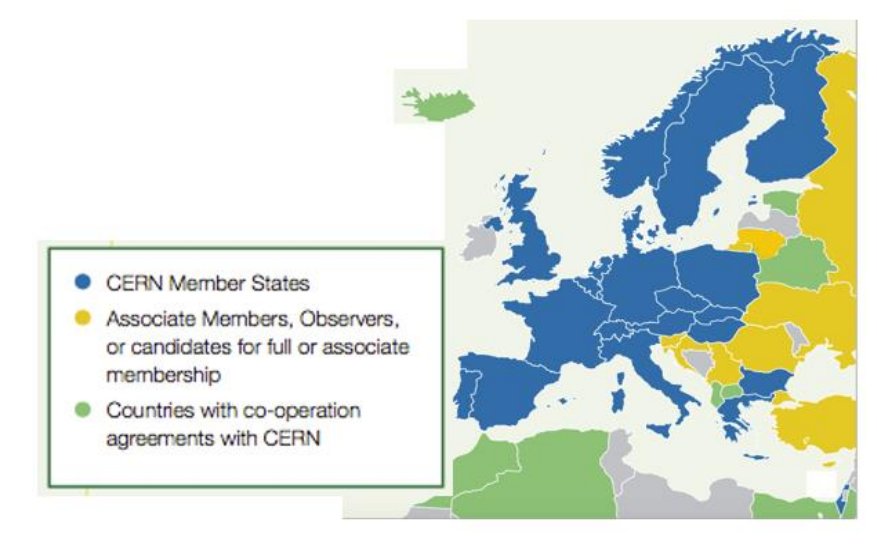
Well it seems there has been progress and, according to the Irish Times, a proposal to join CERN is going to be tabled by the Minister Simon Harris. This follows a long hiatus after a move reported in the news here in Ireland several years ago of a report from a Committee of the Houses of the Oireachtas making the case for Ireland to join CERN. You can download the report here (PDF) and you’ll find this rather striking graphic therein:

You will see that there are only three European countries other than Ireland that don’t have any form of membership or other agreement with CERN: Latvia, Bosnia-Herzegovina, Moldova. The fact that almost everyone else is in is not in itself necessarily a good argument for Ireland to join, but it does make one wonder why so many other countries have found it important to join or have an agreement with CERN while Ireland has not.

As the document explains, if the Irish government  were to decide to take Ireland into CERN then  it would first have to become an Associate Member, which would cost around €1.2 million per year. That’s small potatoes really, and  the financial returns to Irish industry and universities are likely to far exceed that, so the report strongly recommends this step be taken. This Associate member stage would last up to 5 years, and then to acquire full membership a joining fee of around €15.6 million would have to be paid, which is obviously a much greater commitment but in my view still worthwhile.

There were some positive noises when the document came out, but that was near the end of 2019. Not far into 2020 the pandemic struck and the idea sank without trace. Now it looks like the idea is alive again. It’s not exactly a done deal but at least there’s some movement.

While I strongly support the idea of Ireland joining CERN I do have a couple of concerns about the case as presented in the Oireachtas report.

One is that I’m very sad that the actual science done at CERN is downplayed in that report. Most of it is about the cash return to industry, training opportunities, etc. These are important, of course, but it must not be forgotten that big science projects like those carried out at CERN are above all else science projects. The quest for knowledge does have collateral benefits, but it a worthy activity in its own right and we shouldn’t lose sight of that.

My other (related) concern is that joining CERN is one thing, but in order to reap the scientific reward the government has to invest in the resources needed to exploit the access to facilities membership would provide. Without a related increase in research grant funding for basic science the opportunity to raise the level of scientific activity in Ireland would be lost.

Ireland recently joined the European Southern Observatory (ESO), a decision which gave Irish astronomers access to some amazing telescopes. However, there is no sign at all of Irish funding agencies responding to this opportunity by increasing funding for academic time, postdocs and graduate students needed to do the actual science. In one respect ESO is very like CERN: the facilities do not themselves do the science; we need people to do that. The jam for research is already spread very thinly in Ireland so having an extra thing to spread it on will not necessarily be a good thing for science in general.

R.I.P. Carolina Ödman-Govender

Posted in Uncategorized on November 15, 2022 by telescoper

Just got back from a lecture to hear the heartbreaking news that Carolina Ödman-Govender has passed away after a long battle with cancer. I first met Carolina when she was a PhD student at the University of Cambridge about 20 years ago. I think that was at a conference in Erice. She was a lovely human being who was held in the highest esteem by everyone who met her. It is devastating that such an inspirational figure is no longer with us. I send heartfelt condolences to husband Kevin, her family, friends and colleagues at this terrible time.

Transgender Awareness Week

Posted in LGBTQ+ with tags , on November 15, 2022 by telescoper

Apologies for being a bit late with this but I thought I’d just mention that this week (13th-19th November) is Transgender Awareness Week and take the opportunity this presents to send a message of support and solidarity not only to my trans friends colleagues and students, but to all transgender people everywhere.

You can find much more about Transgender Awareness Week at this site which is based in the USA but much of what is there is relevant elsewhere, including Ireland.

The Hubble Tension and Early Dark Energy

Posted in The Universe and Stuff with tags , , , , on November 14, 2022 by telescoper

In recent times I’ve posted quite a few times about the Hubble Tension and possible resolutions thereof. I also had polls to gauge the level of tension among my readers, like this one

and this one:

I’m not sure if these are still working, though, as I think I’ve reached the number of votes allowed on the basic free version of crowdsignal that comes with the free version of WordPress. I refuse to pay for the enhanced version. I’m nothing if not cheap. You can however still see the votes so far.

Anyway, there is a new(ish) paper on the arXiv by Mark Kamionkowski and Adam Riess that presents a nice readable introduction to this topic. I’m still not convinced that the Hubble Tension is anything more than an observational systematic, but I think this is a good discussion of what it might be if it is more than that.

Here is the abstract:

Over the past decade, the disparity between the value of the cosmic expansion rate directly determined from measurements of distance and redshift or instead from the standard ΛCDM cosmological model calibrated by measurements from the early Universe, has grown to a level of significance requiring a solution. Proposed systematic errors are not supported by the breadth of available data (and “unknown errors” untestable by lack of definition). Simple theoretical explanations for this “Hubble tension” that are consistent with the majority of the data have been surprisingly hard to come by, but in recent years, attention has focused increasingly on models that alter the early or pre-recombination physics of ΛCDM as the most feasible. Here, we describe the nature of this tension, emphasizing recent developments on the observational side. We then explain why early-Universe solutions are currently favored and the constraints that any such model must satisfy. We discuss one workable example, early dark energy, and describe how it can be tested with future measurements. Given an assortment of more extended recent reviews on specific aspects of the problem, the discussion is intended to be fairly general and understandable to a broad audience.

The Ott Case Revisited

Posted in Harassment Bullying etc with tags , , , , on November 13, 2022 by telescoper

It is hard to keep up with everything that is surfacing these days to do with bullying and harassment in astronomy. A number of people have contacted me about the anonymous guest post that appeared here recently, all from different universities, and all convinced that the unidentified Department referred to in the post was theirs. I can only infer that there must be a lot of this sort of thing about.

Anyway, there was news of a different sort last week when the magazine Science reported on a legal case initiated by Christian Ott against two Finnish astrophysicists, Syksy Räsänen and Till Sawala. The verdict in this case is due next week, on 17th November to be precise.

Christian Ott resigned from a position at Caltech in 2016 after being found guilty of gender-based harassment against two graduate students, I wrote about this case and some of the issues it raised here. Little information about the case was divulged publicly by Caltech at the time.

After leaving Caltech, Ott was offered a position at the University of Turku in Finland but that offer was rescinded after protests about this apparent case of “passing the harasser”. Syksy Räsänen and Till Sawala initiated an open letter that was signed by a large number of academics calling for Ott’s appointment to be cancelled. Syksy blogged about the case here (in Finnish; scroll down to see the English translation). Ott now works as a software consultant.

Not being at all knowledgeable about Finnish law, I’m not sure of the legal basis on which Ott’s case is being pursued but it seems to involve an accusation of defamation and the publication of confidential documents. As far as I understand it in Finland defamation is a criminal offence, rather as it in Germany, and can lead to a substantial fine and/or a prison sentence on conviction. I sincerely hope that it doesn’t come to either of those, as I believe that Syksy and Till took a principled stand in this matter regardless of what the law says.

According to the Science article

Sawala’s lawyer, Jussi Sarvikivi, said the prosecutor’s position appears to be that “any commentary on the Caltech finding demonstrates an intent to harm” Ott because it inevitably casts Ott in a poor light.

I had better not say any more about this until the verdict is delivered, at which point I expect the defendants to make statements. I will say though that I doubt it was Ott’s intention to draw attention again to his past behaviour but that is something this case has definitely achieved…

Free Jazz – A Collective Improvisation

Posted in Jazz with tags , , , , , , , , on November 12, 2022 by telescoper

In late 1960 the great saxophonist Ornette Coleman did a recording session with a stellar band of eight musicians: Coleman himself (alto sax); Eric Dolphy (bass clarinet); Freddie Hubbard and Don Cherry (trumpets); Charlie Haden and Scott Lafaro (both on bass); Billy Higgins and Ed Blackwell (both on Drums). The octet thus formed is actually two quartets and these are presented one on each stereo channel.

What Ornette Coleman did with these musicians on that day was extraordinary, a piece of collective improvisation that lasted almost 40 minutes duration and which had never been attempted before on record. It’s not entirely improvised – there is a brief introduction and some pre-arranged polyphonic passages (some just an individual chord) between the soloists – but other than that the soloists were told to take turns playing whatever they liked while the rest of the band should accompany as they saw fit. The intervals between solos are largely dissonant which produces an interesting challenge for the soloists in deciding exactly how to start.

One aspect of this otherwise superb album that doesn’t work consistently for me is the inclusion of two drummers; tt least at the start they seem to get in each other’s way more than anything else but as the piece develops they seem to understand that a more subdued approach is needed and that makes it easier for the soloists as well as making the atmosphere looser and more relaxed. Listening to this track just now it struck me how much it is dominated by Ornette Coleman who directs the traffic as well as playing a terrific solo of his own in the middle.

This track was Free Jazz was originally released in two parts on a vinyl LP but it’s now available on CD in one track, along with the originally discarded first take. Not surprisingly given the nature of the piece, critics were divided, with some recognizing it as an important new development, and others hating it. This record is not exactly easy listening and when I first heard this about 40 years ago I didn’t get it at all, but now I think that for all its unevenness it’s a superb record. If you’ve got 40 minutes to spare you can now listen to it and make your own mind up!

Astrophysics & Cosmology Masterclass Next Week!

Posted in Maynooth, The Universe and Stuff with tags , , , , on November 11, 2022 by telescoper

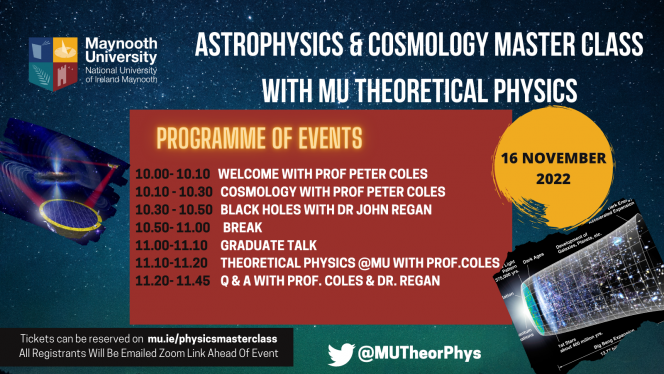
As next week is Science Week I thought I’d remind readers that as part of the festivities we are hosting a virtual  Masterclass in Astrophysics & Cosmology in Maynoothon Wednesday 16th November 2022  .

You may remember that we have presented such events twice before. Last year’s event was a particularly big success, with over a hundred schools joining in, with probably over a thousand young people listening and asking questions.

Like last year’s event this year’s will be a half-day virtual event via Zoom. It’s meant for school students in their 5th or 6th year of the Irish system. There might be a few of them or their teachers who see this blog so I thought I’d share the news here. You can find more information, including instructions on how to book a place, here.

Here is the flyer for the event:

I’ll be talking about cosmology early on, and John Regan will talk about black holes later on. After the coffee break one of our students will talk about why they wanted to study astrophysics. Then I’ll say something about our degree programmes for those students who might be interested in studying astrophysics and/or cosmology as part of a science course. We’ll finish with questions either about the science or the studying!

Here is a more detailed programme:

New Publication at the Open Journal of Astrophysics

Posted in OJAp Papers, Open Access, The Universe and Stuff with tags , , , , on November 10, 2022 by telescoper

I’m delighted to be able to announce the 10000th paper this year, and 1000000th publication overall, at the Open Journal of Astrophysics!

That is counting in binary, of course. In base ten the  new paper at the 16th paper in Volume 5 (2022) as well as the 64th in all.

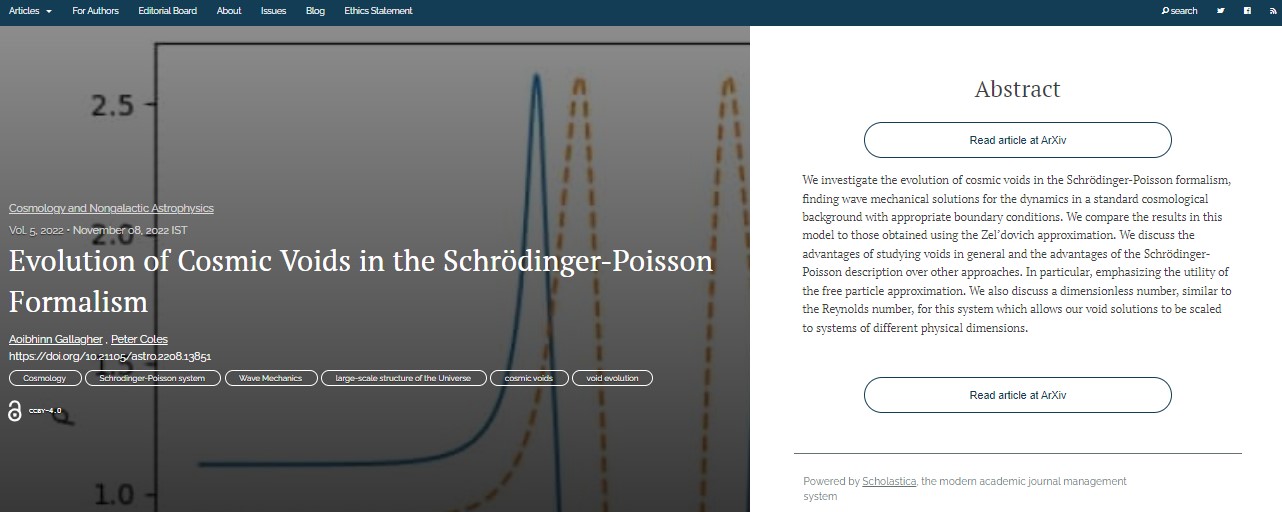
The latest publication is entitled “Evolution of Cosmic Voids in the Schrödinger-Poisson Formalism” and the authors are Aoibhinn Gallagher and Peter Coles (Who he? Ed) both of the Department of Theoretical Physics at Maynooth University. Obviously as author I played no role in the selection of referees or any other aspect of the editorial process.

Aoibhinn Gallagher – bonus marks for pronouncing both names correctly – is my first Maynooth PhD student and this is her first paper, of many I hope (and expect)! We’re already working on extensions of this approach to other aspects of large-scale structure. You can find some discussion of this general approach here.

Anyway, here is a screen grab of the overlay which includes the  abstract:


You can click on the image to make it larger should you wish to do so. You can find the officially accepted version of the paper on the arXiv here.

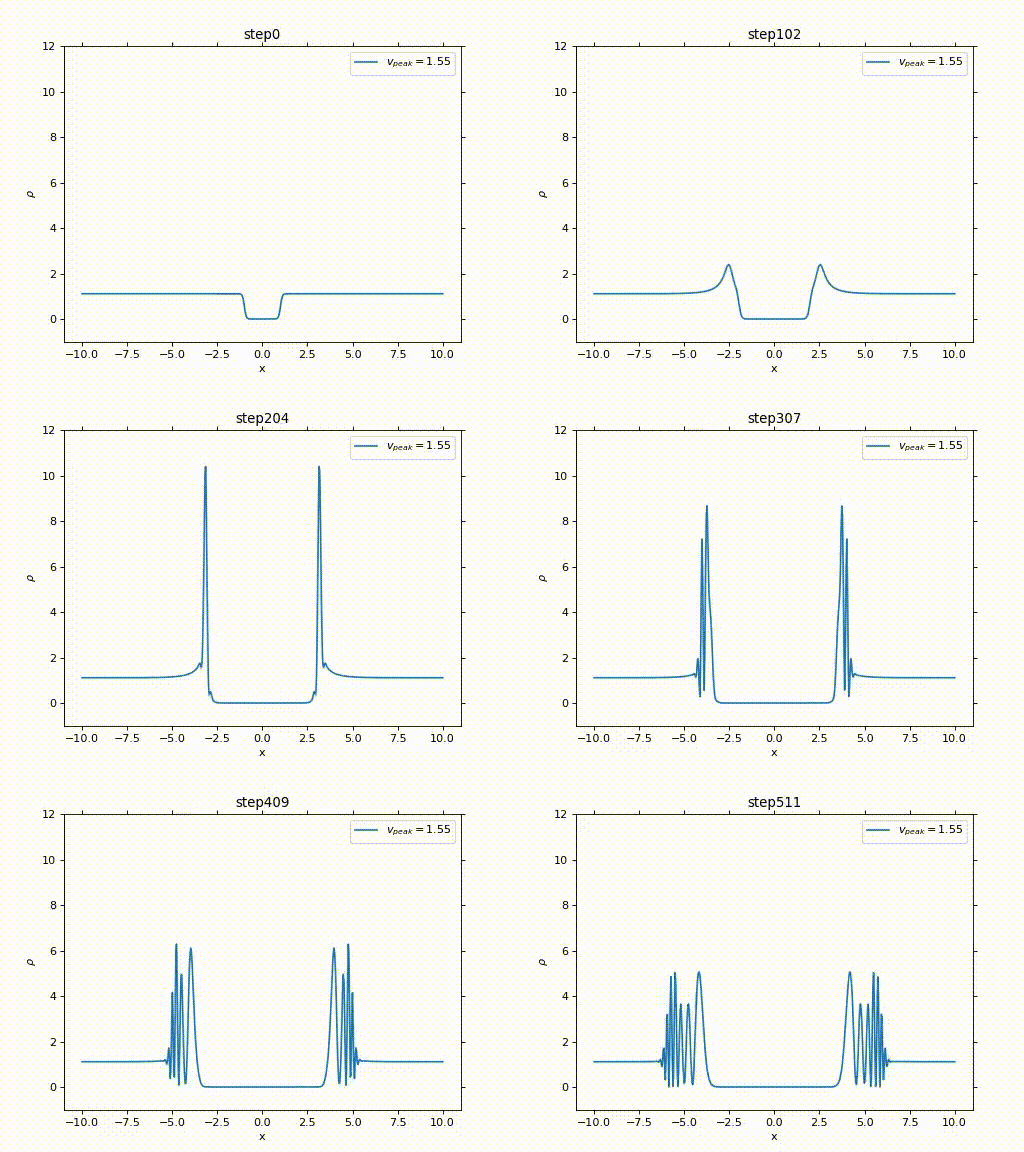
Here is a nice animated version of Figure 5 of the paper showing, for a 1D slice, the radial expansion of a spherically symmetric void (i.e. underdense region) using periodic boundary conditions:

The x-axis is in (scaled) comoving coordinates, i.e. expanding with the cosmological background, so that the global expansion is removed.  You can see that the void expands in these coordinates, so is expanding more quickly than the background, initially pushing matter into a dense ring around the rim of the empty void. That part of the evolution is just the same as for “normal” matter but in this case the wave-mechanical behaviour of the matter prevents it from being confined to a strongly-localized structure as well as affecting the subsequent expansion rate.

Of course in the real Universe, voids are not isolated like this but instead tend to push into each other, but we felt it was worth studying the single void case to understand the dynamics!

DIRAC Research Image Competition – The Winning Entries!

Posted in Art, The Universe and Stuff with tags , , , , , on November 9, 2022 by telescoper

DIRAC is a high-performance computing facility designed to serve the research community supported in the UK by the Science and Technology Facilities Council (STFC). Recently DIRAC ran a competition to select the best images produced using results obtained by this facility, and I was honoured to be asked to be one of the judges. Entries were divided into two Themes: Theme 1 (Particle and Nuclear Physics) and Theme 2 (Astronomy, Cosmology and Solar & Planetary Science) and scores were allocated by the judges based on visual impact and scientific interest. There were 41 entries altogether, all of a very high standard.

So, without further ado, I shall now show you the winning entries!

The winning image in Theme 1 was submitted by Ed Bennett and Biagio Lucini of Swansea University and called Let it (Wilson) flow. The description supplied by the creators reads:

A space-time slice of the topological charge density distribution of a 128 times 643 lattice field configuration (with periodic boundaries) from an ensemble of the SU(2) gauge theory with two flavours of Dirac fermion in the adjoint representation (also known as Minimal Walking Technicolor). Moving along the time direction from left to right, successive time-slices are also iterated using the gradient flow of the Wilson action, which removes the ultraviolet noise that would otherwise prevent computation of the configuration’s topological charge. This noise is clearly visible on the left, with the actual instantons (orange) and anti-instantons (blue) becoming visible at longer flow times to the right.

Here is the winning image for Theme 1:

Theme 1 winner: Let it (Wilson) flow by Ed Bennett and Biagio Lucini.

The winning entry of Theme 2 is entitled Immediate origin of the Moon as a post-impact satellite and was submitted by Jacob Kegerreis of Durham University who supplied the following description:

The Moon is thought to have formed following a giant impact, but the details are still hotly debated. New high-resolution simulations, like the one shown here, reveal that a Moon-like satellite can be immediately placed into a wide orbit around the Earth, in contrast with the traditional idea of later accretion from a debris disk. This opens up new possibilities for the Moon’s initial orbit and interior, which could help to solve mysteries like its tilted orbit, thin crust, and Earth-like isotopes. The 3D smoothed particle hydrodynamics (SPH) simulations were run using the SWIFT code on the DiRAC COSMA8 system with over 100 times higher resolution than the current standard. The SPH data from this mid-impact snapshot are rendered using Houdini and Redshift, with the colour, opacity, and emission controlled by the particle material, density, and internal energy.

Here is the winning image of Theme 2:

Theme 2 Winner: Immediate origin of the Moon as a post-impact satellite by Jacob Kegerreis

Congratulations to the winners!

It was a lot of fun being one of the judges for this competition and I learnt a lot about the science from the clever way in which many of the entries displayed their results. The field was very strong, and many more images were worthy of recognition, but we were only allowed to pick one winner from each Theme. I am however given to understand that it is planned to include the best of the rest alongside the winners in a 2023 calendar which will be distributed to the DIRAC user community.