Once again I find myself having to pass on some sad news. Astronomer Maarten Schmidt has passed away at the age of 92. The highlight of his long and distinguished career was the discovery, in 1963, that quasars showed hydrogen emission lines that revealed them to be at cosmological redshifts. Together with Donald Lynden-Bell (who passed away in 2018), Schmidt was awarded the inaugural Kavli Prize for Astrophysics in 2008.
Last week I gave a couple of talks to new undergraduate students about courses in Theoretical and Mathematical Physics here at Maynooth. As happens from time to time, a student asked me if our programmes are accredited by the Institute of Physics. The short answer to this is ‘no’.
Before going further into this, I should probably explain what accreditation actually means. An accredited degree is one that counts as a professional qualification that enables the holder to pursue a career in a given discipline, usually as a practitioner of some sort. Obvious examples are medical degrees (which Maynooth does not offer), Engineering, Architecture, Law, Accounting and Psychology (for its clinical aspects). Most degree progammes at Maynooth and elsewhere are not accredited
You shouldn’t be concerned about the quality of a course just because it isn’t accredited – not all degree courses are. Accredited courses are only really necessary if there is a professional qualification in the industry you plan to work in – where they can help you to get ahead in your chosen career.
I’ll add for those who weren’t aware that the Institute of Physics covers the UK and Ireland.
Having a physics degree accredited by the IOP is not a professional requirement as it is in, say, Law or Engineering. Indeed, there is no job or career path in physics that requires a degree with IOP accreditation. If there were then nobody with a physics degree from outside the UK or Ireland would be eligible for it. IOP accreditation is also irrelevant for doing a Masters or PhD. Ask any one of a number of our graduates!
We have discussed IOP accreditation a number of times with the unanimous result that we should steer clear of this process. There are two main reasons why.
The first is that the IOP insists on there being a practical laboratory component of any courses it accredits, so it will not accredit a purely theoretical degree programme. There is, for example, a Theoretical Physics degree programme which is accredited, but students on this programme had to do laboratories in the first year. Here in Maynooth the Department of Experimental Physics has accreditation for programmes, including a Double Major in Experimental Physics and Another Subject. Consequently, if you do Experimental Physics and Mathematical Physics that combination is accredited. But if you do Mathematical Physics on its own or with another subject that will not be an accredited programme. So the first reason is that if we applied for IOP accreditation (which we have never done and have no intention of doing), we would not get it unless we required students to take Experimental Physics too, which would reduce the choice available to students.
As an aside I should mention that there is an alternative degree status offered by the IOP, namely recognised rather than accredited. A list of current recognised courses is here (PDF). This includes interdisciplinary programmes involving mathematics and physics. We could apply for this, I suppose, were it not for the second point.
The second point is that we think it would be a huge waste of effort, especially for a very small department like ours. While the accreditation process does provide some external oversight of course content and quality, one has to weigh up the small benefit against the extremely onerous bureaucratic burden it places on departments as well as imposing restrictions on progression rules and forcing an unjustifiable conformity on courses.
We in the Department of Theoretical Physics at Maynooth University feel these negatives strongly outweigh any positives of accreditation, which we feel are in fact very hard to identify. There is no job or career path in physics that requires a degree with IOP accreditation. If there were then nobody with a physics degree from outside the UK or Ireland would be eligible. IOP accreditation is also irrelevant for doing a Masters or PhD. I repeat that we have never to my knowledge had any problem with lack of IOP accreditation being a barrier for any of our graduates.
That doesn’t mean there are no quality controls on our programmes. We go through regular institutional quality reviews that undertake a rigorous assessment of our courses, including interviewing students and staff. The panel on our last review included distinguished physicists from institutions outside Ireland and the UK. We obtained very high commendations for our courses through this process as well as some suggestions of things we might consider to improve things still further. I think such processes that validate our programmes are at least as rigorous as IOP accreditation and are significantly less Anglocentric.
As a Fellow of the Institute of Physics who has taught in Physics Departments for over 20 years I have never understood why people think IOP accreditation is at all important. I know many physicists feel otherwise, however, and indeed most physics courses in the UK and Ireland do appear on the list. I would argue that this is largely for fear of appearing to be out of line rather than for any positive reason.
Anyway, feel free to air your own views through the box below!
Maynooth University is in the middle a consultation exercise involving the construction a new Strategic PlanEnvisioning Our Future for the period 2023-28. This is something higher education institutions do from time to time, and it usually involves dreaming up ways of spending money they haven’t got on things they don’t need. I’ve seen a few Strategic Plans in my time, but yet to see one that was worth the glossy paper it was expensively printed on. I can’t envision this one being any different,
You could dismiss the current Strategic Plan as merely an irrelevance but it is having a real effect, in that it has completed distracted the University management away from crucial operational matters, such as new appointments and fixing various failing systems. Moreover, it seems very likely, there being little chance of a substantial increase in government funding, that any new “initiatives” arising from the Strategic Plan will be paid for by further plundering already hard-pressed departmental budgets.
The other day I looked up “Strategy” in a dictionary and found
Noun: a plan of action designed to achieve a long-term or overall aim.
The biggest issue is not the plan of action bit, it’s the articulation of the aim and the interpretation of long-term as being “the next five years”. I know I am excessively old-fashioned but I think a university – especially a publicly funded one – should be aiming to be as good as possible at teaching and research. If we have to have a plan for the next five years, at a bare minimum it should involve increasing the investment in its existing departments and providing better teaching facilities. I don’t see either of those happening at all. We’ve got a new teaching building, but nothing has been done to improve any of the other teaching rooms on campus. It’s very dispiriting for front-line academic staff to appearance such neglect of what should be the core functions of the institution.
Anyway, now that I am no longer Head of Department and free of the requirement to attend pointless meeting after pointless meeting I am going to focus what remains of my energy on teaching and research, even if The Management does not deem these important.
Tomorrow (19th September) is the first week of teaching term for the 2022-23. Though new students don’t officially start until 26th September, some are already here and I have even spoken to them. Although we have had a very rough couple of years, our first-year numbers look healthy, which is a good point to be handing over the reins. I have two new PhD student and one Research Masters student arriving this academic year which should help me with my research plans.
Undergraduate science degrees and PhD degrees in Maynooth are typically of four years’ duration. I’ll be sixty during this academic year and over the last few weeks I have been doing a bit of strategic planning of my own. Although I can’t be made to retire until I’m 70, I think it will be a good time to go when the incoming UG & PG cohort finishes, i.e. four years from now. I love teaching and enjoy my research but there is a point at which one should step aside and make way for someone younger.
Assuming, that is, that: (a) I live that long; (b) I can sell my old house and pay off my mortgage; (c) my USS pension is not worthless by then; (d) I’m not sacked in the meantime for insubordination.
When I visited Cardiff recently one of the things I did was read the electricity and gas meters (and take photographs of both as proof of the accuracy of the readings. It was only when logged onto the SSE website to enter the numbers that I realised a bill had already been issued (on 1st September) for the amount above.
I know gas has got more expensive, but really…
The bill above is based on an ESTIMATED reading for three months in the summer for an empty house. The energy company know that the house is unoccupied but nevertheless chose to produce an estimate of the amount of gas used that is orders of magnitude higher than any amount I have ever used there, even when the house was occupied in the depths of winter. The reading I took shows that the amount of gas used since the last reading was minimal. I uploaded the reading as soon as I could but am yet to receive a corrected bill.
Why they have come up with such a ridiculous figure is beyond me, but it did make me glad that I don’t pay this bill by direct debit. If I did so I would have been charged automatically which would have emptied my bank account (and more) and caused all kinds of problem with payments for other services.
When I logged onto WordPress yesterday I received a message that it was the 14th anniversary of my registration with them, which is when I took my first step into the blogosphere; that was way back on 15th September 2008.
I actually wrote my first post on the day I registered but unfortunately I didn’t really know what I was doing on my first day at blogging – no change there, then – and I didn’t actually manage to figure out how to publish this earth-shattering piece. It was only after I’d written my second post that I realized that the first one wasn’t actually visible to the general public because I hadn’t pressed the right buttons, so the two appear in the wrong order in my archive.
Such was the inauspicious beginning of this “shitty wordpress blog”!
If you’re interested in statistics then, as of 9.00am Irish Summer Time today, I have published 6060 blog posts posts and have received a total of 4.99 million hits; I expect to pass the 5M mark sometime next week. The largest number of hits I have received in a single day is still 8,864 (at the peak of the BICEP2 controversy).
The last 14 years have been eventful, to say the least, both personally and professionally. I started blogging not long after I’d moved into my house in Pontcanna, Cardiff. Since then I moved to Sussex, then back to Cardiff, and then to Ireland. The last couple of years have been dominated by the Covid-19 pandemic.
Scientifically we’ve seen the discovery of the Higgs Boson and gravitational waves, both of which resulted in Nobel Prizes, as did the studies of high-redshift supernovae. The Planck mission mission was launched, did its stuff, and came to a conclusion in this time too. Most recently we have had the launch of JWST and have started to see the first science results. Science at least has moved forward, even many other things have not.
I didn’t see it myself but there were hundreds of reports last night of a very bright fireball over Ireland and the UK at around 9pm. Here is an example video of the phenomenon:
Quite a few people have asked me today what this object, most people assuming that it was space junk coming back down to Earth. I gave the most accurate answer possible which is that I didn’t know, but I thought that to be that bright it would have to be quite large and if it were that large a bit of space debris we would (a) know what it was and (b) it seemed to me that it would probably have broken up a bit more. While that seemed to rule out, e.g. a rogue bit of one of Elon Musk’s constellations , I am not an expert and thought I could well be wrong.
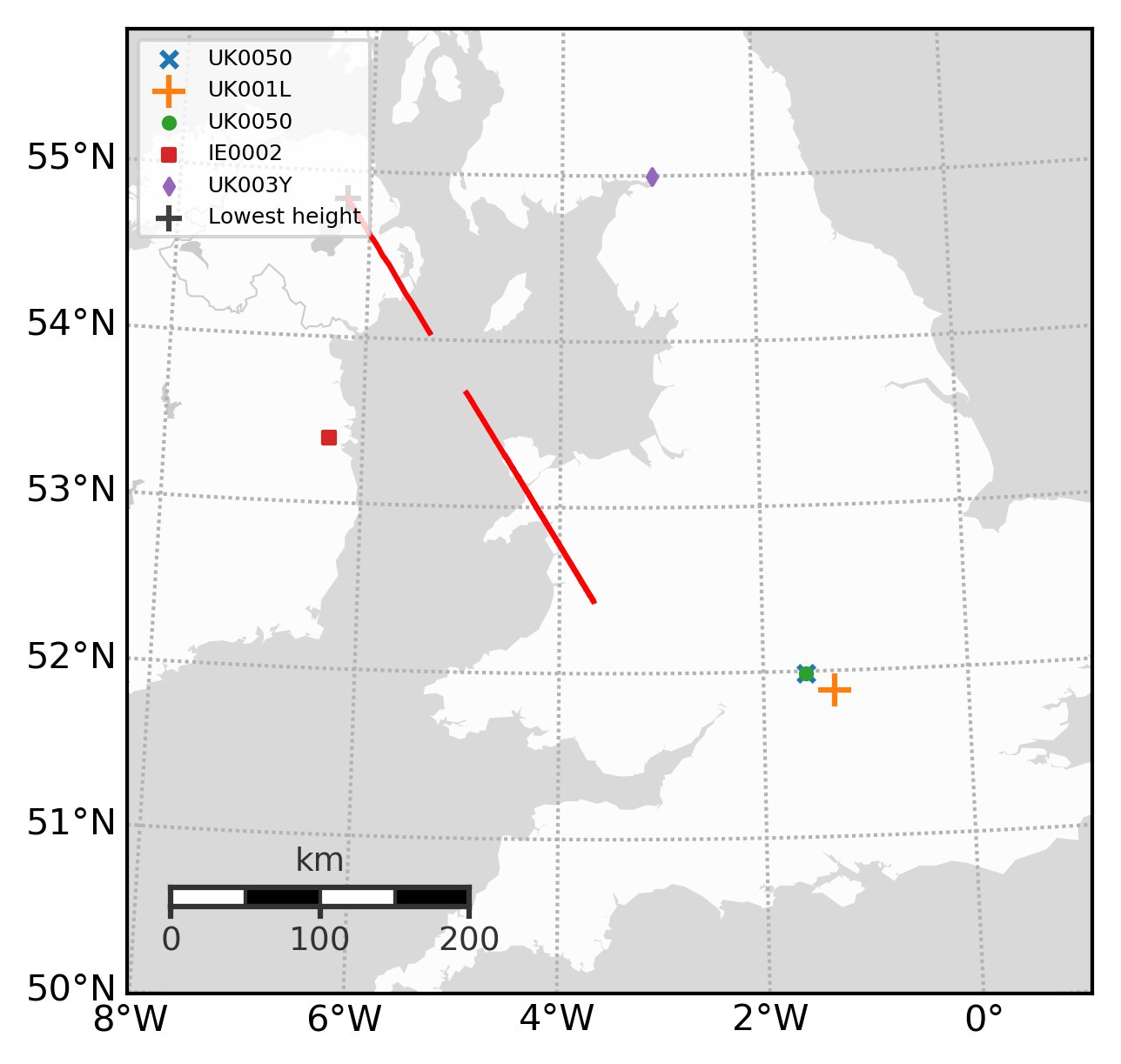
Anyway, the Jury has now returned to deliver a verdict. After collating and cross-referencing all the reports from tracking stations, the UK Meteor Observation Network is now 100% convinced that it was a meteor (rather than space debris). Its trajectory took it in a roughly north-westerly direction, passing directly over Belfast, and it came down in the Atlantic somewhere near the Hebrides.
There is enough data about this object to infer its orbit of the asteroid of which it was originally part: Semi-major axis 1.36A.U., eccentricity 0.33, inclination 8.77°, Period 1.59Y, LA Sun 171.72°, last Perihelion 2021-03-24.
It’s time once again for me to announce the publication of another paper at the Open Journal of Astrophysics. The new paper, published last week, is the 14th paper in Volume 5 (2022) and the 62nd in all. The latest publication is entitled “Gravitational Stability of Vortices in Bose-Einstein Condensate Dark Matter”. This paper is another one for the folder marked Cosmology and Non-Galactic Astrophysics and the authors are Mark N Brook Now at the Institute for Cancer Research in London) and Peter Coles (Who he? Ed).
There is a bit of a story behind this one. The work on which this paper is based was done while both authors (Mark and I) were at the University of Nottingham. Mark was my PhD student at the time. I left Nottingham for Cardiff in 2007 but Mark stayed behind to finish his thesis and write this paper, which appeared on the arXiv in 2009. The paper wasn’t accepted in its original form, Mark left the field after obtaining his PhD, and I was working on other things at Cardiff so the paper remained unpublished on the arXiv.
Last year, however, I was updating my publication list and noticed the old preprint so looked it up on NASA/ADS. Although not Earth-shattering, I found it had been acquiring a reasonable number of citations (16 according to ADS, including some this year) as an unpublished work largely because of increased interest in the field of condensate dark matter. I therefore approached the Editorial Board of the Open Journal of Astrophysics to ask their opinion about whether it would be appropriate to consider it for publication. They agreed and the paper was assigned to an Editor. Obviously I recused myself from the process.
Somewhat to my surprise, given that it’s basically an old paper, the referee comments were supportive. I’ve been very busy for the past year and communication with Mark was slow so it’s taken a while to revise and update the paper in line with the referee requests. We also took the opportunity to include a brief review of some papers that had come out since the original version of the paper appeared. Mark and I agreed a final text l and the paper was accepted last week. I uploaded the agreed version to arXiv and now the paper is now published. It was all a bit unconventional but there we are. It was interesting to be on the author side of the process for a change!
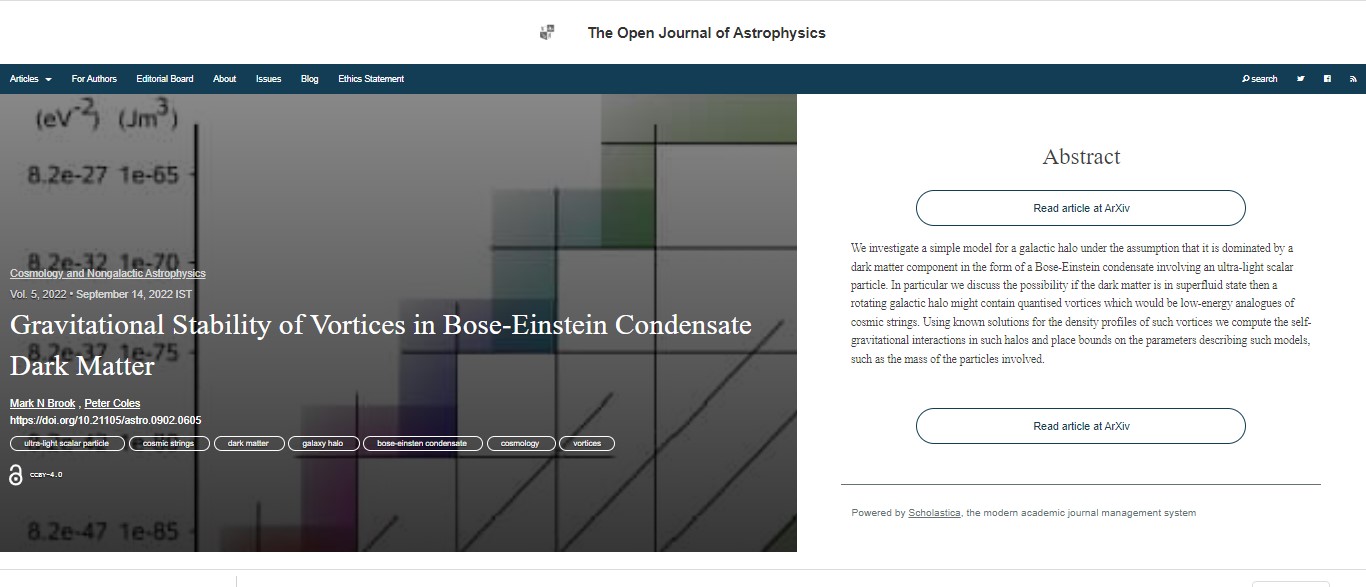
Anyway, here is a screen grab of the overlay which includes the abstract:
You can click on the image to make it larger should you wish to do so. You can find the accepted version of the paper on the arXiv here.
I learned yesterday from Keith Flett’s blog that the new King of England appears to have had a bit of problem with his writing equipment. It must be difficult to face such a severe challenge at such an early stage of his reign but I’m sure he’ll sort it out, or perhaps his servants will.
As a result of this important news I was thinking that I must be very old-fashioned in continuing to use fountain pens. I have four different pens like that, three for everyday use, and one for “best” i.e. mainly for signing important letters. Although I don’t have a blotter, I do fill my pens with ink from a bottle rather than from cartridges. I have noticed, however, that it is rather difficult to buy bottles of ink these days so I tend to buy several bottles at a time. Another issue is that not all forms of paper are suitable for writing on with a fountain pen. I use this as an excuse to buy quite posh notebooks. In particular, fountain pens are useless for doing crosswords as the ink spreads into an illegible smudge on the paper,
You might think I’m an old fuddy-duddy for using such pens rather than biros or even doing everything using a word processor but old habits die hard. When I was at school my handwriting was very bad so a teacher suggested I start using a fountain pen in order to improve it. That didn’t work, but I got into the habit of using that sort of pen and I’ve never broken it (though I have broken many nibs).
I use a keyboard when writing documents nowadays but whenever I have to do calculations, I write out the complete thing (with equations), when I’ve checked it, using a fountain pen. After that I type them up using LaTex. The chaotic scribbles I produce during the actual process of calculating are usually done in pencil or biro, but the final version to go in my notebook is written out with actual ink.
Another example is when I am preparing to give a lecture. Although we have printed notes – like a textbook – I never lecture directly from them. I think a lecture should have a coherent structure to it so I always write out what I want to say with a beginning, middle and end. Writing it out longhand means it enters my mind far better than just reading from the notes.
On reflection, I think these approaches are extensions of the technique for taking lecture notes I used as an undergraduate student. Another teacher at school spent one lesson teaching us all how to write very quickly without looking at the paper. Doing that means you don’t waste time moving your head to and fro between paper and screen or blackboard.
Of course, the notes I produced using this method weren’t exactly aesthetically pleasing, but my handwriting is awful at the best of times so that didn’t make much difference to me. I always wrote my notes up more neatly after the lecture anyway, using a fountain pen. But the great advantage was that I could write down everything in real time without this interfering with my ability to listen to what the lecturer was saying.
An alternative to this approach is to learn shorthand, or invent your own form of abbreviated language. This approach is, however, unlikely to help you take down mathematical equations quickly.
My experience nowadays is that many students simply aren’t used to taking notes like this – I suppose because they get given so many powerpoint presentations or other kinds of handout – so they struggle to cope with the old-fashioned chalk-and-talk style of teaching that some lecturers still prefer (and which actually works very well in mathematically-based disciplines). That’s probably because they get much less practice at school than my generation did. Most of my school education was done via the blackboard..
Even if I hand out copies of slides or other notes, I always encourage my students to make their own independent set of notes, as completely as possible. I don’t mean by copying down what they see on the screen and what they may have on paper already, but by trying to write down what I say as I say it. I don’t think many take that advice, which means much of the spoken illustrations and explanations I give don’t find their way into any long term record of the lecture.
And if the lecturer just reads out the printed notes, adding nothing by way of illustration or explanation, then the audience is bound to get bored very quickly.
My argument, then, is that regardless of what technology the lecturer uses, whether he/she gives out printed notes or not, then if the students can’t take notes accurately and efficiently then lecturing is a complete waste of time. In fact for the modules I’m doing this term I don’t intend to hand out lecture notes at all during the lectures, although I do post lecture summaries and answers to the exercises online after they’ve been done.
As a further study aid, most lectures at my previous institutions (Sussex University and Cardiff University) are recorded and made available to students to view shortly after the event. I have seen no evidence that availability of recorded lectures lowers the attendance at lectures. It appears that students use the recordings for revision and/or to clarify points raised in the notes they have taken, and if anything the recordings allow the students to get greater value from lectures rather than persuading them that there’s no need to attend them. Unfortunately we don’t have lecture capture at Maynooth, and a recent policy decision at high level is basically to ban lecture recordings here. I think that is regrettable to say the least, but since we don’t have proper equipment we can’t do it anyway so there’s nothing I can do.
I do like lecturing, because I like talking about physics and astronomy, but as I’ve got older I’ve become less convinced that lectures play a useful role in actually teaching anything. I think we should use lectures more sparingly, relying more on problem-based learning to instill proper understanding. When we do give lectures, they should focus much more on stimulating interest by being entertaining and thought-provoking. They should not be for the routine transmission of information, which is far too often the default.
As a matter of fact don’t think I ever learned very much about physics from lectures – I found problem-based learning far more effective – but I’m nevertheless glad I learned out how to take notes the way I did because I find it useful in all kinds of situations. Effective note-taking is definitely a transferable skill, but it’s also in danger of becoming a dying art. If we’re going to carry on using lectures, we old fogeys need to stop assuming that students learnt it the way we did and start teaching it as a skill.
A couple of days ago I announced the publication of a new paper in the Open Journal of Astrophysics called Making (dark matter) waves: Untangling wave interference for multi-streaming dark matter by Alex Gough and Cora Uhlemann. I forgot on that occasion to mention that there is a video of a talk by the first author in the series Cosmology at Home, so I’m remedying that now by posting the video here. Enjoy!
(The word “deported” alongside the dates of birth and death of a child at the beginning is of course euphemistic; the poem tells us what really happened.)
The views presented here are personal and not necessarily those of my employer (or anyone else for that matter).
Feel free to comment on any of the posts on this blog but comments may be moderated; anonymous comments and any considered by me to be vexatious and/or abusive and/or defamatory will not be accepted. I do not necessarily endorse, support, sanction, encourage, verify or agree with the opinions or statements of any information or other content in the comments on this site and do not in any way guarantee their accuracy or reliability.





 In the Dark