Tywysog and Taoiseach

Posted in History, Irish Language with tags , , , , on September 12, 2022 by telescoper

When I heard that King Charles III has conferred the title “Prince of Wales, Tywysog Cymru”, on his eldest son and heir William, I was intrigued by the appearance of the Welsh word Tywysog because of its similarity to the Irish word Taioseach. There aren’t that many words that sound so similar in Welsh and Irish because the two language groups to which they belong diverged in the distant past. Their similarity suggests to me a common etymology that pre-dates the development of the two distinct branches of the Celtic languages that we now refer to as Goidelic and Brythonic. There isn’t any literature to go on, as ancient Celtic languages were primarily oral, but the theory is that both words are derived from a Proto-Celtic form towissākos.

The Goidelic group comprises Irish, Manx and Scottish Gaelic; and the Brythonic group comprises Welsh, Cornish and Breton. These are sometimes referred to as q-Celtic and p-Celtic, respectively, although not everyone agrees that is a useful categorization. It stems from the fact that the “q” in Indo-European languages morphed into a “p” in the Brythonic languages. The number five in Irish is a cúig which has a q sound (though there is no letter q in the Irish alphabet); five in Welsh is pump. Contrast with the number two: a dó in Irish and dau in Welsh.

Incidentally, Scottish Gaelic is not the language spoken by the Picts, the Celtic people who lived in Scotland at the time of the Romans, which is lost. Scottish Gaelic is actually descended from Middle Irish due to migration and trading contacts. The Ulster dialect of Irish is in turn much influenced by reverse migration from Scotland. Languages do not evolve in isolation or in any simple linear trajectory.

Contrary to popular belief, Breton is not a Continental Celtic language but was taken to Brittany by a mass migration of people, which peaked in the 6th Century AD, from South-West Britain, fleeing the Anglo-Saxons. The Saxons won a great victory in battle at Dyrham (near Bath) in 577 after which they advanced through Somerset and Devon, splitting the Celts of Cornwall and Wales and leading to the formation of two distinct Brythonic language groups, Welsh and Cornish. Breton is much closer to Cornish than it is to Welsh.

The Continental Celtic languages are all extinct, except for fascinating remnants that linger here and there in local dialect words in French and Spanish.

Anyway, both modern words tywysog and taioseach originally meant “leader”. In Scots Gaelic, tòiseach was the name given to a clan chief; the Irish taioseach had a similar usage. The capitalized form “Taioseach” has only been used for the Head of the Irish Government since 1937 when the name was introduced in the Constitution. It was remarked at the time that An Taoiseach – the equivalent of Prime Minister – has the same literal meaning as “Il Duce” or “Die Führer“…

The last native Welsh Tywysog was Owain Glyndŵr after whose demise in c1415 the title was appropriated by the English monarchy no doubt as part of its rigorous suppression of Welsh identity. The term doesn’t actually mean “Prince” and the “Prince of Wales” is certainly not a leader. If anything the word should be applied to the First Minister of Wales, an office currently held by Mark Drakeford.

P.S. The presence of the “e” in taioseach indicates that the “s” is pronounced like “sh” (as in “Seán”) so the word should not be pronounced “tea sock”…

 

New Publication at the Open Journal of Astrophysics

Posted in OJAp Papers, Open Access, The Universe and Stuff with tags , , , , , , on September 11, 2022 by telescoper

It’s time once again for me to announce another new paper at the Open Journal of Astrophysics. The new paper, published last week, is the 13th paper in Volume 5 (2022) and the 61st in all. The latest publication is entitled “Making (dark matter) waves: Untangling wave interference for multi-streaming dark matter” and the authors are Alex Gough and Cora Uhlemann (both of Newcastle University). The paper is another one for the folder marked Cosmology and Non-Galactic Astrophysics.

Here is a screen grab of the overlay which includes the  abstract:

You can click on the image to make it larger should you wish to do so. You can find the accepted version of the paper on the arXiv here.

This is a paper that’s close to one of my current research interests. I think it’s really excellent and I am very happy the authors chose to publish it in the Open Journal of Astrophysics.

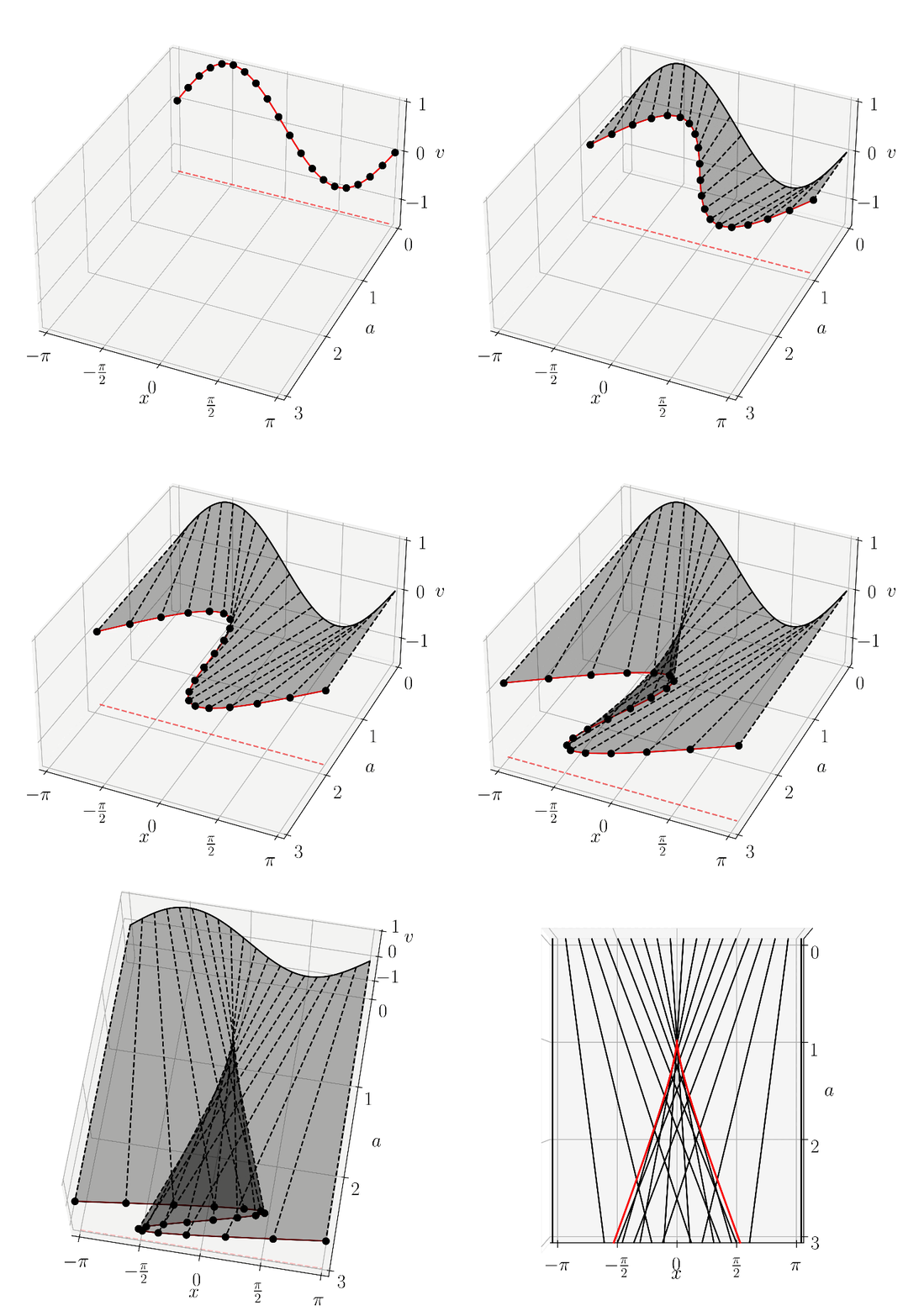
As a bonus here is a groovy animated version of Figure 1 from the paper showing the development of a multi-stream region.

And if that weren’t enough here is a short talk about their work in the Cosmology From Home series by the first author Alex Gough.

Berg & Mahler at the National Concert Hall

Posted in Biographical, Maynooth, Music with tags , , , , , , , on September 10, 2022 by telescoper
Obligatory Souvenir Programme

Last night I made it to the National Concert Hall in Dublin for the opening concert of the season for the National Symphony Orchestra directed by Chief Conductor Jaime Martín. It’s been three years since the last full season of these weekly concerts so let’s hope we get a complete set this time.

The programme for last night’s concert comprised two works by Austrian composers, Alban Berg‘s Violin Concerto (with soloist Simone Lamsma) and Gustav Mahler‘s Fifth Symphony. Each of these great pieces in its own way explores a vast emotional landscape and together they made for a compelling and moving performance.

Berg’s Violin Concerto, composed in 1935, is dedicated “to the memory of an Angel”, namely Manon Gropius, who died of polio at the age of just 18. She was the daughter of Alma Mahler and Walter Gropius (Alma Mahler’s second husband, whom she married four years after Mahler’s death).

The work is divided into two movements, each of which is in two parts. It is often described as a completely atonal (serialist) piece but it’s is composed in such a way that the twelve tones are sometimes grouped in such a way as to suggest an underlying tonality. Emotionally the piece ranges from the poignant to the fiery. Anyone who has experienced grief will recognize the sense of rage that at times bursts through. In other passages, though, the music has an austere beauty that is completely compelling.

After the wine break we had Mahler’s Fifth Symphony. This work is best known for the 4th movement Adagietto but I’ve always felt that section fits rather uncomfortably with the rest of the composition. That’s not to say that I dislike the Adagietto, which I think is one of the most beautiful movements in all music, and regularly makes me shed a tear. I just think it’s a bit of a detour from the rest of the work. I suppose one should think of it as a restful interlude before the journey reaches its climax in the 5th movement Rondo which was played with electrifying passion last night.

Like the Berg piece, Mahler’s Fifth Symphony veers across a vast emotional landscape. The conductor Bruno Walter described it as “passionate, wild, pathetic, buoyant, solemn, tender, full of the sentiments of which the human heat is capable, but still ‘only’ music”. Although by no means an atonal work, there isn’t really a clear tonal signature: at least five different keys are used and there are passages in which the key is ambiguous.

The first movement begins with a funeral march, introduced with a solo trumpet statement like a fanfare, followed by lyrical passages from the strings. The second movement is extremely tempestuous, contrasting moods of melancholy and frenzy, with the trumpet theme from the first movement returning. The third movement, a long Scherzo, is unexpectedly playful, with two thematic forms bouncing off each other. Then there’s the soulful longing of the Adagietto, beautifully played last night to a rapt audience and the joyful finale in an unambiguously major key.

Overall this was a superb concert, with the large orchestral forces marshalled superbly by Jaime Martín. I have to mention the brass section in particular, who were brilliant. It wasn’t a full house, which is a shame for the season’s curtain-raiser, but those who were there clearly enjoyed it enormously.

As it happens, last night was the first of five concerts by Garth Brooks (who he? Ed) at Croke Park. The train from Maynooth unto Dublin earlier in the evening was absolutely crammed with people (many in cowboy hats) going there and the train back was similarly full with people leaving. Fortunately I was only slightly delayed getting home by the congestion, though I think there were seriously issues with later trains. There is another concert by him next Friday, when there is another concert at the NCH so fingers crossed that my travel to and from that isn’t too badly affected either…

Irish Times Supplement

Posted in Education, Maynooth with tags , , , , on September 9, 2022 by telescoper

I don’t usually buy a newspaper during the week but I noticed that today the Irish Times published a special supplement to mark these momentous times so I made an exception. Yes, today is the day the full set of CAO points are published in the print edition, about a year since last year. The official low-tech results for Maynooth are here. Minimum points required for Maynooth’s most important course, MH206 Theoretical Physics and Mathematics, are 510 this year, down a little from 521 last year, but the same as two years ago. Generally speaking, as expected, the points for other courses seem roughly the same as last year.

Students now have to decide whether to accept their first-round offer or try to change course. I suspect there might be fewer this year doing that because of the accommodation shortage, but that remains to be seen…

P.S. There was another supplement in today’s Irish Times about the death of Queen Elizabeth II.

The End of a Reign

Posted in Biographical, History with tags on September 8, 2022 by telescoper

Just a quick note in the manner of a journal entry to mark the fact that Queen Elizabeth II passed away this afternoon at the age of 96.

I was actually sitting on a plane about to take off for Dublin when the news filtered through. The Irish bloke next to me who knew I was born in England as we had been chatting, asked what happens next – what procedure would be followed to install the next Monarch, King Charles III. I told him that The Queen had been The Queen since before I was born, and had reigned all my life until now, so I had never experienced such an event and had no idea at all what comes next!

All I know is that the funeral of Queen Elizabeth will not happen for another ten days, but King Charles becomes King immediately. I’m not sorry to have made it back to Ireland today. I think I would have found the media coverage in the UK very tedious indeed.

It’s strange to imagine there being a King Charles instead of Queen Elizabeth. I suppose football crowds will henceforth be singing “God Save The King” instead of “God Save The Queen”, although I bet they’ll continue to do it just as tunelessly regardless of the change of words.

Queen Elizabeth was the longest-reigning British monarch by a margin of about 7 years over Queen Victoria. If you reckon history as a succession of Kings and Queens like we were taught to at school then today is a historic day. I can’t help wondering though how many more British monarchs there will be…

The Matter of Enoch Burke

Posted in LGBTQ+, Politics with tags , , on September 8, 2022 by telescoper

Not surprisingly, the right-wing press is attempting to portray the intransigent bigotry of the teacher Enoch Burke as some kind of heroic stand against “woke ideology”. I’ve lost track of the number of articles that claim that Mr Burke has been sent to prison for “refusing to use the pronoun they” or for his religious beliefs; he is some sort of Evangelical Christian with extreme political views on a range of subjects as do the other members of his family.

The facts of the matter are that Mr Burke was suspended (on full pay) pending a disciplinary hearing following a confrontation with his school’s principal. He was instructed not to attend the school during the disciplinary process (which is quite normal). Burke refused to comply so the school went to court to get a court order to keep him off the premises. He ignored the injunction so was arrested for contempt of court. He was then sent to Mountjoy Prison where he will remain until he purges his contempt.

The person you should have sympathy for in this case is not Mr Burke who deliberately provoked this incident by breaking the law in order to court controversy, and who deserves everything he has got as a consequence, but the kid at the centre of this case who has done nothing wrong at all. I hope they have plenty of support from their friends and family and the sensible teachers in their school.

A Cardiff Visit

Posted in Art, Cardiff with tags , , , on September 7, 2022 by telescoper

So here I am, then, in Cardiff, for an overdue visit to try to sort out some things to do with the my house and the hopefully forthcoming sale thereof. I decided to treat myself to a stay in a nice hotel for a couple of days while I am here. I have been stuck at home a lot over the last three years or so and I thought it would be nice just have someone else cook my breakfast and make my bed for a change!

It’s been raining off and on while I ran various errands hither and yon so at lunchtime I popped into the excellent National Museum in Cardiff. Entry to this establishment is free, as it is to all the similar public museums and galleries in Ireland.

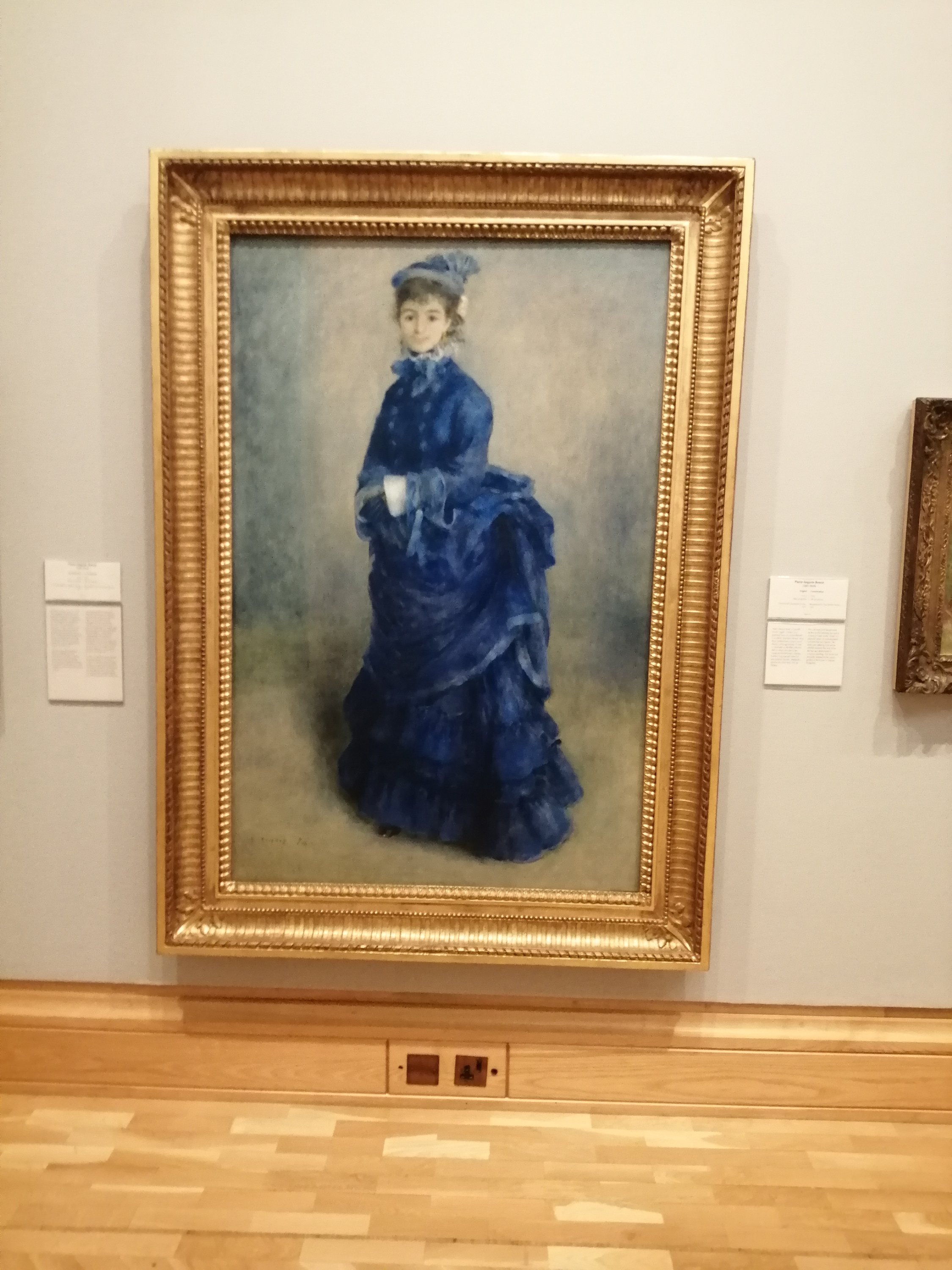
Not many people know what a rich treasury of art you can find in the National Museum. Did you know, for example, that the famous La Parisienne by Pierre-Auguste Renoir is here in Cardiff?

The impressionist collection is very fine indeed, although only part of the collection is on display. Here are two very different post-impressionist works by Paul Cézanne: Still Life With Teapot and Provençal Landscape.

The second of these has to be seen up close to be fully appreciated: the paint looks like it has been combed onto the canvas with different colours going in different directions in such a way that messes with the viewer’s perception of depth.

Here is one from the modern collection. It is by Andre Stitt and is called Municipal Wall Relief for a Residential Housing Complex in a Parallel Universe:

I also experienced the installation Vertigo Sea by John Akomfrah, a moving and at times harrowing visual account of the sea and the dark side of humanity’s relationship with it, from whaling and pollution to slave killings and the trafficking of refugees. There’s some stunning contemporary footage in this work, juxtaposed with archive recordings spread out over three screens. Here’s a short trailer that gives you an idea:

When I lived in Cardiff I hardly ever visited the collection in the National Museum of Wales. Indeed the few times I entered the building were for various meetings and other functions. It was nice to see it as a tourist!

Anyway, I still have a couple more things to do so that will do for now!

Ethics and the SpaceX Business

Posted in Biographical, Euclid, Politics with tags , on September 6, 2022 by telescoper

Six months ago when Russia invaded Ukraine there was considerable debate about the practicality of sanctions on Putin’s regime. The discussion largely centered around whether economic sanctions would be effective and whether they would harm the nations imposing them more than they would Putin. At the time it seemed to me this was the wrong way of looking about it. The main issue as far as I was concerned was not their likely efficacy, but the ethical and moral dimension of doing business with a warmongering state. A similar issue came up frequently in the 1980s over South Africa, for example. The issue was not for me whether not buying South African oranges would end apartheid; it was about whether I personally felt morally comfortable with doing business with a racist state. Russia is not the only country or entity nowadays with whom I would feel very uncomfortable being involved, but it is one.

Ethical considerations are however often compromised by practical issues. A complete ban on Russian oil and gas imports would cause devastation in the short term, for example, so Western sanctions on Putin have concentrated elsewhere.

Individuals also make ethical decisions about what products they buy, which employers they work for, which countries they visit, and so on. These are of course private matters but people have a right to voice their opinions and argue their case.

At least an individual can decide their own position with unanimity. It’s somewhat more complicated in an organization or group as there are likely to be dissenting views. Nevertheless, I think it is good to have these discussions out in the open. That’s what should happen in a free society and in a well-run organization.

You may nor may not agree with the blog post by Arthur Loureiro about Elon Musk and SpaceX that was published here last week, but I think it raises a similar question: with whom do you feel comfortable doing business?

I suspect that I’m not alone in agreeing with Arthur’s discomfort about Elon Musk. As a matter of fact I think he’s a thoroughly nasty piece of work. Many people no doubt also felt moral discomfort at the prospect of Euclid being launched on a Soyuz spacecraft. In the end the decision will probably be based on pragmatism rather than ethics, but I think it was right for Arthur to raise the issue publicly and I am glad to have been able to make his views public via this website. There are limits and we need to discuss where those limits lie.

P.S. I am glad that the Euclid Consortium has stated aims to be as diverse and inclusive as possible. I am also aware that there are members of the Consortium who disagree with its EDI policies. I’ve observed in many organizations that those who disfavour diversity and inclusion often complain about having diversity “forced upon them”. I shall refrain from commenting further.

Conference Badge

Posted in Uncategorized on September 5, 2022 by telescoper

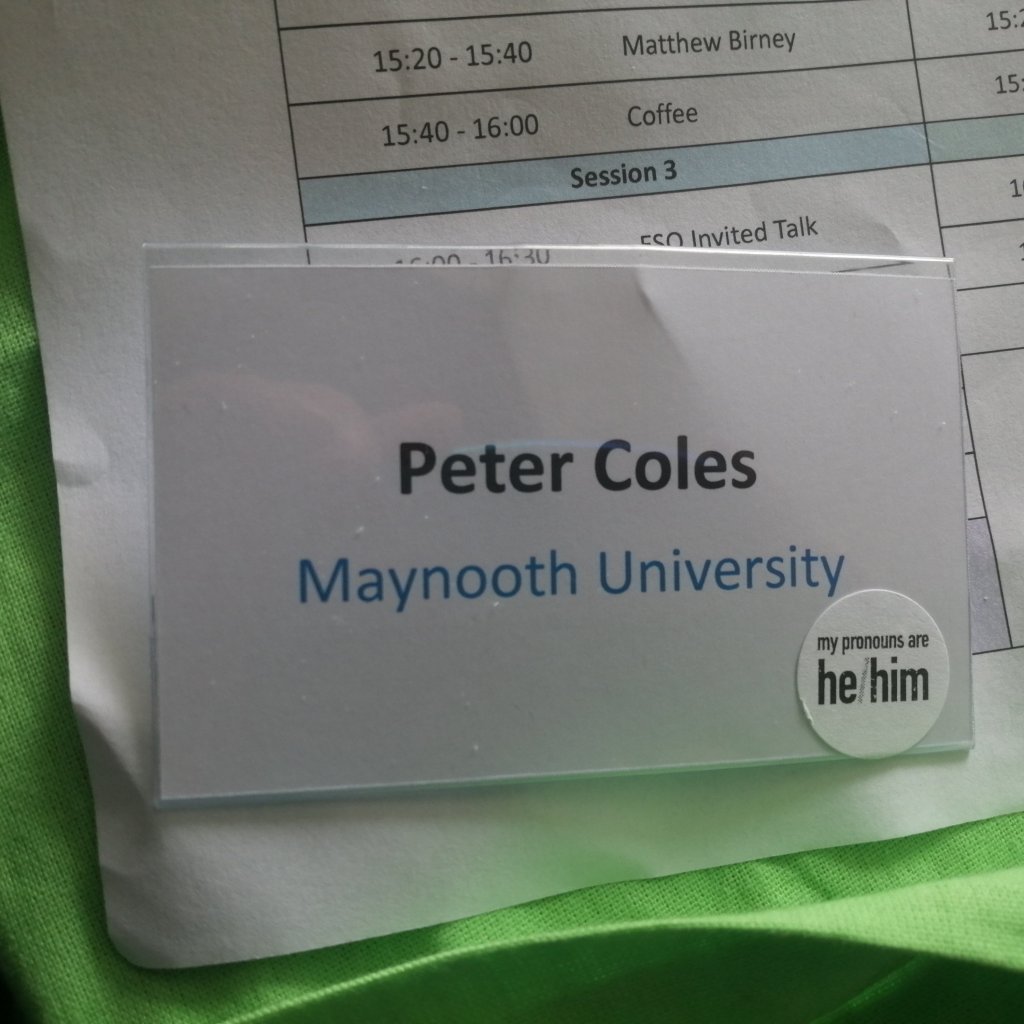
I thought I’d share a picture of my conference badge from INAM 2022, complete with pronouns, for the benefit of those who are triggered by such things.

If you are one of those people triggered by pronouns, just wait until you find out about adjectives!

Louis Armstrong and Bix Beiderbecke: Singin’ the Blues

Posted in History, Jazz with tags , , on September 4, 2022 by telescoper

 Leon “Bix” Beiderbecke became a jazz-age romantic legend not only by playing brilliant cornet but also by drinking too much bad prohibition liquor resulting his premature death in 1931, at the age of only 28. His short life was punctuated by episodes of very bad health caused by chronic alcoholism in an era when the only booze that was available was bathtub gin or rotgut whisky. Despite all his problems, Bix still gave us some of the greatest ever jazz records.

Although he was of middle-class white origins, Bix’s playing was deeply admired by leading black musicians of the day notably the great Louis Armstrong. Some years ago I listened to a radio play called Bix: Singing the Blues which is a fictional account of the only occasion in which Bix Beiderbecke and Louis Armstrong played together, in a private, after-hours session. Given the description of that as “fictional” I assumed that Bix and Satchmo didn’t know each other well. Recently, however, I came across a recording of Louis Armstrong talking about Bix Beiderbecke that shows I was wrong:

(There is one little bit of confusion in the discussion: Bix wasn’t 31 when he died: he died in 1931, at the age of 28. )

So how good was Bix? Well, make your own mind up. Here is his classic version of Singing the Blues, with Frankie Trumbauer’s Orchestra in 1927, a three minute track in which Bix’s stunning solo starts a minute in and lasts a minute.

Jazz being largely improvised music, it is often a bit rough around the edges; even the Hot Fives and Hot Sevens have their share of duff notes. Bix’s solo on this record with that beautiful ringing, bell-like tone, and effortless swing at what is quite a slow tempo, is as close to perfection as you’ll ever find.

But you don’t need to take my word for it.

During his heyday in the1920s Louis Armstrong played virtually every popular tune that was put in front of him, including many songs that seemed unpromising from a jazz perspective, and in the process turned any amount of base metal into solid gold. Singin’ the Blues was a smash hit, but Louis Armstrong refused to play it. When asked why he replied that he didn’t think he could play it as well as Bix. There is no higher praise.