R.I.P. Pharaoh Sanders (1940-2022)

Posted in Jazz, R.I.P. with tags , , on September 25, 2022 by telescoper

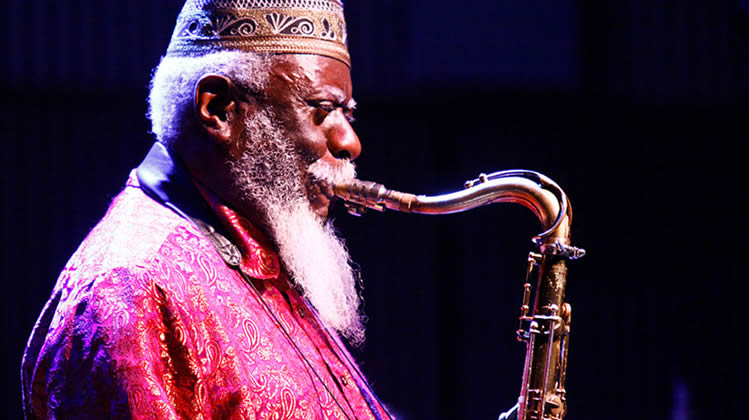
Yesterday I heard the sad news that yet another legendary jazz musician – the tenor saxophonist Pharaoh Sanders – has passed away at the age of 81. As well as having one of the iconic beards of jazz, he had a unique and instantly recognizable style on tenor sax, heavily influenced by African and Asian music, sometimes involving raucous flurries of notes, sometimes overblowing, biting the reed or growling into the horn to achieve unusual effects, and sometimes playing with a contemplative lyricism evoking a deep sense of spirituality.

Pharaoh Sanders began his recording career in the 1960s with John Coltrane on the great albums Ascension and Meditation. His playing then was avant-garde free jazz somewhat reminiscent of Albert Ayler but with a strong influence of Coltrane whom he influenced in return. Later on he embraced wider influences, including electronic instruments, as exemplified by the album Thembi. Later he moved away from free jazz improvisation to more traditional approaches. His recorded output decreased from the end of the 1980s but he carried on touring extensively and still creating wonderful music.

I’ve had the great privilege to hear Pharaoh Sanders play live on a number of occasions and he was terrific every time. He played at the National Concert Hall in Dublin just a few years ago but I was unable to make it to the concert.

I’ve been listening to Pharaoh Sanders tracks all morning to remind myself what a great musician he was. Out of all the superb tracks I could have picked going back to the mid-60s I picked this one, from the 1987 album Africa which I think exemplifies his later style very well. The track is You’ve got to have freedom:

P.S. You might be interested to know that the drummer on this track, Idris Muhammed, also played the drums on Fats Domino’s Blueberry Hill way back in 1956…

Launchpad Saturday

Posted in Biographical, Education, Maynooth with tags , on September 24, 2022 by telescoper

Just a quick note to say that this afternoon I attended today’s Launchpad event organized by Maynooth Access Programme (MAP) on Maynooth University Campus for a panel discussion. Launchpad is orientation designed to support and ease the transition to third level for students who are coming to Maynooth University through entry routes supported by MAP (the Mature Student Entry Route, the Higher Education Access Route (HEAR), the Disability Access Route to Education (DARE)Turn to Teaching Progressed, QQI entry, or new students with a disability). 

The panel discussion I took part in was called Do I Belong Here? The answer, at least initially, was “no” because I went to the wrong room. I blame that on the fact I was wearing my new glasses. When I did make my way to the correct lecture theatre the discussion involved people from diverse backgrounds who have experience of finding their place at university and how to make a valuable contribution by retaining their identity and getting involved with opportunities and activities. I think it went reasonably well, and I enjoyed having the chance to chat to students afterwards in the foyer of the new TSI building.

On the way home afterwards I discovered that my local supermarket is selling bottles of Barolo at half price, so I bought one to have with my dinner which now beckons!

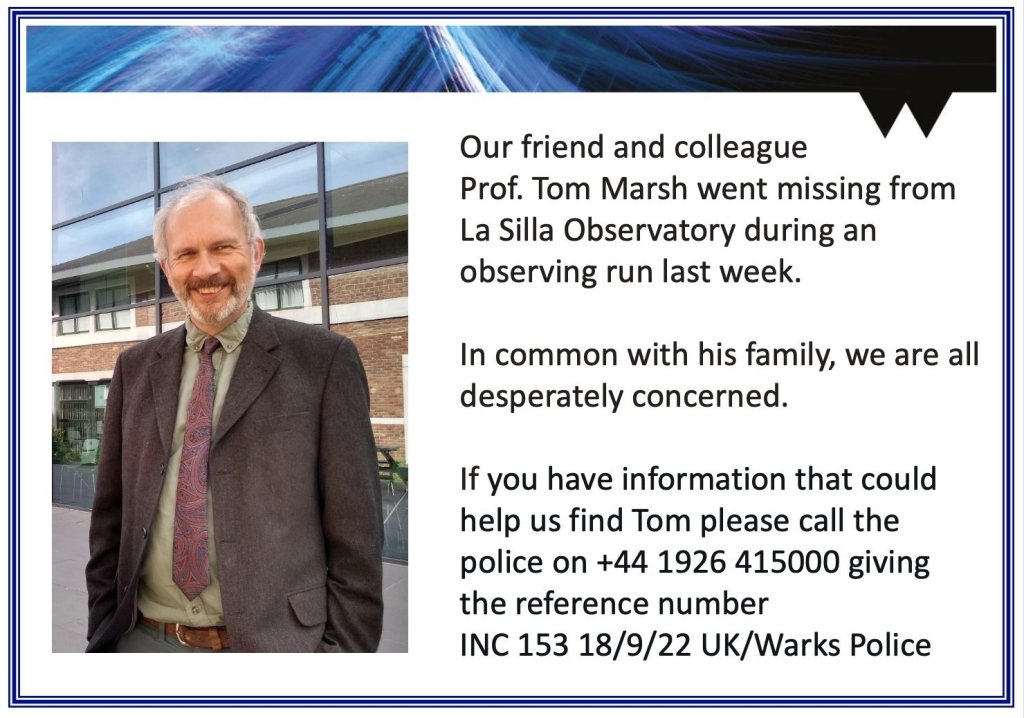
Can you help find Tom Marsh?

Posted in Uncategorized with tags , , on September 23, 2022 by telescoper

Yesterday I heard the worrying news that astronomer Professor Tom Marsh of Warwick University (UK) went missing on 16th September 2022 while on an observing trip at the European Southern Observatory facility in La Silla, Chile. Despite extensive searches over the last week he has not yet been found.

I know it’s a long shot but I’m posting this here in the hope that somebody somewhere might have information about his whereabouts.

There is also a statement from ESO here with further details

Marsh is described as white, about 192 cm in height, with balding grey hair and a beard. He is likely to be wearing a blue rain jacket, walking boots and a grey woollen hat. 

Please forward this as widely as possible!

UPDATE: 11/11/2022. Sadly, almost two months after being reported missing, the body of Tom Marsh has now been found. The cause of death has not yet been announced.

Autumnal Equinox 2022

Posted in Biographical, Maynooth, The Universe and Stuff with tags on September 22, 2022 by telescoper

It’s almost that time of year again. The Autumnal Equinox (in the Northern hemisphere) takes place in the early hours of tomorrow morning (Friday 23nd September 2022)  at 02.04 Irish Summer Time (01.04 UT). That is way past my bedtime so I thought I’d post this a few hours early.

Although  the term `equinox’  refers to a situation in which day and night are of equal length, which implies that it’s a day rather than a specific time, the astronomical equinox is more accurately defined by a specific event, i.e. when the plane defined by Earth’s equator passes through the centre of the Sun’s disk (or, if you prefer, when the centre of the Sun passes through the plane defined by Earth’s equator). Day and night are not necessarily exactly equal on the equinox, but they’re the closest they get. From now on days in the Northern hemisphere will be shorter than nights and they’ll get shorter still until the Winter Solstice on 21st December at 21.48 Irish Time.

Many people take the autumnal equinox to be the end of summer. There is a saying around these parts, however, that `Summer is Summer to Michaelmas Day’ (September 29th), which is not until next week. I must say, though, though it doesn’t feel particularly summery today.

Anyway, this is Welcome Week in Maynooth and we’re due to start teaching first year students next week, on Monday 26th September. It seems to be a bumper year for our intake, with 113 so far registered. That’s more than we’ve had in the 1st year since I arrived here. Returning students commenced on Monday 19th. I already gave my first lecture on Vector Calculus and Fourier Series to this class yesterday; I have another with them tomorrow. We have about the same number of students in Year 2 this year as we had last year.

Second Booster

Posted in Biographical, Covid-19 with tags , , , , on September 22, 2022 by telescoper

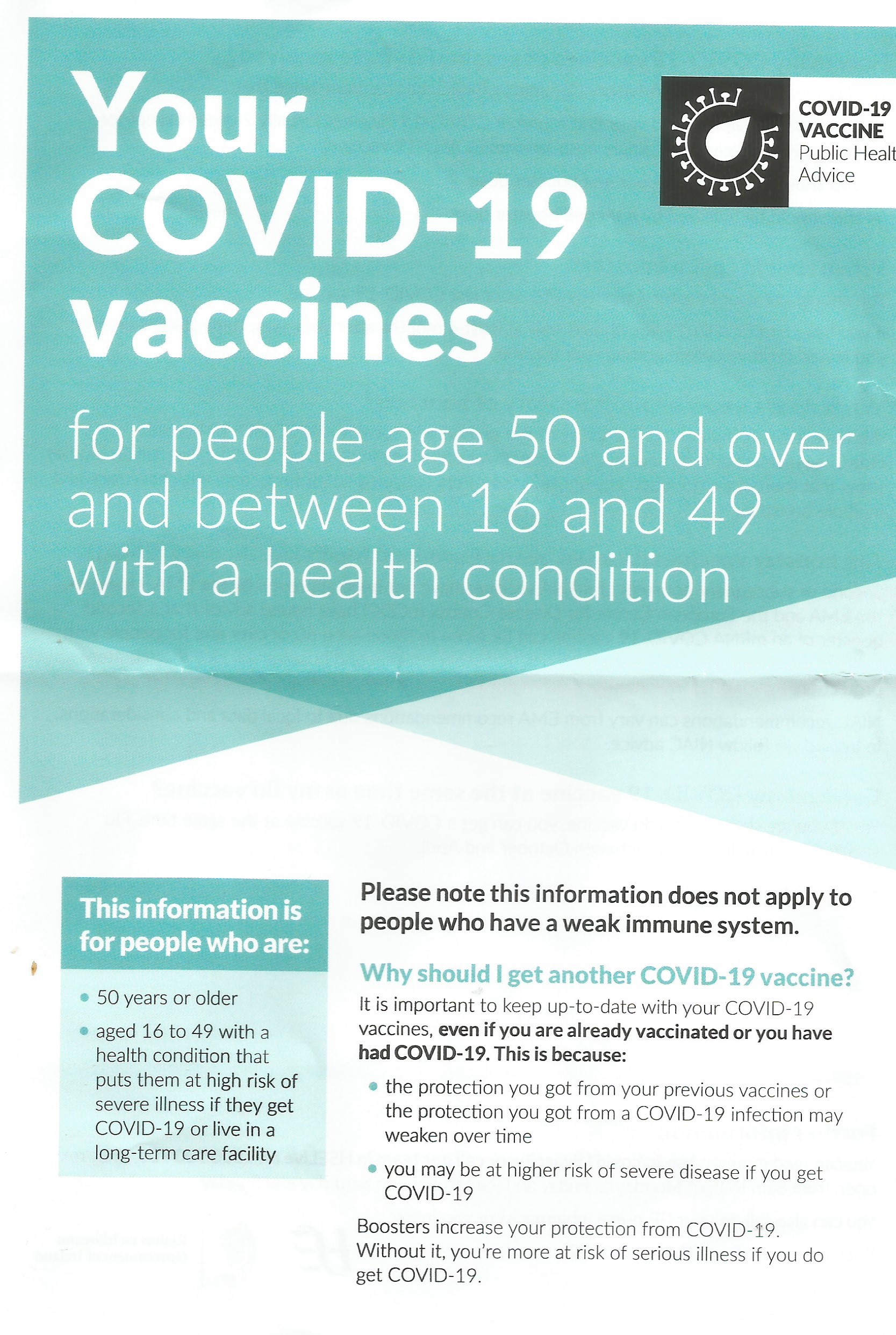
Today I took a trip out to Punchestown Racecourse for my second Covid-19 booster jab. The possibility of booking one of these opened up for my age group (55+) a few weeks ago and I booked one straightaway, but I was advised to postpone it because of a mystery ailment. That now having cleared up I decided to have it done today, ahead of the full start of teaching next week. In the meantime the booster process has been opened up to mere youngsters (50+) but it was easy to get an appointment.

As far as I know I have ever caught Covid-19, but I thought it wise not to take any chances with the new influx of students and the possibility of increased infection levels. My first booster was on 15th December 2021, so protection is likely to have waned considerably since then. As you can see, new cases have been falling recently in Ireland but the level of new infections (7-day average around 230 per day) is still quite high:

My previous jabs were at City West so I was a little surprised when I registered for my second booster that I was directed to Punchestown. It’s about the same distance from Maynooth to either venue, though, and when I got to the racecourse it was very quiet and I was in and out within half an hour (half of which was the 15 minute “recovery” period). The racecourse – used for steeplechases – is heaving at the time of the annual Punchestown Festival, but fortunately I didn’t have to dodge either crowds or horses, though it was raining heavily.

This time I had the Pfizer-BioNTech vaccine (“Comirnaty”), same as my two original shots; my first booster was of the Moderna (“SpikeVax”) variety.

I’ll be working from home this afternoon in case of problems (though I didn’t experience any serious issues with previous jabs). My next lecture is at 11am tomorrow (Friday) so I should be fine by then even if I experience any side-effects this afternoon.

Michaelmas Memories

Posted in Biographical, Education, Maynooth on September 21, 2022 by telescoper

Yesterday I gave my first lecture of the new academic year. It was the first lecture of the second-year Mathematical Methods module I’ve been teaching for several years now, and was about partial differentiation. Because of the late Leaving Certificate results this year, first-year students don’t officially start until next week but we have some doing my second module and most of them actually came to my first lecture. For most of the new arrivals this week is Welcome Week, with a variety of events – both social and administrative – to help them settle into student life before they start their education proper next week.

As often seems to be the case in late September, the weather is very nice today. The Welsh phrase Haf Bach Mihangel (Michael’s Little Summer) refers to this kind of spell. St Michael is also the origin of the term Michaelmas, which is the name of the Autumn term at Cambridge University. Michaelmas Day itself is on 29th September.

This all takes me back to when I myself left home to go to University in 1982, as thousands of fledgling students are doing in their turn right now.

I started my journey by getting on a train at Newcastle Central station with my bags of books and clothes. I said goodbye to my parents there. There was never any question of them taking me in the car all the way to Cambridge. It wasn’t practical and I wouldn’t have wanted them to do it anyway. After changing from the Inter City at Peterborough onto a local train, we trundled through the flatness of East Anglia until it reached Cambridge. The weather, at least in my memory, was exactly like today. It suddenly struck me this week that that was 40 years ago.

I don’t remember much about the actual journey on the train, but I must have felt a mixture of fear and excitement. Nobody in my family had ever been to University before, let alone to Cambridge. Come to think of it, nobody from my family has done so since either. I was a bit worried about whether the course I would take in Natural Sciences would turn out to be very difficult, but I think my main concern was how I would fit in generally.

I had been working between leaving school and starting my undergraduate course, so I had some money in the bank and I was also to receive a full grant. I wasn’t really that worried about cash. But I hadn’t come from a posh family and didn’t really know the form. I didn’t have much experience of life outside the North East either. I’d been to London only once before going to Cambridge, and had never been abroad.

I didn’t have any posh clothes, a deficiency I thought would immediately mark me as an outsider. I had always been grateful for having to wear a school uniform (which was bought with vouchers from the Council) because it meant that I dressed the same as the other kids at school, most of whom came from much wealthier families. But this turned out not to matter at all. Regardless of their family background, students were generally a mixture of shabby and fashionable, just like they are today. Physics students in particular didn’t even bother with the fashionable bit. Although I didn’t have a proper dinner jacket for the Matriculation Dinner, held for all the new undergraduates, nobody said anything about my dark suit which I was told would be acceptable as long as it was a “lounge suit”. Whatever that is.

Taking a taxi from the station, I finally arrived at Magdalene College. I waited outside, a bundle of nerves, before entering the Porter’s Lodge and starting my life as a student. My name was found and ticked off and a key issued for my room in the Lutyen’s building. It turned out to be a large room, with a kind of screen that could be pulled across to divide the room into two, although I never actually used this contraption. There was a single bed and a kind of cupboard containing a sink and a mirror in the bit that could be hidden by the screen. The rest of the room contained a sofa, a table, a desk, and various chairs, all of them quite old but solidly made. Outside my  room, on the landing, was the gyp room, a kind of small kitchen, where I was to make countless cups of tea over the following months, although I never actually cooked anything there.

I struggled in with my bags and sat on the bed. It wasn’t at all like I had imagined. I realised that no amount of imagining would ever really have prepared me for what was going to happen at University.

I  stared at my luggage. I suddenly felt like I had landed in a strange foreign land where I didn’t know anyone, and couldn’t remember why I had gone there or what I was supposed to be doing. One thing I certainly didn’t think then was that 40 years on I’d still be wondering what I’m going to do when I leave University…

Maynooth University Library Cat Update

Posted in Maynooth with tags on September 20, 2022 by telescoper
Breakfast

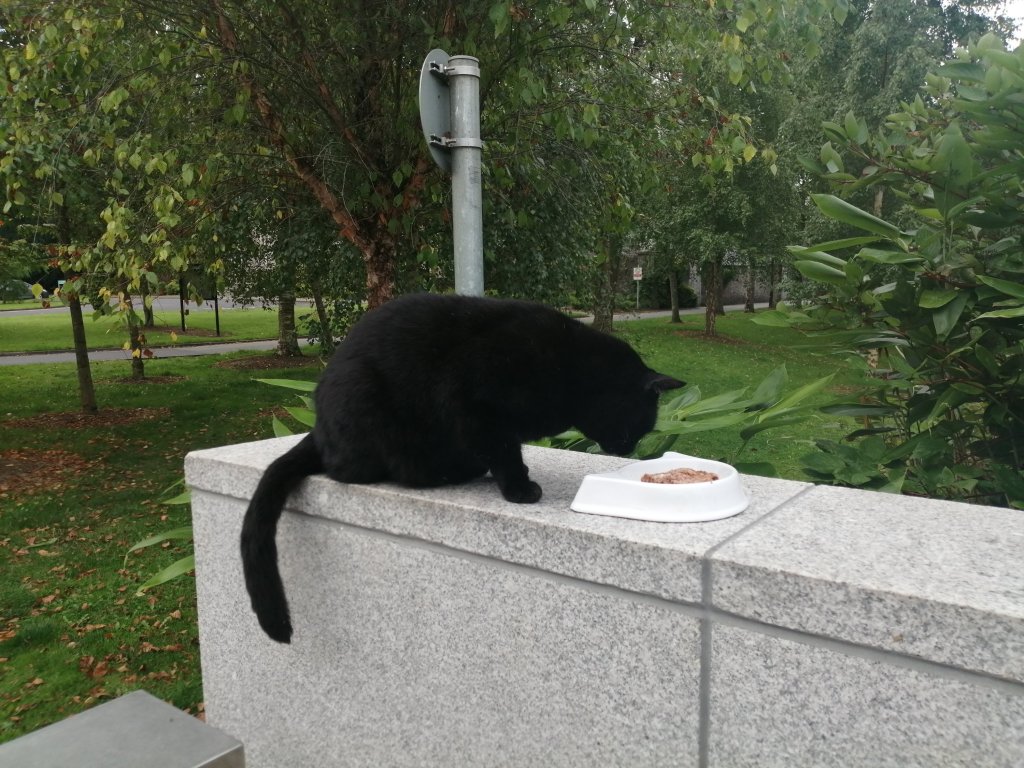
Deciding to make my way to work this morning via the South Campus for a change I stumbled across Maynooth University Library Cat and was able to see to his breakfast needs. He emptied the dish and then went for a nap. With a large number of new students on campus these days our famous feline has greatly increased opportunities for interaction (i.e. cadging food). I am reliably informed that he has had at least two other meals today. I don’t know where he puts it all…

R.I.P. Maarten Schmidt (1929-2022)

Posted in History, R.I.P., The Universe and Stuff with tags , on September 20, 2022 by telescoper

Once again I find myself having to pass on some sad news. Astronomer Maarten Schmidt has passed away at the age of 92. The highlight of his long and distinguished career was the discovery, in 1963, that quasars showed hydrogen emission lines that revealed them to be at cosmological redshifts. Together with Donald Lynden-Bell (who passed away in 2018), Schmidt was awarded the inaugural Kavli Prize for Astrophysics in 2008.

Rest in peace, Maarten Schmidt (1929-2022).

Accreditation, Validation and Recognition of Physics Degrees

Posted in Biographical, Maynooth with tags , , , , , on September 19, 2022 by telescoper

Last week I gave a couple of talks to new undergraduate students about courses in Theoretical and Mathematical Physics here at Maynooth. As happens from time to time, a student asked me if our programmes are accredited by the Institute of Physics. The short answer to this is ‘no’.

Before going further into this, I should probably explain what accreditation actually means. An accredited degree is one that counts as a professional qualification that enables the holder to pursue a career in a given discipline, usually as a practitioner of some sort. Obvious examples are medical degrees (which Maynooth does not offer), Engineering, Architecture, Law, Accounting and Psychology (for its clinical aspects). Most degree progammes at Maynooth and elsewhere are not accredited

As the Complete University Guide says:

You shouldn’t be concerned about the quality of a course just because it isn’t accredited  not all degree courses are. Accredited courses are only really necessary if there is a professional qualification in the industry you plan to work in  where they can help you to get ahead in your chosen career.

I’ll add for those who weren’t aware that the Institute of Physics covers the UK and Ireland.

Having a physics degree accredited by the IOP is not a professional requirement as it is in, say, Law or Engineering. Indeed, there is no job or career path in physics that requires a degree with IOP accreditation. If there were then nobody with a physics degree from outside the UK or Ireland would be eligible for it. IOP accreditation is also irrelevant for doing a Masters or PhD. Ask any one of a number of our graduates!

We have discussed IOP accreditation a number of times with the unanimous result that we should steer clear of this process. There are two main reasons why.

The first is that the IOP insists on there being a practical laboratory component of any courses it accredits, so it will not accredit a purely theoretical degree programme. There is, for example, a Theoretical Physics degree programme which is accredited, but students on this programme had to do laboratories in the first year. Here in Maynooth the Department of Experimental Physics has accreditation for programmes, including a Double Major in Experimental Physics and Another Subject. Consequently, if you do Experimental Physics and Mathematical Physics that combination is accredited. But if you do Mathematical Physics on its own or with another subject that will not be an accredited programme. So the first reason is that if we applied for IOP accreditation (which we have never done and have no intention of doing), we would not get it unless we required students to take Experimental Physics too, which would reduce the choice available to students.

As an aside I should mention that there is an alternative degree status offered by the IOP, namely recognised rather than accredited. A list of current recognised courses is here (PDF). This includes interdisciplinary programmes involving mathematics and physics. We could apply for this, I suppose, were it not for the second point.

The second point is that we think it would be a huge waste of effort, especially for a very small department like ours. While the accreditation process does provide some external oversight of course content and quality, one has to weigh up the small benefit against the extremely onerous bureaucratic burden it places on departments as well as imposing restrictions on progression rules and forcing an unjustifiable conformity on courses.

We in the Department of Theoretical Physics at Maynooth University feel these negatives strongly outweigh any positives of accreditation, which we feel are in fact very hard to identify. There is no job or career path in physics that requires a degree with IOP accreditation. If there were then nobody with a physics degree from outside the UK or Ireland would be eligible. IOP accreditation is also irrelevant for doing a Masters or PhD.  I repeat that we have never to my knowledge had any problem with lack of IOP accreditation being a barrier for any of our graduates.

That doesn’t mean there are no quality controls on our programmes. We go through regular institutional quality reviews that undertake a rigorous assessment of our courses, including interviewing students and staff. The panel on our last review included distinguished physicists from institutions outside Ireland and the UK. We obtained very high commendations for our courses through this process as well as some suggestions of things we might consider to improve things still further. I think such processes that validate our programmes are at least as rigorous as IOP accreditation and are significantly less Anglocentric.

As a Fellow of the Institute of Physics who has taught in Physics Departments for over 20 years I have never understood why people think IOP accreditation is at all important. I know many physicists feel otherwise, however, and indeed most physics courses in the UK and Ireland do appear on the list. I would argue that this is largely for fear of appearing to be out of line rather than for any positive reason.

Anyway, feel free to air your own views through the box below!
Strategic Plans

Posted in Biographical, Education, Maynooth with tags , , on September 18, 2022 by telescoper

Maynooth University is in the middle a consultation exercise involving the construction a new Strategic Plan Envisioning Our Future for the period 2023-28. This is something higher education institutions do from time to time, and it usually involves dreaming up ways of spending money they haven’t got on things they don’t need. I’ve seen a few Strategic Plans in my time, but yet to see one that was worth the glossy paper it was expensively printed on. I can’t envision this one being any different,

You could dismiss the current Strategic Plan as merely an irrelevance but it is having a real effect, in that it has completed distracted the University management away from crucial operational matters, such as new appointments and fixing various failing systems. Moreover, it seems very likely, there being little chance of a substantial increase in government funding, that any new “initiatives” arising from the Strategic Plan will be paid for by further plundering already hard-pressed departmental budgets.

The other day I looked up “Strategy” in a dictionary and found

Noun: a plan of action designed to achieve a long-term or overall aim.

The biggest issue is not the plan of action bit, it’s the articulation of the aim and the interpretation of long-term as being “the next five years”. I know I am excessively old-fashioned but I think a university – especially a publicly funded one – should be aiming to be as good as possible at teaching and research. If we have to have a plan for the next five years, at a bare minimum it should involve increasing the investment in its existing departments and providing better teaching facilities. I don’t see either of those happening at all. We’ve got a new teaching building, but nothing has been done to improve any of the other teaching rooms on campus. It’s very dispiriting for front-line academic staff to appearance such neglect of what should be the core functions of the institution.

Anyway, now that I am no longer Head of Department and free of the requirement to attend pointless meeting after pointless meeting I am going to focus what remains of my energy on teaching and research, even if The Management does not deem these important.

Tomorrow (19th September) is the first week of teaching term for the 2022-23. Though new students don’t officially start until 26th September, some are already here and I have even spoken to them. Although we have had a very rough couple of years, our first-year numbers look healthy, which is a good point to be handing over the reins. I have two new PhD student and one Research Masters student arriving this academic year which should help me with my research plans.

Undergraduate science degrees and PhD degrees in Maynooth are typically of four years’ duration. I’ll be sixty during this academic year and over the last few weeks I have been doing a bit of strategic planning of my own. Although I can’t be made to retire until I’m 70, I think it will be a good time to go when the incoming UG & PG cohort finishes, i.e. four years from now. I love teaching and enjoy my research but there is a point at which one should step aside and make way for someone younger.

Assuming, that is, that: (a) I live that long; (b) I can sell my old house and pay off my mortgage; (c) my USS pension is not worthless by then; (d) I’m not sacked in the meantime for insubordination.