A Chara

Posted in Irish Language, Uncategorized on May 11, 2022 by telescoper

Having spent a great deal of time recently writing reference letters I thought about how at least to start a letter in the Irish language (though I’m nowhere near fluent enough to continue).

It turns out the correct formal way to begin a letter in Irish to someone you don’t know is “A chara” which means literally “O friend” to be compared with the opening you might write in English “Dear Sir/Madam”. The plural version is A chairde.

The Irish form is interesting for a number of reasons. For one thing it is ungendered so there’s no need for the clumsy “Sir/Madam”. For another it presupposes that the person you are writing to is a friend, which is far less frosty than the English alternative.

The Irish word cara is related to many similar words in other European languages, especially the Italian caro and the French cher and like them can be used as an adjective meaning “dear”. If you want to address a letter to someone you know you can write, for example, A Phádraig, a chara which would mean “Dear Patrick”.

A chara is also interesting from a grammatical point of view because the nominative case of the word for friend is cara but in the vocative case (introduced by the particle “a”) it is modified in a manner called a séimhiú which involves lenition of the initial consonant, hence a chara. The plural form of cara is cairde, which also attracts a séimhiú in the same way as the singular form, becoming chairde. In older forms of written Irish this would have been denoted by a dot over the consonant, but in modern script the modification is indicated by inserting an h.

One of the pronunciational things I struggled with when I was attempting to learn Irish last year was the difference between the c in cara and the ch in chara. The c in Irish is usually pronounced like a k in English but in its weakened form ch it only changes slightly: it’s not like the c in census nor the ch in cheese.

If you try saying the letter k out loud as a child would – “kuh” – you will find it involves contact between your tongue and the roof of your mouth. Move the point of contact back to the rear of your mouth and it becomes deeper and thicker; move it towards your front teeth and it becomes narrower and slightly higher in pitch. That’s the difference between the broad and narrow “c”. It’s very hard to spot in spoken Irish, particularly for a beginner!

There is a vocative case in other European languages ancient and modern, e.g. Latin, but that involves changes at the end of a noun rather than the beginning. The particle “a” which introduces it in Irish plays the same role as “o” in archaic and/or poetic English usage but is part of everyday usage in Irish. It is not a preposition because it doesn’t have any particular meaning other than to introduce the vocative case.

Mental Health and the Reasons for Burnout

Posted in Biographical, Education, Maynooth, Mental Health with tags , , , on May 10, 2022 by telescoper

It is now European Health Week as well as “Employee Wellbeing Month” here at Maynooth University. I’m reminded that ten years ago that I was heading for a breakdown and a subsequent spell in a psychiatric institution so I always try to use this opportunity to encourage friends colleagues and students to do what I didn’t back then, and ask for help sooner rather than later.

Today my colleague from, and former Head of, the Psychology Department at Maynooth shared a piece on twitter that provided me with a new theme, burnout, which is usually described in these terms:

Burnout is a state of emotional, physical, and mental exhaustion caused by excessive and prolonged stress. It occurs when you feel overwhelmed, emotionally drained, and unable to meet constant demands. As the stress continues, you begin to lose the interest and motivation that led you to take on a certain role in the first place.

Burnout reduces productivity and saps your energy, leaving you feeling increasingly helpless, hopeless, cynical, and resentful. Eventually, you may feel like you have nothing more to give.

I’d be surprised if any of my friends and colleagues in the University have not felt at least some of the signs of burnout at some point over the last two years during the which the pandemic drastically exacerbated existing conditions of overwork. I know there’s a tendency among staff to blame themselves for struggling and I know that there’s a even stronger tendency for Management to want staff to blame themselves: “you need to be more resilient” is the catchphrase.

As a counter to this attitude I suggest you read this piece which explains that burnout is not the fault of employees but of the environment created by management. In particular, here are the five main causes of burnout:

  1. Unfair treatment at work
  2. Unmanageable workload
  3. Lack of role clarity
  4. Lack of communication and support from their manager
  5. Unreasonable time pressure

Do any of these look familiar to you? They certainly do to me! I would add a sixth: “6. management determination to make 1-5 even worse in future”. Academic staff on proper contracts are much more expensive than low-paid temporary lecturers on insecure contracts. If you care more about making a profit than providing a quality third level education, why not let the former burn out and replace them with the latter?

My biggest fear is that having seen the lengths to which staff have been prepared to go voluntarily to keep things going during the pandemic, all that has been achieved is to establish in the minds of Management an expectation that this is the way things will be for the indefinite future.

It’s not so bad for me. I’ll be 60 next year and I can see the prospect of retirement on the horizon, but I do worry about what this means for the careers of younger staff.

How to do Physics Exam Questions

Posted in Education on May 9, 2022 by telescoper


It’s now Study Week in Maynooth, with the summer examination period starting on Friday. For many of our students this will be the first exam they have ever taken on campus and for others there will have been a gap of two years since their last one.

Bearing this in mind I thought I would share again this video from my YouTube channel (which has several subscribers) which related to a post I did a few years ago about how to solve Physics problems.

These are intended for the type of problems students might encounter at high school or undergraduate level in examinations. I’ve tried to keep the advice as general as possible though so hopefully students in other fields might find this useful too.


The Stormont Elections

Posted in Politics with tags , , , , on May 8, 2022 by telescoper

Yesterday proved to be an historic day in the politics of Northern Ireland, as the counting of votes from elections to the Northern Ireland Assembly at Stormont on Thursday made Sinn Féin the party with the largest number of seats. This is the first time a republican party has topped the poll, and thus the first time that Sinn Féin has the right to nominate the First Minister under the provisions of the Good Friday Agreement. Whether the leading unionist party (the Democratic Unionist Party) will play its part in forming a new administration remains to be seen. The DUP seem to be keener at manufacturing a crisis over the Northern Ireland Protocol than doing anything positive for the people of Northern Ireland as a whole.

For what it’s worth I think that if the DUP had any sense they would actually support the Protocol. Norther Ireland as a whole voted against Brexit, but the DUP helped deliver it anyway. In any case parties in favour of the Protocol are now in the majority in Stormont now.

I’m in no position to provide an expert political commentary on what these results mean for the future, but I will add a couple of observations to counter some silly comments flying around the, especially UK, media.

I saw countless statements that the electoral system used in these elections is “complex” and went on to make misleading statements by misunderstanding or misrepresenting how it works. I don’t think it is at all. The Single Transferable Vote in multi-member constituencies is actually very straightforward and is indeed the same system as used here in the Republic. Much attention was focussed on the share of first-round preferences (of which SF got 29% and the DUP 21%). The reason why the final total of seats is much more even than this is that the DUP lost a number of first-preferences to the Traditional Unionist Voice (TUV) which picked up about 7.7% of the first preferences, but most TUV voters probably put the DUP as second preference and the DUP would have picked up votes when TUV candidates were eliminated: adding TUV+DUP gives about 29%, roughly the same as SF.

The behaviour of voters in selecting parties below their first choice is more complicated than that and can be very interesting. Some will just vote for their favourite party and not list any alternatives at all. Others will carefully rank all the candidates. This is one of the things that makes STV elections something of a spectator sport, as each round of counting gradually reveals the pattern of transfers. I checked the results regularly on Friday and Saturday as the counts progressed, as I did during the election here in 2020.

Overall I wasn’t surprised that the results came out the way they did between SF and DUP but the surprise is how well the Alliance Party did, more than doubling its seats. When I was a lad the Alliance Party was a moderate Unionist outfit but is now basically neutral on the unionist/nationalist issue and is on other issues a pretty conventional centrist party analogous to the Liberal Democrats in the UK.

The other issue that people have been speculating about is whether these results will lead rapidly to a Border Poll and the prospect of a United Ireland. While it is true that a nationalist leadership of the NI Assembly is a necessary condition for that to happen, it is by no means sufficient. A huge amount of groundwork will have to be done before a fully-developed plan, encompassing difficult issues as healthcare provision and taxation, can be presented to voters. Having seen the fiasco of Brexit, no responsible leader would put anything less than concrete proposals to a public vote. It will take time to develop a proper strategy. A United Ireland would be a very big and difficult fish to land, so patience is definitely required: try to reel it in too quickly and you will lose it.

What is interesting is the emergence of a sizeable block of voters that is agnostic on this issue: whether or not there will be a United Ireland will depend on how these people see things. If the UK economy continues to slide and Westminster is further engulfed by corruption then opinion might shift rapidly towards NI unshackling itself from the corpse. But it’s not there yet. It’s not even clear whether a majority of voters in the Republic would want a United Ireland either. The recent rise of Sinn Féin in the Republic has at least as much to do with issues internal to the Republic – especially the chronic housing shortage – as the goal of a United Ireland.

When Northern Ireland it was set up a century ago, it was prepared in such a way that the electorate was polarized along a Catholic-Protestant religious axis (the boundaries of NI chosen to ensure a Protestant majority). Mostly (but not exclusively) this axis coincided with the Republican-Loyalist one, as well as the usual Right and Left of politics. Over time it seems these alignments have shifted and the overall level of polarization has decreased: the system is losing memory of its initial conditions. The rise of a centrist party such as the Alliance is a manifestation of this.

The Brief Span of Life…

Posted in Art, Literature, The Universe and Stuff with tags , , on May 7, 2022 by telescoper

I found this rather poignant cartoon on Facebook because a friend shared it. Some people have told me they find it depressing. I don’t. I think the finiteness of life is one of the things that makes it bearable.

I don’t know the name of the artist. If anyone does please let me know.

Halley’s Comet last visited us in 1986 when I was 23 and living in Brighton. It will next be visible in 2061, when I shall be 98!

The comet’s orbital period of 75 years or so is brief by astronomical standards, as is the duration of a human life. As Quintus Horatius Flaccus (Horace to you and me) put it in one of his Odes (Book I, Ode 4, line 15):

Vitae summa brevis spem nos vetat incohare longam

Last Day of Term!

Posted in Biographical, Education, Maynooth on May 6, 2022 by telescoper

So at last we’ve arrived at the last day of teaching for Semester 2 at Maynooth University. My final session – a revision lecture – was actually yesterday. Today I’m on tenterhooks as the students are submitting their Computational Physics project reports ahead of the deadline of 4pm this afternoon and I’m on hand to help with last minute problems. Some have already appeared on Moodle, bucking the fine academic tradition of only submitting things at the very last minute. Students on this module have to do the project in order to pass the module, so I hope they all manage to submit something by the deadline. I saw a few in the lab yesterday afternoon and they seemed to have good results. I just hope they left enough time to write everything up! No prizes for guessing what I’ll be doing next week: marking project reports (and coursework I didn’t have time to correct earlier).

Next week is a study week for the students, so the powers be must think academic staff are going to be sitting around twiddling their thumbs until the exam period begins (on Friday 13th). That’s the only explanation I can think of for the proliferation of meetings in my calendar for next week.

After that of course my colleagues and I will be marking examinations. I have papers on Tuesday 17th May and Friday 20th May. I may be able to get the first set of scripts marked before the second set arrives, but maybe not. At any rate we have to get all the marks up on the system well before the Exam Boards take place in early June. That should be easy for me, but not so much for those staff who have exams much later in the cycle.

This term has been marked by low attendances at lectures and tutorials, for a number of Covid-related reasons. We’ve done our lectures in person on campus, but only around a third of the students have been attending. Neither I nor anyone else knows what that will mean for the results of the forthcoming examinations. We’ll just have to wait and see…

At least our Exam Board will take place in person this time as the Covid-19 situation here in Ireland looks reasonably positive which will make it a bit easier to discuss any important matters that may arise.

This has been a tough year, with half our lecturing staff being temporary replacements after one departure, one retirement and one on sabbatical. One member of staff will be returning from sabbatical in September, and we have one permanent position under advertisement (application deadline: 22nd May) but we’re going to be forced employ temporary lecturers again next academic year as it seems unlikely the permanent replacement will be in post by September and in any case we will be a post down even if that post is filled. I don’t like this at all, but I have no choice.

Words about Higher Education in Ireland

Posted in Education, Maynooth, Politics on May 5, 2022 by telescoper

Yesterday the Minister for Further and Higher Education, Research, Innovation and Science”, Simon Harris announced a “funding and reform framework” for Ireland which you can find here (PDF).

It’s a typical neoliberal trick to tie “funding” to “reform” because that immediately sends a message that Ireland’s universities are somehow underperforming in some way other than the fact that they are grossly underfunded. The document however admits that there is a huge funding shortfall caused by lack of Government investment over many years, leading among other things to huge student-staff ratios. Perhaps it’s primarily the Government that need reform rather than universities?

That said, I do agree that if extra money is going to be sent to universities, there should be some guarantee that it is spent on the right things: not only academic staff but also, where appropriate, laboratory facilities and so on. Based on my experience in several institutions, typically over half of  university’s budget is spent on central services, some of which are excellent but others of which are expensive and not fit for any purpose at all other than wasting money and causing frustration.

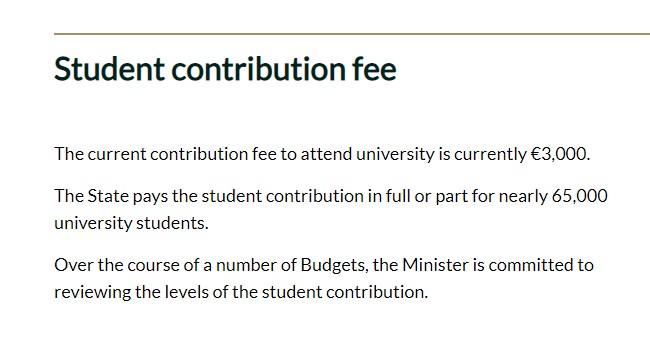
As for the proposals themselves, I’d just say that it is good to have a Minister who recognizes at least some of the problems and is prepared to make positive noises about addressing them. However, the document itself is extremely vague. Look at this, for example, from the
Government’s Press Release announcing the new “landmark policy on funding higher education and reducing the cost of education for families”:

That’s it.

Since the departure of the United Kingdom from the European Union, Ireland’s fees for undergraduate study are the highest in the EU and with the current cost of living crisis (including exorbitant rents) this is in need of reform.  The response however is that the Minister is “committed” only to reviewing (i.e. not necessarily reducing) the fee over some unspecified but probably lengthy timescale.

As with the other items in the “framework” there is no commitment to anything that will halt the immediate crisis currently afflicting students who are struggling to engage and academic staff whose workloads are skyrocketing. In fact I don’t foresee any prospect of material changes before I retire.

Another thing I’ll mention with deep frustration is that there is nothing in the policy about postgraduate education for which there is no framework at all in Ireland and very little funding. It seems Irish Governments just don’t think this is important aspect of what universities do.

Anyway, back to the “policy”, I know that what will actually happen depends on Mr Harris’s success in winning over cabinet colleagues so at this stage he can’t be very specific, but the media somehow dress all this nebulosity up as a policy, which it isn’t: it’s a collection of aspirations.

Warm words, perhaps, but just words nevertheless. We won’t find our for a while whether they actually mean anything.

A Road to Living Documents?

Posted in Open Access, The Universe and Stuff with tags on May 4, 2022 by telescoper

A few weeks ago I posted an item arguing that the scientific paper is an outdated concept and the whole business of research publishing should change to reflect more accurately how science is actually done. I’d argued previously that

the future for many fields will be defined not in terms of “papers” which purport to represent “final” research outcomes, but by living documents continuously updated in response to open scrutiny by the community of researchers. I’ve long argued that the modern academic publishing industry is not facilitating but hindering the communication of research. The arXiv has already made academic journals virtually redundant in many of branches of  physics and astronomy; other disciplines will inevitably follow.

I thought I would explain how the Open Journal of Astrophysics represents a small move in the direction of the “living document” idea.

Recently the author of a paper we published in 2019 contacted me to explain that readers had pointed some errors in that publication and he wished to amend it to correct the mistakes, which were typographical in nature but did propagate through a number of equations though they did not affect the main results. We had dealt with one post-publication amendment in the past and we handled this one in the same way:

  1. The author sent us a new version containing the proposed revisions;
  2. The Editor checked that they were reasonable (i.e. minor and without any significant changes to the scientific content);
  3. After getting the green light the author placed a revised version on arXiv with a comment explanation the revisions (in this case v3);
  4. We changed our overlay to point at the new version.

Here is the new overlay updated this morning.

You will see that there is a note on the overlay after the abstract. There is also a comment alongside the arXiv submission and another in the acknowledgements section of the revised paper. Owing to the separation between the overlay and the arXiv it is not necessary to change the Digital Object Identifier (DOI) or any of the article metadata.

This is a lot easier than the old-fashioned method of publishing an erratum. It may not represent the idea of a living document exactly, but it does demonstrate a way of feeding back to the publication after the “open scrutiny by the community of researchers” I referred to in my quote above.

It also demonstrates that peer review, however thorough, is never perfect and having wider scrutiny can find errors a referee might not.

Astronomical Heads Up

Posted in The Universe and Stuff with tags , , , , on May 3, 2022 by telescoper

You may recall a great deal of excitement about three years ago concerning the imaging of the “shadow” of the event horizon of the black hole in the centre of the galaxy M87. There was so much interest in this measurement that you could hardly move without seeing this picture somewhere or other:

The question I was asked most frequently back then is that there’s a much closer black hole in the centre of our own Galaxy, the Milky Way, so why wasn’t that imaged first? The answer is that the black hole in the centre of M87 is about 1000 times further away from us than the black hole in the centre of the Milky Way – known to its friends as Sagittarius A* or SgrA* for short – but is also about 1000 times more massive, so its Schwarzschild radius is 1000 times larger. In terms of angular resolution, therfore, the observational challenge of imaging the event horizon is similar in the two cases.

I mention this because the Event Horizon Telescope team who made the above image are holding a press conference next week at ESO on “groundbreaking Milky Way results from the Event Horizon Telescope Collaboration”.

I wonder what these “groundbreaking results” might be?

A Dress Code for Physics?

Posted in Biographical, Education with tags , , , , , , on May 2, 2022 by telescoper

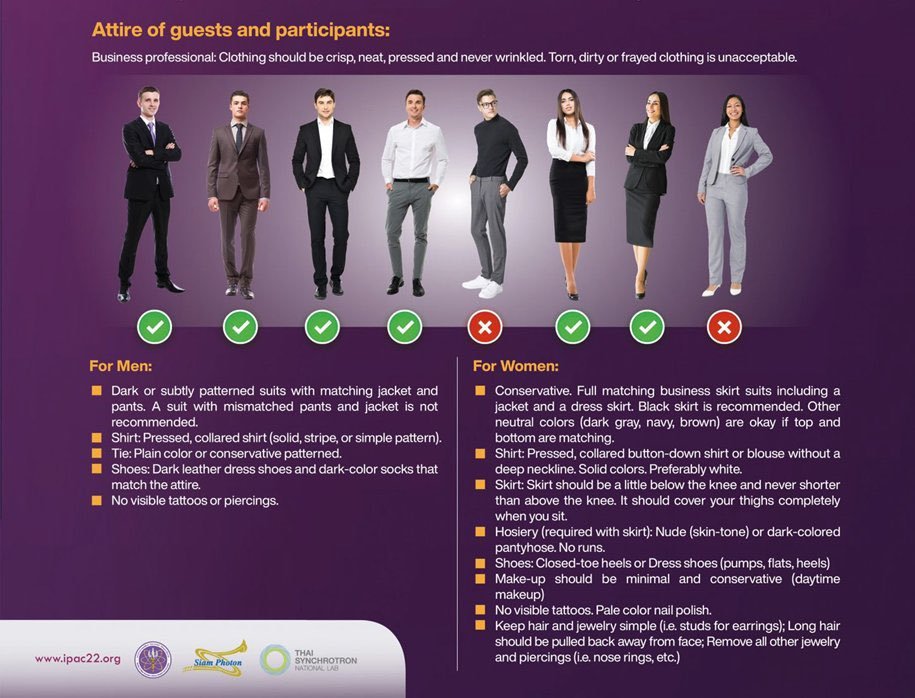
This image has been doing the rounds on Physics Twitter recently, accompanied by a mixture of incredulous, amused and angry comments. It’s from the instructions from the 13th International Particle Accelerator Conference (IPAC2022) which takes place in Thailand next month.

To be fair I think this dress code is only for delegates wishing to attend a special event at which the Thai Royal Family will be present, but that it is strange that it should be so “Westernized”. It seems nobody wearing more traditional formal clothing from African or Asian countries, or even Thailand itself would be allowed.

Aside from that, the highly gendered instructions would make many attendees uncomfortable. Women must wear skirts, not trousers for example. Why? I wonder if they’d allow a Scotsman wearing a kilt? It’s all very silly and not at all inclusive. I suspect this nonsense has put off a number of potential attendees.

Speaking for myself, I don’t mind dressing up a bit for special social occasions that have a dress code. At the RAS Club Dinners at the Athenaeum the dress code for men is, amusingly, “jacket and tie”. Trousers are apparently not allowed and there’s no restriction that I know of on female dress. As a matter of fact I find it a relief when the dress code for a function is formal (e.g. “black tie”) because a male person such as me then doesn’t have to think about what to put on. IG wouldn’t like to have a dress code imposed on me at work, though.

The instruction that clothing must be “crisp, neat, pressed and never wrinkled” would represent an impossible standard for most of my colleagues in physics who for the most part dress in a manner that’s more “scruffy academic” than “business professional”. I have however worked with physicists who dress at work in a wide variety of ways. One I remember always wore a three-piece suit (even at the height of summer) and another was full Goth, neither style made any difference to their ability to do research.

I have sometimes been asked by junior researchers about how to dress for things like interviews or conference talks. I wrote about this before, here.

In brief the idea of of dressing up for job interviews in academia has always seemed rather odd to me. The default style of dress for academics is “scruffy”, so it’s a bit odd that we all seem to pretend that it’s otherwise for interviews. I suppose it’s just to emphasize that it’s a formal occasion from the point of view of the interview panel, and to show that the candidates are taking it seriously. I don’t really pay much attention to what interviewees wear, other than that if they look like they’ve just been dragged through a hedge one might infer that they’re  a bit too disorganized even to be a member of the academic staff at a University or that they’re not really putting enough effort into the whole thing.

On the other hand, some people feel so uncomfortable in anything other than jeans and a T-shirt that putting on a suit would either be an unbearable ordeal for them or conflict with their self-image in some fundamental way. Neither of these are intended, so if that’s going to be the case for you, just dress as you normally do (but preferably with something reasonably clean).

I sometimes get asked whether a (male) candidate for a PhD place should wear a suit and tie forsuch an interview. Having conducted interview days for many years at a number of different institutions, my experience is that a smaller proportion do dress formally for PhD interviews than for job interviews. My advice to students asking about this is just to say that they should try to look reasonably presentable, but suit–and-tie are definitely not compulsory. I would say “smart casual” is a good guide, though I have to say I don’t really know what that is. In any case it’s unlikely the staff interviewing you will be dressed formally…

Anyway, in writing this I started to think that the world would be a better place if “business professionals” were made to dress like academics, rather than the other way round.