Yes, I know there are far more important things to think about these days but if you want to take a break from doom scrolling then you might want to cast your vote in the St Patrick’s Day Beard of Ireland 2022 poll.
Owing no doubt to some form of administrative error, I actually won this in 2020 but sank without trace last year. I’m in the first round group this year and will no doubt be eliminated but I’d be happy if I could cling on to the fourth place (out of four) that I managed last year.
BEARD OF IRELAND 2022 POLL SEES COMPETITION BRISTLING
The Beard Liberation Front, the informal network of beard wearers, has said that competition for the Irish Beard of the Year 2022 is officially open
The 2017 winner was politician Colum Eastwood who bearded broadcaster William Crawley for the annual Award.
In 2018 the DUP’s Lee Reynolds shaved writer Dominic O’Reilly for the honour with Colum Eastwood in a steady third place.
In 2019 Lee Reynolds retained the title
The 2020 winner was Maynooth academic Peter Coles
In 2021 Aodhan Connolly shaved opponents to win the coveted title
The BLF says that while traditionally a land of predominantly clean-shaven cultures, Ireland has in recent times become something of a centre for stylish and trendy beards.
Contenders for the title in 2022 include a diverse range of the hirsute- a golfer…
I was shocked to see just now the news that legendary Australian legspinner Shane Warne has passed away suddenly at the age of just 52. I always admired his bowling hugely no doubt partly because having tried to bowl leg-breaks myself I have some idea how difficult it is to do well! I thought as a tribute I would rehash a piece I posted about 12 years ago about the prodigious amount of spin Shane Warne was able to generate.
For those of you not so familiar with cricket here’s a clip of another prodigious spinner of the ball, Australia’s legend of legspin Shane Warne:
For beginners, the game of cricket is a bit similar to baseball (insofar as it’s a game involving a bat and a ball), but the “strike zone” in cricket is a physical object ( a “wicket” made of wooden stumps with bails balanced on the top) unlike the baseball equivalent, which exists only in the mind of the umpire. The batsman must prevent the ball hitting the wicket and also try to score runs if he can. In contrast to baseball, however, he doesn’t have to score; he can elect to play a purely defensive shot or even not play any short at all if he judges the ball is going to miss, which is what happened to the hapless batsman in the clip.
You will see that Warne imparts considerable spin on the ball, which has the effect of making it change direction when it bounces. The fact that the ball hits the playing surface before the batsman has a chance to play it introduces extra variables that you don’t see in baseball, such as the state of the pitch (which generally deteriorates over the five days of a Test match, especially in the “rough” where bowlers have been running in).
A spin bowler who causes the ball to deviate from right to left is called a legspin bowler, while one who makes it turn the other way is an offspin bowler. An orthodox legspinner generates most of the spin from a flick of the wrist while an offspinner mainly lets his fingers do the torquing.
Another difference that’s worth mentioning with respect to baseball is that the ball is bowled, i.e. the bowler’s arm is not supposed to bend during the delivery (although apparently that doesn’t apply if he’s from Sri Lanka). However, the bowler is allowed to take a run up, which will be quite short for a spin bowler, but long like a javelin thrower if it’s a fast bowler. Fast bowlers – who can bowl up to 95 mph (150 km/h) – don’t spin the ball to any degree but have other tricks up their sleeve I haven’t got time to go into here. A typical spin bowler delivers the ball at speeds ranging from 45 mph to 60 mph (70 km/hour to 100 km/hour).
The physical properties of a cricket ball are specified in the Laws of Cricket. It must be between 22.4 and 22.9 cm in circumference, i.e. 3.57 to 3.64 cm in radius and must weigh between 155.9g and 163g. It’s round, made of cork, and surrounded by a leather case with a stitched seam.
So now, after all that, I can give a back-of-the-envelope answer to the question I was wondering about on the way home. Looking at the video clip my initial impression was that the ball is deflected by an angle as large as a radian, but in fact the foreshortening effect of the camera is quite deceptive. In fact the ball deviates by less than a metre between pitching and hitting the stumps. There is a gap of about 1 metre between the popping crease (where the batsman stands) and the stumps – it looks much less from the camera angle shown – and the ball probably pitches at least 2 metres in front of the crease. I would guess therefore that it actually deflects by an angle less than twenty degrees or so.
What happens physically is that some of the rotational kinetic energy of the ball is converted into translational kinetic energy associated with a component of the velocity at right angles to the original direction of travel. In order for the deflection to be so large, the available rotational kinetic energy must be non-negligible compared to the original kinetic energy of the ball. Suppose the mass of the ball is , the translational kinetic energy is where is the speed of the ball. If the angular velocity of rotation is then the rotational kinetic energy , where is the moment of inertia of the ball.
Approximating the ball as a uniform sphere of mass and radius , the moment of inertia is . Putting , cancelling on both sides and ignoring the factor of – because I’m lazy – we see that the rotational and translational kinetic energies are comparable if
or , which makes sense because is just the speed of a point on the equator of the ball owing to the ball’s rotational motion. This equation therefore says that the speed of sideways motion of a point on the ball’s surface must be roughly comparable to speed of the ball’s forward motion. Taking km/h gives m/s and m gives radians per second, which is about 100 revolutions per second. This would cause a huge deviation (about 45 degrees), but the real effect is rather smaller as I discussed above (see comments below). If the deflection is actually around 15 degrees then the rotation speed needed would be around 30 rev/s.
This estimate is obviously very rough because it ignores the direction of spin and the efficiency with the ball grips on the pitch – friction is obviously involved in the change of direction – but it gives a reasonable ballpark (or at least cricketground) estimate.
Of course if the bowler does the same thing every time it’s relatively easy for the batsman to allow for the spin. The best bowlers therefore vary the amount and angle of spin they impart on each ball. Most, in fact, have at least two qualitatively different types of ball but they disguise the differences in the act of delivery. Offspinners typically have an “arm ball” which doesn’t really spin but holds its line without appearing to be any different to their spinning delivery. Legspinners usually have a variety of alternative balls, including a topspinner and/or a flipper and/or a googly. The latter is a ball that comes out of the back of the hand and actually spins the opposite way to a legspinner while being produced with apparently the same action. It’s very hard to bowl a googly accurately, but it’s a deadly thing when done right.
Another thing also worth mentioning is that the rotation of the cricket ball also causes a deviation of its flightpath through the air, by virtue of the Magnus effect. This causes the ball to curve in the air in the opposite direction to which it is going to deviate on bouncing, i.e. it would drift into a right-handed batsman before breaking away from him off the pitch. You can see a considerable amount of such movement in the video clip, away from the left-hander in the air and then back into him off the pitch. Nature clearly likes to make things tough for batsmen!
With a number of secret weapons in his armoury the spin bowler can be a formidable opponent, a fact that has apparently been known to poets, philosophers and astronomers for the best part of a thousand years:
The Ball no Question makes of Ayes and Noes,
But Right or Left, as strikes the Player goes;
And he that toss’d Thee down into the Field,
He knows about it all — He knows — HE knows!
Modest Mussorgsky’s Piano Suite Pictures at an Exhibition was inspired by a series of artworks by his friend Viktor Hartmann. The 10th movement of this suite was based on a design for Bogatyr Gates intended to be placed at the entrance to Kiev Kyiv:
Hartmann’s plan for the Bogatyr Gate
The gates were never built, so at least they can’t be destroyed. Here is the piece played live at a concert in Carnegie Hall by Vladimir Horowitz, who was born in Kyiv.
A Ukrainian student here in Maynooth gave out some ribbons for staff and students to show support by making a visible statement of solidarity. I’m proud to be wearing one:
Public statements made by institutions such as universities and research organizations aren’t going to end the war in Ukraine, but they can at least offer solidarity with the victims of war and sometimes even offer practical support.
I was very pleased to see on Friday, dust a day after the Russian invasion of Ukraine, that my own University, Maynooth, issued a statement on the conflict:
Maynooth University condemns the invasion of Ukraine and we extend our deepest sympathy at this dark hour to all our Ukrainian colleagues, students and graduates as they anxiously await word from friends and family fleeing their homes.
Also in our thoughts are members of the MU community from the entire region, whose families, lives and livelihoods are affected by the escalating tension and violence.
Maynooth University stands in solidarity with those who cherish democracy and peace, and we will undertake a process of engagement with colleagues from this region to discuss and explore ways to activate our support.
It doesn’t say much, but it was at least timely and thoughtful. Far better than remaining silent.
The Royal Irish Academy, as Ireland’s national academy for science, the humanities, and social sciences, is shocked and deeply concerned at the military invasion by Russia of Ukraine. The Academy notes with grave concern the damage this represents to educational and scientific institutions, academics, and international research collaboration, and to the social, economic and cultural foundations of Ukraine. The Academy expresses support and solidarity with the National Academy of Sciences of Ukraine. The Academy also wishes to salute the courageous position taken by many members of the Russian Academy of Sciences, who associated their signature with that of several hundred researchers and scientific journalists from their country in an open letter denouncing the aggression against Ukraine by the Russian Federation and calling for its immediate end.
In my own field, I saw a statement issued by various learned societies and organizations in the field of astronomy. It’s not as strong but at least does offer some practical supports for Ukrainian academics fleeing the war:
The mission of our societies is to promote and safeguard the science of astronomy in all its aspects, including research, communication, education and development through international cooperation. We believe in free expression and free exchange of scientific ideas and in peaceful collaboration at a global level. The current events jeopardise the scientific cooperation within our European community and with the rest of the world.
We are deeply concerned for the Ukrainian community as well as for the entire region. Triggered by the life-threatening situation in which our Ukrainian colleagues find themselves, we wish to encourage members to help wherever possible in this difficult time for Ukraine. Ukrainian astronomers seeking support should contact the Institute of International Education (IIE) scholar rescue fund, which supports refugee scholars and is activating an Ukraine-specific student emergency fund.
Notice that the Royal Astronomical Society is absent from the list of signatories. Indeed it has not made any public statement whatsoever about the invasion of Ukraine. Their silence is deafening. From where I sit, as a Fellow, their policy of ignoring the conflict just looks spineless and contemptible.
UPDATE: The Royal Astronomical Society has now posted a statement (dated 2nd March):
The Royal Astronomical Society deeply regrets the illegal military invasion of Ukraine, a sovereign democratic nation, by Russia. Our thoughts and hopes go out to our fellow scientists and all the citizens of Ukraine for their safety and well-being. We will be exploring avenues for supporting our fellow scientists who are fleeing the war zone with government agencies and our sister societies.
There are a number of non-governmental organisations working to provide humanitarian relief in Ukraine itself and in neighbouring countries, including the following, who welcome donations:
British Red Cross
United Help Ukraine
Sunflower of Peace
Voices of Children
As far I know the Institute of Physics has so far refused to address the Ukraine crisis.
The Institute of Physics has also now issued a (brief) statement (dated 3rd March):
The Institute of Physics condemns Russia’s actions against Ukraine which are a violation of one of the most fundamental norms of international law that prohibits the use or threat of force by one state against another. As a member of the European Physical Society we support the statement of the Executive Committee.
Physics is a global endeavour, and we continue to support academic freedom of scientists everywhere.
We hope for a quick resolution of the crisis to bring an end to its devastating impacts on the people of Ukraine.
My regard for both these organizations has fallen considerably in the last week, to the point that I now seriously doubt whether I wish to remain a Fellow of either. If there are good reason why I should change my mind, or if either organization has made public statements that I’ve missed, I’d love to hear them, either through the comments box or privately.
P.S. The Royal Society of London is also yet to make a statement on Ukraine. I find this regrettable. Obviously, though, I am not a Fellow of that organization so am not able to resign.
UPDATE: The Royal Society has now joined with the National Academies of all the G7 Nations in making a strong statement against the Russian invasion of Ukraine:
I don’t know why it took a full week to get there, but I am pleased at last that the RAS, IOP and Royal Society have now at least said something. Every little helps.
Posted in Literature on March 1, 2022 by telescoper
It’s St David’s Day today, so I wish you all a great big
Dydd Gŵyl Dewi Hapus!
It has become a bit of a St David’s Day tradition on this this blog to post a piece of verse by the great Welsh poet R.S. Thomas. An Anglican clergyman, Thomas was vicar at St Hywyn’s Church (which was built 1137) in Aberdaron at the western tip of the Llŷn Peninsula. This one, called Pact, carries a message for the sad times we’re living through.
This is my child; that is yours. Let peace be between them when they grow up.
They are far off now; let it not be through war they are brought near. Their languages
are different. Let them both learn it is peace in the hand is the translation of peace in the mind.
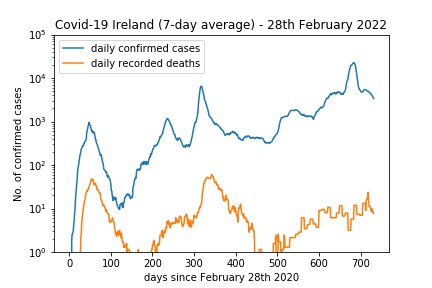
Trying to find something other than the conflict in Ukraine to write about, I thought I’d do a quick post to mark that we have reached the two year mark since the first “official” case of Covid-19 in Ireland was detected. It seems so long ago that I had forgotten that 2020 was a leap year and the date was 29th February, and the case was reported a day later on 1st March 2020.
It was to be another couple of weeks before we went into the first lockdown and I didn’t start keeping a log of all the cases and deaths until 27th March 2020, but you will find a complete record here (backdated to the date of the first case).
Here is the latest plot, with data complete up to today:
Today is the day that most Covid related restrictions are lifted. There is no longer a legal requirement to wear masks anywhere other than in healthcare settings, though at my University there is a recommendation to do so. I dropped into Dunnes this morning to buy a sandwich to have for lunch and I’d say a slight majority of shoppers (including myself) were still wearing masks, though all the staff I saw were unmasked (a fact which I found very disappointing).
I intend to carry on wearing a face covering in shops and, of course, in classrooms (and especially in labs) for the foreseeable future. I didn’t have any teaching this morning so I don’t know what the students are doing. We are told that if a student refuses to wear a mask then lecturers can’t make them, but peer pressure may do the job for us. We do have a significant number of students off and teaching staff unavailable due to Covid-19 infection but we just have to manage this as best we can.
The requirement to have a PCR test if you are symptomatic has also lapsed for most people in Ireland, but not for me. As I’m over the age of 55 I am still required to take a test if I have symptoms.
The drastic reduction in testing implied by the change in regulations will undoubtedly lead to a steep reduction in PCR-confirmed cases (currently running at a seven-day average of around 3500 per day) and in the light of this I’m not sure it’s worth carrying on plotting the data for much longer. I will persevere for the mean time though.
Thinking about the brave defenders of Ukraine, especially in Kyiv, who include numerous civilians I suddenly remembered an old post about a friend I met in Brighton many years ago, a Jewish man of Austrian extraction who went by the name of Solly. He had been sent by his parents to live in England a few years before the start of World War 2 when he was still a teenager.
To cut a long story short, in 1940 Solly ended up joining the Local Defence Volunteers (the Home Guard) in Brighton. This is something he told me reminiscing abut those times. over dinner many years ago.
On 7th September 1940 the War Office issued the following communique:
Message to all UK units: codeword CROMWELL. Home Defence forces to highest degree of readiness. Invasion of mainland UK expected at any time.
After being informed of this signal Solly and his comrades turned up to be issued with the equipment with which they were expected to stop the imminent invasion. In his case it was an ancient pre-WW1 rifle, three rounds of ammunition, and two improvised grenades. With these meagre supplies, they were supposed to hold their positions until reinforced, possibly for up to 7 days.
As they walked to their posts, all the volunteers were certain that they had no chance and that none of them would survive the night. In such a grim situation they were understandably quiet, but what talk there was exclusively concerned the need to make all their shots count. If each of them could kill at least one invader before he himself was killed then the invasion might be thwarted.
After an agonizing wait, and several false alarms, dawn broke. The Germans never came.
Solly clearly found this recollection difficult. Few of us are ever faced with such a stark prospect of death. But I remember one thing he did say, which at the time I didn’t really understand, which is that it was in a way quite liberating – accepting that you are certain to die means that you no longer feel afraid. He had previously worried that he might lack the courage to fight if called upon to do so, but that doubt disappeared on 7th September 1940.
I think we’re already seeing this attitude in Ukrainian President Volodymyr Zelensky, who has emerged as a heroic figure . He must know that he is a marked man, and that his days are probably numbered, but he has refused offers to get him out to safety. The contrast between his courage and another so-called leader, who ran away from reporters to hid in a fridge, could not be greater.
Anyway, as the Russians enter the city of Kyiv, many civilians will be trying to summon up their courage right now. Received wisdom is that in urban fighting, the attacking force needs a numerical advantage of at least five to one and even more if the attackers are poorly trained conscripts, as seems to be the case in some parts of Ukraine. The defenders hold many cards, not least that it’s their land on which they’re fighting.
I fear that there is a bloodbath coming, but it seems to me very likely that the Russians will suffer worse. Not that Putin will be bothered. To him, his soldiers are mere cannon fodder.
You can’t spend over 30 years working in theoretical physics without encountering Russian physicists and mathematicians. Over the years I’ve got to know a few quite well, through collaborations and discussions, and others by acquaintance. It occurred to me this morning that many of them might get caught up in the widespread condemnation of the Putin regime’s invasion of Ukraine. I don’t know any Russians (physicists or anything else) who support Putin or his oligarchs. I’m not saying that there are no such people, just that I don’t know any.
I think it’s important to say that my comments yesterday were not aimed at the many Russians around the world – including Russia itself – who want no part of the war and are horrified by the actions taken by the Russian leader.
On a related note this news, of Russian agency Roscosmos suspending all flights of the Soyuz spacecraft from the ESA launch facility in Kourou and withdrawing all Russian personnel from the site, seems to confirm what I thought yesterday, that the launch of Euclid will be postponed indefinitely. The alternative launcher, Ariane 6, has not yet had its first flight and at least two successful launches are required before it can be established as the vehicle for Euclid. On top of that the Euclid spacecraft itself will be need to be modified for the different vehicle. Details are yet to be confirmed, but it seems a lengthy delay is likely.
Yesterday morning I heard the news about Russia’s invasion of Ukraine via the radio as soon as it woke me up at 7am. It took me a while to summon up the energy to get out of bed and get ready for my 9am lecture. The routine things of life seem so trivial and futile compared to wars and other disasters over which one has no influence. But it does not help Ukraine (nor anyone else, including yourself) to be overwhelmed by despair. So I got up and did my lecture, as I did this morning with a 9am tutorial.
Somehow, it feels like a duty to persevere. I think that’s partly because the tyrants of this world want people to feel powerless. By persisting with the little things you are, in a very small way, defying those who want you to be terrified. The image of Vladimir Putin as some sort mastermind, a Karla-like bogeyman with strategic superpowers, has hypnotized too many. He’s just a sad old relic of the Cold War.
I try to resist looking at the news too often, my desire to stay informed tempered by a wish to remain sane. I’d like to believe that the Ukrainians can hold out, but they’re massively outnumbered and outgunned so the odds are heavily against them. But they’re fighting on their home soil for a just cause against an invader. That should count for something. The longer they can hold out wear down the Russian army the more chance there is that the tide will turn against Putin at home.
I doubt that sanctions from the West will have any impact on Putin’s murderous intentions, at least not in the short term. In any case they look weak to me. Russian teams are still playing in UEFA tournaments, and Russia will still be in Eurovision. Why is this tolerated?
I spent an hour yesterday on a zoom call related to the European Space Agency’s Euclid mission, which is due to be launched on a Russian Soyuz spacecraft in 2023. The latest batch of sanctions may lead to a delay in Euclid or even its cancellation. That would be a major problem for many scientists around the world. It’s a big thing for us, but it gets smaller when you compare it with what’s happening in the world. I bet a majority of us working in cosmology would prefer to see Euclid scrapped altogether than see further death and destruction unfold. I know I would.
It wouldn’t work that way, of course, but the question we have to ask ourselves is who are we happy to do business with? How could you sleep at night after giving money to or taking money from the Kremlin or its proxies? Maybe Putin will succeed only in giving the West a renewed sense of moral certainty.
For years the West has been corrupted by dirty money from Russia’s gangster oligarchs. Now Ukraine is paying the price. We’ve been far too slow to understand the true nature of who and what we’ve been dealing with. Now it’s time to get serious. “Business as usual” no longer applies, at least not with Russia…
Just a reminder that Johnson’s UK Government has a huge majority in the House of Commons and could easily pass emergency laws to impose sanctions on Putin and his oligarch pals after Russia’s invasion of Ukraine, if it wanted to. It won’t, because the Conservative Party is awash with dirty Russian money and is fatally compromised.
The views presented here are personal and not necessarily those of my employer (or anyone else for that matter).
Feel free to comment on any of the posts on this blog but comments may be moderated; anonymous comments and any considered by me to be vexatious and/or abusive and/or defamatory will not be accepted. I do not necessarily endorse, support, sanction, encourage, verify or agree with the opinions or statements of any information or other content in the comments on this site and do not in any way guarantee their accuracy or reliability.


 , the translational kinetic energy is
  where
where  is the speed of the ball. If the
  then the rotational kinetic energy
  , where
  is the
  , the moment of inertia is
  . Putting
  , cancelling
  – because I’m lazy – we see that the rotational and translational kinetic energies are comparable if
 , which makes sense because
  is just the speed of a point on the equator of the ball owing to the ball’s rotational motion. This equation therefore says that the speed of sideways motion of a point on the ball’s surface must be roughly comparable to speed of the ball’s forward motion. Taking
  km/h gives
  m/s and
  m gives
  radians per second, which is about 100 revolutions per second. This would cause a huge deviation (about 45 degrees), but the real effect is rather smaller as I discussed above (see comments below). If the deflection is actually around 15 degrees then the rotation speed needed would be around 30 rev/s.



 In the Dark