A Peer Review Poll

Posted in Open Access on February 14, 2022 by telescoper

A long time ago I posted a poll to see what people think about the issue of peer review. Now seems a good time to circulate it again.

In previous posts (e.g. this one) I had advanced the view that, at least in the subject I work in (astrophysics), while in its usual form peer review does achieve some degree of quality control, it is by no means perfect. Some good papers get rejected and some poor papers get accepted. Moreover, the refereeing is usually done for free by members of the academic community while journal publishers use peer review as a justification for levying publication charges in that it provides added value to the publication process – a view I disputed here.

Any system operated by humans is bound to be flawed to some extent, but the question is whether there might be a way to improve the system so that it is fairer and more transparent.

I suggested that it could be replaced by a kind of crowd-sourcing, in which papers are put on an open-access archive or repository of some sort, and can then be commented upon by the community and from which they can be cited by other researchers. This would, if you like, be a sort of “arXiv plus” – good papers would attract attention and poor ones would disappear.

We did consider having open peer review of the sort mentioned above for the Open Journal of Astrophysics but this option was not available for the no-frills off-the-shelf Scholastica platform we went for so we now operate a version of the traditional peer review system. This achieves some level of gate-keeping but also (and much more importantly, in my view) makes constructive criticism to allow authors to improve their papers. We also discussed publishing referee reports alongside the papers, but that is also beyond the scope of our current system (and would of course require the consent of referees).

I have no idea really how strongly others rate the current system of peer review. The following poll is not very scientific, but ‘ve tried to include a reasonably representative range of views from “everything’s OK – let’s keep the current system” to the radical suggestion I make above.

A Message of Solidarity

Posted in Education, Politics with tags , , , on February 14, 2022 by telescoper

Today members of the Universities and Colleges Union (UCU), which represents academic staff in UK universities, begin ten days of strike action over cuts to pensions, pay and working conditions.

I know it doesn’t help very much, but I’d like to take this opportunity to wish all the strikers well and express solidarity and support for their wholly justified action.

Universities affected by the strike include three that I’ve actually worked in: Sussex, Nottingham and Queen Mary, University of London. I understand that a large majority of those voting in the ballot at Cardiff were in favour of industrial action but there were insufficient responses to meet the legal threshold for a strike to be lawful.

Third Level Ireland – The Core Problem

Posted in Biographical, Education, Maynooth, Politics with tags , on February 13, 2022 by telescoper

One of the things I noticed straight away when I moved from the UK to my current job in Ireland is how under-resourced the Irish higher education system is. That realization was driven home still further by the Covid-19 pandemic during which those of us working in Irish universities had to switch to online teaching with precious little support.

Academic staff worked very hard to keep going during the various lockdown periods, but I’m sure I’m not the only person to feel deep regret that we were unable to do things better and that many students have a right to feel they have been let down by the system.

Now that we’re back teaching on campus the problems have not gone away. With a significant number of students prevented from attending lectures by the need to self-isolate we should be making recordings or live streams available, but we lack the equipment to do so properly. I have to carry a webcam and a tripod around campus to record my classes in improvised and not very satisfactory fashion. Contrast with the UK, where proper lecture capture facilities were commonplace in universities long before the pandemic. We are at least a decade behind.

This is one example of a deep crisis in the Irish third level system. Sadly it is by no means clear that the current Government is interested in solving it. There is talk of reducing the “student contribution” (currently €3000, the highest in the EU) because of the cost-of-living crisis but cutting this tuition fee (which is effectively what it is) would reduce the money coming into higher education unless offset by an increase in Government funding. According to this report (from November 2019), core state funding per student in third level institutions fell from about €9K in 2009 to under €5K in 2019.

A sizeable fraction of the income of a university is spent on its staff. In Ireland academic staff are treated as public sector employees which means that salary levels are set centrally. After being cut after the financial crisis they are now fairly generous and increase in line with overall pay settlements. Academic staff get annual increments and can get promoted, which adds to costs on top of the cost-of-living increases.

And that’s the crunch.

If the resource per student is decreasing but the salary bill is increasing, universities have to find other ways of generating income (which has been particularly difficult during the pandemic) or to increase the number of students. Keeping staff and student numbers constant means sliding into deficit. The way out of this many have found is to freeze permanent academic hires and instead take on casual teaching staff that can be paid lower wages than full-time staff. With no disrespect at all to people employed on such contracts, who generally do an excellent job, I feel we are short-changing students if they are not taught by academics who are active in research.

Take my current Department of Theoretical Physics at Maynooth University as an example. This has a student-staff ratio of about 15. That would be considered quite high for a physics department in the United Kingdom, but lower ratios are financially viable there because the fee income per student is much higher and physics departments bring in significant research income that makes a contribution to both direct and indirect costs. The latter is very difficult in Ireland because of the lack of research funding, especially in basic sciences; fortunately we have been relatively successful in generating research income and have recently increased student numbers, so we’re keeping our head above water. For now.

The price is that all academic staff in the Department have very heavy teaching loads – about five modules a year. That is way higher than physics departments in the UK, where most staff teach at most a couple. That makes it very difficult to stay competitive in research.

The problem is that science subjects are (a) more expensive to teach and (b) have limited capacity to grow because of constraints on, e.g., laboratory space (and the fact that there is a limited pool of suitably qualified school-leavers). As a consequence there is a strong incentive for universities to expand in subjects that are cheaper to teach. Something has to be done to ensure that Ireland’s universities can continue to provide education in a broad range of subjects.

Given the funding situation and the charges currently levied on students, it amazes me that more don’t seek their tertiary education elsewhere in the EU where fees are much lower (and in some places non-existent) especially since there is such a terrible shortage of student housing In Ireland. Does the Government really want to continue giving its young people such strong incentives to emigrate?

I was going to end this post there, having stated that the mismatch between between income and salary costs is the core problem facing Irish universities. As I went along though I came to think that the really basic problem is at a deeper level than that. Irish universities are public institutions but the political parties that have dominated Irish government for decades are of a neoliberal hue and are at best ambivalent towards the public sector. There are many in the current Government who would privatize everything if they could get away with it. They are pragmatic, though, and realize that these institutions are actually popular, just like the NHS in England. It is however very difficult for public institutions to function when the Government in charge doesn’t really believe in them.

Irreversible Changes

Posted in Biographical, Cardiff, Mental Health on February 12, 2022 by telescoper

There’s a feature on Facebook that reminds you of things you posted there on the same day in previous years. It’s often a pleasant thing to be reminded of past events involving your friends but occasionally the memories are not so nice.

Over the past few weeks Facebook has been bringing back posts that I put up a decade ago, when I was experiencing serious mental health issues that had gone on for months. I ended up in a terrible state in summer 2012, resulting in me spending some time in a psychiatric institution near Cardiff.

Some time after that I wrote a piece for Time to Change Wales from which I’ve taken the following excerpt:

I realize how stupid it was for me not to have sought professional help before. It’s only now, looking back, that I realize how ill I actually was. I had almost left it too late. I know I’m not “cured”. I’ll no doubt have to confront this problem again. But next time I know what to do.

So why did I leave it so long? Fear of the stigma, perhaps. But I suppose also pride. It can be difficult to ask for help, to admit to yourself, your friends and your colleagues that you can’t cope, especially when you’re in a job in which you feel that people “expect more” of you. Difficult, yes, but not impossible, and certainly necessary. Don’t do what I did. Life’s too short.

Although I did not enjoy at all the experience of being in a high-dependency psychiatric unit, I was lucky that I got professional help in time back then. Even more happily, in recent years I haven’t had any problems of the same severity.

I have only just come to understand, however, how far I was irreversibly diminished as a person by that episode, not only in social settings but also intellectually. My ability to concentrate has greatly deteriorated, for example, and I have far less energy. The fact that I’m also getting old – another irreversible change – hasn’t helped!

On top of all this, bridges that you burned when you were not in your right mind can’t be rebuilt, no matter how much you wish they could. You can’t hope to go back to things exactly as they were. It’s taken me a decade to realize that it this is a positive: there’s no point in being haunted by the past and dreaming about undoing things that can’t be undone. Moving on is the only way to move forward.

I don’t know if these thoughts will help anyone else who might happen to read this blog, but I hope they do.

Jazz Quiz – Spot the Link

Posted in History, Jazz with tags , , , , on February 11, 2022 by telescoper

Time, I think, for a quick lunchtime jazz quiz. Here are two great old records from the classical period of Jazz. Can you spot the link between them?

The first is a slow blues recorded in 1928 called Superstitious Blues featuring a formidable singer by the name of Hattie Burleson in the company of Don Albert (trumpet), Siki Collins (soprano saxophone), Allen Van (piano), John Henry Bragg (banjo) and Charlie Dixon (brass bass):

The second, an up-tempo stomp recorded a year earlier in 1927, is one of the hottest jazz records ever made – the way it catches fire for the last 45 seconds or so is absolutely sensational no matter how many times you listen to it. It is performed by the Johnny Dodds (on clarinet) and his Black Bottom Stompers, consisting of George Mitchell and Natty Dominique on cornets, John Thomas on trombone, Charlie Alexander piano, Bud Scott banjo and Johnny Dodds’s younger brother, Warren ‘Baby’ Dodds, drums.

So, what’s the connection?

Well, nobody tried to answer so I will: real name of Don Albert, the trumpet player in the first track, was Albert Dominique and he was the nephew of the more famous Natty Dominique who played on the second track. Not a lot of people know that.

Scientific Computing Then and Now

Posted in Biographical, mathematics with tags , , , on February 10, 2022 by telescoper

This afternoon I was in charge of another Computational Physics laboratory session. This one went better than last week, when we had a lot of teething problems, and I’m glad to say that the students are already writing bits of Python code and getting output – some of it was even correct!

After this afternoon’s session I came back to my office and noticed this little book on my shelf:

Despite the exorbitant cost, I bought it when I was an undergraduate back in the 1980s, though it was first published in 1966. It’s an interesting little book, notable for the fact that it doesn’t cover any computer programming at all. It focusses instead on the analysis of accuracy and stability of various methods of doing various things.

This is the jacket blurb:

This short book sets out the principles of the methods commonly employed in obtaining numerical solutions to mathematical equations and shows how they are applied in solving particular types of equations. Now that computing facilities are available to most universities, scientific and engineering laboratories and design shops, an introduction to numerical method is an essential part of the training of scientists and engineers. A course on the lines of Professor Wilkes’s book is given to graduate or undergraduate students of mathematics, the physical sciences and engineering at many universities and the number will increase. By concentrating on the essentials of his subject and giving it a modern slant, Professor Wilkes has written a book that is both concise and that covers the needs of a great many users of digital computers; it will serve also as a sound introduction for those who need to consult more detailed works.

Like any book that describes itself as having “a modern slant” is almost bound to date very quickly, and so this did, but its virtue is that it does complement current “modern” books which don’t include as much about the issues covered by Wilkes because one is nowadays far less constrained by memory and speed than was the case decades ago (and which circumstances I recall very well).

The Course Module I’m teaching covers numerical differentiation, numerical integration, root-finding and the solution of ordinary differential equations. All these topics are covered by Wilkes but I was intrigued to discover when I looked that he does numerical integration before numerical differentiation, whereas I do it the other way round. I put it first because I think it’s easier, and I wanted the students do do actually coding as quickly as possible, but I seem to remember doing e.g. Simpson’s Rule at school but don’t recall ever being taught about derivatives as finite differences.

Looking up the start of numerical differentiation in Wilkes I found:

This is a far less satisfactory method than numerical integration, as the following considerations show.

The following considerations indeed talk about the effect of rounding errors on calculations of finite differences (e.g. the forward difference Δf = [f(x+δ)-f(x)]/δ or backward difference Δf = [f(x)-f(x-δ)]/δ) with relatively large step size δ. Even with a modest modern machine one can use step sizes small enough to make the errors negligible for many purposes. Nevertheless I think it is important to see how the errors behave for those cases where it might be difficult to choose a very small δ. Indeed it seemed to surprise the students that using a symmetric difference Δf=[f(x+δ)-f(x-δ)]/2δ is significantly better than a forward or backward difference. Do a Taylor series expansion and you’ll understand why!

This example with δ=0.1 shows how the symmetric difference recovers the correct derivative of sin(x) far more accurately than the forward or backward derivative:

Particle Physics Masterclass at Maynooth

Posted in Covid-19, Maynooth, The Universe and Stuff on February 9, 2022 by telescoper

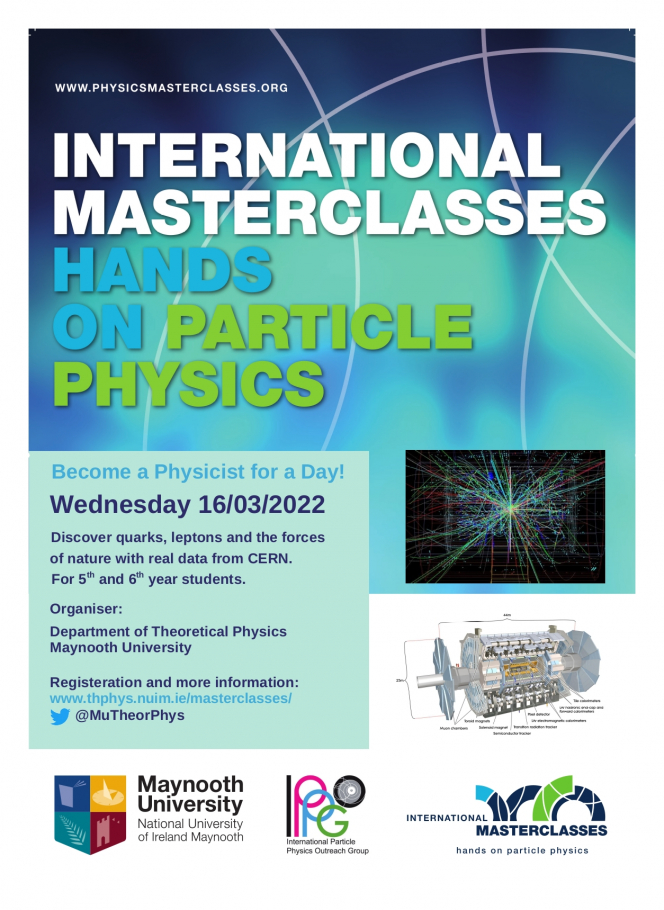
You may remember that we ran a very successful virtual Astrophysics & Cosmology Masterclass at Maynooth University last November. Now it’s time to announce the forthcoming International Masterclass on Particle Physics. This will take place on campus at Maynooth during the half-term break:


You can find more information, including instructions on how to book a place, here. The first such Masterclass at Maynooth took place in March 2012, so this year we will be celebrating the 10th anniversary.

These Masterclasses give secondary school students the opportunity to discover the world of quarks and leptons for themselves, by performing measurements on real data from CERN, meeting active particle physics researchers and linking up with like-minded students from other countries.  We will join thousands of other secondary school students at more than 100 universities and laboratories around Europe and worldwide in a programme stretching over four weeks.

Physics at the most fundamental level – the smallest and most basic building blocks of matter – is an exotic world.  But a few introductory talks and working with data from CERN will give the students insight into the fundamental particles of matter and the forces between them, as well as what went on during the Big Bang.

On Sunday afternoon, the students are introduced to particle physics, experiments and detectors in lectures given by active particle physics researchers.  On Monday, after a virtual visit to the ALICE detector at CERN, they work on their own with data from ALICE Afterwards they participate in a video conference with students from other countries and moderators at CERN, where they discuss and compare their results.

For more information on the Particle Physics Masterclasses, see the International Masterclasses web site.

R.I.P. Bamber Gascoigne

Posted in Biographical, Television with tags , , , on February 8, 2022 by telescoper

I was saddened this morning to hear of the death at the age of 87 of Bamber Gascoigne who was best known as the original presenter of University Challenge. He was an excellent quizmaster, not least because he actually seemed to know the answers to the questions (rather than just reading them from the cards like his successor Jeremy Paxman did) and often supplied extra pieces of information off his own bat.

Though he cut a stern figure whenever anybody transgressed e.g. the “no conferring” rule, he always seem to be generous in his praise and people who took part in the show say he was very gentle with the contestants who were often very nervous.

I never met Bamber Gascoigne in the flesh, although I attended the same college (Magdalene College, Cambridge) as he did when he was an undergraduate (though not at the same time) and I’m sure he was around at some dinners and other events while I was there.

I used to watch University Challenge a lot when I was at school. It’s sad to have to say goodbye to yet another figure from the era.

Rest in Peace Bamber Gascoigne (1935-2022)

Is the Hubble crisis connected with the extinction of dinosaurs?

Posted in Open Access with tags , , on February 7, 2022 by telescoper

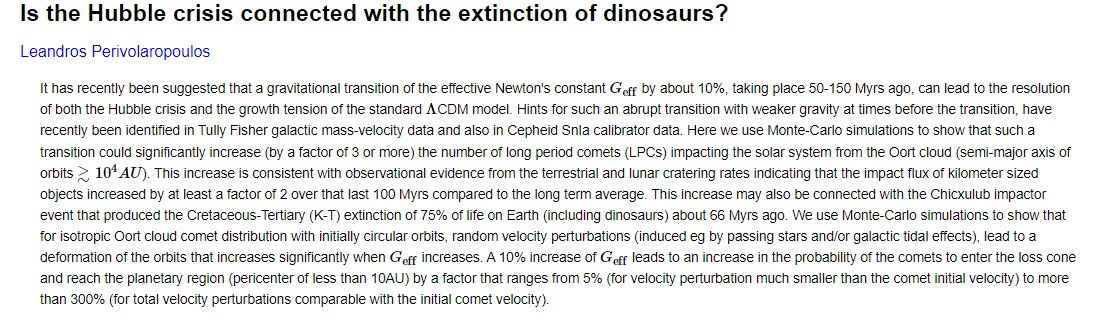
There is a paper on the arXiv (in the astro-ph section) with the title Is the Hubble crisis connected with the extinction of dinosaurs?

The abstract is here:

You can read the paper and make your own mind up, but I’m going to stick my neck out and go for “no” as the answer to the question posed…

And while I’m here I’ll give anyone who is yet to do so the chance to vote on whether there really is a Hubble constant crisis in the first place:

Facebook Folly

Posted in Biographical, Film with tags , , on February 7, 2022 by telescoper

Yesterday I found myself in the Facebook punishment block. My crime? To share a piece from the main RTÉ website about the film In Bruges.

I couldn’t understand the decision to ban me for sharing an innocuous article about a comedy film (though it’s admittedly a very dark comedy) especially when material that is so much worse is allowed. A few hours later, however, I was unbanned. I clicked on the ‘learn more’ link to be taken to a blank page. I assume the whole thing was just a mistake.

Of course this ban/unban episode is of no consequence. What worries me though is that the ban was imposed immediately, suggesting that somebody (or some AI bot) must be watching everything that gets posted by users; the same entity is presumably also checking the constant stream of bigoted bile, anti-vax misinformation, far-right propaganda, and other hateful lunacies one sees on Fashbook every day and deciding that it’s all perfectly acceptable.