Carte Blanche

Posted in Biographical, Crosswords on February 6, 2022 by telescoper

After spending this afternoon going through lots of papers in an attempt to work out how soon I’ll be able to retire – answer: not soon enough – I’ve only just realized that today there is an Azed Competition Prize Puzzle (usually the first Sunday of every month). I haven’t got the energy to do it now, but will have a go later in the week if I get the time.

Some years ago at a lunch event I had the opportunity to chat with some professional crossword compilers. It seems one gets paid around £150 (give or take) for setting a crossword in a national newspaper, which isn’t a lot considering how difficult it is. It has crossed my mind a number of times that I might try to supplement my retirement income that way.

However, when I saw today’s Azed puzzle (which is ofa special Carte Blanche form) I suddenly hit on a potentially lucrative idea.
I’ve decided to start a crossword competition of my own. Here  is Telescoper Prize Crossword No. 1.

Instructions for solvers. To enter the competition, devise a set of clues and solutions that fill the above grid in the manner of a typical Azed puzzle. Mail completed grids, together with clues to me at:  Telescoper Prize Crossword No. 1, PO Box 16  (across), Maynooth, Ireland. The best entries, as judged by me, will win 27p in (used) postage stamps plus the chance to see their crossword in a national newspaper with my name as setter.

As a business plan, this simply can’t fail. It’s nearly as good as running an academic journal!

First Light at L2 for JWST

Posted in History, The Universe and Stuff with tags , , , on February 5, 2022 by telescoper

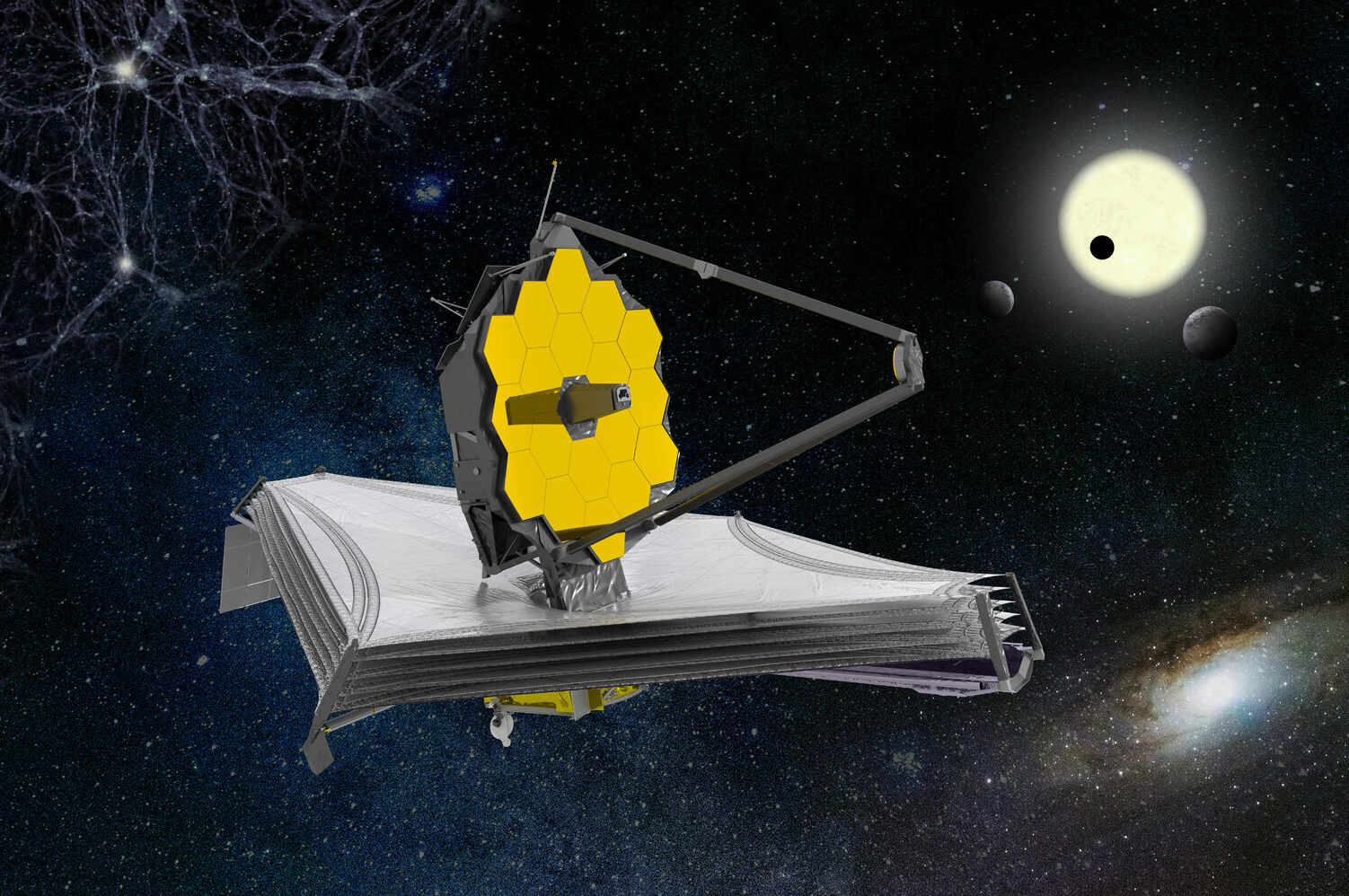
After a successful launch, subsequent deployment of its sunshield and mirrors, and arrival at its orbit around the Second Lagrange Point, the goal now for the James Webb Space Telescope is to align the optical components of the telescope to the required accuracy. This is not a simple task – each of the segments of the main mirror has to be aligned to within a fraction of a wavelength of the light it will observe (in the near-infrared part of the electromagnetic spectrum) – and it will take several months to complete. However, we did hear yesterday that the telescope has now seen “first light”, in the sense that the first photons have landed on its detectors. The first images to be formed will be blurry and distorted, but these will be used to adjust the components until they reach the required sharpness.

For more details of this process see here.

Incidentally, it is worth saying a little bit about L2, the second Lagrange point of the Earth-Sun system. As the diagram below shows, this orbits the Sun at a greater distance from the Sun than the Earth. According to Kepler’s Laws, and ignoring the Earth’s gravitation, a test particle placed in a circular orbit at this radius would move more slowly than the Earth and would not therefore hold a fixed position relative to the Earth and Sun as it went around. The effect of the Earth’s gravity however is to supply an extra force to speed it up a bit, so it can keep up and thus remain in a fixed configuration relative to both Earth and Sun.

The opposite applies to L1: an object placed here would, in the absence of Earth’s gravity, move more quickly and thus pull ahead of the Earth. Having the Earth there holds it back by just the right amount to maintain a fixed position in the rotating frame.

The interesting thing about L1 & L2 is that while they are both equilibrium points, they are both unstable to radial perturbations. An object placed at either of these points would move away if disturbed slightly. JWST does not therefore just sit passively at L2 – it moves in a so-called halo orbit around L2 a process which requires some fuel. It’s not that there’s an actual mass at L2 for it to orbit around, but that its motion produces a Coriolis Force that keeps it from moving away. It’s very clever, but does require a bit of energy to keep it in this orbit.

Unlike L1 & L2, the Lagrange Points L4 & L5 are stable and therefore attract all kinds of space junk, such as asteroids, cometary debris, and preprints by Avi Loeb.

Another interesting Lagrange Point is that Joseph-Louis Lagrange was born in 1736 in Turin, but that does not mean that he was Italian. At that time Italy did not exist as a political entity; in 1736 Turin was part of the Kingdom of Sardinia. Although born in the part of the world now known as Italy, he was never an Italian citizen. In fact he lived most of his life in Berlin and Paris and died in 1813, long before the Kingdom of Italy was founded (in 1861).

Leaving Certificate Matters

Posted in Covid-19, Education, Maynooth with tags on February 4, 2022 by telescoper

On the last day of a very busy first week of the new term I’ve finally cleared a backlog of things and thought I’d take a break for a quick comment about the arrangements for this year’s Leaving Certificate which has implications for this year’s University admissions (amongst many other things).

It has been decided that this year’s Leaving Certificate will revert to the pre-pandemic style of written examinations, but with the important proviso that the overall distribution of marks will be scaled to be no lower than the results last year (when accredited grades were taken into account). In addition the examinations will offer students more choice, so that they have to answer a smaller subset of the questions than in the good old days before Covid.

Last year’s Leaving Certificate results revealed a big increase in scores and consequent changes in offers for many courses. For example, the points required for our Theoretical Physics and Mathematics course (MH206) at Maynooth University went up by about 50 to around 550. Perhaps surprisingly this resulted in the admissions to this course going up by about a factor three. I won’t speculate on the reasons for this here.

The reason for scaling this year’s results is to ensure that students entering third-level education this year are not disadvantaged relative to those who left school last year and took a year out. Also, there is much less information on which to base accredited grades, because of pandemic interruptions.

My concern about the announcement is not so much about the return to formal examinations but on the matter of choice. Take Mathematics for instance. Instead of answering questions in each of 10 sections, students this year will only have to answer questions from six. That means that students can get very high grades despite knowing nothing about 40% of the syllabus. That matters most for subjects that require students to have certain skills and knowledge for entry into University.

In my own discipline (physics) we already have to get new students rapidly up to speed in, e.g., calculus – a difficulty exacerbated this year by the fact that the first Semester was shortened as a knock-on effect of delays in Leaving Certificate process – this is likely also to be a problem for next year’s entry. I can see we’re going to have to do a lot of thinking over the summer about how to deal with this.

Overall I prefer the Leaving Certificate over the UK system of A-levels, as the former gives the students a broader range of subjects than the latter (as does the International Baccalaureate), but I still have doubts about using a simple points count for determining entry into third-level education. Changing a system so deeply embedded is likely to prove difficult, though, so we for the foreseeable future we just have to make the best of what we’ve got.

A Day of Computing

Posted in Biographical, Education, Maynooth, The Universe and Stuff with tags , , , , , , on February 3, 2022 by telescoper

Last Semester, Thursday was what I optimistically called a “Research Day” (on the basis that I had no teaching on it). This Semester it’s one of my busiest teaching days, with lecturing in the morning and a lab session in the afternoon, both for Computational Physics.

For most of the last two years I’ve been delivering the lectures and running the lab remotely, but now that we’re back teaching face-to-face I gave the lecture in person and was in the lab with the class for this afternoon’s session. I’ve got about twice as many students this year as last year swill be running two lab sessions (one next Tuesday repeating the material from the Thursday one, and so on throughout the term).

Running the lab remotely worked reasonably well because Python is available to download for free and works on a standard Windows-based PC. In the lab however we use a Linux (Ubuntu) system, which gives the students the chance to try a different operating system (and one which is for many purposes better than Windows).

It’s good to be back running the computing laboratory class in person but I was a bit nervous this morning because since I last did it that way the machines we have in our laboratory have all been upgraded to a new operating system and have a new (and very different) version of Python (3.9 versus the now obsolete 2.7). I’ve been around long enough to realize that things can go wrong in such situations, so I warned the class during this morning’s lecture that there might be teething troubles. Sure enough we had quite a few technical glitches but, to be honest, it it could have been a lot worse. Next Tuesday’s lab should be a bit less stressful as we’ve fixed a few of the things that went wrong.

So, by no means a disaster, but a busy and quite stressful day. Time to go home and relax.

A Century of Ulysses

Posted in Biographical, Literature with tags , on February 2, 2022 by telescoper


When I woke up this morning the radio reminded me that today, 2nd February 2022, is the centenary of the first complete publication of  Ulysses by James Joyce. It had been published in installments before that, but it took a publisher in Paris to bite the bullet and publish the whole thing. The publication date also happened to be the 40th birthday of the author.

I have toyed with the idea of going into Dublin on Bloomsday (16th June, the day on which Ulysses is set) and wandering about some of the locations described in, but what with work and lockdowns I haven’t got round to it.  Maybe this year will be the time!

Or perhaps instead I’ll prepare dinner this evening in a style that Leopold Bloom would enjoy:

He liked thick giblet soup, nutty gizzards, a stuffed roast heart, liver slices fried with breadcrumbs, fried hen cod’s roe. Most of all he liked grilled mutton kidneys which gave his palate a fine tang of faintly scented urine.

Or perhaps not.

If you haven’t read Ulysses yet then you definitely should. It’s one of the great works of modern literature. And don’t let people put you off by telling you that it’s a difficult read. It really isn’t. It’s a long read that’s for sure -it’s over 900 pages – but the writing is full of colour and energy and it has a  real sense of place. It’s a wonderful book.

(There’s also quite a lot of sex in it….)

I’ve read Ulysses twice, once when I was a teenager and again when I was in my thirties. I then lent my copy to someone and never got it back. The copy shown above is a new one I bought last year with the intention of reading the novel again now that I live in Ireland but I sadly have not had the time yet. I will, though.

Back to Electromagnetism

Posted in Biographical, Education, Maynooth, The Universe and Stuff with tags , , , on February 1, 2022 by telescoper

So today I gave my first lecture of the new Semester, it being a gentle reintroduction to Maxwell’s equations for a 4th-year class on Advanced Electromagnetism. They have seen these equations before but it doesn’t do any harm to spend a bit of time refreshing the memory. In what follows I do some potential theory, applications to electrostatics (method of images, multipole expansions, use of the complex potential, etc), dielectric materials and polarization, magnetostatics, relativistic formalism of electromagnetism, gauge invariance, electromagnetic radiation and energy transport, and (if time) plasma physics (if time).

When I taught this module last year I did it all remotely from home – using the blackboard shown above – but this year until further notice I’ll be doing it in person in an actual lecture theatre, though I will be recording the lectures in case any students wish to look at them again for revision, etc, and webcasting them for any students unable to attend on campus. I know there are differences of opinion on this, but I think recording of lectures should become routine practice – as it is in all UK universities I’m aware of – but that is difficult here in Maynooth because the equipment available is inadequate (by which I mean virtually non-existent). Let’s hope the necessary investment will be made at some point.

All Change for Semester Two!

Posted in Covid-19, Education, Maynooth with tags , , , on January 31, 2022 by telescoper

So here we are, then, at the start of Semester Two at Maynooth University. When I arrived in the Department of Theoretical Physics I noticed a few differences:

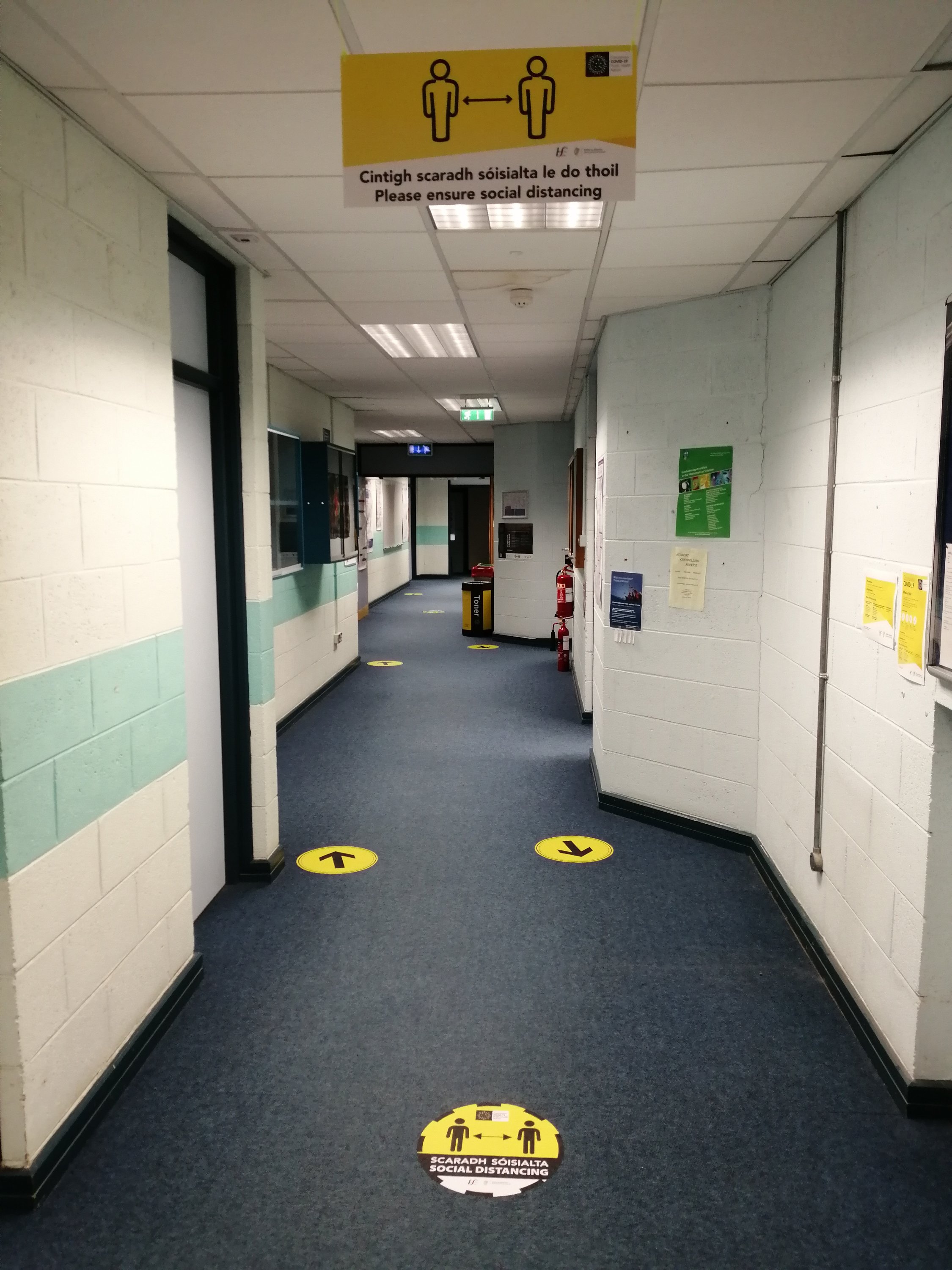
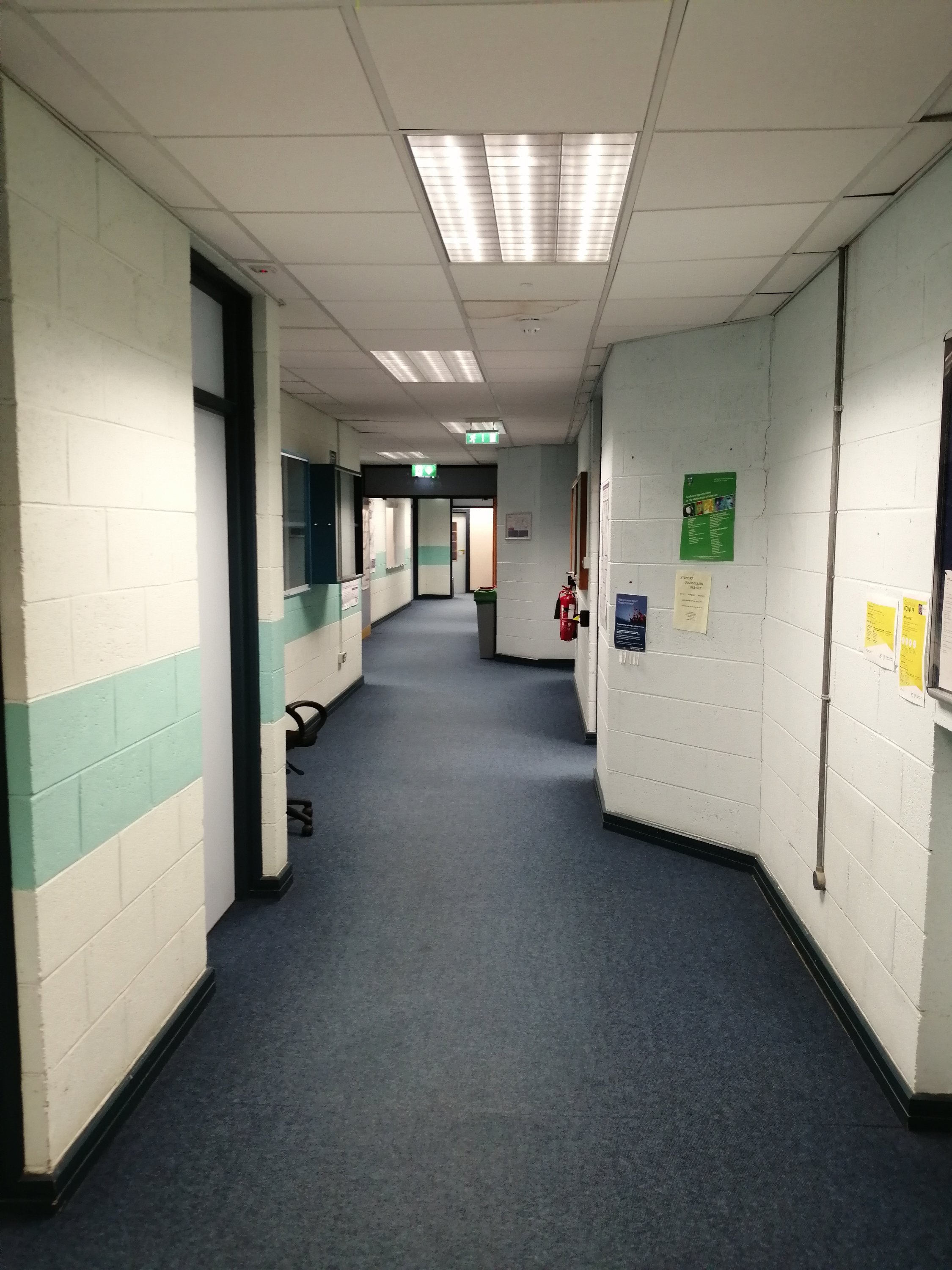
August 2020 versus January 2022

All the signage relating to physical distancing has been removed. We are no longer required to observe 2m spacing between individuals in labs or anywhere else. That solves my potential problem about constraints in the Computational Physics lab (to the left of the picture).

Our little kitchen is also now back in operation so we can share that space for lunch or coffee, sitting around the table which has now been put back in place. Staff meetings can be held in person, though the meeting of Academic Council I have to attend this afternoon will still be via Teams. I don’t actually start teaching until tomorrow and will be in the office most of the day so will have to wait until tomorrow until I find out how busy the campus seems; we expect there to be more students around than last term.

Students are still to wear face coverings in lectures etc but other than that all restrictions seem to have gone, including those on eating and social spaces on campus. Everyone seems to have decided that this pandemic is all over. Only time – and perhaps the next coronavirus variant – will tell whether they are right.

Bloody Sunday Remembered

Posted in History, Politics with tags , , , on January 30, 2022 by telescoper

I’ve been a bit busy today catching up on the backlog caused by my recent incapacity so I’ll just post a quick item to mark the 50th anniversary of the Bogside Massacre which took place on Bloody Sunday (30th January 1972) in Derry as British paratroopers opened fire on a civil rights demonstration. For more information see here.

I’m old enough to remember the news of this at the time and the widespread coverage of this event on the media today brought back a lot of memories. I certainly didn’t think then that, fifty years on, none of the soldiers who murdered these civilians would have been brought to justice.

Thirteen people people died that day, and another died of his wounds some months later. Their names are:

Patrick (‘Paddy’) Doherty (31)
Gerald Donaghey (17)
John (‘Jackie’) Duddy (17)
Hugh Gilmour (17)
Michael Kelly (17)
Michael McDaid (20)
Kevin McElhinney (17)
Bernard (‘Barney’) McGuigan (41)
Gerald McKinney (35)
William (‘Willie’) McKinney (26)
William Nash (19)
James (‘Jim’) Wray (22)
John Young (17)
John Johnston (59) – shot twice and later died on 16 June 1972

May they rest in peace, and may their murderers not.

New Publication at the Open Journal of Astrophysics

Posted in OJAp Papers, Open Access, The Universe and Stuff with tags , , , , , on January 29, 2022 by telescoper

It’s time yet again to announce a new publication in the Open Journal of Astrophysics! This one is the 2nd paper in Volume 5 (2022) and the 50th in all. We actually published this one a couple of days ago I’ve only just got around to announcing it now.

It’s very nice to mark our 50th publication with two firsts: (1) this is the first ‘Citizen Science’ paper we have published; and (2) it is the first paper in the folder corresponding to the arXiv section on Earth and Planetary Astrophysics (astro-ph.EP).

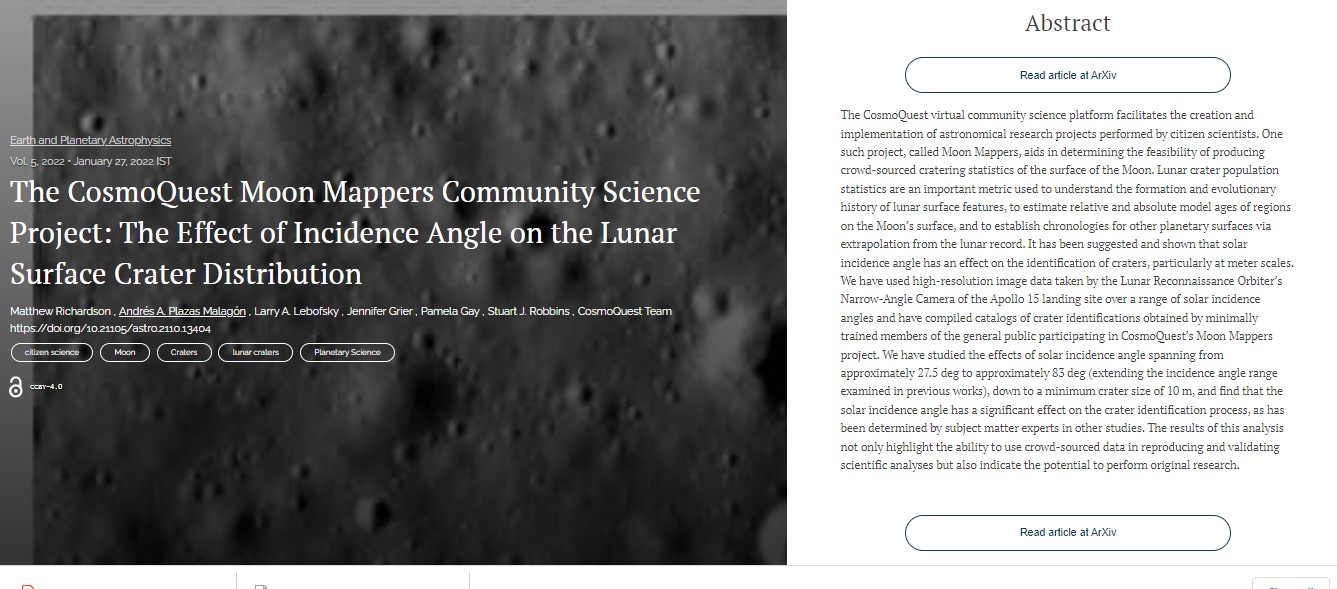
The latest publication is entitled The CosmoQuest Moon Mappers Community Science Project: The Effect of Incidence Angle on the Lunar Surface Crater Distribution and is written by Matthew Richardson (Planetary Sciences Institute, Tucson = PSI), Andrés A. Plazas Malagón (Princeton & Astronomical Society of the Pacific=ASP; corresponding author), Larry A. Lebofsky (PSI), Jennifer Grier (PSI), Pamela Gay (PSI & ASP), Stuart J. Robbins (Southwest Research Institute) and The CosmoQuest Team.

Here is a screen grab of the overlay which includes the abstract:

You can click on the image to make it larger should you wish to do so. You can find the arXiv version of the paper here. As I mentioned above this is the first publication in the folder marked Earth & Planetary Astrophysics.

There is a nice twitter thread by the corresponding author explaining what the paper is about:

If you click on the above it will take you to the rest of the Twitter thread.

Back Pain

Posted in Biographical, Maynooth with tags on January 28, 2022 by telescoper

I broke a 170-day blogging streak yesterday (Thursday) by failing to post anything. The reason for this lapse was that on Wednesday evening I started to experience very painful back spasms which carried on all night and made it almost impossible to get any sleep. It seems only very slight movements would trigger one of these, so it wasn’t just getting into and out of bed that caused problems: even adjusting my sleeping posture triggered a stabbing pain. Getting out of bed involved various abortive attempts to twist and slide into a position from which I could stand before finally managing to find one that minimised the pain. Standing up was OK, but the transition to sitting or lying, or walking, was perilous. As was getting dressed…

I had to be on campus in the morning so I made my way there gingerly and did what I had to do, but sitting in a chair was even more difficult than lying down, and I wasn’t getting anything useful done, so I decided to go home, try to get some rest and hope a bit of natural healing would mend whatever had gone wrong.

I’ve had such spasmodic attacks before though it has been a while since the last one, and they haven’t usually been quite so painful. In the past they’ve usually lasted just a few days and I hoped that would be the case this time too, especially because I have to start teaching on Monday! Luckily that seems to be true, as this morning I found I could get out of bed much more easily than yesterday. I am still getting twinges but, fingers crossed, I think it will pass.

As to what brought this all on, I have no idea.