Merry JWSTmas!

Posted in The Universe and Stuff with tags , , , , on December 25, 2021 by telescoper

Well it’s 10.20am on Christmas Day and I’ve got up specially early in order to be ready for the launch at 12.20pm today (Irish Time) of the James Webb Space Telescope from Kourou in French Guiana. The JWST project has been almost thirty years in the making and it is great that it is finally going to be heading into space. The launch however is just the start – JWST has a very complicated journey in front of it – as demonstrated by the following little video.

In particular, JWST should separate from the Ariane 5 launcher at about 27 minutes after takeoff so look out for that.

I have no direct personal involvement with JWST but I am still feeling a bit nervous. I can’t imagine how it must feel to have spent decades working on it. I know a great many astronomers around the world who are waiting anxiously and hoping all goes well. Fingers crossed!

If you want to watch the launch live you can do so on Youtube here:

You can find alternative viewing options here.

The launch window opens at 12.20 UTC and lasts for 31 minutes but I understand they’re going to launch as early as possible within that so it looks like we’re in for a launch before lunch rather than the other way round.

I’ll update with any news as the day goes on.

UPDATE: 12.28pm Launched right on time, everything nominal as JWST leaves Earth’s atmosphere propelled by Stage One of the Ariane 5.

UPDATE: 12.31pm Stage One jettisoned, Stage 2 ignition. All still nominal.

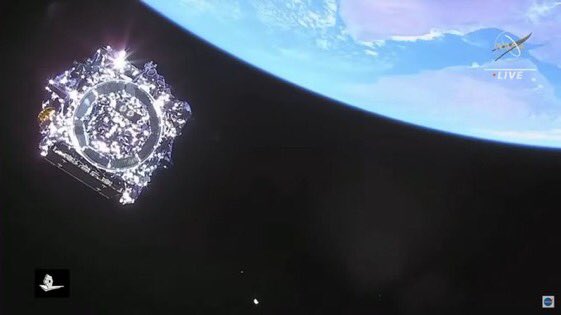
UPDATE: 12.48pm JWST has separated from the launch vehicle and is on its way. The solar panel is deployed and is working. The spectacular onboard video showing the separation of JWST from the Ariane 5 launch vehicle and the deployment of the solar panels was supplied by Irish company Réaltra.
P.S. I still think JWST should have had a different name.
Reasons to be cheerful?

Posted in Biographical, Covid-19 on December 24, 2021 by telescoper

We’ve all been bracing for the arrival of the omicron storm here in Ireland. I has been like waiting for a tsunami know is coming and praying that the flood defences are strong enough to hold.

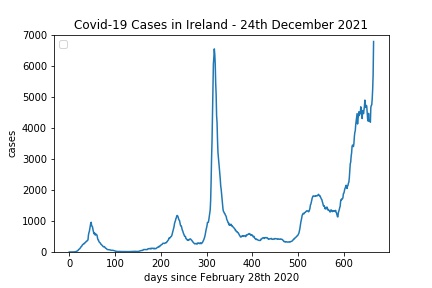
The wave now seems to be here, with 11,182 new cases reported today. That is by far the highest figure reported during the entire pandemic so far and it has dragged the 7-day average up to 6776.4 from yesterday’s figure of 5697.3.

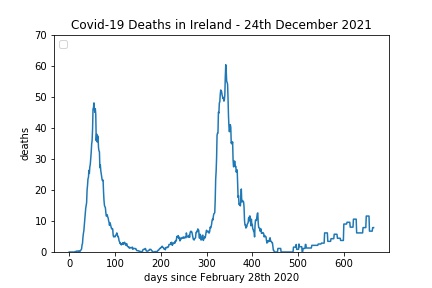
I think it’s probably true to say the worst is yet to come. So far, though, the number of hospitalizations and deaths has not increased hugely; the former has, if anything been falling, and the latter is only rising slowly:

The number of Covid-19 related deaths reported in the last week was 55, which is an average of about 7.9 per day. We won’t know until the New Year whether the latest surge will drive these curves up.

There is some good news in that the omicron variant may be less likely to lead to severe illness than the delta variant. This is non-trivial to assess because one has to allow for factors other than the infecting variant (such as age, underlying health and vaccination status)  before one can see the true effect of this one variable. Comparing sickness and mortality rates now with earlier stages of the pandemic is virtually impossible for this reason. However, because the UK has allowed very large case numbers of both delta and omicron to occur for several weeks, there is enough data to see some difference between omicron and delta in hospitalization rates.

It also seems that while a booster seems to be needed to prevent infection by omicron, a standard two-dose vaccination still seems to be effective at preventing serious illness.

There are grounds for optimism, then. The problem as I see it is that if the number of people infected with omicron goes through the roof then there will still be lots of very sick people around, some of whom will die. Say a combination of vaccination and less severe variant reduces the mortality rate per case to 10% of what it was last January, which seems reasonable. If there are ten times as many cases, the number of deaths will be similar to last January so we’re still in for a terrible New Year.

We’ll just have to wait and see. I recommend staying as drunk as possible over the next week or ten days so as to avoid thinking about it.


A Christmas Scene

Posted in Uncategorized on December 24, 2021 by telescoper

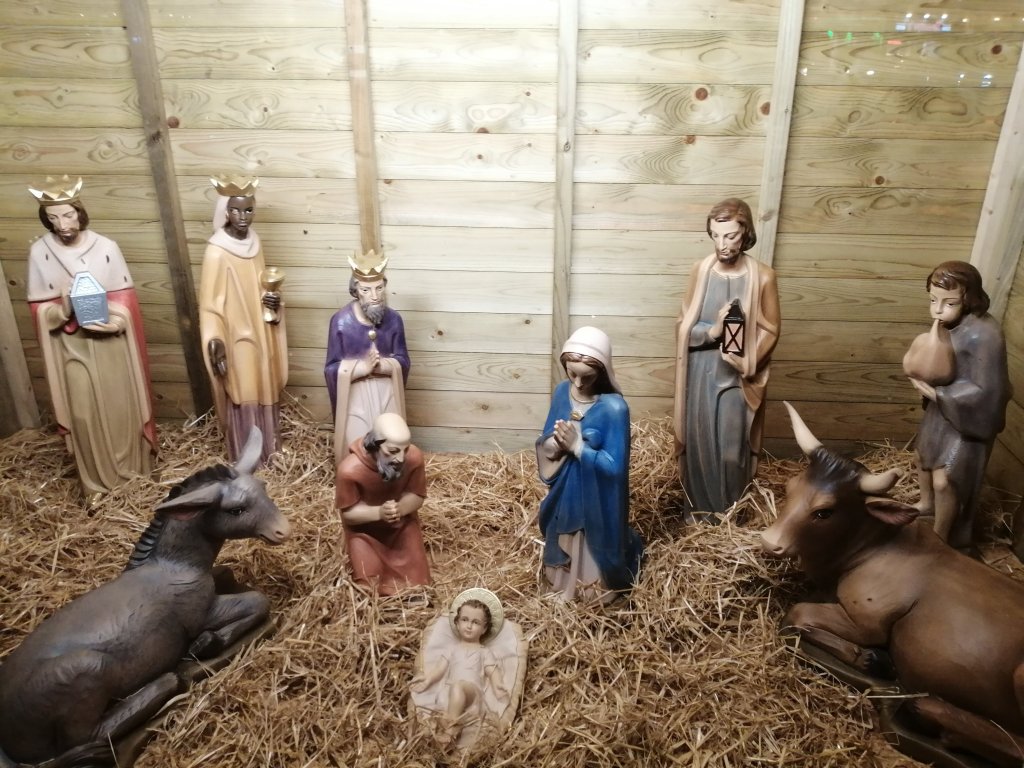
There were disturbing scenes in Maynooth today as concerned passers-by and farm animals gathered around a small child mysteriously injured by being hit on the head by a gold Frisbee.

Bird Life

Posted in Biographical, Uncategorized on December 23, 2021 by telescoper

This morning, while I was waiting for my extra special Christmas veggie box to arrive, I was watching the birds in the garden through my kitchen window. For the last several days I’ve been putting out several full feeders only to see them emptied within minutes by a sundry collection of starlings, sparrows, tits, finches, wood pigeons, a dove, and a couple of jackdaws. A rook which on several occasions tried to demolish one of the feeders (ti being too clumsy to get any food by conventional methods) seems now to have given up and merely watches angrily from a tree.

The dove (a collared dove to be precise) is a new arrival in my garden (though not at all a rare bird). It seems rather shy and quiet in behaviour, usually to be found sitting in a tree while all the smaller birds flutter and chatter around. It does seem to like the seed, but also eats the berries on the hedges. It’s a very interesting bird to look at, its grey feathers making it look rather ghostly. The wood pigeons (which are much bigger) are quite noisy but I haven’t heard the dove make any sound yet.

A number of robins also visit the garden. They’re not agile enough to use the feeders but instead patrol around at ground level collecting bits and pieces that have fallen down. One of them however has realized that my stash of food is in the shed and that my entering the shed is a prelude to good being available. The other day as soon as I went in, one particular robin followed me right inside and jumped onto the bench where I was spooning out the seed. I had spilled some, which he/she tucked into, and I gave him/her a bit more. Now the little critter is there every day waiting in the VIP lane. Whenever I open the back door to go into the garden all the other birds scatter in all directions, except the robin who doesn’t seem to be at all intimidated.

With the eventual arrival of my veggie box I have got just about everything I need for a self-indulgent holiday. The amount of food and wine I’ve laid up for myself is probably enough for a month and I thought that this afternoon’s trip to the fishmonger to collect six oysters for Christmas Eve would be my last trip to the shops before Christmas Day, but I think I’ll make one more trip to buy bird food. At the rate they’re scoffing it I’ll be out of supplies by Boxing* Day!

*”Boxing Day” isn’t really used in Ireland; the usual term is “St Stephen’s Day”


R.I.P. Thomas Kinsella

Posted in Poetry on December 22, 2021 by telescoper

The renowned Irish Poet Thomas Kinsella has passed away at the age of 93. By way of a small tribute I thought I would post again a poem by him that I first posted about 7 years ago when I had no inkling that I would move to Ireland. Probably his most famous and definitely his most anthologised work Mirror in February gives us a reflection (in more ways than one) on the inexorable and irreversible process of ageing. Kinsella actually wrote this in May 1962 when he would have been just 34 years old and probably had no idea he would live almost another sixty years. Apart from everything else this poem confirms my opinion that shaving is to be avoided…

The day dawns with scent of must and rain,
Of opened soil, dark trees, dry bedroom air.
Under the fading lamp, half dressed – my brain
Idling on some compulsive fantasy-
I towel my shaven jaw and stop, and stare,
Riveted by a dark exhausted eye,
A dry downturning mouth.

It seems again that it is time to learn,
In this untiring, crumbling place of growth
To which, for the time being, I return.
Now plainly in the mirror of my soul
I read that I have looked my last on youth
And little more; for they are not made whole
That reach the age of Christ.

Below my window the awakening trees,
Hacked clean for better bearing, stand defaced
Suffering their brute necessities,
And how should the flesh not quail that span for span
Is mutilated more? In slow distaste
I fold my towel with what grace I can,
Not young and not renewable, but man.

by Thomas Kinsella (1928-2021)

The Future of Publishing

Posted in Open Access with tags , , on December 22, 2021 by telescoper
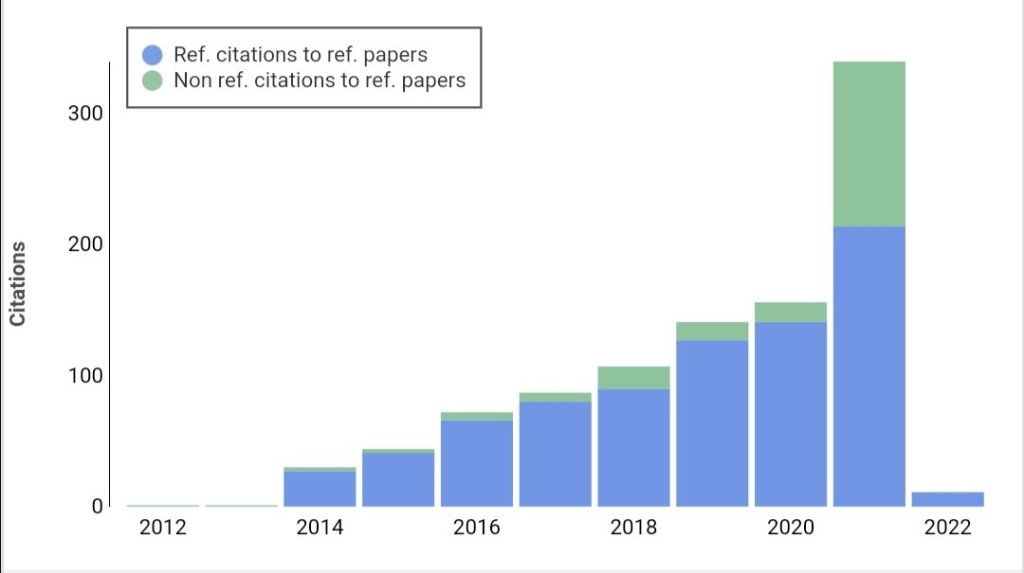
Citations to papers in the Open Journal of Astrophysics

I’ve long thought that The Open Journal of Astrophysics is ahead of its time, but when I checked the citation record via NASA/ADS the other day I found corroborating evidence in the form of citations from papers published in 2022! It’s very futuristic to be cited by papers that haven’t been published yet.

I’ve actually noticed this sort of thing before. Some journals announce publications and lodge metadata well in advance of the official publication date so the citations get tracked. At the Open Journal of Astrophysics we usually publish papers within a day or two of acceptance so this doesn’t really happen to papers cited from our articles.

Notice also there are citations going back to 2014. This might surprise you since our first papers were not published until 2016. The reason is that some papers were hanging around on the arXiv accumulating citations before we officially published them.a

That deals with the Ghosts of Citations Past and Citations Yet to Come so I feel I should mention the Present situation. According to ADS, as of today (22nd December 2021), papers in the Open Journal of Astrophysics have garnered 992 citations. That’s an average of just over 20 per paper. We might just get to a thousand before the end of the year. Now that would be a nice Christmas Present!

The Winter Solstice 2021

Posted in The Universe and Stuff with tags , , , on December 21, 2021 by telescoper

So it comes around again. The winter solstice in the Northern hemisphere happens today, Tuesday 21st December, at 15.59 Irish Time. Among other things, this means that tomorrow is the shortest day of the year in the Northern hemisphere. Days will get steadily longer from then until the Summer Solstice next June.  The  the shortest day – defined by the interval between sunrise and sunset – is today. Tomorrow will be two whole seconds longer. Make the most of it!

This does not, however,  mean that sunrise will happen earlier tomorrow than it did this morning.  Actually, sunrise will carry on getting later until the new year, the length of the day nevertheless increasing because sunset occurs even later. Sunrise yesterday morning (20th December) was at 08.37 Dublin Time while today it was 08.38; the latest sunrise will be on 29th December (08.40). Sunset last night was at 16.07 and tonight it will be at 16.08. The earliest sunset this year was actually on 13th December (16:06).

These complications arise because there is a difference between mean solar time (measured by clocks) and apparent solar time (defined by the position of the Sun in the sky), so that a solar day does not always last exactly 24 hours. A description of apparent and mean time was given by Nevil Maskelyne in the Nautical Almanac for 1767:

Apparent Time is that deduced immediately from the Sun, whether from the Observation of his passing the Meridian, or from his observed Rising or Setting. This Time is different from that shewn by Clocks and Watches well regulated at Land, which is called equated or mean Time.

The discrepancy between mean time and apparent time arises because of the Earth’s axial tilt and the fact that it travels around the Sun in an elliptical orbit in which its orbital speed varies with time of year (being faster at perihelion than at aphelion).

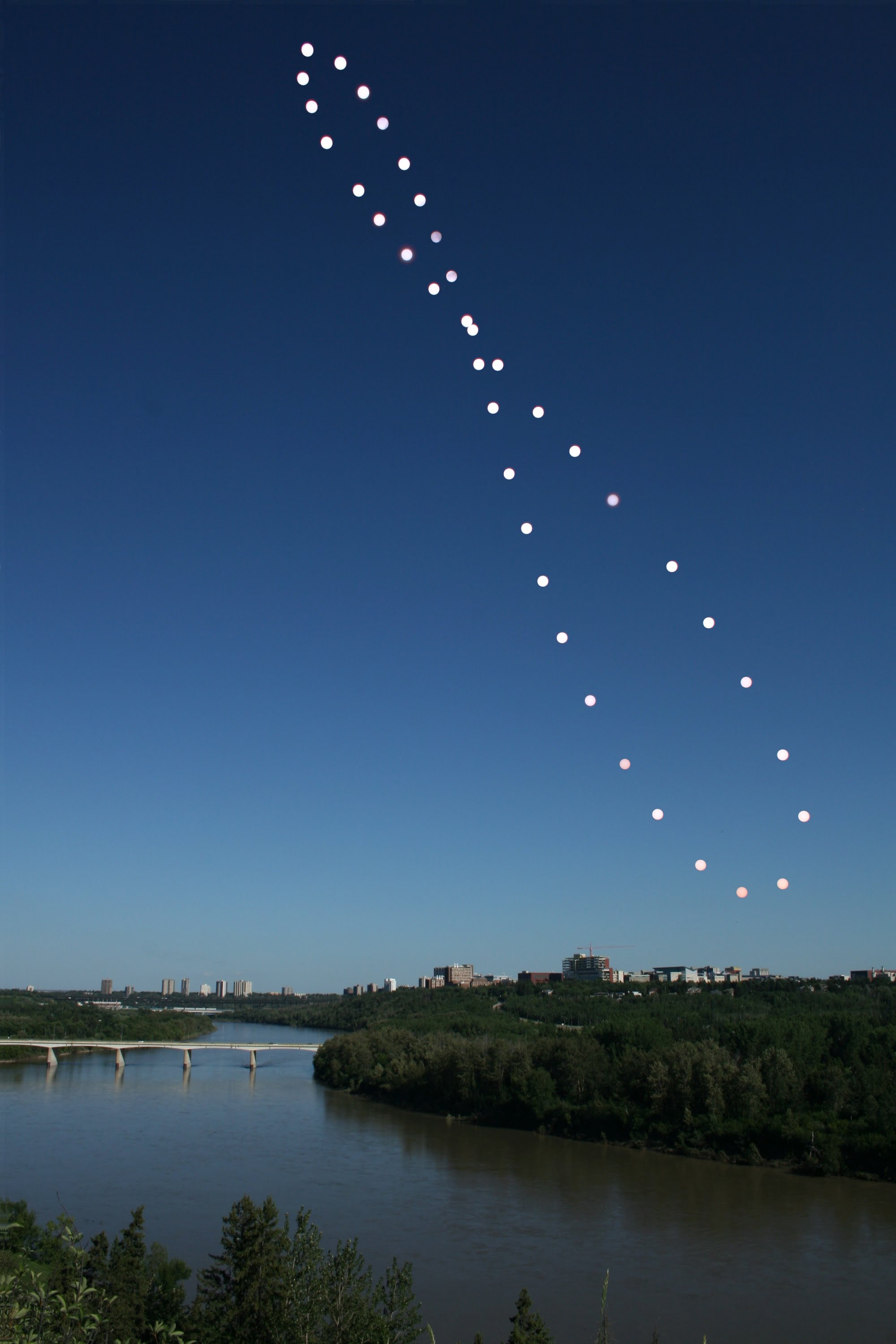
In fact if you plot the position of the Sun in the sky at a fixed time each day from a fixed location on the Earth you get a thing called an analemma, which is a sort of figure-of-eight shape whose shape depends on the observer’s latitude. Here’s a photographic version taken in Edmonton, with photographs of the Sun’s position taken from the same position at the same time on different days over the course of a year:

maxresdefault

The winter solstice is the lowermost point on this curve and the summer solstice is at the top. These two turning points define the time of the solstices much more precisely that the “shortest day” or  “longest night”.

Anyway, the north–south component of the analemma is the Sun’s declination, and the east–west component arises from the  equation of time which quantifies the difference between mean solar time and apparent solar time. This curve can be used to calculate the earliest and/or latest sunrise and/or sunset.

Using a more rapid calculational tool (Google), I found a table of the local mean times of sunrise and sunset for Dublin around the 2020  winter solstice. This shows that today is indeed the shortest day (with a time between sunrise and sunset of 7 hours 29 minutes and 57 seconds).

P.S. As usual, crowds gathered at the spectacular neolithic monument at Newgrange in County Meath to observe the sunrise at the Solstice. As usual it was cloudy.

Carúl Inis Córthaidh

Posted in Irish Language, Music on December 20, 2021 by telescoper

The Wexford Carol is a traditional Christmas song whose origin is obscure. It is often said to date from the 12th Century, or even earlier, but music historians consider it more likely to be from the 15th or 16th Century. Whatever its provenance, it’s a fascinating folk melody with a haunting, timeless quality to it.

The song is associated with Enniscorthy in County Wexford so is called in the Irish Language Carúl Inis Córthaidh or Carúl Loch Garman, Wexford being one of those towns in Ireland with an Irish name (Loch Garman) that bears no phonetic relationship whatsoever to its English name. Anyway the song is very well known and there are a lots of versions floating around, but is usually sung in English so I thought I’d post a version in Irish. Altogether now “Ó, tagaigí uile is adhraigí …”

Il Mio Tesoro – John McCormack

Posted in History, Opera with tags , , , on December 19, 2021 by telescoper

The aria Il Mio Tesoro Intanto from Act II of Mozart’s great Opera Don Giovanni is widely regarded as a test piece for Operatic tenors because of its demanding mix of long flowing lines, big leaps and florid coloratura ornamentation. The other day I heard a performance by the great Irish tenor John McCormack which, despite being recorded over a hundred years ago (in 1916) completely blew me away. I thought I’d share it here.

John McCormack made over 800 records in his lifetime, the vast majority of them Irish songs and ballads that found a huge audience not only in Ireland but also in the Irish diaspora in the United States of America; this part of his career was extremely lucrative making him a millionaire. His first love was the Opera: a lyric tenor of the highest quality, his career overlapped with that of the great Enrico Caruso and the two became great friends after McCormack moved to the United States and became a regular at the Metropolitan Opera. It was Caruso who made the first ever million-selling record (Vesti La Giubba from I Pagliacci in 1902) and perhaps that’s what persuaded McCormack to embark on a recording career.

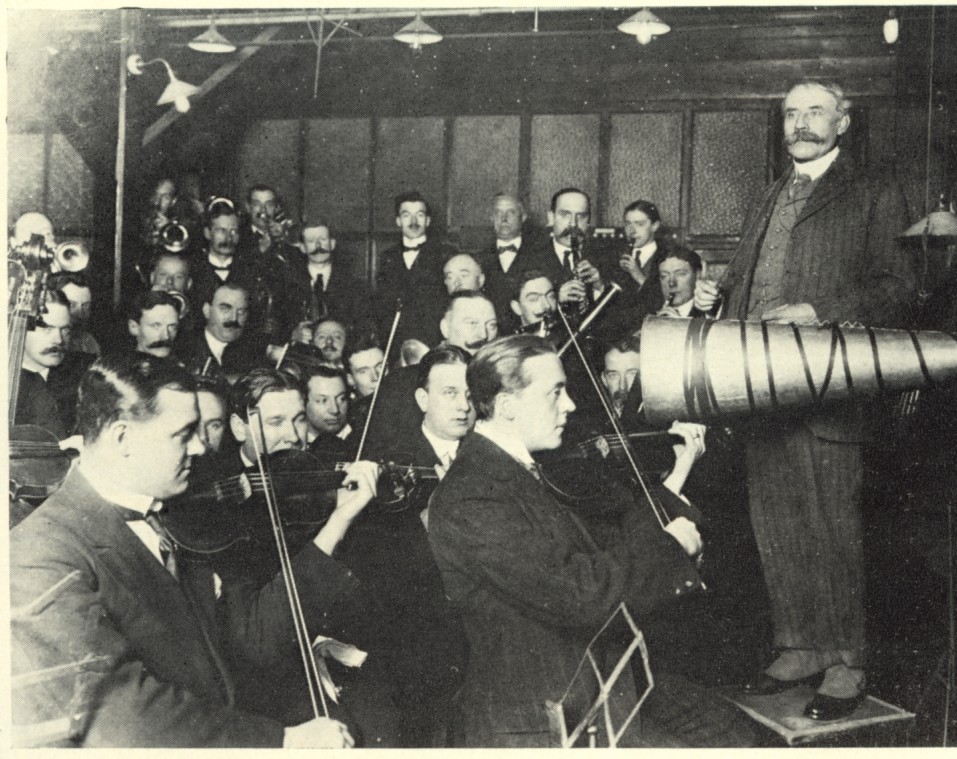
Before the 1920s gramophone recordings were entirely acoustic, made by a process exactly the reverse of a gramophone player. Musicians and singers would play into a horn at the sharp end of which was a needle that could leave an impression on the recording medium. In the early days the recording would be made on a wax cylinder, but this was soon replaced by plastic or acetate discs. It wasn’t possible to make recordings longer than a few minutes using this method.

Here’s an example of an early recording session showing what it was like. The chap with the moustache is Sir Edward Elgar:

Given this sort of arrangement it is no surprise that the sound of the Orchestra of the Met is muffled and distorted on the following recording. Almost certainly McCormack would have been standing right in front of the horn so his sizeable form would have acted as a kind of baffle. When I think of these old records it always seems a wonder that you can hear anything at all.

Despite the limitations of the recording technology the crystal clarity of McCormack’s voice and his superb control shine through. I listen to quite a lot of old jazz records made in a similar way so my ears are perhaps unusually forgiving but I think this is one of the greatest versions of this aria that I’ve ever heard – and I’ve heard quite a few. I hope you enjoy it too.

P.S. John McCormack was born in Athlone, which is about 100km due west of Maynooth.

End of Term Blog

Posted in Biographical, Covid-19, Education, Maynooth with tags , , , , , on December 18, 2021 by telescoper

Yesterday was the last day of teaching at Maynooth University for 2021 and, although I didn’t have any teaching to do, I walked to the Department partly to get a bit of fresh air having been stuck at home on Thursday after my booster jab, and partly to collect a few things before the break. I also discovered that a lovely parcel of goodies had been sent to me and I was anxious to collect the items before Christmas.

I’ll be keeping myself to myself over the break, apart from the odd trip to the shops, and am glad to be doing so. We are yet to see the steep increase in Covid-19 cases associated with the omicron variant happening in the UK and elsewhere in Europe. If anything case numbers are currently declining slowly. But the new wave will undoubtedly hit Ireland soon.

UPDATE: not half an hour after I posted this, the HSE announced 7333 new cases of Covid-19 in Ireland, more than double yesterday’s figure and the highest number seen since early January. And this is before the Christmas surge.

The jury is still out on whether omicron is more or less dangerous than previous variants but it is clearly more transmissible, and I don’t see the point of taking chances, so I agree with the Irish Government on the need to take precautions. I don’t think the latest restrictions go anywhere near far enough though.

Yesterday we received at work an email from University management that said, among other things, that

At present the aim is to resume teaching on 31 January, as in Semester 1.

The phrase “as in Semester 1” means that large lectures will be online-only but everything else will be face-to-face. That is a reasonable starting point because the extent of the omicron wave is as yet unknown, but I think it’s more likely than not that in the end we’ll find ourselves doing everything online. I just hope a decision on that is made in reasonable time for us to put Plan B into action. We don’t start lectures again until January 31st and there should be enough data by then to make an informed decision.

I don’t want to sound unduly pessimistic but I don’t see any sign that we are anywhere near the end of this pandemic. With a bit of luck we might find that we’re roughly halfway through, but as long as governments allow large pools of virus to circulate, mutations will continue to occur and new variants will continue to emerge. To end this cycle will require a majority of the world’s population to be vaccinated, and I don’t see that happening soon.