Beard of Ireland 2021 poll sees competition bristling

Posted in Beards, Biographical on March 5, 2021 by telescoper

And so it begins….

kmflett's avatarKmflett's Blog

Beard Liberation Front

Press release 5th March

Contact Keith Flett 07803 167266

BEARD OF IRELAND 2021 POLL SEES COMPETITION BRISTLING

The Beard Liberation Front, the informal network of beard wearers, has said that competition for the Irish Beard of the Year 2021 is officially open

The 2017 winner was politician Colum Eastwood who bearded broadcaster William Crawley for the annual Award.

In 2018 the DUP’s Lee Reynolds shaved writer Dominic O’Reilly for the honour with Colum Eastwood in a steady third place.

In 2019 Lee Reynolds retained the title

The 2020 winner was Maynooth academic Peter Coles

The BLF says that while traditionally a land of predominantly clean-shaven cultures, Ireland has in recent times become something of a centre for stylish and trendy beards.

Contenders for the title in 2021 include a diverse range of the hirsute- a golfer, political activists, journalists, an academic as well as the two Health…

View original post 151 more words

Seachtain na Gaeilge

Posted in Biographical, Irish Language with tags , on March 4, 2021 by telescoper

Thursdays are very busy days for me this Semester not least because I have to squeeze in my Irish language class at lunchtime in between lectures meetings and an afternoon computational physics lab.

Although learning a new language is challenging I am enjoying it very much and slowly getting the hang of it. I find the pronunciation rather difficult. Today we encountered the difference between the broad “c” and the slender “c” which I found indistinguishable at first hearing, but figured it out well enough to get all the questions correct on the listening test. It’s basically a slight difference in the position of the back of your tongue against the palate.

Another thing in Irish that takes some getting used to is that many words contain a string of vowels, not all of which are pronounced. At least part of the reason for that is that vowels next to consonants are often only there in order to tell you how to pronounce the consonant rather than being voiced themselves.

In today’s class we also learned how to ask such questions as Cé as tú? (which means “where are you from?”) and during the course of that we learned the Irish form of some names of countries. Interestingly some countries, such as France (An Fhrainc), have an article in front whereas others, such as England (Sasana) do not. I also learned that the Irish word for Wales is An Bhreatain Bheag which translates literally as “Little Britain”. I’m not sure the Welsh will be best pleased to learn that…

Anyway, from now until St Patrick’s Day is Seachtain na Gaeilge an annual festival of the Irish language and culture during which we are all encouraged to use our Irish language skills, however limited.

Here is the President of Ireland Michael D. Higgins introducing this year’s Seachtain na Gaeilge.

[twitter_follow screen_name=’telescoper’]

R.I.P. Chris Barber (1930-2021)

Posted in Biographical, Jazz with tags , , on March 3, 2021 by telescoper

I just saw the news that British trombonist and bandleader Chris Barber passed away yesterday at the age of 90. Chris Barber was one of the leading lights of the traditional jazz boom of the 1950s and 60s, during which he led a very fine band including trumpeter Pat Halcox and clarinetist Monty Sunshine among others.

I was fortunate to meet Chris Barber on a couple of occasions at Jazz festivals and he struck me as a really nice man as well as an excellent musician: very friendly and cooperative even with a young student wanting to do an interview for a college magazine. An interesting factoid about him is that he was a very fluent speaker of German and his band toured Germany frequently, even performing in East Berlin in 1965; you can see a recording of that concert here.

I was trying to think of a track to put up as tribute and decided on this one because it allows me to answer a question I asked on this blog a couple of years ago. When I was at school I used to listen to Sounds of Jazz a BBC2 Radio 2 programme presented on Sunday evenings by Peter Clayton. I always used to switch over from John Peel when Sounds of Jazz started and would always listen all the way through. It always ended with this track, a lovely version of an old blues tune called Snag It which I think was written by King Oliver.

R.I.P. Chris Barber (1930-2021).

Hawking and the Mind of God

Posted in Books, Talks and Reviews, Science Politics, The Universe and Stuff with tags , , , , , on March 3, 2021 by telescoper

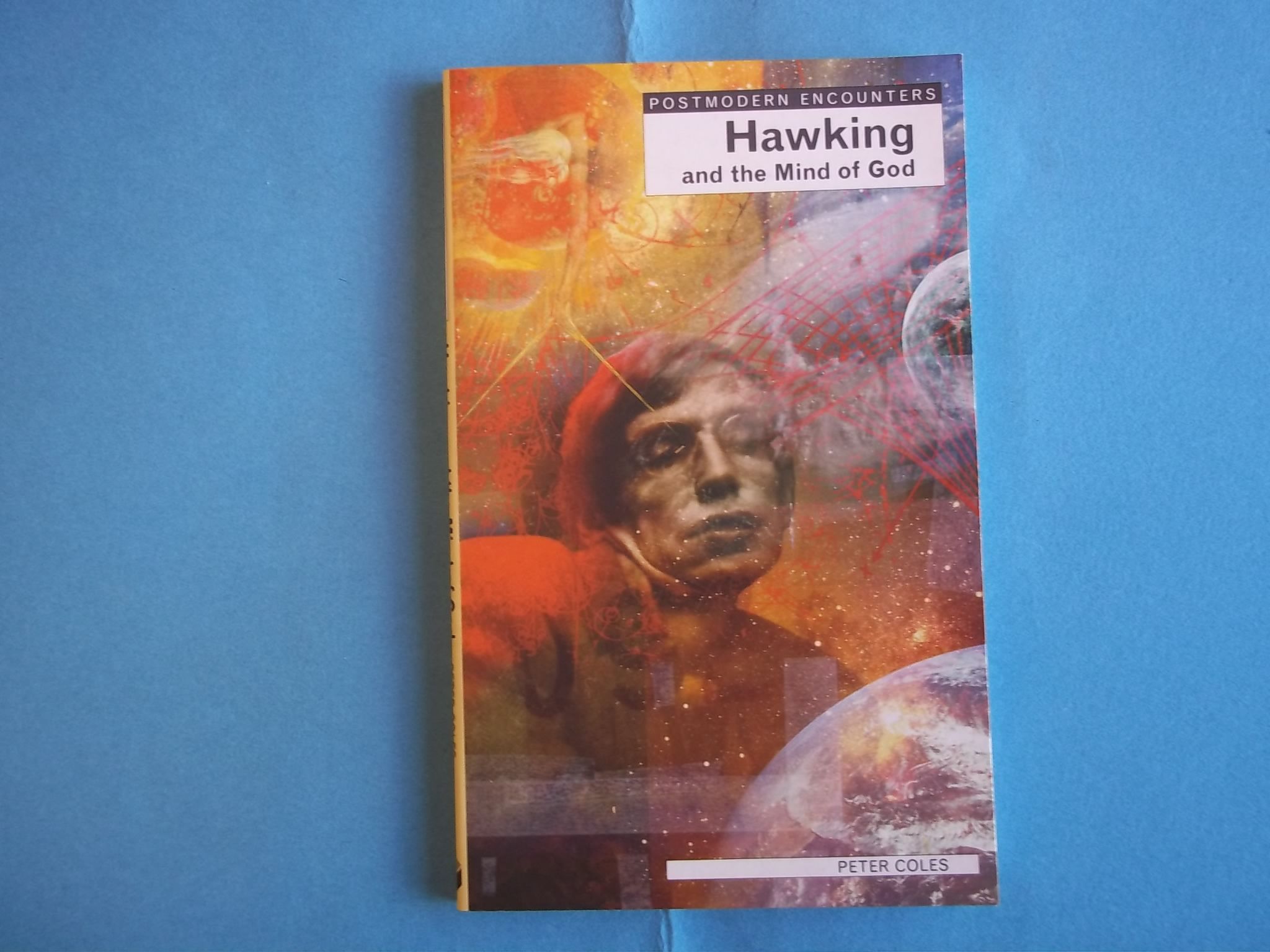
There’s a new book out about Stephen Hawking which has triggered a certain amount of reaction (see, e.g., here) so I thought I’d mention a book I wrote, largely in response to the pseudo-religious nature of some of Hawking’s later writings.

I have in the past gone on record, both on television and in print, as being not entirely positive about the “cult” that surrounds Stephen Hawking. I think a number of my colleagues have found some of my comments disrespectful and/or churlish. I do nevertheless stand by everything I’ve said. I have enormous respect for Hawking the physicist, as well as deep admiration for his tenacity and fortitude, and have never said otherwise. I don’t, however, agree that Hawking is in the same category of revolutionary thinkers as Newton or Einstein, which is how he is often portrayed.

In fact a poll of 100 theoretical physicists in 1999 came to exactly the same conclusion. The top ten in that list were:

  1. Albert Einstein
  2. Isaac Newton
  3. James Clerk Maxwell
  4. Niels Bohr
  5. Werner Heisenberg
  6. Galileo Galilei
  7. Richard Feynman
  8. Paul Dirac
  9. Erwin Schrödinger
  10. Ernest Rutherford

The idea of a league table like this is of course a bit silly, but it does at least give some insight into the way physicists regard prominent figures in their subject. Hawking came way down the list, in fact, in 300th (equal) place. I don’t think it is disrespectful to Hawking to point this out. I’m not saying he isn’t a brilliant physicist. I’m just saying that there are a great many other brilliant physicists that no one outside physics has ever heard of.

It is interesting to speculate what would have happened if the list had been restricted to living physicists. I’d guess Hawking would be in the top ten, but I’m not at all sure where…

And before I get accused of jealousy about Stephen Hawking’s fame, let me make it absolutely clear that if Hawking was like a top Premiership footballer (which I think is an appropriate analogy), then I am definitely like someone kicking a ball around for a pub team on a Sunday morning (with a hangover). This gulf does not make me envious; it just makes me admire his ability all the more, just as trying to play football makes one realise exactly how good the top players really are.

I am not myself religious but I do think that there are many things that science does not – and probably will never – explain, such as why there is something rather than nothing. I also believe that science and religious belief are not in principle incompatible – although whether there is a conflict in practice does depend of course on the form of religious belief and how it is observed. God and physics are in my view pretty much orthogonal. To put it another way, if I were religious, there’s nothing in theoretical physics that would change make me want to change my mind. However, I’ll leave it to those many physicists who are learned in matters of theology to take up the (metaphorical) cudgels with Professor Hawking.

Anyway, this is the book I wrote:.

And here is the jacket blurb:

Stephen Hawking has achieved a unique position in contemporary culture, combining eminence in the rarefied world of theoretical physics with the popular fame usually reserved for film stars and rock musicians. Yet Hawking’s technical work is so challenging, both in its conceptual scope and in its mathematical detail, that proper understanding of its significance lies beyond the grasp of all but a few specialists. How, then, did Hawking-the-scientist become Hawking-the-icon? Hawking’s theories often take him into the intellectual territory that has traditionally been the province of religion rather than science. He acknowledges this explicitly in the closing sentence of his bestseller, A Brief History of Time , where he says that his ultimate aim is to know the Mind of God . Hawking and the Mind of God examines the pseudo-religious connotations of some of the key themes in Hawking’s work, and how these shed light not only on the Hawking cult itself, but also on the wider issue of how scientists represent themselves in the media.

I’m sure you’ll understand that there isn’t a hint of opportunism in the way I’m drawing this to your attention because my book is long out of print so you can’t buy it unless you get a copy second-hand…

Postgraduate Programmes in Theoretical Physics at Maynooth University

Posted in Education, Maynooth, The Universe and Stuff with tags , , on March 2, 2021 by telescoper

We have a (virtual) Postgraduate Open Day coming up on Tuesday 9th March at Maynooth University (for which you can register here). To go with that here is a short video of our new Postgraduate Coordinator Dr John Regan answering some frequently asked questions about the programmes we offer in the Department of Theoretical Physics:

If you have any other questions then you can register for the Open Day where we will have staff on hand to answer them in a live Q&A session.

You could also follow the Department’s Twitter feed here:

The Joy of Rollmops

Posted in Biographical, Maynooth with tags , , on March 2, 2021 by telescoper

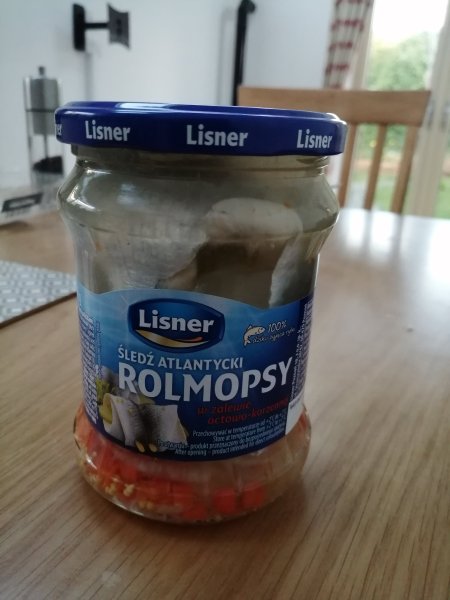
The other day I had a bit of a craving for pickled herring which, in the form of rollmops, is something I’ve liked since I was a kid but rediscovered on a trip to Denmark many years ago where sild on lovely rugbrød with a peberrod sauce became one of my favourite light meals. Pickled herring doesn’t seem to be so popular in Ireland but fortunately it is popular with folk from countries around the Baltic Sea, including Poland, and in Maynooth there is a very nice little Polish mini-market where I found a wide variety of pickled herrings with different kinds of marinade.

In the course of this discovered what the Polish word for rollmops is:

For some reason I had always assumed that “rollmops” was an English word but in fact it is of German origin and Rollmops is actually singular (the plural is Rollmöpse).

In the shop I also bought some rye bread and horseradish to go with the fish. In fact the little shop is full of lovely produce and, although yesterday was the first time I’ve been inside, I’m sure to be a regular visitor in future.

I know some people don’t like pickled herring at all but I love it. In fact I think it’s tanginess makes it an ideal starter and I’ve often served it as such when I’ve had guests for dinner. The bonus is you don’t need to cook it!

A Poem for St David’s Day

Posted in Poetry with tags , , , on March 1, 2021 by telescoper

It’s St David’s Day today, and a lovely spring morning it is too, so I wish you all a big

Dydd Gŵyl Dewi Hapus!

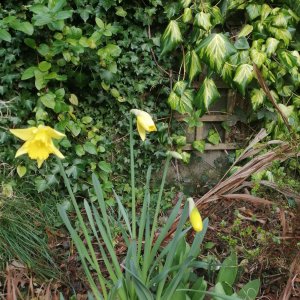
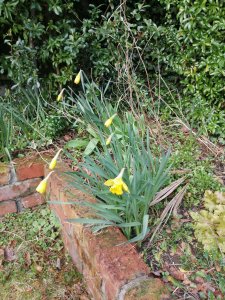
The daffodils in my garden have come out in celebration, apart from the clump under the tree which are reluctant to emerge:

It has become a bit of a St David’s Day tradition on this this blog to post a piece of verse but instead of the more usual R.S. Thomas I thought I’d carry on with the theme of daffodils with this wonderfully moving poem by Gillian Clarke inspired by Wordsworth’s famous poem and called Miracle on St David’s Day:

‘They flash upon that inward eye
Which is the bliss of solitude’

The Daffodils by W. Wordsworth

An afternoon yellow and open-mouthed
with daffodils. The sun treads the path
among cedars and enormous oaks.
It might be a country house, guests strolling,
the rumps of gardeners between nursery shrubs.

I am reading poetry to the insane.
An old woman, interrupting, offers
as many buckets of coal as I need.
A beautiful chestnut-haired boy listens
entirely absorbed. A schizophrenic

on a good day, they tell me later.
In a cage of first March sun a woman
sits not listening, not seeing, not feeling.
In her neat clothes the woman is absent.
A big, mild man is tenderly led

to his chair. He has never spoken.
His labourer’s hands on his knees, he rocks
gently to the rhythms of the poems.
I read to their presences, absences,
to the big, dumb labouring man as he rocks.

He is suddenly standing, silently,
huge and mild, but I feel afraid. Like slow
movement of spring water or the first bird
of the year in the breaking darkness,
the labourer’s voice recites ‘The Daffodils’.

The nurses are frozen, alert; the patients
seem to listen. He is hoarse but word-perfect.
Outside the daffodils are still as wax,
a thousand, ten thousand, their syllables
unspoken, their creams and yellows still.

Forty years ago, in a Valleys school,
the class recited poetry by rote.
Since the dumbness of misery fell
he has remembered there was a music
of speech and that once he had something to say.

When he’s done, before the applause, we observe
the flowers’ silence. A thrush sings
and the daffodils are flame.

A Year of Covid-19 in Ireland

Posted in Biographical, Covid-19, Maynooth, Politics with tags , , on February 28, 2021 by telescoper

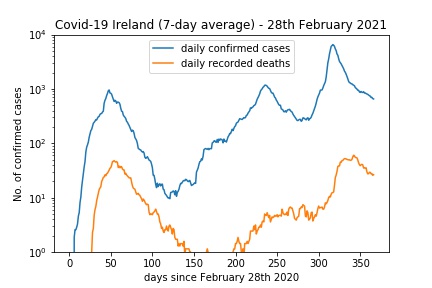
Last night I was updating my Covid-19 statistics and plotting new graphs (which I do every day – the results are here) when I noticed that I now have 365 data points. The first officially recorded case of Covid-19 in Ireland was dated 29th February 2020 (although there is evidence of cases in Ireland before that, including one of community transmission). I can’t actually mark the anniversary of that date exactly – for obvious reasons – but it seems a good point to look at what has happened. I didn’t actually start doing a daily update until 22nd March when we were all in the first lockdown but there were relatively few cases in the intervening time and it was possible quite easily to fill in the earlier data.

Little did I know that I would be doing an update every day for a year!

Anyway, here are today’s plots:


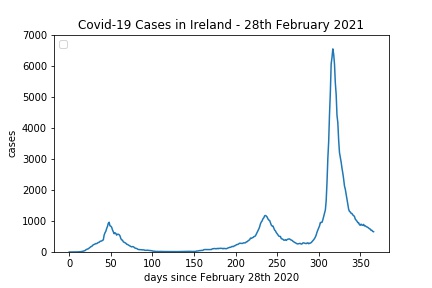
On a linear y-axis the cases look like this:


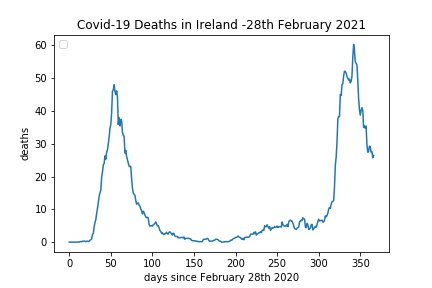
The numbers for deaths on a linear scale look like this:


The recent trend is for a slow decline in new cases, hospitalizations, ICU referrals and testing positivity rates which is all good news. The rate of vaccination- severely limited by supply issues – is starting to increase and from April to June is expected to reach a million a month and then two million a month thereafter. There is therefore some grounds for optimism that a significant fraction of the population will be immunized by the end of the summer, assuming the supply ramps up as expected and there are no more dirty tricks from certain pharmaceutical companies.

Comparing with the situations elsewhere I’d say that Ireland has in broad terms handled the pandemic quite well: worse than some (especially Scandinavian countries) but better than many. It does seem to me that there have been three serious errors:

  1. There has never been – and still isn’t – any sensible plan for imposing quarantine on arrivals into Ireland. A year on one is being put in place but it is simply ridiculous that an island like Ireland failed to do this earlier.
  2. Those lockdown measures that have been imposed have been very weakly enforced, and have often been accompanied by confused messaging from the Government, with the result that a significant minority of people have simply ignored the restrictions. The majority of the population has complied but the others that haven’t have kept the virus in circulation at a high level: the current daily rate of new cases is 650-700, which is far too high, and is declining only slowly.
  3. Finally, and probably the biggest mistake of all, was to relax restriction for the Christmas holiday. The huge spike in infections and deaths in January and February is a direct result of this catastrophic decision for which the Government is entirely culpable.

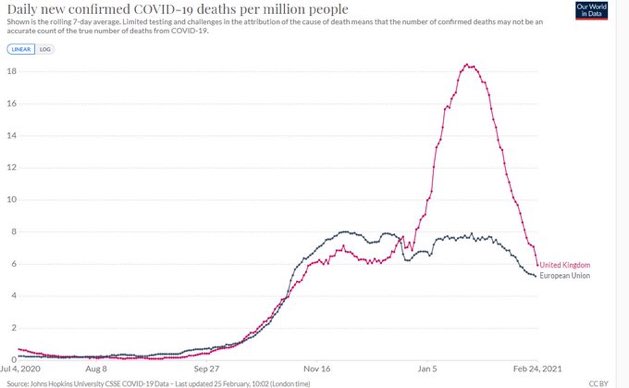
The situation in the United Kingdom with regard to 3 was even worse:

The excess mortality from January is a direct consequence of Boris Johnson “saving Christmas”. The difference in area under the two curves tells you precisely how many people he killed. I hope politicians on both sides of the Irish Sea are one day held to account for their negligence.

As for myself, I am reasonably optimistic for the future, and not just because Spring appears to have arrived. I have found the Covid-19 restrictions very irksome but I am fortunate to be in a position to cope with them reasonably well, especially now that I have my own house with a garden in a nice quiet neighbourhood.

It has been very hard work doing everything online, and it’s essential to take a break from the screen from time to time, but the upside of that is that by keeping busy you avoid becoming bored and frustrated. One thing that does annoy me though is the number of people who thinking that “working from home” means “not working at all”. I’m sure there are many others, especially in the education sector, who will agree with me!

Although I have coped reasonably well in a personal sense I still very much want to get back to campus to resume face-to-face teaching. I like talking to students and find teaching much more rewarding when there is a response. Moreover, since we’re now going to be off campus until the end of this academic year, that means that a second cohort of students will complete their degrees and graduate this summer without their lecturers being there to congratulate them in person and give them a proper sendoff into the big wide world. I find that very sad.

Anyway, tomorrow we start week 5 of the Semester, which means 4 weeks have passed. That means there are two weeks before the Study Break, the halfway point of teaching term, and we are one-third of the way through the semester. Life goes on.

The Reason I’m Alive

Posted in Biographical, LGBTQ+ with tags , , , on February 27, 2021 by telescoper

For a variety of reasons I’ve always considered myself to have been exceptionally lucky, but last week I got news that increased still further the extent of this sense of good fortune. I hesitated before putting anything about this on here because it is rather personal and there are details I’m going to leave out about how I came by the information.

Over a month ago I posted some thoughts about the TV series It’s A Sin based on my own experiences back in the 1980s. That post ended with this:

… a question that often troubles me returned once again to my mind: why am I still alive, when so many people I knew back then are not?

In response to this a former colleague of mine suggested I get my DNA sequenced to see if I had any innate resistance to HIV infection. I wasn’t sure how to go about doing this but one of the advantages of having worked in several different universities is that I know people in several bioscience and biomedical departments, including people who work on the data science aspects of genetics. After emailing around for advice I eventually ended up talking to a very distinguished scientist in that field to whom I explained the situation.

Since I didn’t really want to have a copy of my entire genome sequence – that’s a lot of data most of which I wouldn’t understand – but just wanted to know the answer to one question it seemed a waste of money to have this done commercially (although at around €1000 it’s not enormously expensive). Instead a plan emerged in which I would offer my (suitably anonymized) DNA as part of a scientific study in return for the small piece of information I wanted.

After a few days I received a kit for taking oral swabs, a medical questionnaire and quite a lot of paperwork to do with ethical considerations and data protection. I sent everything back by return post. Last week the results came back. There was some general info about my genetic make-up – which shows a considerable dollop of Scandinavian ancestry – alongside the answer the question I had asked.

The full DNA sequence of my genome reveals that I have the CCR5-Δ32 genetic mutation. Not just that. I have it twice (i.e. it’s homozygous), which means that I inherited it from both parents.

Of order 1% of the European population has this mutation, which is thought to have arisen in a single Scandinavian individual at some stage during the Viking era and subsequently propagated through mainly Northern Europe where about 10% have one copy, and about 1% have two.

Here is a map of the geographical distribution in Europe (from this paper) :

It’s nowhere near as prevalent in Asia or African populations.

So what does this mean?

Heterozygotic CCR5-Δ32 (i.e. one mutated gene) confers some protection against HIV infection but the homozygotic CCR5-Δ32 mutation involving both copies confers virtually total immunity. I was terrified of AIDS in the 1980s but it turns out I was immune all the time without knowing it. This explains why to my great surprise the HIV test I took in the 1980s came back negative despite my sexual history and behaviour.

As a friend told me when I passed this news on: “you’re a f**king lucky bugger”. Indeed I am. I already considered myself to have been very lucky but this absolutely takes the biscuit.

P.S. My immediate “reward” for having this genetic peculiarity is to take part in further scientific study on it, which I am of course very happy to do.

Particle Physics Masterclass at Maynooth

Posted in Education, Maynooth, The Universe and Stuff with tags , , on February 26, 2021 by telescoper

I have already informed you of a Masterclass in Astrophysics & Cosmology at Maynooth that will take place on March 25th 2021. For more information on that event including instructions on how to book see here.

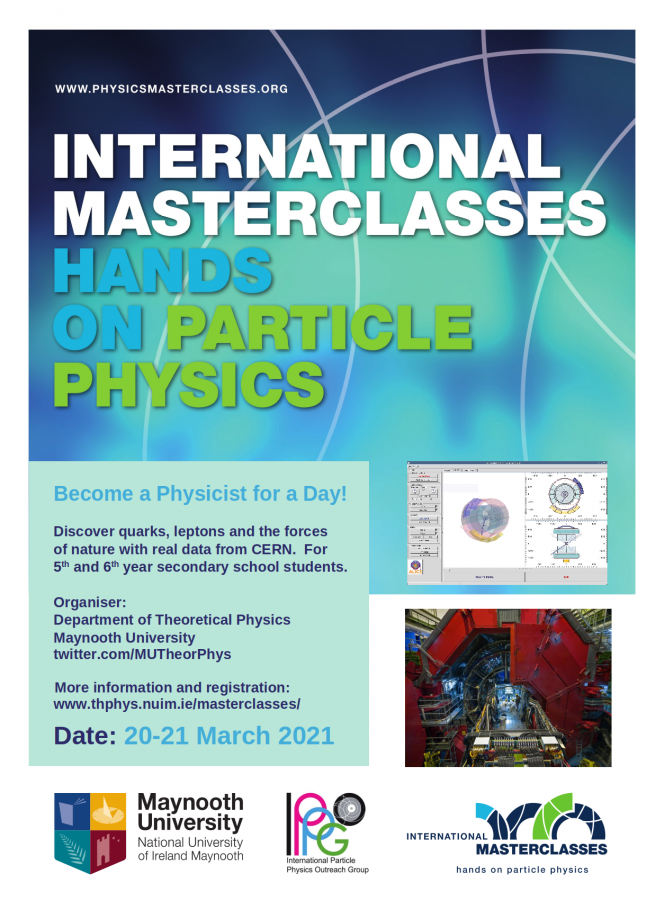
Now it’s time to announce the International Masterclass on Particle Physics. The  Department of Theoretical Physics has hosted such event for secondary school students each Spring, apart from last year when it was cancelled because of Covid-19.  The next event will take place online on 21 and 22 March 2021. You can find more information, including instructions on how to book a place, here.

These Masterclasses give secondary school students the opportunity to discover the world of quarks and leptons for themselves, by performing measurements on real data from CERN, meeting active particle physics researchers and linking up with like-minded students from other countries.  We will join thousands of other secondary school students at more than 100 universities and laboratories around Europe and worldwide in a programme stretching over four weeks.

Physics at the most fundamental level – the smallest and most basic building blocks of matter – is an exotic world.  But a few introductory talks and working with data from CERN will give the students insight into the fundamental particles of matter and the forces between them, as well as what went on during the Big Bang.

On Sunday afternoon, the students are introduced to particle physics, experiments and detectors in lectures given by active particle physics researchers.  On Monday, after a virtual visit to the ALICE detector at CERN, they work on their own with data from ALICE Afterwards they participate in a video conference with students from other countries and moderators at CERN, where they discuss and compare their results.

For more information on the Particle Physics Masterclasses, see the International Masterclasses web site.

I don’t know. You wait ages for a Masterclass in Physics at Maynooth University, and then along come two in quick succession!