R.I.P. Ennio Morricone (1928-2020)

Posted in Film, Music with tags , , on July 6, 2020 by telescoper

I heard the sad news this morning that legendary composer Ennio Morricone has passed away at the age of 91. Morricone will be remembered not only for the music he himself created for films but on the huge influence he had on other composers and indeed on cinema generally.

I’ve posted this piece before but I make no apology for posting it again as a tribute to the Maestro. It’s the climactic final shoot-out from Sergio Leone’s iconic Spaghetti Western* The Good The Bad And The Ugly, featuring Clint Eastwood, Lee Van Cleef and Eli Wallach, respectively, together with superbly innovative (and very complex) music on the soundtrack from Morricone. It was the guitarist Alessandro Alessandroni (who also did the whistling on the soundtrack) producing that unforgettable twangy sound with a hint of scordatura. I also think this is the first time any film composer had used gunshots as part of the score…

*These films are way better than was generally appreciated at the time of their release.

Update: I just love this response to an efflux of babble…

Memories of Italia 90

Posted in Biographical with tags , , , , , , , on July 5, 2020 by telescoper

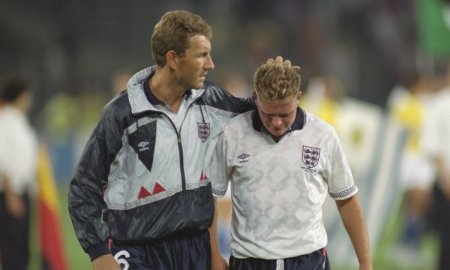
Twitter reminded me that 30 years ago yesterday (4th July 1990) was the date of the semi final between England and Germany in the 1990 World Cup, an event remembered by most people for Gazza’s tears. Paul Gascoigne cried before England lost (on penalties) because he picked up a yellow card which meant he wouldn’t play in the final even if England got through. As it happened, England lost so none of the England players played in the World Cup Final.

My memories of Italia 90 have somewhat different focus. I travelled to Italy on 1st July 1990 to attend a cosmology conference/workshop in a place called Sesto Pusteria in the region known as Trentino-Alto Adige/Südtirol (South Tyrol). Sesto is a village, set in the Italian Dolomites, primarily a ski resort in the winter but used for conferences in the summer when there is no snow.

I think it was only my second trip to Italy and I had been learning some Italian on the flight. My plane was supposed to land in Venice whence a bus would take conference guests up to Sesto. Unfortunately my flight was diverted to land at Treviso. I missed the bus and decided to stay overnight in a hotel and travel under my own steam the next day.

I found a hotel in Treviso and that night I watched the quarter final between Cameroon and England on my own on the television in my room.

I got up early the next morning and with the aid of the railway timetable supplied by the hotel reception, I set out on a long journey by train. There might have been a quicker way by bus but I was more comfortable doing it by train and was actually looking forward to a bit of exploration.

The route involved four different trains: Treviso to Mestre, then Mestre to Verona, then Verona to Bolzano, then a local (very slow) train from Bolzano up into the mountains to San Candido. The last leg was a little bus from San Candido to Sesto Pusteria. It took me most of the day to get there but I made it without any real difficulty.

I did notice however that on the way there the style of buildings I could see changed from very Italian to very Austrian.

Anyway I arrived in Sesto Pusteria (which is a small place) and found the name of the hotel I was booked in which was Bellavista. I wandered about looking for it – there was no Google Maps in those days – but failed. I did however find the conference centre where the meeting was located. I went in and asked in broken Italian Prego, Dov’è l’hotel Bellavista?

The answer came back in perfect English with a hint of a German accent. It’s down the road on the right, about 50 metres. It’s easy to find because the outside is all white. I was puzzled because I must have walked right past it. Anyway I walked back to down the road and found a hotel with a white exterior. The sign said Hotel Schönblick…

It turned out that my meagre Italian was of no use at all because the locals all spoke German. The South Tyrol has historically been part of Austria. It was annexed by Italy at the end of the First World War and the present border is just a few km from Sesto Pusteria. Attempts to assign Italian names to things however have been only partly successful.

So I made it to the conference, a day late. There weren’t any mobile phones in those days so I’d been unable to contact the organisers so they were quite relieved when I eventually showed up.

And so I saw both semi finals of Italia 90 at the conference: Italy lost theirs against Argentina and England lost on penalties.

After the workshop I travelled with a colleague by car to Trieste to work on a collaboration. During that I remember watching the 3rd/4th playoff (‘Piccolo Finale’) on a big screen from a bar in a public square in Trieste. Italy won that (deservedly). I think I watched the final too, but can remember little about it.

The Joy of Penguin Faeces

Posted in The Universe and Stuff with tags , , , on July 4, 2020 by telescoper

Last night my attention was drawn to an important article on the ArXiv in the domain of biophysics. The title is Projectile Trajectory of Penguin’s Faeces and Rectal Pressure Revisited*.

Here is the abstract:

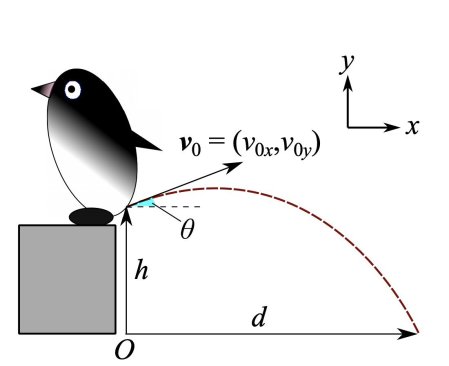
We discuss a trajectory of penguins’ faeces after the powerful shooting due to their strong rectal pressure. Practically, it is important to see how far faeceses reach when penguins expel them from higher places. Such information is useful for keepers to avoid the direct hitting of faeceses. We estimate the upper bound for the maximum flight distance by solving the Newton’s equation of motion. Our results indicate that the safety zone should be 1.34 meters away from a penguin trying to poop in typical environments. In the presence of the viscous resistance, the grounding time and the flying distance of faeces can be expressed in terms of Lambert W function. Furthermore, we address the penguin’s rectal pressure within the hydrodynamical approximation combining Bernoulli’s theorem and Hagen-Poiseuille equation for viscosity corrections. We found that the calculated rectal pressure is larger than the estimation in the previous work.

That is amusing enough (though admittedly the English isn’t great) but the diagrams are an absolute joy!

*In case you’re wondering about the “revisited” at the end of the title, the authors of the present work present a critique of earlier work by Meyer-Rochow & Gal (2003) in which “the projectile trajectory of the faeces is not taken into account”. This previous paper was awarded the Ignobel Prize in 2005.

One should not pooh-pooh research on this topic and now that we have got to Number Two I for one hope for the speedy production of further outputs in this area.

Excess Deaths due to Coronavirus: Compare and Contrast

Posted in Covid-19, Politics with tags , , on July 3, 2020 by telescoper

I saw an interesting news item this morning about excess deaths registered in Ireland between 11th March and 16th June, the period that brackets the peak of the Covid-19 pandemic.

According to the official numbers, 1709 deaths occurred during that time of people who had tested positive for the Coronavirus. During the same period, however,  about about 1100-1200 deaths were registered in excess of the average mortality figures.
One interpretation of this discrepancy is that many of those counted as Covid-19 cases actually died of other causes. Consistent with that interpretation is the fact that over 60% of those deaths were people in care homes, many of whom may have had chronic illness.

Taking 1150 as an estimate of the excess deaths caused by Covid-19 the mortality per million in Ireland drops from 352 to about 237. It must be noted that this figure is still much higher than similar-sized countries such as Denmark and Norway.

The contrast with the United Kingdom is stark. A recent analysis of excess deaths there suggests about 69,000 people have lost their lives directly or indirectly due to Covid-19, which is about 57% higher than the official figure of around 44,000. Taking 69,000 instead of 44,000, the United Kingdom’s mortality rate increases from 647 per million to over a thousand.

I haven’t really been following the reporting in the United Kingdom very closely, because I don’t live there anymore, but the data on new cases found by testing is hopelessly confusing. This, together, with the apparent under-reporting of deaths, may be the reason behind the lax adherence to public health measures over the other side of the Irish Sea.

There is also the fact that daily Covid-19 briefings here in Ireland are led by medical experts, with the politicians taking a back seat (and often not involved at all). These are much more likely to be trusted than politicians, especially those involved in the current Tory government.

Thank you, Tony

Posted in Covid-19 with tags on July 2, 2020 by telescoper

As Ireland’s Chief Medical Officer, Dr Tony Holohan has been constantly in the public eye during the Covid-19 outbreak. At the daily press briefings he has impressed with his authoritative and frank delivery. During this time he has come across not only as a leading health expert, but as a good honest man and a dedicated public servant. His personal qualities have done much to win the confidence of the public in the battle against the Coronavirus.

Today I learnt that throughout this period Dr Holohan had also been caring for his wife, who is very ill with cancer, and their two young children. I have no idea how he managed to carry out his public role, which must have been onerous in itself, so professionally while carrying such a heavy additional burden in private.

Now his wife has gone into palliative care, and he has taken the decision to stand down from his job in order to be with her and their family.

All I can do is add a small voice to the many others saying a heartfelt “thank you” to Dr Tony Holohan for service far beyond the call of duty, and send my best wishes for the challenges ahead.

Football Roundup

Posted in Football with tags , , on July 2, 2020 by telescoper

By way of a diversion this lunchtime after a morning of Microsoft Teams, I thought I’d comment briefly on another kind of team, by looking at the state of play in the Premier League.

Liverpool of course deservedly won the title last weekend when Manchester city lost to Chelsea. To have won the Premiership with seven games left to play is a remarkable achievement. All credit to their excellent manager Jürgen Klopp, who actually seems a thoroughly decent fellow as well. Although based in the English Midlands, Liverpool have a strong following here in Ireland so there were many celebrations here when the Premiership race was sealed.

The absence of any football for many weeks at least removed one usual cause of springtime stress, namely Newcastle United’s struggle to avoid relegation. Since the return, however, Steve Bruce’s team have done pretty well, with seven points out of a possible nine, though they did get knocked out of the FA Cup. Last night they beat struggling Bournemouth 4-1 away from home which leaves them on 42 points with six games left to play. They’re not mathematically safe from relegation but it’s very difficult to see any of the bottom three teams getting more than 15 points from their remaining games so I think relegation is extremely improbable. Norwich look relegation certainties, but who will go down with them? Based on last night’s poor performance at home, I’d say probably Bournemouth and one other.

The Bookies odds at the moment are:

  • Norwich: 1/100.
  • Bournemouth: 1/6.
  • Aston Villa: 1/4.
  • Watford: 2/1.
  • West Ham: 6/1.
  • Brighton: 28/1.

Watford or West Ham might be worth a bet. There are still six games to be played, after all.

I’ve only seen bits and pieces of the games since the season restarted. Playing in an empty stadium makes football very strange to watch, and the artificial crowd noises make it even stranger. It problem reduces home advantage not having supporters in the ground, but I haven’t looked at the statistical evidence whether or not this is the case..

It’s worth mentioning the situation in League 1:

Here the season has been declared closed. Wycombe Wanderers finish in third on the basis of points per game despite having fewer points than the team in fourth. Wycombe’s 35th game would have been against Coventry…

I’ll just mention in passing that Sunderland will not be promoted. Tragic.

The Open Journal of Astrophysics & INSPIRE

Posted in Open Access, The Universe and Stuff with tags , , , , on July 1, 2020 by telescoper

After a busy morning I’ve got time for an update or two about the Open Journal of Astrophysics.

As well as the NASA Astrophysics Data System (ADS) many papers in astrophysics are also indexed by INSPIRE HEP the analogous information management system for high energy physics. Here is the logo for the latter:

Being indexed in INSPIRE  is particularly relevant for authors of papers in astroparticle physics and cosmology, but papers in other areas of astrophysics are also listed on INSPIRE HEP. I am given to understand that, e.g., postdoc selection committees often look at INSPIRE for bibliometric information about applications so this is potentially important for early career researchers.

I am very grateful to staff at Inspire for ensuring that all our papers are now fully indexed in INSPIRE HEP as refereed articles with metadata fully consistent with NASA/ADS. The back catalogue having been dealt with manually we can now set up a feed to ensure that future papers are indexed automatically by NASA/ADS and Inspire HEP.

It is worth noting that because our papers are only published online we do not use the standard referencing style of volumes and pages. We have volumes: Volume 3 is 2020, Volume 2 is 2019, and everything before that is Volume 1. Each paper published in a given year is allocated an numerical id which is just an integer.

For an example of this style, see here.

The main thing for proper cross-referencing and citation is the Digital Object Identifier, which is displayed on the overlay for each paper.

The final thing I wanted to say is that I’m now reliably informed that the correct name to be use for the form of Open Access Publishing offered by the Open Journal of Astrophysics is not Green (which has come to mean author self-archiving of papers) but Diamond Open Access, which means that neither authors nor readers are charged.

Evicted – Elizabeth Thompson (Lady Butler)

Posted in Art, History with tags , , , , , on July 1, 2020 by telescoper

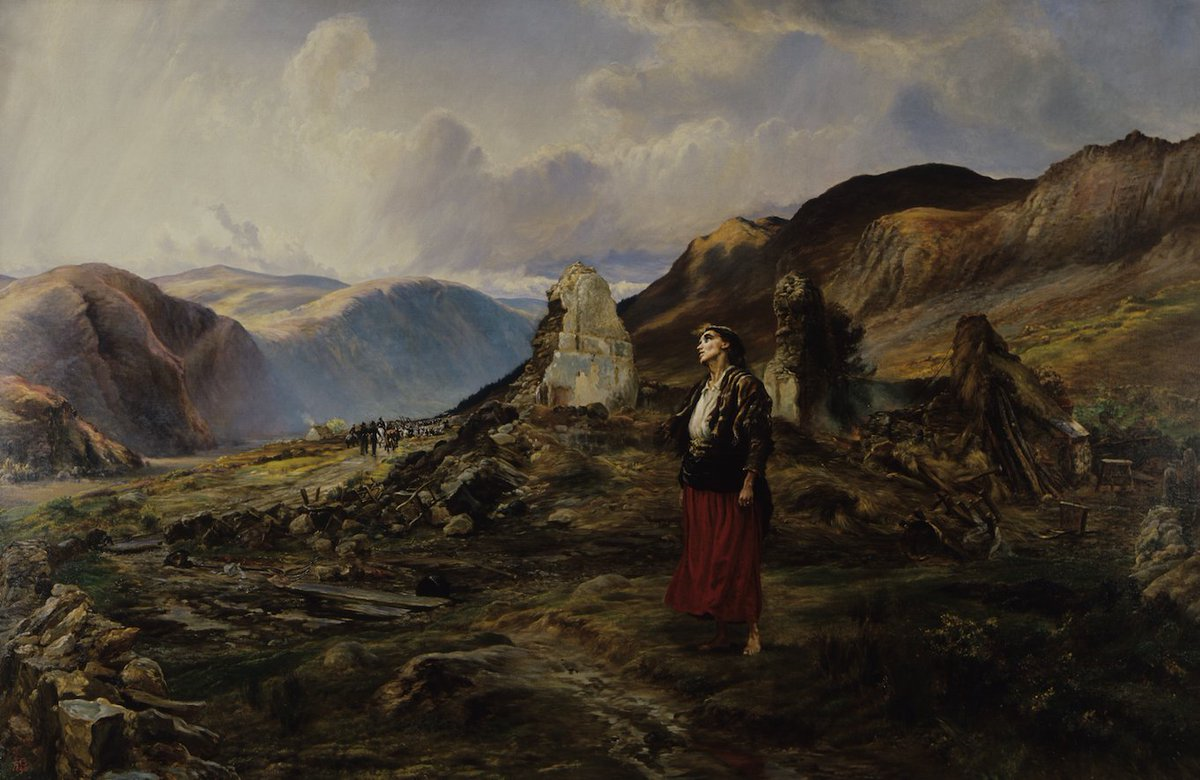
I was listening to an interesting radio programme the other day about artistic depictions of Ireland and Irish history. One of the paintings discussed  was a work called Evicted which was painted in 1890 by Elizabeth Thompson (Lady Butler). I haven’t seen the actual painting – the original (oil on canvas) is apparently somewhere in University College Dublin – but i found the discussion intriguing and decided to see if I could find a representation on the internet. Here it is in reasonably high resolution.


I’m not a proper art critic or anything, but I found this a remarkably powerful work of art made all the more interesting when I read a little bit about the artists. Elizabeth Thompson married Lieutenant General Sir William Butler after which she became Lady Butler. She made her name as an artist painting heroic depictions of British soldiers in, for example, the Crimean War. When her husband retired from military service the couple moved to Ireland, and at the time this painting was made they were living in Wicklow where one of their neighbours was none other than Charles Stewart Parnell. The late 19th Century was the time of the Land War, a period of intense social unrest in rural Ireland caused by the exploitative practices of landlords and the unfair treatment of tenants. Parnell was a vigorous campaigner for land reform and the Butlers became staunch supporters of the cause.

One day Elizabeth witnessed the eviction of a Irishwoman from her cottage in the Wicklow mountains and was so moved by it that she made this wonderful painting. When it was exhibited in London it was met with disapproval for being “too political”. The British establishment of the time did not appreciate anything too critical of the Empire.

In the painting itself there are some striking touches. The eviction party, its job done, can be seen to the left disappearing back down the valley. By all accounts the people who did this sort of thing were sadistic brutes who very much enjoyed their work. Tenants were not only evicted, but their homes  and possessions completely destroyed in order to prevent them returning.  The standing figure of the woman seems to form a group with the pieces of her cottage that are still standing, her own devastation mirroring that of her home. A few glowing embers can be seen among the wreckage.

But it’s the depiction of the woman herself which in my opinion gives the painting most of its power. You might have expected her to be shown in obvious distress, hunched, perhaps crying or wringing her hands. Instead she is standing up with her hands by her sides, looking up at the sky. Is she praying? Resigned to her fate? Or perhaps just traumatized? The painting seems to ask the viewer: how would you react if this happened to you?


Ireland’s New Government

Posted in Politics with tags , , , , , , , , on June 30, 2020 by telescoper

I remembered this morning that I haven’t posted anything about the news that Ireland has a new Government, so decided to do a quick lunchtime blog on that topic. The election that happened earlier this year left no party with enough seats to form an administration and negotiations to form a coalition were drastically slowed by the Covid-19 pandemic. Last week, however, members of the three parties involved in drafting the Programme for Government – Fine Gael, Fianna Fáil, and the Green Party – all ratified the proposal. A vote in the Dáil Éireann to formally approve the new Taoiseach was held on Saturday and a new Government formed. Its Ministers have now all been appointed.

Ireland’s new Taoiseach (the equivalent of Prime Minister) is Micheál Martin of Fianna Fáil. He replaces Leo Varadkar of Fine Gael who becomes Tánaiste (Deputy Prime Minister). Under the terms of the coalition agreement they will swap places after two and a half years of the five year term, i.e. at the end of 2022 (assuming the Goverment survives that long).

This isn’t the kind of government that I wanted because it seems to only to offer more of the same short-sighted and socially divisive neoliberal economic policies that have led to disintegrating public services and increasing levels of poverty and homelessness over the last decade. Increasing GDP growth while at the same time worsening social outcomes is not successful government in my view. Tempering my disappointment, though, I do think the coalition represents a step forward in some ways. In my view there is very little difference between Fine Gael and Fianna Fáil in terms of policy, which means that there has been little substantive opposition from one when the other has been in power, which has been the way Irish politics has been for decades. Now that similarity in political complexion has been formally recognized and Ireland now has a proper opposition party in the form of a resurgent Sinn Féin led by Mary Lou McDonald. I know better than to try to predict political developments but I can see Sinn Féin rising in popularity in opposition, probably at the expense of Fianna Fáil as the incumbent parties are unlikely to find the immediate future plain sailing. I think Leo Varadkar will be privately happy that Micheál Martin is Taoiseach for what is likely to prove the toughest phase.

Ireland’s electoral system involves a single transferable vote and I know many people who used their ballot to “transfer left”. The Green Party clearly prospered from such transfers during the 2020 election, but now finds itself propping up a Centre-Right coalition. No doubt many who transferred left are dismayed to find that they inadvertently transferred right. What that does for the popularity of the Greens in future remains to be seen. I would comment however that the Greens have been pretty successful in getting their proposals into the Programme for Government and I welcome many of them.

Another thing well worth mentioning is the creation of a new Minister at Cabinet level with responsibility for Higher Education. That was a Fianna Fáil idea but I didn’t see it in the Programme for Government. There is a little bit of confusion* about what the title of this new position is. When it was first announced it was reported as “Minister for Higher Education, Innovation and Research” though that seems to have morphed into “Minister for Higher Education, Innovation and Science”, which has left colleagues in the arts, humanities and social sciences feeling a bit disgruntled. It’s a pity that there isn’t an English word like the German Wissenschaft to use in such general contexts.

*UPDATE: I am reliably informed (by Twitter) that the correct title is “The Department of Further and Higher Education, Research, Innovation and Science”.

Whatever its precise name, the announcement of the creation of this new Ministry has received a cautious welcome from across the third-level sector. I also see this as potentially promising but I think I’ll reserve judgement until we see what it proposes to do. Interesting, though it was a Fianna Fáil policy to create this new cabinet position, the person appointed to it, Simon Harris TD, is actually from Fine Gael and was the Health Minister in the previous administration. I think the general opinion is that he did fairly well in that position, though reading his biography I see that he dropped out of university without getting a degree, which hardly inspires confidence in his commitment to higher education.

This isn’t the sort of Government I voted for, but I hope it can steer Ireland safely through the ongoing crisis reasonably safely. I’ll take it over the dismal collection of crooks and charlatans who are in power across the Irish Sea any day.

Watch “Why the Universe is quite disappointing really – Episode 6” on YouTube

Posted in The Universe and Stuff, YouTube with tags , , on June 30, 2020 by telescoper

I had to suspend the production of these videos for a month or so while I dealt with examination matters, but after that short hiatus, here is Episode 6 during which I explain just how weak and feeble the force of gravity really is. Combined with the fact that the Universe has such a low density (see Episode 5), the weakness of gravity means that the cosmos evolves extremely slowly.