And so to Phase Three..

Posted in Biographical, Covid-19, Education with tags , , , , on June 29, 2020 by telescoper

Well, Phase Three of the Great Reopening happened has started on schedule. As I walked to campus this morning I saw long queues in the street outside every barber’s shop in Maynooth. I decided to wait a few days before trying to get my long overdue haircut. It’s been over three months now.

Maynooth has quite a lot of barber’s shops for a town of its size. It also has quite a lot of nice restaurants. I noticed this evening that quite a few will be opening this week for sit-down meals rather than takeaway. I wish them well, but I think I’ll be sticking with the takeaways for a while longer.

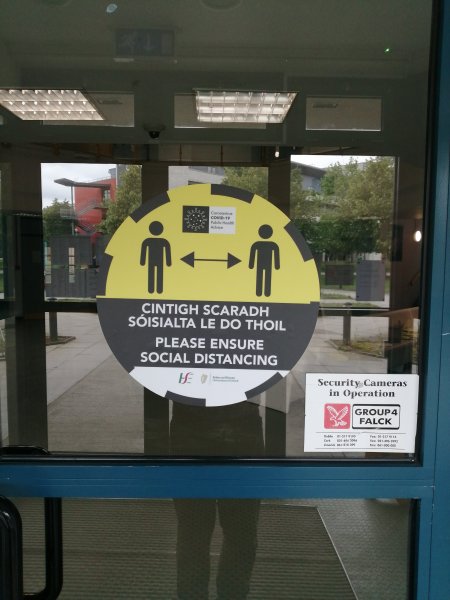
When I got into the office to start work on the risk assessment I’m supposed to complete so staff can return to work, there was quite a lot of activity in the Science Building, including signs of various kinds being put up.
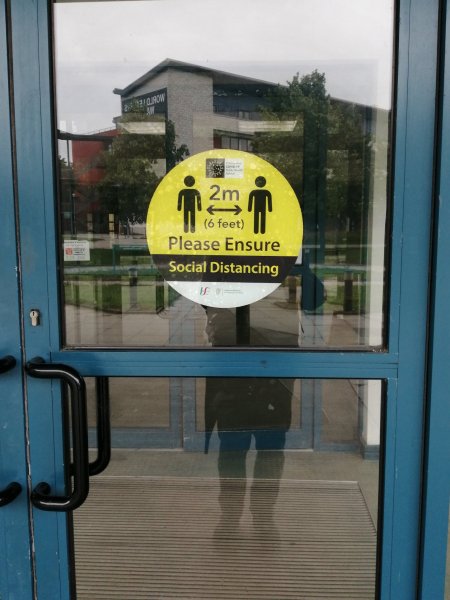
Some of the signs are bisexual bilingual:
All this reminded me of some lines from the Leonard Cohen song Anthem:

We asked for signs. The signs were sent

……

Signs for all to see.

The arrows will be put on the floor at regular intervals to enforce a one-way system around the building to allow people to circulate without bumping into each other.

I’m also expecting to be issued with tape to be used to mark some of the machines in our computer laboratory out of use, to keep users from sitting too close. I was going to remove the chairs but I don’t have anywhere to out them and we’ll probably – hopefully – need them back sometime!

I started work on the risk assessment but didn’t get it finished. I should be able to complete it tomorrow. Then it needs to be approved. Only after that will staff be able to begin routinely working in the Department. Until then, working from home continues.

R.I.P. Olivier Le Fèvre (1960-2020)

Posted in The Universe and Stuff with tags , , , , , on June 29, 2020 by telescoper

Olivier Le Fèvre (1960-2020)

The international cosmological community was deeply saddened last week to hear of the death on 25th June after a long illness of Olivier Le Fèvre. He was 59 years old.

Olivier was a specialist in astronomical spectroscopy and as such he made important contributions to cosmology through galaxy redshift surveys. He was Director of the Laboratoire d’Astrophysique de Marseille from 2004 to 2011. In latter years he was involved, among many other things, in the Euclid space mission.

You can find a full obituary and appreciation of Olivier’s life and work here. His funeral takes place this morning and there is an online book of condolence here to send messages of condolence and support to his family, friends and colleagues at this difficult time.

Rest in peace, Olivier Le Fèvre (1960-2020).

Temporary Lectureship in Theoretical Physics at Maynooth University!

Posted in Education, Maynooth with tags , on June 28, 2020 by telescoper

While I remember I should announce that we have fixed term ten-month full-time teaching position available in the Department of Theoretical Physics at Maynooth University.

The appointment is to provide sabbatical cover for Dr Jiri Vala.

The advert only went up last week but the deadline is just a fortnight away, on Sunday 12th July, which is pretty soon. This is because we need the person in post by September! Interviews are likely to be held in early August.

You can find the ad here or here or at the Maynooth University website here (which is also where you should apply).

Please feel free to pass this on to anyone you think might be interested!

Before Phase Three..

Posted in Biographical, Covid-19, Maynooth with tags , , on June 28, 2020 by telescoper

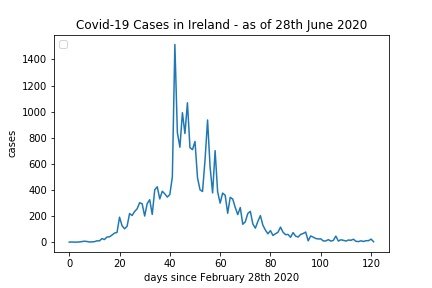
Tomorrow (on Monday 29th June) Ireland will enter Phase Three of its (accelerated) Roadmap for Reopening after the Covid-19 restrictions.

The Coronavirus situation here remains relatively stable, with new cases steady at a low level:

This is not the case for the rest of the world, however. Yesterday two grim milestones were passed: 10,000,000 confirmed cases of Covid-19 worldwide and 500,000 deaths:

Much of the recent numerical growth of the pandemic is associated with North and South America. Brazil is particularly badly affected as are some of the United States. I don’t need to comment on the quality of the political leadership involved.

I am very nervous about the situation in the United Kingdom too, where I feel the reopening is being rushed. Poor leadership is partly responsible for the continuing high levels of infection there too.

Anyway, back to Phase Three in Ireland. Yesterday I bought a copy of the Irish Times and found this booklet inside:

The emphasis is on the fact that despite the low levels in Ireland Covid-19 has not gone away and we all have to be prepared to take special precautions for the foreseeable future. I would be amazed if there wasn’t another flare-up here at some point, actually, it’s just a question of when. And those optimistic about the delivery of a vaccine in the near future, I’ll remind you that there isn’t yet a vaccine for any form of Coronavirus let alone the novel form responsible for Covid-19 (SARS-CoV-2).

Anyway, on Friday I attended a virtual Question and Answer session with the President of Maynooth University, Professor Philip Nolan, about the plans for reopening campus over the Summer and into the new academic year. It is clear that lots will have to be done before staff can return fully and even then it won’t be anything like “normal”.

Incidentally the issue of face masks came up and there was some discussion about their effectiveness. Not being a medical expert I don’t really know about that, but I think one of the important things about masks in a work environment is that their visibility means that they work as a signal to remind people to be aware of Covid-19. I have discarded my home-made face masks and bought a box of proper ones and I intend to wear them whenever I am in a work setting in which anyone else is present.

On Friday evening I finally received (relatively) detailed instructions on how the return to work process will work. The Department of Theoretical Physics at Maynooth University is still basically in Phase 1 while the university working group has been assembling this guidance. It will probably be several more weeks before we can get people back to work because there are many things still to be done: including the installation of hand sanitizers, one-way systems, screens, and new signage.

Another thing that came up during the President’s Q&A was the question of vacations for staff. Fortunately I had muted both my audio and video feeds for this as I laughed out loud. What with organising the return to work, overseeing repeat exams, recruiting a sabbatical replacement, planning teaching for next year, rewriting my own lectures for the “new normal”, etc etc, and (hopefully) moving into a new house, I can’t see any prospect of any summer holiday this year at all!

“Like a rusty squeezebox… ” – Mozart’s Serenade No 10 for Winds III. Adagio

Posted in Music with tags , , , , on June 27, 2020 by telescoper

Although it has introduced many people to the music of Wolfgang Amadeus Mozart, which is a very good thing, I have to admit that I didn’t really enjoy the film Amadeus. This is partly because not much of it is actually true and partly because, even treated as a piece of fiction, the two main protagonists are depicted far too crudely.

It is probably true that Mozart was quite a strange man as an adult but I attribute that largely to the fact that he was an infant prodigy which, together with having a very pushy and ambitious father, denied him a proper childhood. You see the same phenomenon in the modern era with child stars in Hollywood and the music industry.

The film is also very hard on Antonio Salieri who is made out to be a musical incompetent, which he certainly wasn’t. Salieri actually wrote a lot of very lovely music, though he obviously wasn’t Mozart.

One thing that the play/film does get right however is in Salieri’s description of the Adagio movement from Mozart’s Serenade No. 10 (K361) for wind instruments (and string bass):

On the page it looked nothing. The beginning simple, almost comic. Just a pulse, bassoons and basset horns, like a rusty squeezebox. Then suddenly; high above it, an oboe, a single note, hanging there unwavering, till a clarinet took over and sweetened it into a phrase of such delight! This was no composition by a performing monkey! This was a music I’d never heard. Filled with such longing, such unfulfillable longing. It seemed to me that I was hearing the very voice of God.

I stick to my opinion that Mozart wrote a lot of music that wasn’t really all that good, but I also think you should judge artists by their best work rather than their worst and Mozart wrote enough masterpieces any one of which would confirm him as a creative genius of the highest order. This piece is one of those masterpieces. The whole Serenade – seven movements, lasting almost an hour – is beautiful but this movement stands out.

The hallmark of a genius is often simplicity, isn’t it? That goes for science as well as the arts. I don’t really know what beauty really is but the essence of it often lies in simplicity too.

Now I have to make a confession and ask for help from readers. The confession is twofold: (a) I have never heard this piece in a live performance; and (b) I don’t possess a recording of it. I’d therefore like to ask my readers for recommendations as to the best version to buy on CD or download.

In the meantime here is a taster in the form of a performance by the wind musicians of the London Symphony Orchestra. Enjoy!

Maynooth University Open Day is here!

Posted in Education, Maynooth with tags , , on June 27, 2020 by telescoper

So here I am at home answering questions online from visitors at our virtual Open Day. It’s actually pouring with rain which might have dampened the enthusiasm of visitors to a traditional Open Day but it’s been quite busy so far. Here is a video tour of the Maynooth University campus, filmed in better weather than today!

You will see that it includes an artist’s impression of the new building on the North Campus which isn’t actually finished yet.

And here is a gratuitous picture of our star attraction:

Another Open Day Preview – General Science at Maynooth

Posted in Education, Maynooth, The Universe and Stuff with tags , , , on June 26, 2020 by telescoper

I thought I’d put up another post following on from yesterday’s post about Open Day at Maynooth coming up on Saturday 27th June which, owing to Covid-19 restrictions still being in place,  is once again a virtual event. It will take place between 10am and 2pm and be online for that period to answer queries about Theoretical and Mathematical Physics at Maynooth University. You can sign up for the event here.

Yesterday’s post was about our denominated degree programme in Theoretical Physics and Mathematics, but I also recorded a separate video for students interested in studying Mathematical Physics  (or Theoretical Physics – we use the terms interchangeably) through our General Science programme, MH201, so here’s a little presentation about how to study Mathematical physics at Maynooth that way:

Currently, most students doing Science subjects here in Maynooth enter on the General Science programme (codename)  a four-year Omnibus science course that involves doing four subjects in the first year, but becoming increasingly specialised thereafter. That’s not unlike the Natural Sciences course I did at Cambridge, except that students at Maynooth can do both Mathematical Theoretical Physics and Experimental Physics in the first year as separate choices. Other possibilities include Chemistry, Computer Science, Biology, etc.

In Year 1 students do four subjects (one of which has to be Mathematics). That is narrowed down to three in Year 2 and two in Year 3. In their final year, students can stick with two subjects for a Joint Honours (Double Major) degree, or specialise in one, for Single Honours.

I like this programme very much because it does not force the students to choose a specialism before they have had a taste of the subject, and that it is flexible enough to accommodate Joint Honours qualifications in, e.g., Theoretical Physics and Mathematics. It also allows us to enrol students onto Physics degrees who have not done Physics or Applied Mathematics as part of the Leaving Certificate.

I think Mathematical Physics has a particular value in the first year of this course, even for students who do now wish to continue with beyond that level. The material we present in the first year focusses on Mechanics, which is perfect for students to learn how to apply concepts from the Mathematics courses in calculus and linear algebra (especially vectors). It obviously complements Experimental Physics and I would recommend all students who want to do Experimental Physics to do Mathematical Physics too, but  basic mechanics comes up in a wide range of contexts in science, including Biology and Chemistry, so it is relevant for students taking a wide range of pathways through this very flexible programme.


Maynooth Open Day Preview

Posted in Education, Maynooth with tags , , , on June 25, 2020 by telescoper

No sooner has the examination period finished when we have to start thinking about admissions again. There is an Open Day at Maynooth coming up on Saturday 27th June. Covid-19 restrictions still being in place this is once again a virtual event that will take place between 10am and 2pm. I will be online for that period to answer queries about Theoretical and Mathematical Physics at Maynooth University. You can sign up for the event here.

In the meantime, to whet your appetite, here is a little video introduction I recorded for the Open Dday for our Double Major BSc programme in Theoretical Physics & Mathematics (codename: MH206)


New Publication at the Open Journal of Astrophysics!

Posted in OJAp Papers, Open Access, The Universe and Stuff with tags , , , , , , on June 25, 2020 by telescoper

Proving further the point that the The Open Journal of Astrophysics is definitely fully open we have published yet another paper. This one was actually published yesterday, which means that we had two in two days..

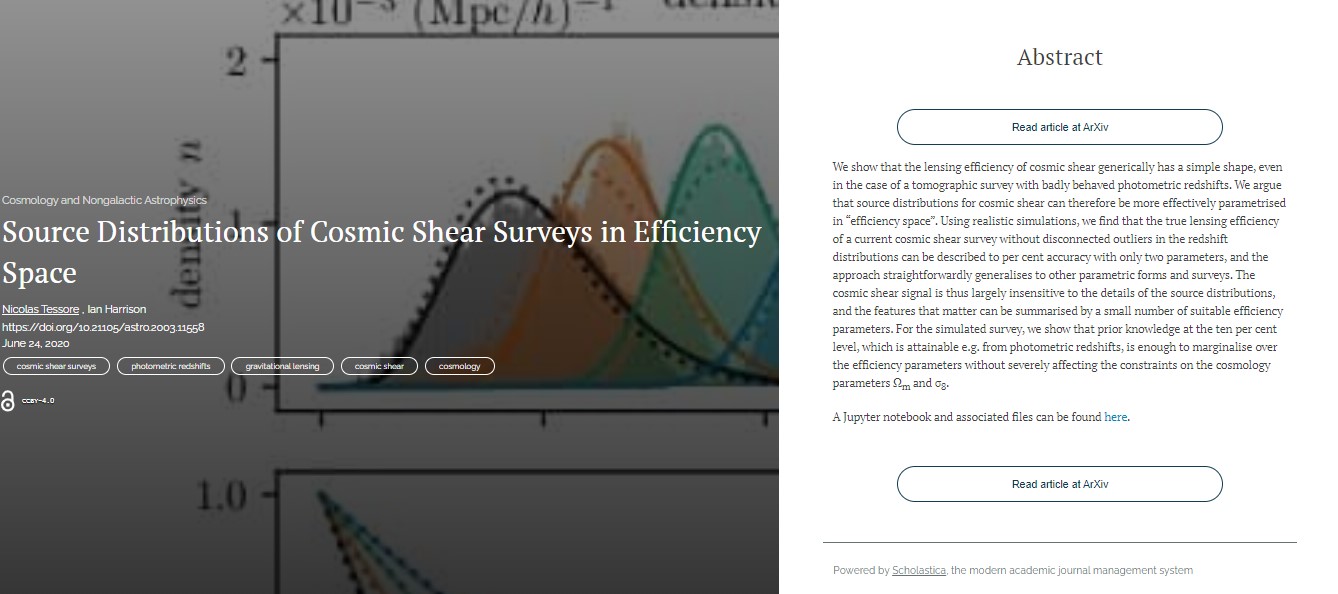
This one is in the Cosmology and Nongalactic Astrophysics section and is entitled Source Distributions of Cosmic Shear Surveys in Efficiency Space. The authors are Nicolas Tessore and Ian Harrison, both from the University of Manchester. The paper is concerned with the extraction of cosmological information from cosmic shear surveys.

Here is a screen grab of the overlay:

You can find the arXiv version of the paper here.

What kind of thing is GW190814?

Posted in The Universe and Stuff with tags , , , , , , , on June 24, 2020 by telescoper

There’s been a lot of interest in the past day or two over an event that occurred in the LIGO detectors last August, entitled GW190814. A paper has appeared declaring this to be “the observation of a compact binary coalescence involving a 22.2–24.3 M  black hole and a compact object with a mass of 2.50–2.67 M “. That would be interesting of course because the smaller object is smaller than the black holes involved in previous detections and its mass suggests the possibility that it may be a neutron star, although no electromagnetic counterpart has yet been detected.  It’s a mystery.

I was quite excited when I saw the announcement about this yesterday but my enthusiasm was dampened a bit when I saw the data from the two LIGO detectors at Hanford and Livingston in the USA and the Virgo detector in Italy.

Visually, the Livingston detection seems reasonably firm, but the paper notes that there were thunderstorms in the area at the time of  GW190814 which affected the low-frequency data. There doesn’t look like anything at all but noise in the Virgo channel. The Hanford data may show something but, according to the paper, the detector was “not in nominal observing mode at the time of GW190814” so the data from this detector require special treatment. What you see in the Hanford channel looks rather similar to the two (presumably noise) features seen to the left in the Livingston plot.

I know that – not for the first time – I’m probably going to incur the wrath of my colleagues in the gravitational waves community but I have to sound a note of caution. Before asking whether the event involves a black hole or a neutron star you have to be convinced that the event is an event at all.  Fortunately, at least some of the data relating to this have been released and will no doubt be subjected to independent scrutiny.

Now I’m going to retreat into my bunker and hide from the inevitable comments…