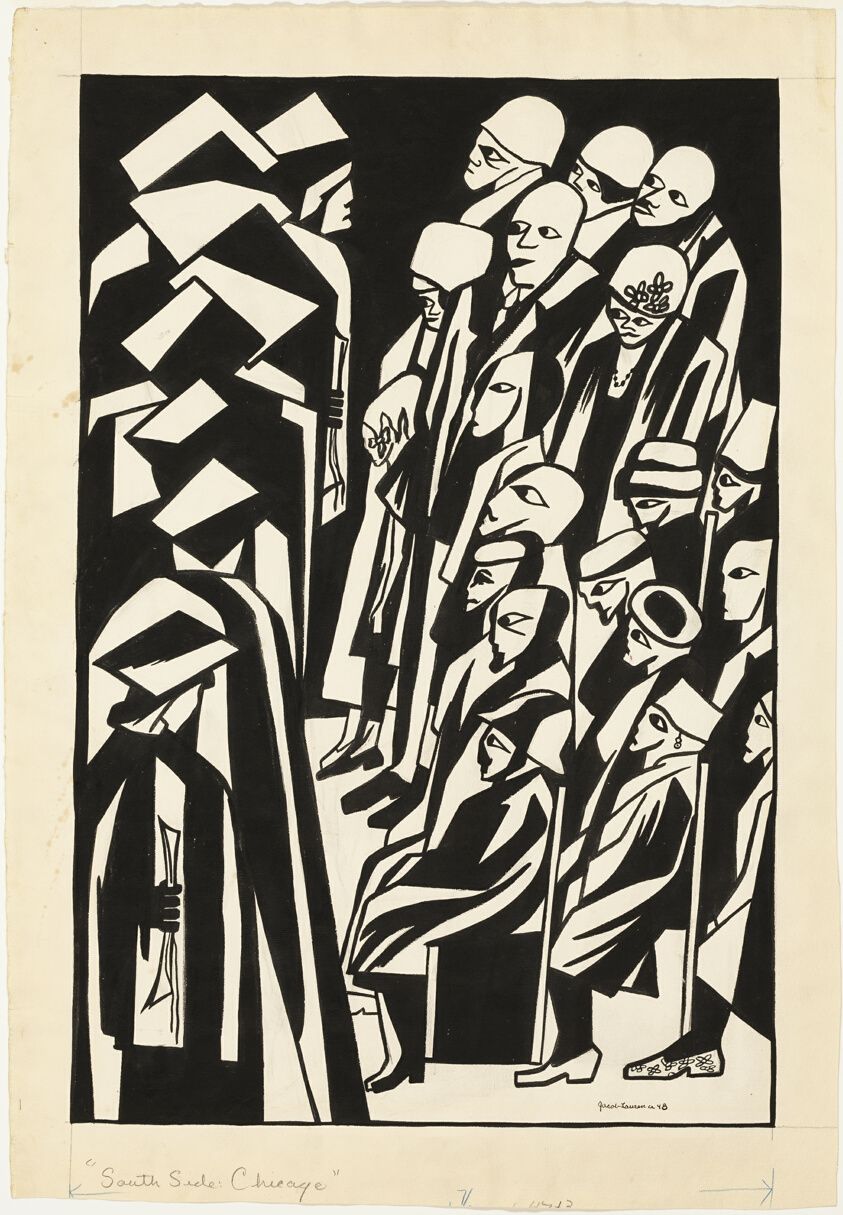
by Jacob Lawrence (1948, ink over graphite on paper, 72 × 49.8 cm, Art Institute of Chicago, USA)
This work, Graduation, is one of six drawings that Jacob Lawrence made as illustrations for Langston Hughes’s 1949 book of poetry, One-Way Ticket.
by Jacob Lawrence (1948, ink over graphite on paper, 72 × 49.8 cm, Art Institute of Chicago, USA)
This work, Graduation, is one of six drawings that Jacob Lawrence made as illustrations for Langston Hughes’s 1949 book of poetry, One-Way Ticket.
Every now and again I look at the latest particle physics literature on arXiv to see what’s going on. The other day I saw a preprint there which gives a review of the latest results on supersymmetry from the Compact Muon Solenoid (CMS) experiment at the Large Hadron Collider at CERN. I should explain that, in experimental particle physics, “compact” means “fucking enormous”.
Anyway, the abstract of the paper reads:
The Run 2 data-taking period of the CERN Large Hadron Collider during years 2015-2018 provided about 140 fb-1 of proton-proton collisions at 13 TeV, offering an unprecedented opportunity to explore supersymmetry (SUSY) across a wide range of experimental signatures. CMS responded with a broad and diverse search program, carrying out dozens of analyses that probed a multitude of final states and systematically explored different regions of the SUSY parameter space. No significant deviations from standard model predictions were observed, and the results were used for constraining the SUSY landscape. In this review, I provide a comprehensive account of the CMS Run 2 SUSY program, covering its strategy, targeted models, and analysis methods. I then present the full set of searches and conclude with their combined impact through simplified model and phenomenological MSSM interpretations.
arXiv:2510.17971
Here is one of the pretty pictures from the review. This one shows the constraints on the masses of any supersymmetric counterparts of the electroweak gauge bosons.

To summarize the evidence for supersymmetry from CMS, there is none, nil, nought, nada, zero, zilch, zip, sweet Fanny Adams, bugger-all and diddly-squat. I hope this clarifies the situation.

It’s Sunday 26th October 2025 and in the early hours of this morning the clocks went back, bidding goodbye to Summer Time. You can tell I’m an oldie because I have quite a lot of time-keeping devices around the house that need to be set by hand. My computer updates itself, of course, but I’m not sure if WordPress does. I’ll find out when I publish this post!
I’ve written before about the silly business of moving the clocks backwards and forwards (e.g. here) so I won’t repeat it all again. I will mention, however, that some time ago, before the Covid-19 Pandemic, the European Parliament approved a directive that would abolish `Daylight Saving Time’. Unfortunately that plan was ‘paused’ although Spain is apparently going to try to get it going again. I’ve long felt that the annual ritual of putting the clocks forward in the Spring and back again in the Autumn was a waste of time effort, so I’ll be glad if and when this silly practice is terminated. It would be far better in my view to stick with a single Mean Time throughout the year. I’m disappointed that this hasn’t already happened.
Anyway, talking of time, we have now completed five weeks of teaching in Semester 1 at Maynooth University. Tomorrow (Monday 27th October) is the October Bank Holiday and next week is Study Week so there are no lectures or tutorials. We do, however, have conferring (graduation) ceremonies including one that involves my recently-completed PhD student. Looking at my diary I notice also that I also have an appointment for my flu jab and Covid-19 booster, another sign that I’m an old codger.
Normally Study Break comes halfway through the 12-week teaching term but this year it splits 5-7. It did so last year too, actually. I am not unhappy to have an earlier break as I’m very tired, but I am conscious that this is going to make for a longer run-in to the Christmas holiday. We are supposed to teach up until Friday 19th December, but I don’t have any lectures on that day.
I’m not sure how much studying the students do during Study Week, but it’s not a holiday for academic staff even though there is no undergraduate teaching. Among other things we have examinations to write for the January examination period, which must be checked and printed well in advance. The deadline for these is November 3rd, so I have all week but I am planning to spend next weekend elsewhere so I need to get them done beforehand.

To nobody’s surprise, the winner of the Irish Presidential Election is Catherine Connolly. The official declaration of the results from the 43 constituencies of the Republic of Ireland was announced in Dublin Castle shortly after 7pm this evening, with an emphatic margin of victory for the Galway West TD. The total number of votes cast was 1,656,436, a turnout of just 45.8% (though that was a little higher than in 2018). The number of Invalid votes was 213,738.
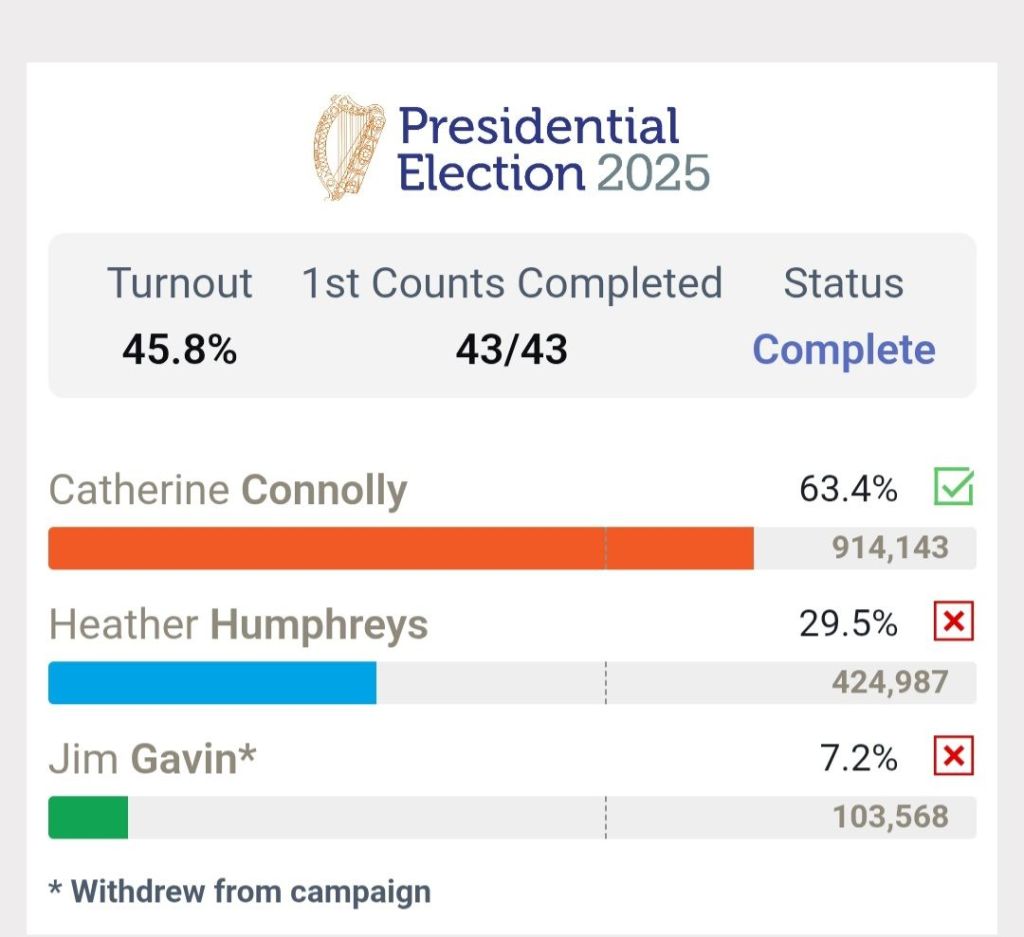
Catherine Connolly was comfortably elected on the first count with 914,143 votes, more than half the number of valid votes. Heather Humphreys had 424,987 votes and Jim Gavin (who withdrew at the start) got 103,568 votes.
It is worth pointing out that the share of the vote (63%) and the number of votes cast in her favour are the largest for any President in the Republic’s history.
The large number of spoilt votes (13%) is probably attributable to the narrowness of the field, but those arguing that the nomination process should be changed need to remember that Article 12 of the Constitution of the Republic of Ireland stipulates how the process should occur so any change will need a referendum. People of course are entitled to spoil their paper if they wish, but I did read that one voter smearing their ballot paper with faeces, which is both disgusting and inexcusable.
I’ll repeat my view that the decision to hold the ballot on the Friday before a Bank Holiday long weekend probably contributed to the low turnout, as many people would have been planning to go away. I said the same last time, in 2018. The 2011 Presidential Election was held on a Thursday, which I think is a much better day to have an election.
Anyway, heartiest congratulations to Catherine Connolly, who won by a country mile, and will shortly become the next Uachtarán na hÉireann, the 10th person to hold that title.
It may be a Bank Holiday weekend here in Ireland, but it’s still time for the usual Saturday update of the week’s new papers at the Open Journal of Astrophysics (although a bit later in the day than usual). Since the last update we have published another five papers, which brings the number in Volume 8 (2025) up to 161, and the total so far published by OJAp up to 396.
This week’s update is rather unusual because there are four papers in a series (or, more precisely, mathematically speaking, a sequence) all published on the same day (Wednesday October 22nd 2025), in the same folder (Cosmology and NonGalactic Astrophysics), with the same first author (Dhayaa Anbajagane of the University of Chicago), with long author lists and many co-authors in common. These papers all relate to the DECADE cosmic shear project. Instead of doing them one by one, therefore, I’ve decided to put all four overlays together and provide links to all the papers afterwards. As I’m trying to encourage people to follow our feed on the Fediverse via Mastodon (where I announce papers as they are published, including the all-important DOI), I’ll include links to each announcement there too.


The fediverse announcements follow:
The fifth and final paper for this week is “Clustering of DESI galaxies split by thermal Sunyaev-Zeldovich effect” by Michael Rashkovetskyi of the Harvard-Smithsonian Center for Astrophysics, or CfA for short, and 48 others. This one was published on Wednesday 23rd October in the folder Cosmology and NonGalactic Astrophysics. This paper explores how the clustering properties of galaxies mapped by the Dark energy Spectroscopic Instrument (DESI) relate to the local thermal Sunyaev-Zeldovich emission mapped by the Atacama Cosmology Telescope (ACT). The overlay is here:
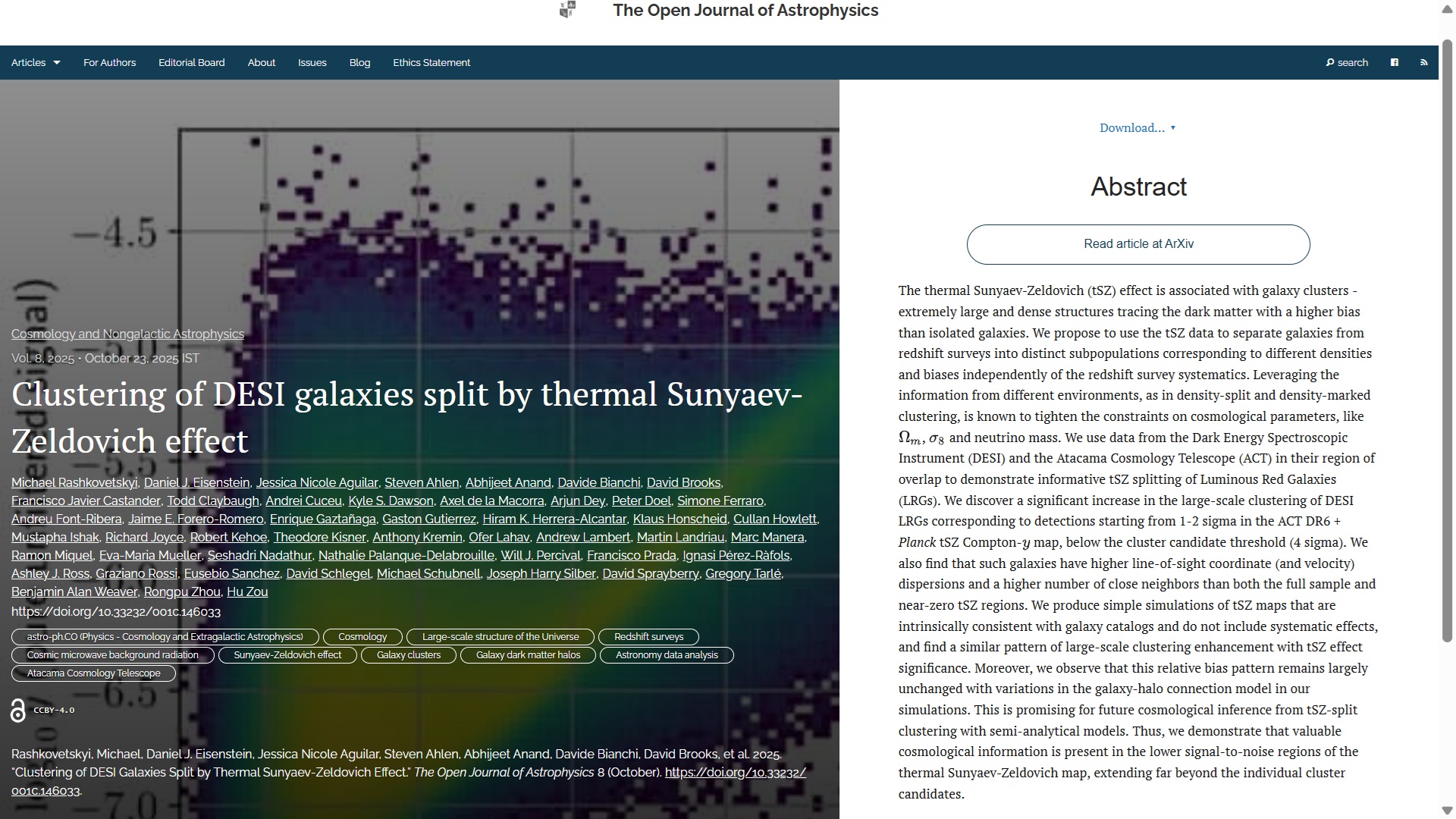
The officially accepted version can be found on arXiv here, and the fediverse announcement is here:
That concludes the papers for this week. With one week to go and our total at 396, I still think we might reach the 400 total by the end of October.
So we come to it at last. After weeks of campaigning, today’s the day we get to cast our votes in the election of a new President of the Republic of Ireland. All the polls suggest that the winner will be Catherine Connolly, and indeed the only posters I have seen around my neighbourhood are for her.
The only message I got through the door was for her too:
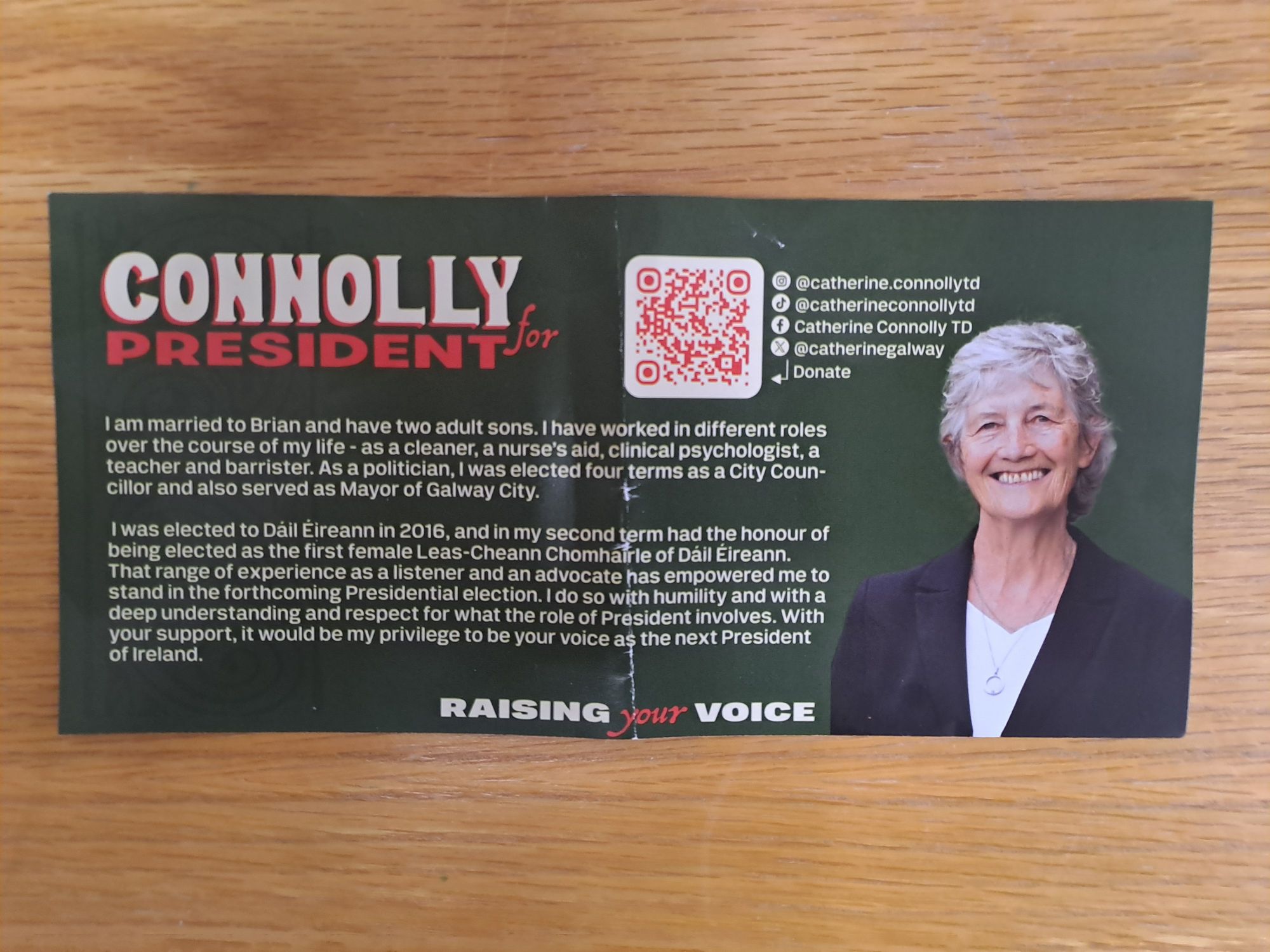
I shall shortly be heading to the Presentation Girls National School in Maynooth, which is my polling station. I’ll be voting for Catherine Connolly, in case you want to know. She is clearly the better candidate; my opinion of Heather Humphreys went down every time I heard her speak. Anyway, we should know the result by tomorrow evening when we’ll find out whether the opinion polls are right.
Today also happens to be the last day before our study break in Maynooth University and the start of a long weekend. I did my last teaching session of the week yesterday, actually. That’s why I didn’t have to get up early to vote before work. It also means have research on the agenda for today. Monday 27th October is a Bank Holiday and there are no lectures for the rest of the week. There are conferring ceremonies, though, including one for my recently-completed PhD student on Wednesday.
Update: I voted as planned. The polling station was fairly busy.
It’s been a cool autumn day so this seems appropriate. It’s from the classic 1958 album Somethin’ Else which was Cannonball Adderley’s first as a leader, and one of Miles Davis’s last as a sideman (also a rare recording for Miles on the Blue Note label). Adderley went on to play alto sax with the great Miles Davis sextet that recorded Kind of Blue, and Miles obviously influenced this album enormously, but the rhythm section here is different from that band’s – Art Blakey on drums, Hank Jones on piano, and Sam Jones on bass. Miles Davis was also responsible for this arrangement of the standard Autumn Leaves, which he based on a version by Ahmad Jamal.

I saw the news today that the Republic of Ireland is now officially an associate member state of the Conseil Européen pour la Recherche Nucléaire, better known as CERN. This has been in the pipeline for a while: I blogged about it here, for example. But today’s the day that Ireland formally joined.
I think this is a very good move for Irish physics, and indeed for Ireland generally. I will, however, repeat a worry that I have expressed previously. There is an important point about CERN membership, however, which I hope is not sidelined. The case for joining CERN made at political levels was largely about the return in terms of the potential in contracts to technology companies based in Ireland from instrumentation and other infrastructure investments. This was also the case for Ireland’s membership of the European Southern Observatory (ESO), which Ireland joined 7 years ago. The same thing is true for involvement in the European Space Agency, which Ireland joined in 1975. These benefits are of course real and valuable and it is entirely right that arguments should involve them.
Looking at CERN membership from a purely scientific point of view, however, the return to Ireland will be negligible unless there is a funding to support scientific exploitation of the facility. That would include funding for academic staff time, and for postgraduate and postdoctoral researchers to build up an active community as well as, e.g., computing facilities. This need not be expensive even relative to the modest cost of associate membership (approximately €1.9M). I would estimate a figure of around half that would be needed to support CERN-based science. I am given to understand that some funds have been made available as part of the joining arrangements, but I don’t know the details.
As I have mentioned before, Ireland’s membership of ESO provides a cautionary tale. The Irish astronomical community was very happy about the decision to join ESO, but that decision was not accompanied by significant funding to exploit the telescopes. Few astronomers have therefore been able to benefit from ESO membership. While there are other benefits of course, the return to science has been extremely limited. The phrase “to spoil a ship for a ha’porth of tar” springs to mind.
Although Ireland joined ESA almost fifty years ago, the same issue applies there. ESA member countries pay into a mandatory science programme which includes, for example, Euclid. However, the Irish Government did not put any resources on the table to allow full participation in the Euclid Consortium. There is Irish involvement in other ESA projects (such as JWST) but this is somewhat piecemeal. There is no funding programme in Ireland dedicated to the scientific exploitation of ESA projects.
Under current arrangements the best bet in Ireland for funding for ESA, ESO or CERN exploitation is via the European Research Council, but to get a grant from that one has to compete with much better developed communities in those areas.
The recent merger of Science Foundation Ireland and the Irish Research Council to form a single entity called Research Ireland could provide an opportunity to correct this shortfall in funding for science exploitation. The reorganization won’t do anything on its own, however: the overall level of public sector research funding will have to increase dramatically from its current level, well below the OECD average. The recent Budget in Ireland for 2026 does include an allocation of €426 million for research under the National Development Plan, but how much of this will find its way into basic research generally and CERN science in particular?

by Jackson Pollock (1950, enamel paint on canvas, 266.7 x 525.8 cm, Metropolitan Museum of Art, New York)
This painting, an example of Pollock’s “poured-painting” style, was featured in the 1980 BBC Two series 100 Great Paintings.
The start of this term has been so busy that I forgot that October 1st was the 40th anniversary of the day I officially started as a research student at the University of Sussex (1st October 1985). Reflecting on that event I realized with something approaching horror that 1985 is halfway between 1945 and 2025, so I started my PhD DPhil closer in time to the end of World War 2 than to today. Yikes!
Before travelling to the Sussex to embark on my research degree, I spent a couple of weeks at a summer school for all the new Astronomy PhD students. These are still held annually, although they are now just a week long instead of a fortnight. They are now sponsored by the Science and Technology Facilities Council (STFC) but the one I attended was before that came into being, and even before its predecessor, the Particle Physics and Astronomy Research PPARC. The Science and Engineering Research Council (SERC) summer school I went to was held at Durham University; we all stayed in St Mary’s College, just over the road from the Physics Department. I remember it well and indeed still have the notes I took during the lectures there.
Another difference in those days was that we got our stipends paid by cheque – every three months, if I remember correctly – directly from the Research Council. Nowadays STFC gives block grants to universities and other research institutions, who then pay the students.
Anyway, here is the summer school conference picture:

Unfortunately (for such a rare and valuable document) it is slightly damaged on the left -hand side. I leave it up to my readers to identify the people in this group who are still in the business 40 years later. I can see quite a few – Moira Jardine, Alan Fitzsimmons, Melvyn Hoare, Jon Loveday and Alastair Edge, among others! A more complete list can be found here.
I don’t think I’m the only member of this group who is thinking of retiring fairly soon. This post was occasioned by the 40th anniversary of the start of my DPhil; my plan is to retire 40 years after the date of the completion of my thesis. That’s less than three years from now…
"What we call the beginning is often the end
And to make an end is to make a beginning.
The end is where we start from. "
from Little Gidding V, Four Quartets by T.S. Eliot


 In the Dark