Two Hundred Years of Tyndall

Posted in Beards, History, The Universe and Stuff with tags , , on August 2, 2020 by telescoper

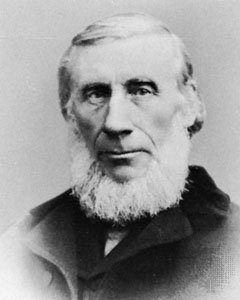
Just a short post to mark the fact that celebrated Irish physicist John Tyndall was born 200 years ago today, on 2nd August 1820.

Tyndall made his name initially for his research on diamagnetism but then worked on the scattering of light by atmospheric particles, and on the absorption of infrared radiation by gases. In the latter context he is generally credited with having discovered the Greenhouse Effect.

One should also mention his rather splendid beard.

John Tyndall was born at Leighlin Bridge, near Carlow in Ireland. After a little formal schooling, he gained a practical education by working as a surveyor and engineer. He entered the University of Marburg, Germany, in 1848 and earned his doctorate two years later. His dissertation research interested Michael Faraday, who later brought him to the Royal Institution of London. In 1867 Tyndall succeeded Faraday as superintendent there. He retired in 1887 and died in 1893.

The excellent Tyndall National Institute in Cork is named in his honour.

Spot the Deliberate Mistake

Posted in Covid-19 on August 1, 2020 by telescoper

The following graphic was recently used by a television programme to show the parts of England in which special Covid-19 restrictions are imposed:

Can any of you spot the deliberate mistake?

See below for the answer..

Continue reading →

Trustan with Usolde

Posted in Literature, Opera with tags , , , , , , , , on August 1, 2020 by telescoper

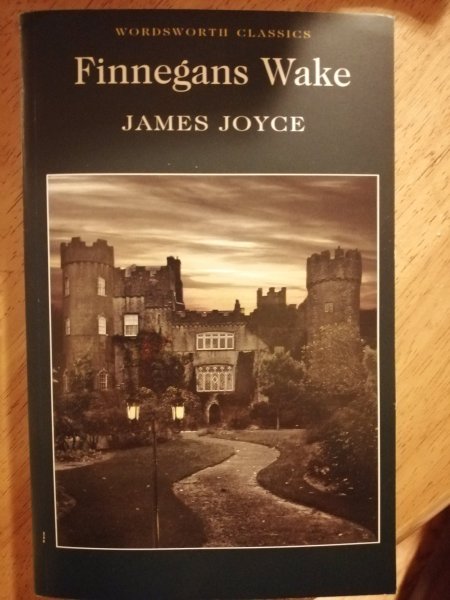
It is, I think, fairly well known that physicist Murray Gell-Mann was inspired to pick the name quark for the name of a type of subatomic particle by a passage from Finnegans Wake by James Joyce:

— Three quarks for Muster Mark!
Sure he hasn’t got much of a bark
And sure any he has it’s all beside the mark.

What is perhaps less well known is the identity of “Muster Mark” in that quote. In fact it is King Mark of Cornwall, husband of Queen Iseult in the legend of Tristan and Iseult. The Iseult in that legend is Irish. She has has an affair with Tristan, nephew of King Mark, with tragic consequences. This legend appears in many literary forms including, most famously, Richard Wagner’s Opera Tristan und Isolde. It also comes up frequently in Finnegans Wake including this passage on the same page (in the edition I have) as the Muster Mark quote above:

That song sang seaswans.
The winging ones. Seahawk, seagull, curlew and plover, kestrel
and capercallzie. All the birds of the sea they trolled out rightbold
when they smacked the big kuss of Trustan with Usolde.

See how Joyce plays with the substitution of “u” for “i” here as in “Muster”. Either that or the “I” key on his typewriter didn’t work properly. Or he had fat fingers and kept hitting the wrong key; U and I are next door on the keyboard.

Incidentally there is a small village in Dublin called Chapelizod which is where a church was built dedicated to Queen Iseult. Whether there is any real connection between this place and the historical Iseult is very doubtful.

Now, where was I. Oh yes. Back to Opera.

Years ago, when I lived in Nottingham, on a warm summer evening I decided to listen to some of the live broadcast on BBC Radio 3 of a performance of Wagner’s Tristan und Isolde from Glyndebourne. I made myself a cocktail and took the radio out into the garden with the intention of listening to a bit of it before going out for the evening. This was back in the days when I actually used to go out on the town on Saturday nights; now I’m too old for that sort of thing.

Anyway, I was hooked right from the Prelude. Act I came and went and I decided to make some dinner in the interval, opened a bottle of wine, and returned to listen to the rest of it. The glorious music washed over me in the sultry twilight. Darkness fell, a second bottle of wine was opened, and still I listened – no doubt to the consternation of my neighbours. The final Liebestod was so beautiful I almost cried. Eventually I retreated to the house having experienced my first all-out Wagner trip.

My enjoyment of that occasion was of course helped by the fact I could get up and walk around occasionally, as well as by the liberal intake of fine wine. Nevertheless I do think Tristan and Isolde works very well on the radio – nothing very much happens on stage anyway (especially in Act II) so you can just let the music work it’s magic.

The reason for all this rambling is that there is a special broadcast of Tristan und Isolde on RTÉ Lyric FM. This performance, recorded in 2012, features as Isolde the celebrated dramatic soprano Miriam Murphy who very sadly passed away suddenly a few weeks ago. Tonight’s programme is a tribute to her memory. I believe Miriam Murphy is the only Irish soprano to have sung the role of Isolde. I’ve heard a few clips from it and her voice sounds amazing.

The Opera is preceded on the radio by a documentary about the production, the first in Ireland for 50 years and the first by a brand new company based in Ireland. I think James Joyce would have approved.

So that’s my Saturday evening sorted out!

Update: I listened to the broadcast and it is an astonishingly wonderful performance by Miriam Murphy.

The Mystery of Meaning

Posted in Poetry with tags , , , on July 31, 2020 by telescoper

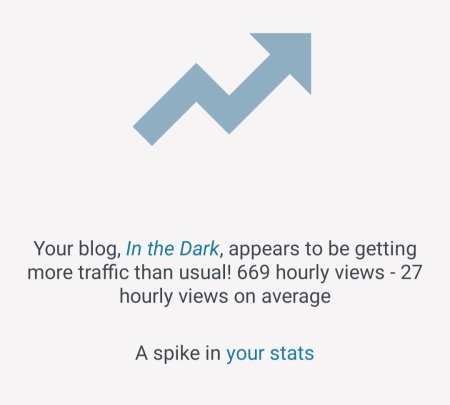
Contrary to the expectation I expressed yesterday when posting an obscure article about the chord changes in Duke Jordan’s Jordu, I got the following alert from WordPress:

Usually I get a bit nervous when there’s a spike in my stats. I tend to imagine I’ve posted something controversial and the people checking it out are all lawyers. As it turns out the destination of most of the traffic was not the piece I had just posted but an old post about a poem, Meaning by Czeslaw Milosz. Here is the poem:

When I die, I will see the lining of the world.
The other side, beyond bird, mountain, sunset.
The true meaning, ready to be decoded.
What never added up will add Up,
What was incomprehensible will be comprehended.
– And if there is no lining to the world?
If a thrush on a branch is not a sign,
But just a thrush on the branch? If night and day
Make no sense following each other?
And on this earth there is nothing except this earth?
– Even if that is so, there will remain
A word wakened by lips that perish,
A tireless messenger who runs and runs
Through interstellar fields, through the revolving galaxies,
And calls out, protests, screams.

I have no idea why there was a sudden surge in interest yesterday – most of it from the USA – in this particular poem. I’d guess that it may have featured in a TV broadcast, as that sort of thing has in the past caused sudden increases in traffic to posts about music.

If anyone can solve the mystery of Meaning I’d be very grateful to hear through the comments box.

Update: Mystery solved. The poem was read by the Reverend James Lawson at the funeral of civil rights campaigner John Lewis. Many thanks to the commenter below for this information.

Jordu

Posted in Jazz with tags , , , , , , on July 30, 2020 by telescoper

Now for one of those jazz posts that people don’t seem to like and which will no doubt reduce today’s blog traffic even further. This is a very nice version of a tune called Jordu which was written by pianist Irving “Duke” Jordan in 1953 and which became part of the standard jazz repertoire after a wonderful version was recorded by Clifford Brown and Max Roach in 1954. It’s not hard to figure out where the title comes from. The version I’ve picked is much later, and features a trio with the great Ed Thigpen on drums and Mads Vinding.

Duke Jordan began his recording career with the brilliant Dial sessions with Charlie Parker in 1947 and he carried on making great music after he moved to Denmark in the 1970s until his death in 2006. The Steeplechase label on which this record was released is actually based in Copenhagen too. He is buried in Vestre Kirkegard in Copenhagen. He was in my opinion one of the most consistently underrated pianists of his era.

When I was younger I used to try to figure out by ear the chord changes in Jazz standards. Nowadays you can find cheat sheets all over the internet, which rather takes the fun out of it. This tune is a particularly interesting challenge to unravel as well as to perform  but if I ever got a band together we would definitely (try to) play it!

Jordu is in a standard AABA form. The A sections are constructed from dominant chords in a pattern based on the ii-V-I progression which is very common in jazz. The variation introduced here is to use a major II instead of a minor ii and add a dominant 7th to the basic triad, which makes a much richer sound. The eight bars of the A section are divided into four pairs, the first of which finds the theme played without backing chords or rhythm accompaniment, the second having the backing instruments accent beats 1, 3 and 4. The first sequence is a II/V/I in C minor, using a D7 instead of a minor ii chord. Then it’s a similar sequence in in Eb major (F7/Bb7/EbMaj7). After a repeat of the first II/V/I, the A sections ends with Ab7 – G7 (bVII7 – V7). Every chord but one in the entire section is a dominant 7th.

Since the A section ends in an unresolved way on the V chord (G7), a device used quite a lot in music stylistically based in the bebop era, Duke Jordan devised  a two-bar coda to be played at the end of a performance that resolves to the tonic (Cm), bringing everything gently back to Earth to finish.

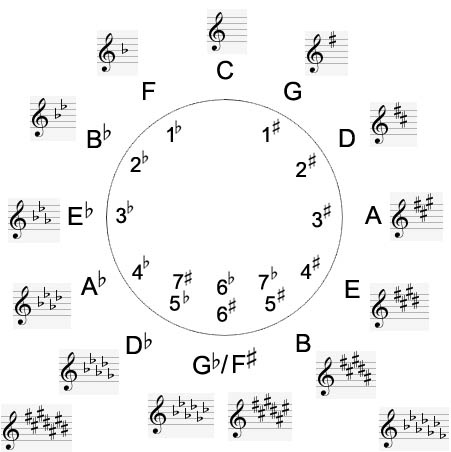
The B section is based on the Circle of Fourths, another standard jazz device but still a challenging pattern to improvise on. If you want to learn to play jazz most tutors will have you practicing a lot on the Circle of Fifths (clockwise) and Circle of Fourths (anticlockwise) trips around this diagram showing all the major and minor keys:

Anyway, you don’t have to know anything about the harmonic structure of this piece to enjoy this lovely playing. Duke Jordan’s solo finds him completely at home in this tune, and why shouldn’t he? He wrote it!

Stars, by Emily Brontë

Posted in Poetry with tags , , on July 30, 2020 by telescoper

Ah! why, because the dazzling sun
Restored our Earth to joy,
Have you departed, every one,
And left a desert sky?

All through the night, your glorious eyes
Were gazing down in mine,
And, with a full heart’s thankful sighs,
I blessed that watch divine.

I was at peace, and drank your beams
As they were life to me;
And revelled in my changeful dreams,
Like petrel on the sea.

Thought followed thought, star followed star,
Through boundless regions, on;
While one sweet influence, near and far,
Thrilled through, and proved us one!

Why did the morning dawn to break
So great, so pure, a spell;
And scorch with fire the tranquil cheek,
Where your cool radiance fell?

Blood-red, he rose, and, arrow-straight,
His fierce beams struck my brow;
The soul of nature sprang, elate,
But mine sank sad and low!

My lids closed down, yet through their veil
I saw him, blazing, still,
And steep in gold the misty dale,
And flash upon the hill.

I turned me to the pillow, then,
To call back night, and see
Your worlds of solemn light, again,
Throb with my heart, and me!

It would not do—the pillow glowed,
And glowed both roof and floor;
And birds sang loudly in the wood,
And fresh winds shook the door;

The curtains waved, the wakened flies
Were murmuring round my room,
Imprisoned there, till I should rise,
And give them leave to roam.

Oh, stars, and dreams, and gentle night;
Oh, night and stars, return!
And hide me from the hostile light
That does not warm, but burn;

That drains the blood of suffering men;
Drinks tears, instead of dew;
Let me sleep through his blinding reign,
And only wake with you!

by Emily Brontë (1818-1848; she was born on 30th July)

On the Coronavirus and the Cricket

Posted in Covid-19, Cricket with tags , , on July 29, 2020 by telescoper

Yesterday the UK Government reported that there were 119 Covid-19 related deaths in the United Kingdom:

Between

In other news, it was also announced yesterday that Stuart Broad and I have now taken 500 Test wickets between us…

New Publication at the Open Journal of Astrophysics!

Posted in OJAp Papers, Uncategorized with tags , , , , on July 29, 2020 by telescoper

To celebrate yesterday’s news, I have great pleasure today in publishing another paper in The Open Journal of Astrophysics.

A reason to be especially pleased with this article is that this is our first publication in the Solar and Stellar Astrophysics category of astro-ph. It’s good to be spreading out beyond cosmology and extragalactic astrophysics which is where most of our papers appear.

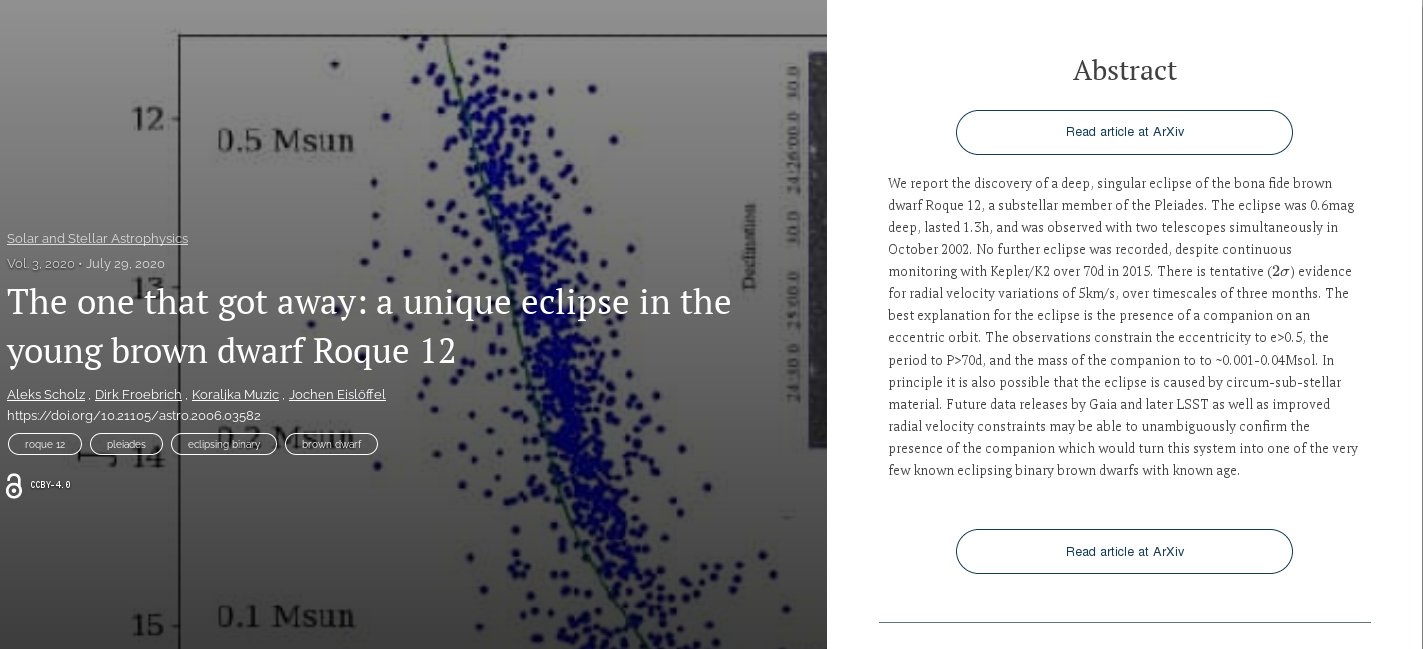
The intriguing title of the latest paper is The one that got away: a unique eclipse in the young brown dwarf Roque 12. There’s also a blog post by one of the authors that tells the fascinating behind-the-scenes story of this paper.

The authors of the paper are Aleks Scholz (University of St Andrews, UK), Dirk Froebrich (University of Kent, Canterbury, UK); Koraljka Muzic (University of Lisbon, Portugal) and Jochen Eislöffel (TLS Tautenburg, Germany).

Here is a screen grab of the overlay:

You might notice that we now have the volume number appearing on the overlay, a change we requested recently from Scholastica.

You can find the arXiv version of the paper here.

The Open Journal of Astrophysics is now in the Directory of Open Access Journals!

Posted in Open Access with tags , , on July 28, 2020 by telescoper

One of the things I did during the recent Covid-19 campus closure was to complete an application for the Open Journal of Astrophysics to be indexed in the Directory of Open Access Journals (DOJA).

I did apply late last year but there was an issue with the registration of the ISSN (International Standard Serial Number) which had not been done correctly when it was issued by the National Library of Ireland. That was easily fixed but DOAJ requires unsuccessful applicants to wait six months before applying again.

Getting listed on DOAJ is by no means trivial. The criteria are rather strict and the application form rather lengthy. All of which means that I was delighted to learn today that my application was successful this time, and we’re now listed.

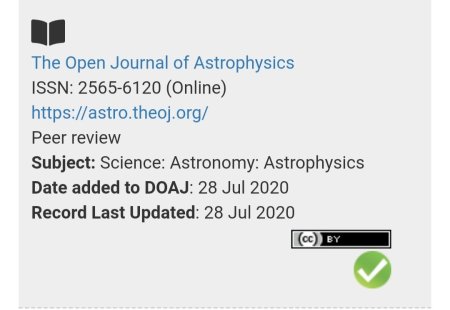
To prove it here is our entry:

Apart from the intrinsic usefulness of being indexed, being listed on DOAJ is one of the criteria for being an acceptable Open Access publisher for some funding agencies, including those who have signed up for Plan S.

I also imagine that our being on DOAJ might convince new authors to submit to us!

All I have to do now is figure out how to add our papers and metadata to the DOAJ and find the time to do it.

P. S. The Directory of Open Access Journals also has a WordPress blog which you can find here!

More Lockdown Perspectives on the Hubble Tension and thoughts on the future of scientific publications

Posted in Open Access, The Universe and Stuff with tags , , , , on July 28, 2020 by telescoper

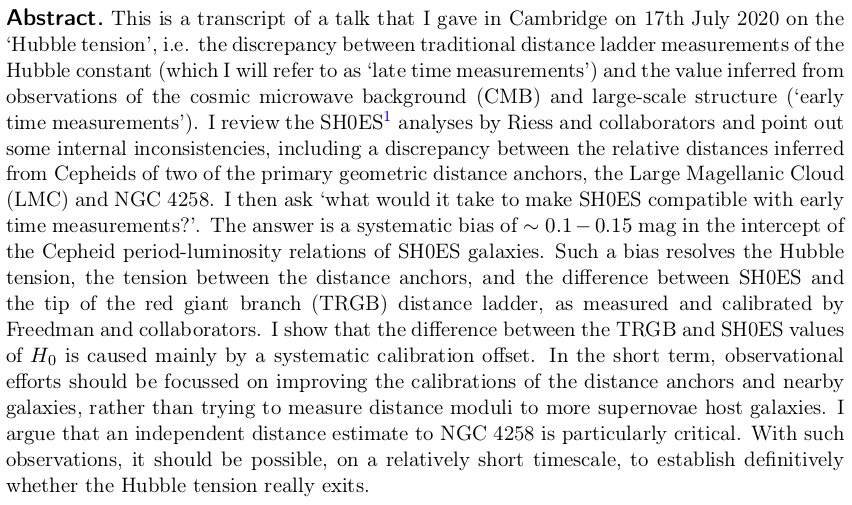
This is interesting. Remember last week when I posted about a paper by George Efstathiou on the Hubble Constant controversy. This is the abstract.

Well, a new version of the paper has just appeared on the arXiv that includes some comments in response from the SH0ES team.

It is of course interesting in itself to see the cut and thrust of scientific debate on a live topic such as this, but in my mind at least it raises interesting questions about the nature of scientific publication. To repeat something I wrote a a while ago, it seems  to me that the scientific paper published in an academic journal is an anachronism. Digital technology enables us to communicate ideas far more rapidly than in the past and allows much greater levels of interaction between researchers. I agree with Daniel Shanahan that the future for many fields will be defined not in terms of “papers” which purport to represent “final” research outcomes, but by living documents continuously updated in response to open scrutiny by the research community.

The Open Journal of Astrophysics is innovative in some ways but remains wedded to the paper as its fundamental object, and the platform is not able to facilitate interaction with readers. Of course one of the worries is that the comment facilities on many websites tend to get clogged up with mindless abuse, but I think that is manageable. I have some ideas on this, but for the time being I’m afraid all my energies are taken up with other things so this is for the future.

I’ve long argued that the modern academic publishing industry is not facilitating but hindering the communication of research. The arXiv has already made academic journals virtually redundant in many of branches of  physics and astronomy; other disciplines will inevitably follow. The age of the academic journal is drawing to a close, and it is consequently time to rethink the concept of a paper.