New Publication at the Open Journal of Astrophysics!

Posted in OJAp Papers, Open Access, The Universe and Stuff with tags , , , , , , on January 8, 2020 by telescoper

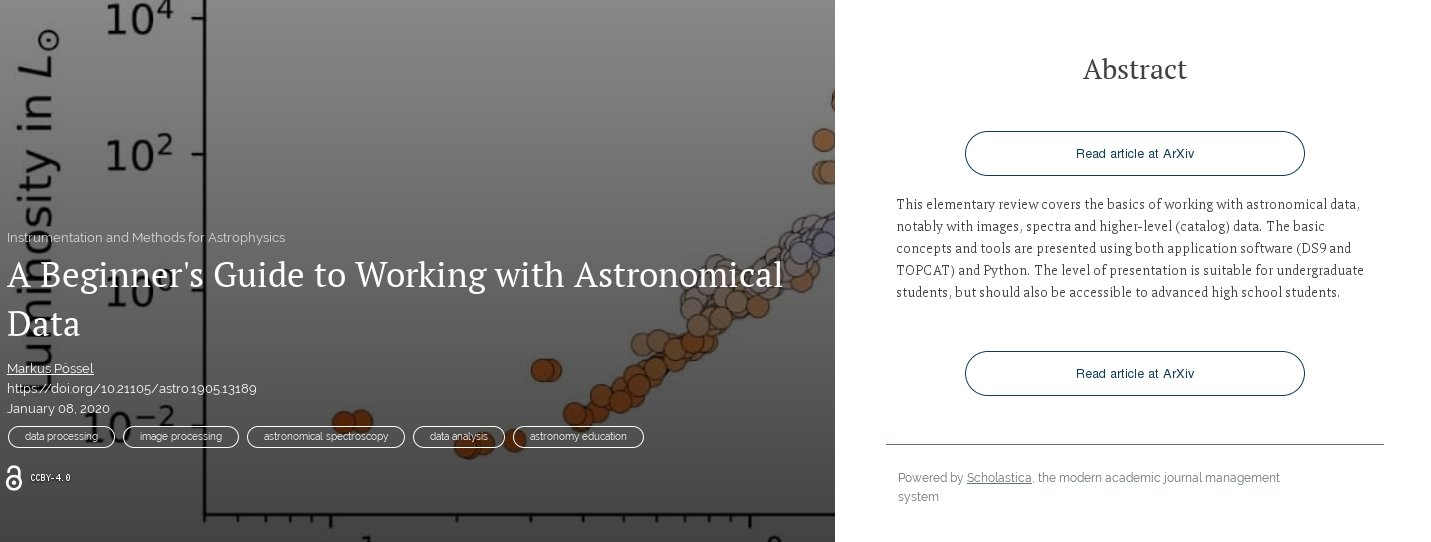
It’s two in two days because we have published another new paper at The Open Journal of Astrophysics. The title is A Beginner’s Guide to working with Astronomical Data. Here is a grab of the overlay:
You can find the arXiv version of the paper here.

The author is Markus Pössel of the Haus der Astronomie at the Max Planck Institute for Astronomy in Heidelberg (Germany). This is a long paper – 71 pages with over a hundred figures – that gives a comprehensive introduction to the various kinds of astronomical data and techniques for working with such data. I think this paper will attract a lot of interest from many different kinds of people but it will be particularly interesting to students doing undergraduate projects involving astronomical data (and their supervisors).

Another point worth noting is that there’s a small addition to the overlay for this paper, which will apply to all future papers (and retrospectively once we have worked through the back catalogue) and that is in the bottom left of the image above. It shows that the article is published with the latest form of Creative Commons License (CC-BY-4.0). It has always been our policy to publish under a CC-BY licence but Scholastica have very helpfully set up a new facility to make this explicit on each page. This is part of our efforts to ensure that we are compliant with Plan S which makes CC-BY licenses mandatory.

UPDATE: the CC-BY-4.0 license has now been applied retrospectively to all our publications.

New Publication at the Open Journal of Astrophysics!

Posted in OJAp Papers, Open Access, The Universe and Stuff with tags , , , on January 7, 2020 by telescoper

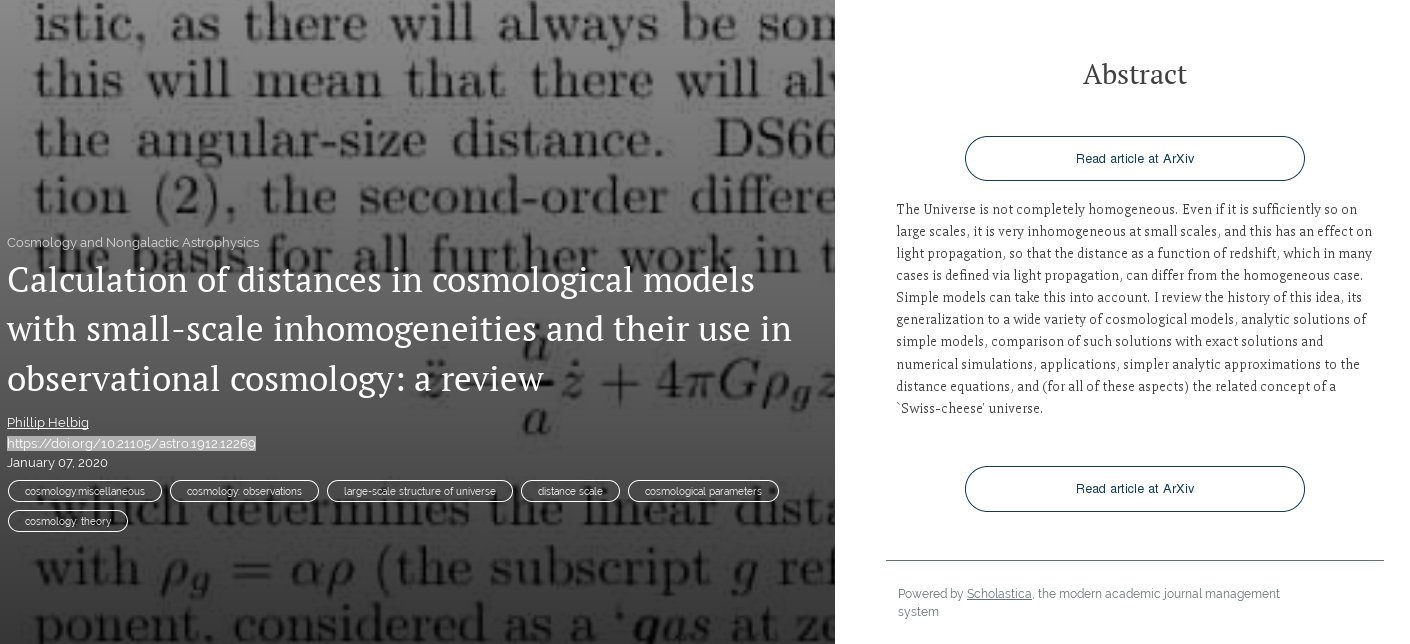
Back after the New Year break we have published another new paper at The Open Journal of Astrophysics, our first of 2020!

Here is a grab of the overlay:

The author is Phillip Helbig (Who? Ed). This is a review article. Our `For Authors‘ page includes the following:

We may accept review articles on appropriate subjects if the Editorial Board considers them a useful contribution to the literature.

You can find the accepted version on the arXiv here. This is another one for the `Cosmology and Nongalactic Astrophysics’ section . We would be very happy to get more submissions from other areas, especially Stellar and Planetary astrophysics. Hint! Hint!

P.S. Just another reminder that we now have an Open Journal of Astrophysics Facebook page where you can follow updates from the Journal should you so wish..

A Blog on Nollaig na mBan

Posted in Biographical, Maynooth on January 6, 2020 by telescoper

In the Liturgical Calendar today (6th January) is the date of Epiphany, the tradition arrival date of the Wise Men from the East bearing gifts. Like them I also travelled from the East today and gave arrived at my destination in Maynooth. Not sure about the gifts though.

In Ireland today is also Nollaig na mBan (Women’s Christmas), a day on which it is traditional for women to get together and enjoy their own Christmas, while the menfolk stay at home and handle the chores. Although an old tradition, emanating from the West of Ireland, the traditional Nollaig na mBan has apparently had a bit of a resurgence in recent years.

Anyway it’s been a very quiet Christmas for me, not least in terms of the weather which has been mild and largely rain-free. Except, that is, for the precise time that I walked to the bus stop to get the bus to Cardiff Airport during which I got drenched. I’ve been away from Ireland for a couple of weeks so don’t know what it has been like here but it’s a lot chillier here. My flat is particularly cold as the heating has been off all the time I’ve been away.

I was supposed to be in the office today but I only realised on Saturday that I’d booked my return flight on 6th (today) not 5th (yesterday). Not a great start to a year in which I am supposed to be improving my time management! I probably didn’t miss anything vital as there are no lectures this week; the January examination period starts on Friday and the days before that are meant for private study.

I do have quite a few things to do tomorrow though – including answering a ton of emails – so I think an early night followed by an early start tomorrow morning might be in order!

The Largest Known Spiral Galaxy – UGC 2885

Posted in The Universe and Stuff with tags , , , , , on January 6, 2020 by telescoper

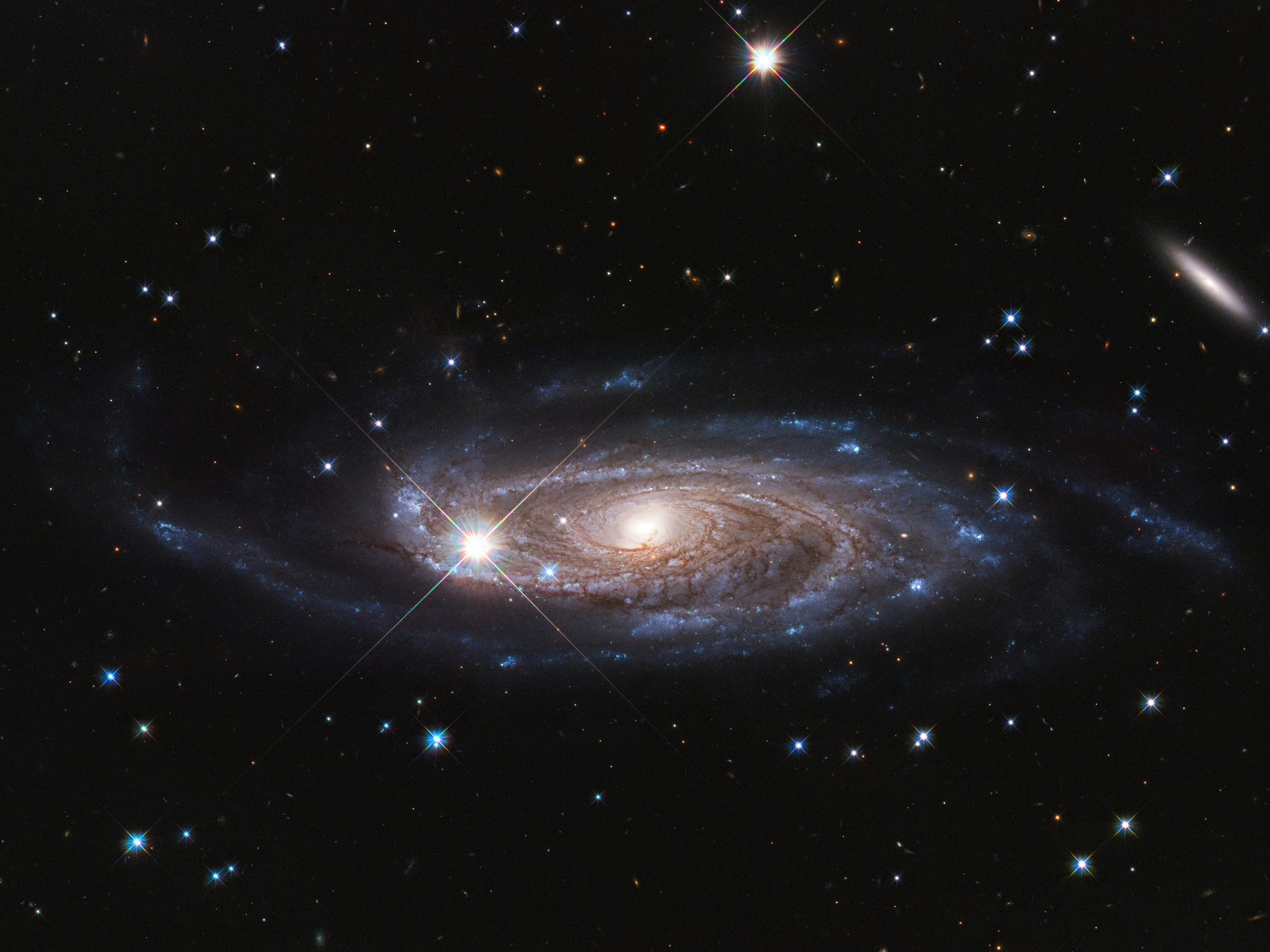
So here I am, Christmas break over, waiting in Cardiff Airport for my flight back to civilization. I thought I’d take the opportunity to share this wonderful picture, courtesy of the Hubble Space Telescope, of the galaxy UGC 2885 – the largest known spiral galaxy. You can click on the picture to make it bigger or if you really are a size queen you can download an ultra-high=resolution version here.

UGC 2885 is located about 71 Mpc (232 million light-years) from us, in the direction of the constellation Perseus. The galaxy is 2.5 times wider than our own Milky Way and contains approximately 10 times as many stars. A number of foreground stars (in our Galaxy), identified by the diffraction crosses produced by unresolved point sources, can be seen in the image, including one superimposed on the disk of the galaxy, to the left of its centre. The galaxy UGC 2885 has been nicknamed “Rubin’s galaxy” after Vera Rubin, the astronomer who studied the rotation of the galaxy and found evidence for dark matter therein.

There is a very interesting and informative thread on Twitter by Benne Holwerda covering the background to this latest image of the galaxy:

If you click on the above it will take you to Twitter where you can read the series of linked tweets on this subject by clicking on `show this thread’.

Call for support for Carrick McClean school student barred from A-Levels due to having a beard

Posted in Beards on January 5, 2020 by telescoper

Mr Carrick Mcclean has been barred from his A-level* classes at St Columb’s College in Derry because of his facial hair. Please sign the petition to have him reinstated. I’m sure such blatant pogonophobic discrimination would not be tolerated in a United Ireland.

*for readers in the Republic, the A-level is the Protestant Leaving Certificate.

kmflett's avatarKmflett's Blog


Beard Liberation Front

Press Release 4th January Contact Keith Flett 07803 167266

Call for support for Carrick McClean, school student barred from A-Levels due to having a beard

The Beard Liberation Front, the informal network of beard wearers, has called for support for a Derry Sixth Form student Carrick McClean.

Mr McClean has been banned from sitting for his A Level at St Columbs in Derry because he has a beard.

The pogonophobic rules of the school do not allow students to have a beard

BLF Organiser Keith Flett said, this is not the 1950s and we fully support Mr McClean. There is a petition that can be signed and we expect a change of mind by the school

https://www.change.org/p/principal-abolish-st-columb-s-college-clean-shaven-policy

View original post

Advance of Perihelion

Posted in The Universe and Stuff with tags , , , , , , , on January 4, 2020 by telescoper


Tomorrow (Sunday 5th January 2020) at approximately 07.48 GMT the Earth reaches at the point on its orbit at which it is at its closest to the Sun, i.e. at its perihelion. At this time the distance from the Sun’s centre to Earth’s centre will be 147,091,144 km.

This year, aphelion (the furthest distance from the Sun) is  at 12.34 GMT on July 4th 2020 at which point the centre of the Earth will be 152,095,295 km from the centre of the Sun.

You can find a list of times and dates of perihelion and aphelion for future years  here.

It surprises me how many people think that the existence of the seasons has something to do with the variation of the Earth’s distance from the Sun as it moves in its orbit. The fact that perihelion occurs in the depth of winter should convince anyone living in the Northern hemisphere that this just can’t be the case, as should the fact that it’s summer in the Southern hemisphere while it is winter in the North.

The real reason for the existence of seasons is the tilt of the Earth’s axis of rotation. I used to do a little demonstration with a torch (flashlight to American readers) to illustrate this when I taught first-year astrophysics. If you shine a torch horizontally at a piece of card it will illuminate a patch of the card. Keep the torch at the same distance but tilt the card and you will see the illuminated patch increase in size. The torch is radiating the same amount of energy but in the second case that energy is spread over a larger area than in the first. This means that the energy per unit area incident on the card is decreases when the card is tilted. It is that which is responsible for  winter being  colder than summer. In the summer the sun is higher in the sky (on average) than in winter. From this argument you can infer that the winter solstice not the perihelion, is the relevant astronomical indicator of winter.

That is not to say that the shape of the Earth’s orbit has no effect on temperatures. It may, for example, contribute to the summer in the Southern hemisphere being hotter than in the North although it is not the only effect. The Earth’s surface possesses a significant North-South asymmetry: there is a much larger fraction of ocean in the Southern hemisphere, for example, which could be responsible for moderating any differences in temperature due to isolation. The climate is a non-linear system that involves circulating air and ocean currents that respond in complicated ways and on different timescales not just to insolation but to many other parameters, including atmospheric composition (especially the amount of water vapour).

The dates when Earth reaches the extreme points on its orbit (apsides) are not fixed because of the variations in its orbital eccentricity so, in the short-term, the dates can vary up to 2 days from one year to another. The perihelion distance varies from year to year too.

There is however a long-term trend for perihelion to occur later in the year. For  example, in 1246, the December Solstice (Winter Solstice for the Northern Hemisphere) was on the same day as the Earth’s perihelion. Since then, the perihelion and aphelion dates have drifted by an average of one day every 58 years and this trend will continue. This means that by  the year 6430 the timing of the perihelion and the March Equinox will coincide (although I will probably have retired by then).


In defence of the indefensible.

Posted in Uncategorized on January 4, 2020 by telescoper

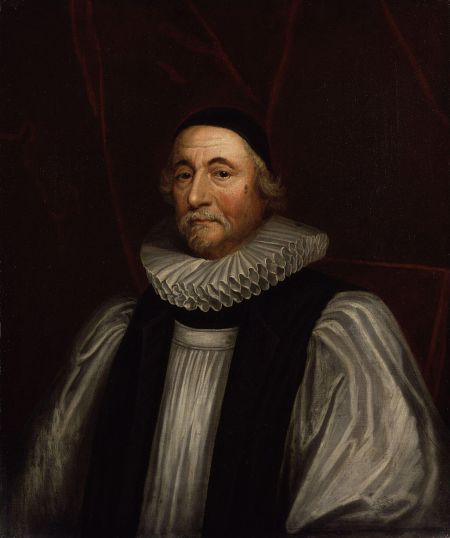
I came across this very interesting piece just now via Twitter. It’s not new but was circulated today, January 4, it is the birthday of Church of Ireland Archbishop of Armagh and Primate of All Ireland James Ussher, who was born in 1581.

thonyc's avatarThe Renaissance Mathematicus

Friday was the 23rd of October and the Internet sceptics had a field day mocking one of their favourite punching bags James Ussher (1581 – 1656) Archbishop of Armagh. Ussher is notorious for dating the creation of the world to 6 pm on the 22nd of October 4004 BCE (and not 9 am on 23rd October as Pharyngula falsely stated) a fact that the hordes of Pharyngula and other similar self appointed defenders of scientism love to brandish as a proof of the stupidity of Christians.

1024px-james_ussher_by_sir_peter_lely James Ussher Source: Wikimedia Commons

However Ussher has a right to be judged by the social and cultural standards of his own time and not those of the twenty first century. Who knows which things that we hold sacred will be ridiculed by sneering sceptics in three or four hundred years? “Can you believe it in the early 21st century…

View original post 990 more words

The Strategic Academic Leadership Initiative Begins

Posted in Education, Maynooth with tags , , , , , on January 3, 2020 by telescoper

I was caught on the hop this morning by the formal announcement that twenty new professorships for women have been created in Ireland. I hadn’t expected this announcement to come so quickly since the idea was only floated in November 2018. There is a piece in the Irish Times about today’s announcement here.

I blogged about this scheme here when it was announced, a little over a year ago. The appointments are to be in areas where there is “clear evidence” of significant under-representation of women, such as physics, computer science and engineering.

I’m delighted that two of these new positions will be at Maynooth University, one in Computer Science and one in Physical Geography (in the area of Climate Science). These areas were selected as being of particularly high strategic priority.

The 20 new Chairs represent the first tranche of positions out of 45 planned under the Strategic Academic Leadership Initiative. I understand there will be two further rounds. I do hope that we might get a position in physics at Maynooth in a subsequent round. I note however that there will be a Professorship in Theoretical Physics at Dublin Institute for Advanced Studies. I’ll be sure to pass on the advertisement here when it appears.

Reactions to this scheme among people I know have been very varied, so it seems a good topic on which to have a simplistically binary poll:

For the record, I should state that although I had reservations when about this scheme when it was first announced, largely due to lack of detail about how it was to be implemented, I am now very enthusiastic about it and hope it is successful in its aims.

I will however also repeat that this initiative should not distract attention away from the need for Irish higher education institutions to have much better promotion procedures; see, e.g. here. There are plenty of female academics at lecturer level in Irish universities, but they seem to face serious difficulties getting promoted to Professorships.

Not my New Year’s Resolutions

Posted in Biographical, Music on January 2, 2020 by telescoper

What we call the beginning is often the end. And to make an end is to make a beginning. The end is where we start from.

from Four Quartets, ‘Little Gidding’ by T. S. Eliot.

I said yesterday that I don’t really do New Year’s resolutions (largely because I know I’m no good at keeping them) but in an idle moment this morning (or should I say “a period of reflection”?) I posted on Twitter a few things I hope to achieve in 2020 and thought I’d share them here.

In no particular order:

  1. Go to more live concerts. Although I enjoy the radio and recordings, I far prefer to listen to live music at concerts. Attending such events helps also support the venues and musicians as without an audience both would die. I’m ashamed to say I haven’t heard any live jazz in Ireland!
  2. See more of Ireland. I moved to Maynooth two years ago but apart from one visit to Galway and one to Armagh I still haven’t travelled much beyond the Dublin area. I must get around more, especially to the South.
  3. No more working weekends. I’ve been in the office for at least one day every weekend since I started at Maynooth. I did the same when I was at Sussex too, and seem to have relapsed. I have always had problems managing my own work/life balance but I realise it’s not setting a good example to younger folk to be getting it so obviously wrong. I’ll add not reading work emails at weekends to this.
  4. Be a better colleague. This is something I think one should always strive to be, but I have particular need to improve. I know that over the last four years or so things weighed very heavily on me behind the scenes and I ended up letting people down on too many occasions. I apologise for that and will try to do better in future.
  5. Read more books. I used to be a voracious reader of all kinds of books, both fiction and non-fiction, but I somehow got out of the habit. I now have a stack of unread works that I must try to read before the year is out!
  6. Finish more things! Not unrelated to No. 4 above, I have been very poor over the last few years at completing projects and writing papers. I need to clear the backlog and get on with some new things.
  7. Do more to promote Open Access publishing. I’m not surprised that the status quo in academic publishing is proving hard to dislodge, but I believe that change can be achieved if researchers take the initiative. I’m proud of what we have achieved so far at the Open Journal of Astrophysics but there’s much more to be done.

There are some others, but they’re too personal to put on here!

The New Year’s Old Year Blog Statistics

Posted in Uncategorized on January 1, 2020 by telescoper

Here we are then, in 2020. I thought I’d see in the New Year by following the tradition of doing a quick blog about this blog.

Once upon a time, in the good old days, in the dim and distant past, WordPress used to publish an annual statistical summary page for its bloggers, but it has discontinued that practice so now I’ll just write my own brief summary based on the data available via the usual dashboard.

For those interested I got about 340K hits last year, just over 930 a day, with about 168K unique views. That’s down quite a bit (~19%) since last year. In fact 2019 saw the lowest visitor numbers here since 2010. I guess interest in my ramblings is waning out there. I’m just surprised it has taken so long!

Despite the sharp decrease, I still get more readers than I ever thought I would when I started way back in 2008 so I think I’ll keep going, at least for now.

Incidentally, there are 1652 followers of In The Dark on WordPress itself. These are fellow bloggers who use the built-in reader to access posts. I don’t know whether or not these are counted in the above visitor numbers.

In 2019 there were 1963 comments, also down sharply on last year. In the same period, however, posts received 1898 ‘likes’; that’s a big increase on last year’s figure. The most liked category, incidentally, was Poetry.

Altogether, since this blog started in 2008 to the end of 2019, it has been viewed about 4.1 million times by a total of 1.4 million unique visitors (though, obviously, all my visitors are unique).

Athbhliain faoi shéan is faoi mhaise daoibh go léir!

P. S. I don’t really go in for New Year’s resolutions but I really hope that this year I can sell my old house, buy a new one, and complete my relocation to Ireland.