Gas Filaments in the Cosmic Web

Posted in Astrohype, The Universe and Stuff with tags , , , , , on October 4, 2019 by telescoper

I saw that there’s a new paper that has just been published in the journal Science by Umehata et al with the title Gas filaments of the cosmic web located around active galaxies in a protocluster. In case you run into a paywall at Science, you may of course, find the paper on the arXiv here.

The abstract reads:

Cosmological simulations predict the Universe contains a network of intergalactic gas filaments, within which galaxies form and evolve. However, the faintness of any emission from these filaments has limited tests of this prediction. We report the detection of rest-frame ultraviolet Lyman-alpha radiation from multiple filaments extending more than one megaparsec between galaxies within the SSA 22 proto-cluster at a redshift of 3.1. Intense star formation and supermassive black-hole activity is occurring within the galaxies embedded in these structures, which are the likely sources of the elevated ionizing radiation powering the observed Lyman-alpha emission. Our observations map the gas in filamentary structures of the type thought to fuel the growth of galaxies and black holes in massive proto-clusters.

The existence of a complex cosmic web of filaments and voids has been known about for some time as it is revealed on large scales by the distribution of galaxies through redshift surveys:
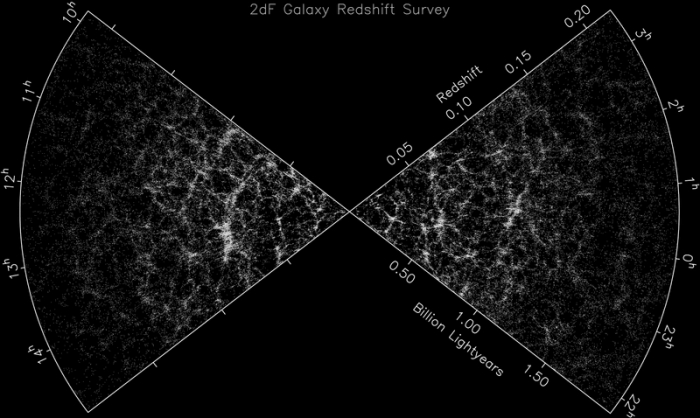
You can see all my posts agged with `Cosmic Web’ here. There are also good theoretical reasons (besides numerical simulations) for believing this is what the large-scale distribution of matter should look like. Roughly speaking, dense knots of matter lie at the vertices of a three-dimensional pattern traced out by one-dimensional structures.

We have also known for some time, however, that there is more going on in cosmic structure than is revealed by light from stars in galaxies. In particular the way gas flows along the filaments into the knots plays an important role in galaxy and cluster formation. This paper reveals the distribution of gas around a giant cluster that has formed at such a node using observations made using the European Southern Observatory’s MUSE instrument.

Here’s a pretty picture:
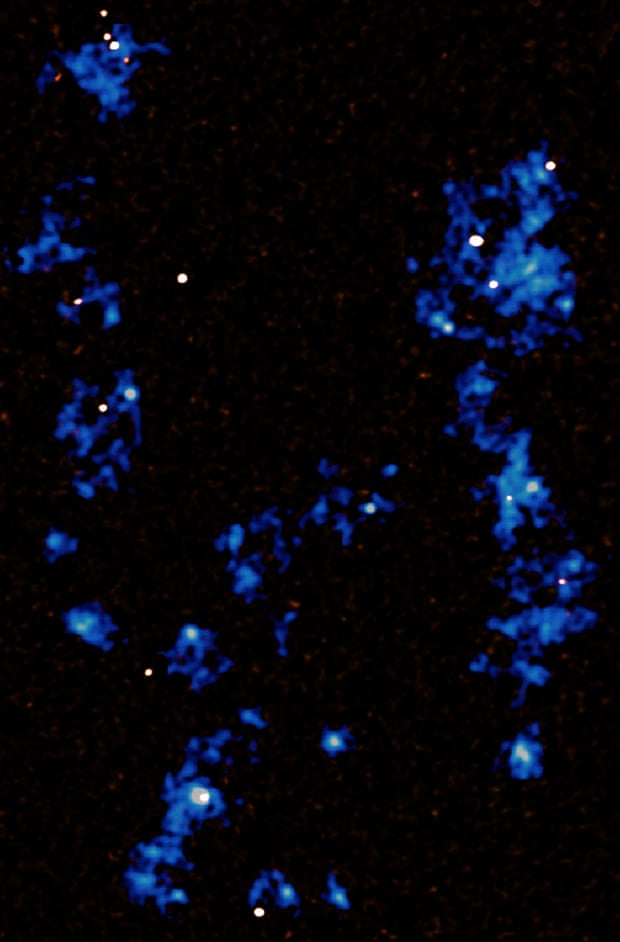
I found out about this paper from a news piece in the Guardian with the title Scientists observe mysterious cosmic web directly for first time. That’s sufficiently misleading for me to cross-file the paper under `Astrohype’ because, as I explained above, we have been observing the cosmic web for decades. It is however only just becoming possible to observe the diffuse gas rather than having to join the dots between the galaxies so it is an exciting result. My complaint, I suppose, is that the word `directly’ is doing a lot of heavy lifting in the title!

After the Storm..

Posted in Maynooth with tags , , on October 4, 2019 by telescoper

Storm Lorenzo passed over Maynooth during the night bringing with it a lot of rain but at least the winds were not too fierce. At least I assume they were not too fierce because I slept through the whole thing. I tend to sleep well with a bottle of fine wine inside me.

This morning as I walked into work it was still raining but other than that fairly peaceful. Maynooth University Library Cat was on post despite the rain although he was looking a bit bedraggled and his food dishes were filled with water. He must have had a rough night, as I’m not sure his box provided must protection. Unfortunately this was one morning when I didn’t have any treats for him in my pocket so I hope some other nice person gives him something to eat!


Government of Ireland Postdoctoral Fellowships

Posted in Uncategorized with tags , on October 3, 2019 by telescoper

Before I go home to shelter from Storm Lorenzo I thought I’d use the medium of this blog to advertise the Government of Ireland Postdoctoral Research Fellowships which have just been announced by the Irish Research Council.

These positions are of one or two years’ duration starting from 1st October 2020. The research relating to the fellowship can be in any discipline (including Astrophysics and Cosmology, hint hint….) and can be held in any University in the Irish Republic (including Maynooth, hint hint..). These positions are intended for early career researchers; applicants are required to have a PhD by May 2020 but not have been awarded it before May 2015.

The deadline for completed applications is 20th November 2019.

For further information, see here.

Anyone interested in applying to hold one of these positions in Maynooth is welcome to contact me privately for advice and/or assistance!

The Calm Before Lorenzo

Posted in Maynooth, The Universe and Stuff with tags , , on October 3, 2019 by telescoper

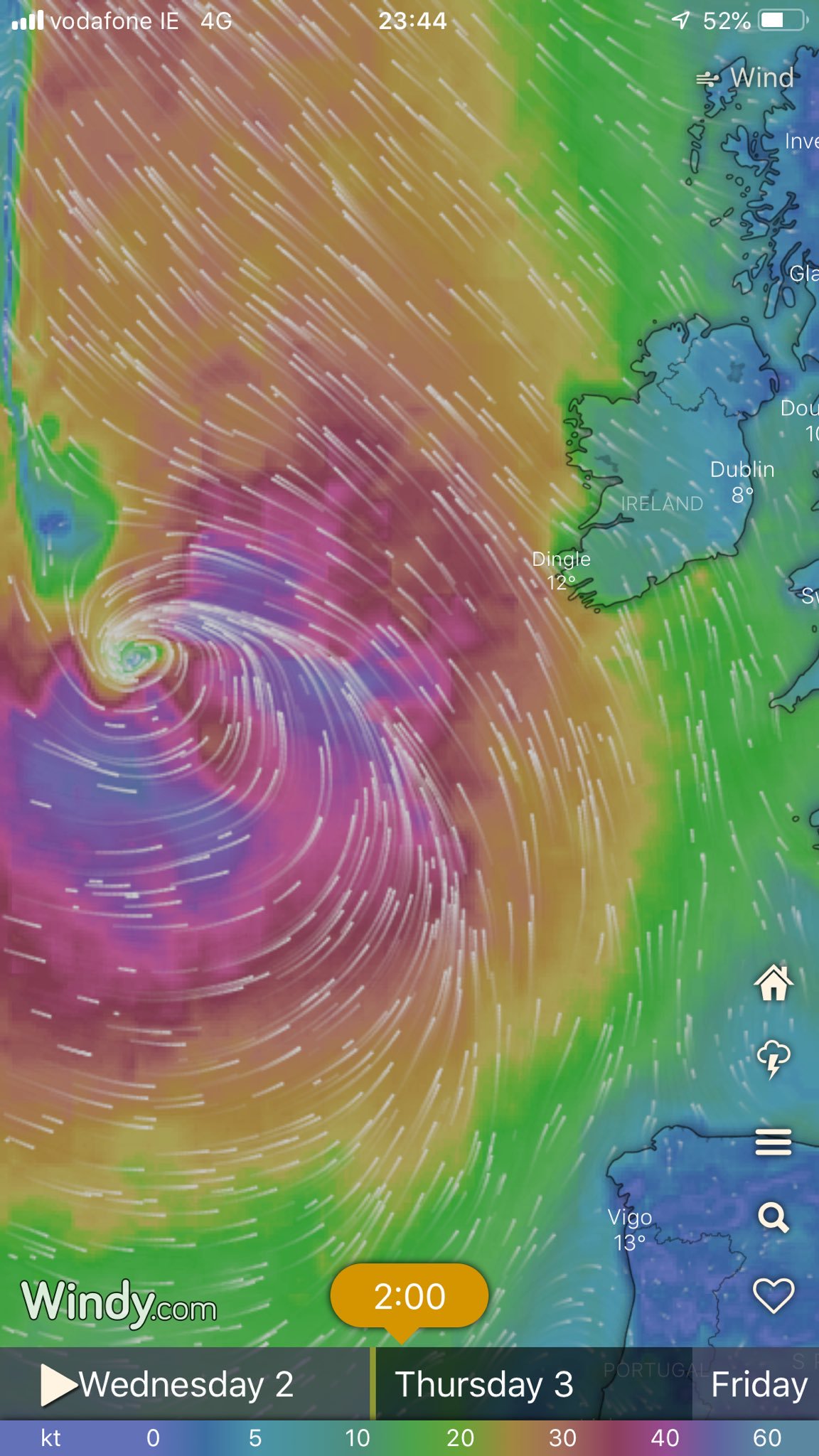
It was calm and rather mild this morning as I walked into work, although the news on the radio this morning was filled with news about the rapidly approaching Storm Lorenzo. Lorenzo is a huge storm and was only downgraded from hurricane to tropical storm when it was about 500km from the Irish coast so it could be even more serious than Storm Ophelia, which caused chaos a couple of years ago.

This is how the storm looked in the early hours of this morning:

And this is the projection for later today. The prevailing wind right now is westerly, but this will veer to south-westerly as the storm moves along its (roughly) north-easterly path:

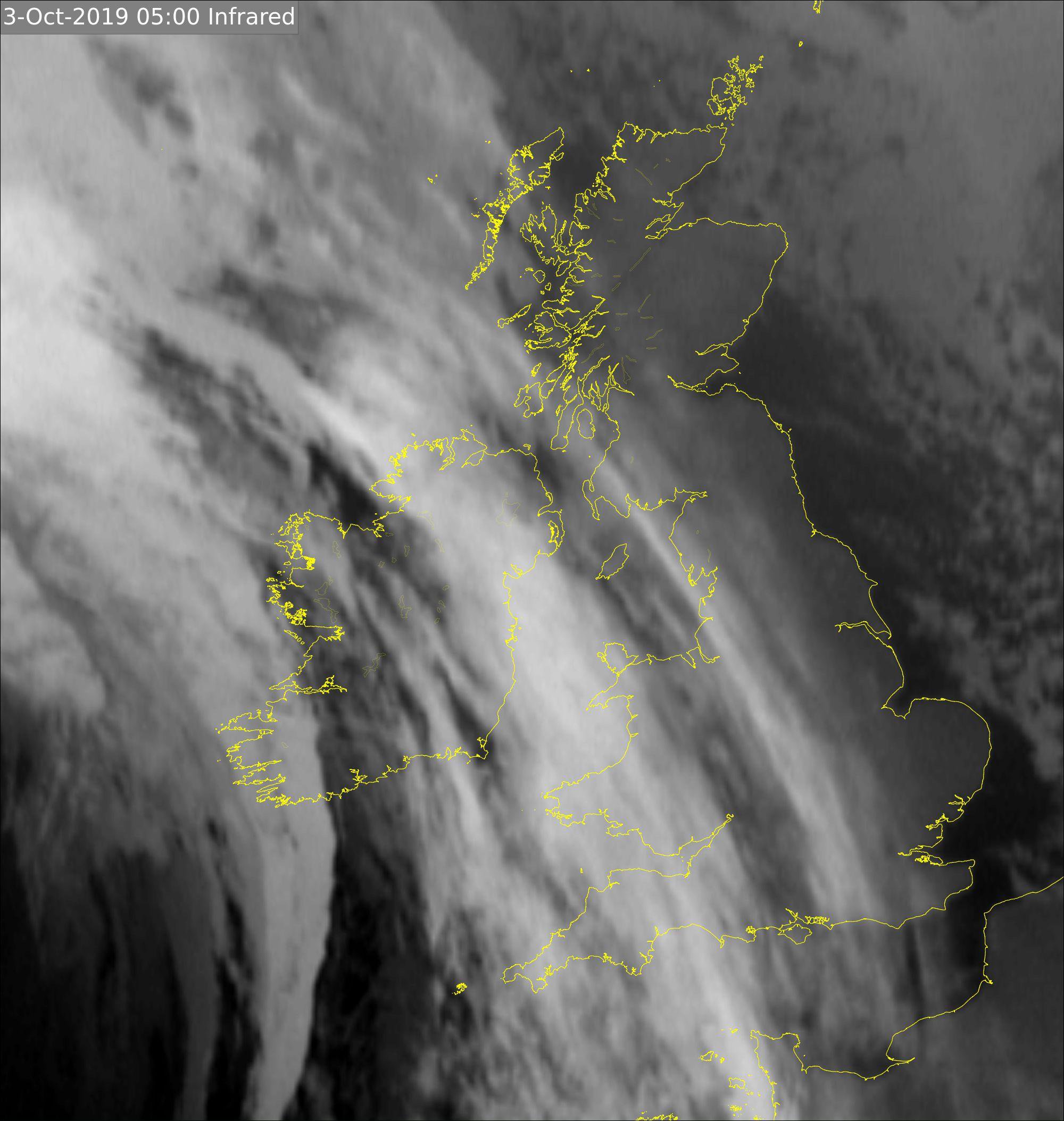
Here is an infra-red image taken this morning showing the outer belts of cloud already over Ireland.

Quite a few events have been called off in anticipation of the arrival of Storm Lorenzo this evening, with heavy rain and gale force winds forecast across the country. There are signs, however, that the low pressure region at the heart of the storm is filling more rapidly than expected, so it might not be as severe as feared, although there remains a significant risk of localized flooding and wind damage, especially in the West. I plan to sit it out at home this evening with a glass or two of wine for company…

Scholastica Webinar – The Open Journal of Astrophysics Project

Posted in Maynooth, Open Access with tags , , on October 2, 2019 by telescoper

As you may know, together with Fiona Morley of Maynooth University Library, last week I contributed to this `webinar’:

If you missed the event itself then you can follow the link here to access a full recording of the webinar. You can also find a quick summary of the goings-on here.

And if all this weren’t exciting enough, here are the slides I used for my bit.


Dido’s Lament – Jessye Norman

Posted in Opera with tags , , on October 1, 2019 by telescoper

I found out this morning that the wonderful Jessye Norman passed away yesterday at the age of 74. It’s impossible to post an adequate tribute in words to such a stellar artist so I’ll just post a clip of her, not in one of the big operatic number by Wagner or Strauss with which she was probably most strongly associated, but in a piece from a different era altogether:  Dido’s Lament by Henry Purcell. It seems to be an apt choice at this sad time.

R.I.P. Jessye Norman (1945-2019).


A Diary of the Other Place

Posted in Biographical, The Universe and Stuff with tags , , , , on October 1, 2019 by telescoper

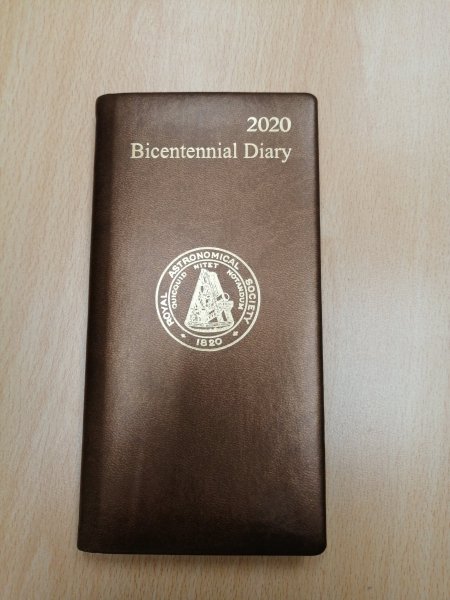
The arrival yesterday of this year’s Royal Astronomical Society diary reminded (for obvious reasons) that next year (2020) sees the bicentenary of the Society and that there will be a number of special events to mark the occasion.

According to the brief history published on the RAS website:

The ‘Astronomical Society of London’ was conceived on 12 January 1820 when 14 gentlemen sat down to dinner at the Freemason’s Tavern, in Lincoln’s Inn Fields, London. After an unusually short gestation the new Society was born on 10 March 1820 with the first meeting of the Council and the Society as a whole. An early setback, when Sir Joseph Banks induced the Duke of Somerset to withdraw his agreement to be the first President, was overcome when Sir William Herschel agreed to be the titular first President, though he never actually took the Chair at a meeting.

The Society became the `Royal Astronomical Society’ in 1831 when it was granted a Royal Charter by William IV, but this is no time to be quibbling about names.

It’s not only the Royal Astronomical Society that has survived and prospered for two hundred years. The group of `gentlemen’ who met for dinner in January 1820 has also carried on in the form of the RAS Club which is, of course, older than the RAS itself.

As well as being a Fellow of the Royal Astronomical Society (and having twice served on its Council), I also have the honour of having been elected a Member of the RAS Club about 11 years ago. I blogged about this here.

The members of the RAS Club are all Fellows of the Royal Astronomical Society. All you have to do to join the Royal Astronomical Society is to find two Felllows to support you, pay some money and sign your name in a book, but to get into the RAS Club you have to be elected by the existing membership. Nominations are solicited each November (via a process called `The Naming of Names’) and the elections held – usually with a great deal of confusion about the voting system – in January. Frankly, it’s all a bit dotty, but I like it. I don’t really carte much for the real world anyway. The club’s various little rituals are a bit bizarre, but quaintly amusing in their own way, and the proceedings are remarkably lacking in pomposity.

Nowadays, the RAS Club usually meets at the Athenaeum in Pall Mall, shortly after the end of the monthly `Ordinary Meetings’ of the RAS at Burlington House (always referred to at the Club as `another place’) which happen on the second friday of each month. That is except when the RAS meeting is the annual National Astronomy Meeting (NAM) which is held at a different location each year; on these occasions the club also meets, but at an appropriate alternative venue near the NAM location.

I think the RAS Club (and even the RAS itself) is sometimes viewed with suspicion and perhaps even hostility by some astronomers, who seem to think the club is a kind of sinister secret society whose existence is intrinsically detrimental to the health of astronomy in the UK. Actually it’s just an excuse for a good nosh-up and some daft jokes, although I was initially disappointed to find out that there wasn’t after all a covert plan for world domination. Or if there is, nobody told me about it.

The other common complaint is that the club’s membership is just a bunch of old male dinosaurs. Now it is true that your typical member of the RAS Club isn’t exactly in the first flush of youth, but that’s no excuse for ageism. And the club does try very hard to secure encourage nominations from female Fellows and the gender balance is improving steadily.

The diary reminded me also that the first meeting of the RAS of the new term, and hence the first Club dinner, will be on Friday October 11th. I hope to be there to find out more about the plans for the bicentennial dinner in January 2020…

Anyway, as a postscript, although many of my colleagues seem not to use them, I like old-fashioned diaries like the one above. I do run an electronic calendar for work-related events, meetings etc, but I use the paper one to scribble down extra-curricular activities such as concerts and cricket fixtures, as I find the smartphone version of my electronic calendar a bit fiddly. I’m interested to know the extent to which I am an old fogey so here’s a little poll on the subject of diaries:

The Problem of the Disintegrating Asteroid

Posted in Cute Problems, The Universe and Stuff with tags , , on September 30, 2019 by telescoper

I thought you might enjoy this entry in the Cute Problems folder.

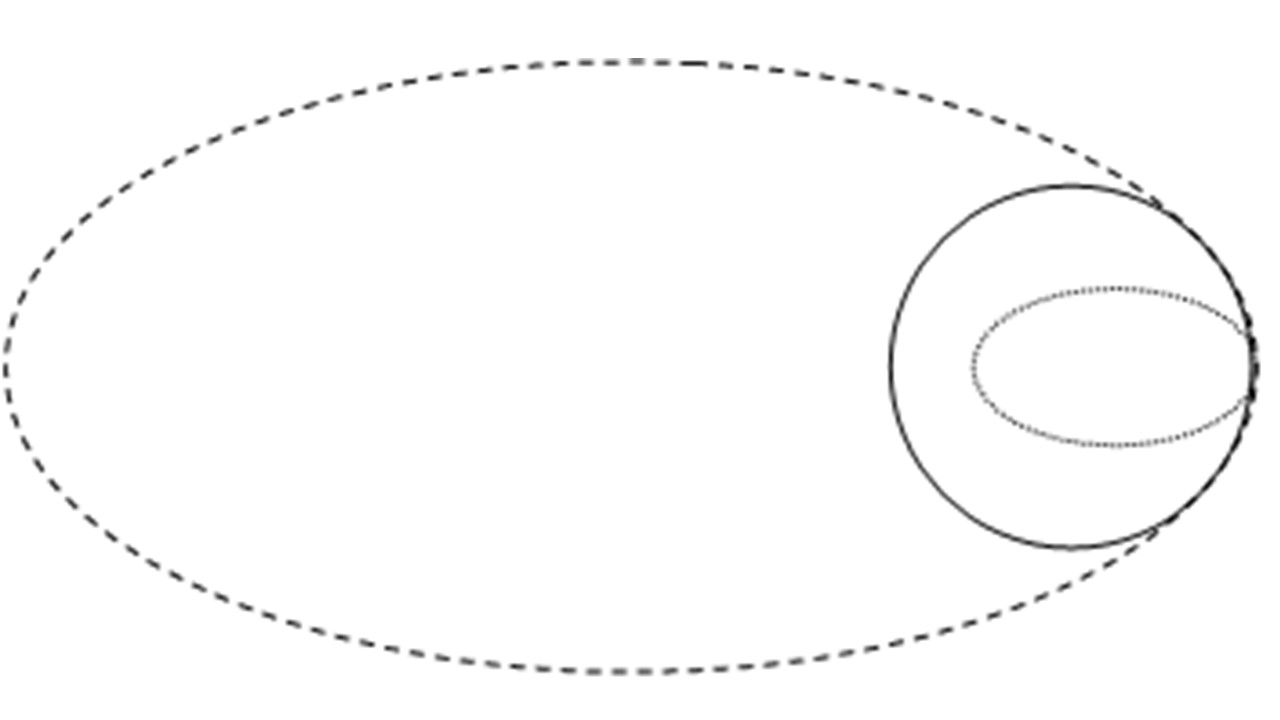
An asteroid is moving on a circular orbit around the Sun with an orbital radius of 3AU when it spontaneously splits into two fragments, which initially move apart along the direction of the original orbit. One fragment has a speed which is a fraction 0.65 of the original speed, the other has a speed of 1.35 times the original speed. The original orbit (solid line) is shown above, along with the two new orbits (dashed and dotted).

  1. Which orbit does the fast fragment follow, and which the slow fragment?
  2.  Calculate the original orbital speed in AU/year.
  3. Calculate the angular momentum per unit mass, h, of the original asteroid and of each of the two fragments in units of AU2 per year. [HINT: Show that in these units, for a general orbit of eccentricity e and semi-major axis a, h2=4π2 a (1-e2).]
  4.  Calculate the eccentricities of the orbits of the two fragments.
  5.  Calculate the orbital periods of the two fragments in years.

Answers please through the Comments box. First complete set of answers wins a trip to the Moon on gossamer wings.


More on Comments

Posted in Uncategorized with tags , , on September 29, 2019 by telescoper

At the end of the month I usually give the blog a bit of a clean out, especially the blocked comments that have accumulated in my filter. Here’s just a sample of the contributions from my admirer, Mr Hine. These are just a few of the dozens of comments he’s failed to post here. No doubt he’ll try to post some more gibberish when he sees this but although I know it makes me a bad person, I just can’t resist winding him up.

A Drunk and Disorderly Brexit

Posted in Politics with tags , , on September 28, 2019 by telescoper

Having to return to Parliament following the Supreme Court’s unanimous (and undoubtedly correct) decision that Boris Johnson’s attempted prorogation was unlawful seems to have driven certain Tories to drink (or something stronger).

The clip above shows a clearly intoxicated Michael Gove (not just an MP but a Cabinet Minister) in the House of Commons.

More generally I’m sure that alcohol played a big part in the appallingly offensive language and shouty behaviour coming from the Government benches, including from the Prime Minister who, for some reason, has not yet resigned but is regularly too tired and emotional to speak any sense at all. It wouldn’t surprise me if he were to be found dead drunk in a ditch before too long.

The Houses of Parliament are supposed to be places of work for MPs. Most of us would be summarily dismissed if we turned up at our workplace steaming drunk and I don’t see any reason why it should be any different for Members of Parliament.

If I had my way all MPs would be breathalyzed before being allowed to participate in a debate or vote at a division. Anyone over the limit should be barred.

After much sober reflection, I think keeping the drunk and disorderly out of Parliament might not only improve the quality and civility of the debates but also improve the decision-making of the House.

What do you think?