In My Solitude

Posted in Jazz with tags , , , on March 2, 2020 by telescoper

Whether or not you’re in a state of self-isolation because of coronavirus, please give up three and a bit minutes of your time to listen to this little gem by the quartet that was led for a short time by Ruby Braff (cornet) and George Barnes (guitar). That band not only knew how to play but also exactly when to stop, as demonstrated on this exquisite live version of the great Duke Ellington song, In My Solitude. Michael Moore is on bass (arco on parts of this number) and Wayne Wright on rhythm guitar, but it’s Ruby Braff who takes the lead on this one, using his beautiful tone to stunning effect…


Coronavirus Reactions

Posted in Covid-19, Maynooth with tags , , on March 2, 2020 by telescoper

I was having lunch last week when a colleague from another department here stated that he thought that within two weeks that he thought that within a fortnight Maynooth University would be closed down owing to the threat from Covid-19 (the Coronavirus). I’m not sure whether he meant it seriously. At the time I thought that was extremely improbable but this morning we heard that a school in the Dublin area has been closed for two weeks because one of its students has the virus, and now I’m not so sure…

Incidentally, setting aside possible the rights or wrongs decision to close the Dublin school the attempt by the Health Service Executive to keep its name from the public strikes me as utterly daft. Do they seriously think that none of the hundreds of pupils or parents thereof is going to talk about it? I checked on social media this morning and easily found its name. It won’t give people much confidence in the HSE to see them losing sight of reality.

Another reaction to this worldwide health scare became apparent yesterday as the American Physical Society cancelled at very short notice its meeting in Denver due to take place this week. Thousands of delegates were due to attend, and many of them had already arrived when the cancellation announcement was made.

I’m bound to say that I find all this to be quite an overreaction to the threat from Covid-19, but I am not an epidemiologist and I suppose the medical people must know what they are doing. It seems the primary objective at present is to limit the spread of the disease, which makes sense particularly as there is as yet to vaccine. Whether measures like those mentioned above will actually achieve that I don’t know. One has to balance that consideration against the risk of causing panic by giving the impression that things are out of control.

We’ll just have to wait and see what happens over the next couple of weeks.

In the meantime, as part of my public service responsibility here is the official advert from the Irish Government:

Three Poems for St David’s Day

Posted in Poetry with tags , , , , , , , on March 1, 2020 by telescoper

It’s St David’s Day today, and I’m glad to say that Storm Jorge has passed, so I wish you all a big

Dydd Gŵyl Dewi Hapus!


Gratuitous Picture of some Daffodils near the Maynooth University Library.

It has become a bit of a St David’s Day tradition on this this blog to post a piece of verse by the great Welsh poet R.S. Thomas, but this year I decided to post three poems by different Welsh poets. But I’ll start with R.S. Thomas. This is The Bright Field.

I have seen the sun break through
to illuminate a small field
for a while, and gone my way
and forgotten it. But that was the pearl
of great price, the one field that had
treasure in it. I realize now
that I must give all that I have
to possess it. Life is not hurrying

on to a receding future, nor hankering after
an imagined past. It is the turning
aside like Moses to the miracle
of the lit bush, to a brightness
that seemed as transitory as your youth
once, but is the eternity that awaits you.

This one is by a poet who shared the same surname (but little else either stylistically or thematically), Dylan Thomas. It’s called Here in This Spring.

Here in this spring, stars float along the void;
Here in this ornamental winter
Down pelts the naked weather;
This summer buries a spring bird.

Symbols are selected from the years’
Slow rounding of four seasons’ coasts,
In autumn teach three seasons’ fires
And four birds’ notes.

I should tell summer from the trees, the worms
Tell, if at all, the winter’s storms
Or the funeral of the sun;
I should learn spring by the cuckooing,
And the slug should teach me destruction.

A worm tells summer better than the clock,
The slug’s a living calendar of days;
What shall it tell me if a timeless insect
Says the world wears away?

And finally, by popular request, a poem by Dannie Abse called The Old Gods.

The gods, old as night, don’t trouble us.
Poor weeping Venus! Her pubic hairs are grey,
and her magic love girdle has lost its spring.
Neptune wonders where he put his trident.
Mars is gaga – illusory vultures on the wing.

Pluto exhumed, blinks. My kind of world, he thinks.
Kidnapping and rape, like my Front Page exploits
adroitly brutal – but he looks out of sorts when
other unmanned gods shake their heads tut tut,
respond boastingly, boringly anecdotal.

Diana has done a bunk, fearing astronauts.
Saturn, Time on his hands, stares at nothing and
nothing stares back. Glum Bacchus talks ad nauseam
of cirrhosis and small bald Cupid, fiddling
with arrows, can’t recall which side the heart is.

All the old gods have become enfeebled,
mere playthings for poets. Few, doze or daft,
frolic on Parnassian clover. True, sometimes
summer light dies in a room – but only
a bearded profile in a cloud floats over.


R.I.P. Freeman Dyson (1923-2020)

Posted in The Universe and Stuff with tags , on February 29, 2020 by telescoper

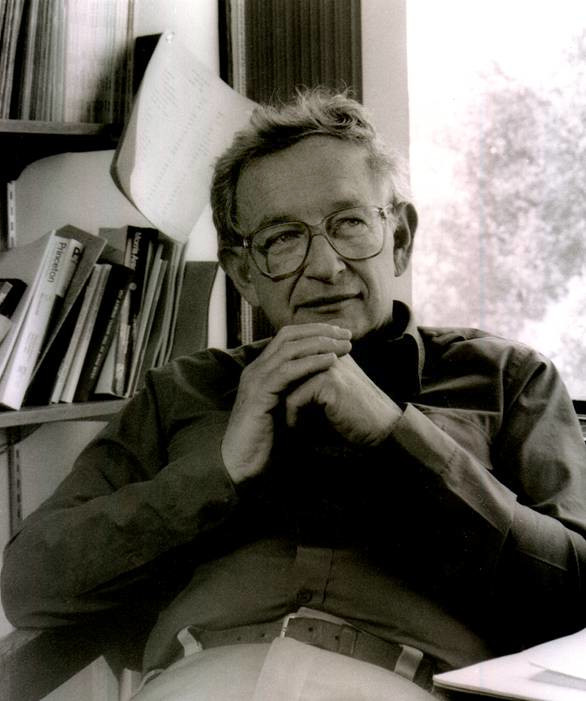
I was just about to leave work last night when I heard via social media the sad news of the death at the age of 96 of the theoretical physicist Freeman Dyson.

Overnight the regular media have been running tributes to him, and various friends and colleagues have been posting their own personal recollections of a remarkable scientist who also seems to have been a kind and generous human being.

I never had the opportunity to meet, or even correspond with, Freeman Dyson myself but I do recall from Nottingham times being told that both Dyson and Julian Schwinger visited and gave lectures for the bicentennial celebrations of the birth of George Green. People there remembered him with fondness.

Please feel free to share any personal reminiscences through the Comments Box below.

Freeman Dyson was an original and creative thinker who was by no means always right but I’ve always felt that scientists should be judged by their best work rather that their worst, and Dyson was a wonderful generator of ideas and made important and influential contributions across a wide range of fields from Quantum Electrodynamics and Solid State Physics to Astronomy and Cosmology.

Rest in peace, Freeman Dyson (1923-2020).

Maynooth University Library Cat Update

Posted in Maynooth with tags on February 28, 2020 by telescoper

This morning I was proceeding in a Northerly direction when I spied the local celebrity feline on post near the library. As I prepared to take a picture he turned to wash his rear parts. If he sits there when it’s raining or snowing it’s because he wants to be fed, so I duly opened a small serving of luxury cat food. Before I could get it into his bowl, however, he legged it over the wall and and hid in the bushes. Turning round, I saw that a person was approaching with a dog on a lead. As soon as they passed, he was back on the wall scoffing the vitacat salmon terrine.

Yesterday the Library hosted a visit from the President of Ireland, Michael D. Higgins, but he likes dogs rather than cats so I won’t dwell on the matter.


Booming Stats

Posted in Biographical on February 27, 2020 by telescoper

I really don’t understand the internet at all. After months in the doldrums the traffic to this blog suddenly went into overdrive yesterday as a result of a little post about W.K. Clifford. It’s not often that I get more than 2,000 visitors per day but so far today I have already had 2,500, and it’s not even 6pm!

I have never been able to predict which posts will  generate interest and which won’t, so I gave up trying to do that a long time ago. In any case I’ve written pieces that I thought were much more interesting only to watch them sink without trace. This time I can only assume that Clifford’s magnificent beard is responsible for the factor of ten increase in traffic.

On the subject of not really understanding the internet, I saw the other day I saw an incoming link from Phil Moriarty’s blog and followed it back to see what he disagreed with me about.

It turns out he was answering a question I have often been asked but have never really answered (because I really don’t know): why write a blog? If I ever had a reason then eleven years after I started I’ve definitely forgotten. There probably never was `a’ reason…

Part of it is that I actually quite like writing. Another is that writing about something is often quite a good way of working out what you actually think (this is basically the same as one of Phil’s points). Another is that, perhaps, it is quite useful to pass on little snippets of information that might be useful to various people. Another (that applies especially to music, poetry, etc) is that I like the idea that sharing things here might introduce someone – perhaps a total stranger – to something that they go on to enjoy.

So you see there are lots of reasons to write a blog, but none of them has anything to do with traffic statistics. It’s nice when posts prove popular, of course, but it’s not as if my livelihood depends on how many visitors I get (which is the case for people who write for commercial sites). I wouldn’t enjoy this blogging lark half as much if I felt I had to produce content that I thought would be popular!

Clifford’s `Space-Theory of Matter’

Posted in Beards, History, mathematics, The Universe and Stuff with tags , , , on February 26, 2020 by telescoper

Well, here’s another thing I didn’t know until I was informed by Twitter.

Way back in 1876 –  forty years before Einstein presented his Theory of General Relativity – the mathematician W.K. Clifford (who is most famous nowadays for the Clifford Algebra) presented a short paper in the Proceedings of the Cambridge Philosophical Society in which he speculated that space might be described by Riemannian rather than Euclidean Geometry.

Here are a couple of excerpts:

and

The paper does not contain any actual equations, and his concentration on small scales rather than large was misguided, but it is quite remarkable that he was thinking about such matters such a long time ago!

Unfortunately Clifford died very young, in 1879, at the age of 33, tuberculosis. Had he lived longer he might have been able to develop these ideas a bit further.

As a postscript I should mention that Clifford had an impressive beard.

Ash Wednesday Observance

Posted in Uncategorized on February 26, 2020 by telescoper

So today is post-Pancake Day, or Ash Wednesday as it is sometimes known. I remember this time two years ago when I was very much a newcomer to Maynooth being quite surprised to see some folk wearing a cross marked in ash on their forehead as in the picture above. I think this practice is a tradition within the Roman Catholic Church with which Maynooth has long historical associations, so it’s not really surprising to see it here. Having been brought up in Protestant England I had never seen this before moving to Ireland, but it has become a familiar sight to me to see people with crosses on their foreheads.

Apparently the tradition used to be for ashes to be sprinkled on the top of the head of a male worshipper but a cross to be made on the forehead of a woman because she would be expected to be wearing a hat. Based on a small sample of those I have observed it seems both genders wear the cross on the forehead nowadays.

Anyway, although I’m not a Christian myself, respect to all those observing the season of Lent (Quadragesima), whether that means fasting, devotional prayer, or just giving up luxuries, such as reading this blog perhaps.

P.S. I’m told that the normal rule for Lent is `One meal and two collations’. The word collation, in the sense of ‘light meal,’ comes from the title of John Cassian‘s early fifth-century work Collationes patrum in scetica eremo (Conferences with the Egyptian hermits), which was read in Benedictine communities before a light meal. I haven’t heard that English word for a while, but it has the same origin as the Italian colazione, used in prima colazione (breakfast).

A Problem of Snooker

Posted in Cute Problems, The Universe and Stuff with tags , , , on February 25, 2020 by telescoper

I came across the following question in a first-year physics examination from Cambridge (Part 1A Natural Sciences) and, since I have posted anything in the Cute Problems folder for a while I thought I would share it here:

Answers through the comments box please! And please show your working!

P.S. The preamble does not say whether you can also assume irrelevant formulae without proof…


A Statistical Solution to the Chaotic, Non-Hierarchical Three-Body Problem

Posted in The Universe and Stuff with tags , , , on February 24, 2020 by telescoper

I’m a bit late passing this on but I think some of my readers might find this interesting, as I did when I came across it a week or so ago. There’s a paper on the arXiv by Nicholas Stone and Nathan Leigh with the title A Statistical Solution to the Chaotic, Non-Hierarchical Three-Body Problem and the following abstract:

The three-body problem is arguably the oldest open question in astrophysics, and has resisted a general analytic solution for centuries. Various implementations of perturbation theory provide solutions in portions of parameter space, but only where hierarchies of masses or separations exist. Numerical integrations show that bound, non-hierarchical triples of Newtonian point particles will almost always disintegrate into a single escaping star and a stable, bound binary, but the chaotic nature of the three-body problem prevents the derivation of tractable analytic formulae deterministically mapping initial conditions to final outcomes. However, chaos also motivates the assumption of ergodicity, suggesting that the distribution of outcomes is uniform across the accessible phase volume. Here, we use the ergodic hypothesis to derive a complete statistical solution to the non-hierarchical three-body problem, one which provides closed-form distributions of outcomes (e.g. binary orbital elements) given the conserved integrals of motion. We compare our outcome distributions to large ensembles of numerical three-body integrations, and find good agreement, so long as we restrict ourselves to “resonant” encounters (the ~50% of scatterings that undergo chaotic evolution). In analyzing our scattering experiments, we identify “scrambles” (periods in time where no pairwise binaries exist) as the key dynamical state that ergodicizes a non-hierarchical triple. The generally super-thermal distributions of survivor binary eccentricity that we predict have notable applications to many astrophysical scenarios. For example, non-hierarchical triples produced dynamically in globular clusters are a primary formation channel for black hole mergers, but the rates and properties of the resulting gravitational waves depend on the distribution of post-disintegration eccentricities.

The full paper can be downloaded here. The abstract is very clear but you might want to read the wikipedia entry for the three-body problem for general background. Here’s a fun figure from the paper:

Let me just add a note of explanation of the word `hierarchical’ as applied here: it means when the mass of one body is very different from the other two, or that two of the bodies have a much smaller separation from each other than they do from the third.

This paper does not present an analytic solution of the unrestricted three-body problem (which is known to be intractable) but does provide some very useful statistical insights into the long-term evolution of three-body systems, for example confirming the generally held opinion that most such systems evolve into a state in which one body is ejected and the other two form a tight binary.