And now for something completely different. I have recently been listening a lot to a fascinating album Urlicht by jazz pianist and bandleader Uri Caine in which he re-imagines the music of Gustav Mahler with a small band to wonderful effect. The music he produces is not only influenced by jazz but full of references to klezmer music and (to my ears at least) redolent of the music of the Weimar era. I confidently predict that many Mahler fans will absolutely hate this, with its pared-down arrangements and roughness around the edges, but I find it very refreshing. Anyway, you can decide for yourself whether you like it or not. This is Uri Caine’s take on the Funeral March from Mahler’s Symphony No. 5:
Follow @telescoperUri Caine’s Mahler
Posted in Music with tags Gustav Mahler, Mahler Symphony No. 5, Uri Caine, Urlicht on October 18, 2019 by telescoperTen Years on Twitter
Posted in Biographical with tags social media, Twitter on October 17, 2019 by telescoper
This morning, a certain social media site pointed out to me that it is ten years to the day since I started using it.
My experiences of Twitter haven’t been anything like as bad as some people I know have reported. I think that’s probably because I’m quite liberal with the ‘block’ facility when it comes to bots and trolls and sundry other tediously offensive types. I have found that the positives have definitely outweighed the negatives over the last decade, and I count myself lucky to have encountered some very lovely people on Twitter, some of whom I have eventually met in the real world.
I don’t have a huge following on Twitter, but I’d like to take this opportunity to say that I do appreciate those who do read my tweets and hope that they find at least some of them interesting or amusing!
Follow @telescoperGravitational Lensing, Cosmological Distances and the Hubble Constant
Posted in The Universe and Stuff with tags arXiv:1910.06306, cosmological distance ladder, Gravitational Lensing, Hubble constant on October 17, 2019 by telescoper
To continue the ongoing Hubble constant theme, there is an interesting paper on the arXiv by Shajib et al. about determining a distance to a gravitational lens system; I grabbed the above pretty picture from the paper.
The abstract is:

You can click on this to make it bigger. You will see that this approach gives a `high’ value of H0 ≈ 74.2, consistent with local stellar distances measures, rather than with the `cosmological’ value which comes in around H0 ≈ 67 or so. It’s also consistent with the value derived from other gravitational lens studies discussed here.
Here’s my ongoing poll on the Hubble constant, with
Follow @telescoper
Happy Birthday, Quaternions!
Posted in History, mathematics with tags Broom Bridge, Broombridge, Dublin, Quaternions, William Rowan Hamilton on October 16, 2019 by telescoper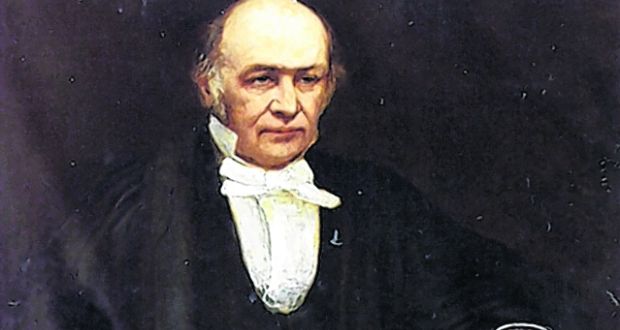
Sir William Rowan Hamilton (1805-1865)
Today, October 16th, is Hamilton day! It was on this day 176 years ago, in 1843, that William Rowan Hamilton first wrote down the fundamental result of quaternions. Apparently he was walking from his residence at Dunsink Observatory into Dublin when he had a sudden flash of inspiration and wrote the result down on the spot, now marked by a plaque:
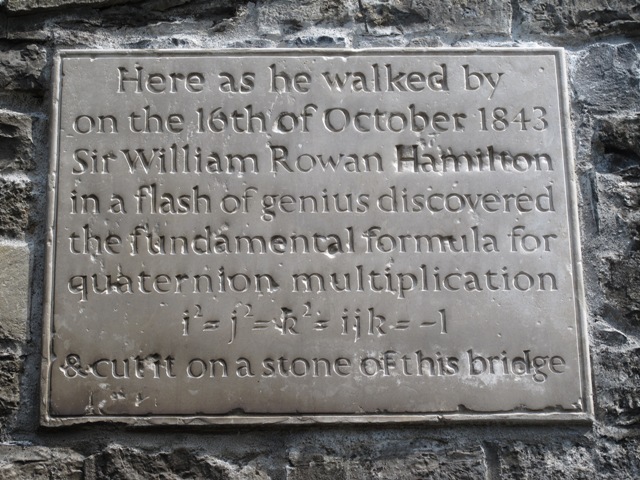
Picture Credit: Brian Dolan
This episode is commemorated by an annual Hamilton Walk. Sadly, Broombridge (Droichead Broome) is near the bridge (Broom Bridge) where Hamilton had his Eureka moment and it is on the main commuter line from Maynooth into Dublin. This is ironic because Quaternion algebra does not commute. (Geddit?)
Although it is quite easy to reach Broombridge from Maynooth, I sadly can’t attend the walk this year because I’m teaching this afternoon.
P.S. Maynooth is also home to the Hamilton Institute which promotes and facilitates research links between mathematics and other fields.
Follow @telescoperPrestige Bias and Luck
Posted in Uncategorized with tags arXiv:1910.05813, Brian Skinner, prestige bias, privilege on October 15, 2019 by telescoperQuite a few times on this blog I have acknowledged the tremendous amount of luck I have had all the way through my career, not least that the opportunity which led to my current position in Maynooth came up when exactly when it did, but another thing that has played a role has been privilege, defined not only in terms of race and social class but also educational and institutional background. Those of us who have benefitted from this are often blind to its influence, preferring to think we achieve things purely on merit. I was reminded of this by an interesting paper on the arXiv by Brian Skinner, which has the abstract:
One of the major benefits of belonging to a prestigious group is that it affects the way you are viewed by others. Here I use a simple mathematical model to explore the implications of this “prestige bias” when candidates undergo repeated rounds of evaluation. In the model, candidates who are evaluated most highly are admitted to a “prestige class”, and their membership biases future rounds of evaluation in their favor. I use the language of Bayesian inference to describe this bias, and show that it can lead to a runaway effect in which the weight given to the prior expectation associated with a candidate’s class becomes stronger with each round. Most dramatically, the strength of the prestige bias after many rounds undergoes a first-order transition as a function of the precision of the examination on which the evaluation is based.
You can read the full paper here. The author acknowledges the role that blind luck played in his own career but also develops a simple mathematical model of prestige bias. It’s an interesting paper, well worth a read.
Follow @telescoperThe Bush, by R.S. Thomas
Posted in Poetry with tags Poetry, R.S. Thomas, The Bush on October 15, 2019 by telescoperI know that bush,
Moses; there are many of them
in Wales in the autumn, braziers
where the imagination
warms itself. I have put off
pride and, knowing the ground
holy, lingered to wonder
how it is that I do not burn
and yet am consumed.
And in this country
of failure, the rain
falling out of a black
cloud in gold pieces
there are none to gather,
I have thought often
of the fountain of my people
that played beautifully here
once in the sun’s light
like a tree undressing.
by R.S. Thomas (1913-2000)
Follow @telescoper
More Hubble Constant Tension
Posted in The Universe and Stuff with tags arXiv:1910.02978, Distance Ladder, Hubble constant, Hubble Tension on October 14, 2019 by telescoperHere’s the abstract of another contribution to ongoing discussions around so-called tension between different estimates of the Hubble Constantpolldaddy (see this blog passim):

You can find the actual paper (by Lin, Mack and Hou) on the arXiv here.
Now, before Mr Hine starts to fill up my blocked comments folder with rants, I will add a few comments of my own.
First, at the Royal Astronomical Society on Friday I discussed all this with a renowned observational astronomer and expert on stellar distance measurements. He agreed with me that if the `tension’ is indeed real then it is far more likely to be a problem with stellar distance measurements than the cosmology.
Second, I am writing a review of all this to be published in Astronomy & Geophysics next year. Watch this space.
Third, this gives me an excuse to include yet again my poll on whether you are worried about the “tension”:
Follow @telescoperDinner with Wagner
Posted in History, Opera with tags Carl Wilhelm Siemens, RAS Club, Richard Wagner, The Athenaeum on October 13, 2019 by telescoperBefore dinner with the RAS Club on Friday evening I was looking through the display cabinets at the Athenaeum and saw this, the record of a dinner involving a member and guests on 23rd May 1877. The member was electrical engineer, businessman and Fellow of the Royal Society Carl Wilhelm Siemens and among is guests was Richard Wagner:
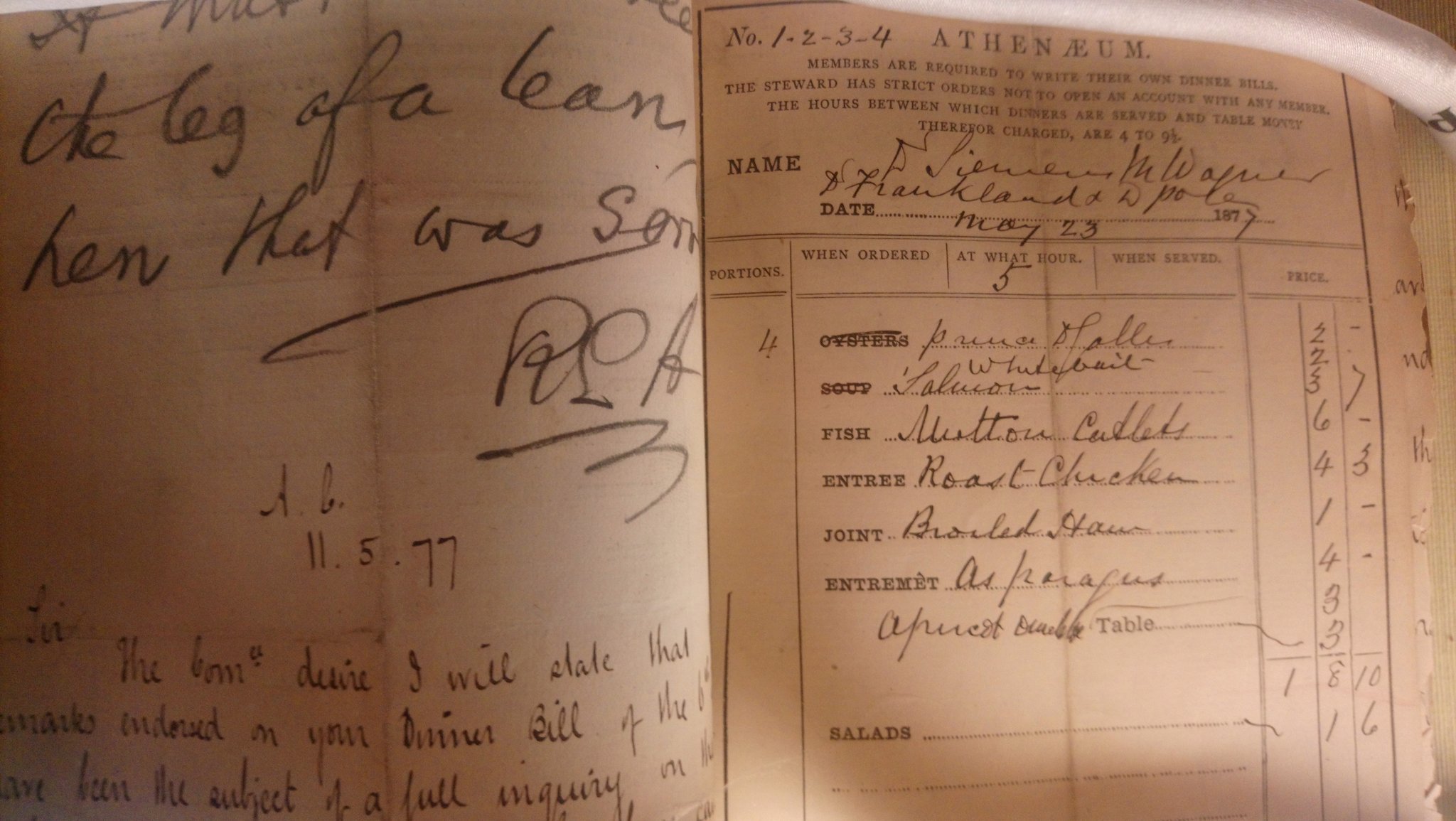
Dinner started early and was evidently a lengthy affair, much like Wagner’s operas!
That reminds me of a famous review of one of Wagner’s operas by a critic who clearly wasn’t a fan.
Parsifal is an Opera by Richard Wagner that starts at half past five. Three hours later, you look at your watch and it’s quarter to six.
P.S. There is a photograph taken of Wagner (whose 64th birthday was on 22nd May) during his visit to London in 1877:

Antony Gormley at the Royal Academy
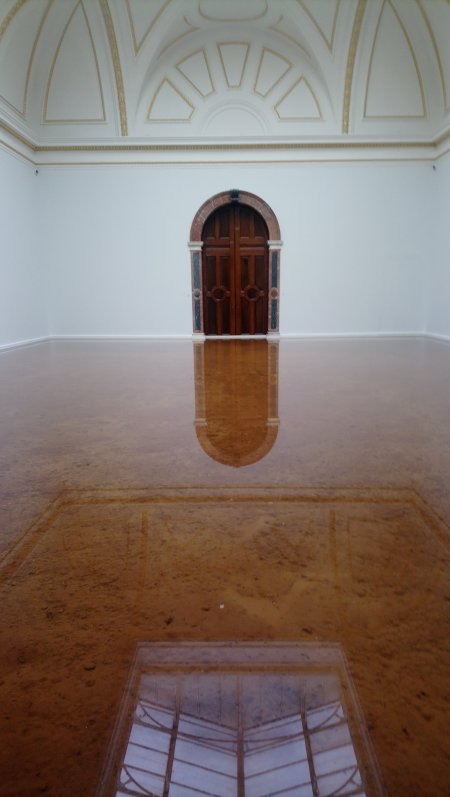
Posted in Art with tags Antony Gormley, Royal Academy, Royal Astronomical Society on October 11, 2019 by telescoperOne of the nice things about the location of premises of the Royal Astronomical Society in Burlington House is that it’s right next to the Royal Academy. I took advantage of this proximity yesterday to have a look at the exhibition of work by Antony Gormley. The Main Gallery was very busy as I did my tour but I spent a very enjoyable time wandering around the various rooms and, in some cases, inside the installations therein.
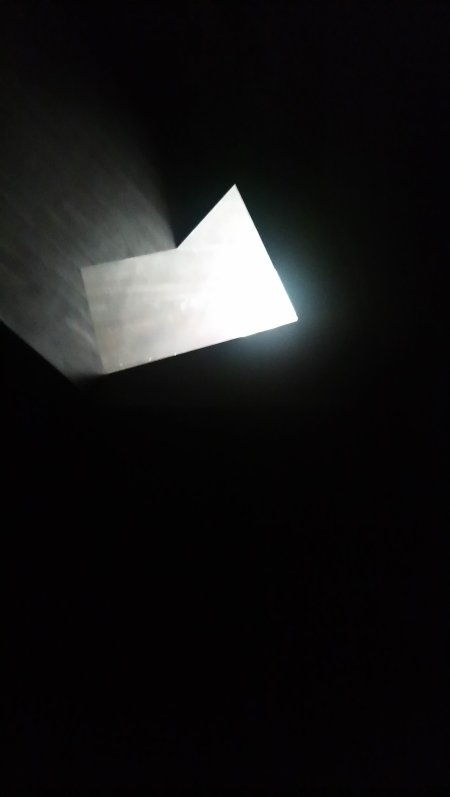
The Royal Academy is a very traditional gallery space and it was the ingenious use of that space within the formal confines of the gallery that I found most impressive. In some of the rooms thin steel bars run through and out from the doors like beam of laser light. Two such beams arrive in one room where they are joined by a vertical bar of the same type, setting up coordinate axes for the whole show.
Here are some snaps I took on the way around:

Clearing
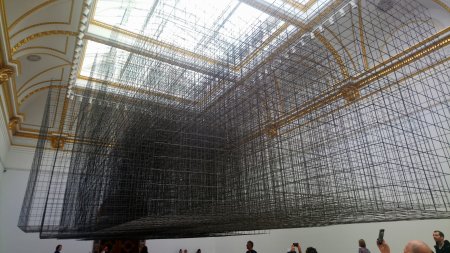
Matrix

Lost Horizon
Cave
Host
`Cave’ is a large sculpture in rolled steel that you can go into. Parts of it are very dark; the photograph I took was from inside looking out. `Lost Horizons’ has typical Gormleyesque human figures standing upright, upside-down and horizontally on the floor ceiling and walls, an idea that resonates with the coordinate axes mentioned above, which you encounter just before entering this room.
But one of the most fascinating parts of the exhibition is the large collection of Gormley’s workbooks, which show how he develops his ideas, always with reference both to the form and materials of his sculpture and the space into which they are to be placed.
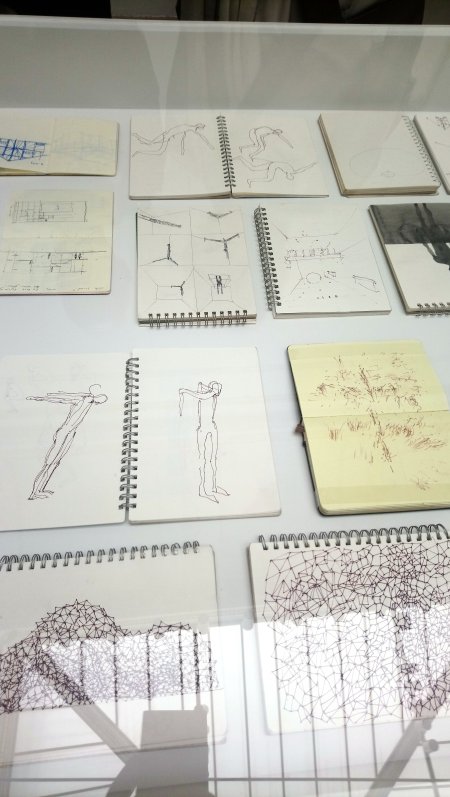
The exhibition is open until 3rd December 2019. Do catch it if you can!
Follow @telescoper
Diversity, Inclusion, Rain and Brexit
Posted in Biographical, Politics with tags Boris Johnson, BrExit, Institute of Physics, Leo Varadkar, Royal Astronomical Society on October 11, 2019 by telescoperSo here I am in a very rainy London. I arrived yesterday for a meeting of the IOP Diversity and Inclusion Committee, which was an interesting occasion with many new things about to unfold, tempered by a bit of sadness that the wonderful Head of Diversity at the IOP, Jenni Dyer, is leaving shortly to take up a new job. However will we manage?
Anyway, instead of flying back to Ireland last night after the meeting, I stayed in London last night because today there is an ordinary meeting of the Royal Astronomical Society at Burlington House, to be followed by a Club Dinner. I’ll be going home to Ireland tomorrow.
Unfortunately the weather has put a dampener on my plans to spend a bit of time wandering around London because it is raining quite heavily and is forecast to do so for the rest of the day. Still, at least the hotel I’m in has WIFI so I can get a few things done this morning before venturing out into the inclement conditions.
Meanwhile the pound is rising against the euro on optimism that there may be a Brexit deal on the horizon after yesterday’s meeting between Boris Johnson and Leo Varadkar. Nobody knows the details but it seems likely that it’s basically the same as Theresa May’s `deal’ except that the `backstop’ is to be replaced by what is effectively a customs border in the Irish Sea. My personal preference would be Boris Johnson thrown in the Irish Sea.
I doubt the Democratic Unionists will be happy with this, but Johnson is probably gambling that enough Labour quitlings will vote for it that he no longer needs their support. Of course, that all depends on whether what was discussed yesterday turns into a concrete legally-binding agreement signed off by the EU.
P.S. Bookies’ odds on a No-Deal Brexit on October 31st have drifted out from 4/1 to 5/1.
Follow @telescoper

 In the Dark