The Winter Solstice 2018

Posted in The Universe and Stuff with tags , , , , , , on December 21, 2018 by telescoper

The winter solstice in the Northern hemisphere happens today, Friday 21st December 2018, at 22.23 Irish Time (22.23 UTC). Among other things, this means that today is the shortest day of the year. Days will get longer from now until the Summer Solstice next June.  In fact, the interval between sunrise and sunset tomorrow will be a whole second longer tomorrow than it is today. Yippee!

This does not mean that sunrise will happen earlier tomorrow than it did this morning, however. Actually, sunrise will carry on getting later until the new year. This is because there is a difference between mean solar time (measured by clocks) and apparent solar time (defined by the position of the Sun in the sky), so that a solar day does not always last exactly 24 hours. A description of apparent and mean time was given by Nevil Maskelyne in the Nautical Almanac for 1767:

Apparent Time is that deduced immediately from the Sun, whether from the Observation of his passing the Meridian, or from his observed Rising or Setting. This Time is different from that shewn by Clocks and Watches well regulated at Land, which is called equated or mean Time.

The discrepancy between mean time and apparent time arises because of the Earth’s axial tilt and the fact that it travels around the Sun in an elliptical orbit in which its orbital speed varies with time of year (being faster at perihelion than at aphelion).

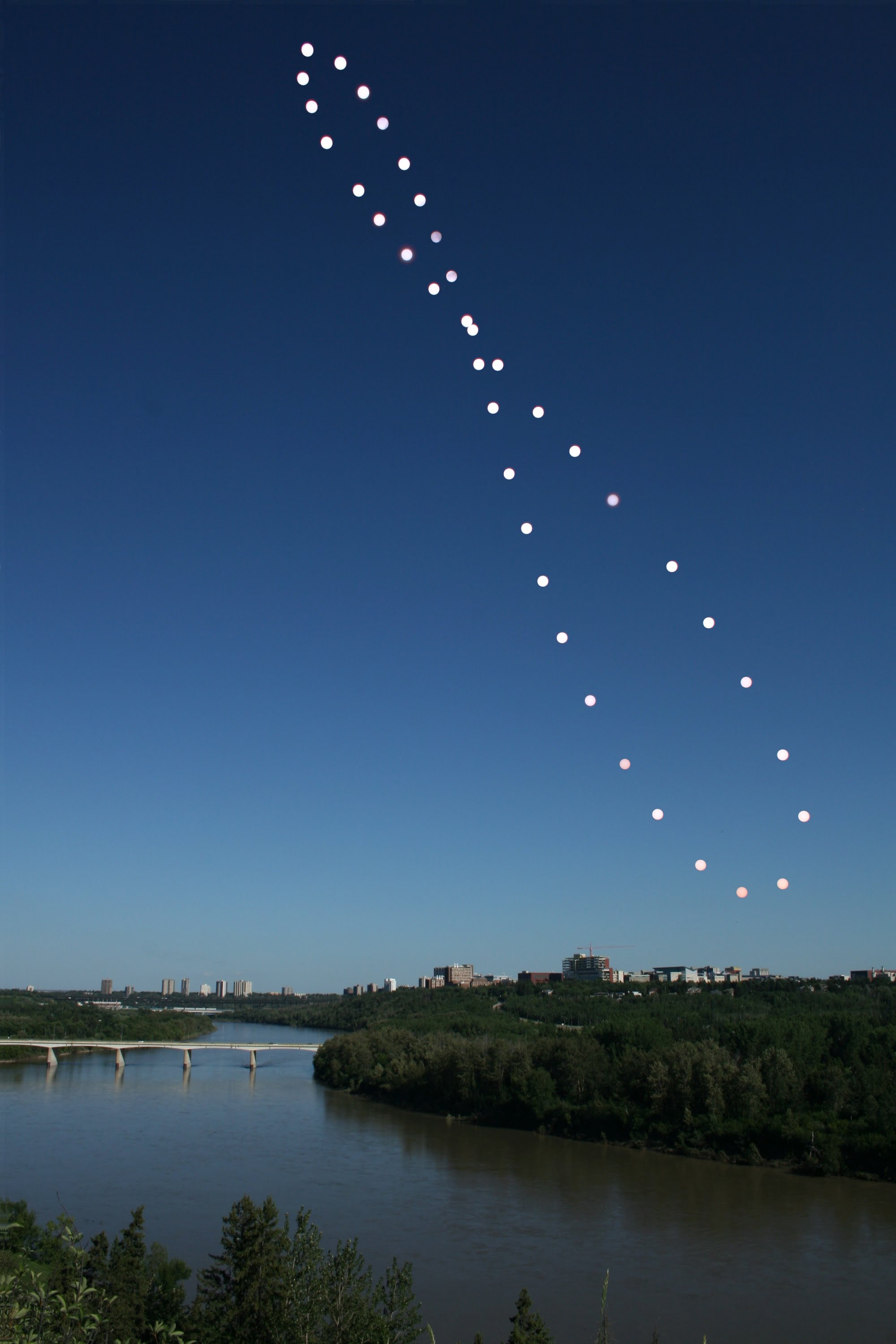
In fact if you plot the position of the Sun in the sky at a fixed time each day from a fixed location on the Earth you get a thing called an analemma, which is a sort of figure-of-eight shape whose shape depends on the observer’s latitude. Here’s a photographic version taken in Edmonton, with photographs of the Sun’s position taken from the same position at the same time on different days over the course of a year:
maxresdefault

The winter solstice is the lowermost point on this curve and the summer solstice is at the top. The north–south component of the analemma is the Sun’s declination, and the east–west component is the so-called equation of time which quantifies the difference between mean solar time and apparent solar time. This curve can be used to calculate the earliest and/or latest sunrise and/or sunset.

Using a more rapid calculational tool (Google), I found a table of the local mean times of sunrise and sunset for Dublin around the 2018 winter solstice. This shows that today is indeed the shortest day (with a time between sunrise and sunset of 7 hours 29 minutes and 59 seconds).  The table also shows that sunset already started occurring later in the day before the winter solstice, and sunrise will continue to happen later for a few days after the solstice, notwithstanding the fact that the interval between sunrise and sunset gets longer from today onwards.

I hope this clarifies the situation.

The Open Journal of Astrophysics: Last Update for 2018

Posted in Maynooth, Open Access, The Universe and Stuff with tags , , , , , on December 20, 2018 by telescoper


As term staggers to its close tomorrow, two things this morning reminded me that I should post a final update for the The Open Journal of Astrophysics.  I’ve been regularly boring all my readers with a stream of stuff about the Open Journal of Astrophysics, but if it’s all new to you, try reading the short post about the background to the Open Journal project that you can find here.

The first item was a little piece in the latest edition of University News (which was delivered this morning) about the launch event for the journal here at Maynooth University way back in October.

I didn’t make it into the picture above as I had to leave the event before the end in order to give an undergraduate lecture, but the appearance of this piece reminds me to express once more my gratitude to Maynooth for providing such excellent support for this project.

The other event this morning was an email notification that the OJA has received yet another submission. We now have a number of papers in the pipeline, and interest seems to be picking up. I can’t say how many submissions will actually be published, but the papers we have received are working their way through the peer-review system and we’ll see what transpires.

On a related point, a few people have asked me why the Open Journal of Astrophysics is not in the Directory of Open Access Journals (DOAJ). The answer to that is simply that DOAJ requires a minimum of five papers published in a calendar year and because we had a long hiatus before the re-launch we don’t yet qualify. The way things are going we should meet the threshold for 2019 pretty quickly.

Though I stress that the Editorial Board of OJA is not going to compromise standards just to get listed on DOAJ.
we are hoping to increase the number of submissions with time (in a manageable way). As it happens, we do have funds available to promote the OJA as I think quite a large number of members of the astrophysics community still haven’t heard of it. This also makes it a little difficult to enlist referees who perhaps jump to the conclusion that this is a dodgy or predatory journal. There are many of these about, sadly, but I hope we can establish relatively easily the fact that we’re not of that ilk.

I would like here to repeat a small request I posted a while ago. Do any of you have any ideas for promoting The Open Journal of Astrophysics? We could advertise directly in journals of course, but I’m wondering if anyone out there in the interwebs has any more imaginative ideas? If you do please let me know through the comments box below.

Sustainability and Irish Science

Posted in Politics, Science Politics, The Universe and Stuff with tags , , , , on December 19, 2018 by telescoper

There’s an interesting news item in the Education section of the Irish times about the appointment of Prof Séamus Davis to positions at both the University of Oxford and University College Cork, under a Science Foundation Ireland scheme intended to capitalize on Brexit (and the imminent loss of EU funding it implies) and the unhappy situation for science in the USA. This is the first appointment to one of the new Research Professorships, which allow the holders to be paid up to €250K.

While I support any investment in Irish science, and wish Prof. Davis every success in his new role, my reaction to the SFI scheme is very similar to my view of the Sêr Cymru (“Star Wales”) project which began a few years ago when I was working in Cardiff, with the aim of attracting `research leaders’ to Wales.

I am very skeptical about the likely success of `top-down’ moves like this. What Ireland really needs (and currently does not have) is a sustainable research base, so at very least I’d like to complementary  `bottom-up’ projects nurturing  researchers at PhD and PDRA level, perhaps through a greatly expanded system of national fellowships.  The trouble in Ireland is that there are so few opportunities for early career researchers that many have to go abroad to further their careers. There’s nothing wrong with Irish researchers choosing to work in another country, of course, but in an ideal world they would choose rather than be forced to do so by lack of opportunity and their loss would be offset by a other nationals choosing to come into Ireland. Unless this problem is fixed Ireland might end up with some leaders but nobody around to follow them.

The question I ask myself is, if one had to choose, what would be better in the long run for Irish science, one Professor on a salary of €250,000 or eight new postdoctoral fellowships (at roughly the same cost)?

Of course the idea of bringing in `research leaders’ is that they will manage to bring in funds from elsewhere, especially the European Union. This may indeed happen and indeed some may already have money in the bag when they move in. The problem with the strategy, though,  is that it’s not very easy to persuade such leaders to leave their current institutions, especially in experimental sciences, if they’ve already spend years acquiring the funding needed to equip their laboratories. This is not just a question of moving people, which is relatively easy, but can involve trying to replace lots of expensive and delicate equipment. The financial inducements needed to fund the relocation of a major research group and fight off counter-offers from its present host are likely to be so expensive that the benefit gained from doing this takes years to accrue, even they succeed. And EU grants are exceptionally competitive..

It’s a big shame that Ireland does not take research funding as seriously as it should, especially in fundamental science. Brexit could well turn out to be very damaging for the Irish economy, but science is one area where in which there are enormous opportunities if only there was the political will to seize them.


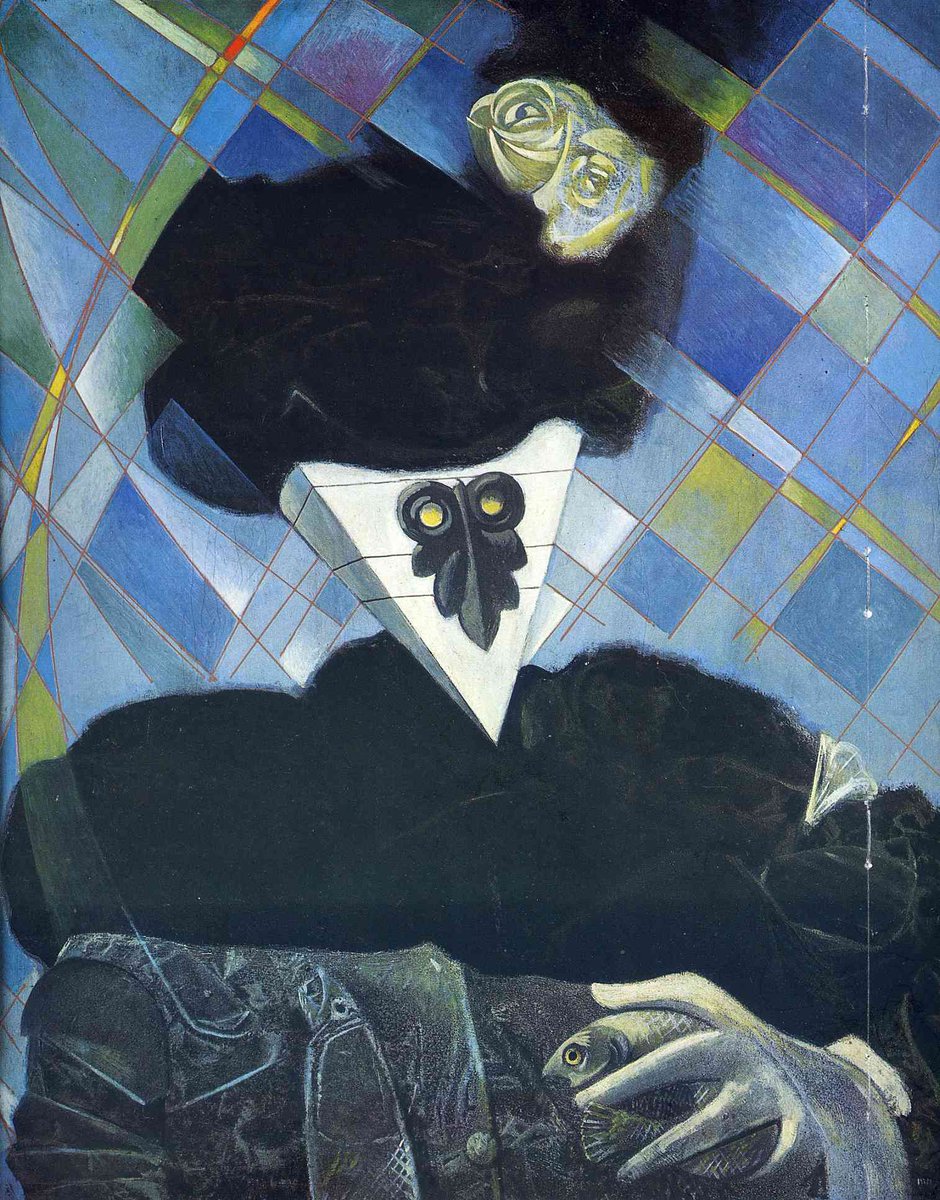
Euclid, by Max Ernst

Posted in Art with tags , , on December 18, 2018 by telescoper

by Max Ernst (1891-1976) , painted in 1945 (oil on canvas, 65 x 57.5 cm).


The Goethe-Institut Choir Christmas Concert

Posted in Music with tags , , , , on December 18, 2018 by telescoper


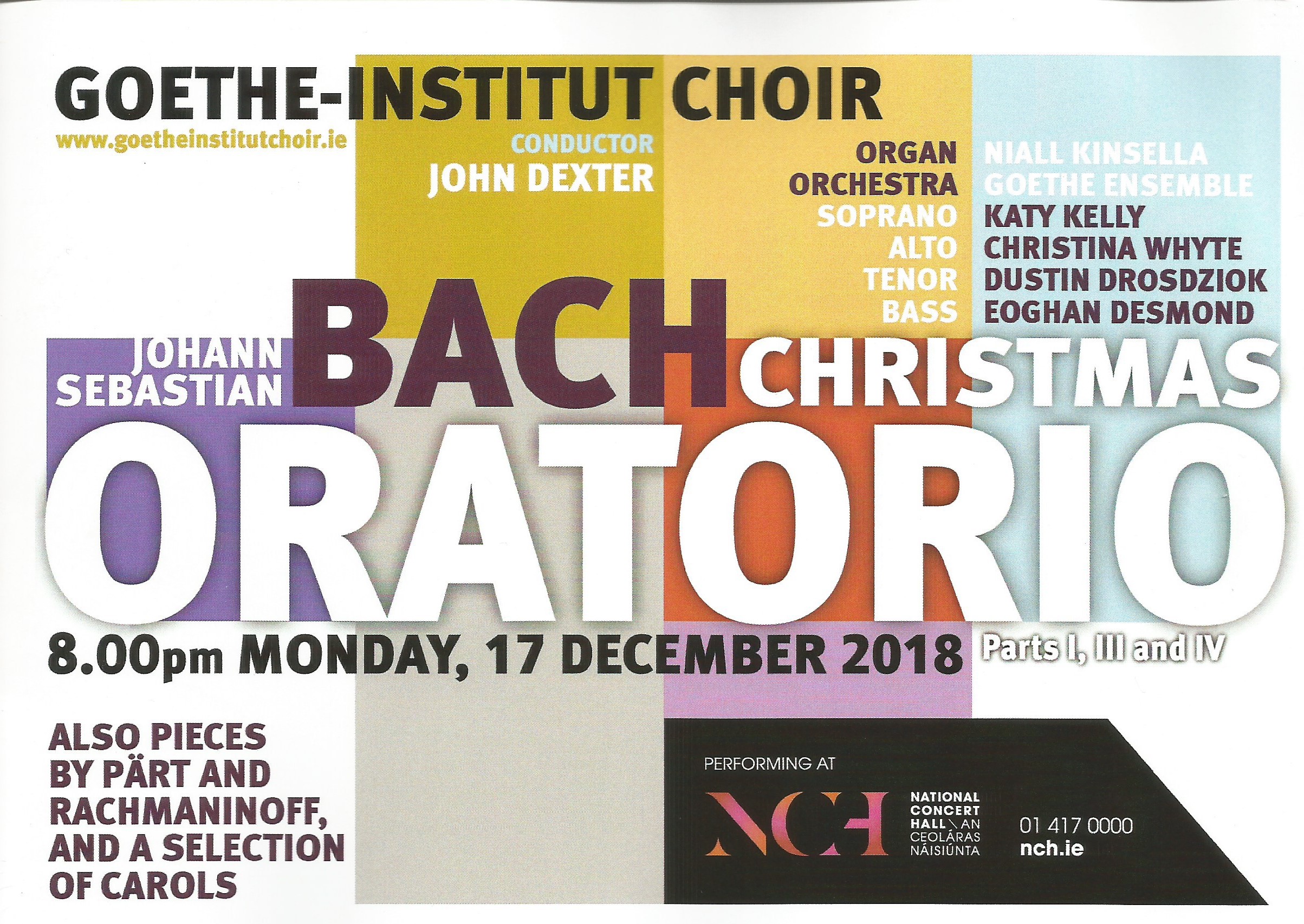
Last night I found myself yet again at the National Concert Hall in Dublin, this time for a Christmas Concert by the Goethe-Institut Choir and the Goethe Ensemble, directed by John Dexter, together with a fine set of principals Katy Kelly (soprano), Christina Whyte (alto), Dustin Drosdziok (tenor) and Eoghan Desmond (bass).

The main items on the menu were three Parts of the Christmas Oratorio by Johann Sebastian Bach. Before the interval wine break we heard Parts I and IV, the former opening with the famous Jauchzet, frohlocket!, followed in the second half by Part III. The whole Oratorio is in six parts, which I think would make it too long for an evening concert, which explains why only three pieces were performed. I’m not sure why the particular ordering was chosen for the selected parts but it worked rather well. The various Parts are basically separate cantatas anyway, so performing them individually like this is perfectly sensible.

Before Part III of the Oratorio, which came in Part II of the Concert, after Part IV, which came in Part I,  the Choir performed some shorter pieces without the orchestra: a mediaeval carol called Angelus ad Virginem, a piece from the magnificent All-Night Vigil by Sergei Rachmaninov, БОГОРОДИЦЕ ДЈЕВО, and a much jauntier version of the same text (closely related to Ave Maria) by Arvo Pärt.  Then there was an audience singalong to Stille Nacht, with verses in English, Irish and German.

In case you’re interested, the opening verse of Silent Night in Irish reads

Oíche chiúin, oíche Mhic Dé,
Cách ‘na suan, dís araon,
Dís is dílse ag faire le spéis,
Naí beag gnaoi-gheal ceanán tais caomh
Críost ina chodladh go séimh,
Críost ina chodladh go séimh.

The choir was really excellent in these pieces, as it was throughout the concert.

The second piece in the concert  (Part IV) was marred by poor pitching of the two French horns, but there was compensation in the form of lovely playing by the interweaving violins behind the tenor aria, and an echo effect achieved by placing an oboe and vocalist (soprano Eilis Dexter) in the choir balcony (the main choir being on stage with the Orchestra).

The concert got off to an inauspicious (but rather amusing) start when the power supply failed for the chamber organ played by Niall Kinsella just as the concert was about to begin. I didn’t realise those instruments needed to be plugged in. Obviously batteries are not included. A stage hand had to dash on and fiddle about to find another socket behind the drapes surrounding the stage and then bring on an extension cable. Fortunately the delay wasn’t long.

Overall this was a very enjoyable concert, with Choir and Orchestra on good form. The principal vocalists were good too. I particularly liked Katy Kelly. It didn’t surprise me when I read in the programme that she has recently performed two great roles in Mozart operas: Donna Anna (Don Giovanni), La Contessa (Le Nozze di Figaro) and performed the Die Königin der Nacht coloratura arias from the Magic Flute on television. I think she has a great voice for Mozart, agile and graceful.

I should also mention that the Concert was pretty much sold out, which was good to see. No doubt the absence of a harpsichord contributed to its success.

Anyway, that concludes my concert-going for 2018. Hopefully there will be a few more to report on in 2019!


Fourier, Hamilton and Ptolemy

Posted in History, Poetry, The Universe and Stuff with tags , , , , , , , on December 17, 2018 by telescoper

As we stagger into the last week of term I find myself with just two lectures to give in my second-year module on Vector Calculus and Fourier Series. I didn’t want to present the two topics mentioned in the title as disconnected, so I linked them in a lecture in which I used the divergence theorem of vector calculus to derive the heat equation, the solution of which led Joseph Fourier to devise his series in Mémoire sur la propagation de la chaleur dans les corps solides (1807), a truly remarkable work for its time that inspired so many subsequent developments.

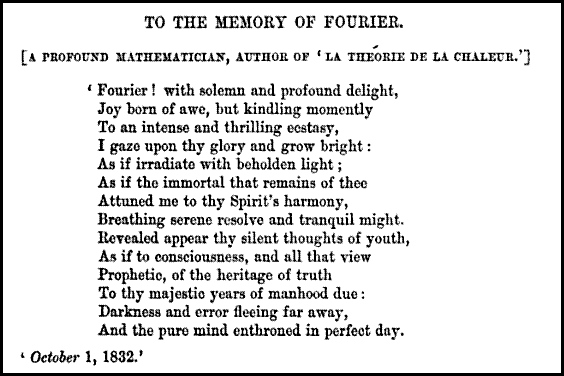
Fourier’s work was so influential and widely admired that it inspired a famous Irish mathematician William Rowan Hamilton to write the following poem:

Hamilton-for Fourier

The serious thing that strikes me is not the quality of the verse, but how many scientists of the 19th Century, Hamilton included, saw their scientific interrogation of Nature as a manifestation of the human condition just as the romantic poets saw their artistic contemplation and how many poets of the time were also interested in science.

Anyway I was looking for nice demonstrations of Fourier series to help my class get to grips with them when I remembered this little video recommended to me some time ago by esteemed Professor George Ellis. It’s a nice illustration of the principles of Fourier series, by which any periodic function can be decomposed into a series of sine and cosine functions.

This reminds me of a point I’ve made a few times in popular talks about Astronomy. It’s a common view that Kepler’s laws of planetary motion according to which which the planets move in elliptical motion around the Sun, is a completely different formulation from the previous Ptolemaic system which involved epicycles and deferents and which is generally held to have been much more complicated.

The video demonstrates however that epicycles and deferents can be viewed as the elements used in the construction of a Fourier series. Since elliptical orbits are periodic, it is perfectly valid to present them in the form a Fourier series. Therefore, in a sense, there’s nothing so very wrong with epicycles. I admit, however, that a closed-form expression for such an orbit is considerably more compact and elegant than a Fourier representation, and also encapsulates a deeper level of physical understanding.

Everyman

Posted in Art, Crosswords with tags , , on December 16, 2018 by telescoper

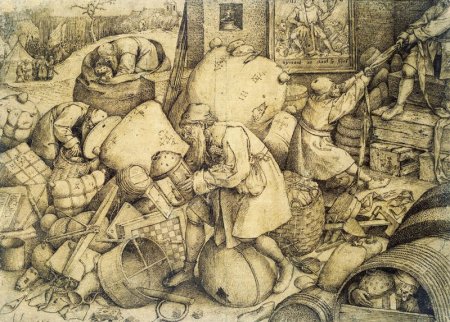
Having finished the Everyman crossword in this morning’s Observer, I was reading a review of some books about Pieter Bruegel in the Times Literary Supplement where I found mention of a piece by that artist also called Everyman.

Here is the work, an ink drawing on paper, of dimensions 20.9cm by 29.2 cm made in Antwerp in 1558 and currently in the British Museum.

According to the catalogue, the work is called Elck in Dutch, which means ‘each’ or ‘everyone’, but is usually known in English as ‘Everyman’.

The scenes in the drawing illustrate proverbs or sayings. The central proverb concerns Elck who vainly seeks himself in the objects of this world as he stands over a broken globe. With a lantern he searches through a pile of barrels and bales, a game board, cards and objects which signify the distractions of life.

To the right, two more Elck figures play tug of war with a rope, illustrating the saying, ‘each tugs for the longest end’.

In the background on a wall hangs a picture which continues the moral theme. It shows a fool sitting among a pile of broken household objects gazing at himself in a mirror. He is Nemo or Nobody, as the inscription below him informs us: ‘Nobody knows himself.

To me it seems that Elck is searching (no doubt in vain) for something worth keeping in the junkyard of human existence. Perhaps he should perhaps have a go at a crossword to cheer himself up?

A Sign of Ireland

Posted in Maynooth with tags , , on December 15, 2018 by telescoper

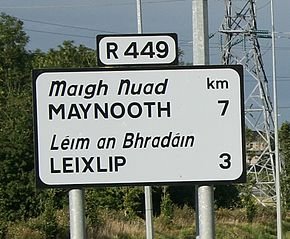
Following my post earlier this week about Irish orthography and related matters, I thought I’d share a couple of random thoughts inspired by the above road sign.

First, notice the font used for the Irish names, which is a variant of the UK Transport typeface, but is notable for the absence of any tittles (a ‘tittle’ being one of those little dots above the i and j in standard type).

The other thing, which I only found out a few days ago, is that`Leixlip’ is a name of Norse origin – it means ‘Salmon’s Leap’. Apparently there was a viking settlement there, positioned because of the abundance salmon in the River Liffey which flows through on the way to Dublin. `Leix’ is similar to, e.g., the Danish `Laks’, meaning salmon, and ‘leap’ is similar to many words in modern European languages derived from proto-Germanic sources.

There is a Salmon Leap Inn in Leixlip. I have heard very good things about the food but not yet dined there. Nowadays however Leixlip is best known for the presence of a huge Intel ‘campus’, which is home to a large semiconductor fabrication facility, among other things.

Messiah in Dublin

Posted in Biographical, Maynooth, Music with tags , , , , on December 14, 2018 by telescoper

On 10th December last year I posted a review of a performance of Handel’s Messiah in Cardiff. At the end of that item I wondered where I would be listening to Messiah in 2018. Well, the answer to that question turned out to be at the National Concert Hall in Dublin, the city where Messiah received its premiere way back in 1742.

Messiah was initially performed at Easter (on 13th April 1742) and it’s by no means clear (to me) why it ended up almost universally regarded as a Christmas piece. The work actually spans the entire biblical story of the Messiah, from Old Testament prophecy to the Nativity (Part 1), the Passion of Christ (Part II), culminating in the Hallelujah Chorus, and the Resurrection of the Dead (Part III). The Nativity only features (briefly) in Part I, which is why it’s a little curious that Messiah is so strongly associated with Christmas.

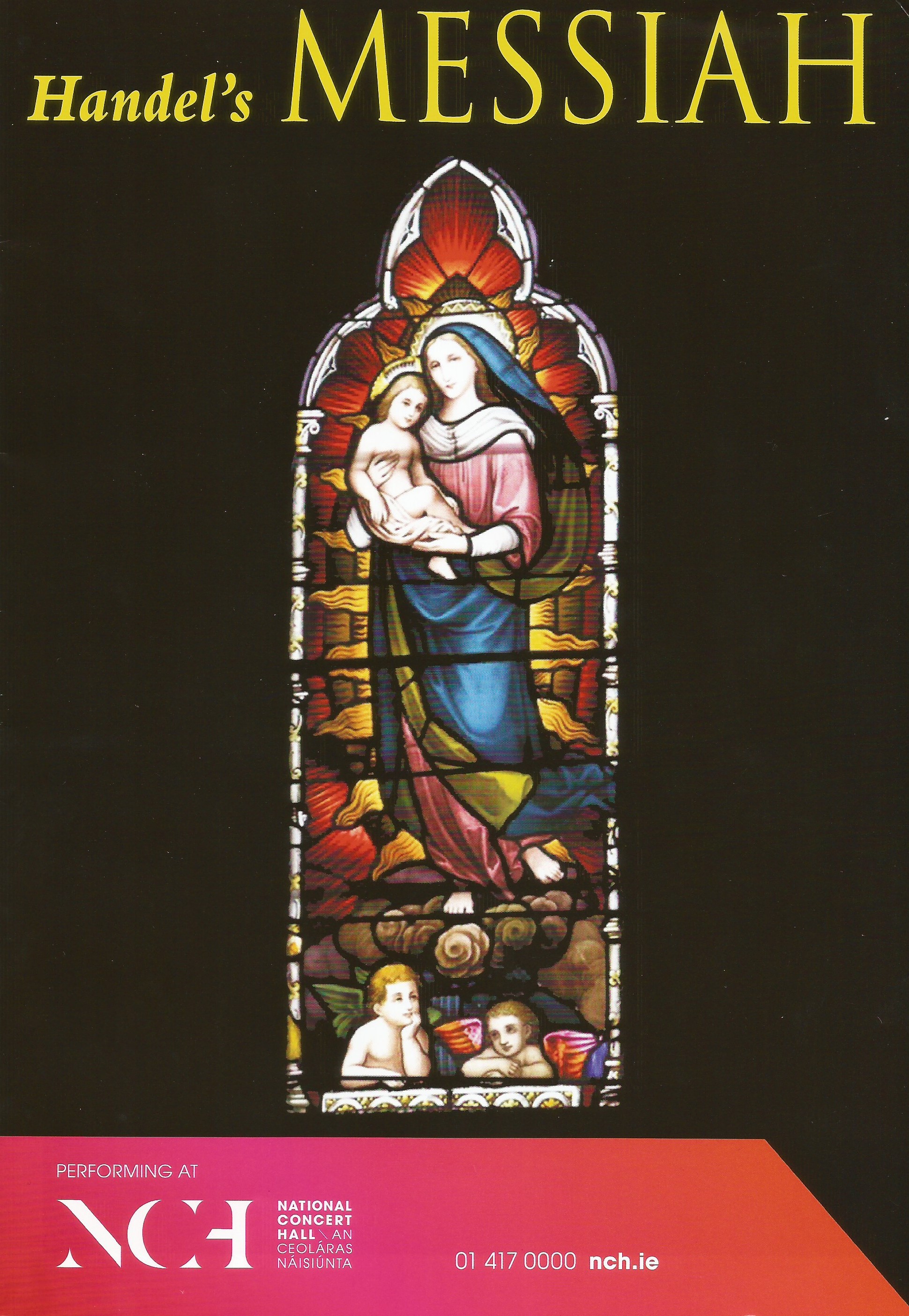
The printed programme for last night (cover shown above) included the first advertisement for the first performance of Messiah:

For the relief of the prisoners in the several Gaols and for the Support of Mercer’s Hospital in Stephen’s Street and of the Charitable Infirmary on the Inn’s Quay, on Monday 12th April will be performed at the Musick Hall in Fishamble Street, Mr Handel’s new Grand Oratorio MESSIAH…

The venue was designed to hold 600 people (less than half the capacity of the National Concert Hall) but 700 people crammed in. Ladies had been asked not to wear hoops in their dresses and gentlemen were asked not to bring their swords to help squeeze in the extra hundred. The concert raised the huge sum of £400 and Messiah was an immediate hit in Ireland.

It wasn’t the same story when Messiah was first performed in England the following year. It failed again in England when performed in 1745 but after some rewriting Handel put it on again in 1749 and it proved an enormous success. It has remained popular ever since. But it is still exceptionally popular in Dublin. There are umpteen performances of Messiah at this time of year, and the one I attended last night was one of three in the same week at the same venue, all more-or-less sold out. The Dubliners I chatted to in the bar before the concert were extremely proud that their city is so strongly associated with this remarkable work.

I don’t mind admitting that Messiah is a piece that’s redolent with nostalgia for me. Some of the texts remind me a lot of Sunday School and singing in a church choir when I was little and then, a bit later, listening to the whole thing at Christmas time at the City Hall in Newcastle. I loved it then, and still do now, well over 40 years later. I know it’s possible to take nostalgia too far – nobody can afford to spend too much time living in the past – but I think it’s good to stay in contact with your memories and the things that shaped you when you were young.

Last night’s performance was by Our Lady’s Choral Society with the RTÉ Concert Orchestra. Soloists were Sarah Brady (soprano), Patricia Bardon (mezzo), Andrew Gavin (tenor) and Padraic Rowan (bass), the latter really coming into his own in the second half with a wonderfully woody sonority to his voice, especially in No. 40:

Why do the nations so furiously rage together, and why do the people imagine a vain thing?

Topical, or what?

Our Lady’s Choral Society is an amateur outfit and, while it might not sound as slick and polished as some professional choirs, there was an honesty about its performance last night that I found very engaging. It actually sounded like people singing, which professional choirs sometimes do not. The orchestra played very well too, and weren’t forced to use the dreaded `period instruments’. There was a harpsichord, but fortunately it was barely audible. Anyway, I enjoyed the concert very much and so did the packed house. I couldn’t stay for all the applause as I had dash off to get the last train back to Maynooth, but that doesn’t mean I didn’t appreciate the music.

Incidentally, among the bass section of Our Lady’s Choral Society last night was my colleague Brian Dolan. On Monday next I’m going to another Concert at the National Concert Hall, Bach’s Christmas Oratorio. Among the choir for that performance is another of my colleagues, Jonivar Skullerud. Obviously, choral singing is the in-thing for theoretical physicists in this part of the world!

Voting for Beard of the Year 2018

Posted in Beards, Biographical on December 13, 2018 by telescoper

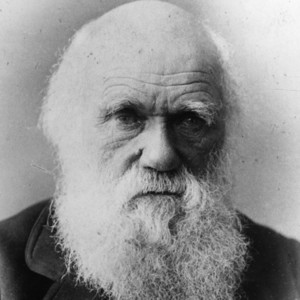
Having made it onto the shortlist, I seem to be ahead in the polling for this Year’s Beard of the Year (for the time being at least – it’s very early days).

I know some people would consider it inappropriate for me to use the medium of this blog to tout for votes. All I can say to such people is VOTE FOR ME!

kmflett's avatarKmflett's Blog

Beard Liberation Front

Media Release 11th December

Contact Keith Flett 07803 16726

Voting for the Beard of the Year 2018

The Beard Liberation Front the informal network of beard wearers, has said that voting is open for the Beard of the Year 2018. The vote closes at midnight on 24th December with the winner declared on 28th December.

Names can be added by write-ins at the bottom of the poll. 1% of the overall vote is needed for someone to join the poll.

The BLF say that the shortlist comprises those whose beard has had a positive impact in the public eye during the year rather than the style or the length of the beard or the views of the beard wearer.

BLF Organiser Keith Flett said, competition for Beard of the Year is bristling

For the first time this year the result will be determined by a…

View original post 128 more words