
Pride 2025

Posted in History, LGBTQ+, Maynooth with tags , , , , , , , , on June 13, 2025 by telescoper

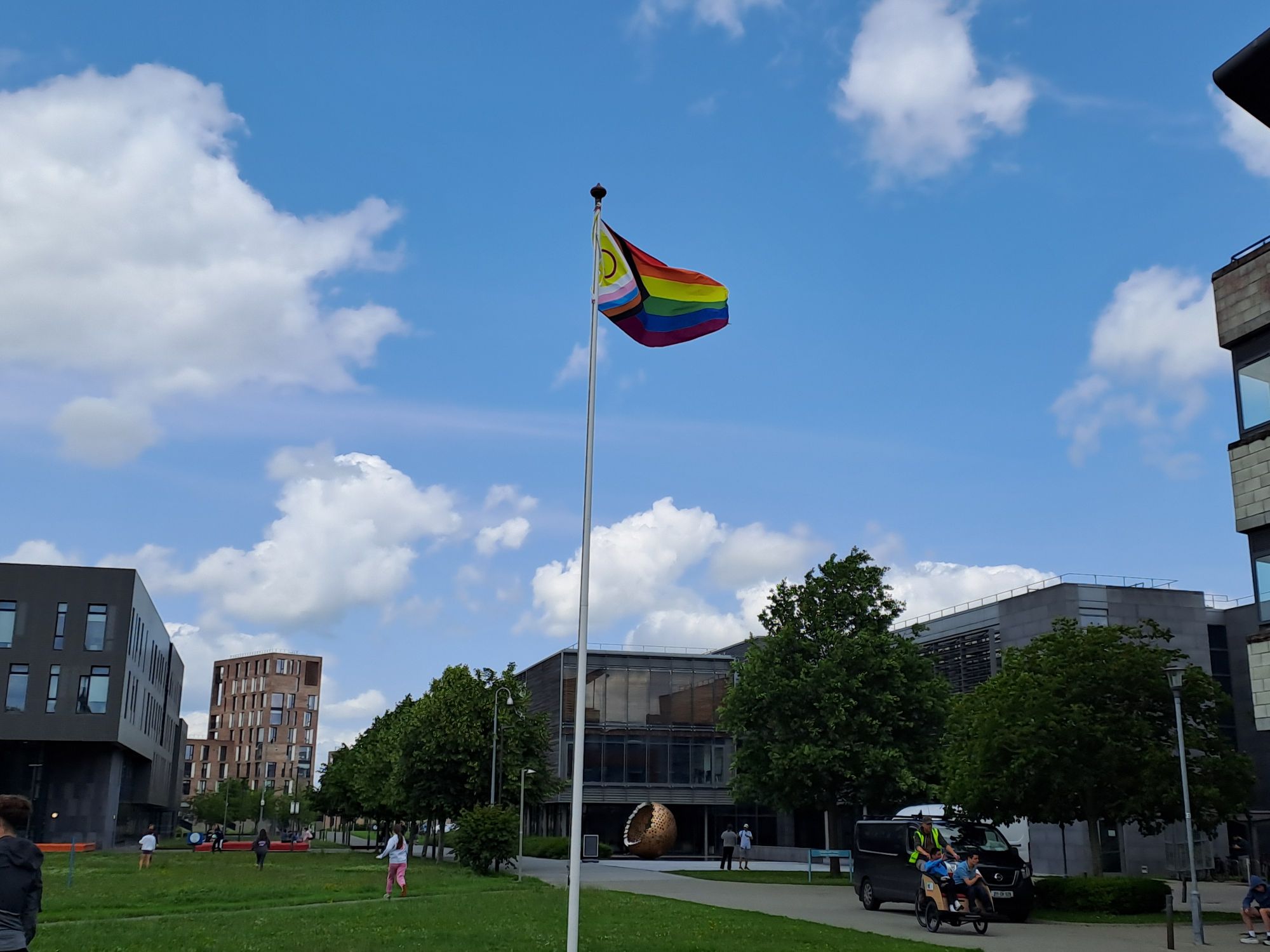
It’s 13th June, which means it’s almost halfway through this year’s Pride Month. I’ve been so busy that I am very late in posting about Pride 2025. I usually post something to mark Pride Month on 1st June (e.g. here). In fact I hadn’t even noticed the Pride Progress Flag flying on Maynooth Campus (between the Arts Block and John Hume Building) until today. I didn’t see anything on Maynooth’s social media about Pride either. I didn’t see the flag yesterday when I left the Science Building and assumed it wasn’t there. It was however raining heavily so my view may have been obscured by the rain on my spectacles, so I went back today to check. I am relieved it is there, as we need such symbols now more than ever.

With its origins as a commemoration of the Stonewall Riots of 1969, Pride remains both a celebration and protest. It’s more necessary than ever now because of the sustained abuse being aimed at trans people from all quarters, including those in political power and those sad losers who have nothing better to do that spend all day tweeting their bigotry on social media. Bigots will always be bigots, but the lowest of the low are those that masquerade as some sort of progressive while spouting their hate and prejudice.

Someone asked me the other day whether we still needed Pride. I replied that I think Pride will be necessary for as long as there are people who are annoyed by its existence. As well as a celebration and a protest, Pride is an opportunity for us all to show solidarity against those who seek to divide us. Though many LGBTQIA+ people in many countries – even those that claim to be more liberal – still face discrimination, hostility and violence, Pride Month always reminds me of how far we’ve come in the past 50 years but also serves as a reminder that the rights we have won could so easily be taken away. As I get older, I find I have become more and more protective towards younger LGBTQ+ people. I don’t want them to have to put up with the crap that I did when I was their age.

To mark this year’s Pride I decided to become a patron of Gay Community News, a free magazine that is, I hope, a vital resource to for the Irish LGBTQ+ community. I hope to take part in the Dublin Pride March on 28th June too. More generally, I would like to wish all LGBTQIA+ people around the world, but especially staff and students at Maynooth University, a very enjoyable and inspiring Pride 2025!

The Test Final and Final Examination Board

Posted in Cricket, Education, Maynooth with tags , , , , , , on June 12, 2025 by telescoper

Had I not been obliged to attend this morning’s final Examination Board for Theoretical Physics programmes at Maynooth University, I would have been at Lord’s today watching Day 2 of the World Test Cricket final between Australia and South Africam where it is now the Tea interval. There certainly wouldn’t have been any cricket in Maynooth this morning, as there has been torrential rain all day so far, but the Exam Board went ahead and finished even before South Africa were all out in their first innings for 138, after late-order collapse, in response to Australia’s first innings total of 212.

As I already mentioned, today’s Examination Board we went through the results in the presence of our External Examiner. Since this is the end of the academic year, we also looked at the final grades of those students who are completing their studies this year in order to consider the classification of their degrees. Another (pleasant) duty of our Examination Board was to award prizes for the best performance, not just for finalists but for students at every stage, including the first year. These will be announced in due course.

But that’s not quite the end of it – there is an overall University Examination Board that covers all courses in the University to formally bring an end to the examination process. It is not until after all the Boards have done their business that the students get their marks. If all goes to plan, students will receive their final marks on Friday 27th June.

Soon after that, on Tuesday 1st July, we have a Consultation Day, where

Staff will be available in all Departments to discuss results with students. Students are entitled to see their examination scripts if they wish, these will be generally available on this day or at another mutually convenient time.

If I had my way we would actually give all students their marked examination scripts back as a matter of routine. Obviously examination scripts have to go through a pretty strict quality assurance process involving the whole paraphernalia of examination boards (including External Examiners), so the scripts can’t be given back immediately but once that process is complete there doesn’t seem to me any reason why we shouldn’t give their work, together with any feedback written on it,  back to the students in its entirety. I have heard it argued that under the provisions of the Data Protection Act students have a legal right to see what’s written on the scripts – as that constitutes part of their student record – but I’m not making a legalistic point here. My point is purely educational, based on the benefit to the student’s learning experience.

That’s one set of examination duties done and dusted, but not everything. Next Tuesday I am Internal Examiner for a PhD at Maynooth and, about a month from now, I have to travel to a foreign land to be an External Examiner. It’s all go…

Ologies and Nouns of Agency

Posted in Pedantry with tags , , , , , , , on June 11, 2025 by telescoper

The other day I was wondering, for no particular reason, why it is that a person who does astrology is called an astrologer, whereas a person (such as myself) who specializes in cosmology is a cosmologist.

Before proceeding to bore you further I will point out: (i) that words such as astrologer or cosmologist are examples of “noun of agency” or “agentive nouns” as they denote the agent or doer of an action; and (ii) that the suffix “-ology” signifies the study of a particular subject of thing. The word “ology” itself has come to mean “a branch of study” (at least informally).

Most ologies have an agentive noun that ends in “ologist”. As well as cosmologist, we have biologist, geologist, anthropologist, sociologist, and so on. There’s even “apologist” although I don’t think “apology” is an ology in the usual sense. Astrology is an ology, but we don’t usually talk about astrologists. In fact I rarely talk about astrologers either, but that’s not the point.

Looking in various dictionaries, however, I do see that the “-ologer” ending is given for some of the ologies listed above, including “geologer” but in all cases that I’ve found these are marked as archaic. Perhaps “astrologer” has lingered because astrology is a subject that likes to present itself as having ancient credentials.

There is another exception to the “ology-ologist” rule. At least in English English, a person who studies theology is not a theologist, nor even a theologer, but a theologian. I don’t know how that came about. There are quite a few people who can’t resist mixing religion with science when they talk about the field of cosmology, so perhaps cosmologian might be an appropriate term for them?

The Borgias are having an orgy

Posted in History with tags , on June 10, 2025 by telescoper

And now for something completely different.

The magnetic moment of the muon revisited

Posted in The Universe and Stuff with tags , , , , on June 10, 2025 by telescoper

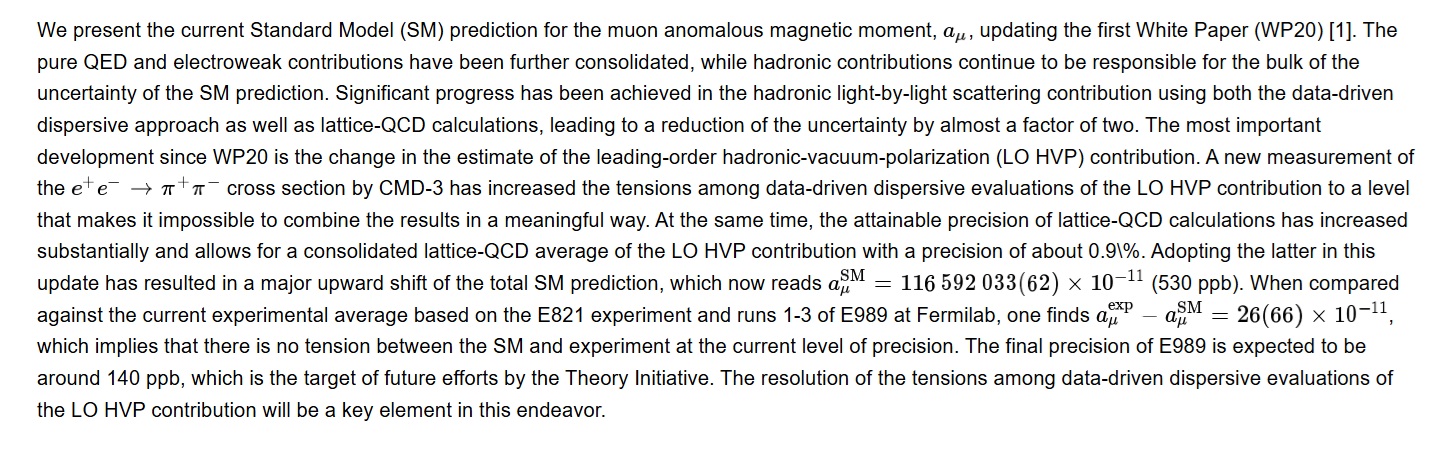
A couple of years ago I posted an item about a measurement of the anomalous magnetic moment of the muon, a quantity usually known as (g-2). At the time this appeared to be in conflict with the predictions of the standard model (SM)of particle physics but the general opinion among experts was that the problem was likely to lie with the calculations rather than the experiment.

Well, catching up on things I missed during examination marking season, I refer you to a substantial paper (188 pages long) that appeared on arXiv on 27th May 2025, with the abstract:

If this is too small to read I direct yourself to the salient point, namely that “there is no tension between the SM and experiment at the current level of precision”.

It seems the Standard Model survives to fight another day…

On Scholarly Communication

Posted in Open Access with tags , , , , on June 9, 2025 by telescoper

My marking duties being over, it’s time once more to take up the cudgels against the academic publishing racket, at least in a small way, by sharing an article from the European University Association called Reclaiming academic ownership of the scholarly communication system. I recommend you read the entire piece, which is an extended briefing note. It can be downloaded as a PDF here. One of the points it makes very strongly is how much the Open Access movement has been hijacked by commercial publishers.

I will share a couple of sections with you here. First, some background information about Open Access Publishing:

Now I’ll cut to the chase and share the key points from the end.

  1. Accelerate the reform of research assessment. Most of the issues in the current publishing system are rooted in how academic staff are evaluated. Research assessment reform is essential to break the cycle of dependence on high-impact commercial journals and related metrics. Universities should consider broadening the criteria used in academic evaluation, to ensure that recognition goes beyond research to include teaching, innovation, leadership, open science practices, and societal outreach. While institutional, regulatory, and cultural factors can either facilitate or hinder reforms, many universities are already taking the initiative and implementing changes (even in countries with centrally regulated academic career assessment processes).
  2. Strengthen institutional publishing services and infrastructures. A robust, sustainable and interoperable scholarly publishing ecosystem requires each university to properly curate their research contributions and outputs, through institutional or shared infrastructure and services (e.g. repositories, publishing platforms, and CRIS systems). Strengthening these institutional capacities may require reallocating resources and cooperation (see points 3 and 4). This should also apply to the various institutional departments (libraries, research management, etc.) and staff needed to support academics and researchers.
  3. Cooperate and coordinate with other universities, research performing and funding organisations, as well as researchers’ associations and learned societies. The challenges of scholarly publishing are systemic, and no single institution can tackle them alone. Universities should align their efforts with other academic organisations, funders and research institutions. Cooperation and coordination can be valuable for advocacy, policy development and implementation, as well as for shared or “horizontal” services and infrastructures. Cooperation can also take place within regional, national, European and global frameworks.
  4. Critically evaluate expenditure on commercial research publishing and information products and services. As new not-for-profit publishing alternatives emerge and consolidate, universities should regularly evaluate their expenditure on commercial products and services, including journal publication costs and research databases. By promoting cost transparency and cost efficiency, institutions can make informed decisions that support innovation and reinvest funds into institutional publishing services and infrastructure (see point 2). Where feasible, preference should be given to not-for-profit solutions, ultimately reducing costs and ensuring sustainability.
  5. Support and promote the use of rights retention by the university community. Rights retention should be used to regain academic ownership of scholarly communication. Universities should actively advocate for legislative reforms that allow researchers to retain their rights and freely share their research. They should also educate and inform their faculty and researchers of the importance of rights retention and provide legal support. Where legally feasible, institutions should implement and enforce rights retention policies to ensure that publicly funded research remains publicly accessible.
  6. Ensure researcher engagement. Any transition toward a more equitable and sustainable scholarly communication system must involve the academic community. Universities should raise awareness of the systemic issues in scholarly publishing and create spaces for dialogue, reflection, and co-design to discuss how to address them at institutional level. Engaging researchers early and consistently can help shift perceptions, foster a sense of shared responsibility and build support for longterm cultural change.

I endorse all of these, and have written about some of them before (e.g. here) but I would add to the first that universities should actively lobby their governments to change research assessment methods which in many cases are causing an immense waste of public money by outsourcing research assessment to entities, such as Scopus, who are mere fronts for the academic publishing industry.

Marking Over

Posted in Biographical, Education, Maynooth with tags , on June 9, 2025 by telescoper

Better is the end of a thing than the beginning thereof…

I’ve just graded the last of my assignments for this (academic year). I had a bigger class than usual for Computational Physics this time round, so it took much longer than usual to mark the project component. It always takes a while because I not only have to read and grade the reports, but also look at the code they submit and run it to check that it works. I uploaded the final grades to our system just now and although I finished later than planned I was relieved to see that I’m not the last lecturer to do so!

What happens next is that all the marks from all the modules will be collated and cross-checked. Then we will have a meeting of the Departmental Examination Board (on Thursday morning) to go through the results in the presence of our External Examiner. Since this is the end of the academic year, we will also look at the final grades of those students who are completing their studies this year in order to consider the classification of their degrees. There may also be some who are not qualified to graduate and may have to repeat failed examinations or other assessments. Another (pleasant) duty of our Examination Board on Thursday will be to award prizes for the best performance, not just for finalists but for students at every stage, including the first year.

I was teaching a module for the Department of Engineering last Semester so I should attend their final Examination Board too. Many of our students at Maynooth take joint degrees, in which case their final degree classification depends on grades from two Departments. For that reason, there is an overall Examination Board at which the marks are combined. Fortunately, only the Head of Department (who is not me) has to attend that one.

If all goes to plan, students will receive their final marks on Friday 27th June. It’s a lengthy process so as to allow plenty of opportunities to check and validate the different stages. After that, on Tuesday 1st July, we have a consultation day at which students can ask for advice about repeat examinations, etc, and after that we have to make sure repeat examinations are available. The repeat examination period is Wednesday 6th August to Tuesday 19th August.

Between the end of this week and the repeat exams, perhaps I’ll get a bit of time to do some research…

The Cosmic Poltergeist

Posted in Film, The Universe and Stuff with tags , , on June 8, 2025 by telescoper

Last night I stayed up long past my usual bedtime to watch the film Poltergeist. This film, about the haunting of a family house by malevolent spirits, was a huge hit when it came out in cinemas back 1982, and I was interested to see how well it has endured. I think it stans up pretty well actually. The special effects could be done better nowadays, but it is still credibly scary.

The idea of a poltergeist is not new, but the film cleverly combines the old legends with new technology, in the way that the first manifestation of an evil presence is through a TV set. It is the youngest child of the house in question, Carol Anne, who is able to detect the ghosts when all we can see on the screen is static. The implication is that the young are the most receptive to paranormal phenomena.

Most of the static produced in a TV set when it is not tuned to a broadcast frequency is produced by thermal noise in the receiver, but around 1% of it comes from the cosmic microwave background (CMB). I’ve used static on a TV screen as a gimmick in public lectures on several occasions, with the joke that it may only be 1% but the birth of the Universe is far more interesting than most things you can see on TV!

The CMB is a ghost of the Big Bang. Watching Poltergeist last night, it occurred to me that when cosmologists study this relic radiation, we are all a bit like Carol Anne, trying to make sense of an eery presence that is always with us, but is barely perceptible. Such studies involve extensive use of spectral analysis.

This line of thinking led me to my new theory of the Universe. Perhaps it was built on the remains of an earlier, deceased Universe which is now trying to make contact this one in order to wreak revenge for the violation of its grave…

The 2025 Leaving Certificate Mathematics Papers

Posted in Education, mathematics with tags , , on June 7, 2025 by telescoper

As I mentioned a few days ago, examinations for the 2025 school Leaving Certificate are under way. One of the interesting things about the Irish system is that the examination papers are put up online immediately after the examinations. Students took their first paper in Mathematics (either Ordinary or Higher level) on Friday (yesterday), and there has been some reaction.

Anyway, I thought I’d share the papers here so you can see what you think. Paper 2 is on Monday 9th June, so I’ll add those papers then.

They look reasonable to me. The thing that strikes me about them is that they are much more structured than the A-level mathematics examinations I took way back in 1981.

Comments are welcome through the box below.

Update: As promised here are the Papers 2:

Reaction to Paper 2 of Higher Mathematics is that it was more challenging than Paper 1.

Weekly Update from the Open Journal of Astrophysics – 07/06/2025

Posted in OJAp Papers, Open Access, The Universe and Stuff with tags , , , , , , , , , , , on June 7, 2025 by telescoper

It’s Saturday so once again it’s time for the weekly update of papers published at the Open Journal of Astrophysics. Since the last update we have published two new papers, which brings the number in Volume 8 (2025) up to 69 and the total so far published by OJAp  is now up to 304.

The two papers published this week, with their overlays, are as follows. You can click on the images of the overlays to make them larger should you wish to do so.

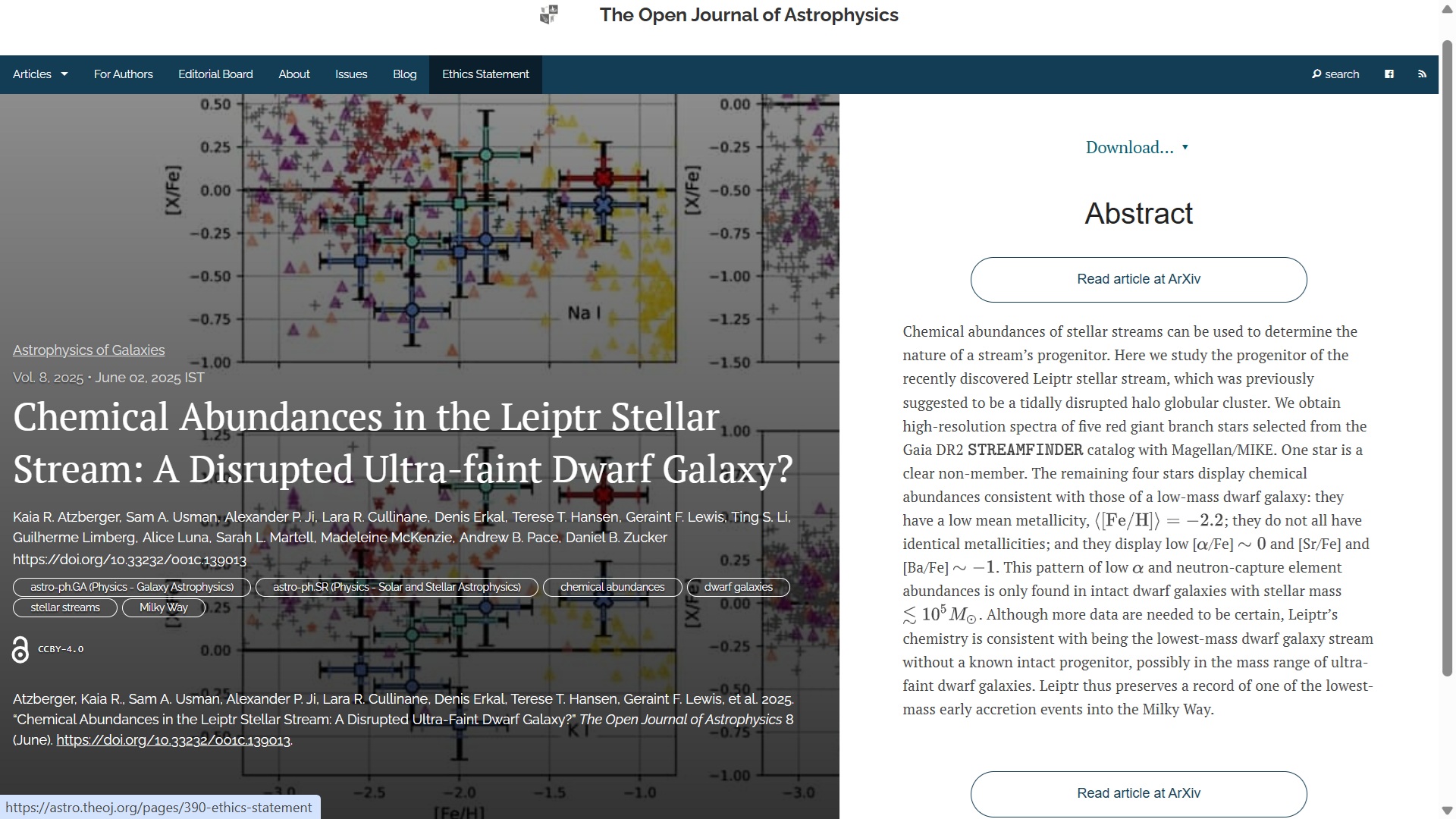
The first paper to report is “Chemical Abundances in the Leiptr Stellar Stream: A Disrupted Ultra-faint Dwarf Galaxy?” by Kaia R. Atzberger (Ohio State University) and 13 others based in the USA, Germany, the UK, Sweden, Australia, Canada and Brazil. This one was published on 2nd June 2025 and is in the folder marked Astrophysics of Galaxies. It presents a spectroscopic study of stars in a stellar stream suggesting that the stream originated by the accretion of a dwarf galaxy by the Milky Way.

The overlay is here:


You can read the final accepted version on arXiv here.

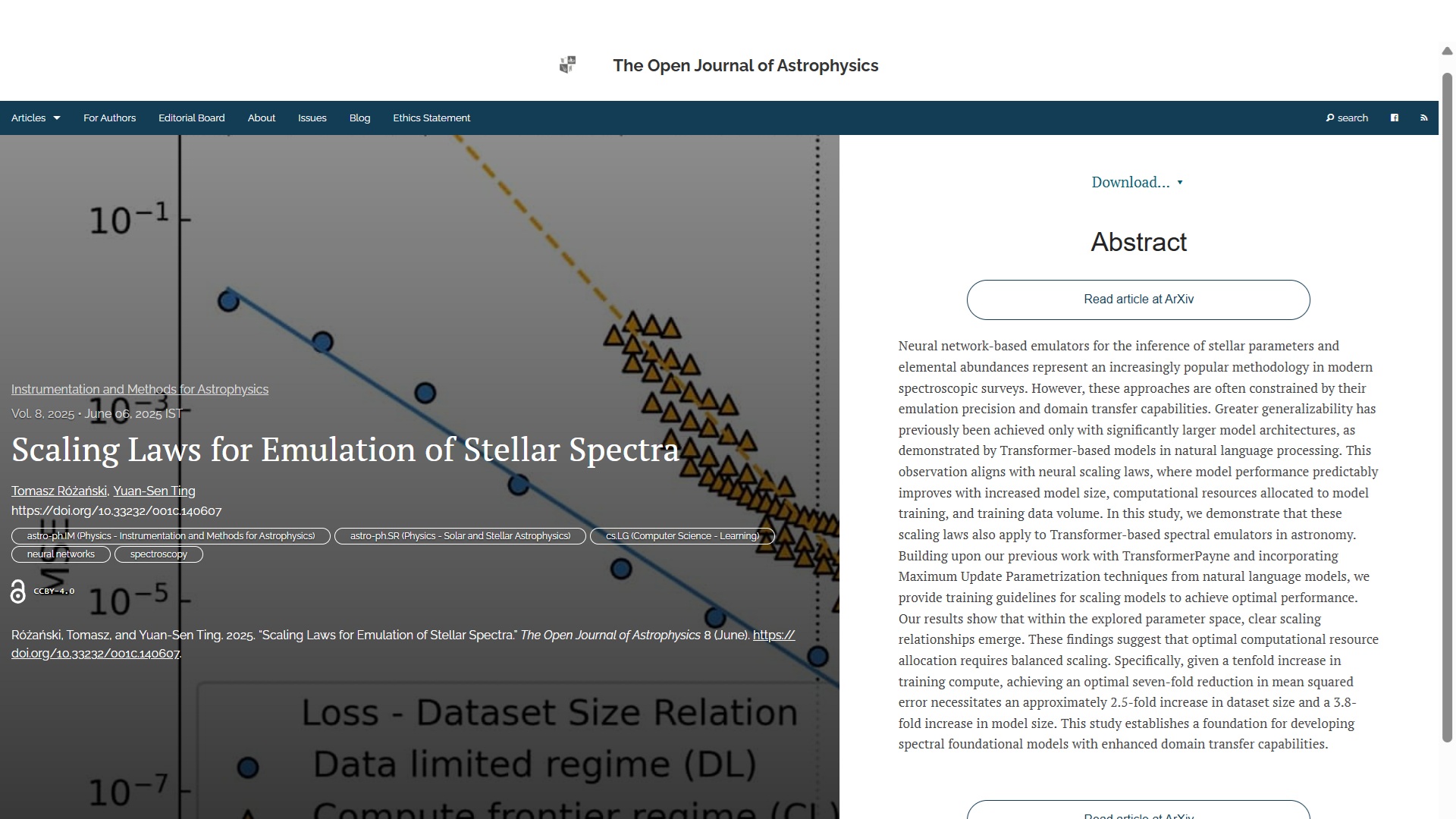
The second paper is “Scaling Laws for Emulation of Stellar Spectra” by Tomasz Różański (Australian Nastional University) and Yuan-Sen Ting (Ohio State University, USA). This was published yesterday, i.e. on 6th June 2025, and is in the folder Instrumentation and Methods for Astrophysics. The paper discusses certain scaling models and their use to achieve optimal performance for neural network emulators in the inference of stellar parameters and element abundances from spectroscopic data.

The overlay is here:

You can find the officially-accepted version of the paper on arXiv here.

That’s the papers for this week. I’ll post another update next weekend.

As a postscript I have a small announcement about our social media. Owing to the imminent demise of Astrodon, we have moved the Mastodon profile of the Open Journal of Astrophysics to a new instance, Fediscience. You can find us here. The old profile currently redirects to the new one, but you might want to update your links as the old server will eventually go offline.