On The Alteration Of Time

Posted in History with tags , , , , on October 28, 2018 by telescoper

So here we are again, having put our clocks back an hour. Summer Time is over, but at least I had extra time to do this morning’s crosswords. Or so it seems. It’s really only the clocks that changed, not the time. But then what is time, other than what clocks measure?

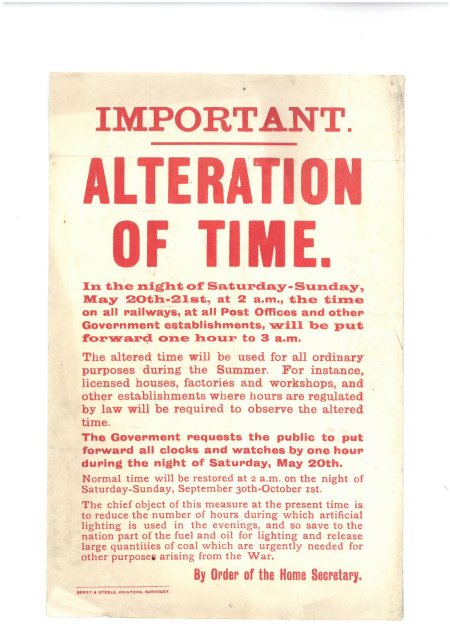
Anyway, before I get too philosophical let me mention that I found the marvellous poster above on Twitter. It’s from 1916, when British Summer Time was introduced. I was surprised that the practice of changing clocks backwards and forwards began so recently in the United Kingdom. To be honest I’m also surprised that the practice persists to this day, as I can’t see any real advantage in it.

It would be better in my view to stick with Greenwich Mean Time throughout the year. Any institution or organisation that wants to change its working hours in summer can easily do so, but the world of work is far more flexible nowadays than it was a hundred years ago and I think few would feel the need.

Anyway, while I am on about Mean Time, here is a another poster from 1916.

Until October 1916, clocks in Ireland were set to Dublin Mean Time, as defined at Dunsink Observatory rather than at Greenwich. The adoption of GMT in Ireland was driven largely by the fact that the British authorities found that the time difference between Dublin and London had confused telegraphic communications during the Easter Rising earlier in 1916. Its imposition was therefore, at least in part, intended to bring Ireland under closer control and this did not go down well with Irish nationalists.

Ireland had not moved to Summer Time with Britain in May 1916 because of the Easter Rising. Dublin Mean Time was 25 minutes 21 seconds behind GMT but the change was introduced at the same time as BST ended in the UK, hence the alteration by one hour minus 25 minutes 21 seconds, ie 34 minutes and 39 seconds as in the poster.

Shostakovich – The Leningrad Symphony

Posted in History, Music with tags , , , on October 27, 2018 by telescoper

I don’t know. You wait 50-odd years for the opportunity to hear a live performance of Symphony No. 7 in C by Dmitri Shostakovich, and then two come along within a year. It was last November in Cardiff that I first heard this epic work in concert, and last night I was at the National Concert Hall in Dublin where it was performed by the RTÉ National Symphony Orchestra conducted by Stanislav Kochanovsky.

The first half of last night’s concert featured two works by Dmitry Kabalevesky (a contemporary of Shostakovich): his overture to the Opera Colas Breugnon and is Cello Concerto No. 1 with soloist Richard Harwood. Both of these were pleasant enough but I (and, I think, most of the rest of the audience) had their minds firmly on the main event to come after the interval.

The Leningrad Symphony is a piece that evokes particular memories for me as I first heard it about thirty years ago on the radio while sitting in a car that was driving through a torrential downpour in the middle of the night from Kansas City to Lawrence in the mid-West of the USA. The repeating theme and snare drum figures in the 1st Movement that represent the remorseless advance of the invading army had even more powerful effect when accompanied by the incessant driving rain. I’ve heard this piece on recordings and live broadcasts on many occasions since then, but had never heard it performed live until last November.
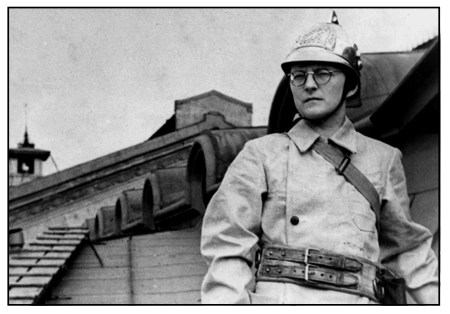
Shostakovich in a fireman’s uniform in Leningrad, 1941

What can I say about this work? Well, not much that hasn’t been said before. It was dedicated to the city of Leningrad where the composer lived, until he was evacuated during the siege, and where he wrote most of the 7th Symphony. He served as a volunteer fireman in Leningrad during the early part of the Second World War (see above), having been turned down for military service owing to his poor eyesight. Leningrad was besieged by German forces for almost 900 days, from September 1941 until January 1944, and it’s impossible not to see the work in this historical context.

Though the four movements have themes – `War’, `Memories’, `My Native Field’ and `Victory’ – this is not really a programmatic piece. It does, however, succeed in invoking the terror and brutality of armed conflict in a manner that is so compelling that it’s almost overpowering. Many symphonies have as a theme some kind of struggle between light and dark, or between good and evil, but it always seemed to me that this work is not so much like that as it is a representation of a struggle simply for survival against annihilation. Even the end of the intense fourth movement, when the music finally resolves into the key of C Major, suggesting a kind of `victory’, echoes of the previous conflict persist, suggesting (to me anyway) that this particular battle does not intend in any kind of triumph but in a sense of grim endurance that is more resignation than resolution. The composer himself, however, explained later in life that the ending represented

..the victory of light over darkness, wisdom over frenzy, lofty humanism over monstrous tyranny.

We could do with a victory of that sort these days.

Musicologists tend not to like this Symphony so much as some of Shostakovich’s others and its reputation dwindled in the West in the post-War period. Maybe it is true that it has defects when thought of as an exercise in composition, but fortunately I am not a professional critic so I am quite content to say that for me, personally, this work has an emotional impact like few others and it is one of my favourites in the whole symphonic repertoire. Last night the RTÉ Symphony Orchestra delivered an impassioned performance that confirmed everything I felt about this work but with the added dimensions that you can only get from a live performance.

At the beginning I wasn’t sure I was going to enjoy last night’s performance. I thought it began at an uncomfortably brisk tempo, but once the orchestra had settled down it turned into a magnificent performance. From the immaculately controlled crescendo representing the advancing invaders that erupts into a nightmarish depiction of the ensuing battle right through to the last movement with its ending in resolution tempered in bitterness and regret, this performance had me gripped at least as much as last year’s.
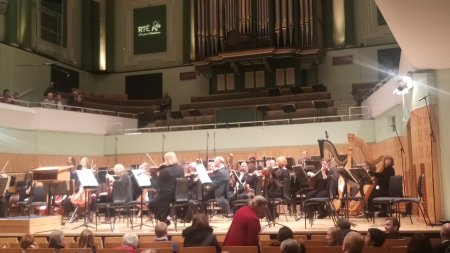
In the first movement, Kochanovsky had the strings playing with a strident, agonized sound that was remarkably affecting . But the highlight of the evening came from the brass section placed in the choir stalls (four French horns, three trombones and three trumpets; you can see their empty desks in the picture I took before the start of the concert). When they stood up and let rip at the climax of the first movement crescendo the effect was absolutely thrilling. Their position high above the stage made it seem they were playing right in your face. When the glorious noise eventually subsided I realized that I had been gripping the armrests of my seat and my knuckles had turned white. I don’t think you can experience music with such intensity unless you hear it live.

At the end there was an immediate outbreak of cheering and a well-deserved standing ovation. I wish I could have stayed longer but I had to leave to catch a train back to Maynooth. (The Leningrad Symphony being rather long, I thought I might have to dash off at the end so I booked an end-row seat.) Let me at least use the opportunity afforded by this blog to congratulate Stanislav Kochanovsky and all the musicians last night for a magnificent performance of an epic masterpiece.
Another Day, Another Open Access Talk..

Posted in Biographical, Maynooth, Open Access with tags , , on October 26, 2018 by telescoper

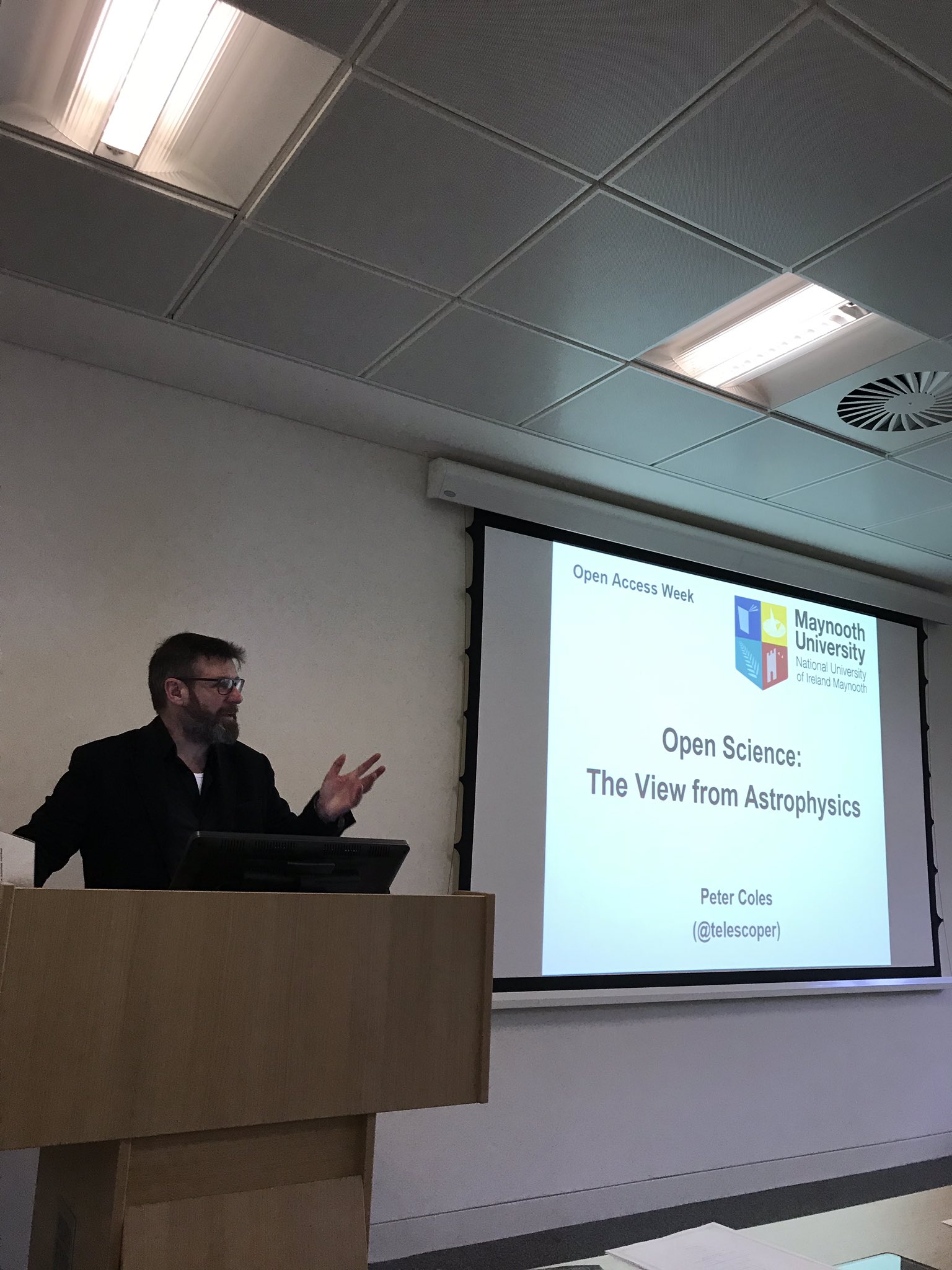
So having exercised my franchise earlier this morning, I found myself in Maynooth University Library giving yet another talk about Open Access publishing as part of Open Access Week.

I’ve got a lecture at noon, which will be the last one I give before the half-term `Study Week’ which begins with a bank holiday on Monday 29th October (Lá Saoire i mí Dheireadh Fómhair). It’s very nice to have a break before Christmas like this. Also the University study week is timed to be the same as School half-term holidays, which is good for those members of staff who have kids of school age.

Well, that’s enough blogging. I need to get my vector calculus notes together. I’m doing line integrals today, by the way

This Bitter Earth

Posted in Music with tags , , on October 25, 2018 by telescoper

This bitter earth
What fruit it bears
What good is love
That no one shares?

And if my life is like the dust
That hides the glow of a rose
What good am I?
Heaven only knows.

This bitter earth
Can be so cold.
Today you’re young.
Too soon you’re old.

But while a voice
Within me cries
I’m sure someone
May answer my call.

And this bitter earth,
May not be so bitter after all.

(Vocals by Dinah Washington with orchestration by Max Richter)

A Letter of Note

Posted in Biographical on October 24, 2018 by telescoper

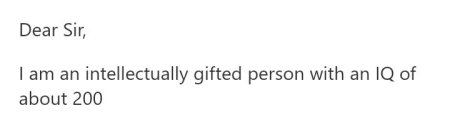
I often receive unsolicited emails, but one that arrived this evening has the boldest opening sentence of any:

Predictably, however, the rest of the. message fails to provide evidence to support my correspondent’s initial assertion…

BepiColombo goes to Mercury

Posted in The Universe and Stuff with tags , , , on October 24, 2018 by telescoper

You may have missed the news that the joint Japanese-European (JAXA-ESA) Mission BepiColombo was successfully launched on October 19th 2018 and is now on its way to the planet Mercury, where it will arrive in December 2025.

As it happens I’ve just finished delivering a set of lectures on gravitational dynamics, part of which was devoted to orbital mechanics. One of the problems I worked out during these lectures was the Hohmann Transfer Orbit which is the simplest way to get a spacecraft from Earth to, e.g., Mars (which take 8 to 9 months to reach).

Since the radius of Mercury’s orbit is 0.39 AU (compared with Mars’s 1.52 AU) you might think it would take a similar time to reach Mercury, but designing a trajectory that results in a controlled encounter with Mercury in an efficient manner is much harder than for Mars (largely because Mercury is moving much faster). The solution to this problem involves a series of encounters with VEarth, Venus and Mercury each of which results in an adjustment to BepiColombo’s orbit until it finally encounters the target planet at a reasonable speed. This approach takes over seven years, but it saves an enormous amount on fuel – using the gravitational boost from planetary encounters instead of firing rockets.

Here’s a video showing this complex but fascinating example of orbital mechanics in action:

p.s. the dates in the video correspond to the originally planned launch date of 5th October, so are off by a couple of weeks.

Government of Ireland Postdoctoral Fellowships

Posted in Uncategorized with tags , on October 23, 2018 by telescoper

A busy teaching days is over, but before I go home I thought I’d use the medium of this blog to advertise the Government of Ireland Postdoctoral Research Fellowships which have just been announced by the Irish Research Council.

These positions are of one or two years’ duration starting from 1st October 2019. The research relating to the fellowship can be in any discipline (including Astrophysics and Cosmology) and can be held in any University in the Irish Republic (including Maynooth). The deadline for applications is 29th November 2018.

For further information, see here.

Anyone interested in applying to hold one of these positions in Maynooth is welcome to contact me privately for advice or assistance.

The Signs of Age

Posted in Biographical, The Universe and Stuff with tags , , , , on October 23, 2018 by telescoper

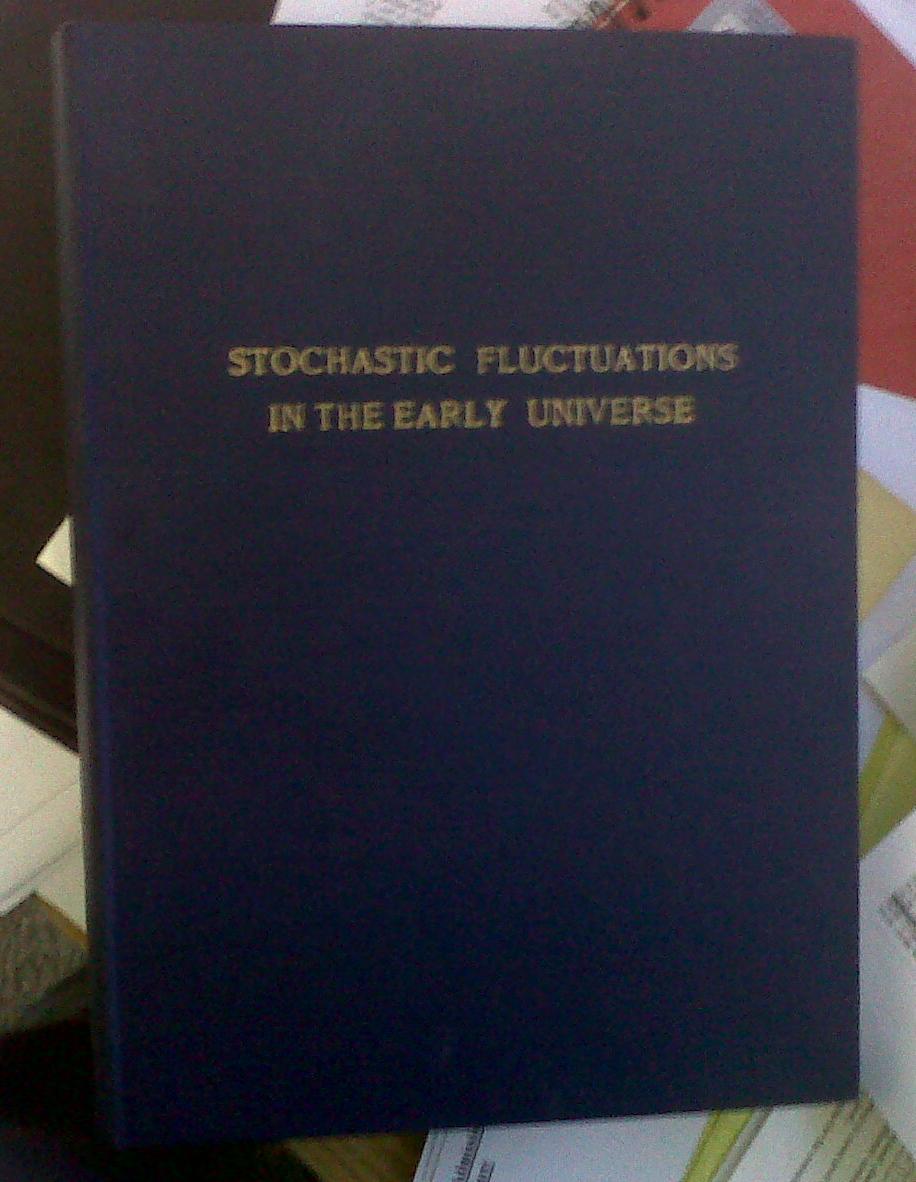
I was feeling very tired yesterday evening and in my vegetative state I suddenly realised that last month I missed a significant personal anniversary. In September 1988, now over thirty years ago I submitted my DPhil thesis at the University of Sussex. Here it is..

It was to be another couple of months until I had my viva (an experience I’d definitely rather forget) so I didn’t get to receive the postgraduate degree formally until the following summer, but at least I finished and submitted within the three years my funding allowed. Incidentally, mine was one of the first generation of theses at the University of Sussex to be typeset in LaTeX. At least I avoided the hassle of having carbon copies made!

The field of cosmology has changed so much in the three intervening decades that I’m sure current graduate students would find my thesis as incredibly simple-minded as I do. There weren’t any measurements of CMB temperature patterns in those days (the COBE results were not announced not until 1992) so I had to generate simulated observations, for example. Still, a few of the things in my thesis have stood the test of time, in the form of papers that still get cited to this day. I was lucky that my research  was in an area that was about to take off, rather than one that was already in decline, and that there will still problems around that were easy enough for me to tackle!

The way of working was very different too: the fact that my generation didn’t have computers on our desks makes younger graduate students wonder how we managed to do anything at all! I still amuse my colleagues with my habit of writing out bits of code in longhand on paper  and `desk-checking’ them before typing them in.

The fact that I now have over 30 years’ postdoctoral experience definitely adds to the feeling of getting very old, along with the all-pervading fatigue, the random aches and pains that afflict me from time to time, failing eyesight, and the tendency of Facebook to send me advertisements about stairlifts, hearing aids, and (worst of all) golf equipment.

The start of University term in late September brings with it a new intake of students that always looks even  younger than the last. That produces a strange alternation of feelings. On the one hand, working in a University means that you’re always surrounded by bright young students which is a good thing when you’re getting on a bit in that it reminds you that you were once like that. On the other, the proliferation of young persons around does force you to face up to how old you actually are.

I remember some years ago I was teaching a module on astrophysics as part of which I did a lecture on supernovae. In the middle of that I said to my class: “of course, you will all remember SN 1987A” (which was detected while I was a PhD student). Blank faces. I then realized that none of them had even been born in 1987. Nowadays it is the case that I was already a Professor when all my undergraduate students were born.

But these signs of age are as nothing compared to the shock I underwent when a few months ago I discovered that I’m older than Nigel Farage.

Counting String Theory Standard Models

Posted in The Universe and Stuff with tags , on October 22, 2018 by telescoper

I saw a paper on the arXiv and couldn’t resist a (snarky) comment. Here is the abstract:

We derive an approximate analytic relation between the number of consistent heterotic Calabi-Yau compactifications of string theory with the exact charged matter content of the standard model of particle physics and the topological data of the internal manifold: the former scaling exponentially with the number of Kahler parameters. This is done by an estimate of the number of solutions to a set of Diophantine equations representing constraints satisfied by any consistent heterotic string vacuum with three chiral massless families, and has been computationally checked to hold for complete intersection Calabi-Yau threefolds (CICYs) with up to seven Kahler parameters. When extrapolated to the entire CICY list, the relation gives about 1023 string theory standard models; for the class of Calabi-Yau hypersurfaces in toric varieties, it gives about 10723 standard models.

Isn’t  10723 also the number of angels that can dance on the head of a pin? That number of models for the price of one theory looks like a bargain to me!

But, seriously, people often complain that string theory isn’t really scientific because it isn’t predictive. That clearly isn’t true. String theory is the most predictive theory ever: it can predict anything you want!


Halloween in LaTeX

Posted in History, mathematics on October 21, 2018 by telescoper

I forget where I found this list of spooky LaTeX commands but, with the dreaded Halloween coming up soon, I thought I’d share it here.

Anyway, it reminded of the mathematical curve known in English as The Witch of Agnesi, the witch of which is a mistranslation of the Italian versiera meaning a ‘sheet’ (ie the rope connecting to a ship’s sail) rather than a shortened version of ‘avversiera’ meaning ‘a female devil’ or ‘witch’.