The Importance of Taking Notes

Posted in Biographical, Education with tags , , , on September 24, 2018 by telescoper

Well, term has officially started and the campus of Maynooth University is looking very busy. Taking a short break from the task of preparing notes and problem sets for the modules  I’m teaching this term.  I’ve just remembered an old post I did some time ago about  lecture notes. I won’t repeat the entire content of my earlier discussion, but one of the main points I made in that was that many students are simply not used to taking notes and find it difficult to do so effectively during lectures, so much so that the effort of copying things onto paper must surely prevent them absorbing the intellectual content of the lecture (assuming that there is any). Since it’s the first week of teaching here, I thought I’d share some thoughts, for the benefit of those starting a new term.

I dealt with the problem  of taking notes when I was an undergraduate by learning to write very quickly without looking at the paper as I did so. That way I didn’t waste time moving my head to and fro between paper and screen or blackboard. Of course, the notes I produced using this method weren’t exactly aesthetically pleasing, but my handwriting is awful at the best of times so that didn’t make much difference to me. I always wrote my notes up more neatly after the lecture anyway. But the great advantage was that I could write down everything in real time without this interfering with my ability to listen to what the lecturer was saying.

An alternative to this approach is to learn shorthand, or invent your own form of abbreviated language. This approach is, however, unlikely to help you take down mathematical equations quickly.

My experience nowadays is that many students simply aren’t used to taking notes like this – I suppose because they get given so many powerpoint presentations or other kinds of handout –  so they struggle to cope with the old-fashioned chalk-and-talk style of teaching that some lecturers still prefer (and which actually works very well in mathematically-based disciplines). That’s probably because they get much less practice at school than my generation did. Most of my school education was done via the blackboard..

Nowadays,  many lecturers  give copies of their powerpoint slides to students and others even give out complete sets of printed notes before, during, or after lectures. That’s all very well, I think, but what are the students supposed to be doing during the lecture if you do that? Listen, of course, but if there is to be a long-term benefit they should take notes too. In other words, entirely passive learning is unlikely to be effective.

Even if I hand out copies of slides or other notes, I always encourage my students to make their own independent set of notes, as completely as possible. I don’t mean by copying down what they see on the screen and what they may have on paper already, but by trying to write down what I say as I say it. I don’t think many take that advice, which means much of the spoken illustrations and explanations I give don’t find their way into any long term record of the lecture.

And if the lecturer just reads out the printed notes, adding nothing by way of illustration or explanation, then the audience is bound to get bored very quickly.

My argument, then, is that regardless of what technology the lecturer uses, whether he/she gives out printed notes or not, then if the students can’t take notes accurately and efficiently then lecturing is a complete waste of time. In fact for the modules I’m doing this term I don’t intend to hand out lecture notes at all during the lectures, although I do post lecture summaries and answers to the exercises online after they’ve been done.

As a further study aid, most lectures at my previous institutions (Sussex University and Cardiff University) are recorded and made available to students to view shortly after the event. Contrary to popular myth there’s no evidence that availability of recorded lectures lowers the attendance at lectures. It appears that students use the recordings for revision and/or to clarify points raised in the notes they have taken, and if anything the recordings allow the students to get greater value from lectures rather than persuading them that there’s no need to attend them. Unfortunately we don’t have lecture capture at Maynooth, but I hope it can be introduced  here at some point.

I do like lecturing, because I like talking about physics and astronomy, but as I’ve got older I’ve become less convinced that lectures play a useful role in actually teaching anything. I think we should use lectures more sparingly, relying more on problem-based learning to instil proper understanding. When we do give lectures, they should focus much more on stimulating interest by being entertaining and thought-provoking. They should not be for the routine transmission of information, which is far too often the default.

I’m not saying we should scrap lectures altogether. At the very least they have the advantage of giving the students a shared experience, which is good for networking and building a group identity. Some students probably get a lot out of lectures anyway, perhaps more than I did when I was their age. But different people benefit from different styles of teaching, so we need to move away from lecturing as the only  option and ensure that a range of teaching methods is available.

I don’t think I ever learned very much about physics from lectures – I found problem-based learning far more effective – but I’m nevertheless glad I learned out how to take notes the way I did because I find it useful in all kinds of situations. Effective note-taking is definitely a transferable skill, but it’s also in danger of becoming a dying art. If we’re going to carry on using lectures, we old fogeys need to stop assuming that students learnt it the way we did and start teaching it as a skill.

Perhaps the biggest problem with the way we* teach physics these days, however,  is not really about the mode of delivery but the compartmentalization that has crept in via the school system which encourages students to think of each `module’ as a bite-sized piece that can be retained until the examinations, regurgitated, and then forgotten. I’ve no doubt that a great many students pass the examinations we set by simply memorizing notes with little genuine understanding  needed or problem-solving ability demonstrated. We promote physics as a subject that nurtures these skills, but I don’t think many physics graduates – even those with good degrees – actually possess them at the end. We should be making much more of an effort in teaching students how to use their brains in other ways than as memory devices, and getting them engaged in more active teaching activities seems to me to be a very high priority. That said, I think we probably do much more of this in physics than in most other subjects!

*by `we’ I mean physicists generally, rather than my current Department (where we do actually make a lot of effort to develop these skills through small group sessions that complement other teaching activities.

The Autumnal Equinox

Posted in Biographical, Maynooth with tags , , , on September 23, 2018 by telescoper

So here we are then. The Autumnal Equinox (in the Northern hemisphere) took place in the early hours of this morning, at 01.54 UT (which is 02.54 Irish Time) on Sunday 23rd September. I was, of course, sound asleep during this momentous event.

People sometimes ask me how one can define the `equinox’ so precisely when surely it just refers to a day on which day and night are of equal length implying that it’s a day not a specific time? The answer is that the equinox is defined by a specific event, the event in question being when the plane defined by Earth’s equator passes through the centre of the Sun’s disk (or, if you prefer, when the centre of the Sun passes through the plane defined by Earth’s equator passes through the centre of the Sun’s disk). Day and night are not necessarily exactly equal on the equinox, but they’re the closest they get. From now on days in the Northern hemisphere will be shorter than nights and they’ll get shorter until the Winter Solstice.

For many people the autumnal equinox is taken to be the end of summer, though there is a saying around tyhese parts that `Summer is Summer to Michaelmas Day’ (which does not happen until September 29th). It has actually been a nice morning in Maynooth, though the winds are roughly Northerly and it is consequently a tad on the blustery side. Looking back over the posts I’ve written at this time of year since I started blogging in 2008, it’s noticeable how many times we’ve had a window of good weather around the autumnal equinox, although this year there have been storms and heavy rainfall over the last few days. Here’s am excerpt from the post I wrote in 2008 on this:

The weather is unsettling. It’s warm, but somehow the warmth doesn’t quite fill the air; somewhere inside it there’s a chill that reminds you that autumn is not far away.

I find this kind of weather a bit spooky because it always takes me back to the time when I left home to go to University, as thousands of fledgling students are about to do this year in their turn.

Indeed tomorrow, Monday 24th September, is the first day of lectures for the new term in Maynooth. The new students have been going through various induction and orientation processes for a week or so already, but their first encounter with actual teaching will be to morrow. I don’t actually take the stage until Tuesday, on which day both my new modules start. The second years will get Vector Calculus and Fourier Series while the fourth years get Astrology and Cosmetics Astrophysics and Cosmology. That is assuming that I take the right notes to the right lectures.

Looking back to the corresponding equinoctial piece I posted last year brought it home to me just what a strange year has passed. On 22nd September 2017 I visited the Office of the Consulate of India in Cardiff to lodge an application for a visa for a trip to attend a conference in Pune, watched a bit of cricket, then some work preparing for the launch event of the Centre for Doctoral Training (CDT) in Data-Intensive Science that was about to take place. I was only working part-time in Cardiff then.

Although I no longer work at Cardiff University, I still hold it in great affection and wish it all the best. I heard on the grapevine that it has been a good year for undergraduate recruitment in the School of Physics & Astronomy, which is excellent news, and the Data Innovation Research Institute also seems to be thriving. No doubt I’ll bump into various members of staff on occasional visits to Cardiff, at least until such time as I sell my house in Pontcanna.

At the time of last year’s autumnal equinox I hadn’t even been interviewed for the job I now hold in Maynooth, and had no inkling that within a year I would have relocated to Ireland. I actually took an hour out of the CDT event to be interviewed via Skype over a crappy Hotel internet connection. I thought it went terribly badly – I hate Skype! – but I ended up being offered the job. I was able to put in a quick visit to Maynooth to confirm the details before going to India as planned. I’ve been so busy flitting back and forth betweeing Ireland and Wales during the last 12 months that I haven’t really had time to reflect properly on how extraordinary life is that it can change so much as a result of lucky coincidences!

Anyway, I think that’s enough rambling for now. I’ve got a couple of problem sets to put together. Let me end by wishing the new and returning students at Maynooth and at Cardiff all the best for the new academic year. Work hard, and enjoy your studies, but don’t forget to enjoy life on the way!

Thoughts on `Plan S’, `cOAlition S’ and Open Access Publishing

Posted in Open Access with tags , , , , , , on September 22, 2018 by telescoper

Those of you who have been following my recent updates on progress with The Open Journal of Astrophysics may be interested to hear about `Plan S’, which is a proposal by 11 European Nations to give the public free access to publicly funded science. The 11 countries involved in this initiative are: France, Italy, Austria, Ireland, Luxembourg, the Netherlands, Norway, Poland, Slovenia, Sweden, and the UK. Since the plan will not come into effect until 1st January 2020, which is after the UK leaves the EU it is by no means clear whether the UK will actually be involved in ERC initiatives after that. Norway is not in the EU but is associated to the ERC. It is unlikely that the UK will have a similar status after Brexit.

Anyway, these 11 countries have formed `cOAlition S’ – the `OA’ is for `Open Access’ – to carry out the plan, which can be found here.

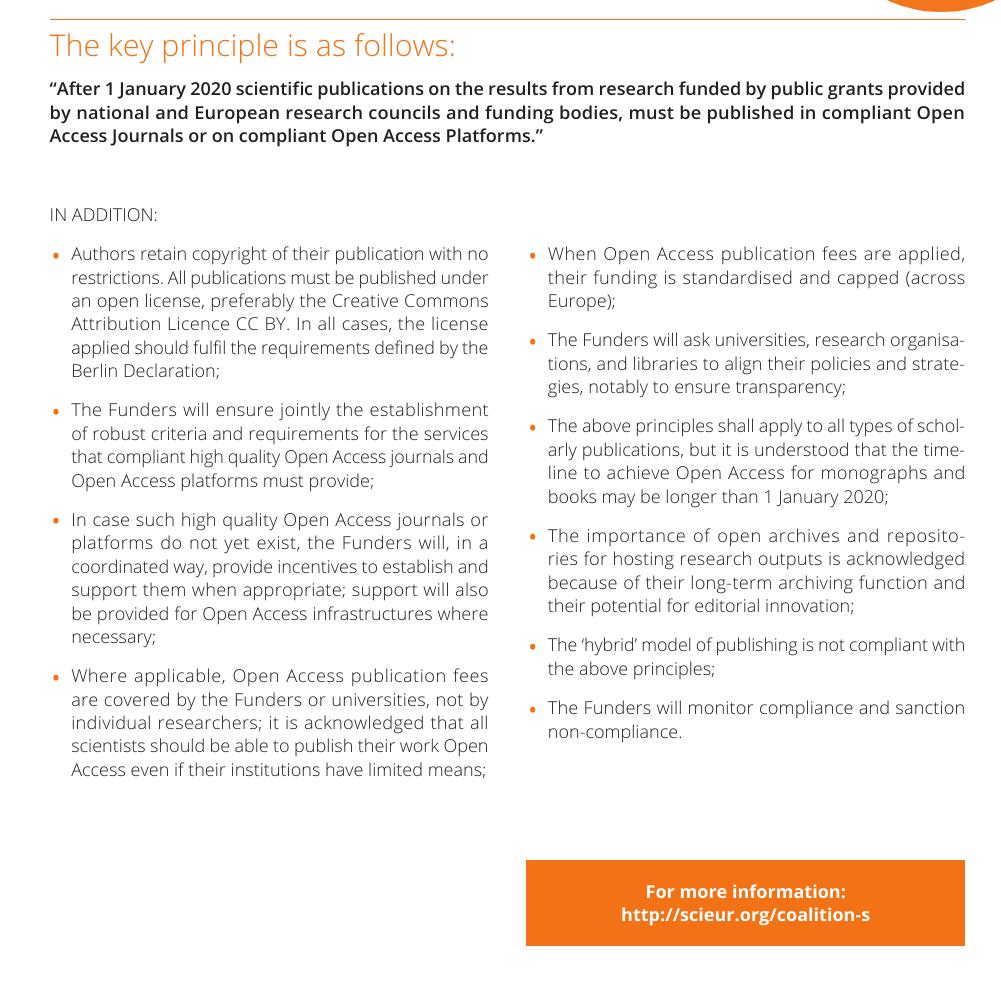
Here is a summary:

You can read more about it here. I have not yet looked at the details of what will be regarded as `compliant’ in terms of Open Access but if the the Open Journal of Astrophysics is not fully compliant as it stands, I expect it can be made so (although we are a genuinely international journal not limited to the 11 countries involved in Plan S).

Anyway, although I support Plan S in general terms what I sincerely hope will not happen with this initiative is that researchers and their institutions get mugged into paying an extortionate `Gold’ Open Access Article Processing Charge (APC) which is simply a means for the academic publishing industry to maintain its inflated profit margins at the expense of actual research. The Open Journal of Astrophysics is Green rather than Gold. In fact the cost of maintaining and running the platform is about $1000 per annum, and the marginal cost for processing each paper is $10 or actually $11 if you count registering published articles with CrossRef (though we do not incur that cost if the article is rejected). In effect running the entire journal costs less than a typical APC for Gold Open Access for one physics paper. Those costs will be born by my institution, Maynooth University. The UK was conned into going down this route some years ago by the publishing lobby, and I hope the other cOAlition S partners do not fall for the same scam.

Tonight is Culture Night!

Posted in Art, Maynooth, Music with tags on September 21, 2018 by telescoper

Just time for a quick post to mention that tonight is Culture Night in Ireland, which means that over 1600 venues around the country are open this evening for free cultural events. Museums, art galleries and other public buildings and spaces will open later this evening to welcome the general public and there are scores of free concerts going on all over the place. There’s a useful guide here.There are some events in Maynooth tonight, including one at Maynooth Castle.

I would have gone to tonight’s free concert at the National Concert Hall. Although it’s free you have to book a ticket because the capacity is limited and unfortunately I was too late getting around to doing that so couldn’t get in. I’ll probably listen to it on the radio tonight instead.

I think Culture Night is a great idea, as it encourages people to sample cultural fare they might otherwise not get around to trying, and may boost the audiences for the rest of the year as a result. I wonder if anyone has ever thought of running a Culture Night in, say, Cardiff?

Seven Years From Swindon

Posted in Biographical with tags , on September 20, 2018 by telescoper

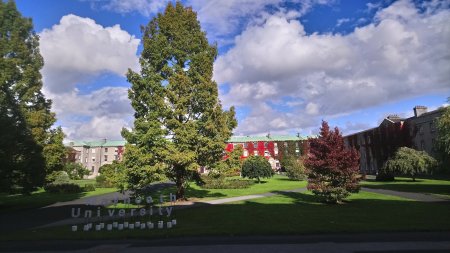
I took the above snap this morning walking back to the Science Building. It shows the view from the other side of St Joseph’s Square compared to the picture I posted on Tuesday, i.e. towards St Patrick’s House rather than away from it. The weather has taken a turn for the worse since Tuesday, and it’s decidedly autumnal today but it’s still not a bad view to be greeted with on the way to the office.

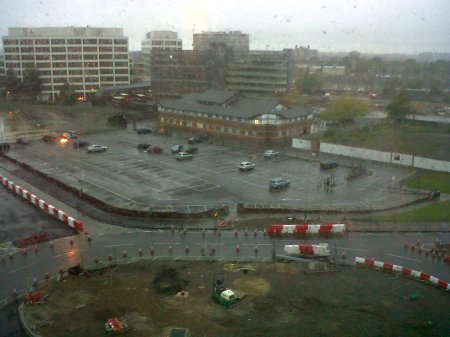
Contrast this with a photograph I took precisely seven years ago today, on September 20th 2011, when I had just arrived in Swindon for a stint on the STFC Astronomy Grants Panel:

I’m no longer part of the UK research system so I guess I’ll never have to visit Swindon again…

When The Saints Go Marching In

Posted in Music with tags , , on September 19, 2018 by telescoper

As a bit of a change from Open Journal of Astrophysics stuff I thought I’d post this very hot Gospel number featuring the very wonderful Mahalia Jackson, whose many claims to fame include the fact that she gave singing lessons to Aretha Franklin. If you think her voice sounds powerful in this recording, then it’s even more impressive when you see that in this live performance at the Newport Jazz Festival she was standing way back from the microphone! She wasn’t called `The World’s Greatest Gospel Singer’ for nothing.

Anyway, if you look at the title of this piece and think `Oh no, not that old one again’ because it has been done to death by Trad Jazz bands then please give it a listen because I think this version really rocks. The tune When The Saints Go Marching In is an old spiritual and, as such, was composed by the person who wrote all the best music: `Trad’.

One of the things about Gospel music is that it’s usually played in a very distinctive 4/4 which makes it very difficult to resist clapping. But why do so many people -even at Jazz festivals – find it so hard to clap on the right beat? It only works if you clap on an off beat (i.e. beats 2 and 4). If you clap on all the beats or just on the on beats it just kills the rhythm. On this track you’ll hear that Ms Jackson has to deliver clapping instructions not once but twice to an audience that seems to insist to clap on every beat of the bar (and on some beats that don’t correlate with the actual rhythm in any way). I guess “All God’s Children Got Rhythm” might not actually be a true statement.

Autumn in Maynooth

Posted in Maynooth on September 18, 2018 by telescoper

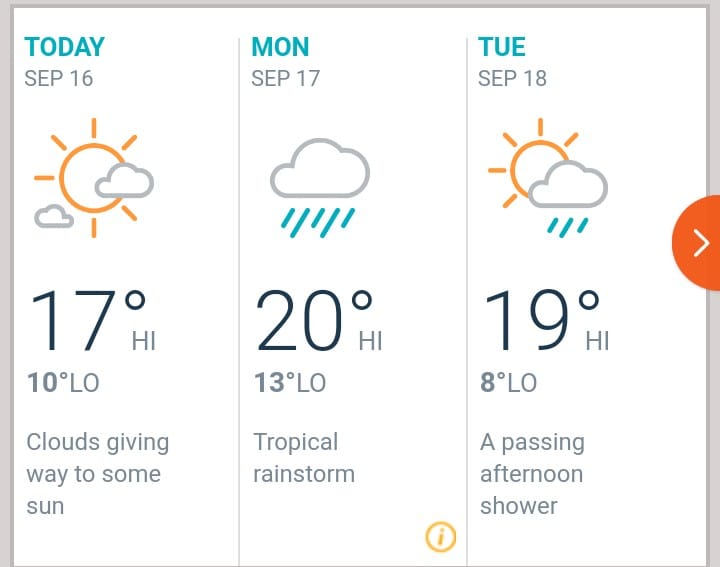
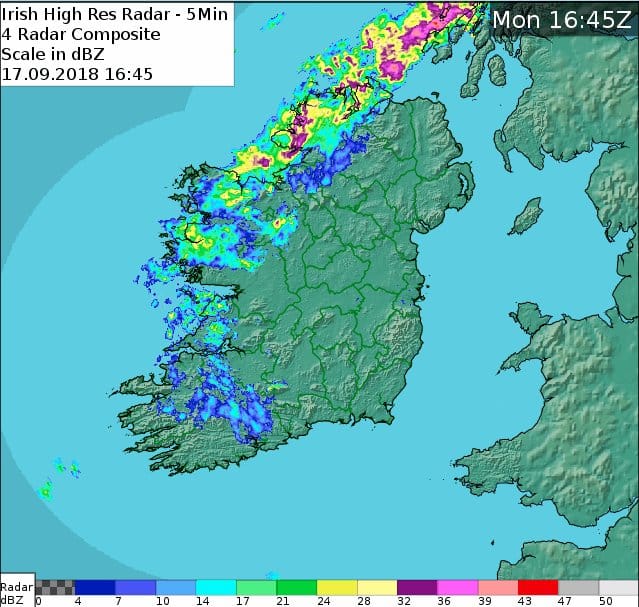
I was struck by the contrasting mixture of colours in St Joseph’s Square as I walked through just now so thought I’d share a quick snap taken on my phone. The trees are still in full leaf, but the Virginia Creeper that covers the facades of many of the buildings in the quadrangle is turning blood red, a sure sign that autumn is arriving. It is still rather warm, if a little breezy, however, because we’re in the airflow behind tropical storm Helene. This part of Ireland missed the worst of it, despite a rather worrying weather forecast for yesterday:

As it happens, the worst of the rainfall missed this part of Ireland but it has dumped a lot of rain to the West, from Galway to Donegal.

Among the other signs of autumn are the large number of groups of new students being guided around the campus during this orientation week. Lectures don’t begin until Monday 24th September but the first-year students are already here and trying their best to settle in before teaching starts.

The Open Journal of Astrophysics and NASA/ADS

Posted in Uncategorized with tags , , , , on September 18, 2018 by telescoper

As I’m working on the Open Journal of Astrophysics project quite a lot these days I’m probably going to be boring a lot of people with updates, but there you go.

First astro.theog.org is now transferred to the new platform here. It doesn’t look like much now but there is a lot sitting behind the front page and we will get the new site up and running when we’ve got various administrative things approved.

Another thing I forgot to mention in yesterday’s post concerns the SAO/NASA Astrophysics Data System which (for the uninitiated) is a Digital Library portal for researchers in astronomy and physics, operated by the Smithsonian Astrophysical Observatory (SAO) under a NASA grant. The ADS maintains three bibliographic databases containing more than 14.0 million records covering publications in Astronomy and Astrophysics, Physics, and (of course) the arXiv e-prints. In addition to maintaining its bibliographic corpus, the ADS tracks citations and other information, which means that it is an important tool for evaluating publication impact.

One of the issues that we’ve had with the handful of papers published so far by the Open Journal of Astrophysics is that, because it is an overlay journal, the primary location of the papers published is on the arXiv, alongside other content that has not been refereed. Up until recently searching ADS for `All bibliographic sources’ would return OJA papers, but `All refereed articles’ would not. I’m glad to say that with the help of the ADS team, this issue has now been resolved and OJA papers now show up as refereed articles, as demonstrated by this example:

I know that this was a particular worry for early career researchers who might have been deterred from submitting to the Open Journal of Astrophysics by the fear that their publications would not look like refereed publications. They need worry no longer!

Incidentally, that image also shows that citations are tracked through the CROSSREF system, in which OJA papers are registered when published and issued with a DOI. All this happens behind the scenes from the point of view of an author, but it involves a lot of interesting machinery! A discussion on facebook the other day led to an academic publisher stating that one of the greatest costs of running a journal was registering publications for citation tracking. In fact it costs a maximum of $1 per article (see here). The industry is relying on academics not understanding how cheap things actually are.


The Open Journal of Astrophysics – Call for Editors

Posted in Maynooth, Open Access with tags , , , on September 17, 2018 by telescoper

It’s nice to see that my recent post on the Open Journal of Astrophysics has been attracting some interest. The project is developing rather swiftly right now and it seems the main problems we have to deal with are administrative rather than technical. Fingers crossed anyway.

I thought I’d do a follow-up re-iterating a request in that recent post. As you will be aware, the Open Journal of Astrophysics is an arXiv overlay journal. We apply a simple criterion to decide whether a paper is on a suitable topic for publication, namely that if it it is suitable for the astro-ph section of the arXiv then it is suitable for the Open Journal of Astrophysics. This section of the arXiv, which is rather broad,is divided thuswise:

  1. astro-ph.GA – Astrophysics of Galaxies.
    Phenomena pertaining to galaxies or the Milky Way. Star clusters, HII regions and planetary nebulae, the interstellar medium, atomic and molecular clouds, dust. Stellar populations. Galactic structure, formation, dynamics. Galactic nuclei, bulges, disks, halo. Active Galactic Nuclei, supermassive black holes, quasars. Gravitational lens systems. The Milky Way and its contents
  2. astro-ph.CO – Cosmology and Nongalactic Astrophysics.
    Phenomenology of early universe, cosmic microwave background, cosmological parameters, primordial element abundances, extragalactic distance scale, large-scale structure of the universe. Groups, superclusters, voids, intergalactic medium. Particle astrophysics: dark energy, dark matter, baryogenesis, leptogenesis, inflationary models, reheating, monopoles, WIMPs, cosmic strings, primordial black holes, cosmological gravitational radiation
  3. astro-ph.EP – Earth and Planetary Astrophysics.
    Interplanetary medium, planetary physics, planetary astrobiology, extrasolar planets, comets, asteroids, meteorites. Structure and formation of the solar system
  4. astro-ph.HE – High Energy Astrophysical Phenomena.
    Cosmic ray production, acceleration, propagation, detection. Gamma ray astronomy and bursts, X-rays, charged particles, supernovae and other explosive phenomena, stellar remnants and accretion systems, jets, microquasars, neutron stars, pulsars, black holes
  5. astro-ph.IM – Instrumentation and Methods for Astrophysics.
    Detector and telescope design, experiment proposals. Laboratory Astrophysics. Methods for data analysis, statistical methods. Software, database design
  6. astro-ph.SR – Solar and Stellar Astrophysics.
    White dwarfs, brown dwarfs, cataclysmic variables. Star formation and protostellar systems, stellar astrobiology, binary and multiple systems of stars, stellar evolution and structure, coronas. Central stars of planetary nebulae. Helioseismology, solar neutrinos, production and detection of gravitational radiation from stellar systems.

The expertise of the current Editorial Board is concentrated in the area of (2), and a bit of (5), but we would really like to add some editors from different areas (i.e. 1, 3, 4 and 6).  We  would therefore really appreciate volunteers from other areas of astrophysics (especially stars/exoplanets, etc). If you’re interested please let me know. Please also circulate this call as widely as possible among your colleagues so we can recruit the necessary expertise. The journal is entirely free (both to publish in and to read) and we can’t afford to pay a fee, but there is of course the prestige of being in at the start of a publishing revolution of cosmic proportions!

If you join the Editorial Board we will invite you to an online training session to show you how the platform works.

Thank you in advance for your interest in this project, and I look forward to hearing from you.


A Decade In The Dark!

Posted in Biographical, The Universe and Stuff with tags on September 16, 2018 by telescoper

When I logged onto WordPress yesterday I received a message that it was the 10th anniversary of my registration with them as a blogger, which is when I took my first step into the blogosphere; that was way back on 15th September 2008.

I actually wrote my first post on the day I registered but unfortunately I didn’t really know what I was doing on my first day at blogging – no change there, then –  and I didn’t actually manage to figure out how to publish this earth-shattering piece. It was only after I’d written my second post that I realized that the first one wasn’t actually visible to the general public because I hadn’t pressed the right buttons, so the two appear in the wrong order in my archive. Anyway, that confusion is the reason why I usually take 16th September as this blog’s real anniversary.

I’d like to take this opportunity to send my best wishes, and to thank, everyone who reads this blog, however occasionally. According to the WordPress stats, I’ve got readers from all round the world, including  the Vatican!

If you’re interested in statistics then, as of 14.00 Irish Summer Time Today today, I have published 4,225 blog posts, not counting about 20 that I wrote but have not yet published; I’ll probably save these for my memoirs.. These posts have received 3,688,023 hits altogether; I get an average of about 1200 per day.  This varies in a very erratic fashion from day to day, but the annual average has been fairly constant over the last several years. The greatest number of hits I have received in a single day is 8,864 (at the peak of the BICEP2 controversy). Some of the most popular posts have not been about science at all, including  my rant about Virgin Media and a post about the last episode of Inspector Morse.

There have been 30,372 comments published on here and  2,213,145 rejected by my filters. The vast majority of the rejected comments were from automated spam bots, but a small number have been removed for various violations, usually for abuse of some kind. And, yes, I do get to decide what is published. It is my blog!

While I am on the subject of comments, I’ll just repeat here the policy stated on the home page of this blog:

Feel free to comment on any of the posts on this blog but comments may be moderated; anonymous comments and any considered by me to be abusive will not be accepted. I do not necessarily endorse, support, sanction, encourage, verify or agree with the opinions or statements of any information or other content in the comments on this site and do not in any way guarantee their accuracy or reliability.

It does mean a lot to me to know that there are people who find my ramblings on this `shitty wordpress blog’ interesting enough to look at, or even read, and sometimes even to come back for more, so I’d like to take this opportunity to send my best wishes to all those who follow this blog and especially those who take the trouble to comment on it in such interesting and unpredictable ways!

The last decade has been eventful, to say the least, both personally and professionally. I started blogging not long after I’d moved into my house in Pontcanna, Cardiff. Since then I moved to Sussex, and then back to Cardiff, and now to Ireland. More importantly we’ve seen the discovery of the Higgs Boson and gravitational waves, both of which resulted in Nobel Prizes, as did the studies of high-redshift supernovae. The Planck mission mission was launched, did its stuff, and came to a conclusion in this decade too. Science has moved forward, even if there are many things in this world that seem to be going backwards.

I don’t know how long I’ll keep blogging – vitae summa brevis spem nos vetat incohare longam – but I’ve got no immediate plans to stop.