Anyone for Cricket?

Posted in Biographical, Cricket with tags , on March 18, 2018 by telescoper

Going through the mail that arrived during the ten days or so I’ve been in Ireland, and with the snow steadily descending outside my window, I find the handy booklet containing this year’s fixtures for Glamorgan County Cricket Club has arrived at last.

Glamorgan’s first County Championship match starts on April 20th, just a month away, but their first home game isn’t until May (against Kent) . Hopefully the snow will have melted by then!

I now have a bit of planning to do in order to fit in as much cricket as I can this summer in between trips to and from Ireland as well as conferences and other things…

Lá fhéile Pádraig sona dhaoibh!

Posted in Cardiff, Rugby on March 17, 2018 by telescoper

Rather than wait around in the cold for today’s St Patrick’s Day parade in Maynooth I hopped onto the Hopper bus and took the morning flight back to Cardiff.

The bus from from the airport to Cardiff city centre was mainly occupied by French rugby fans on their way to this evening’s match against Wales. That turned out to be a tense, bruising affair, with Wales clinging on at the end to win 14-13.

Dublin airport was busy with Irish rugby fans travelling to London to see their team’s last game of the Six Nations, and hoping for a victory against England at Twickenham that would give them the Grand Slam. And so it came to pass, in a surprisingly one-sided game in which Ireland were clearly the better team.

So congratulations to Ireland, worthy winners of the Six Nations 2018, and a Grand Slam to boot!

I think there’ll be some pretty lively celebrations of this St Patrick’s Day tonight!

So that’s the Six Nations over for another year. I usually think of the end of this competition as the beginning of spring, but the weather today is distinctly wintry. In fact it’s just started to snow in Cardiff. Time, I think to get my dinner together: beef stewed in red wine, accompanied by a nice Amarone..

Other People’s Code

Posted in Education, mathematics with tags , , , on March 16, 2018 by telescoper

I don’t know if this is just me being useless, but one of the things I’ve always found difficult is debugging or rewriting computer programs written by other people. This is not a complaint about people who fail to document their code sufficiently to see what’s going on, it’s that even when the code is documented it seems much more difficult to spot errors in code written by other people than it is when you’ve written the program yourself.

I’ve been thinking a lot since I’ve been teaching Computational Physics here in Maynooth University. One of the standard elements of the assessment for this module is a task wherein the students are given a Python script intended to perform a given task (e.g. a numerical integral) but which contains a number of errors and asked to identify and correct the errors. This is actually a pretty tough challenge, though it is likely to be one that a graduate might have to meet if they get a job in any environment that involves programming.

Another context in which this arises is our twice-weekly computing laboratory sessions. Twice in the last couple of weeks I’ve been asked for a bit of help by students with code that wasn’t working, only to stare at the offending script for ages and fiddling with a number of things that made no difference, without seeing what turned out to be an obvious mistake. Last week it was an incorrect indent in Python (always a hazard if you’ve been brought up on Fortran). This week it was even simpler, a sign error in a line that was just supposed to calculate the mid-point of an interval. I should have been able to spot these very quickly, but I couldn’t.

What makes this so difficult? When given a mathematical calculation to mark I can usually spot errors reasonably easily (unless the working is illegible), but with code it’s different (at least for me). If I’d been given it on a piece of paper as part of a formula, I reckon I would have spotted that minus sign almost immediately.

One possibility is just that I’m getting old. While that may well be true, it doesn’t explain why I found debugging other people’s code difficult even when I was working on software at British Gas when I was 18. In that context I quite often gave up trying to edit and correct software, and instead just deleted it all and wrote my own version from scratch. That’s fine if the task is quite small, but not practicable for large suites written by teams of programmers.

I think one problem is that other people rarely approach a programming task exactly the same way as one would oneself. I have written programs myself to do the tasks given to students in the computing lab, and I’m always conscious of the method I’ve used. That may make it harder to follow what others have tried to do. Perhaps I’d be better off not prejudicing my mind doing the exercises myself?

Anyway, I’d be interested to know if anyone else has the same with other people’s code and if they have any tips that might improve my ability to deal with it. The comments box is at your disposal…

A Rambling Post

Posted in Biographical, Maynooth with tags , , , , on March 15, 2018 by telescoper

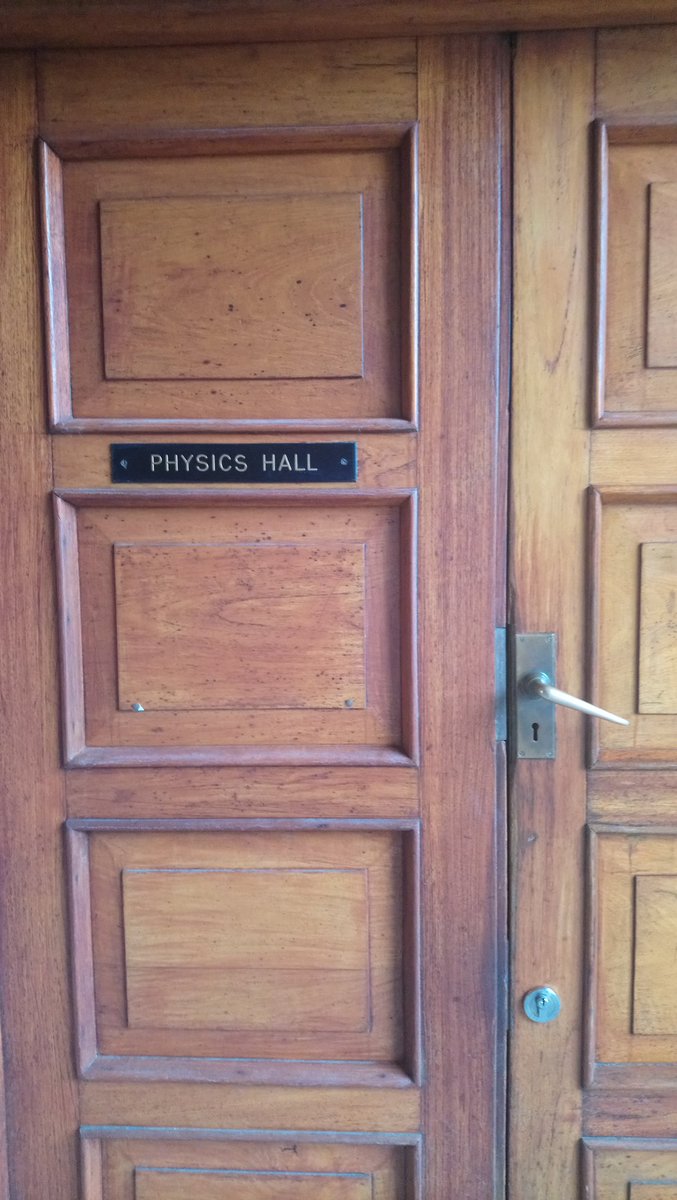
Thursdays are busy days for me, starting with a 9am lecture on Computational Physics in Physics Hall, followed in the afternoon by a two-hour laboratory session on the same subject. Today we did exercises on root-finding and numerical integration, but didn’t get through as many examples as I had hoped. In between I had a number of jobs to do, including a lunchtime meeting off campus with my landlord to pay the rent (which he collects in person). I was a bit late back for the lab and, after apologizing, complained that I was too old for all this running around. One of the students kindly said that `age is only a number’. I replied `I know, but unfortunately in my case it’s a rather large one..’

I now have a bit of a break from teaching in Maynooth. There is no teaching next week as it is `Study Week’ and Monday 19th March is a public holiday (for St Patrick’s Day, 17th March, which this year falls on a Saturday). Study week is followed by a week’s holiday because of Easter. Teaching resumes here on Tuesday April 3rd. Somewhat surprisingly the Easter break here is shorter than in the UK.

The four-week batch of strikes in UK universities over pensions in which I have been participating ends tomorrow, which means that I will be lecturing in Cardiff again next Tuesday (20th March). This lecture will be Lecture 8 of 11, with lectures 5, 6 and 7 missing in action (industrial action, to be precise). Cardiff students are then on vacation for three weeks for the Easter break, with lectures resuming on 16th April. All of this means that for the next three weeks I won’t have to do the mid-week trip from Cardiff to Maynooth (which I am beginning to find rather tedious). I plan to stay all next week in Wales and return to Ireland the following week, as I have been invited to give a seminar then at the Dublin Institute for Advanced Studies (which I have never visited before).

Anyway, all that rambling just serves to illustrate that it’s a complicated business being in a superposition of jobs. I’m looking forward to the summer, when my wavefunction will collapse onto Ireland (if I haven’t collapsed from exhaustion before that).

To end on a very sad note, I heard today that Emeritus Professor David Bailin passed away yesterday. I knew David from both times I was at Sussex (as a graduate student and postdoc in the 1980s, and as Head of School of Mathematical and Physical  Sciences from 2013 to 2016). He was a very fine theoretical physicist and a very nice man who was held in a very high regard by all who worked with him. Condolences to his family, friends and colleagues.

R.I.P. Stephen Hawking (1942-2018)

Posted in Books, Talks and Reviews, Television, The Universe and Stuff with tags on March 14, 2018 by telescoper

I woke today to the sad news of the death, at the age of 76, of theoretical physicist and cosmologist Stephen Hawking. We all knew he had to pass away one day, but having been diagnosed with Motor Neurone Disease and given just a couple of years to live at the age of 22, I think we had all come to regard him as indestructible, so news of his death still came as a shock.

Stephen’s immense contributions to physics, including but not restricted to cosmology, are remarkable in their own right, but made even more remarkable that has done so much after having been stricken by such a debilitating disease when he was only in his twenties. Hawking was undoubtedly a brilliant and inspirational mind, but his courage and physical endurance in the face of difficulties that others might have found unbearable have provided inspiration for many far beyond the field of physics.

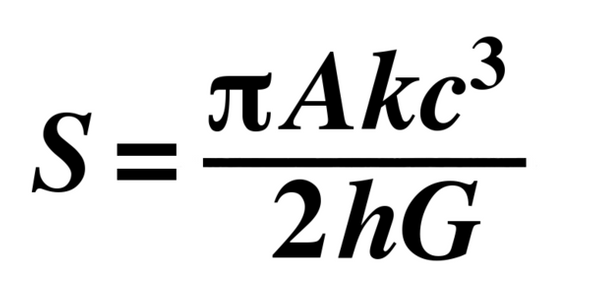
To give an example of his scientific work, here is an equation which I think would serve as a memorial to Stephen Hawking as it brings together quantum mechanics, gravity and thermodynamics in giving the entropy of a black hole in terms of its surface area and fundamental constants:

I’ve talked and written quite a lot about Stephen Hawking over the years. In particular I have in the past gone on record, both on television and in print, as being not entirely positive about the `cult’ that surrounds him. I think a number of my colleagues (and some some people at the University of Cambridge) have found things I have said insufficiently reverential or perhaps even disrespectful. This is not the time to go over these things. For the record I’ll just say (yet again) that, while I stand by everything I have said, I do – and always will have – enormous respect for Hawking the physicist, as well as deep admiration for his tenacity and courage.

I may post a longer reflection on Stephen Hawking’s life and work in due course, but for now let me just offer my condolences to his family, friends, and colleagues. He was one of the most celebrated public intellectuals of his day as well as a courageous and determined human being. He is irreplaceable.

USS Pension Proposal: Poll

Posted in Education, Politics with tags , , , , , on March 13, 2018 by telescoper

Last night I saw the news on Twitter that negotiators on behalf of the Universities and Colleges Union (UCU) and the employers’ organisation Universities UK (UUK) under the auspices of the Advisory Conciliation and Arbitration Service (ACAS) agreed a proposal to end the strike over pensions that has been going on since the end of February.

The text of the agreement can be found here (PDF). This proposal will have to be discussed and ratified formally, but the negotiators hope this can be do today and that the strike will be suspended from tomorrow.

The proposal suggests a transitional period of three years from April 2019 during which a much reduced Defined Benefit scheme will operate, but it still affirms the much disputed November 2017 valuation of the scheme which means that it is overwhelmingly likely that after three years the dispute will be back on.

I shall be leaving the USS scheme in July 2018 as I’m moving full-time to Ireland where I will be joining a Defined Benefit scheme so the changes outlined in the document will not affect me. Moreover, though I have supported the strike I am not a member of UCU. If I were I would not be in favour of accepting this deal because it seems to me that it amounts to an abject surrender on all the main issues. But given my personal situation I don’t think my opinion should carry much weight. The few friends I have discussed this with feel the same as I do, but I’m interested to know what the general opinion is. If you feel like filling in the poll below please feel free to do so. I’ve divided the responses between UCU members and non-UCU members to see if there’s a difference.

On one matter however I am less equivocal. The document calls on staff to `prioritise the rescheduling of teaching’ (lost during the strike). I have a one-word response to that: NO. Not only will it be logistically impossible to reschedule so many teaching sessions, but I am also not going to do extra teaching for free when my pay is being deducted for days on strike.

As usual, I invite your comments through the box below.

UPDATE: Here is a Google Document showing how UCU branches are responding to the proposal: at the time of posting, it is solidly `reject’..

UPDATE: Following on from the above, the UCU has now formally rejected the proposal. The strikes continue.

Bird of Paradise – In Memoriam Charlie Parker

Posted in Jazz with tags , , on March 12, 2018 by telescoper

Today is the 63rd anniversary of the death, in 1955 aged just 34, of the great saxophonist and composer Charlie Parker, also known as `Bird’.  I know a lot of people don’t really `get’ Bird’s way of playing, but for me he created some of the most beautiful and exciting sounds not only in jazz, but in any musical genre. Here, to mark his memory, is a piece called Bird of Paradise (a thinly disguised version of the Jerome Kern standard All The Things You Are) recorded in 1947 for the Dial label with a quintet that included a young (21 year-old) Miles Davis on trumpet. Miles Davis was still finding his way musically at the time of the Dial sessions, but Bird had already established himself as a powerful creative force and his solo on this number is absolutely exquisite.

De Valera’s ‘Last Letter’, Kilmainham, May 1916

Posted in History with tags , , on March 11, 2018 by telescoper

I’ve just been reading Charles Townshend’s book ‘Easter 1916: The Irish Rebellion’ and was searching for the photograph it includes of Eamon de Valera surrendering with his men at the end of the uprising. I found it at this excellent blog post, which includes a great deal of other interesting information, so I thought I’d reblog the whole thing!

Brenda Malone's avatarThe Cricket Bat that Died for Ireland

View original post 1,054 more words

An Image For Our Times

Posted in Art, Politics with tags , , on March 10, 2018 by telescoper

Picture Credit: Mark Harrison

I couldn’t resist posting this brilliant photograph (by Mark Harrison) of Jacob Rees-Mogg. I’ll refrain from commenting on the subject, but I think the picture is a work of art!

Anyone like to suggest a caption?

An Interview with Lauritz Melchior

Posted in Opera with tags on March 10, 2018 by telescoper

I’ve written more than once about the great tenor Lauritz Melchior, and the other day I came across this fascinating interview with him recorded when he was in his eighties and was living in America.

It’s full of interesting comments, but I have to say that above all I just love the way he speaks. English spoken with a Danish accent sounds so wonderful to my ears, especially with that tendency to inflect downward at the end of words. It sounds wonderfully lugubrious.