Ariel to Fly

Posted in The Universe and Stuff with tags , , , , on March 23, 2018 by telescoper

All hail, great master! Grave sir, hail! I come
To answer thy best pleasure. Be ‘t to fly,
To swim, to dive into the fire, to ride
On the curled clouds, to thy strong bidding task
Ariel and all his quality.

The Tempest, Act I, Scene 2.

It’s nice to be able to pass on a bit of good news for the good folk of the Astronomy Instrumentation Group here in the School of Physics & Astronomy at Cardiff University.

The ARIEL mission has been given the green light by the European Space Agency and will launch sometime around 2028. It will produce the first ever large-scale survey of the atmospheric chemistry of planets outside our solar system. Ariel will extract the chemical fingerprints of the gases in the atmospheres of over 1000 exoplanets, as well as capturing information about the temperatures and pressures in their atmospheres and the presence of clouds.

Whenever I read of exciting news from the field of exoplanet research – which happens quite frequently nowadays – it reminds me that when I started my graduate studies (in 1985) the field didn’t really exist. Now it’s one of the biggest and most active areas of astronomy! Another thing that makes me feel a bit of a dinosaur is that when Ariel actually launches I’ll be 65…

As with all such missions, a large international collaboration will be involved in Ariel, and much of the detail of who will do what is yet to be worked out, but Cardiff scientists will be providing detailed computer simulations of the Ariel satellite and its instruments, ensuring that the scientific observations can be carefully planned and the resulting data can be analysed correctly. The team will also be involved in the ground segment after launch, interpreting the data from the observations to characterise the atmospheres of the exoplanets. The Principal Investigator of the whole mission is Professor Giovanna Tinetti of University College, London, who I see regularly at dinner with the RAS Club.

Head Irishman of the School, Matt Griffin, who will himself is quoted in the news item as saying

The decision to select the Ariel mission demonstrates the scientific vision and ambition of ESA, and it’s the start of a great adventure for everyone involved. This is a mission that will hugely advance our understanding of the nature of planets and of our place in the Universe, and at Cardiff we are very much looking forward to our participation in the project.

The launch date of 2028 is some way off but space missions are exceedingly complicated things and there’s a lot to do in the next decade or so until Ariel finally flies. Hopefully neither swimming, nor diving into fire nor riding on the curled clouds will be involved, but the scientific quality is something of which we can be very confident.

Congratulations to everyone involved in getting this mission selected and best wishes to all those involved in Cardiff and elsewhere!

Peter Tatchell: Equality is not Enough

Posted in Cardiff, History, LGBTQ+, Politics with tags , on March 23, 2018 by telescoper

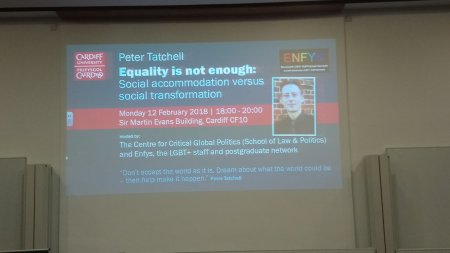
On the evening of Monday 12th February, during LGBT History Month, I went to a lecture by Peter Tatchell which was held in the Sir Martin Evans lecture theatre at Cardiff University. I was going to do a post about it but never found the time. Here’s a snap of the title slide I took at the time:

Today I noticed that a video of the lecture had been posted on Cardiff University’s youtube channel which reminded me to say something about it. I admire and respect Peter Tatchell’s integrity and determination, and the way he has stood up against homophobia for more than 50 years is inspirational. I don’t agree with everything he says, but I found myself agreeing with most of the content of this lecture, the main idea of which was that it is not enough for LGBT people to seek equality within a system that is so manifestly discriminatory against whole sectors of the population. The aim of of LGBT campaigners should be to transform society, not to be accommodate within it.

Anyway, here’s his lecture. Form your own opinions!

A photograph of Sir John Herschel

Posted in Art, History on March 22, 2018 by telescoper

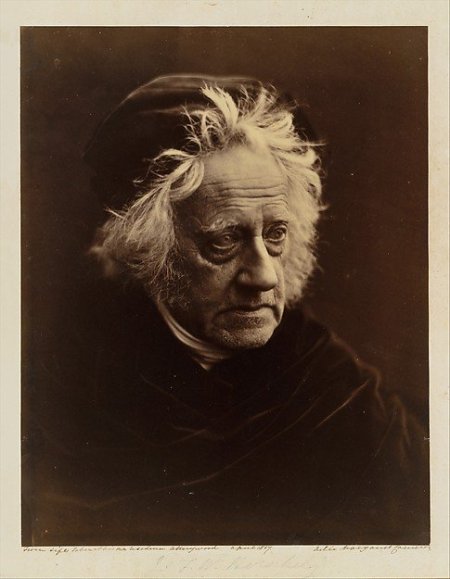
I didn’t have time to write a post today before it became necessary for me to go to the pub, so I thought I’d just share this marvellous photograph of astronomer Sir John Herschel taken in 1867 by pioneering portrait photographer Julia Margaret Cameron.

Manchester Hill – “Here we fight, and here we die”

Posted in History with tags , , , , on March 21, 2018 by telescoper

Today is the centenary of the start of a major offensive of the Western Front by the German forces against the British and French armies during the First World War. One particular action that took place on the first day of that offensive took place at a location now known as Manchester Hill, a region of high ground forming a salient overlooking the town of St Quentin, on this day 100 years ago i.e. on 21st March 1918. I read about this some time ago, but thought I would do a brief post about it to mark this grim anniversary.

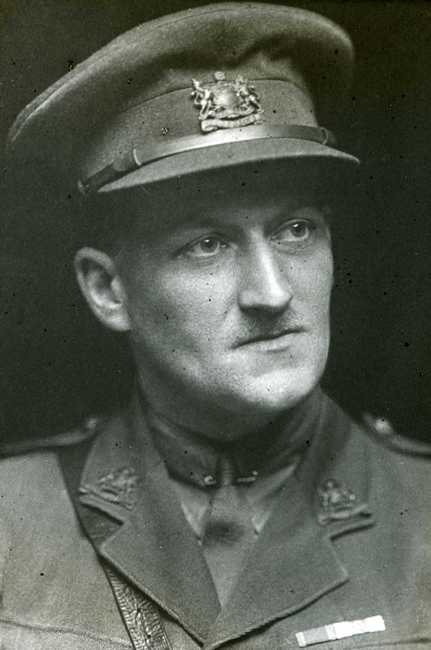
Lieutenant-Colonel Wilfrith Elstob, Commanding Officer, 16th Battalion Manchester Rifles.

Manchester Hill had been captured by the 2nd Battalion of the Manchester Regiment in April 1917 and in March 2018 it was held by the 16th Battalion of the same Regiment under the command of Lieutenant-Colonel Wilfrith Elstob, a schoolteacher before the War who had joined the army in 1914 as a private soldier and was promoted through the ranks. His gallantry on that day earned him a posthumous Victoria Cross with the citation:

For most conspicuous bravery, devotion to duty and self-sacrifice during operations at Manchester Redoubt, near St. Quentin, on the 21st March, 1918. During the preliminary bombardment he encouraged his men in the posts in the Redoubt by frequent visits, and when repeated attacks developed controlled the defence at the points threatened, giving personal support with revolver, rifle and bombs. Single-handed he repulsed one bombing assault driving back the enemy and inflicting severe casualties. Later, when ammunition was required, he made several journeys under severe fire in order to replenish the supply. Throughout the day Lieutenant-Colonel Elstob, although twice wounded, showed the most fearless disregard of his own safety, and by his encouragement and noble example inspired his command to the fullest degree. The Manchester Redoubt was surrounded in the first wave of the enemy attack, but by means of the buried cable Lieutenant-Colonel Elstob was able to assure his Brigade Commander that “The Manchester Regiment will defend Manchester Hill to the last.” Sometime after this post was overcome by vastly superior forces, and this very gallant officer was killed in the final assault, having maintained to the end the duty which he had impressed on his men – namely, “Here we fight, and here we die.” He set throughout the highest example of valour, determination, endurance and fine soldierly bearing.

His last action, after the Germans had broken through the last line of defences, was to use the field telephone to call down an artillery barrage onto his own position. His body was never found and he has no known grave.

You can read the stories of other soldiers who fought and died that day here.

Manchester Hill jutted out into the German lines so, although it was heavily fortified, it was very vulnerable and difficult to defend. Enemy troops were in position on three sides of the hill, and in the event of an attack was difficult to prevent it being surrounded, isolated and destroyed. In the days and hours preceding March 21st the troops on Manchester Hill could see the Germans moving into position and knew a major offensive was imminent. Elstob repeatedly asked his superior offices for permission to withdraw, but it was repeatedly refused. When specific intelligence was received that the attack would take place in the morning of 21st March he once more contacted his HQ to request position to withdraw. After having his request refused once more, he returned to his men and made the famous statement “This is our position. He we fight and here we die.”

There was thick fog the following morning, hiding the inevitable German advance which began at 6.30am with an artillery bombardment until it was too late to prevent them encircling the British garrison. By 11.30 the British were completely encircled. Nevertheless the defenders of Manchester Hill fought off repeated attacks and managed to hold their position until late afternoon against an overwhelmingly larger force. Elstob was in the thick of the action throughout, once holding a position alone using his service revolver and hand grenades. By 4pm however, the battle was lost and virtually all the defenders were dead. Of the 168 men (8 officers and 160 other ranks) who participated in the defence of the Manchester Hill redoubt, just 17 survived (two officers and 15 other ranks).

The German advance broke through Allied lines and stormed on, even at one point threatening Paris, but the pace of the advance led to supply difficulties and it eventually stuttered, was stopped and then flung back into a full retreat. Although German forces had been reinforced by troops no longer needed in the East after the Russian Revolution of 1917, American forces had been arriving in huge numbers – 300,000 a month – at the time of the Spring offensive and it this influx of troops across the Atlantic that proved decisive in the end.

We should celebrate the bravery of the defenders of Manchester Hill, especially Lieutenant-Colonel Elstob, but one can’t help asking why he was not given permission to withdraw. It is true that they delayed and disrupted the German advance, but at a terrible cost. It does seem to me that for all the courage and gallantry displayed by Elstob and his men, their sacrifice was unnecessary.

Equinoctial Molehills

Posted in Biographical, Bute Park, The Universe and Stuff with tags , , , on March 20, 2018 by telescoper

Very busy today, what with a return to lecturing in Cardiff and so on, so I’ve just got time for a quick post to mark the fact that the Vernal Equinox in the Northern Hemisphere took place today, Tuesday 20th March 2018, at 16.15 UTC (which is 16.15 GMT). This means that the Sun has just crossed the celestial equator on its journey Northward. Some people regard this as the first day of spring, which is fair enough as it does correspond fairly well to the end of the Six Nations rugby.

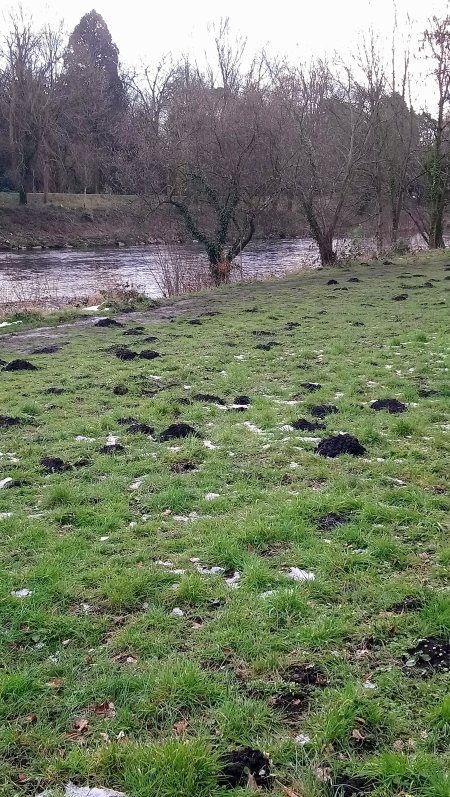
It wasn’t exactly spring weather when I walked into work this morning, as there are still bits of snow around in Bute Park.

More significantly, a huge number of molehills have appeared. Not quite a mole of molehills, but still quite a few. I’m not sure of the reason for all this molar activity. Perhaps moles have special rituals for marking the Vernal Equinox?

Incidentally I was dismayed to see that my Royal Astronomical Society diary gives the time of the 2018 Vernal Equinox as 16.16 GMT while the wikipedia page I linked to above gives 16.15 GMT. I find a discrepancy of this magnitude extremely unnerving. Or am I making a mountain out of a molehill?

Back to work in Cardiff..

Posted in Biographical, Education with tags , on March 19, 2018 by telescoper

So here I am, then. Back in the offices of the Data Innovation Research Institute in Cardiff for the first time in almost a fortnight. The four-week batch of strikes over pensions has come to an end so I have returned to work. No agreement has been reached so it seems likely there will be further industrial action, but for the time being normal services are being resumed. In fact it’s not exactly back to normal because there’s a large backlog of things to be done (including marking coursework and setting examinations), but I mean at least that lectures resume and will be delivered on the normal timetable. In my Physics of the Early Universe module I have only given four (two-hour) lectures and have missed three. I return to the fray tomorrow morning to give Lecture 8. Frustratingly, that’s the only lecture I have before the Easter break which starts on Friday and lasts for three weeks. Assuming there are no further strikes I’ll be giving lectures 9-12 (the last a revision lecture) after the holiday.

I now have to figure out how to cope with the six hours of lectures missed because of industrial action. That will be tricky, but I’ll do my level best to ensure that I cover everything needed for the examination. I spent most of this morning trying to figure out how to reorganise the remaining material, and I think I can do it as long as we don’t lose any more teaching time. At any rate I have made the decision not to give additional lectures to cover what I’ve missed. Owing to the timing of the strikes (and the fact that only work half the time here in Cardiff) I have been on strike for all the days I would have been working for three weeks. That means I will lose three full weeks pay. Even if it were logistically possible to fit in 6 hours of extra lectures after Easter, I don’t think it’s reasonable for me to do that for free.

While I was on strike a group of my students emailed the Vice-Chancellor of Cardiff University (copying me in) to point out how much teaching they were missing and request some form of compensation. I have a lot of sympathy for their situation and in no way do I want to damage their education. I will do what I can to mitigate the effect of the strike but won’t take any action that reduces the effectiveness of the industrial action. It remains to be seen if any compensation will be offered by the University management, but I think their best policy would be pressure Universities UK to stop pratting about and find a speedy settlement of the dispute.

Anyway, today is a bank holiday in Maynooth – St Patrick’s Day fell on a Saturday this year – and the rest of the week is `Study Week’, so there are no lectures or laboratory sessions. I’ll therefore be staying in Cardiff all week, which gives me the chance to go to a concert on Friday at St David’s Hall – the first for quite a while.

Now, time to get back to writing tomorrow’s lecture…

Anyone for Cricket?

Posted in Biographical, Cricket with tags , on March 18, 2018 by telescoper

Going through the mail that arrived during the ten days or so I’ve been in Ireland, and with the snow steadily descending outside my window, I find the handy booklet containing this year’s fixtures for Glamorgan County Cricket Club has arrived at last.

Glamorgan’s first County Championship match starts on April 20th, just a month away, but their first home game isn’t until May (against Kent) . Hopefully the snow will have melted by then!

I now have a bit of planning to do in order to fit in as much cricket as I can this summer in between trips to and from Ireland as well as conferences and other things…

Lá fhéile Pádraig sona dhaoibh!

Posted in Cardiff, Rugby on March 17, 2018 by telescoper

Rather than wait around in the cold for today’s St Patrick’s Day parade in Maynooth I hopped onto the Hopper bus and took the morning flight back to Cardiff.

The bus from from the airport to Cardiff city centre was mainly occupied by French rugby fans on their way to this evening’s match against Wales. That turned out to be a tense, bruising affair, with Wales clinging on at the end to win 14-13.

Dublin airport was busy with Irish rugby fans travelling to London to see their team’s last game of the Six Nations, and hoping for a victory against England at Twickenham that would give them the Grand Slam. And so it came to pass, in a surprisingly one-sided game in which Ireland were clearly the better team.

So congratulations to Ireland, worthy winners of the Six Nations 2018, and a Grand Slam to boot!

I think there’ll be some pretty lively celebrations of this St Patrick’s Day tonight!

So that’s the Six Nations over for another year. I usually think of the end of this competition as the beginning of spring, but the weather today is distinctly wintry. In fact it’s just started to snow in Cardiff. Time, I think to get my dinner together: beef stewed in red wine, accompanied by a nice Amarone..

Other People’s Code

Posted in Education, mathematics with tags , , , on March 16, 2018 by telescoper

I don’t know if this is just me being useless, but one of the things I’ve always found difficult is debugging or rewriting computer programs written by other people. This is not a complaint about people who fail to document their code sufficiently to see what’s going on, it’s that even when the code is documented it seems much more difficult to spot errors in code written by other people than it is when you’ve written the program yourself.

I’ve been thinking a lot since I’ve been teaching Computational Physics here in Maynooth University. One of the standard elements of the assessment for this module is a task wherein the students are given a Python script intended to perform a given task (e.g. a numerical integral) but which contains a number of errors and asked to identify and correct the errors. This is actually a pretty tough challenge, though it is likely to be one that a graduate might have to meet if they get a job in any environment that involves programming.

Another context in which this arises is our twice-weekly computing laboratory sessions. Twice in the last couple of weeks I’ve been asked for a bit of help by students with code that wasn’t working, only to stare at the offending script for ages and fiddling with a number of things that made no difference, without seeing what turned out to be an obvious mistake. Last week it was an incorrect indent in Python (always a hazard if you’ve been brought up on Fortran). This week it was even simpler, a sign error in a line that was just supposed to calculate the mid-point of an interval. I should have been able to spot these very quickly, but I couldn’t.

What makes this so difficult? When given a mathematical calculation to mark I can usually spot errors reasonably easily (unless the working is illegible), but with code it’s different (at least for me). If I’d been given it on a piece of paper as part of a formula, I reckon I would have spotted that minus sign almost immediately.

One possibility is just that I’m getting old. While that may well be true, it doesn’t explain why I found debugging other people’s code difficult even when I was working on software at British Gas when I was 18. In that context I quite often gave up trying to edit and correct software, and instead just deleted it all and wrote my own version from scratch. That’s fine if the task is quite small, but not practicable for large suites written by teams of programmers.

I think one problem is that other people rarely approach a programming task exactly the same way as one would oneself. I have written programs myself to do the tasks given to students in the computing lab, and I’m always conscious of the method I’ve used. That may make it harder to follow what others have tried to do. Perhaps I’d be better off not prejudicing my mind doing the exercises myself?

Anyway, I’d be interested to know if anyone else has the same with other people’s code and if they have any tips that might improve my ability to deal with it. The comments box is at your disposal…

A Rambling Post

Posted in Biographical, Maynooth with tags , , , , on March 15, 2018 by telescoper

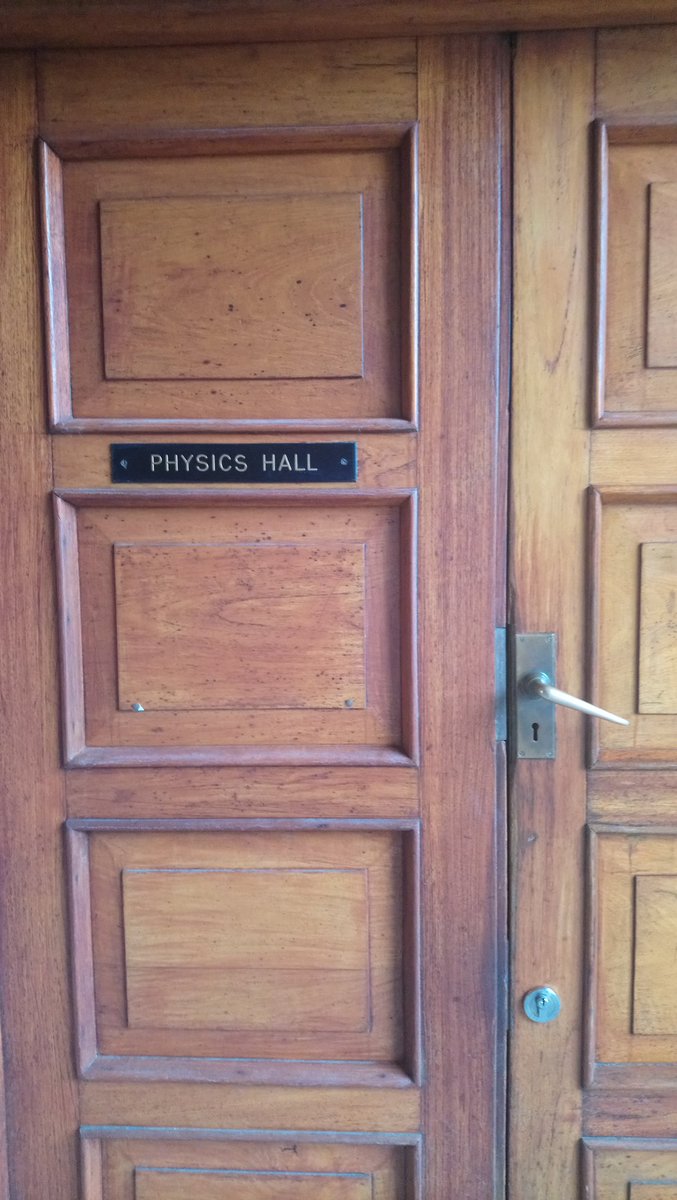
Thursdays are busy days for me, starting with a 9am lecture on Computational Physics in Physics Hall, followed in the afternoon by a two-hour laboratory session on the same subject. Today we did exercises on root-finding and numerical integration, but didn’t get through as many examples as I had hoped. In between I had a number of jobs to do, including a lunchtime meeting off campus with my landlord to pay the rent (which he collects in person). I was a bit late back for the lab and, after apologizing, complained that I was too old for all this running around. One of the students kindly said that `age is only a number’. I replied `I know, but unfortunately in my case it’s a rather large one..’

I now have a bit of a break from teaching in Maynooth. There is no teaching next week as it is `Study Week’ and Monday 19th March is a public holiday (for St Patrick’s Day, 17th March, which this year falls on a Saturday). Study week is followed by a week’s holiday because of Easter. Teaching resumes here on Tuesday April 3rd. Somewhat surprisingly the Easter break here is shorter than in the UK.

The four-week batch of strikes in UK universities over pensions in which I have been participating ends tomorrow, which means that I will be lecturing in Cardiff again next Tuesday (20th March). This lecture will be Lecture 8 of 11, with lectures 5, 6 and 7 missing in action (industrial action, to be precise). Cardiff students are then on vacation for three weeks for the Easter break, with lectures resuming on 16th April. All of this means that for the next three weeks I won’t have to do the mid-week trip from Cardiff to Maynooth (which I am beginning to find rather tedious). I plan to stay all next week in Wales and return to Ireland the following week, as I have been invited to give a seminar then at the Dublin Institute for Advanced Studies (which I have never visited before).

Anyway, all that rambling just serves to illustrate that it’s a complicated business being in a superposition of jobs. I’m looking forward to the summer, when my wavefunction will collapse onto Ireland (if I haven’t collapsed from exhaustion before that).

To end on a very sad note, I heard today that Emeritus Professor David Bailin passed away yesterday. I knew David from both times I was at Sussex (as a graduate student and postdoc in the 1980s, and as Head of School of Mathematical and Physical  Sciences from 2013 to 2016). He was a very fine theoretical physicist and a very nice man who was held in a very high regard by all who worked with him. Condolences to his family, friends and colleagues.