The Weather and the LGBT Physical Sciences Climate Survey.

Posted in Uncategorized on March 3, 2018 by telescoper

I wrote this post on Thursday, after a long and busy day, in a hotel near Paddington station, having long since given up the possibility of returning to Cardiff today owing to the inclement weather conditions. Fortunately I had taken my overnight things and a change of clothes in anticipation of the likelihood of getting stranded.

Unfortunately the hotel WiFi crapped out and it seems it never got posted, so I’ve updated it and here it is now. I was in London for the launch event for the LGBT Physical Sciences Climate survey.

Before going on please let me wish you a belated Dydd Gŵyl Dewi Hapus, as Thursday was St David’s Day!

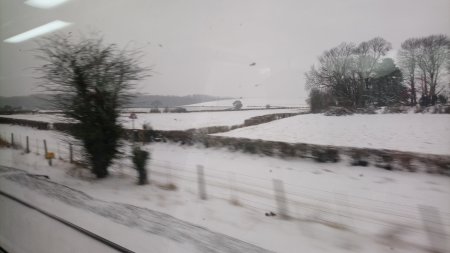
I rose at 5 o’clock on Thursday morning to get the 6.26 train to London to participate in this event. It was all going well until we reached Swindon (about halfway into the journey) but then we warned that Paddington station was closed and the train would be terminating at Reading. I was a bit surprised by this as there wasn’t really very much snow at all, but it turns out that the snowy conditions had made Paddington too slippery to be safe. That’s no doubt because of the shiny floors added at great expense but very little point when the station was refurbished some years ago. At no point on the journey into London did I see more than half an inch of snow. It’s truly pathetic that such total disruption of this major transport route resulted from such a small amount of snow.

I was advised by the GWR staff at Reading to turn forget about making it to London and instead to get on the train back to Cardiff, as no trains were going into out out of London and snow was heading for Cardiff making it unlikely I would get back this evening even if I did continue on my journey.

Eschewing this advice I found that trains were leaving from Reading to Ealing Broadway, so I got one of those and took the Central Line underground from there into town. I arrived about 11am at the Institute of Physics, about two hours later than planned but I had left early in anticipation of likely delays.

Anyway, the event itself seemed to go quite well. I gave a little introductory talk, followed by four other speakers, and then chaired a panel discussion. Here’s a few pictures:
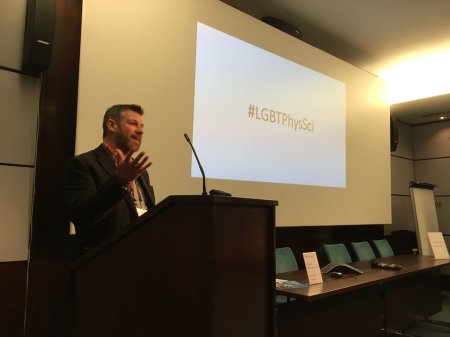
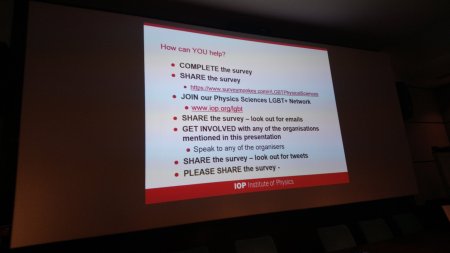
The participants (from left to right) were: Dr Ashley Spindler, Dr James Claverley, myself, Niamh Kavanagh, and Professor Dave Smith. There then followed a little drinks reception and a group of us subsequently adjourned to a local pub for drinks.

Anyway, the main point is that the survey is now live and can be found here. That link also tells you who’s eligible to complete it.

The survey is open until the end of April so I’ll probably post a few reminders over the next few weeks…

Back to Snowy Cardiff

Posted in Biographical, Bute Park, Cardiff on March 3, 2018 by telescoper

I made it back to Cardiff yesterday. The train I was on was about half an hour late, but that was understandable. The strange bit was that most of the delay resulted from us running very slowly through the Severn Tunnel. There certainly wasn’t any snow down there!

Cardiff city centre was virtually deserted and none of the roads had been cleared of snow. I’m guessing no buses were running, as I didn’t see any on the way, and there were few cars. Many shops were closed. The M&S in the station was open but had received no deliveries that day, and was just selling what it had from the day before. I bought some groceries, mostly at a reduced price.

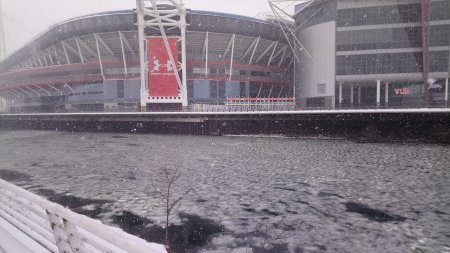
It was snowing quite heavily and was very cold when I walked back to my house from the station, so I didn’t take many pictures, but I couldn’t resist this one of the River Taff, frozen over by the Principality Stadium:

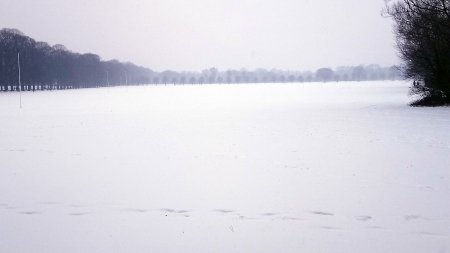
This was the view towards Pontcanna Fields from near the cricket ground.

Fortunately I was wearing heavy walking boots, but I’d forgotten what hard work it is to walk through snow!

This morning there’s still a lot of snow around and no sign of any attempt to clear the roads.

I wonder if there’ll be anywhere open to buy a paper?

Cosmic Dawn?

Posted in Astrohype, The Universe and Stuff on March 2, 2018 by telescoper

I’m still in London hoping to get a train back to Cardiff at some point this morning – as I write they are running, but with a reduced service – so I thought I’d make a quick comment on a big piece of astrophysics news. There’s a paper out in this week’s Nature, the abstract of which is

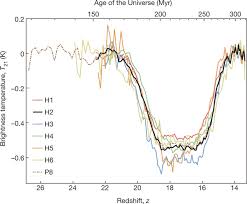
After stars formed in the early Universe, their ultraviolet light is expected, eventually, to have penetrated the primordial hydrogen gas and altered the excitation state of its 21-centimetre hyperfine line. This alteration would cause the gas to absorb photons from the cosmic microwave background, producing a spectral distortion that should be observable today at radio frequencies of less than 200 megahertz1. Here we report the detection of a flattened absorption profile in the sky-averaged radio spectrum, which is centred at a frequency of 78 megahertz and has a best-fitting full-width at half-maximum of 19 megahertz and an amplitude of 0.5 kelvin. The profile is largely consistent with expectations for the 21-centimetre signal induced by early stars; however, the best-fitting amplitude of the profile is more than a factor of two greater than the largest predictions2. This discrepancy suggests that either the primordial gas was much colder than expected or the background radiation temperature was hotter than expected. Astrophysical phenomena (such as radiation from stars and stellar remnants) are unlikely to account for this discrepancy; of the proposed extensions to the standard model of cosmology and particle physics, only cooling of the gas as a result of interactions between dark matter and baryons seems to explain the observed amplitude3. The low-frequency edge of the observed profile indicates that stars existed and had produced a background of Lyman-α photons by 180 million years after the Big Bang. The high-frequency edge indicates that the gas was heated to above the radiation temperature less than 100 million years later.

The key plot from the paper is this:

I’ve read the paper and, as was the case with the BICEP2 announcement a few years ago, I’m not entirely convinced. I think the paper is very good at describing the EDGES experiment, but far less convincing that all necessary foregrounds and systematics have been properly accounted for. There are many artefacts that could mimic the signal shown in the diagram.

If true, the signal is quite a lot larger than amplitude than standard models predict. That doesn’t mean that it must be wrong – I’ve never gone along with the saying `never trust an experimental result until it is confirmed by theory’ – but it’s way too early to claim that it proves that some new exotic physics is involved. The real explanation may be far more mundane.

There’s been a lot of media hype about this result – reminiscent of the BICEP bubble – and, while I agree that if it is true it is an extremely exciting result – I think it’s far too early to be certain of what it really represents. To my mind there’s a significant chance this could be a false cosmic dawn.

I gather the EDGES team is going to release its data publicly. That will be good, as independent checks of the data analysis would be very valuable.

I’m sorry I haven’t got time for a more detailed post on this, but I have to get my stuff together and head for the train. Comments from experts and non-experts are, as usual, most welcome via the comments box.

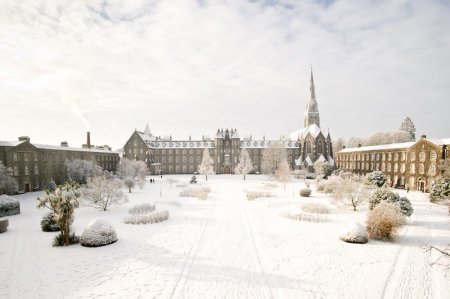
Maynooth in the Snow

Posted in Maynooth with tags , on February 28, 2018 by telescoper

There has been very little snow in Cardiff (so far) but there have been heavy falls in Maynooth. The above picture was tweeted by Maynooth University this morning, along with an announcement that the campus is closed today (and probably until Friday, as more snow is on the way).

Under normal circumstances I would be in Ireland from today until the weekend, but I have to be in London tomorrow (Thursday) so arranged cover for my teaching. Looks like teaching will be cancelled tomorrow anyway.

UPDATE: Maynooth University campus will be closed until Monday.

Whether I can make it to and from London, or whether the event I’m supposed to attend tomorrow will be cancelled, remains to be seen…

The Beast From The East

Posted in Sport with tags , , , on February 27, 2018 by telescoper

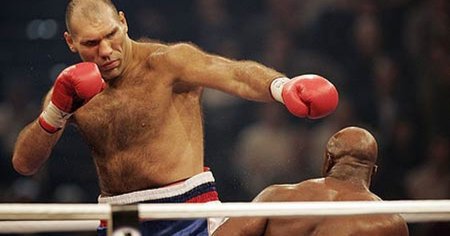
From my viewpoint in sunny snow-free Cardiff I can only assume that all this talk of The Beast From The East means that Nikolai Valuev is about to make a comeback to the boxing ring.

Standing a mighty seven foot tall, Valuev is the heaviest and tallest man ever to have been a world boxing champion. He retired from the ring on 2009, but I think he’d still be capable of surviving a few inches of snow…

Void Fill

Posted in Biographical, Cardiff, Politics with tags , , on February 26, 2018 by telescoper

It’s quite hard being on strike when you find your job interesting and rewarding so I’ve been looking for things not related to my employment at Cardiff University with which to plug the gap in my working schedule.

I’ve found the ideal thing:

Value for money in higher education: a very English debate

Posted in Uncategorized on February 25, 2018 by telescoper

Quite long, but very informative, blog post about the problem of defining ‘value for money’ in higher education. Well worth reading.

amcrae2014's avatar[ex-] HEAD OF DEPARTMENT’S BLOG

The term ‘value for money’ is now deeply entrenched in public discourse about higher education in England. It is written into the Higher Education and Research Act. It is the subject of an ongoing enquiry by te House of Commons Education Committee, and it has launched a few dozen identikit newspaper columns. It is at the centre of what the Office for Students describes as a ‘major piece of research’ that it has recently commissioned, intending to probe students’ perceptions of value for money to ‘inform’ how the OfS ‘takes forward its legal responsibilities to promote’ it. And no doubt it will in turn inform the thinking of Sam Gyimah, the new minister for Higher Education and Science, as he implements the review of student finance and university funding announced last week.

But one missing element in this debate is an agreed definition of value for money. When we talk…

View original post 2,403 more words

45° Angle

Posted in Jazz with tags , , , , on February 24, 2018 by telescoper

Some time ago I posted a piece of music by Dick Twardzik from the mid-50s. The jazz piano scene in those days was so heavily dominated by Thelonious Monk and Bud Powell that pianists seem to struggle to find their own voice in the space created by those two. Twardzik certainly succeeded, though he died very young. Well, here’s another track from roughly the same period (1957) featuring another underrated musician who solved this problem in a different way. This fine track, undoubtedly influenced by Monk and Powell, but at the same time with its own sound, is by Herbie Nicholls, playing his own composition 45° Angle with the excellent George Duvivier on bass and Dannie Richmond on drums. Enjoy!

LGBT+ History Month and the Royal Society

Posted in Biographical, History, LGBTQ+ with tags , , , , , on February 23, 2018 by telescoper

You may or may not know that this month is LGBT+ History Month for 2018, and, to mark it, the Royal Society has been marking it on Twitter by celebrating LGBT+ scientists.

I am very proud to be included among those featured on Twitter, although slightly disappointed that no mention was made of my greatest achievement, namely the Beard of Winter 2018 award.

I can’t show all the people in the Twitter thread produced by the Royal Society because there are too many of us, but I will mention two people that I know personally.

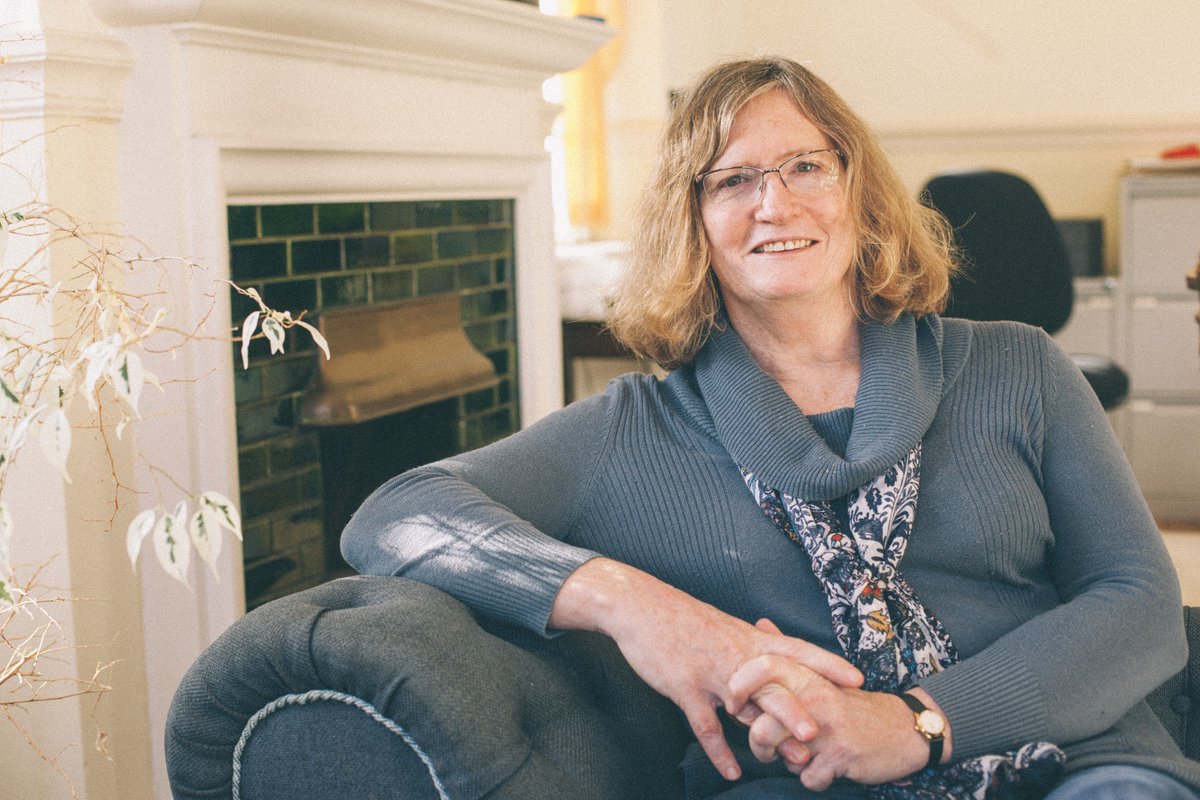
The first is radio astronomer Rachael Padman from the University of Cambridge:

Among other things, Rachael recently won an award from Gay Times magazine. I worked quite a bit with Rachael when I was External Examiner for Natural Sciences (Physics), a job I did from 2014-2016, as she was heavily involved in the administration of the examinations process at Cambridge during this time.

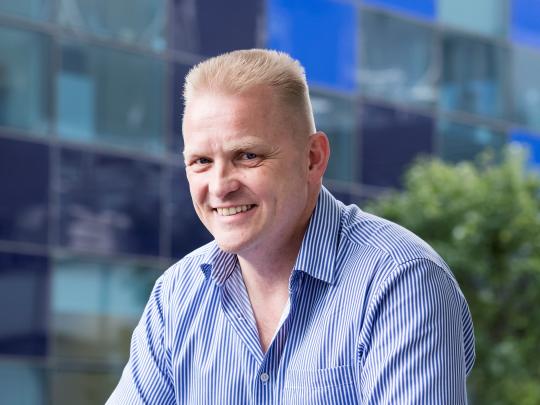
The other person I’d like to mention is Tom Welton, who is Professor of Sustainable Chemistry and Dean of the Faculty of Natural Sciences at Imperial College in London.

I especially wanted to mention Tom because he and I were contemporaries at the University of Sussex way back in the 1980s when I was a research student. I hadn’t seen him since I moved from Sussex in 1990 until two years ago when we were both panellists at an `Out in STEM’ event run by the Royal Society.

I know some of you will be asking whether the Royal Society should be getting involved in LGBT History Month. Some people commenting on the Twitter thread certainly think it shouldn’t.  I think it should, in order to demonstrate that a person can be openly LGBT+ and have a successful career in STEM.  If being visible in this way helps just one career feel more comfortable in themselves and in their career it would be well worth it.


Hands off the Good Friday Agreement!

Posted in Biographical, Politics with tags , , , , , , on February 22, 2018 by telescoper


I’ve been watching with increasing alarm the concerted attempt that certain extremist `Brexiteers’ have been trying to make a case for scrapping the Good Friday Agreement that came about in 1998 after decades of violent conflict in Northern Ireland and elsewhere.  These reckless fools think that derailing the peace process is a price worth paying for their ideological obsession with rejecting anything that involves the EU, in this case the Customs Union that allows an open border between the Republic of Ireland (whose future lies in the vibrant and outward-looking European Union) and Northern Ireland (which will remain shackled to the corpse of the United Kingdom, at least for the time being, until the creation of a united Ireland…). Not surprisingly, Irish politicians and the Irish are incensed about the reckless statements being made by some UK politicians.

Incidentally, the Good Friday Agreement was supported by simultaneous referendums in Northern Ireland (71.1% in favour) and the Republic  of Ireland  (94.4% in favour) ; a majority of the NI electorate also voted against leaving th European Union.  It’s strange how selectively some people are prepared to accept `The Will of the People’…

Anyway, just as a reminder of what is at stake, here are three examples based on my own experiences of what things were like before the GFA, when I lived in London (which I did for about eight years, between 1990 and 1998). During that time I found myself in relatively close proximity to three major bomb explosions, though fortunately I wasn’t close enough to be actually harmed. I also concluded that my proximity to these events was purely coincidental.

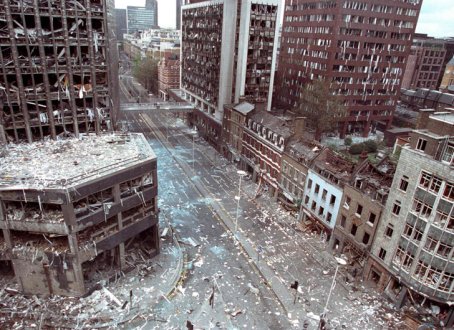
The first, in 1993, was the Bishopsgate Bombing. I happened to be looking out of the kitchen window of my flat in Bethnal Green when that bomb went off. I had a clear view across Weavers Fields towards the City of London and saw the explosion happen. I heard it too, several seconds later, loud enough to set off the car alarms in the car park beneath my window.

This picture, from the relevant Wikipedia page, shows the devastation of the area affected by the blast.

The other two came in quick succession. First, a large bomb exploded in London Docklands on Friday February 8th 1996, at around 5pm, when our regular weekly Astronomy seminar was just about to finish at Queen Mary College on the Mile End Road. We were only a couple of miles from the blast, but I don’t remember hearing anything and it was only later that I found out what had happened.

Then, on the evening of Sunday 18th February 1996, I was in a fairly long queue trying to get into a night club in Covent Garden when there was a loud bang followed by a tinkling sound caused by pieces of glass falling to the ground. It sounded very close but I was in a narrow street surrounded by tall buildings and it was hard to figure out from which direction the sound had come from. It turned out that someone had accidentally detonated a bomb on a bus in Aldwych, apparently en route to plant it somewhere else (probably King’s Cross). What I remember most about that evening was that it took me a very long time to get home. Several blocks around the site of the explosion were cordoned off. I lived in the East End, on the wrong side of sealed-off area, so I had to find a way around it before heading home. No buses or taxis were to be found so I had to walk all the way. I arrived home in the early hours of the morning.


Does anyone really  want to go back to experiencing this kind of event on a regular basis? If  the UK government is persuaded in its weakness to ditch the Good Friday Agreement then there is a real risk of that happening. And if it does, those calling for it will have blood on their hands.