Why I’m taking part in the UCU Strike Action

Posted in Education, Politics with tags , , , , , , on February 21, 2018 by telescoper

In case you weren’t aware, from tomorrow (22nd February) the University and College Union (UCU) is taking industrial action over proposed drastic cuts to staff pensions funded by the Universities Superannuation Scheme (USS). You can find some background to the pensions dispute here (and in related articles). A clear explanation of why the employers’ justification for these cuts is little more than fraudulent is given here and here you can find an example of the effect of the proposed changes on a real person’s pension (ie a cut of almost 50%). I also blogged about this a few weeks ago. There’s no doubt whose side the Financial Times is on, either.

I am not a member of UCU – I left its forerunner organisation the Association of University Teachers (AUT) as a result of its behaviour when I was at the University of Nottingham – but I will be participating in the industrial action, which takes place over four weeks as follows:

  • Week one – Thursday 22 and Friday 23 February (two days)
  • Week two – Monday 26, Tuesday 27 and Wednesday 28 February (three days)
  • Week three – Monday 5, Tuesday 6, Wednesday 7 and Thursday 8 March (four days)
  • Week four – Monday 12, Tuesday 13, Wednesday 14, Thursday 15 and Friday 16 March (five days)

This is a bit complicated for me because I only work half-time at Cardiff University (usually Mondays, Tuesdays and half of Wednesdays) and at Maynooth University the rest of the time. The USS only covers UK universities, and the dispute does not apply in the Republic of Ireland (though it does affect higher education institutions in Northern Ireland) so I won’t be on strike when I’m working for Maynooth University, which includes the first two strike days (tomorrow and Friday). I will be participating in industrial action next week, however, and have today sent an announcement to my students they hear from me that the strike has been called off there will be no lectures on 27th February, 6th March or 13th March.

All staff will be docked pay for days not worked owing to strike action, of course, but that will be far less than the amount to be lost in these pension cuts. In my case I will be docked the equivalent of three weeks’ pay as 2.5 days a week I work are all strike days in Weeks 2-4. Moreover, I shall be leaving the UK for Ireland this summer and the pension cuts will not affect my pension anyway – any changes will not be made until after I’ve left the USS scheme. Nevertheless, this is an important issue and I feel it is right to take a stand.

One final comment. Last week Cardiff University sent an email to staff including a link to a website that stated:

If staff refuse to cross a picket line and they are not a member of UCU they will be in breach of their contract of employment with the University.

In fact, any strike action (even by a union member) is a breach of contract. The law however prevents employers dismissing staff who participate in industrial action, provided that it is lawful (i.e. following a ballot, and with due notice given to the employer, etc). The government website makes it clear that non-union members have exactly the same protection as union members in this regard. The Cardiff website has now been changed, but I’m very unhappy that this extremely misleading communication was sent out in the first place.

I sincerely hope that there is a negotiated settlement to this issue. Nobody wants to go on strike, especially when it has the potential to damage students’ learning. But there comes a point where you have to draw a line in the sand, and we have reached that point. I hope I’m proved wrong, but I think this could be a very prolonged and very unpleasant dispute.

Learning Technology

Posted in Biographical, Cardiff, Education, Maynooth with tags , , , , , , , , on February 20, 2018 by telescoper

I’m just taking a tea break in the Data Innovation Research Institute. Today has been a very day as I have to finish off a lot of things by tomorrow, for reasons that I’ll make clear in my next post…

It struck me when I was putting on the brew how much more technology we use for teaching now than when I was a student. I think many of my colleagues make far more effective use of the available technology than I do, but I do my best to overcome my Luddite tendencies. Reflecting on today’s teaching makes me feel just a little less like a dinosaur.

This morning I gave a two-hour lecture on my Cardiff module Physics of the Early Universe which, as usual, I recorded using our Panopto system. Although there was a problem with some of the University’s central file storage this morning, which made me a bit nervous about whether the lecture recording would work, it did. Predictably I couldn’t access the network drives from the PC in the lecture theatre, but I had anticipated that and took everything I needed on a memory stick.

After a short break for lunch I checked the lecture recording and made it available for registered students via the Virtual Learning Environment (VLE), known to its friends as Learning Central. I use this as a sort of repository of stuff connected with the module: notes, list of textbooks, problem sets, model answers, instructions and, of course, recorded lectures. The students also submit their coursework assignment (an essay) through this system, through the plagiarism detection software Turnitin.

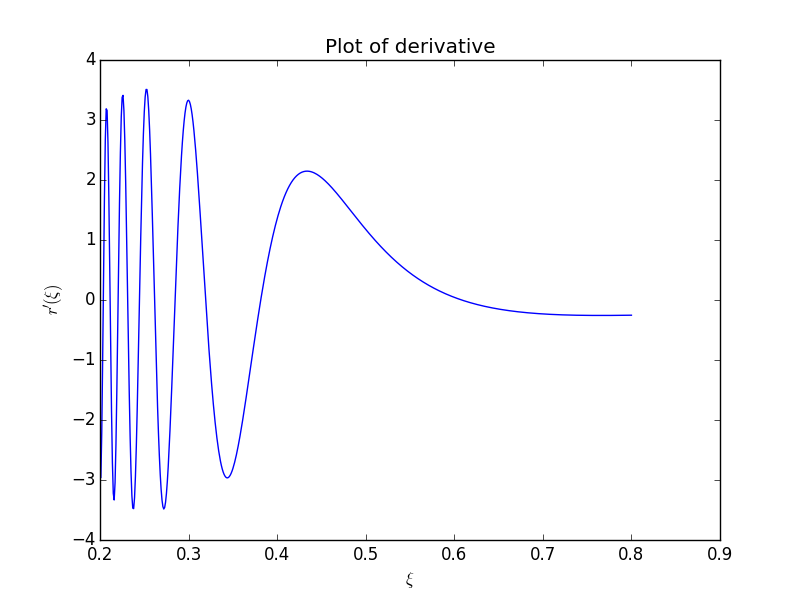
This afternoon the students on my Computational Physics course in Maynooth University had a lab test, the first of four such tests, this one consisting of a short coding exercise. There are two lab sessions per week for this class, one on Thursdays (when I am normally in Maynooth to help supervise) and another on Tuesdays (when I am normally in Cardiff). I have a number of exercises, which are similar in scope but different in detail (to prevent copying) and the Tuesday lab has a completely different set of exercises from the Thursday one. In each exercise the students have to write a simple Python script to plot graphs of a function and its derivative (computed numerically) using matplotlib. The students upload their script and pictures of the plot to the VLE used in Maynooth, which is called Moodle.

In the manner of a TV chef announcing `here’s one I did earlier’, this a sample output produced by my `model’ code:

I wonder if you can guess of what function this is the derivative? By the way in this context `model’ does not mean `a standard of excellence’ but `an imitation of something’ (me being an imitation of a computational physicist). Anyway, students will get marks for producing plots that look right, but also for presenting a nice (commented!) bit of code

This afternoon I’m on Cardiff time but I was able to keep an eye on the submissions coming in to Moodle in case something went wrong. It seemed to work out OK, but the main problem now is that I’ve got 20-odd bits of code to mark! That will have to wait until I’m properly on Maynooth time!

Now, back to the grind…

The Philharmonia Orchestra: Beethoven & Mahler

Posted in Music with tags , , , , , , on February 19, 2018 by telescoper

I spent yesterday afternoon at a very enjoyable concert at St David’s Hall in Cardiff for a programme of music by Beethoven and Mahler given by the Philharmonia Orchestra under Principal Guest Conductor Jakub Hrůša. The picture above was taken about 10 minutes before the concert started, from my seat in Tier 1. Quite a few people arrived between then and the beginning of the performance, but there wasn’t a very big audience. St David’s Hall may have been less than half full but those who did come were treated to some fantastic playing.

The first half of the concert consisted of Beethoven’s Piano Concerto No. 1 (in C) with soloist Piotr Anderszewski. This work was actually composed after his Piano Concerto No. 2 but was published first. It consists of three movements, an expansive slow movement (marked Largo) sandwiched between two sprightly up-tempo movements, marked Allegro con brio and Rondo-Allegro Scherzando, respectively. I think the first part of the last movement, full of energy and wit, is the best part of this work and Anderszewski play it with genuine sparkle. His performance was very well received, and he rounded it off with a charming encore in the form of a piece for solo piano by Bartok.

After the wine break we returned to find the piano gone, and the orchestra greatly expanded for a performance of Mahler’s Symphony No. 5 , the fourth movement of which (the `Adagietto’) is probably Mahler’s best-known music (made famous by its use in Visconti’s 1971 film Death in Venice). This lovely movement is sometimes performed on its own – a practice Mahler himself encouraged – but I think it’s particularly powerful when heard in its proper context, embedded in a large orchestral work that lasts well over an hour.

Although nominally five movements, this work is really in three sections: the first section consists of the first two movements (the first starting with Trauermarsch (a funeral march), and the second a stormy and at times savage movement, punctuated with brief interludes of peace). The last section consists of the beautiful Adagietto 4th movement (played entirely on the strings) followed by an energetic and ultimately triumphant finale. In between there’s an extended Scherzo, which is (unusually for Mahler) rather light and cheerful. Roughly speaking this symphony follows a trajectory from darkness into light and, although it certainly doesn’t go in a straight line, and does start with a death march, this is undoubtedly one of Mahler’s cheerier works!

The Philharmonia Orchestra gave a very accomplished and passionate reading of this piece, with especially fine playing from the brass section (who have lot to do). The exuberant ending brought many members of the audience to their feet and rightly so, as it was a very fine performance – the best I’ve heard live of this work.

Today’s Earthquake in Wales

Posted in Uncategorized on February 17, 2018 by telescoper

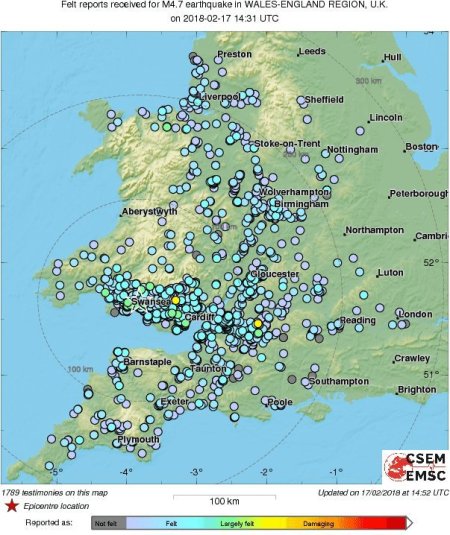
Just after 2.30 this afternoon I felt a vibration of my house in Cardiff, initially like a heavy truck going outside but then a distinct ‘bump’. The whole house moved, but only for less than a second and no damage ensued.

I thought it was a minor tremor, and out of curiosity I looked on Twitter to see how widespread were the reports. The answer was very:

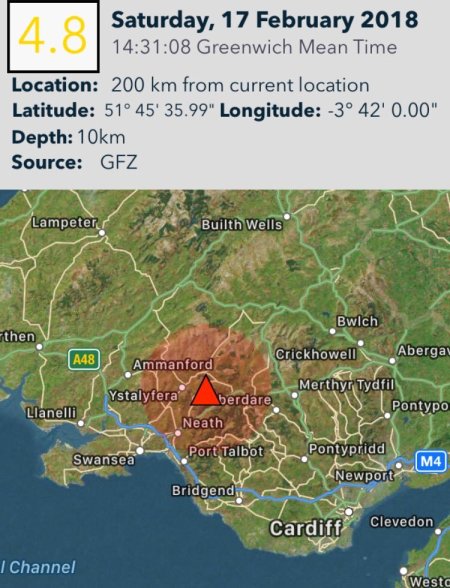
It seems it was an earthquake of Magnitude 4.7, centered near (or, presumably, under) Neath. That’s actually pretty big by UK standards.

Thankfully I don’t think anyone has been hurt.

Anyone else feel it?

P. S. I learned today that the Welsh word for ‘earthquake’ is daeargryn..

Flying back to Wales

Posted in Uncategorized on February 17, 2018 by telescoper

Today, as usual, I took the morning flight back from Dublin to Cardiff. This was the first time this year it’s been clear enough and light enough to see anything from the cabin so I took this snap our of the window as we reached the Welsh coast. You can see the curve of Cardigan Bay reasonably well.

The propeller was working, by the way…

Wild Man Blues

Posted in Jazz with tags , , on February 16, 2018 by telescoper

Time, I think, for some vintage jazz. This one doesn’t really need many words of introduction. It was recorded on May 7th 1927 in the Okeh Studios in Chicago by Louis Armstrong and his Hot Seven: Louis Armstrong (cornet), John Thomas (trombone), Johnny Dodds (clarinet), Lil Armstrong (piano), Johnny St. Cyr (banjo), Pete Briggs (tuba), and Warren `Baby’ Dodds (drums). Two things are worth saying, though. One is that this piece is very modern-sounding for its time, in that there’s very little of the ensemble work that one associates with New Orleans jazz, just two extended solos by Louis and Johnny Dodds, and that those solos are both very free. The other is that Armstrong’s solo is so good that there were only a few soloists who could have taken over from him without creating an anti-climax. Fortunately, one of those men (Johnny Dodds) was in the studio and did just that, matching Satchmo in power and invention. Enjoy!

Windows Horror

Posted in Uncategorized with tags , on February 16, 2018 by telescoper

This week was going reasonably well, I thought. The class test for my Computational Physics students yesterday went reasonably well; they even managed to upload their code and output to Moodle at the end.

However, when I came into work this morning and started up my laptop, which belongs to Cardiff University, it announced that it was doing a BIOS update. I sighed and then went to make a cup of tea while it did the job. When I got back I found I was locked out by BitLocker, the Windows 10 disk encryption feature that Cardiff University insist is used on its laptops.

There isn’t/wasn’t any USB disk attached to the machine, by the way, and I did try restarting the machine but that didn’t help. I can only infer that BitLocker can’t cope with a change at the BIOS level which, if true, is really pathetic.

Not having the required `recovery key’ (which I have never been given) and being informed by the FAQ that I would need a system administrator to supply it, I got in panicky touch with Cardiff’s IT services, but three hours later I still can’t get in. I do have my desktop (which runs Unix) so am not completely stymied, but I don’t have the files on my laptop. I was planning to work on some things on there today, but it looks like I won’t be able to. It even looks possible that all the data on this laptop is lost for good.

The thing I can’t help thinking about is how terrible this would be if I had been just about to give a talk at a conference….

WINDOWS UPDATE: I’m back into my laptop and have not lost any data (as far as I can tell). The problem is indeed a known conflict between BIOS and BitLocker, which I think is atrocious.

The Greatest Scarpia

Posted in Opera with tags , , on February 15, 2018 by telescoper

Thursdays are always busy so today I’ll just put this here. It’s the great operatic baritone Tito Gobbi as Baron Scarpia in Tosca, a role he sang almost a thousand times in his career. This is the Te Deum scene, at the end of Act I, in which Scarpia after sending his men to follow Tosca to her lover Cavaradossi, he sings of his lustful desire as worshippers gather fora service at the Church in which the action takes place.

There have been many excellent interpreters of the role of Tosca (in which role I think Renata Tebaldi was every bit as good as Maria Callas) but Tito Gobbi (who sang the role with both Callas and Tebaldi) was the Scarpia of his age, and perhaps of any…

The de Valera connection

Posted in History, mathematics, Maynooth with tags , , on February 14, 2018 by telescoper

This morning I took the early flight to Dublin, which was on time, and thence via the Airport Hopper to Maynooth. There were only two passengers on the bus, both going to the terminus, so it made good time, travelling all the way along the motorway.

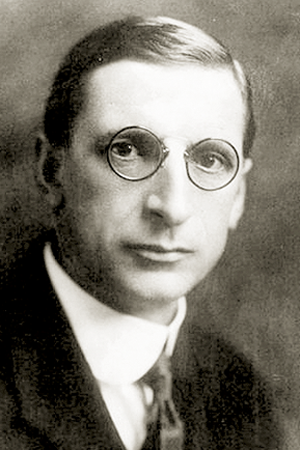
Walking into the Maynooth campus I remembered an interesting little historical fact that I stumbled across last week, concerning Éamon de Valera, founder of Fianna Fáil (one of the two largest political parties in Ireland) and architect of the Irish constitution. De Valera (nickname `Dev’) is an enigmatic figure, who was a Commandant in the Irish Republican Army during the 1916 Easter Rising, but despite being captured he somehow evaded execution by the British. He subsequently became Taoiseach (Prime Minister) and then President (Head of State) of the Irish Republic.

Eamon de Valera, photographed sometime during the 1920s.

The point of connection with Maynooth, however, is less about Dev’s political career than his educational background: he was a mathematics graduate, and for a short time (1912-13) he was Head of the Department of Mathematics and Mathematical Physics at St Patrick’s College, Maynooth, which was then a recognised college of the National University of Ireland. The Department became incorporated in Maynooth University, when it was created in 1997. It is said that one of the spare gowns available to be borrowed by staff for graduation ceremonies belonged to de Valera. Mathematical Physics is no longer a part of the Mathematics Department at Maynooth, having become a Department in its own right and it recently changed its name to the Department of Theoretical Physics.

De Valera missed out on a Professorship in Mathematical Physics at University College Cork in 1913. He joined the the Irish Volunteers, when it was established the same year. And the rest is history. I wonder how differently things would have turned out had he got the job in Cork?

That’s one connection, but when I arrived in the office this morning I found another. An email had arrived announcing a conference later this year in honour of Erwin Schrödinger.  It was de Valera – a notable advocate for science – who in 1940 set up the Dublin Institute for Advanced Studies (DIAS); Schrödinger became the first Director of the School of Theoretical Physics, one of the three Schools in DIAS.

LGBT+ Physical Sciences Climate Survey

Posted in LGBTQ+ with tags , on February 13, 2018 by telescoper

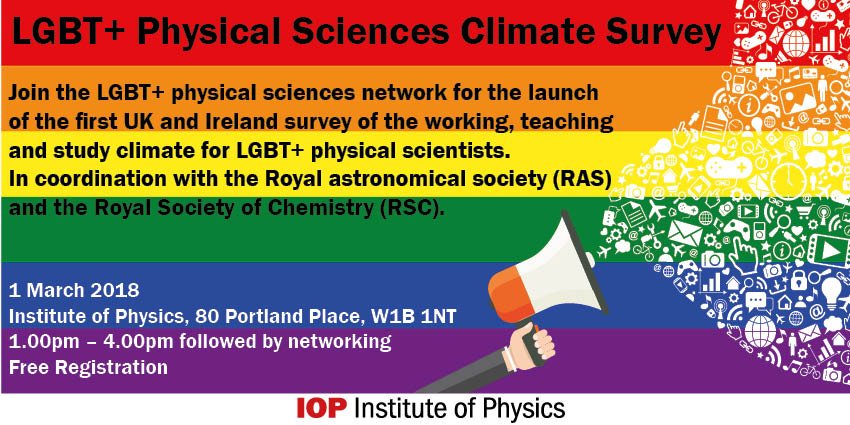
Very busy day today so I only have time to post a quick notice about an event coming up in a couple of weeks (on 1st March 2018) at the Institute of Physics in London:

This event celebrates the launch of the LGBT+ physical sciences survey, the first UK and Ireland survey of the working, teaching and studying climate for LGBT+ physicists, astronomers and chemists and those in related sciences.

Speakers from the community will be sharing their perspectives on the successes and challenges of creating a climate that enables everyone to be fully themselves in the workplace and place of study. The event is also an opportunity to find out more about the survey and meet other members of the network at an informal reception with drinks and snacks.

I am greatly honoured to have been asked to give a talk to introduce the event and chair the session, which ends in a panel discussion.The event is open to all, but space is limited at the venue so you will have to sign up if you want to go. You can sign up here.

See you there!