Back in the office after a rather chaotic Bank Holiday Weekend during which, among other things, I managed to mislay my phone, I couldn’t resist a short post about yesterday’s victory by the West Indies over England at Headingley. I don’t often write about sporting events that I haven’t attended in person, but I thought I’d make an exception in this case for the reasons I’ll outline below.
The first is that, although England will be hurting after losing a game many expected them to win comfortably, I think this result is great for cricket. Before this game I was gearing up to write a post wondering why there seem to be so few close Test matches these days, the previous series and the first one in this series having been quite one-sided. Although the West Indies won this one fairly comfortably in the end – by five wickets with several overs to spare, it still counts as `close’ in my book because the final day started with any result possible. That doesn’t happen very often, but when it does it makes for a marvellous experience. I wish I had been there. Long may five-day Test matches endure!
Shai Hope, whose beardpower led the West Indies to victory (Photo credit: JEWEL SAMAD/AFP/Getty Images)
Secondly, I am not as critical as some of Joe Root’s decision to declare on 490-8 on Monday evening, leaving the visitors 322 to win. He obviously hoped to knock over a couple of West Indian wickets in the six overs left to play that evening, but that didn’t happen. However, as long as no significant time was lost to the weather (which it wasn’t), that decision meant took the draw out of the equation. If the Windies batted all day on the last day – a big `’if’ – they would comfortably score the runs as only a shade over three an over was required. It’s one of the fascinating curiosities of cricket that maximising the chance of winning by declaring can also maximise the chance of losing.
In the end, England’s bowlers didn’t perform to their best on the last day and, while many expected the batsmen to feel the pressure, it was England that seemed to crack, losing their cool in the field and dropping a couple of important catches. Crucially, Jimmy Anderson just didn’t get the ball to swing enough to be the threat that he can be. The other likely match-winner, Moeen Ali, did not bowl well either. But let that take nothing away from the excellent performance by the West Indies batsmen, especially Shai Hope (above), who looks a super player. Well played to him, and the rest of his team!
Incidentally, England’s 2nd innings score of 490 for 8 (declared) is the largest Test innings ever in which no batsmen has scored a century. Not a lot of people know that.
I have to admit that I was a bit saddened by the manner of the West Indies defeat in the First Test at Edgbaston because they looked so outclassed. So many of my boyhood sporting heroes were from the West Indies (including such illustrious names as Clive Lloyd, Viv Richards, Gordon Greenidge, Michael Holding, Joel Garner, and Malcom Marshall to name but a few) that it was painful to think of the team fading so badly as a force in Test cricket. They seem to have been in decline for some years, but perhaps the comeback starts now. I certainly hope so. The game is richer for having the West Indies as a force.
Finally, on the result. As regularly readers of this blog will know, I’m not averse to placing the odd bet now and then. When Joe Root declared I had a look at the website of Mr William Hill and noticed that the West Indies were 12/1 against to win the match. Largely based on England’s lacklustre bowling in the first innings (with the exception of James Anderson), the strong batting performance by the West Indies in their first innings, and the draw having been eliminated from consideration, I decided to put a pony (£25) on a West Indies win. I had a look at the betting markets along with the score now and then throughout the day yesterday. The available odds changed throughout the day: at 84 for 2 the price was 8-1, at 101 for 2 it was 5-1, at 169 for 2 it was 13/10 and by the time they passed 200 the West Indies were favourites at 11/10 on (England 4/1 against).
At one game apiece with the West Indies on a high, it’s all set up nicely for the deciding match of the series at Lord’s next week!
Posted in Uncategorized on August 28, 2017 by telescoper
I haven’t been paying much attention to the blog statistics recently, what with one thing and another, but I just realized when I checked tonight that sometime in the last week or so In The Dark received its one millionth visitor.
I don’t know how or why so many people found their way here, but you’re all very welcome!
Today I took part in the annual Cardiff Pride Parade – which was much bigger than I expected! – followed by the ‘Big Weekend’ festival in Cathays Park. I walked in the Parade with LGBT Labour Wales. Here’s the group photo taken at the end of the march:
The start, in Windsor Place, was quite congested and we were rather late setting off because of the crowds in front of us, as we were quite near the back.
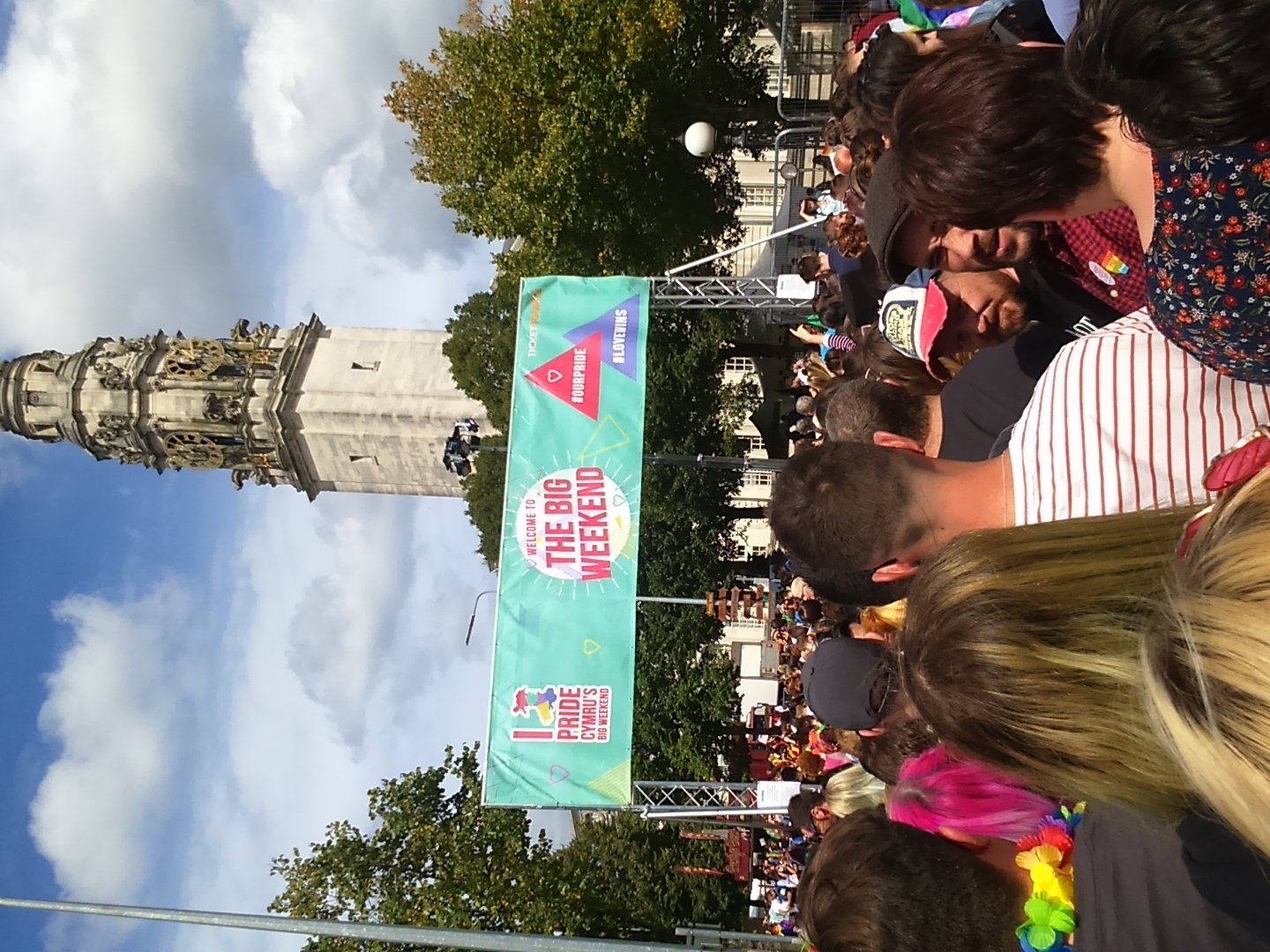
Here’s the view from the bottom of St Mary Street:
It was a lovely day, marred only by poorly organised access to Cathays Park. I had to queue for 90 minutes..
Once inside, though, there was plenty to do: funfair, music, food and drink, and of course stalls run by various organisations. I had a chat with the good folk of Time To Change Wales, who campaign on mental health issues, and spent some time with Enfys, the Cardiff University Staff LGBT+ network.
And, of course, no Cardiff Pride event would be complete without a Shirley Bassey impersonator!
The ‘Big Weekend’ continues tomorrow, but I’m busy elsewhere so I’ll wish everyone a happy time for the rest of the festival!
It’s been a while since I had a guest post on this blog so it’s a pleasure to present this, by Philip Moriarty, to add to your reading for the Bank Holiday Weekend. Phil and I have had a number of exchanges over the years about the possibility of him writing a post for In The Dark and I’m very happy that it’s finally happened!
Take it away, Philip Moriarty…
–o–
If the conversations and feedback I’ve had at recent “social media in academia” meetings are anything to go by, I suspect that the majority of my academic friends and colleagues will be unaware of the source of the quote above. Although ignorance is certainly the more blissful option here, those of us with any semblance of interest in diversity, equality, gender balance, and widening participation issues in higher education need to start paying attention to just why memes like the title of this post are gaining such wide traction online. That way we can learn a great deal about the origins of the hostility that academics, on either side of the political divide, are increasingly facing, both inside and outside (see also this) the lecture theatre. Forewarned is forearmed [1].
The “Conservatism is the New Punk Rock” tagline was popularised earlier this year by a certain Paul Joseph Watson, of Infowars infamy. Watson is a conspiracy theorist-cum-YouTube pundit-cum-Alt-Right talking ranting head who, when not being given a thorough dressing-down on Twitter for his amusingly uninformed bleating about ethnicity in Roman Britain [2], spends his time as editor-at-large of the aforementioned Infowars. He’s essentially a bargain basement Milo Yiannopoulos [3]; a self-styled “New Right” provocateur who believes that it’s the height of cultural cool to channel the casual seventies racism and bigotry of an Alf Garnett or a Bernard Manning.
And the problem is that Watson is dead right about this new breed of conservatism.
Generation Z. Plus ça change…
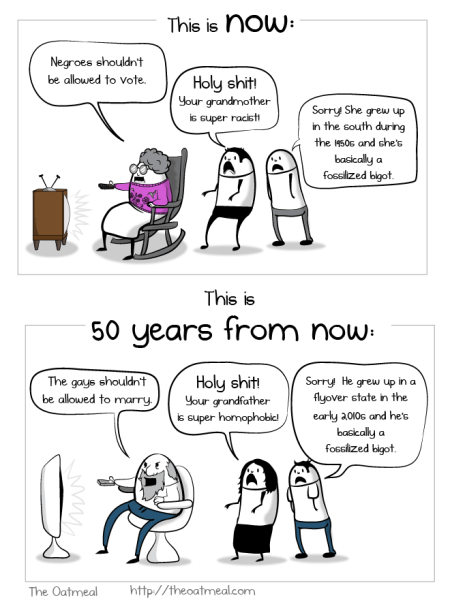
It’s now achingly edgy in some teenage (and permateen) circles to espouse bigotry, to rail against “PC culture”, and — as the YouTuber ContraPoints pointed out in a recent online discussion — to echo the views of a stereotypically racist grandmother. Even the more moderate in those particular cliques appear to have adopted the mindset of an uber-reactionary lifelong Tory backbencher. Bizarrely, this is what passes for teenage rebellion these days.
To illustrate what I mean, I’m afraid that I’m going to have to ask you to forgo the conventional advice on reading comments sections online. (My apologies for this — we all know that online forums are where the touchingly naive “marketplace of ideas” concept goes to die.) I suggest that you take a look at the comments under the “Conservatism is the new Counter-Culture” video Watson uploaded back in February. Here are just three comments that I happened upon in a cursory ten second trawl through the thread:
All anonymous, of course, so we have no way of telling whether or not each claim to be a Millenial/member of Generation Z — which are both rather ill-defined in terms of the date-of-birth range that they span in any case — holds up to scrutiny. But there’s very good reason to believe that Watson and his ilk indeed appeal to large sections of those particular demographics. Putting the demographic diversity (or lack thereof) of his audience to one side, however, Watson and others like him have subscriber bases numbering in the hundreds of thousands to over one million. Watson himself recently passed 1M subscribers on YouTube. On Twitter, Watson has got some way to go before he reaches the lofty heights of, for example, a Deepak Chopra (3.18M and rising steadily; another one in the eye for the marketplace of ideas). But, nonetheless, he, and other “New Right” pundits like him, clearly appeal to a sizable audience.
A defining feature of Generation Z is that they are, if you’ll excuse the jargon, digital natives. I’m a couple of chapters into Angela Nagle’s brilliant Kill All Normies at the moment. If you’d like to get an insight into just how internet subcultures and communities have influenced the rise of the New Right (and the alt-right, and neo-Nazism, and anti-social-justice cliques etc…) I enthusiastically recommend both Nagle’s book and Whitney Phillips’ This Is Why We Can’t Have Nice Things[4]. (Be warned, however, Nagle’s book, while being critical of the new right/alt-right, doesn’t exactly go easy on those on the left of the political spectrum. It’s equal opportunities critique.)
Nagle and Phillips each highlight the importance of the meme culture of the internet, of the pervasive influence of message boards like 4chan, and of anonymity’s central contribution to online interactions. But they also both focus on the key role of transgression: of pushing the boundaries, of ‘edginess’ in youth sub-cultures. It was ever thus, of course — each and every generation kicks against the pricks. And transgression of this type is key to understanding the rise of the “new right” among certain Generation Z sub-cultures.
With parents who will be counted among the “normies” of the title of Nagle’s book — conventional, staid, boring, “virtue signalling” and, most of all, politically correct — what better way for the more aggrieved and brooding members of Generation Z to rebel than to reject PC culture? “Fuck your feelings” and all that. (Of course, the Right (New or otherwise) is just as sensitive and prone to signalling as the “PC” Left on very many issues. More on this soon but let’s not have ugly facts get in the way of a good narrative just yet.)
Like many who regularly read the In The Dark blog [5],I’m an academic — a physicist at the University of Nottingham. (I used to blog quite regularly. Less so now). In common with practically all other UK universities, the majority of our undergraduate students are members of Generation Z. (This was made abundantly clear to me while I spent days answering the phone during the clearing period after A-level results were released last week. I entered a lot of date-of-birth details for applicants into online forms. My, but did I feel old.) If, as Watson suggests, the New Right indeed has quite some cachet among Generation Z — and we certainly don’t need to rely on Watson’s YouTube content for evidence of this; hyperbolic paranoia about ‘leftist’ professors brainwashing their classes is rife out there [6] — we academics need to be rather less complacent and naive about the extent to which our continued focus on diversity and inclusion will be met with unalloyed enthusiasm by some undergraduate students. We should perhaps expect some resistance.
And that brings me to…
Inclusion Matters
The Engineering and Physical Sciences Research Council (EPSRC), which funds the bulk of physics research in the UK, has very recently announced an innovative and welcome new funding scheme focused on furthering equality, diversity and inclusion in engineering and physical sciences research. Here’s how the EPSRC describes the call:
Funding of up to £5 million is available to support around ten inspiring applications with duration of up to 24 months to promote a more diverse, fair and inclusive engineering and physical sciences community. There is no limit on how large or small requests for funding can be.
(…listen carefully now and you too will hear the frantic rattling of keyboards late into the night as a certain hypersensitive online faction catches wind of this funding scheme. Of late, the Ghostbusters remake, superheroes on tins of pasta, and the announcement of a female Doctor have each been enough to drive the righteous anger of that faction to new heights as they bemoan the injustice of it all. The levels of distress caused by EPSRC’s allocation of £5M to diversity and inclusion in STEM could well be off the scale. Perhaps some type of helpline might be in order?)
All joking aside, while EPSRC is to be loudly applauded for establishing this funding initiative, the potential for a significant backlash is very high indeed. Too often, as academics we assume that all it takes to fix a problem is education, education, education. This is unfortunately exceptionally naive in political/ideological contexts, particularly, and especially, when it comes to the types of gender balance and diversity issues that EPSRC hopes to address. The James Damore/Google manifesto furore that broke out at the end of last month highlighted just how much sensitivity underpins the themes of the Inclusion Matters call.
I’m not going to go into a blow-by-blow dissection of Damore’s claims here. For one, it’s already been done by so many others much better than I ever could (here,here, and here. And definitely here. Oh, and here.) For another, a couple of weeks ago I spent a little over two hours chatting with my friend the “Ranting Feminist” (RF is, in fact, among the least ranty people I know) about Damore’s claim that the science backs up his position on the aptitudes and preferences of women in STEM fields. The science of course does no such thing — it’s equivocal at best and there’s a complete lack of consensus in many areas, as RF and I discuss in the video below. Moreover, Damore’s claim of “universal” traits, independent of culture and environment, is a remarkably uninformed, unscientific, and unconvincing position that can be readily rebutted when it comes to, for example, aptitude in maths.
I refer to Angela Saini‘sInferiora number of times during the discussion with RF. Beg, borrow, steal, or, better, shell out some of your hard-earned cash for Saini’s book. You will not regret it. It’s an exceptionally good piece of writing which provides a well-balanced analysis of the science (and the pseudoscience) underpinning gender differences. (I thought I was a major fan of Saini’s work until I met Jess Wade at the recent SciFoo conference at the Googleplex. Jess had bought up a supply of Saini’s book to hand out during the session she organised!) While I’m at it, I’ll also strongly recommend BBC2’s “No More Boys and Girls: Can Our Kids Go Gender Free?“, presented by Javid Abelmoneim. I watched Part 1 with my kids over the weekend and they were so engrossed they had to tell me to shut up because I was talking over the TV at one point. (Those who may be upset by the title of the BBC programme alone should perhaps pay attention to the trigger warning at the start of the discussion with RF above).
What would Sagan say? The Cult of Peterson.
At about the 1:41:00 mark in the video above, we turn to a consideration of Prof. Jordan Peterson, a Professor of Psychology at the University of Toronto, who currently makes of order $50K per month via Patreon for his YouTube videos. I’m not going to rehash my arguments about Peterson beyond those in the video largely because Eiynah has comprehensively analysed and dissected the Cult of Peterson in an important post. (Note the Reddit thread to which Eiynah refers where Peterson is described as a prophet.).
The sociology of Peterson’s YT/Patreon/Twitter following is truly fascinating and is part-and-parcel of the “edginess” and cachet of the New Right. Peterson — who, let’s be clear, is an intelligent, charismatic, and eloquent man [7] – largely gained his Patreon and YouTube following via his criticism of hate speech legislation in Canada and his associated often overwrought — or, at worst, histrionic — musings on the descent of modern academia into a Cultural Marxist Lowest Circle of Hell. But what’s remarkable is that Peterson is a Christian conservative who, while railing against the evils of postmodernism (and I’m certainly not a fan of a great deal of postmodern writing), has some very postmodern things indeed to say about the value of scientific truth vs religious/moral truth (or as he puts it, Darwinian truth).
It’s worth taking two hours of your time to listen to the podcast that Sam Harris did with Peterson earlier this year, where they focus on the meaning of truth. Harris repeatedly cuts Peterson’s exceptionally flawed and woolly thinking down to size. Just like Chopra, and indeed in line with many of the postmodernists Peterson criticises at length, Peterson’s arguments about truth and the nature of reality are dressed up in obscure and impenetrable language — a triumph of style over substance. And yet Peterson attracts a large, and growing, audience of those who would class themselves as rational, skeptical, logical, and atheist in their thinking. Strip away the florid language, however, as Harris does, and the emperor clearly has no clothes.
Listening to Peterson flail around during his podcast with Harris, I couldn’t help but be reminded of Carl Sagan‘s words:
Skeptical scrutiny is the means, in both science and religion, by which deep thoughts can be winnowed from deep nonsense.
When so-called “rational skeptics” (including many STEM students) enthusiastically embrace the deep postmodernist thoughts of Peterson, it’s clear that the edgy transgressiveness of the New Right has trumped reasoned, logical argument. What does it matter if Peterson argues that the morality and ethics of a scientist studying smallpox defines the truth of the underlying biochemistry? (As he does. No, really — he does.). Let his post-modern views on science slide. What matters is that he’s edgily refused to use the preferred pronouns of transgender students. [8] So where do I sign away my Patreon bucks?
This cult of personality represents something of a challenge for universities, whose core “mission” should be to develop the critical thinking skills of the students we teach. Anyone who comes away from the Harris-Peterson exchange feeling that Peterson successfully argued his position in the face of Harris’ systematic skeptical scrutiny — and, remarkably, many do (just take a look at the comments thread under the YouTube upload of the podcast [9]) — is clearly putting their ideological biases and allegiances before reason, logic, and objectivity. (Ummm, now where have I heard that complaint before?)
Let’s bring this overlong post to a close by reconnecting with the spirit of punk. The parallels of the 70s punk movement with the rise of the New Right are striking — Paul Joseph Watson is closer to the truth than I suspect he realises.
The photo of the poster below has been circulating widely on Twitter over the last week. (Kristi Winters, the author of the tweet in question, certainly gave that particular poster a massively large “signal boost” on Twitter — it’s accrued quite a number of retweets in just a few days). It’s a telling example of online culture bleeding into the offline “real” world (and vice versa). The clever visual simplicity of the poster accounts for its popularity and is yet another example of the increasing importance of visual content, rather than traditional text, online. Memes abound. (This is especially troublesome when it comes to how universities instill deep learning, analytic skills, and critical thinking in (some of) Generation Z, but that’s a whole other story.)
The frog at the bottom of the poster, for those of you again blissfully unaware of the relevance, is Pepe, whose tarnished history — in particular, its appropriation by white supremacists — is described here. What’s more important in the context of Paul J Watson’s “new punk” aphorism, however, is that there are also those who use the Pepe symbol/meme online (alongside other in-group signalling such as the Kekistani flag and the appropriation of Nazi symbols and gestures) who are adamant that they are not neo-Nazi or alt-right sympathisers. Here’s a good example:
The appropriation of Nazi symbolism and gestures, and the use of all those Pepe/ Kekistan memes clichés, is apparently edgy and transgressive, it’s pushing the envelope, it’s all about freedom of speech. And that type of posturing and signalling has, of course, definitely not got anything to do with the “identity politics” so despised by some on the Right. Nothing at all. Zilch. Nada. Definitely not. Because that’s how the “Regressive Left” behaves. The Pepe meme and the Kekistan flag “ironically” critique in-group dynamics and identity politics…by fostering and strengthening in-group dynamics, group-think, and identity politics. Right?
Yawn.
For something meant to be so “edgy”, this is all so tediously deja vu. The older punk generation did it all before back in the seventies. They could certainly teach the new breed a thing or two about the appropriation of Nazi symbols…
Siouxsie’s appropriation of Nazi icongraphy, and the use of an anti-Semitic lyric here or there, could never backfire, could it? It’s all just a bit of fun. You’d have to be a “normie” to take it seriously.
Well, let’s hear what Siouxsie herself has to say. The following excerpts from an interview back in 2005 are telling. Siouxsie at first sounds just like a member of today’s Pepe/Kekistan/”ironic Nazi” club:
For much of 1976, Siouxsie wore swastika armbands in an attempt to enrage the Establishment’s ‘we fought a war for the likes of you’ mindset. She succeeded, though today her naivety- what NME’s Julie Burchill decried as “making a fashion accessory out of the death of millions of people”-seems unforgivable. Siouxsie is surprisingly frank, if unrepentant.
“The culture around then,” she explains, “it was Monty Python, Basil Fawlty, Freddie Starr, The Producers- ‘Springtime For Hitler’.” She kicks out her leg in a mock goosestep. “It was very much Salon Kitty. It was used as a glamour thing. And you know what?” she sighs.” I have to be honest but I do like the Nazi uniform. I shouldn’t say it but I think it’s a very good-looking uniform.”
You shouldn’t say it for fear of upsetting the PC mob?
“Yeah. It’s almost like you feel like saying,’Aw, come on. Nazis – they’re brilliant.’ Political correctness becomes imprisoning. It’s very – what’s the word? It’s being very Nazi! It’s ironic but this PC-ness is so fucking fascist. In America they’re especially touchy about Nazis and it’s so Nazi! You go to LA and it’s so segregated. It’s very Nazi and the irony is they don’t get it. They don’t realise how Nazi they are about taking offence to mentioning the word Nazi.”
Let’s leave aside the issue of the comparable PC hypersensitivity of the right, and scroll down that interview a little to see just what effect Siouxsie’s penchant for Nazi memorabilia and “ironic” anti-Semitism had on the Banshees’ audience (and, subsequently, Siouxsie herself).
What about the accusation of anti-Semitism? Come on, there was that original lyric in “Love In A Void”: “Too many Jews for my liking”…
“That was a Severin lyric.”
You sang it.
“Yeah, I sang it, but I took it as it was meant, as ‘skinflints’. Obviously a lot of people didn’t get it that way, so it was changed.”
Sadly, not in time to prevent the Far Right from claiming Siouxsie as one of their own. Dismayed by the NF‘s attendance at gigs, she resorted to wearing a Star of David T-shirt as a middle finger to the BNP.
We reap what we sow.
[1] A major irritation in online communication is the exceptional and tiresome literal-mindedness that is often encountered. Subtlety and nuance are in very short supply. I’ve been “burnt” by this previously (on many occasions) so let me state here, for the record, that this is not a literal call to arms. [Add smiley emoticon to taste].
[3] Prior to the precipitous drop in his public speaking engagements prompted by his comments on paedophilia, Yiannopoulos was also very fond of trotting out the “conservatism is the new punk rock” mantra.
[5] Thanks, Peter, for this opportunity to write a guest post for In The Dark. Embarrassingly, particularly as I’m a big fan of your blog, it’s only taken me about three years to get round to it…
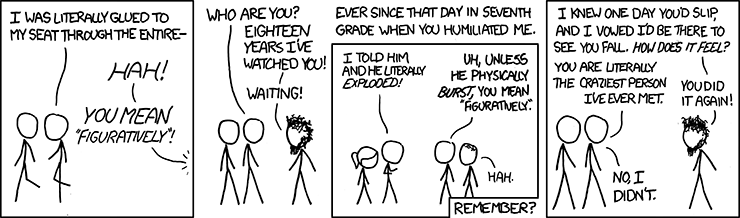
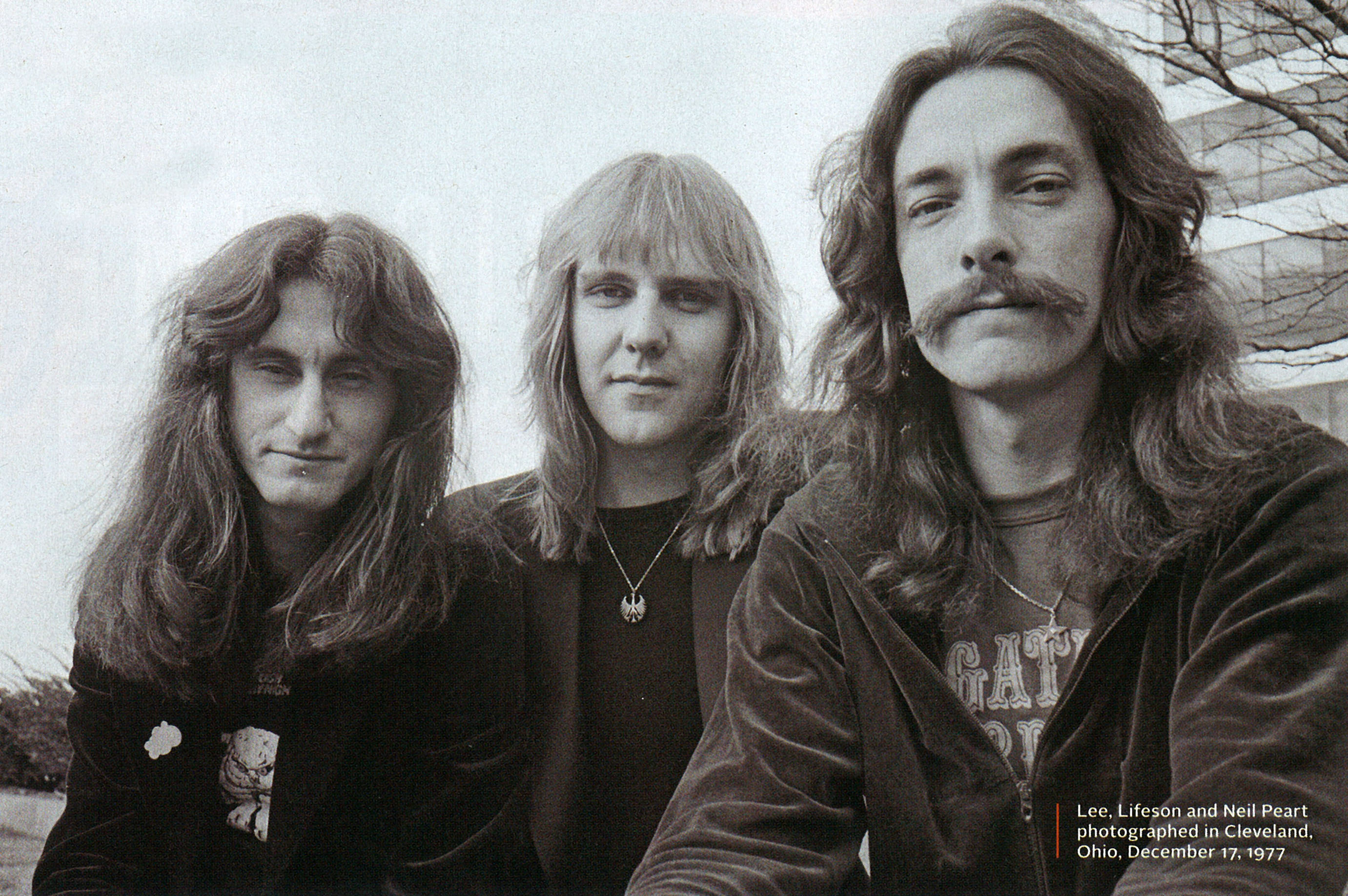
[6] I only wish I could routinely brainwash undergraduate students. There’d be a heck of a lot more Rush fans emerging from my lectures…
[7] One important criticism that can be levelled at both the left and the right of the online political spectrum is that there’s a strong tendency to demonise and indulge personal attacks. (And I’ve regrettably not been blameless here). For example, and despite my criticisms of Peterson’s arguments, I’m not at all comfortable with this. Peterson has spoken very movingly about his mental health issues in the past. I think we do our critiques of Peterson a disservice if we exploit those mental health issues to ridicule him.
[8] It’s similarly worrying when an academic feels that it’s fine to use a slur popularised by 4chan/8chan (which has subsequently diffused “overground” via the worst corners of social media). Steve Fuller has caught a lot of flak at this point for his lack of judgement in posting this a couple of days ago: “Academic Autism: Its Institutional presence and Treatment”. The use of “autistic” as a perjorative is exceptionally common among those edgy meme-driven teenage and permateen sub-cultures online. It’s immensely dispiriting that the slur has now been normalised to the extent that an academic feels free to similarly adopt the pejorative. Nonetheless, Steve has apologised more than once and I don’t think it’s at all helpful at this stage to castigate him any further. We all make mistakes and I, for one, can certainly not get on my high-horse when it comes to inappropriate language online.
Last night I went to the Natwest T20 Blast Quarter Final match between Glamorgan and Leicestershire at the SSE Swalec Stadium in Cardiff. By beating Middlesex last week, Glamorgan finished top of the `South’ Group hence the home tie against Leicestershire who finished fourth in the North Midlands Group. In contrast to most of the rest of the competition, we had good weather: there was a bit of cloud, but it was warm and as we settled into our seats we were confident of a full match.
The game was preceded by a moving tribute to the late Don Shepherd, who died last week shortly after celebrating his 90th birthday. It’s a shame he wasn’t around to experience what turned out to be a fine evening for Glamorgan cricket.
Leicestershire won the toss and decided to bat first. They got off to a flying start and although Cameron Delport and Luke Ronchi were both clean bowled by excellent deliveries (the former a superb yorker from Marchant De Lange), Leicestershire emerged from the six overs of Powerplay on 57 for 2. A big score looked likely.
The trajectory of the match thereafter was defined by a really excellent bowling and fielding display from Glamorgan, to such an extent that the next ten overs for Leicestershire produced just 43 runs for the loss of seven wickets. Their last wicket fell in the last over, by which time they had accumulated only 123 runs.
The pick of the Glamorgan bowlers was Craig Meschede who bowled at a sharpish fast-medium, but with the wicket-keeper standing up to the stumps to frustrate the batsmen who clearly wanted to come down the wicket to make use of the short straight boundaries. He also bowled a considerable number of slower balls and cutters, but despite these variations he kept to a very accurate line. He finished with figures of 3 for 17 off his four overs, which is really excellent for this format. At the other end for much of the time, Colin Ingram bowled his leg breaks with similar accuracy and got quite a few to turn; he took the wicket of Wells with one that turned enough to take the leading edge, resulting in a simple caught-and-bowled. Ingram finished with 1-19; both he and Meschede bowled 12 dot balls in their four-over spells. All this was backed up by sharp fielding and good catching.
The target of 124 never looked like being enough, although there was nervousness around the ground when Aneurin Donald holed out to mid off early on after which Glamorgan’s batsmen took some time to get the scoreboard moving. But that was just Rudolph and Ingram being sensible. They had no need to rush with such a modest score to chase. Suddenly Ingram sprang into life and took the bull by the horns. The scoring accelerated with a flurry of boundaries, the tension melted away and the Glamorgan supporters starting singing. In all, Ingram clubbed five huge sixes including one that went so high I lost it in the floodlights and feared it might land on my head. It actually landed in the crowd a few yards away but didn’t cause any injury. Ingram is an impressive player when he gets doing – he hits the ball very hard but it looks so effortless, and he’s as skilled with the rapier as with the bludgeon: many deft flicks and cuts were included in his innings.
Ingram was in no mood to hang about once he’d got his eye in. At the end of the 13th over, Glamorgan were 104 for 1. The next five balls went for 6-6-4-2-4 and that was that. Glamorgan finished 126 for 1, winning by nine wickets. Ingram finished on 70 not out having overtaken Jacques Rudolph and left him stranded four short of a fifty. Together with his excellent bowling, his batting amply justified the Man of the Match award. It had been a one-sided contest, but in a way that I found entirely satisfactory. Well played Glamorgan, and commiserations to the Leicestershire fans who played their part in creating a great atmosphere at Sophia Gardens.
So there we are. For the first time since 2004, Glamorgan have qualified for the semi-finals of the Twenty20 competition, where they join Hampshire (who thrashed Derbyshire on Tuesday night); the two remaining quarter-finals are played tonight and tomorrow. Both semi-finals and the final are played on Saturday September 2nd at Edgbaston. David Miller, who had flown back for this match having played in South Africa the day before, was scheduled to bat at No. 4 last night but wasn’t needed. He may well get a game on Finals Day!
UPDATE: Here’s a short video of the highlights of the match! De Lange’s brilliant yorker is about 19s in…
No matter what the official policy may be, the more people there are in a collaboration the more likely it is that someone will let their excitement get to their head and start leaking news and starting rumours either directly or indirectly via social media. And so it came to pass last Friday that the following tweet appeared:
New LIGO. Source with optical counterpart. Blow your sox off!
I didn’t comment on the time as I thought it might be unreliable – as it indeed it still may be – but now New Scientist has amplified the signal I feel I can’t really be blamed for mentioning it here.
NGC 4993 is the fuzzy blob slightly above and to the left of the centre of the image. It’s a fairly nondescript lenticular galaxy in a group that can be found in the constellation of Hydra. It lies in the constellation of Hydra, was actually first discovered by William Herschel and it is about 10 arcmin across on the sky. It’s quite nearby, as these things go, with a distance of about 124 million light years (i.e. 40 Mpc or so) and is about 14th magnitude.
If there is an optical counterpart to a gravitational wave event coming from this galaxy then that suggests it may be a coalescence of neutron stars. The black hole mergers that appear to be responsible to the three existing gravitational wave signals that are claimed to have been detected are not expected to release optical light. Confirmation of this interpretation can be found by where the Hubble Space Telescope was pointed yesterday:
Look familiar? HST was, in fact, observing a `BNS-Merger’ (which is short for `Binary Neutron Star’)…
If this rumour is true then it’s obviously exciting, but there are questions to be asked. Chief among these is how sure is the identification of the counterpart? A transient optical source in NGC4993 may have been observed at the same time as a gravitational wave signal was detected, but the ability of LIGO to resolve positions on the sky is very poor. On the other hand, the European VIRGO experiment joined Advanced LIGO for the ongoing `O2′ observing run (which ends in a couple of days). Although VIRGO is less sensitive than LIGO having a third detector does improve the localization of the source – assuming, of course, that it detects a signal. Even in that case it certainly won’t be possible to pinpoint the GW source to within 10 arc minutes, which is the precision needed to place it definitely within NGC 4993.
Anyway, we wait and see what, if anything, has been found. If it is a claimed detection then I hope that LIGO and VIRGO will release sufficient data to enable the analysis to be checked and verified. That’s what most of the respondents to my poll seem to hope too!
This wonderful recording of Hoagy Carmichael’s great song Stardust was made in 1931 by Louis Armstrong with his big band. After the heights that Armstrong reached in the 1920s, starting with King Oliver and then with the Hot Fives and Hot Sevens, some jazz critics maintain that the 1930s were a comparative wilderness. Well, I think he sings and plays beautifully on this so if this is a wilderness just take me to it, and I’ll pitch my tent there anytime!
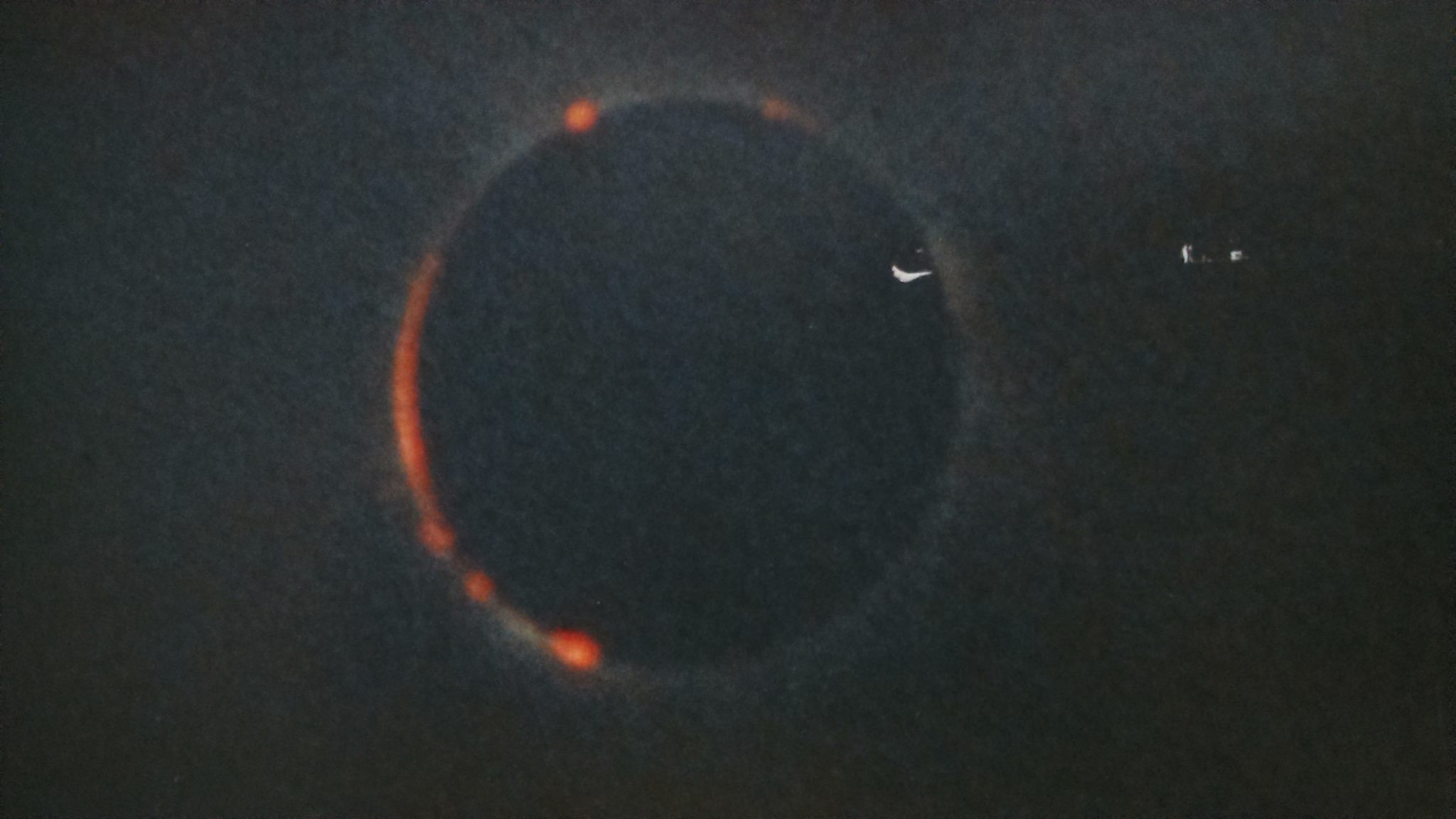
Unless you have been living on another planet, you will know that today there will be an eclipse of the Sun although from the UK it will be rather underwhelming, as only about 4% of the Sun’s disk will be covered by the moon; for totality you have to be in the United States. For the record, however, the eclipse will begin 15:46 GMT on August 21 out over the Pacific. It will reach the coast of Oregon at Lincoln City, just west of Salem, at 16:04 GMT (09:04 local time) where it will reach its maximum at 17:17 GMT (10:17 local time). The path of totality will then track right across the United States to South Carolina. For more details see here. Best wishes to all who are hoping to see this cosmic spectacle! I saw the total eclipse of August 11, 1999 from Alderney in the Channel Islands, and it was a very special experience.
Here’s a (not very good and slightly damaged) scan of a picture from that eclipse that I found last night in a box of old photographs:
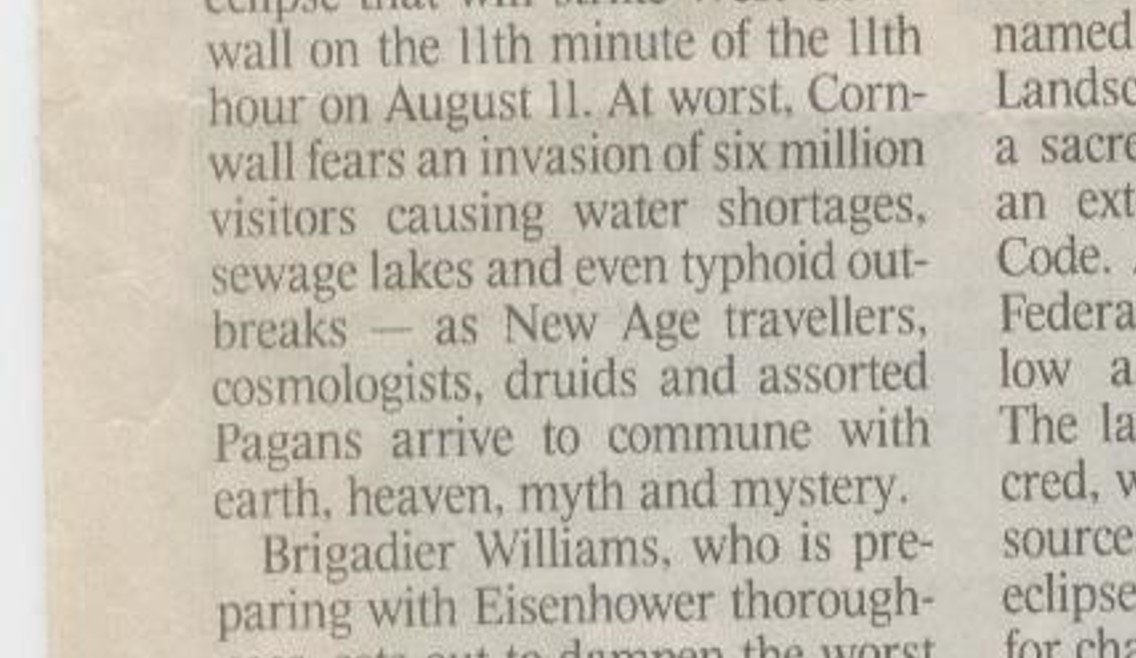
Before starting I can’t resist adding this excerpt from the Times warning about the consequences of a mass influx of people to Cornwall for the 1999 eclipse. No doubt there are similar things going around about today’s eclipse:
I did write a letter to the Times complaining that, as a cosmologist, I felt this was very insulting to druids. They didn’t publish it.
This provides me with a good excuse to repost an old item about the famous expedition during which, on 29th May 1919, measurements were made that have gone down in history as vindicating Einstein’s (then) new general theory of relativity. I’ve written quite a lot about this in past years, including a little book and a slightly more technical paper. I decided, though, to post this little piece which is based on an article I wrote some years ago for Firstscience.
–0–
The Eclipse that Changed the Universe
A total eclipse of the Sun is a moment of magic: a scant few minutes when our perceptions of the whole Universe are turned on their heads. The Sun’s blinding disc is replaced by ghostly pale tentacles surrounding a black heart – an eerie experience witnessed by hundreds of millions of people throughout Europe and the Near East last August.
But one particular eclipse of the Sun, eighty years ago, challenged not only people’s emotional world. It was set to turn the science of the Universe on its head. For over two centuries, scientists had believed Sir Isaac Newton’s view of the Universe. Now his ideas had been challenged by a young German-Swiss scientist, called Albert Einstein. The showdown – Newton vs Einstein – would be the total eclipse of 29 May 1919.
Newton’s position was set out in his monumental Philosophiae Naturalis Principia Mathematica, published in 1687. The Principia – as it’s familiarly known – laid down a set of mathematical laws that described all forms of motion in the Universe. These rules applied as much to the motion of planets around the Sun as to more mundane objects like apples falling from trees.
At the heart of Newton’s concept of the Universe were his ideas about space and time. Space was inflexible, laid out in a way that had been described by the ancient Greek mathematician Euclid in his laws of geometry. To Newton, space was the immovable and unyielding stage on which bodies acted out their motions. Time was also absolute, ticking away inexorably at the same rate for everyone in the Universe.
Sir Isaac Newton, painted by Sir Godfrey Kneller. Picture Credit: National Portrait Gallery,
For over 200 years, scientists saw the Cosmos through Newton’s eyes. It was a vast clockwork machine, evolving by predetermined rules through regular space, against the beat of an absolute clock. This edifice totally dominated scientific thought, until it was challenged by Albert Einstein.
In 1905, Einstein dispensed with Newton’s absolute nature of space and time. Although born in Germany, during this period of his life he was working as a patent clerk in Berne, Switzerland. He encapsulated his new ideas on motion, space and time in his special theory of relativity. But it took another ten years for Einstein to work out the full consequences of his ideas, including gravity. The general theory of relativity, first aired in 1915, was as complete a description of motion as Newton had prescribed in his Principia. But Einstein’s description of gravity required space to be curved. Whereas for Newton space was an inflexible backdrop, for Einstein it had to bend and flex near massive bodies. This warping of space, in turn, would be responsible for guiding objects such as planets along their orbits.
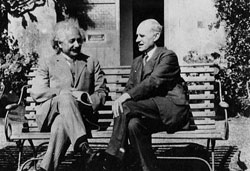
Albert Einstein (left), pictured with Arthur Stanley Eddington (right). Picture Credit: Royal Greenwich Observatory.
By the time he developed his general theory, Einstein was back in Germany, working in Berlin. But a copy of his general theory of relativity was soon smuggled through war-torn Europe to Cambridge. There it was read by Arthur Stanley Eddington, Britain’s leading astrophysicist. Eddington realised that Einstein’s theory could be tested. If space really was distorted by gravity, then light passing through it would not travel in a straight line, but would follow a curved path. The stronger the force of gravity, the more the light would be bent. The bending would be largest for light passing very close to a very massive body, such as the Sun.
Unfortunately, the most massive objects known to astronomers at the time were also very bright. This was before black holes were seriously considered, and stars provided the strongest gravitational fields known. The Sun was particularly useful, being a star right on our doorstep. But it is impossible to see how the light from faint background stars might be bent by the Sun’s gravity, because the Sun’s light is so bright it completely swamps the light from objects beyond it.
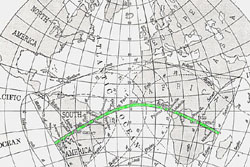
A scientific sketch of the path of totality for the 1919 eclipse. Picture Credit: Royal Greenwich Observatory.
Eddington realised the solution. Observe during a total eclipse, when the Sun’s light is blotted out for a few minutes, and you can see distant stars that appear close to the Sun in the sky. If Einstein was right, the Sun’s gravity would shift these stars to slightly different positions, compared to where they are seen in the night sky at other times of the year when the Sun far away from them. The closer the star appears to the Sun during totality, the bigger the shift would be.
Eddington began to put pressure on the British scientific establishment to organise an experiment. The Astronomer Royal of the time, Sir Frank Watson Dyson, realised that the 1919 eclipse was ideal. Not only was totality unusually long (around six minutes, compared with the two minutes we experienced in 1999) but during totality the Sun would be right in front of the Hyades, a cluster of bright stars.
But at this point the story took a twist. Eddington was a Quaker and, as such, a pacifist. In 1917, after disastrous losses during the Somme offensive, the British government introduced conscription to the armed forces. Eddington refused the draft and was threatened with imprisonment. In the end, Dyson’s intervention was crucial persuading the government to spare Eddington. His conscription was postponed under the condition that, if the war had finished by 1919, Eddington himself would lead an expedition to measure the bending of light by the Sun. The rest, as they say, is history.
The path of totality of the 1919 eclipse passed from northern Brazil, across the Atlantic Ocean to West Africa. In case of bad weather (amongst other reasons) two expeditions were organised: one to Sobral, in Brazil, and the other to the island of Principe, in the Gulf of Guinea close to the West African coast. Eddington himself went to Principe; the expedition to Sobral was led by Andrew Crommelin from the Royal Observatory at Greenwich.
British scientists in the field at their observing site in Sobral in 1919. Picture Credit: Royal Greenwich Observatory
The expeditions did not go entirely according to plan. When the day of the eclipse (29 May) dawned on Principe, Eddington was greeted with a thunderstorm and torrential rain. By mid-afternoon the skies had partly cleared and he took some pictures through cloud.
Meanwhile, at Sobral, Crommelin had much better weather – but he had made serious errors in setting up his equipment. He focused his main telescope the night before the eclipse, but did not allow for the distortions that would take place as the temperature climbed during the day. Luckily, he had taken a backup telescope along, and this in the end provided the best results of all.
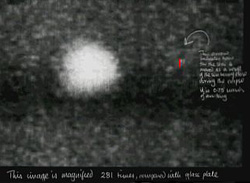
After the eclipse, Eddington himself carefully measured the positions of the stars that appeared near the Sun’s eclipsed image, on the photographic plates exposed at both Sobral and Principe. He then compared them with reference positions taken previously when the Hyades were visible in the night sky. The measurements had to be incredibly accurate, not only because the expected deflections were small. The images of the stars were also quite blurred, because of problems with the telescopes and because they were seen through the light of the Sun’s glowing atmosphere, the solar corona.
Before long the results were ready. Britain’s premier scientific body, the Royal Society, called a special meeting in London on 6 November. Dyson, as Astronomer Royal took the floor, and announced that the measurements did not support Newton’s long-accepted theory of gravity. Instead, they agreed with the predictions of Einstein’s new theory.
The final proof: the small red line shows how far the position of the star has been shifted by the Sun’s gravity. Each star experiences a tiny deflection, but averaged over many exposures the results definitely support Einstein’s theory. Picture Credit: Royal Greenwich Observatory.
The press reaction was extraordinary. Einstein was immediately propelled onto the front pages of the world’s media and, almost overnight, became a household name. There was more to this than purely the scientific content of his theory. After years of war, the public embraced a moment that moved mankind from the horrors of destruction to the sublimity of the human mind laying bare the secrets of the Cosmos. The two pacifists in the limelight – the British Eddington and the German-born Einstein – were particularly pleased at the reconciliation between their nations brought about by the results.
But the popular perception of the eclipse results differed quite significantly from the way they were viewed in the scientific establishment. Physicists of the day were justifiably cautious. Eddington had needed to make significant corrections to some of the measurements, for various technical reasons, and in the end decided to leave some of the Sobral data out of the calculation entirely. Many scientists were suspicious that he had cooked the books. Although the suspicion lingered for years in some quarters, in the end the results were confirmed at eclipse after eclipse with higher and higher precision.
In this cosmic ‘gravitational lens,’ a huge cluster of galaxies distorts the light from more distant galaxies into a pattern of giant arcs. Picture Credit: NASA
Nowadays astronomers are so confident of Einstein’s theory that they rely on the bending of light by gravity to make telescopes almost as big as the Universe. When the conditions are right, gravity can shift an object’s position by far more than a microscopic amount. The ideal situation is when we look far out into space, and centre our view not on an individual star like the Sun, but on a cluster of hundreds of galaxies – with a total mass of perhaps 100 million million suns. The space-curvature of this immense ‘gravitational lens’ can gather the light from more remote objects, and focus them into brilliant curved arcs in the sky. From the size of the arcs, astronomers can ‘weigh’ the cluster of galaxies.
Einstein didn’t live long enough to see through a gravitational lens, but if he had he would definitely have approved….
Why did nobody tell me that Beethoven wrote a collection of 26 Welsh Folk Songs? I had to rely on BBC Radio 3 to educate me about them!
Here’s one example, Number 19 in the published collection, arranged for soprano voice with piano, violin and cello accompaniment and called The Vale of Clwyd .
The views presented here are personal and not necessarily those of my employer (or anyone else for that matter).
Feel free to comment on any of the posts on this blog but comments may be moderated; anonymous comments and any considered by me to be vexatious and/or abusive and/or defamatory will not be accepted. I do not necessarily endorse, support, sanction, encourage, verify or agree with the opinions or statements of any information or other content in the comments on this site and do not in any way guarantee their accuracy or reliability.




















 In the Dark