Beard of Summer 2017 poll opens with Glastonbury focus

Posted in Uncategorized on June 26, 2017 by telescoper

Oh Blimey.

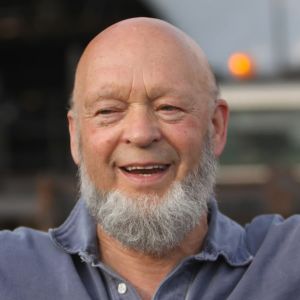
Owing (no doubt) to some form of administrative error I have been nominated for Beard of Summer 2017!

Please feel free to vote for me, or not, as your fancy takes you!

kmflett's avatarKmflett's Blog

Beard Liberation Front

Media release

26th June

Contact Keith Flett 07803 167266

BEARD OF SUMMER 2017 POLL OPENS WITH GLASTONBURY FOCUS

The Beard Liberation Front, the informal network of beard wearers, has said the poll for the coveted Beard of Summer Award is now open with the result revealed at the end of National Beard Week on Saturday July 1st

The poll is the third of four seasonal Awards that culminates in the Beard of the Year Award at the end of December.

The campaigners say that as ever it is not just the style of the beard but the impact it makes in public

BLF Organiser Keith Flett said, we’re looking for the summer beard that adds the most gravitas and the shortlist probably has the biggest range of beard styles ever

Beard of Summer shortlist

Bill Bailey, comedian

Peter Coles, cosmologist

Hefin David, politician

Michael Eavis, farmer

View original post 161 more words

A Day/Night County Match

Posted in Cricket on June 26, 2017 by telescoper

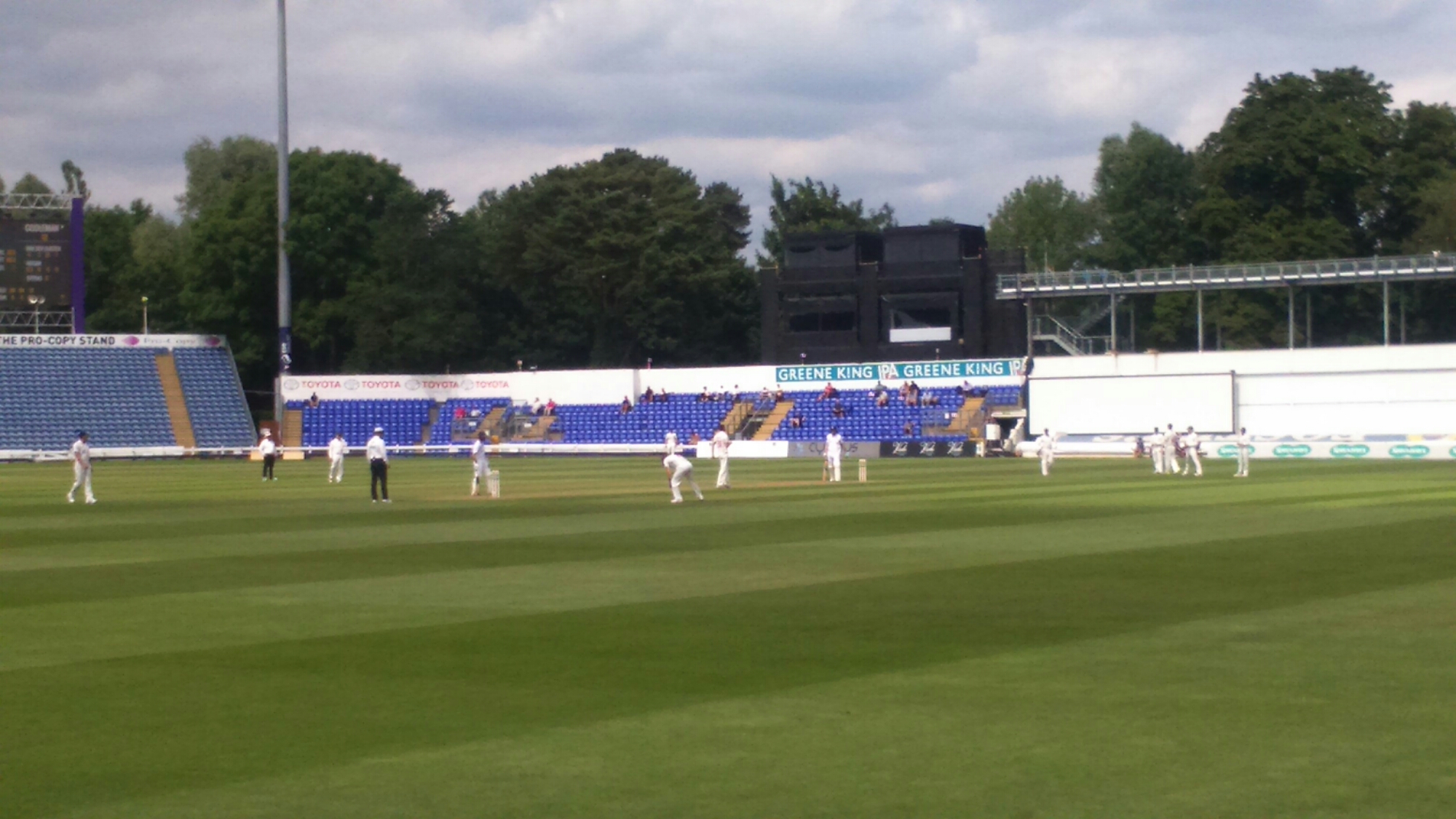
After two very busy weeks I decided to take a couple of days off to watch the County Championship match between Glamorgan and Derbyshire at the SSE Swalec Stadium here in Cardiff.

It turns out that this match is something of a landmark in that it’s the first ever Day/Night County match to be held in Wales.

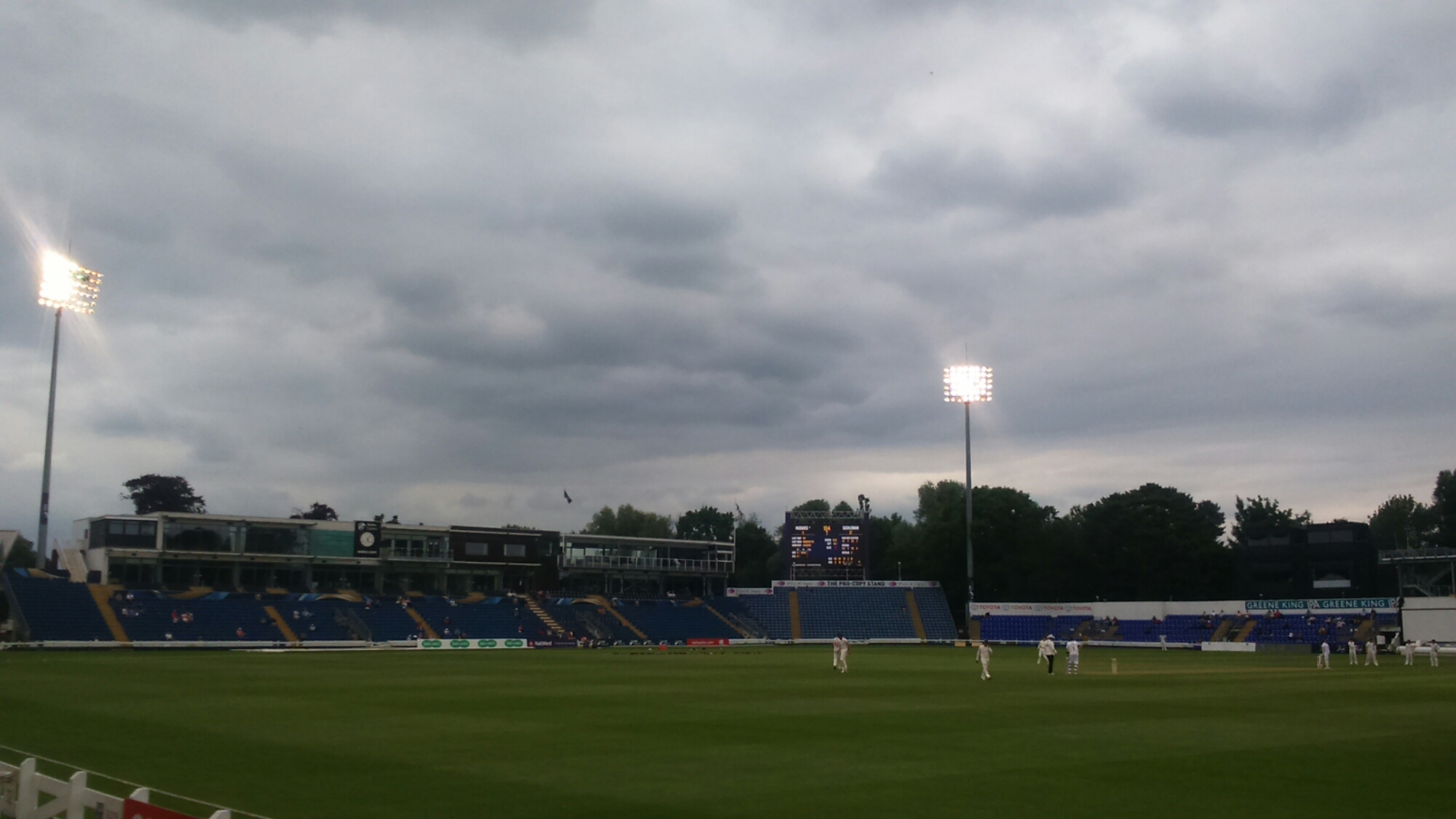
The format of this match is like a regular 4-day County game except that each day’s play starts at 2pm rather than the usual 11am. This means that the “lunch” interval is taken at 4pm instead of 1pm, and “tea” is taken at 6.40. Play is scheduled to continue, with the aid of floodlights, until 9pm.

Oh, and they’re using a rather lurid pink ball…

I can see why they are trying this out: to see if they can get more people coming after work or school than would come with the usual 6pm close. At the moment (3.45pm) the attendance is about average for a county game…

I don’t like this new format, however, got two reasons. One is that it wastes three hours of daylight. I like to watch my cricket sitting in the sunshine rather in the twilight. As it happens, it was a beautiful morning in Cardiff today. I had the day off and would have relished watching the morning session basking in the sun. I couldn’t because there wasn’t one.

The other reason I don’t like it is that it finishes too late to have dinner at a reasonable hour. The food and drink available at the Swalec – particularly the beer – is overpriced and not of high quality, so I shall probably leave at the start of the tea interval. Unless it gets very exciting..

At the moment, Derbyshire are 68 for 1 off 24 overs. Madsen and Godleman not looking entirely comfortable but digging in.

UPDATE: It’s 5pm, Derbyshire are 104 for 2, and the lights have come on:

Glamorgan were quite slow getting through their overs so the Tea interval wasn’t taken until 7.09pm, with the fall of the 7th Derbyshire wicket with the score on 157. A good bowling performance from Glamorgan, but I decided to go home and make some dinner rather than stay for the last session. Quite a few others  left at the same time.

Play finished at about 10pm. Derbyshire rallied to finish on 288 all out, and Glamorgan batted two overs for 5 without loss. Appropriately enough, Glamorgan sent in a Night Watchman (Tim van den Gugten) to open the innings.

Theresa May and the Holy Grail

Posted in Uncategorized on June 25, 2017 by telescoper

Mysteries of the Horizon

Posted in Art with tags , , , on June 24, 2017 by telescoper

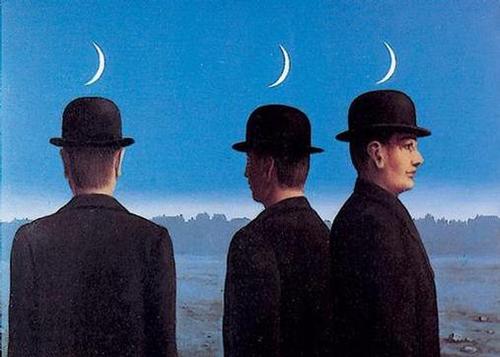
by René Magritte (Oil on Canvas, 1955)

The Quantum Mechanics of Voting

Posted in Politics, The Universe and Stuff with tags , , , , , , on June 23, 2017 by telescoper

Now that I’ve finished a marathon session of report-writing I thought I’d take a few minutes out this Friday afternoon, have a cup of tea and pass on a rather silly thought I had the other day about the relationship between Quantum Mechanics (and specifically the behaviour of spin therein) and voting behaviour in elections and referendums.

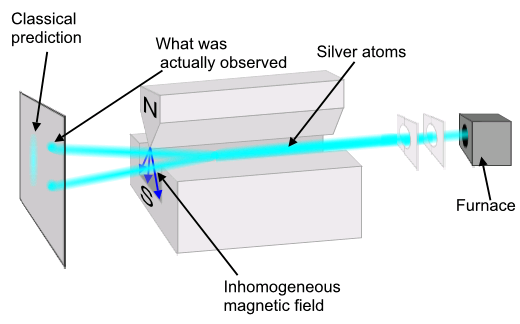
Gratuitous picture of a Stern-Gerlach experiment

For a start here’s a brief summary of the usual quantum-mechanical context as it relates to, e.g., electrons (rather than elections). Being fermions, electrons possess half-integer spin. This attribute has the property that a measurement of its component in any direction has only two possible values, ±½ in units of Planck’s constant. In the Stern-Gerlach experiment illustrated above, which measures the spin in the vertical direction of silver atoms emerging from a source, the outcome is either “up” or “down”, not some spread of values in between. Silver has a single unpaired electron which is why its atoms behave in this respect in the same way as an individual electron.

The way this is often described in physics textbooks is to say that the operator corresponding to spin in the z-direction has only two eigenstates  (call these ↑ and ↓) ; the act of measurement has to select one of them, not some intermediate state. If the source is thermal then the spins of individual atoms have no preferred direction so 50% turn out to be ↑ and 50% to be ↓ as shown in the cartoon.

Once such measurement has been made, a given particle remains in the same eigenstate, which means that if it is passed through another similar measuring device it will always turn out to have spin pointing in the same direction. If you like, the particle has been `prepared’ in a given state by the act of measurement.

This applies as long as no attempt is made to make a measurement of the spin in a different direction, which is when the fun starts. If we start with a particle in the ↑ state and then pass it through an experiment that measures spin (say) with respect to the x-axis instead of the z-axis then the two allowed eigenstates are then not ↑ and ↓ but ← and →.  A particle that was definitely spin-up would then be forced to decide between spin-left and spin-right (each would have a  50% probability).

Suppose now we took our long-suffering particle that began with spin ↑ after a measurement in the z-direction, then turned out to be spin → when we measured it in the x-direction. What would happen if we repeated the z-measurement? The answer is that “preparing” the particle in the → state destroys the information about the fact that it was previously prepared in the ↑ state –  the outcome of this second z-measurement is that the particle that was previously definitely ↑ now has a 50% chance of being either ↑ or ↓.

So what does all this have to do with voting? It is clear than an election (or a referendum) is very far from a simple act of measurement. During the campaign the various sides of the debate make attempts to prepare a given voter in a given state. In the case of last year’s EU referendum the choice of eigenstates was `Leave’ or `Remain’;  no other possibilities were allowed. The referendum then `prepared’ each voter in one or other of these possibilities.

If voters behaved quantum mechanically each would stay in their chosen state until some other measurement were attempted. But that’s exactly what did happen. Earlier this month there was a General Election. More than two parties were represented, but let’s simplify and assume there were only two options, `Labour’ and `Conservative’.

Now it is true that the `Leave’ camp was dominated by the right wing of the Conservative party, and the majority of Labour voters voted `Remain’, but there were a significant number of Labour Leave voters and a significant number of Tories voted Remain. While these pairs of states are therefore not exactly orthogonal, they are clearly not measuring the same thing so the situation is somewhat analogous to the spin measurement problem.

So along came the General Election result which `prepared’ voters in a state of `Labour’ or `Conservative’, with a slight preference for the latter whereas the earlier referendum had prepared a them in a state of `Leave’ versus `Remain’ with a slight preference for the former. From a quantum mechanical perspective, however, you can further argue that the General Election prepared the voters in such a way that should have erased memories of their vote in the referendum so the previous BrExit vote is now invalid.

There’s only one way to test this quantum-mechanical interpretation of voting patterns, and that is by repeating the EU Referendum…

It isn’t Time that’s passing

Posted in Poetry with tags , , on June 23, 2017 by telescoper

Remember the long ago when we lay together
In a pain of tenderness and counted
Our dreams: long summer afternoons
When the whistling-thrush released
A deep sweet secret on the trembling air;
Blackbird on the wing, bird of the forest shadows,
Black rose in the long ago summer,
This was your song:
It isn’t time that’s passing by,
It is you and I.

by Ruskin Bond (b. 1934)


That Martin Rowson Cartoon..

Posted in Art, Politics on June 22, 2017 by telescoper

I heard that the proprietors of The Sun and Daily Mail are getting very upset about this savage but brilliant cartoon by Martin Rowson of the Guardian in the wake of the recent terrorist attack on worshippers outside a mosque in Finsbury Park, so naturally I decided to post it here:

Is it hotter than normal?

Posted in Uncategorized on June 22, 2017 by telescoper

I remember the summer of 1976 very well indeed, both for the heat and for the West Indies’s victory over England in the test series, including bowling England out for 71 at Old Trafford.

Michael de Podesta's avatarProtons for Breakfast

MaxTemp_Average_1981-2010_June This map shows how the average of the maximum daily temperature in June varies across the UK.

It was hot last night. And hot today. But is this hotter than normal? Is this global warming?

Human beings have a remarkably poor perspective on such questions for two reasons.

  • Firstly we only experience the weather in a single place which may not be representative of a country or region. And certainly not the entire Earth!
  • And secondly, our memory of previous weather is poor. Can you remember whether last winter was warmer or colder than average?

Personally I thought last winter was cold. But it was not.

Another reason to love the Met Office.

The Met Office have created carefully written digests of past weather, with month-by-month summaries.

You can see their summaries here and use links from that page to chase historical month-by-month data for the UK…

View original post 748 more words

MSc Opportunities in Data-Intensive Physics and Astrophysics

Posted in Biographical, Education with tags , , , , on June 22, 2017 by telescoper

Back to the office after external examining duties, I received an email this morning to say that the results have now been posted in Cambridge. I also had an email from Miss Lemon at Sussex that told me that their finalists’ results went up last Friday. We did ours in Cardiff last week. This provides me with a timely opportunity to congratulate all students at all three of these institutions – and indeed everywhere else – on their success!

It also occurred to me tha,t now that most students know how well they’ve done in their undergraduate degree, some may be thinking about further study, at postgraduate level. It seems a good opportunity to remind potential applicants about our two brand new MSc courses at Masters (MSc) level, called Data-Intensive Physics and Data-Intensive Astrophysics and they are both taught jointly by staff in the School of Physics and Astronomy and the School of Computer Science and Informatics in a kind of major/minor combination.

The aim of these courses is twofold.

One is to provide specialist postgraduate training for students wishing to go into academic research in a ‘data-intensive’ area of physics or astrophysics, by which I mean a field which involves the analysis and manipulation of very large or complex data sets and/or the use of high-performance computing for, e.g., simulation work. There is a shortage of postgraduates with the necessary combination of skills to undertake academic research in such areas, and we plan to try to fill the gap with these courses.

The other aim is to cater for students who may not have made up their mind whether to go into academic research, but wish to keep their options open while pursuing a postgraduate course. The unique combination of physics/astrophysics and computer science will give those with these qualifications the option of either continuing or going into another sphere of data-intensive research in the wider world of Big Data.

The motivation for these courses has been further strengthened recently by the announcement earlier this year of extra funding for PhD research in Data-Intensive Physics. We’ve been selecting students for this programme and making other preparations for the arrival of the first cohort in September. We’ve had many more applicants than we can accommodate this time, but this looks set to be a growth area for the future so anyone thinking of putting themselves in a good position for a PhD in Data-Intensive Physics or Astrophysics in the future might think about preparing by taking a Masters in Data-Intensive Physics or Astrophysics now!

I just checked on our admissions system and saw, as expected, conditional offers turning into firm acceptances now that the finals exam results are being published across the country but we have still got plenty of room on these courses so if you’re thinking about applying, please be assured that we’re still accepting new applications!


LISA gets the go-ahead!

Posted in The Universe and Stuff with tags , , , , , on June 21, 2017 by telescoper

Just taking a short break from examining duties to pass on the news that the European Space Agency has selected the Laser Interferometric Space Experiment (LISA) – a gravitational wave experiment in space – for its large mission L3. This follows the detection of gravitational waves using the ground-based experiment Advanced LIGO and the success of a space-based technology demonstrator mission called Lisa Pathfinder.

LISA consists of a flotilla of three spacecraft in orbit around the Sun forming the arms of an interferometer with baselines of the order of 2.5 million kilometres, much longer than the ~1km arms of Advanced LIGO. These larger dimensions make LISA much more sensitive to long-period signals. Each of the LISA spacecraft contains two telescopes, two lasers and two test masses, arranged in two optical assemblies pointed at the other two spacecraft. This forms Michelson-like interferometers, each centred on one of the spacecraft, with the platinum-gold test masses defining the ends of the arms.

Here’s an artist’s impression of LISA:

This is excellent news for the gravitational waves community, especially since LISA was threatened with the chop when NASA pulled out a few years ago. Space experiments are huge projects – and LISA is more complicated than most – so it will take some time before it actually happens. At the moment, LISA is pencilled in for launch in 2034…