Weekly Update from the Open Journal of Astrophysics – 17/05/2025

Posted in OJAp Papers, Open Access, The Universe and Stuff with tags , , , , , , , , , , , , on May 17, 2025 by telescoper

It’s a lovely Saturday morning in May, and it’s time for the weekly  update of papers published at the Open Journal of Astrophysics. Since the last update we have published four new papers, which brings the number in Volume 8 (2025) up to 59 and the total so far published by OJAp up to 294.

In chronological order of publication, the four papers published this week, with their overlays, are as follows. You can click on the images of the overlays to make them larger should you wish to do so.

The first paper to report is: “Multi-Phase Thermal Structure & The Origin of the Broad-Line Region, Torus, and Corona in Magnetically-Dominated Accretion Disks” by Philip F. Hopkins (Caltech, USA). This was published on Monday May 12th in the folder Astrophysics of Galaxies. It presents simple accretion disk model that predicts the properties of many features including the dusty torus, broad-line region, continuum emission and coronal gas.

The overlay is here:
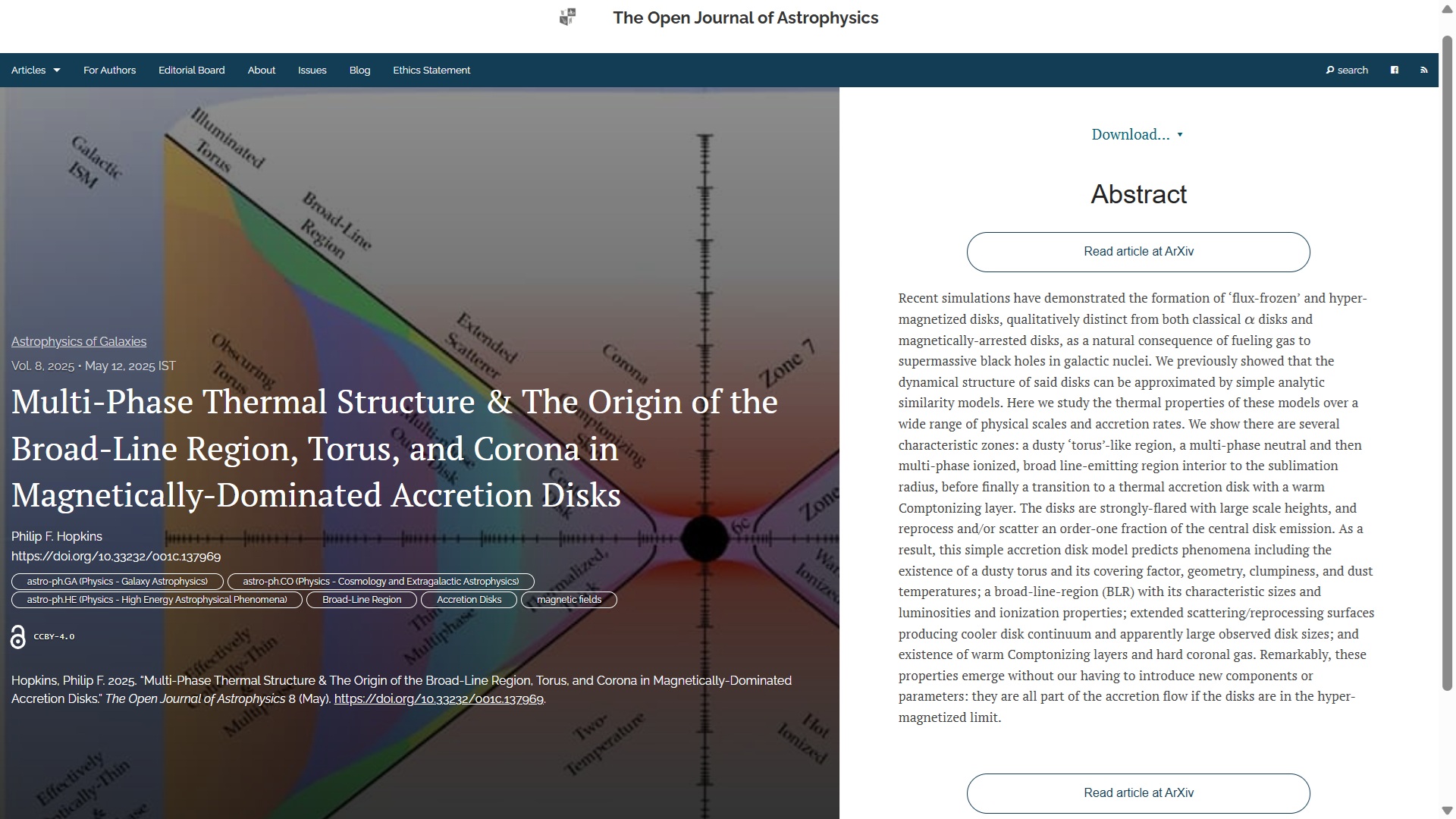
You can find the officially accepted version on arXiv here.

Second one up is “Sparsity covariance: a source of uncertainty when estimating correlation functions with a discrete sample of observations in the sky” by Pierre Fleury (U. Montpellier, France). This one was published on Tuesday 13th May 2025 in the folder Cosmology and NonGalactic Astrophysics.  This paper presents a discussion of the uncertainty in cosmological observables caused by discrete sampling and a method to compute the covariances resulting from this.

The overlay is here:
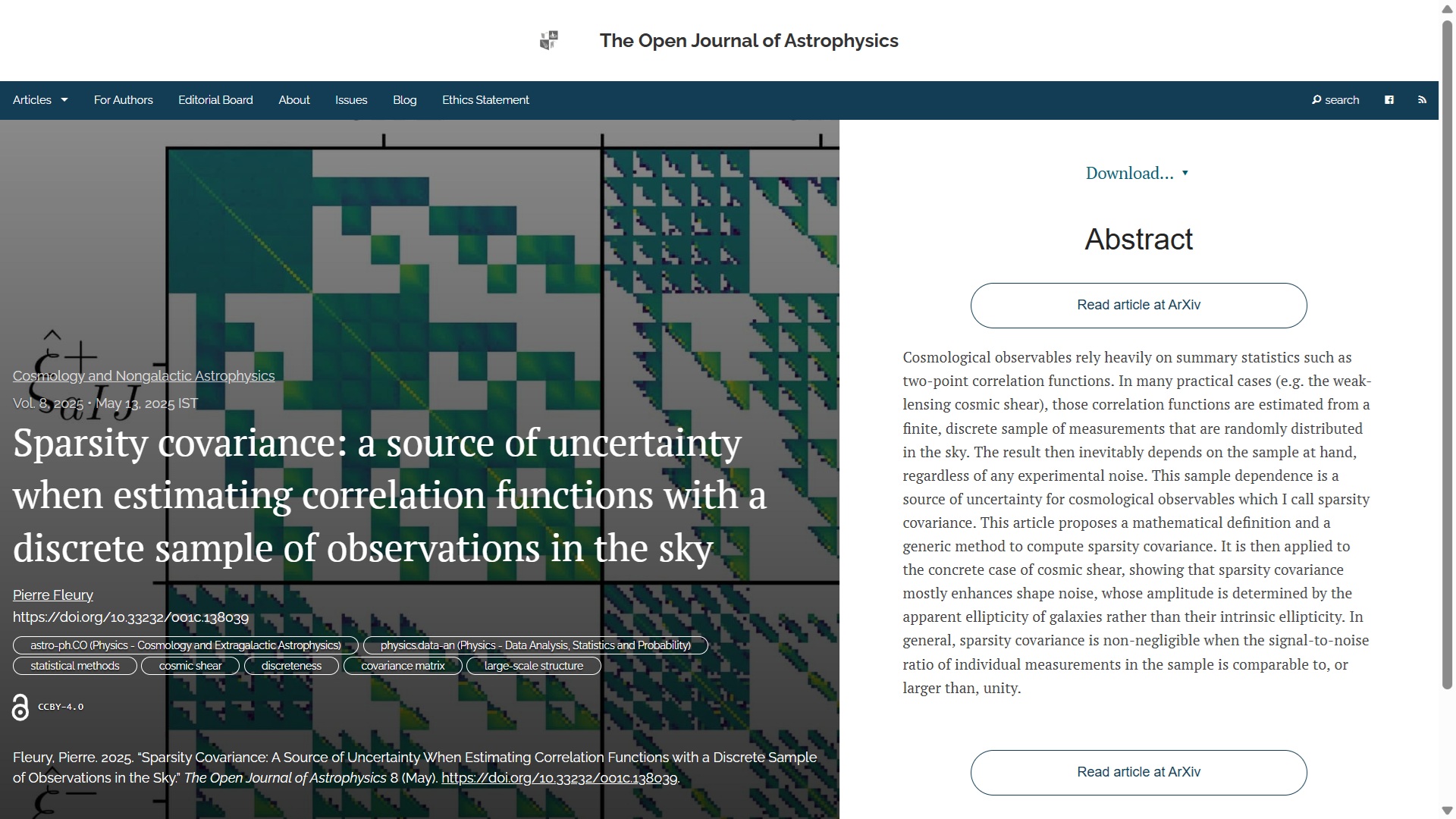
You can find the officially-accepted version of the paper on arXiv here.

The third paper of the week, published on Wednesday May 14th 2025,  is “Dark Matter Particle Flux in a Dynamically Self-consistent Milky Way Model” by Lucijana Stanic, Mark Eberlein, Stanislav Linchakovskyy, Christopher Magnoli, Maryna Mesiura, Luca Morf, Prasenjit Saha (University of Zurich, Switzerland) and Eugene Vasiliev (University of Surrey, UK). This one presents a study of the behaviour of dark matter in an anisotropic model for the Milky Way halo with implications for particle detection rates. It is in the folder Astrophysics of Galaxies.

Here is the overlay:

You can find the officially accepted version of this paper on arXiv here.

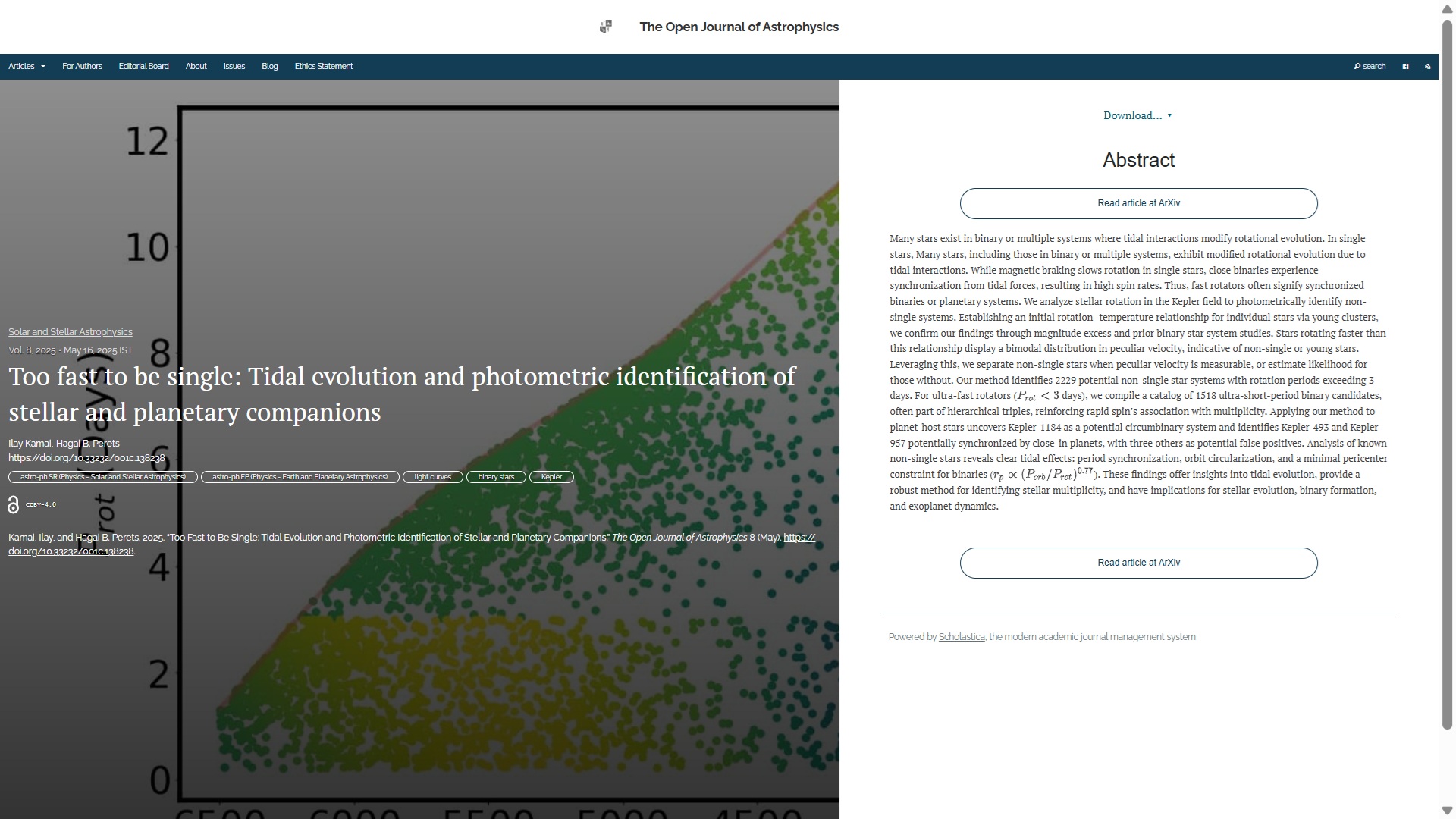
The last paper published this week is “Too fast to be single: Tidal evolution and photometric identification of stellar and planetary companions” by Ilay Kamai and Hagai B. Perets (Technion, Haifa, Israel). This one was published on Friday 16th May 2025 in the folder Solar and Stellar Astrophysics. It presents an analysis of the rotation of stars observed in the Kepler field to identify non-single systems with high spin rates resulting from tidal effects.

Here is the overlay:
The official published version can be found on the arXiv here.

That’s all the papers for this week. I’ll post another update next week.
The CosmoVerse: The White Paper

Posted in The Universe and Stuff with tags , , , on May 16, 2025 by telescoper

Newly announced on arXiv there is a review article with the title The CosmoVerse White Paper: Addressing observational tensions in cosmology with systematics and fundamental physics. The abridged form of the abstract reads:

The standard model of cosmology has provided a good phenomenological description of a wide range of observations both at astrophysical and cosmological scales for several decades. This concordance model is constructed by a universal cosmological constant and supported by a matter sector described by the standard model of particle physics and a cold dark matter contribution, as well as very early-time inflationary physics, and underpinned by gravitation through general relativity. There have always been open questions about the soundness of the foundations of the standard model. However, recent years have shown that there may also be questions from the observational sector with the emergence of differences between certain cosmological probes. In this White Paper, we identify the key objectives that need to be addressed over the coming decade together with the core science projects that aim to meet these challenges. These discordances primarily rest on the divergence in the measurement of core cosmological parameters with varying levels of statistical confidence. These possible statistical tensions may be partially accounted for by systematics in various measurements or cosmological probes but there is also a growing indication of potential new physics beyond the standard model. After reviewing the principal probes used in the measurement of cosmological parameters, as well as potential systematics, we discuss the most promising array of potential new physics that may be observable in upcoming surveys. We also discuss the growing set of novel data analysis approaches that go beyond traditional methods to test physical models.

arXiv:2504.01669v2

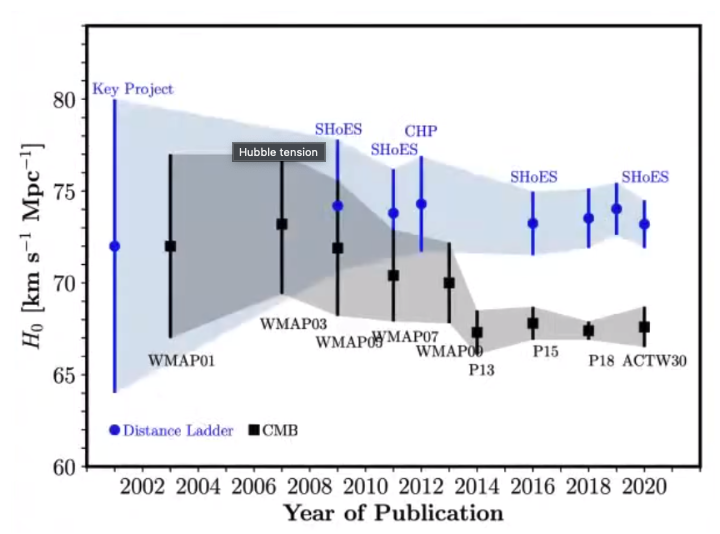
Here’s a plot demonstrating one of the tensions discussed in this paper, and widely on this blog, the Hubble Tension:


This is a very comprehensive review article consisting of over 400 pages and having over 400 authors. I expect all of you to read it over the weekend. There will be a test on Monday.

*One of whom happens to be a PhD student of mine.

After Lectures and before Examinations

Posted in Education, Maynooth, The Universe and Stuff with tags , , on May 15, 2025 by telescoper

This morning I did my last teaching session of the Academic Year 2024-5, a revision lecture/tutorial on Computational Physics. It was optional, as this is officially a study break, and was at 9am, but I had about 30% attendance which wasn’t bad in the circumstances. As is often the case with optional sessions, I think the students who came were the keenest and probably therefore those who least needed last-minute tips for the examination, but that’s always the way.

The Examination Period starts tomorrow morning, but most of the students who turned up this morning have their first examination on Monday 19th May which happens to be Computational Physics.

Anyway, now that my teaching is over I thought I’d take the opportunity to wish all students the best for their examinations:

You shouldn’t really be relying on luck of course, so here are some tips (especially for physics students, but applicable elsewhere).

  1. Try to get a good night’s sleep before the examination and arrive in plenty of time before the start. Spending all night cramming is unlikely to help you do well.
  2. Prepare well in advance so you’re relaxed when the time comes.
  3. Read the entire paper before starting to answer any questions. In particular, make sure you are aware of any supplementary information, formulae, etc, given in the rubric or at the end.
  4. Start off by tackling the question you are most confident about answering, even if it’s not Question 1. This will help settle any nerves. You’re under no obligation to answer the questions in the order they are asked.
  5. Don’t rush! Students often lose marks by making careless errors. In particular, check all your working out, including numerical results obtained your calculator, at least twice
  6. Please remember the units!
  7. Don’t panic! You’re not expected to answer everything perfectly. A first-class mark is anything over 70%, so don’t worry if there are bits you can’t do. If you get stuck on a part of a question, don’t waste too much time on it (especially if it’s just a few marks). Just leave it and move on. You can always come back to it later.

An Archive for arXiv

Posted in Open Access with tags , , , on May 14, 2025 by telescoper

A few weeks ago I mentioned the concerning news that arXiv was changing the way it works and moving all of its content into cloud storage. Related to this was a decision made last year to shut down the previously existing arXiv mirror sites. At the time arXiv explained that

The arXiv mirror network served a role – acting as a backup for the corpus, allowing some degree of load distribution, and providing improved access for users who were geographically closer to a mirror – that is no longer necessary. arXiv now has multiple backups for the arXiv corpus in place, and the Fastly CDN (Content Delivery Network) that we use to deliver content provides excellent service throughout the world.

This decision, which puts all the eggs in one basket, is looking very questionable after in the Trump era. The already oppressive restrictions on academic freedom in the United States are expected to escalate further. These developments will affect research infrastructures worldwide. In other words, the USA has become a single-point failure. This ongoing and escalating risk can only be mitigated by moving to a more decentralized and thus more resilient infrastructure.

One move in this direction has been made by the German National Library for Science and Technology which, in German, is the Technische Informationsbibliothek or TIB for short; their website is here. As explained here, TIB is in the process of creating a “dark archive” of the arXiv, i.e. a backup of all the arXiv content. According to TIB,

The establishment of a “dark archive” is an expression of our long-standing commitment to reliable, international scientific provision and as a partner of arXiv. Even though the “dark archive” currently only operates in the background, it is a crucial building block for the long-term safeguarding of digital research content, because in the event of a crisis, we can open the archive.

In other words, there will be a backup that can be activated if the arXiv main site collapses.

I think this is a valuable precaution, and there should probably be more dark mirrors of this kind around the world. As well as this specific measure I also endorse the general philosophy of creating a “more decentralized and thus more resilient infrastructure”. Yesterday I did an interview with a journalist about the Open Journal of Astrophysics at the end of which I said that I thought the future of academic publishing was a federated system of overlays over a wide range of institutional and/or subject repositories. That’s the only way to spread the cost of maintaining the infrastructure in a reasonable way as well as reducing the clear vulnerability of the current system.

Maynooth University Library Cat Update

Posted in Maynooth with tags , on May 14, 2025 by telescoper

I was on a mission to the South Campus just now and found Maynooth University Library Cat behind bars. He’s actually just resting in the semi-shade behind the gate to conserve energy before the exams start on Friday morning, at which time he will need to make himself available for last-minute consultations and therapeutic petting.

Botanical Garden

Posted in Biographical, Maynooth with tags , , , on May 13, 2025 by telescoper
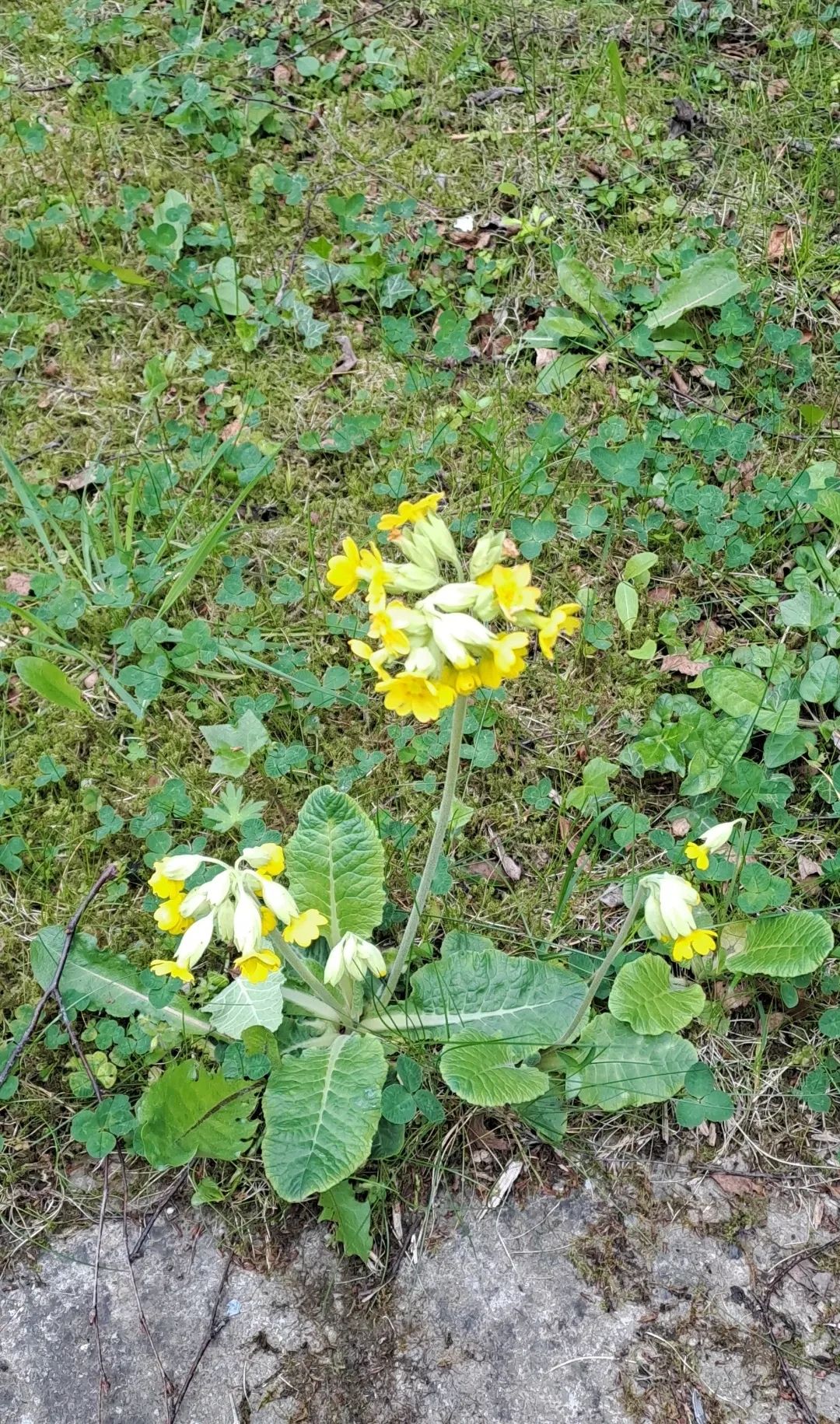
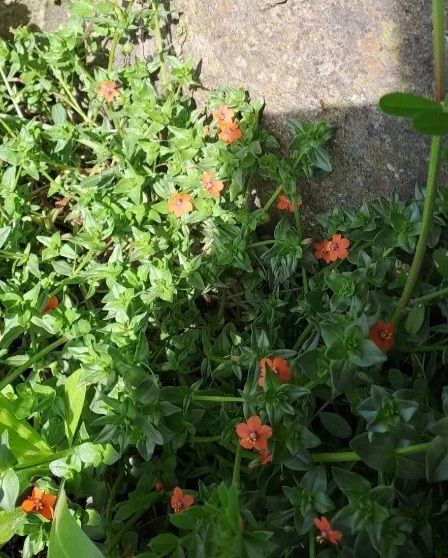
How many kinds of sweet flowers grow
In an English Irish country suburban garden?
I'll tell you now of some that I know
And those that I miss you'll surely pardon..

These are all wild flowers, often considered to be weeds, but I like having them in my garden!

An Island of Strangers

Posted in Literature, Politics with tags , , , on May 13, 2025 by telescoper

In the light of Keir Starmer’s deplorable Faragist rhetoric about Britain becoming an ‘Island of Strangers’, and the obscene deportations and detentions without legal process of immigrants in the United States, I thought I’d repost this speech from the play Sir Thomas More which is widely attributed to William Shakespeare. It’s from Act 2 Scene 4, at which point in the drama Thomas More (who was then London’s Deputy Sheriff) is called upon to put down an anti-immigration riot in the Parish of St Martin Le Grand, that took place on 1st May 1517. In reality  More’s intevention wasn’t effective, and it took the arrival of 5000 troops to disperse the mob.

As well as being powerful for many other reasons, this speech especially fascinating because a hand-written manuscript (thought to be by Shakespeare himself) survives and is kept in the British Library.

The backdrop to this story is that, between 1330 and 1550 about 64,000 immigrants from all across Europe came to England in search of better lives. Locals blamed them for taking their jobs and threatening their culture. Tensions reached breaking point in 1517 and a mob armed with stones, bricks, bats, boots and boiling water attacked the immigrants and looted their homes.  Five hundred years on, and we still haven’t learned.

Here is the text of the opening part of the speech ‘This is the strangers case’.

Grant them removed, and grant that this your noise
Hath chid down all the majesty of England;
Imagine that you see the wretched strangers,
Their babies at their backs and their poor luggage,
Plodding to the ports and coasts for transportation,
And that you sit as kings in your desires,
Authority quite silent by your brawl,
And you in ruff of your opinions clothed;
What had you got? I’ll tell you: you had taught
How insolence and strong hand should prevail,
How order should be quelled; and by this pattern
Not one of you should live an aged man,
For other ruffians, as their fancies wrought,
With self same hand, self reasons, and self right,
Would shark on you, and men like ravenous fishes
Would feed on one another….

Say now the king
Should so much come too short of your great trespass
As but to banish you, whither would you go?
What country, by the nature of your error,
Should give you harbour? go you to France or Flanders,
To any German province, to Spain or Portugal,
Nay, any where that not adheres to England,
Why, you must needs be strangers: would you be pleased
To find a nation of such barbarous temper,
That, breaking out in hideous violence,
Would not afford you an abode on earth,
Whet their detested knives against your throats,
Spurn you like dogs, and like as if that God
Owed not nor made not you, nor that the claimants
Were not all appropriate to your comforts,
But chartered unto them, what would you think
To be thus used? this is the strangers case;
And this your mountainish inhumanity.

Better an Island of Strangers than an Island of Starmers, I’d say…

Marking Time

Posted in Biographical, Education, Maynooth with tags , , , on May 12, 2025 by telescoper

So here we are, then, with only a few days before examinations start (next Friday, 16th May). The examinations for my two modules take place on Monday 19th and Tuesday 27th May, and after that I’ll be busy with marking for a while.


Marking doesn’t just mean written examinations. I have been teaching a module on Computational Physics to 3rd Year students here in Maynooth, and 40% of the assessment for that is a mini-project (usually done in groups of two or three). Early on the term, I put up a list of  16  projects and asked them to pick first second and third choices so I could form groups in such a way that most students get to work on a project they have actively chosen.

Anyway, the deadline for projects to be handed in passed last week so I’ve got a stack of those to mark which, you will realise, why I am indulging in a displacement activity by writing this blog post. My plan is to mark these during this week so that they’re done before the written examinations come in, which means by next Monday (19th). This year we have had a bigger class than usual, so this I have quite a lot of marking to do.

Last week also saw the deadline for the last assignment in Particle Physics to be handed in. I want to mark those as soon as possible, but I’m not sure I’ll have time this week, but I should be able to do them before the exam on the 27th.

Incidentally, one of the submissions of the last assignment came with a note that this was the last assignment the student had done in Maynooth and that the first one he had done, when he was in his first year, was also set by me.


Last Remarks

Posted in Biographical, Education, Euclid, Maynooth, The Universe and Stuff, Uncategorized with tags , , on May 11, 2025 by telescoper

On Friday (9th May), the last day of undergraduate teaching at Maynooth, I gave the last lecture in my module on Particle Physics. I actually finished the syllabus on Tuesday (6th) so the final one was more a revision class than a lecture. I used it to go through some past examination questions and (try to) answer some general points raised by the class.

What surprised me about this lecture was that, as has usually been the case, there was more-or-less a full attendance. Examinations in Maynooth start on Friday (May 16th), but the Particle Physics examination is not until May 27th, near the end of the examination period. I therefore expected that many students would be concentrating on their revision for their other modules, which have exams earlier in the season or finishing their projects (which are due in before the exams start). There were one or two absences, but most came anyway. In fact there was even an extra student, one of our MSc students. When I saw him at the back of the lecture hall I asked, jokingly, why he had come. He replied “I haven’t got anything better to do”. I wasn’t sure how to interpret that!

That lecture was at 11am. Later that day, at 3pm, I gave a Departmental colloquium (which had quite a big audience). The title was Euclid: The Story So Far and the abstract was

The European Space Agency’s Euclid satellite was launched on 1st July 2023 and, after instrument calibration and performance verification, the main cosmological survey is now well under way. In this talk I will explain the main science goals of Euclid, give a brief summary of progress so far, showcase some of the science results already obtained, and set out the time line for future developments, including the main data releases and cosmological analysis.

The audience for these talks is very mixed: experimental and theoretical physics staff, postgraduates and even some undergraduate students (including some who were in my lecture earlier) so it was quite a general talk rather than one I might give to an specialist astrophysics audience. If you’re interested you can find the slides here.

Having a quick cup of tea after the end of the talk and before I headed off to catch the train, I talked briefly with a student who is taking his final examinations at Maynooth this year. He told me that I had actually given the first lecture he attended when he had just started his first year and the colloquium was the last talk he would attend at Maynooth. That would be the case for quite a few students in the audience, I suppose, but it won’t be true for any in future: I am no longer teaching any modules taken by first year students, and I’ll be retired when the current first year students graduate…

Shostakovich 50 at the National Concert Hall

Posted in Uncategorized with tags , , , , , , , , on May 10, 2025 by telescoper

Last night’s concert at the National Concert Hall in Dublin was billed Shostakovich 50 because 2025 marks the 50th anniversity of the death in 1975 of Dmitri Shostakovich, whose First Symphony was performed after the interval, by the National Symphony Orchestra under the direction of guest conductor John Storgårds. As you can see, though, the programme was quite varied and no fewer than three other composers were represented.

The first piece was The Oceanides, tone poem by Jean Sibelius intended to evoke the sea nymphs of Greek mythology. It’s quite a short piece – only eleven minutes in performance – but full of movement, suggesting the ebb-and-flow of the sea and its different moods, from tranquil to stormy. Its place on the programme made it a good workout for the orchestra and a wonderful starter to whet their appetite of the audience for the rest of the menu.

After that appetizer we had a performance of the Rhapsody on a Theme by Paganini by Sergei Rachmaninov with soloist Yukine Kuroki at the piano. This piece comprises a set of 24 variations on a them from one of Paganini’s caprices for solo violin. The Rhapsody on a theme of Paganini is piece full of contrasts: sometimes pyrotechnical, sometimes lyrical. My favourite section is the 18th variation, in which a lovely romantic melody emerges and is picked up by the whole orchestra in a manner that’s very characteristic of Rachmaninov. This tune is just an inversion of the theme transposed into a different  key and slowed down.

The Rachmaninov alone was worth the cost of the ticket. I was amazed how pianist Yukine Kuroki coped with the technical challenges of this work but also how she managed to generate so much power for a person of such slight build. Rachmaninov himself was quite a large man who had hands like shovels, so his work often places difficult demands on a soloist. Not last night, though, as Yukine Kuroki not only played with great accomplishment but also clearly enjoyed herself. In the passages during which the piano was not playing she was bouncing up and down and tapping her feet waiting for her cue. It was lovely to watch as well as to listen to. I’ll also mention that she was wearing a gorgeous one-shoulder dress with a vivid red colour.

After the wine break interval we returned for a piece that was new to me, the Symphony No. 3 ‘White Interment’ by Ukrainian composer Victoria Vita Polyova. This is described a symphony, but it doesn’t have the traditional structure in terms of movements. It has instead a rather static structure, consisting of thematic blocks based on a poem Now always snows. It’s a sombre and rather minimalist piece, with little of the development you would expect from a true symphony, but the sound world it creates is layered in interesting ways. I enjoyed the performance.

And finally we have the Symphony No. 1 by Dmitri Shostakovich which I don’t think I had heard in concert before. The most astonishing thing about this work was that he wrote it as a graduation piece for the St Petersburg Conservatory. Its first performance was in 1926, when the composer was only 19. It is a substanial work over four movements (the last two played without interruption) and there are passages within it in which you can see that he had already found much of the distinct voice that he used in his later compositions. This piece isn’t really reminiscent of any other composers, either.

The performance was excellent, with particularly strong work by the woodwinds and brass. It was very well received by the NCH audience which is always very generous with its applause.