We analyze the role of first (leading) author gender on the number of citations that a paper receives, on the publishing frequency and on the self-citing tendency. We consider a complete sample of over 200,000 publications from 1950 to 2015 from five major astronomy journals. We determine the gender of the first author for over 70% of all publications. The fraction of papers which have a female first author has increased from less than 5% in the 1960s to about 25% today. We find that the increase of the fraction of papers authored by females is slowest in the most prestigious journals such as Science and Nature. Furthermore, female authors write 19$pm$7% fewer papers in seven years following their first paper than their male colleagues. At all times papers with male first authors receive more citations than papers with female first authors. This difference has been decreasing with time…
It’s Hallowe’en again, and although I feel I should concoct something appropriate, I really don’t have time. I’ve decided therefore to recycle a couple of items I’ve previously posted on this lamentable occasion.
We never had Halloween when I was a kid. I mean it existed. People mentioned it. There were programmes on the telly. But we never celebrated it. At least not in my house, when I was a kid. It just wasn’t thought of as a big occasion. Or, worse, it was “American” (meaning that it was tacky, synthetic and commercialized).
So there were no Halloween parties, no costumes, no horror masks, no pumpkins and definitely no trick-or-treat when I was a lad.
Having never done trick-or-treat myself as a child, I never really had any clue what it was about until relatively recently. I’d always assumed “Trick or Treat?” was a rhetorical question or merely a greeting like “How do you do?”.
In fact my first direct experience of this peculiar custom didn’t happen until I was in my mid-thirties and had moved to a suburban house in Beeston, just outside Nottingham. I was sitting at home one October 31st, watching the TV and – probably, though I can’t remember for sure – drinking a glass of wine, when the front door bell rang. I didn’t really want to, but I got up and answered it.
When I opened the door, I saw in front of me two small girls in witches’ costumes. Behind them, near my front gate, was an adult guardian, presumably a parent, keeping a watchful eye on them.
“Trick or Treat?” the two girls shouted. Trying my best to get into the spirit but not knowing what I was actually supposed to do, I answered “Great! I’d like a treat please”.
They stared at me as if I was mad, turned round and retreated towards their minder who was clearly making a mental note to avoid this house in future. Off they went and I, embarrassed at being exposed as a social inadequate, retired to my house in shame.
Ever since then I’ve tried to ensure that I never again have to endure such Halloween horrors. Every October 31st, when nightfall comes, I switch off the TV, radio and lights and sit soundlessly in the dark so the trick-or-treaters think there’s nobody home.
That way I can be sure I won’t be made to feel uncomfortable.
Anyway, despite my own reservations about Hallowe’en, I’ve decided to resurrect the following little video which seems to be appropriate for the occasion. It’s made of bits of old horror B-movies but the music – by Bobby “Boris” Pickett and the Crypt-kickers is actually the second single I ever bought, way back in 1973…
The following is tangentially related to a discussion I had during a PhD examination last week, and I thought it might be worth sharing here to stimulate some thought among people interested in cosmology.
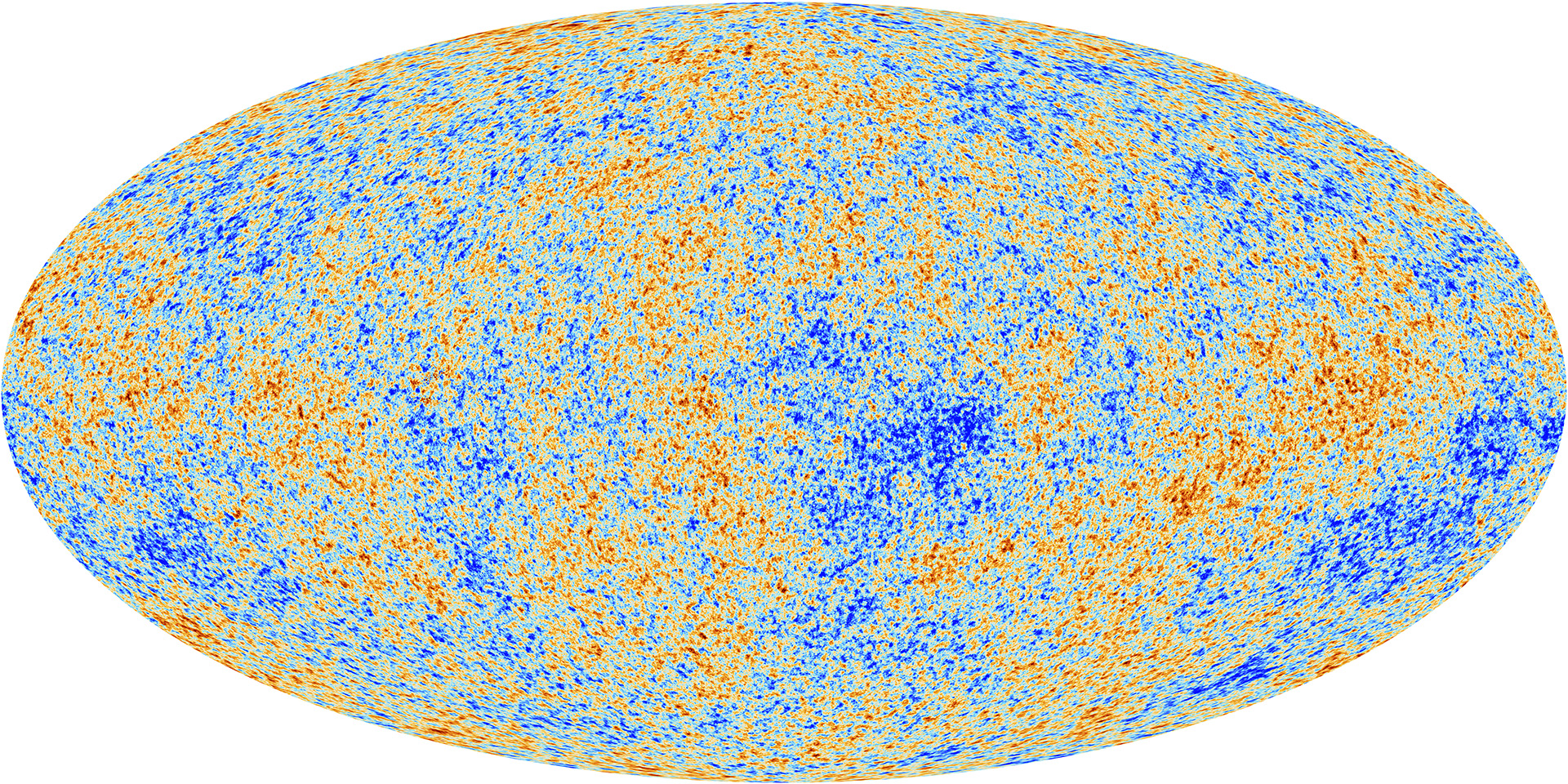
The analysis of these fluctuations yields a huge amount of information about the universe, including its matter content and spatial geometry as well as the form of primordial fluctuations that gave rise to galaxies and large-scale structure. The variations in temperature that you see in this image are small – about one-part in a hundred thousand – and they show that the universe appears to be close to isotropic (at least around us).
I’ll blog later on (assuming I find time) on the latest constraints on this subject, but for the moment I’ll just point out something that has to be removed from the above map to make it look isotropic, and that is the Cosmic Microwave Background Dipole. Here is a picture (which I got from here):
This signal – called a dipole because it corresponds to a simple 180 degree variation across the sky – is about a hundred times larger than the “intrinsic” fluctuations which occur on smaller angular scales and are seen in the first map. According to the standard cosmological framework this dipole is caused by our peculiar motion through the frame in which microwave background photons are distributed homogeneously and isotropically. Had we no peculiar motion then we would be “at rest” with respect to this CMB reference frame so there would be no such dipole. In the standard cosmological framework this “peculiar motion” of ours is generated by the gravitational effect of local structures and is thus a manifestation of the fact that our universe is not homogeneous on small scales; by “small” I mean on the scales of a hundred Megaparsecs or so. Anyway, if you’re interested in goings-on in the very early universe or its properties on extremely large scales the dipole is thus of no interest and, being so large, it is quite easy to subtract. That’s why it isn’t there in maps such as the Planck map shown above. If it had been left in it would swamp the other variations.
Anyway, the interpretation of the CMB dipole in terms of our peculiar motion through the CMB frame leads to a simple connection between the pattern shown in the second figure and the velocity of the observational frame: it’s a Doppler Effect. We are moving towards the upper right of the figure (in which direction photons are blueshifted, so the CMB looks a bit hotter in that direction) and away from the bottom left (whence the CMB photons are redshifted so the CMB appears a bit cooler). The amplitude of the dipole implies that the Solar System is moving with a velocity of around 370 km/s with respect to the CMB frame.
Now 370 km/s is quite fast, but it’s much smaller than the speed of light – it’s only about 0.12%, in fact – which means that one can treat this is basically a non-relativistic Doppler Effect. That means that it’s all quite straightforward to understand with elementary physics. In the limit that v/c<<1 the Doppler Effect only produces a dipole pattern of the type we see in the Figure above, and the amplitude of the dipole is ΔT/T~v/c because all terms of higher order in v/c are negligibly small. Furthermore in this case the dipole is simply superimposed on the primordial fluctuations but otherwise does not affect them.
My question to the reader, i.e. you, is the following. Suppose we weren’t travelling at a sedate 370 km/s through the CMB frame but instead enter the world of science fiction and take a trip on a spacecraft that can travel close to the speed of light. What would this do to the CMB? Would we still just see a dipole, or would we see additional (relativistic) effects? If there are other effects, what would they do to the pattern of “intrinsic” fluctuations?
Comments and answers through the box below, please!
Posted in Uncategorized on October 30, 2016 by telescoper
Horloge! dieu sinistre, effrayant, impassible,
Dont le doigt nous menace et nous dit: «Souviens-toi!
Les vibrantes Douleurs dans ton coeur plein d’effroi
Se planteront bientôt comme dans une cible;
Le Plaisir vaporeux fuira vers l’horizon
Ainsi qu’une sylphide au fond de la coulisse;
Chaque instant te dévore un morceau du délice
À chaque homme accordé pour toute sa saison.
Trois mille six cents fois par heure, la Seconde
Chuchote: Souviens-toi! — Rapide, avec sa voix
D’insecte, Maintenant dit: Je suis Autrefois,
Et j’ai pompé ta vie avec ma trompe immonde!
Remember! Souviens-toi! prodigue! Esto memor!
(Mon gosier de métal parle toutes les langues.)
Les minutes, mortel folâtre, sont des gangues
Qu’il ne faut pas lâcher sans en extraire l’or!
Souviens-toi que le Temps est un joueur avide
Qui gagne sans tricher, à tout coup! c’est la loi.
Le jour décroît; la nuit augmente; Souviens-toi!
Le gouffre a toujours soif; la clepsydre se vide.
Tantôt sonnera l’heure où le divin Hasard,
Où l’auguste Vertu, ton épouse encor vierge,
Où le Repentir même (oh! la dernière auberge!),
Où tout te dira Meurs, vieux lâche! il est trop tard!»
Posted in Uncategorized on October 29, 2016 by telescoper
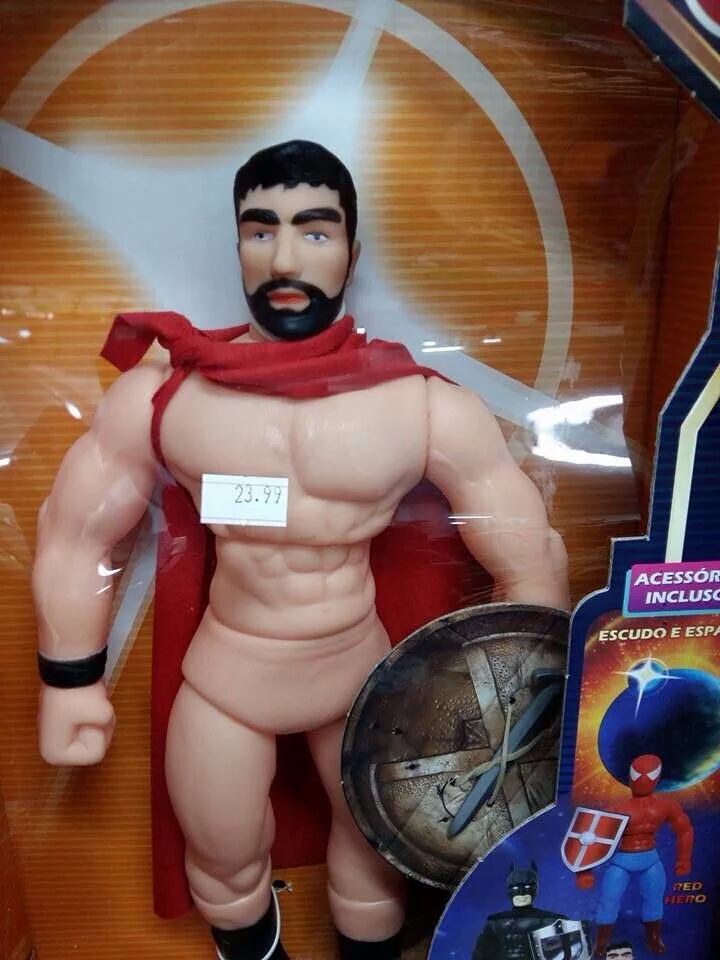
We academics are continually being told to be more entrepreneurial, so I have decided to branch out into the commercial domain by developing and marketing, just in time for Christmas, my very own Telescoper action figure:
Priced at just £99.99 (or, equivalently, €23.99) this figure is lifelike in every anatomical detail but batteries are not included. Neither are spectacles.
This item is not available in the shops but can be ordered direct from this website; postage & packing costs £25 extra (please allow 1000 days for delivery).
Just time for a quick post as I’m having a very busy couple of days, including two PhD examinations in consecutive days, one at UCL today and another at Cambridge tomorrow. I don’t why I agreed to this crazy schedule, but there we are.
This morning I travelled from Cardiff to London in good time for a 2pm kickoff. The Astrophysics group at University College London is not in its usual near Gower Street in Bloomsbury but has been displaced pending refurbishment to a disused warehouse behind Euston station. Everyone – from PhD students to Professors – is in one ginormous open-plan office, even bigger than the one I have in Cardiff!
Anyway the viva went fine (about three hours) and we raised a glass or two of Prosecco to the new Dr Saadeh.
After that I walked to King’s Cross to get the train to Cambridge. The train was very overcrowded so I had to stand all the way. It also ran very slowly and arrived 15 minutes late. Apart from that it was all fine.
So now I find myself at the very posh Møller Centre in the ground of Churchill College where I am staying the night. It’s just a stones throw from the Kavli Centre, where tomorrow’s exam will take place.
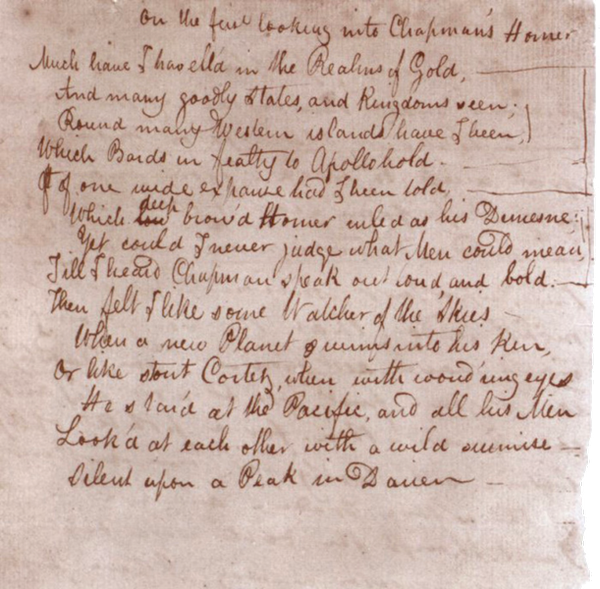
This very famous and very wonderful sonnet, considered the highlight of Keats’s first volume of poetry, was written on this day in October 1816 and is thus exactly 200 years old. It was originally a gift for his friend, Charles Cowden Clarke. The two men had spent an evening reading George Chapman’s superb 17th century translation of the Iliad and Odyssey. Here is the original hand-written version (which I got here)
And here’s a more legible version:
Much have I travell’d in the realms of gold, And many goodly states and kingdoms seen; Round many western islands have I been Which bards in fealty to Apollo hold. Oft of one wide expanse had I been told That deep-brow’d Homer ruled as his demesne; Yet did I never breathe its pure serene Till I heard Chapman speak out loud and bold: Then felt I like some watcher of the skies When a new planet swims into his ken; Or like stout Cortez when with eagle eyes He star’d at the Pacific–and all his men Look’d at each other with a wild surmise– Silent, upon a peak in Darien.
There’s been quite a lot of reaction on the interwebs over the last few days much of it very misleading; here’s a sensible account) to a paper by Nielsen, Guffanti and Sarkar which has just been published online in Scientific Reports, an offshoot of Nature. I think the above link should take you an “open access” version of the paper but if it doesn’t you can find the arXiv version here. I haven’t cross-checked the two versions so the arXiv one may differ slightly.
Anyway, here is the abstract:
The ‘standard’ model of cosmology is founded on the basis that the expansion rate of the universe is accelerating at present — as was inferred originally from the Hubble diagram of Type Ia supernovae. There exists now a much bigger database of supernovae so we can perform rigorous statistical tests to check whether these ‘standardisable candles’ indeed indicate cosmic acceleration. Taking account of the empirical procedure by which corrections are made to their absolute magnitudes to allow for the varying shape of the light curve and extinction by dust, we find, rather surprisingly, that the data are still quite consistent with a constant rate of expansion.
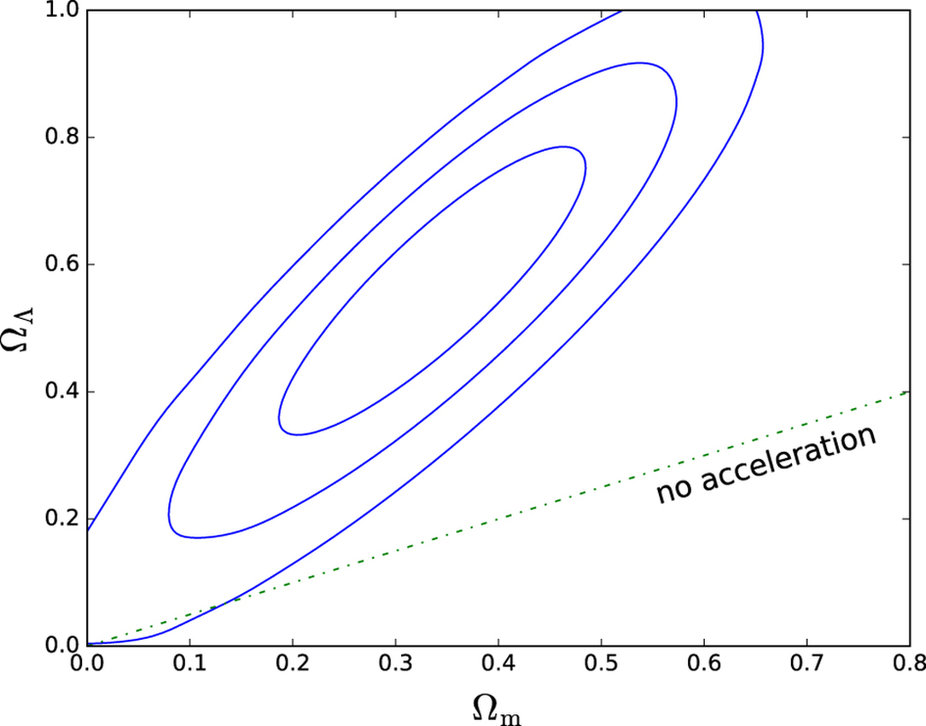
Obviously I haven’t been able to repeat the statistical analysis but I’ve skimmed over what they’ve done and as far as I can tell it looks a fairly sensible piece of work (although it is a frequentist analysis). Here is the telling plot (from the Nature version) in terms of the dark energy (y-axis) and matter (x-axis) density parameters:
Models shown in this plane by a line have the correct balance between Ωm, and ΩΛ to cancel out the decelerating effect of the former against the accelerating effect of the latter (a special case is the origin on the plot, which is called the Milne model and represents an entirely empty universe). The contours show “1, 2 and 3σ” contours, regarding all other parameters as nuisance parameters. It is true that the line of no acceleration does go inside the 3σcontour so in that sense is not entirely inconsistent with the data. On the other hand, the “best fit” (which is at the point Ωm=0.341, ΩΛ=0.569) does represent an accelerating universe.
I am not all that surprised by this result, actually. I’ve always felt that taken on its own the evidence for cosmic acceleration from supernovae alone was not compelling. However, when it is combined with other measurements (particularly of the cosmic microwave background and large-scale structure) which are sensitive to other aspects of the cosmological space-time geometry, the agreement is extremely convincing and has established a standard “concordance” cosmology. The CMB, for example, is particularly sensitive to spatial curvature which, measurements tells us, must be close to zero. The Milne model, on the other hand, has a large (negative) spatial curvature entirely excluded by CMB observations. Curvature is regarded as a “nuisance parameter” in the above diagram.
I think this paper is a worthwhile exercise. Subir Sarkar (one of the authors) in particular has devoted a lot of energy to questioning the standard ΛCDM model which far too many others accept unquestioningly. That’s a noble thing to do, and it is an essential part of the scientific method, but this paper only looks at one part of an interlocking picture. The strongest evidence comes from the cosmic microwave background and despite this reanalysis I feel the supernovae measurements still provide a powerful corroboration of the standard cosmology.
Let me add, however, that the supernovae measurements do not directly measure cosmic acceleration. If one tries to account for them with a model based on Einstein’s general relativity and the assumption that the Universe is on large-scales is homogeneous and isotropic and with certain kinds of matter and energy then the observations do imply a universe that accelerates. Any or all of those assumptions may be violated (though some possibilities are quite heavily constrained). In short we could, at least in principle, simply be interpreting these measurements within the wrong framework, and statistics can’t help us with that!
News yesterday of the death, at the age of 57, of Pete Burns reminded me of this number from 1985 by Dead or Alive. This seemed to be playing every time I went to a club in those days and is thus a kind of theme song for happy times, now lost forever.
Posted in Uncategorized on October 24, 2016 by telescoper
The post I wrote on Saturday about the case of Bode versus Mundell had attracted a lot of attention on this blog over the past few days, and has led to a number of people sending me private messages and emails, mainly about wider aspects of the case.
Most of these have expressed thanks for bringing this matter to the attention of the astronomy community. Others have been extremely critical of my post. The rest have contents that I cannot possibly disclose here. Or anywhere else.
For the record I have no regrets whatsoever about writing what I did. Whatever the rights and wrongs of the libel action it seems to me that the publicity arising from its failure has revealed an apparent failure of process, in that a charge of sexual harassment was raised but never properly resolved.
After much thought I have decided not to accept the invitation by Dr Chris Simpson to discuss the harassment case in person via Skype. There are two main reasons for this.
One is that I do not feel it would be appropriate to get only one side of the story and am clearly unable to talk to whoever made the complaint to see the other side. Their identity is rightly not in the public domain. In other words it is precisely in the interest of balance that I am not going to be drawn into further discussion of the original harassment allegations with one of the parties to the case and not the other(s).
The other reason is that the most important point I wanted to make in my post was not about whether the harassment complaint would or would not have been upheld (which was not an in issue in the court case either) but that the investigation ended before a resolution could be reached one way or the other. Lessons need to be learnt if we are to reach a situation in which bona fide complainants have sufficient confidence in the process to make it worthwhile coming forward.
The views presented here are personal and not necessarily those of my employer (or anyone else for that matter).
Feel free to comment on any of the posts on this blog but comments may be moderated; anonymous comments and any considered by me to be vexatious and/or abusive and/or defamatory will not be accepted. I do not necessarily endorse, support, sanction, encourage, verify or agree with the opinions or statements of any information or other content in the comments on this site and do not in any way guarantee their accuracy or reliability.



 In the Dark