50 Years of the Astronomy Centre at the University of Sussex

Posted in Biographical, Education, The Universe and Stuff with tags , , , , , on October 18, 2016 by telescoper

On Saturday (15th October) I was back in Brighton for the first time since I left my job there at the end of July. The occasion was a very nice lunch party to celebrate 50 years of the Astronomy Centre at the University of Sussex, which started properly in 1966. It was a pleasant occasion, and great to have the chance to catch up with some people I haven’t seen for far too long. I had two stints in the Astronomy Centre: once as a student then postdoc from 1985 to 1990, and the other from 2013 to 2016 when I was Head of the School of which the Astronomy Centre is part. I had a lot more time to do research in the first incarnation than in the second!

Quite a few people present hadn’t realised I was no longer working at Sussex, which led to one or two slightly awkward conversations, but I was thankfully very far from being the centre of attention.

After the lunch itself we had short speeches from various alumni of the Astronomy Centre: esteemed science writer John Gribbbin (who was one of its first MSc students in 1966); Lord Martin Rees (who was briefly a Professor at Sussex, before he returned to Cambridge to take up the Plumian Professorship); John Barrow (who was my supervisor while I was there); Carlos Frenk (who was a postdoctoral researcher when I arrived in September 1985, but who left to take up a lectureship in Durham at the end of that year so we overlapped only for a short time); Andrew Liddle (who arrived near the end of my stay and was there for 22 years altogether, leaving at the end of 2012 to take up a post in Edinburgh); and Peter Thomas (current Director of the Astronomy Centre).

When I arrived in 1985 there were only four permanent faculty in the Astronomy Centre itself – Roger Tayler, Leon Mestel, John Barrow and Robert Smith – but research there was thriving and it was a great environment to work in. I count myself very lucky at having made such a good choice of a place to do my PhD DPhil. Leon and Robert both worked on stellar astrophysics, but after Leon’s retirement the centre increasingly focussed on cosmology and extragalactic astrophysics, which remains the case today. Roger Tayler sadly passed away in 1997, but Leon is still around: he is 89 years old and now lives in Cambridge.

Those present at the lunch were given a booklet featuring around 50 academic papers or other research “highlights”(e.g. the launch of Planck), approximately one for each year of the Astronomy Centre, chosen to be the “best” of that year. Each page was also shown as a slide during the lunch. I was thrilled to see that two of my papers (from 1987 and 1991 respectively) made it into the collection. The second one was published after I’d left Sussex, but I definitely did the work on it and submitted it while an employee of the Astronomy Centre. Andrew Liddle and John Barrow have the largest number of “greatest hits”, but the most famous paper is probably the classic “DEFW” which won Carlos Frenk and his collaborators the Gruber Prize about five years ago.

The book also contains various bits of interesting bibliometric information, such as this, which shows that the variation in the productivity of the Astronomy Centre over time.

us-astronomy-50-powerpoint

Anyway, for those who are interested, the whole collection of slides can be viewed here:

Thanks to Seb Oliver and the rest of the Astronomy Centre for organizing this very enjoyable event – and for sending me the slides! Here’s to the next 50 years of Astronomy at the University of Sussex!


The Firebird (and more) at St David’s Hall

Posted in Music with tags , , , , , , on October 18, 2016 by telescoper

Just a quick note to catch up on concert-going activities from last week, as for various reasons I had to skip a few days of blogging…

Last Thursday night (13th October) I was lucky enough to attend a tremendous concert at St David’s Hall in Cardiff featuring the BBC National Orchestra of Wales conducted by Thomas Søndergård at the start of their 2016/7 season. The main item on the bill was the complete score for Igor Stravinsky’s ballet The Firebird. This is a thrillingly piece, involving a huge orchestra, numbering about a hundred musicians, including some positioned away from the rest of the orchestra. In a performance of the ballet the main orchestra would be in the pit, not on the stage, and the musicians offstage in the concert would be onstage with the dancers. If you see what I mean.

The orchestration of The Firebird is a tour de force: intricate but vividly coloured, full of excitement and colour and the BBC National Orchestra of Wales played it with great passion and aplomb. A really brilliant performance.

The Firebird filled the second half of the programme. In the first half we heard three pieces by French composers: Prélude à l’après-midi d’un faune by Claude Debussy; the three songs from Shéhérazade by Maurice Ravel, sung by the inestimable Sarah Connolly; and  the Flute Concerto by Jacques Ibert played by Emily Beynon. The first two pieces are fairly standard in the concert repertoire, but the last one was completely new to me. The last piece is very fine indeed, consisting of two dazzlingly virtuosic faster movements (Allegro and Allegro Scherzando) either side of a lyrical Andante. The orchestra was somewhat pared down for this part of the concert, but it’s nevertheless a piece of substantial weight and harmonic complexity. Hats off to Emily Beynon and the BBC NOW for a wonderful introduction to this work.

What a rich and varied programme for a single concert, all wonderfully played. I’m certainly looking forward to the rest of the season!


Passport to Pimlico

Posted in Uncategorized on October 14, 2016 by telescoper

So, here I am one Friday night in Pimlico. This afternoon there has been the first Ordinary Meeting of the Royal Astronomical Society of the new season, followed, this evening,  by  dinner with the RAS Club.

On the bill for the RAS meeting were talks about galaxy formation and extrasolar planets, followed by the headline attraction of this year’s Gerald Whitrow Lecture, by Neil Turok of the Perimeter Institute in Canada. The abstract of his talk reads

A spate of new observations are providing powerful clues about the laws of fundamental physics and the cosmos. The implications are revolutionary: the universe is astonishingly simple on the largest and the smallest observable scales, with great complexity in between. These findings contrast sharply with expectations from popular twentieth century paradigms including inflation, supersymmetry and string theory, which led many to take seriously the idea of a wild and unpredictable “multiverse” on large scales. Key “predictions” derived from that picture have been recently falsified, posing observational challenges to the paradigm which compound its many logical problems. In this talk I will discuss a new, and in my view more promising, approach to understanding the quantum nature and integrity of the universe.

There was a great deal of interesting and stimulating material in his talk, and I found myself in agreement with at least some  of the criticisms he made about the multiverse (of which idea I am myself no fan). I remain however unconvinced (as yet) that his “new approach” is more promising as he claims, probably because the last bit was a bit rushed. I look forward to being proved wrong!

Anyway, after that it was dinner at the Athenaeum with the club, but instead of making the long journey of returning to Cardiff (the Severn Tunnel remains closed) I decided to stay in London.

In fact tomorrow I shall be attending a lunch at Sussex University in honour of the 50th anniversary of the founding of Astronomy Centre, my first trip back there since I left at the end of July, so it makes sense to stay overnight in London, close enough to Victoria that I don’t have far to go to get the train to Brighton tomorrow…

A Universe of Two Trillion Galaxies

Posted in The Universe and Stuff with tags , , , , , on October 13, 2016 by telescoper

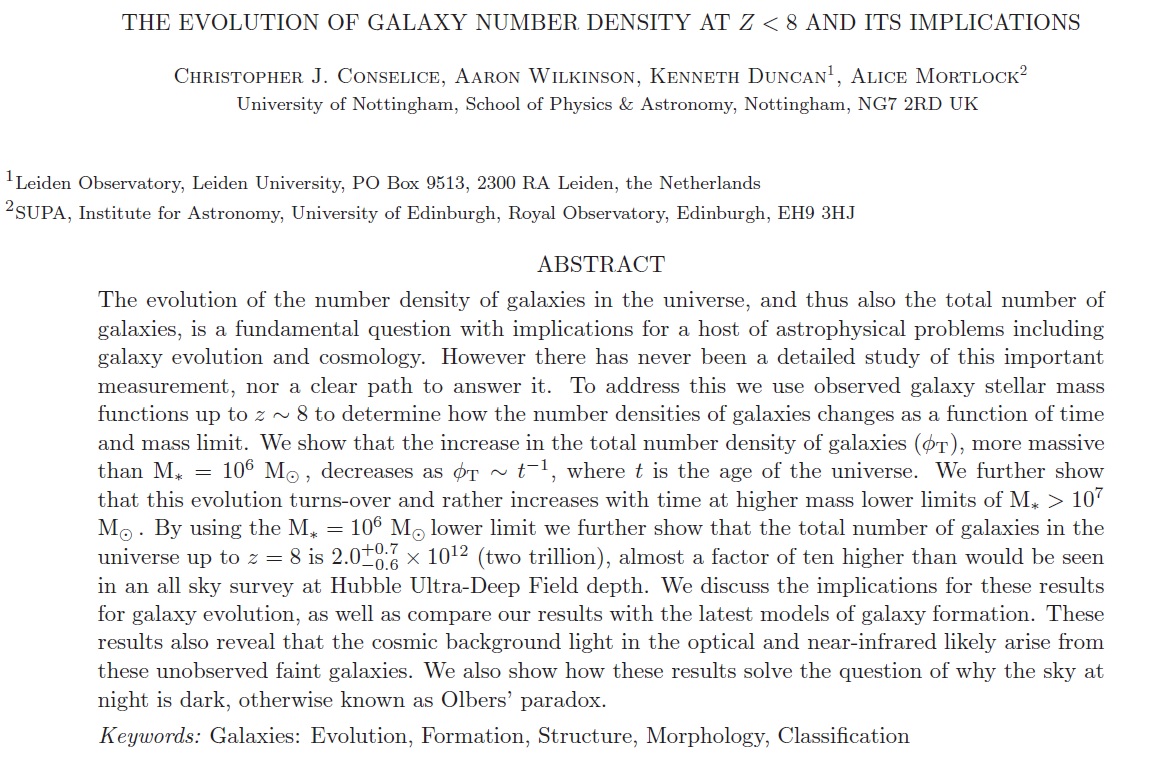
I just saw a press-release that describes a paper, just out, authored by Chris Conselice et al from the University of Nottingham (in the Midlands), with this here abstract:

conselice

The key conclusion of this paper is that when the universe was only a few billion years old there were about ten times as many galaxies in a given volume of space as there are within a similar volume today, but most of these galaxies were much lower mass systems than, e.g., the Milky Way. In fact their masses are similar to those of the satellite galaxies surrounding the Milky Way. These objects are numerous but so faint that even in very deep surveys with very big telescopes they are very easy to miss.

Here’s an image from a deep survey: this is from the Hubble Space Telescoper Great Observatories Deep Survey (HST-GOODS).

hst_goods-south

You can click on this to make it larger if you wish. This is typical of a “pencil beam” survey. It opens a very small window on the heavens – about a millionth of its total area of the sky – in a direction chosen to avoid having too many bright stars from our own Galaxy getting in the way. When you look at such a patch with a big telescope for a long time, what you see is basically all galaxies. The few stars in the above image can be identified by the diffraction patterns they produce, but almost every fuzzy blob in the picture is a galaxy. It looks like there are a lot of galaxies in this image, but the real number seems to be substantially higher than we thought.

When I’ve given popular talks about this kind of thing I’ve always said something like “There are at least as many galaxies in the observable Universe as there are stars in our own Galaxy”. It turns out that I was wise to include the “at least as”. There are about 100 billion (1011) stars in the Milky Way, but the latest estimate is now that there are two trillion (2 ×10¹²) galaxies in the observable Universe. I quote Douglas Adams:

“The Universe, as has been observed before, is an unsettlingly big place, a fact which for the sake of a quiet life most people tend to ignore. Many would happily move to somewhere rather smaller of their own devising, and this is what most beings in fact do.

I believe this explains a lot about modern politics.


Just Like a Woman

Posted in Music with tags , , on October 13, 2016 by telescoper

Posted in honour of Bob Dylan being awarded the Nobel Prize for Literature.

I am of course delighted that this prestigious honour has, for the first time, been bestowed on a singer/songwriter. Surely it can only be a matter of time before it goes to a blogger?


General Relativity and Cosmology: Unsolved Questions and Future Directions [CL]

Posted in The Universe and Stuff with tags , on October 12, 2016 by telescoper

I missed this when it appeared on the arXiv last week, but now that I’ve read it I couldn’t resist reblogging this nice review of the current state of General Relativity and its alternatives, with an emphasis on the cosmological ramifications.

arxiver's avatararXiver

http://arxiv.org/abs/1609.09781

For the last 100 years, General Relativity (GR) has taken over the gravitational theory mantle held by Newtonian Gravity for the previous 200 years. This article reviews the status of GR in terms of its self-consistency, completeness, and the evidence provided by observations, which have allowed GR to remain the champion of gravitational theories against several other classes of competing theories. We pay particular attention to the role of GR and gravity in cosmology, one of the areas in which one gravity dominates and new phenomena and effects challenge the orthodoxy. We also review other areas where there are likely conflicts pointing to the need to replace or revise GR to represent correctly observations and consistent theoretical framework. Observations have long been key both to the theoretical liveliness and viability of GR. We conclude with a discussion of the likely developments over the next 100 years.

Read this paper…

View original post 17 more words

Paul Carr’s Lunchtime Concert at St David’s Hall

Posted in Music with tags , , , on October 12, 2016 by telescoper

Yesterday I went to my first-ever lunchtime event at St David’s Hall in Cardiff, which was a concert of organ music performed by Paul Carr. There wasn’t a very big crowd, which must have been quite unsettling for the soloist in such a big venue, but the recital was thoroughly enjoyable. The eclectic programme consisted of:

Alfred Hollins: Concert Overture No 2 in C minor

JS Bach: Trio Sonata No 5 in C, BWV 529 (3 movements)

Antonio Soler:  Concerto No 6 for two organs (Minué)

Hans-Martin Kiefer:  Die ganze Welt hast du uns überlassen (Blues Chorale)

Eric Coates, arr Edward Marsh:  The Dambusters March

Marco Enrico Bossi: Scherzo in G minor

Louis Vierne: Two movements from Symphony No. 1

The reason I attended – apart from just having the rare opportunity to hear the magnificent organ at St David’s Hall – was the Bach Trio Sonata. Bach wrote six of these and they’re all an absolute joy to listen to, so for me the concert was worth it just for that piece.  I have to admit that I was also intrigued to the music by Eric Coates for the 1955 film The Dam Busters played on an organ. Paul Carr actually pointed out that this piece is a nod in the direction of Elgar: its fanfare-like opening and big “very English sounding tune” is really reminiscent Pomp and Circumstance March No. 1. Indeed I gather the famous “bouncing bomb” melody has even been used for a hymn (“God is our strength and refuge”, based on Psalm 46). Anyway, the climactic ending of the piece, played on a huge organ like the one at St David’s Hall with all the stops out, is powerfully effective, and almost as noisy as I imagine flying in a Lancaster bomber must be.

The other pieces were completely unfamiliar to me before, but constituted a very pleasant menu for a lunchtime treat, all wonderfully served by Paul Carr. The only problem with lunchtime concerts, is that they don’t give you time for an actual lunch!


Thinking of Applying for a PhD Place in Physics or Astronomy?

Posted in Education with tags , , , , , , on October 12, 2016 by telescoper

This morning I am to give a short talk to interested students within the School of Physics & Astronomy here at Cardiff University about postgraduate research in which I aim to pass on some, hopefully useful,  information about how to go about applying for PhDs  in Physics  and Astronomy. Since I’ve finished writing the talk more than the usual few minutes before I have to deliver it, I thought I’d jot down here a few general remarks that might be useful to people elsewhere who are thinking of taking the plunge when they graduate. I’m aiming this primarily at UK students applying for places in the UK; special considerations apply for students wanting to do graduate research abroad.

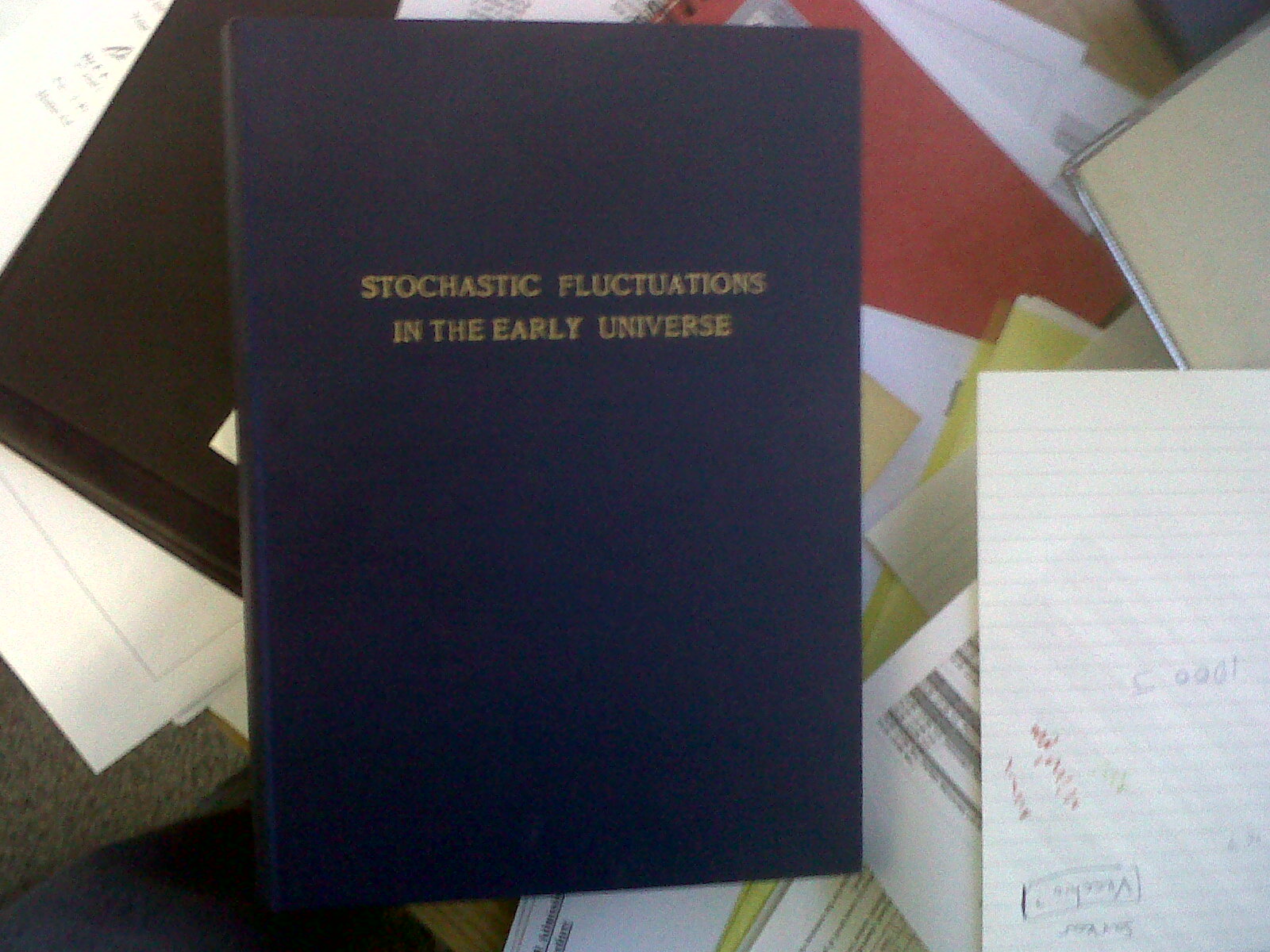
What is a PhD? The answer to that is relatively easy; it’s a postgraduate research degree. In order to obtain a PhD you have to present a thesis like that shown on the left (which happens to be mine, vintage 1988), typically in the range 100-250  pages long. A thesis has to satisfy two conditions for the award of the degree: it should contain original research, which is publishable in an academic journal; and it should present a coherent discussion of that original work within the context of ongoing work in the area of study. In Physics & Astronomy, the PhD is pretty much a prerequisite for any career in academic research, and it usually takes between 3 and 4 years to complete. After submission of the thesis you will have to undergo a viva voce examination conducted by two examiners, one internal and one external. This is quite a tough test, which  can last anywhere between about 2 and about 6 hours, during which you can be asked  detailed questions about your research and wide-ranging questions about the general area.

The Money Side. In the UK most PhDs are supported financially by the research councils, either EPSRC (most physics) or STFC (nuclear & particle physics, astronomy). These generally award quotas of studentships to departments who distribute them to students they admit. A studentship will cover your fees and pay a stipend, currently £14296 pa. That doesn’t sound like a lot, but you should at least remember that it is a stipend rather than a wage; it is therefore not taxed and there is no national insurance payable. There is a fee (currently £4121) payable for a PhD course, but that only comes into play if you are planning to fund yourself. If you receive a studentship it will normally cover the fee as an additional component. What I mean by that is you don’t need to pay it out of the stipend, it is separate. In top of that, research council funding also supplies a Research Training Grant which covers, e.g., travel and small items of equipment so you don’t need to pay for those out of your stipend either.

How do I choose a PhD? During the course of a postgraduate degree you are expected to become an expert in the area in which you specialize. In particular you should reach the point where you know more about that specific topic than your supervisor does. You will therefore have to work quite a lot on your own, which means you need determination, stamina and enthusiasm. In my view the most important criterion in your choice of PhD is not the institution where you might study but the project. You need to be genuinely excited by the topic in order to drive yourself to keep through the frustrations (of which there will be many). So, find an area that interests you and find the departments that do active research in that area by looking on the web. Check out the recent publications by staff in each department, to ensure that they are active and to have something to talk about at interview!

Qualifications. Most universities have a formal requirement that candidates for admission to the PhD should have a “good honours degree”, which basically means at least an Upper Second Class Honours degree. Some areas are more competitive than others, however, and in many disciplines you will find you are competing with a great many applicants with First Class degrees.

How to apply successfully. The application procedure at most universities is quite simple and can be done online. You will need to say something about the area in which you wish to do research (e.g. experiment/theory, and particular field, e.g. cosmology or star formation). You’ll also need a CV and a couple of references. Given the competition, it’s essential that you prepare. Give your curriculum vitae some attention, and get other people (e.g. your personal tutor) to help you improve it. It’s worth emphasizing particular skills (e.g. computing). If you get the chance, make use of your summer vacations by taking on an internship or other opportunity to get a taste of research; things like that will undoubtedly give your CV an edge.

The Interview. Good applicants will be invited for an interview, which is primarily to assess whether you have the necessary skills and determination, but also to match applicants to projects and supervisors. Prepare for your interview! You will almost certainly be asked to talk about your final-year project, so it will come across very badly if you’re not ready when they ask you. Most importantly, mug up about your chosen field. You will look really silly if you haven’t the vaguest idea of what’s going on in the area you claimed to be interested in when you wrote your  application!

Don’t be shy! There’s nothing at all wrong with being pro-active about this process. Contact academic staff at other universities by email and ask them about research, PhD opportunities. That will make a good impression. Also, don’t be afraid to ask for advice. Although we’re all keen to recruit good PhD students for our own departments, we academics are  conscious that it is also our job to give impartial advice. Ask your tutor’s opinion.

How many places should I apply for? Some research areas are more fashionable than others so the level of competition varies with field. As a general rule I would advise applying for about half-a-dozen places, chosen because they offer research in the right area. Apply to fewer than that and you might lose out to the competition. Apply to many more and you might not have time to attend the interviews.

What’s the timetable?  Most applications come in early in the new year for entry to the PhD in the following September/October. The Christmas break is therefore a pretty good time to get your applications sorted out. Interviews are normally held in February or March, and decisions made by late March. STFC runs a deadline system whereby departments can not force students to accept or decline offers before the end of March, so there should be ample time to visit all your prospective departments before having to make any decisions.

That’s all I can think of for now. I hope at least some of these comments are useful to undergraduates anywhere in the UK thinking of applying for a PhD. If there are any further questions, please feel free to ask through the comments box. Likewise if I’ve missed anything important, please feel free to suggest additions in the same manner…

Those “Light-Bulb” Moments..

Posted in Biographical, The Universe and Stuff with tags , , , , , on October 11, 2016 by telescoper

Last week I read a piece in the October edition of Physics World (which you can read here, but only if you have a subscription) about whether breakthroughs in physics occur through sudden “light-bulb moments”, or are more often the result of solid hard graft? The piece includes some interesting comments from distinguished scientists about their own “Eureka” moments, which I’m sure will resonate with many researchers, not only physicists. Incidentally, the article refers to such moments as “claritons”, a word I’ve never heard before, presumably a soliton of clarity…

I’m pretty sure that everyone who works in science – even the eminent individuals interviewed for the Physics World piece – has spent a large part of their time “stuck”. I know I have. In the long run it’s probably good to go through such periods as I think they’re essential for intellectual development, but they’re undoubtedly extremely frustrating at the time. How you get “unstuck” is a very mysterious process. I’m not a neuroscientist, but it seems to me that when you get really immersed in, say, a research problem, your subconscious brain gets drawn into what you think is a fully conscious process, to the extent that even when you’re apparently not thinking about something you really are. I’ve had ideas come to me in all kinds of weird situations: watching ducks paddling on a pond, listening to music, walking in a park, and even pushing a trolley around a supermarket. Often it seems that it’s precisely when you’re not thinking that you have your best ideas. It’s not always clear what acted as the trigger, but and when it is it is often something quite abstract. In the case I mentioned of the ducks on the pond it was just a question of thinking about reference frames. It was a nudge in the right direction, but I still had to do quite a lot of work to finish the calculation. Come to think of it, it’s usually at that conceptual level that such things happen rather than in the detailed working, at least in my case.

The Physics World piece also talks about ideas coming through dreams. That has happened to me too, but I think it’s basically the same phenomenon that I’ve just discussed. It seems to me that dreams are a product of your brain sorting through recent events or experiences and trying to make sense of them in terms of others it has filed away. This can help with a research problem by flagging up a connection with something else hidden away. I can remember at least two occasions when I’ve woken up from a dream with an exact understanding of what I’d been doing wrong and how I could fix it. It’s great to wake up in the morning with that kind of feeling!

I know it’s wrong to draw inferences about other people from one’s own particular experiences, but I do feel that there are general lessons. One is that if you are going to be successful at research you have to have a sense of determination that borders on obsession. You have to immerse yourself in it and be prepared to put long hours in. When things are going well you will be so excited that you will find it as hard to stop as it is when you’re struggling. I’m writing as a physicist, but I imagine it is the just same for other disciplines.

The other, equally important, lesson to be learned is that it is essential to do other things as well as doing science. Being “stuck” on a problem is an essential part of mathematics or physics research, but sometimes battering your head against the same thing for days on end just makes it less and less likely you will crack it. The human brain is a wonderful thing, but it can get stuck in a rut. One way to avoid this happening is to have more than one thing to think about.

I’ve lost count of the number of times I’ve been stuck on the last clue in a crossword. What I always do in that situation is put it down and do something else for a bit. It could even be something as trivial as making a cup of tea, just as long as I don’t think about the clue at all while I’m doing it. Nearly always when I come back to it and look at it afresh I can solve it. I have a large stack of prize dictionaries to prove that this works!

It can be difficult to force yourself to pause in this way. I’m sure that I’m not the only physicist who has been unable to sleep for thinking about their research. I do think however that it is essential to learn how to effect your own mental reboot. In the context of my research this involved simply turning to a different research problem, but I think the same purpose can be served in many other ways: taking a break, going for a walk, playing sport, listening to or playing music, reading poetry, doing a crossword, or even just taking time out to socialize with your friends. Time spent sitting at your desk isn’t guaranteed to be productive, and you should never feel guilty about taking a thinking break.

I’d be interested to receive examples of other “light-bulb” moments through the comments box. I’d also welcome comments from neuroscientists on my extremely naïve comments about how the brain works in such situations.

P.S. It’s interesting how the light-bulb has become so strongly associated with the sort of brainwave discussed in this piece. Here’s a short discussion.


World Mental Health Day

Posted in Mental Health on October 10, 2016 by telescoper

image

Today is World Mental Health Day 2016, so I made use of the part-time nature of my current employment to take the day off work and, among other things, go for a walk in the park in the autumn sunshine. That is all.