In Memoriam – HMS Hood

Posted in History on May 24, 2016 by telescoper

Today is a solemn anniversary which surprisingly hasn’t been marked in the media. On this day 75 years ago, i.e. 24th May 1941, the Royal Navy battlecruiser HMS Hood was sunk by the German Battleship Bismarck in the Battle of the Denmark Strait. Of a ship’s complement of 1418 only three survived the sinking of HMS Hood; it was one of the greatest maritime disasters of the Second World War. I’m not one for dwelling excessively on the past, but I think it’s a shame this event has not been better remembered. We owe a lot to people like the 1415 who gave their lives that day, so I’m glad I remembered in time to pay my respects.

image

From Sappho to Babbage

Posted in Astrohype, Poetry, The Universe and Stuff with tags , , , on May 24, 2016 by telescoper

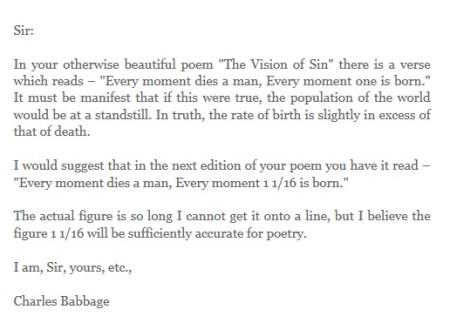
The English mathematician Charles Babbage, who designed and built the first programmable calculating machine, wrote to the (then) young poet Tennyson, whose poem The Vision of Sin he had recently read:

BabbageToTennyson

I like to think Babbage was having a laugh with Tennyson here, rather than expressing a view that poetry should be taken so literally, but you never know..

Anyway, I was reminded of the above letter by the much-hyped recent story of the alleged astronomical “dating” of this ancient poem (actually just a fragment) by Sappho:

Tonight I’ve watched
the moon and then
the Pleiades
go down

The night is now
half-gone; youth
goes; I am

in bed alone

It is a trivial piece of astronomical work to decuded that if the “Pleiades” does indeed refer to the constellation and “the night is now half-gone” means sometime around midnight, then the scene described in the fragment happened, if it happened at all, between January and March. However, as an excellent rebuttal piece by Darin Hayton points out, the assumptions needed to arrive at a specific date are all questionable.

More important, poetry is not and never has been intended for such superficial interpretation.  That goes for modern works, but is even more true for ancient verse. Who knows what the imagery and allusions in the text would have meant to an audience when it was composed, over 2500 years ago, but which are lost on a modern reader?

I’m not so much saddened that someone thought to study the possible astronomical interpretation an ancient text, even if they didn’t do a very thorough job of it. At least that means they are interested in poetry, although I doubt they were joking as Babbage may have been.

What does sadden me, however, is the ludicrous hype generated by the University of Texas publicity machine. There’s far too much of that about, and it’s getting worse.


The Dream of Gerontius

Posted in Music with tags , , , , , on May 23, 2016 by telescoper

Just a quick lunchtime post to mention that I took yesterday (Sunday) evening off to attend a concert at the Brighton Dome which was part of the annual Brighton Festival. The perf0rmance consisted of just one piece: The Dream of Gerontius by Sir Edward Elgar, performed by the City of Birmingham Symphony Orchestra (conducted by Edward Gardner) together with the Brighton Festival Chorus.

I happen to know a couple of people who sing with the Brighton Festival Chorus. Both were a bit nervous ahead of last night’s performance because it’s a challenging work and although they’ve been rehearsing the choral passages themselves, they only had a short time to practice together with the orchestra. Reading about the performance history of this work, their fears might have been justified: the first performance, in Birmingham in 1900, was a shambles, largely due to inadequate rehearsal time, and it took some time for it to become established in the repertoire. As it turned out, however, they had nothing to worry about. I thought the Chorus was magnificent, as was the Orchestra and indeed the three soloists: Alice Coote (Mezzo), Robert Murray (Tenor) and Matthew Rose (Bass). I particularly liked Matthew Rose’s performance. He cut an imposing figure on the platform, towering over the other musicians, and his sonorous bass tones projected wonderfully.

Although I began by saying that the concert was “just one piece”, The Dream of Gerontius is a very substantial work, lasting over 90 minutes (excluding the interval). It requires a large choir (well over a hundred voices last night) as well as large orchestral forces, including two harps and a big brass section. I’m sure it’s a handful to perform, but last night’s concert was well-controlled and at times simply beautiful.

It’s basically a setting of a long poem, describing the journey of a dying man towards death. It takes a very Roman-Catholic view of Paradise, Purgatory, and the Last Judgement and this may have contributed to its initial lack of popularity in (Protestant) England; it found greater favour in Germany in the years after its first performance.

I’m actually not the biggest fan of Elgar, generally speaking. He’s often very rhythmically unimaginative and predictable, as in the opening passage of Part 1 in last night’s performance which plodded along for a quite a while before getting going. However, there are some thrilling passages too. This work does sound surprisingly modern at times and at others is very reminiscent of Richard Strauss, at least to my ears.

Anyway, an excellent performance of a profound and challenging work. I’m glad to say that it attracted a full house too, though the majority of the audience were (like me) not in the first flush of youth..

P.S. I texted a friend that I was at The Dream of Gerontius, but autocorrect turned it into The Dream of Geronimo. As far as I know there’s no choral work with that title, but perhaps there should be!

R.I.P. John David Jackson (1925-2016)

Posted in Biographical, The Universe and Stuff with tags , on May 23, 2016 by telescoper

Yet again I have to pass on some very sad news. Physicist John David Jackson, best known for his classic textbook Classical Electrodynamics, has passed away at the age of 91. I’m sure I speak for many physicists when I say that Classical Electrodynamics was not only an essential part of my physics education but also a constant companion throughout the rest of my career. I have consulted my copy regularly over the last thirty years. I was often frustrated that when I found the topic I was looking for in the index, it referred to a problem (usually a difficult one) rather than a solution, but there’s no question it made me a better physicist.

Jackson

Rest in peace, John David Jackson (1925-2016).

I did my research. Yes, I think academic publishers are greedy. (With notes on publishers’ rhetoric and creationism)

Posted in Uncategorized on May 22, 2016 by telescoper

As promised…

Mike Taylor's avatarSauropod Vertebra Picture of the Week

Another day, another puff-piece from academic publishers about how awesome they are. This time, the Publisher’s Association somehow suckered the Guardian into giving them a credible-looking platform for their party political broadcast, Think academic publishers are greedy? Do your research. I have to give the PA credit for coming up with about the most patronising title possible.

Yes, I did my research. Guess what? Academic publishers are greedy.

Greedy-diner

(The article doesn’t say it’s by the Publishers Association, by the way. It’s credited to Stephen Lotinga, who LinkedIn tells us is Chief Executive of The Publishers Assocation, but the article doesn’t declare that.)

Oh boy do I get tired of constantly rebutting the same old bs. from publishers. And it really is the same bs. They’re not even taking the trouble to invent new bs., just churning out the same nonsense each time — for example, equating their massive profits with investment in…

View original post 665 more words

Yes, academic publishers are greedy (and dishonest)

Posted in Open Access, Uncategorized with tags , , , on May 22, 2016 by telescoper

I saw a blatant piece of propaganda in the Guardian the other day, written by the Chief Executive of the Publishers Association.The piece argues that the academic publishing industry benefits the academic community through “innovation and development” and by doing so “adds value” to the raw material supplied by researchers. This is nonsense. The academic publishing industry does not add any value to anything. It just adds cost. And by so doing generates huge profits for itself.

I was annoyed by several other things relating to this item:

  1. It’s written by a vested interest but is presented without a balancing opinion, which makes one wonder why the Guardian is allowing itself to be used as a mouthpiece by these profiteers;
  2. It has been tweeted and retweeed by the Publishers Association several times, as if it were a piece of reporting instead of what it actually is, essentially a commercial;
  3. Some of the claims made in the piece are so risible that they’re insulting.

However, the most annoying thing for me is that I’ve been too busy marking examinations to let off steam by writing a riposte.

I should have worried however, because scrolling down to the comments on the article you can easily find out what academics really think. Moreover, there’s an excellent rebuttal by Mike Taylor here, which I shall reblog.


Why you SHOULD respond to student requests

Posted in Uncategorized on May 21, 2016 by telescoper

I agree with this guy. Even though I doubt the educational value of teachers asking kids to send these things out, I always try to reply.

Shane L. Larson's avatarWrite Science

by Shane L. Larson

To my colleagues in professional science:

There has been a tremendous and acerbic backlash over the last week against a current popular practice of K-12 students emailing professional scientists with a list of questions they would like the scientists to comment on. I too have received these emails, and I have to very clearly state (in case you haven’t already been in one of these debates with me) that I have an unpopular view on this issue: I vehemently reject the view that we cannot respond to these emails. It is part of our professional obligation to society to respond to these notes.

In the spirit of intellectual debate, which is the purported hallmark of our discipline, let me recount some of the many aspects of the arguments that have been swirling around.

The Scenario. Emails will sail into our inboxes from (usually) middle-school science students…

View original post 1,742 more words

Unconscious Bias – from the Royal Society

Posted in Uncategorized with tags , on May 21, 2016 by telescoper

I’m in examination-marking mode at the moment so in lieu of a proper post I thought I’d post this video from the Royal Society which explains the key points of Unconscious Bias (which was the subject of half the Awayday I attended this week):


Wakeham Review of STEM Degree Provision Graduate Employability and

Posted in Politics, Science Politics, Uncategorized with tags , , on May 20, 2016 by telescoper

About to embark on a weekend of examination marking, a desperate search for displacement activities reminded me of this important report by Sir William Wakeham (who happens to be the Chair of SEPNet, the South-East Physics Network, of which the University of Sussex is a member, so I get to call him Bill).

Apparently Bill’s report has been ready for some time but has been stuck on a shelf in Whitehall somewhere waiting to be released. Arcane rules about publishing government reports in the run-up to elections meant that it had to wait until after May 5th for publication.

Anyway, it was published this week (May 16th to be precise) and I encourage you all to read it. You can find the report and various annexes here. It has clearly been a complex task to make sense of some of the datasets used because they are incomplete and/or confusing, so inevitably some important questions remain unanswered. There are nevertheless clearly worrying signs for certain disciplines, as described in the Executive Summary:

Based on the accumulated evidence we have arrived at a list of degree disciplines where the graduate employment outcomes are sufficiently concerning for us to recommend additional targeted work. The STEM disciplines that the review has identified as being of particular concern are:
•Biological Sciences
•Earth, Marine and Environmental Sciences
•Agriculture, Animal Sciences and Food Sciences

I’m a little surprised that Biological Sciences appears in that list, because that is usually perceived as a burgeoning area, but it’s clear that some graduates in that area do find it more difficult to find employment than in other STEM areas. However, if you read the report in more detail you will see that there are many sub-disciplines involved in Biological Sciences and the picture isn’t the same for all of them. It does seem, however, that in some of the Biological Sciences, graduates do not have sufficient training in quantitative methods to suit the demands of potential employers.

There you go. Give it a read. Any comments?

If I Can’t Change Your Mind

Posted in Uncategorized on May 20, 2016 by telescoper

Why do people still use Journal Impact Factors?

I don’t know either, but they should stop..

quantixed's avatarquantixed

I have written previously about Journal Impact Factors (here and here). The response to these articles has been great and earlier this year I was asked to write something about JIFs and citation distributions for one of my favourite journals. I agreed and set to work.

Things started off so well. A title came straight to mind. In the style of quantixed, I thought The Number of The Beast would be amusing. I asked for opinions on Twitter and got an even better one (from Scott Silverman @sksilverman) Too Many Significant Figures, Not Enough Significance. Next, I found an absolute gem of a quote to kick off the piece. It was from the eminently quotable Sydney Brenner.

Before we develop a pseudoscience of citation analysis, we should remind ourselves that what matters absolutely is the scientific content of a paper and that nothing will substitute for either knowing it…

View original post 956 more words